Written by: Joel Khalili
Compiled by: Luffy, Foresight News
In 2019, two Canadian brothers used cryptocurrency to split real estate into "tokens priced at just $50 each," building a real estate empire in Detroit with hundreds of properties and attracting tens of thousands of investors worldwide. They claimed to use blockchain to "make everyone a landlord," promising ultra-high returns, and tokens were once snapped up. But beneath the glossy crypto narrative was the collapse of the real world: leaking, moldy, burning, and collapsing houses; tenants struggling in dangerous environments; the city issuing hundreds of violation fines; and parties blaming each other. It ultimately led to lawsuits, a breakdown of trust, and a seemingly innovative financial experiment that turned into a complete disaster.
Wired magazine reporter Joel Khalili还原 the entire process of RealT's crypto myth from rise to collapse through on-the-ground investigation, revealing the harsh reality of tokenized real estate: no matter how perfect it is on-chain, it can't cover up the rot offline.
The following is the Chinese translation of Joel Khalili's report:
Becoming a Landlord for $50: The Utopian Lie of Crypto Real Estate
I walk up a wooden staircase leading to the basement of a 1920s-built duplex in eastern Detroit, Michigan. A smell hits me, a mix of damp brick, stagnant water, mold, and bleach. Walking ahead of me is Cornell Dorris, who has lived here for nearly a decade. Dorris is in his early forties, has two daughters who visit on weekends, and makes a living smoking meats and catering events.
As my eyes adjust to the dim light, I see rat droppings on the floor and a pool of black water spreading across the entire basement floor. "When it rains, the water pours in," Dorris says. The air is unnaturally heavy, and a strong urge to leave immediately wells up inside me.
Dorris's landlord is not an ordinary person. About four years ago, this building was acquired by a startup called RealToken (RealT for short). The company had an ambitious plan: to use cryptocurrency technology to "democratize real estate investment." The idea was that a property could be split into thousands of crypto tokens, each selling for about $50. Token holders would receive a share of the property's rental income, with annualized returns as high as 12%. They would also profit from the property's appreciation.
Investors flocked to the concept, and RealT expanded aggressively in Detroit, snapping up about 500 buildings. They also bought around 200 properties in over 40 other cities across the Americas, bringing their total asset value to about $150 million. Due to regulatory reasons, U.S. residents were not allowed to invest, but at least 16,000 people from 150 countries had purchased RealT tokens. Although reliable data is hard to come by, RealT once called itself "the world's largest real estate tokenization platform by any metric."
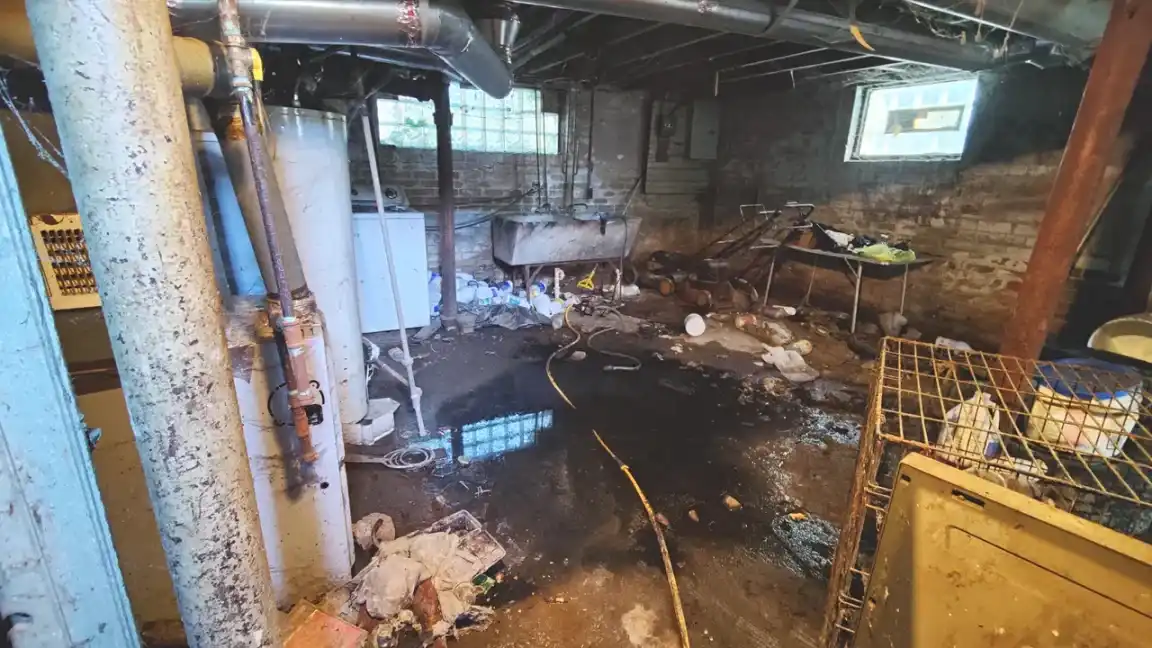
The flooded basement of the duplex where Cornell Dorris lives
However, despite RealT's great success in the crypto world, it ran into serious trouble in the real world. Last summer, the City of Detroit sued RealT and its founders, alleging "hundreds of environmental health violations." The place where Dorris lives was one of many properties deemed uninhabitable by city inspectors. He told me that while previous landlords weren't perfect either, sometimes letting Dorris arrange repairs himself, the building's condition noticeably deteriorated after RealT took over. Inspectors found missing smoke detectors and a bathtub with no hot water. "I have to shower standing at the sink now," Dorris said. "There are rats downstairs and squirrels upstairs."
Tokenized real estate represents a minuscule fraction of the U.S. real estate market, estimated by Zillow to be worth $55 trillion. But according to Deutsche Bank data, the concept of using cryptocurrency to buy fractionalized assets has grown into a $30 billion industry in just a few years. Yet in Detroit, the vision of becoming a landlord for a small amount of money clashed with the practical inconveniences of the houses themselves and the people living in them.
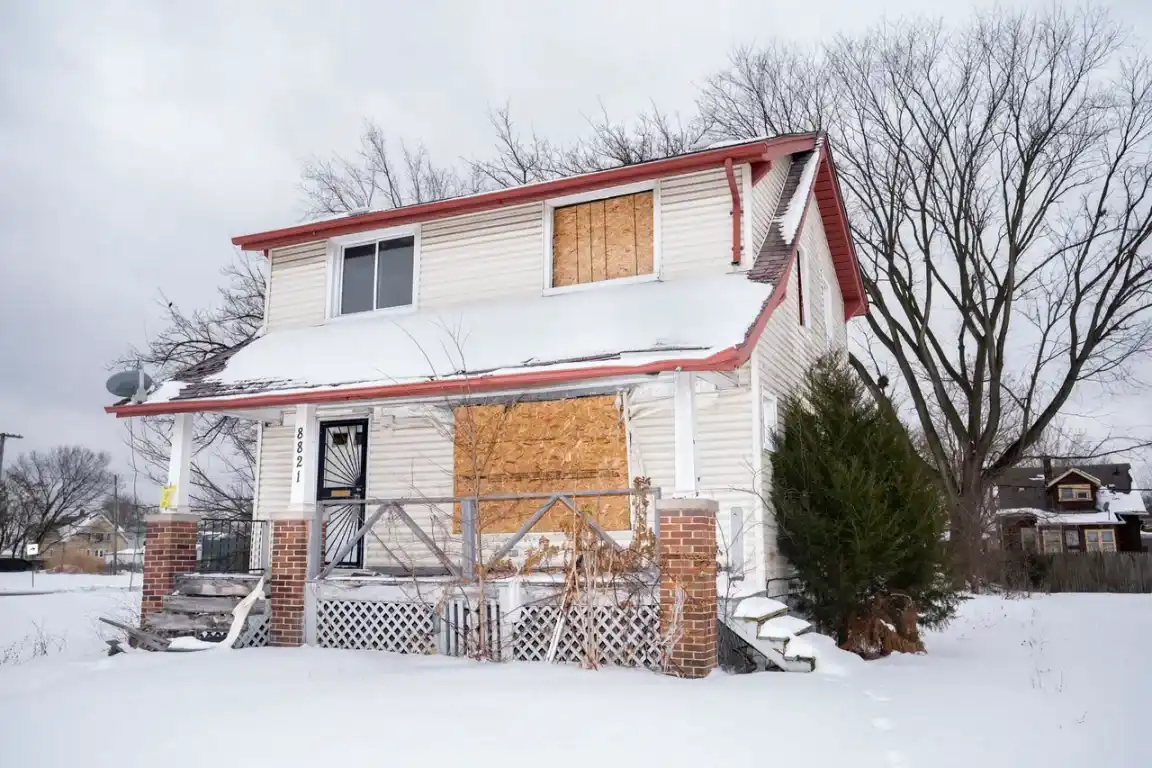
The house at 8821 Prairie Street is missing windows on the front and side, the porch steps have collapsed, and the siding is warped
Canadian brothers Rémy and Jean-Marc Jacobson founded RealT. They are not twins but look alike, both wearing glasses with slicked-back hair and graying beards. Both describe themselves as staunch libertarians, advocating for free markets and minimal government intervention. When we met on Zoom, Jean-Marc was enthusiastic but sometimes sharp. When I tried to phrase a question delicately, he told me, "Just ask directly."
The Jacobson brothers grew up in Canada and Europe, part of a family full of stories and lawsuits spanning the globe. One sister's divorce was highly publicized, eventually turning into a battle over millions of dollars in assets previously seized in the Bahamas, which the sister won. Their brother-in-law received a suspended sentence for his involvement with a group linked to illegal arms sales to Angola. Their father was a financier; when asked by a journalist in a 2003 article about the family's wealth, he replied, "Don't ask, and I won't have to hide it."
Rémy and Jean-Marc said their real estate career began with flipping properties in Quebec and parts of the U.S. Then, in the early 2010s, they discovered Bitcoin. Almost immediately, they started their own Bitcoin mining operation, later founding several other companies and a non-profit. The brothers also encountered Bitcoin-related troubles; they were caught up in a Ponzi scheme and settled with a client who accused their company of withholding cryptocurrency now worth millions.
According to Jean-Marc, as early as 2013, the Jacobson brothers began thinking about combining their expertise in real estate and cryptocurrency. In traditional finance, one can invest in Real Estate Investment Trusts (REITs) to get a share of rental income from a portfolio of properties. But this usually requires an investment of at least thousands of dollars. The brothers were looking for a way to build a similar product using cryptocurrency but allowing for much smaller investments. It wasn't until five years later, when Rémy received a call from a lawyer, that they found a breakthrough.
Normally, it's impossible to sell a house to a thousand people. But if the Jacobson brothers transferred property ownership to a Limited Liability Company (LLC), they could create and sell crypto tokens representing shares in that company.
The Jacobson brothers began looking for a location to test their tokenization concept. Detroit, known for its low house prices and ambitious urban renewal plans, was an obvious choice. "Detroit is a city just out of bankruptcy, already on the path to recovery," Jean-Marc said. "It naturally represented a potential for value growth. Most importantly, it was also suitable for beautifying and improving communities."
They bought their first property—an ordinary single-family home at 9943 Marlowe Street in western Detroit. In April 2019, they tokenized it, issuing 1,000 tokens. The proceeds from the token sale were used to cover various costs, repairs, and a 10% cut for the Jacobson brothers. They also planned to take 2% of future rental income, with the rest used for maintenance, taxes, other expenses, and the remainder distributed to token holders.
Jean-Marc told me that on the first day of the sale, RealT sold fewer than five tokens. The brothers asked friends and family to buy in and tried to promote it on X, Medium, and in media interviews. "People were very skeptical at first," Jean-Marc said. "We sold very, very, very few." About five months later, the Jacobson brothers considered selling the house, refunding those who had bought tokens, and calling it quits.
However, the tokens for 9943 Marlowe Street slowly started to sell. By December 13th, they were all sold out. At that time, the property had 107 investors from 33 countries, each holding an average of 0.93% of the shares, sharing a daily rental income of $25.22.
The Jacobson brothers created a Telegram chat group for French-speaking investors, and demand for RealT tokens began to soar. In 2020, RealT expanded frantically in Detroit: they tokenized an apartment building on Appoline Street, a fourplex on Schaefer Street, then a single-family home on Mansfield Street. That year, they tokenized nearly 50 properties.
As they planned further expansion in Detroit, the brothers partnered with real estate professional Shawn Reed. According to court documents, Reed began finding properties for RealT, sometimes even assisting with renovations, for RealT to tokenize. The Jacobson brothers did not know that Reed had a checkered past: he had served time in prison for bank fraud and had been called a "slumlord." The deals he facilitated helped RealT keep up with the soaring token demand at the time.
I interviewed an investor who goes by the online name TokNist on Telegram. He said that when he first heard about RealT, he immediately understood the model. This French citizen, based in Asia, had always wanted to buy real estate but couldn't get a loan. RealT offered a way to invest small amounts without involving banks. "Many people are like me," TokNist said. "They are not wealthy speculators. They are just ordinary people who want to own a piece of real estate, who want fixed income."
In 2022, TokNist started buying RealT tokens in large quantities. The process was not smooth. Whenever RealT was about to list a new property, he would sit in front of his computer, watching the countdown. The website often crashed, the screen went blank, or tokens disappeared from the shopping cart. "The property tokens sold out instantly. There could be six or seven properties listed on the same day, and minutes later, all the tokens were gone," TokNist told me. "It shows the demand was really huge."
Behind the scenes, the Jacobson brothers began to encounter problems managing their rapidly膨胀ing portfolio. In 2023, a bank foreclosed on a commercial property the brothers owned in another business venture in Miami, Florida, because they defaulted on a loan and were ordered to pay $10.4 million. The City of Miami also happened to deem the property an unsafe structure. (The Jacobson brothers described this experience as a strategic decision given the COVID-19 pandemic, an exception in their Florida business record.) That same year, the City of Chicago issued tickets to several LLCs owned by RealT, alleging dilapidated housing, building code violations, and unpaid debts. It was an early sign of the trouble coming in Detroit.
Dilapidation, Fires, and Abandoned Tenants: The Empire Begins to Crumble
In the summer of 2024, Aaron Mondry was looking for a new story. As a reporter for the nonprofit local news outlet Outlier Media, Mondry was writing a series titled "Detroit's Speculators" about the city's real estate market. Then, a source pointed him to a strange pattern in the property registration records of Wayne County, Michigan.
Looking through the records, Mondry found a large number of Detroit properties held by LLCs with "RealToken" in their names. By then, through these numerous LLC subsidiaries, RealT had purchased and tokenized hundreds of properties in Detroit, becoming one of the city's largest landlords. Many of these properties were single-family homes acquired by RealT through bulk deals with other landlords, sometimes without even seeing the houses in person. RealT's properties were concentrated in low-income, predominantly Black neighborhoods on Detroit's east and west sides.
Mondry compiled a list of RealT properties and started knocking on doors. Quickly, he noticed a shocking pattern: many of the houses he visited were in terrible condition, a large number seemed vacant, and checking various databases revealed that many properties had long been delinquent on property taxes.
In February 2025, Mondry published the first in a series of articles about RealT, based on public records and conversations with tenants. These reports alleged widespread mismanagement, cutting corners, and neglect by RealT, with some tenants telling Mondry they lived in squalid and恶劣 conditions. Around the same time, city building inspectors warned RealT that an apartment building on Cadieux Road lacked working smoke alarms, emergency lighting, and fire doors. In March, a fire swept through the building.
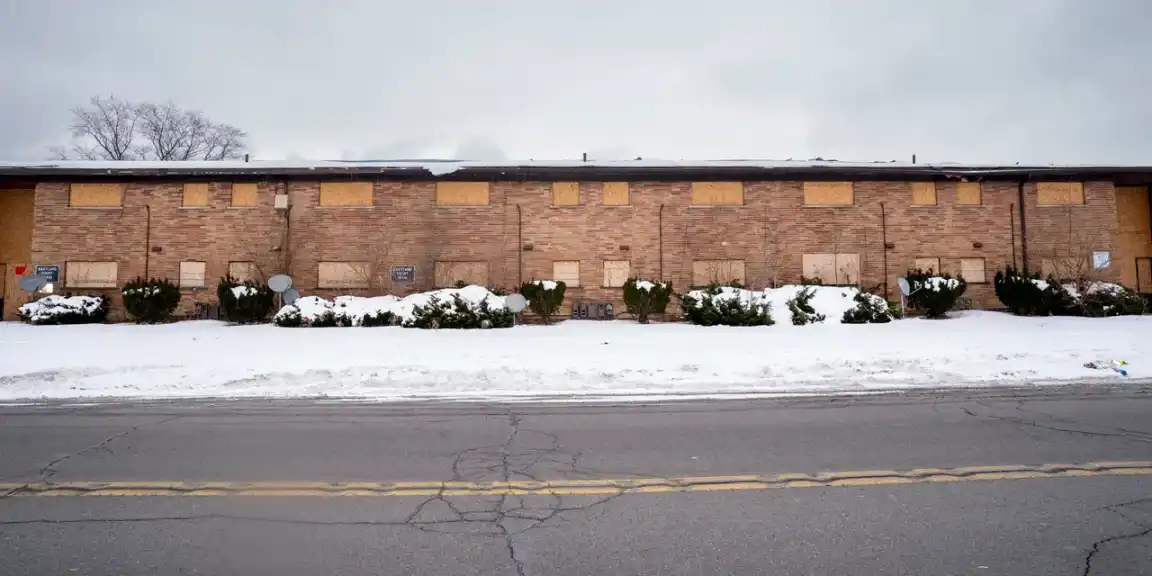
The apartment building at 10410 Cadieux Street has been vacant since the fire in March 2025, its charred remains boarded up
In early September, when I went door-to-door, I heard similar descriptions. I drove a rental car past basketball hoops weighted down with cinder blocks, smelling barbecue and hearing music drift from behind fences—these snippets of joy from daily life contrasted sharply with the poor condition of the RealT properties I saw in the neighborhoods.
I parked my car in front of the apartment building on Cadieux Road and found the charred remains boarded up. In the northwest Grand River-St. Marys neighborhood, a group calling itself a gang said they had taken control of 14881 Greenfield Street, a two-story brick apartment building with a striking red awning. In a YouTube video, the group claimed to be renting out the dilapidated units as landlords. "For a drug addict, this is like a five-star hotel," one person in the video said. Two other RealT houses I visited were riddled with bullet holes. Multiple tenants told me they were withholding rent, hoping to force the landlord to make repairs.
At a Tim Hortons coffee shop in Redford, on Detroit's west side, I met Maya, a RealT tenant living in a nearby square red-brick house. When Maya gets home, she parks in the driveway and sometimes sits in her car for up to an hour before going inside. One bedroom ceiling leaks, leaving a large hole that exposes the wooden roof supports. Paint is peeling, and damp, yellowed bits of insulation hang down into the bedroom. Maya only dares to stay in the bathroom, kitchen, and living room, where she sleeps. "Honestly, I probably shouldn't be living here, but I'm trying to find a place," Maya said. "It's literally a slum."
A few blocks from Maya's place, I knocked on Monica's door. She has lived in a house south of the famous Eight Mile Road for six years, recently with two grandchildren. The tokens for this house are held by 331 people, who have received an average annualized return of 9.3% on their investment from Monica's rent. Monica told me the heating is broken, the water supply is unreliable—I could see some windows were broken and the roof was damaged. A long-dead large tree stood in the front yard. At night, Monica can't sleep for fear of someone breaking in through the broken windows. She said she has applied for emergency shelter many times, but it's always full. "Go home, dear. Go home," Monica said to me. "It's terrible here."
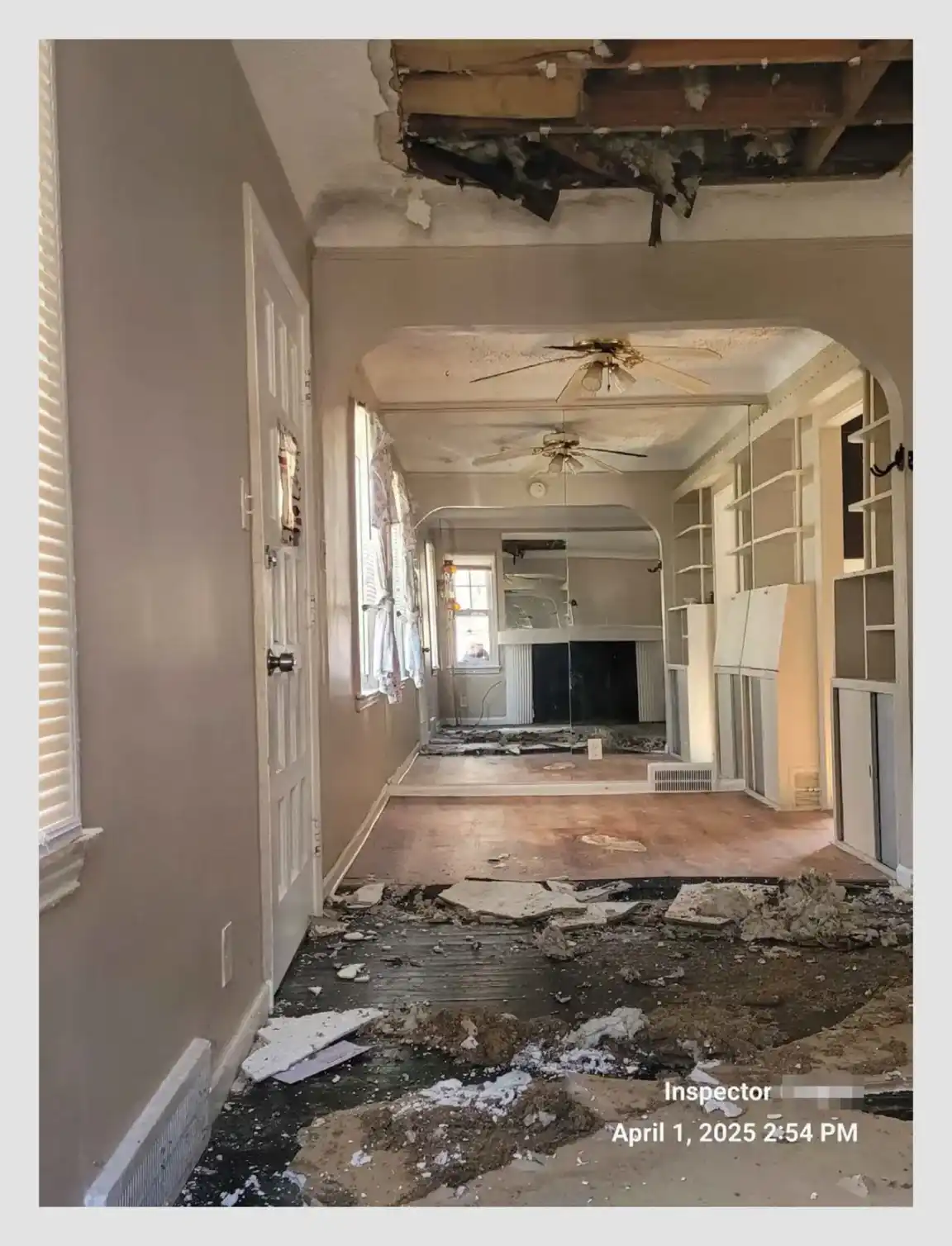
The collapsed ceiling at 18415 Fielding Street, with plaster blocks and damp insulation piled in the hallway
Lawsuits, Blame-Shifting, and Collapsed Trust: The Tokenization Experiment Spins Completely Out of Control
On the fifth floor of the Coleman A. Young Municipal Center, in a maze of beige tiles and worn carpet, I found Conrad Mallett, who handles all civil litigation for the city. Portraits of Muhammad Ali and key figures in the Black civil rights movement hang on his office walls. Mallett, a former deputy mayor of Detroit and chief justice of the Michigan Supreme Court, noticed Outlier Media's reports on RealT last spring. He launched an investigation. Building inspectors assessed properties, recording violations. "It turned out there were thousands of violations across the properties," Mallett told me. "We concluded that, in the vast majority of cases, people were living in substandard housing."
Mallett's deputy, Tamara York Cook, sent building inspectors door-to-door, taping her business card to front doors. Soon, her phone started ringing constantly. "Most people were very eager to tell their stories," she said.
In July, the city filed a civil lawsuit against RealT, its founders, and 165 related LLCs, alleging hundreds of public nuisance and regulatory violations, and tens of thousands of dollars in unpaid blight fines and property taxes. The lawsuit stated that 408 properties lacked the city's "Certificate of Compliance" deemed necessary for habitation. The Jacobson brothers told Wired magazine: "Regarding Certificates of Compliance, RealT's tokenized asset portfolio is no better or worse than other properties in the relevant zip codes."
Soon after, a judge issued a temporary restraining order prohibiting RealT from collecting rent or evicting tenants from these Detroit properties until they were brought up to code. The order was later extended but modified to allow RealT to evict tenants who withheld rent.
On Telegram, some investors heard about the lawsuit, and Rémy Jacobson immediately stepped in to reassure them. Apart from the information they got from the Jacobson brothers, RealT investors had little insight into the reality in Detroit. "We are committed to resolving all issues," Rémy said. Twenty-one investors responded with heart emojis. Jean-Marc also chimed in, touting the rapid growth of the Detroit real estate market.
Around the same time, the Jacobson brothers told investors that a potential buyer had expressed interest in the building where Cornell Dorris lived—the one with the flooded basement. If investors agreed to sell, they would receive a total return of up to 75.61%. In a Telegram post, Jean-Marc described the deal as proof of the vitality of the Detroit real estate market and RealT's deal-making skills. In a call with RealT investors at the end of July, Jean-Marc announced that the property deal was "done."
The buyer, East Coast Servicing LLC, was registered at the same Michigan address RealT used in its filings. The documents were signed by Rémy Jacobson on behalf of the buyer. The Jacobson brothers appeared to have effectively sold the property to another company they controlled.
After I followed up to verify this transaction, in February 2026, the Jacobson brothers sent an email to investors saying the buyer had backed out, despite saying the property was "sold" in July. The brothers later told Wired that East Coast Servicing LLC was merely a tool they used to facilitate sales to foreign buyers.
A core argument made by the City of Detroit in its lawsuit against RealT is that the company's business model inherently involves neglecting property maintenance. "The way they were able to generate annualized returns was by not maintaining the houses to a high-quality standard," Mallett alleged.
Jean-Marc Jacobson denied this allegation. He said their intention had always been to help beautify Detroit neighborhoods by allowing more people to invest. He said that when RealT tokenizes a property, it sets up a fund for maintenance. The Jacobson brothers pointed out that for investors to get good returns, the properties must remain occupied and generate decent rental income, and deliberate neglect would make that impossible.
He claimed that property management companies and other real estate professionals had neglected the properties or otherwise deceived RealT. The company has sued several of them, including Shawn Reed.
On the morning of September 3rd, I met Reed in the lobby of The Henry, a fancy hotel a few miles west of Detroit. I found him sitting in a brown leather armchair under a crystal chandelier, an electronic fireplace flickering behind him. Bald with a long black beard and wearing cowboy boots, he was striking. As we talked, he ran his fingers through his beard.
By then, Reed's relationship with the Jacobson brothers had deteriorated. According to court documents, by 2024, they began arguing over the details of certain property deals. Then conflicts arose over property renovations. Eventually, they stopped working together. Then the Jacobson brothers sued Reed, alleging fraudulent misrepresentation.
In a lawsuit filed in a Michigan court in February 2025, RealT accused Reed of billing for repairs and renovations that were never performed. Reed denied the allegations. He also claimed his role was only to help renovate a few RealT properties, not to manage the entire portfolio day-to-day. In June of the same year, he filed a countersuit, alleging RealT was trying to scapegoat him, falsely claiming he was responsible for the mess in Detroit. "I was never the property manager. That was never my job," he told me. The lawsuit is ongoing.
In the interview, Jean-Marc refused to discuss Reed specifically but told me: "Sometimes, when you enter a new city, you initially meet all the wrong people... No one can say they won't encounter scammers."
While the dispute with Reed was in court, the Jacobson brothers had already established New Detroit Property Management. The brothers handed over management of RealT's Detroit portfolio to this new company and appointed experienced property manager Salvatore Palazzolo as vice president. On my last day in the city, Palazzolo picked me up outside the hotel in a black SUV, a small cross hanging from the rearview mirror. He was eager to show me RealT properties his team had recently renovated.
Driving, Palazzolo explained that his task was to identify vacant properties that needed only minor renovations to be quickly rented out and start generating income. Meanwhile, the city kept issuing blight tickets, which Palazzolo said meant pulling construction crews away from renovation work. "You have to understand how many properties we have," Palazzolo said. "The city is giving us tickets like crazy. The workload is huge, really huge."
Even after New Detroit completed renovations, problems persisted. In at least one case, someone impersonated the landlord, collected a one-time fee, and arranged for someone to move into a renovated RealT property. The Jacobson brothers said the impostor tried to take advantage of the court's pause on evictions, advising this prospective tenant that they wouldn't be evicted if they paid a small amount into a city escrow account.
Palazzolo and I parked in front of the first property: a small red brick house with a gabled roof and white trim. Palazzolo, a black folder under his arm, showed me around the house, pointing out the repairs he had arranged. The windows were intact, the bathroom and kitchen remodeled, the walls painted, a collapsed awning bent back into shape, the floors either polished or re-carpeted.
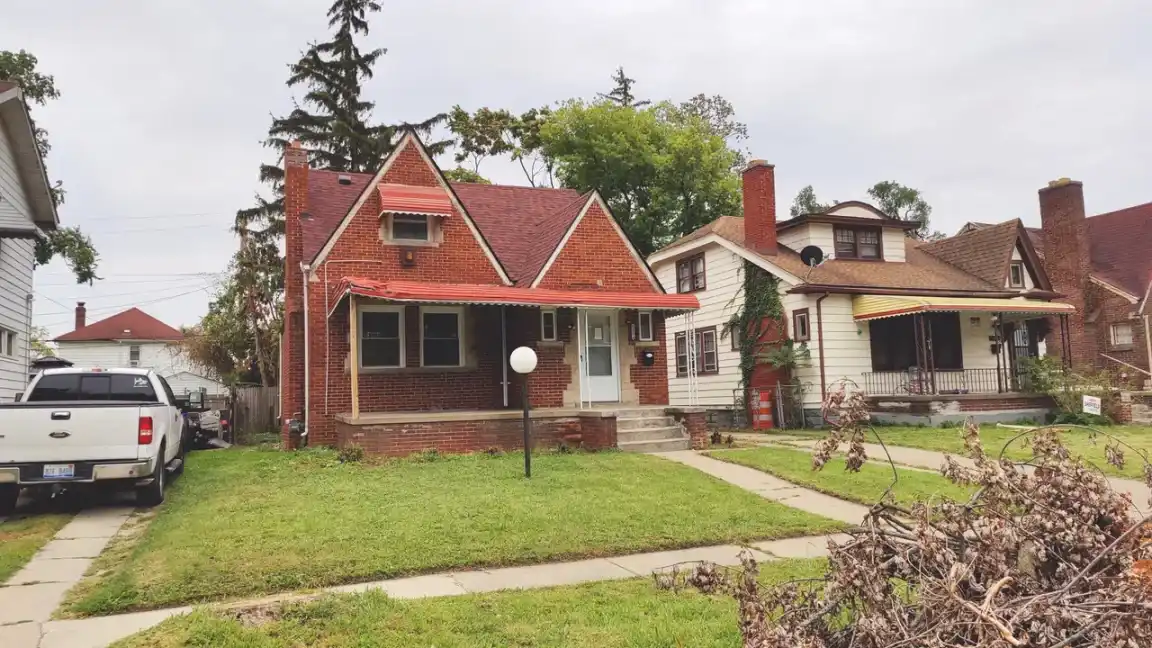
14574 Strathmoor Street, one of the RealToken properties renovated by New Detroit Property Management
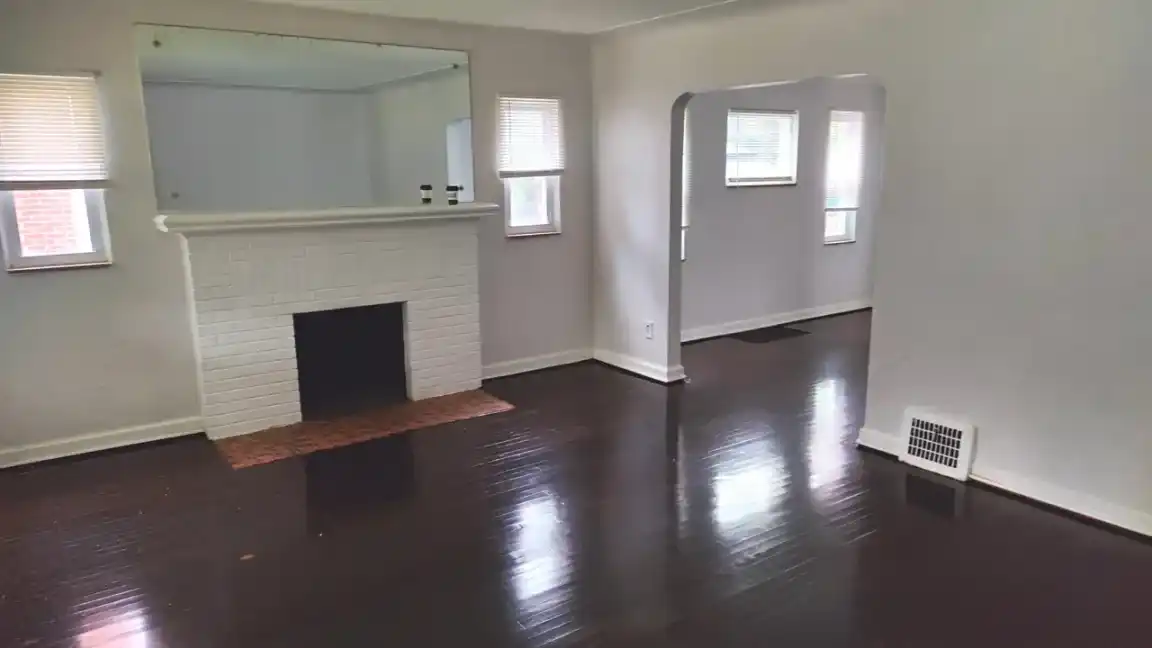
The bathroom and kitchen have been remodeled, the collapsed awning restored, and the floors polished
He showed me five other houses in similar condition. They weren't luxurious, but they looked clean and habitable.
Palazzolo estimated that by then, New Detroit had renovated about 40 houses for RealT. According to recent court filings, the company had obtained Certificates of Compliance for 28 of the properties involved in the lawsuit. "I don't think people realize how bad some of these properties were. It takes a lot of work to bring them up to a compliant standard," Palazzolo said. "We are really trying to make them safe and affordable."
Jean-Marc Jacobson acknowledged the condition of the Detroit properties was "terrible," but he also criticized the parties exposing RealT's problems. Throughout the summer, he communicated almost weekly with French-speaking investors on Telegram and repeatedly disparaged local reporter Mondry. "Clearly, this journalist doesn't like us. We knew that months ago. Clearly, he only writes what he chooses to write, ignoring all evidence to the contrary," Jean-Marc told investors on Telegram in early July. Weeks later, he added: "He's never had this many clicks in his career. He portrays us as evil crypto capitalists, raising rents and making vulnerable people suffer." The Jacobson brothers offered similar criticism to Wired, calling this magazine's reporting a "superficial analysis" pursuing a "targeted narrative." Last September, Jean-Marc told investors he believed the city's lawsuit was the product of "administrative corruption, political agendas, backroom deals, and abuse of power."
On Telegram, token investors occasionally questioned whether the city's case or Outlier Media's reporting had merit. Someone recently suggested that RealT should have run background checks on property management companies. Jean-Marc responded: "You seem to enjoy venting hatred." In another Telegram message, Jean-Marc seemed to mock a tenant. "Emergency alert!!! My faucet is broken!!! Emergency alert!!! 🆘" he wrote. The three RealT token holders I interviewed all described the Telegram community as hostile. The Jacobson brothers denied the Telegram groups were hostile; they said tension within the investor community was normal during difficult times.
Nonetheless, investors began asking the Jacobson brothers increasingly pointed questions. In September, investors discovered 2023 filings they believed showed RealT had taken out mortgages totaling $950,000 on two Chicago properties months after tokenizing them. One investor called this "very suspicious" because it would expose token holders to the risk of the lender foreclosing if the loans defaulted. Jean-Marc claimed RealT took out the mortgages to do a favor for the seller, who would benefit in some unspecified way. He said these mortgages were now paid off. "Sometimes corporate-level maneuvers are necessary," Jean-Marc told investors. "If we want to make a deal happen, sometimes we need to show a little flexibility." Columbia Business School real estate professor Tomasz Piskorski said the arrangement Jean-Marc described was not normal. "I don't see a rational reason. Maybe there is one, but I'm not aware of it."
In late November, investors began questioning a RealT property in Chicago: it had been deemed dangerous by the city and slated for demolition months earlier, yet it was still generating rental income for token holders, meaning someone was living there. "I'm starting to really not know what to think," one RealT investor said on Telegram. I encountered a similar situation in Detroit. All 13 properties that appeared vacant when I visited last September were listed on the website as "fully rented." The same was true for the apartment building occupied by the疑似 gang. The Jacobson brothers said the escrow system set up by the City of Detroit disrupted their ability to verify occupancy.
Some RealT investors said they felt betrayed by the Jacobson brothers. One told me he had stopped buying RealT tokens until the Detroit dispute was resolved. Asia-based investor TokNist expressed skepticism about the Jacobson brothers' management. Another investor, using the online name "Demetrius Flenory" on a Q&A platform, wrote to the Jacobson brothers: "Our tokens were supposed to support innovation and democratize real estate investment, yet they are associated with unsanitary, dangerous properties, exacerbating the social plight of these vulnerable communities... We cannot turn a blind eye to the new scandals breaking every week."
Shawn Reed, who claimed not to be the property manager, also publicly criticized RealT last year, posting a video on X where he toured a dilapidated building he claimed belonged to RealT. In one room, a dirty mattress lay on the floor; in the next, food containers and other trash were piled high. "If I held tokens for this building, I'd be furious," Reed said from behind the camera. By then, however, Reed had joined another tokenized real estate company.
In February, the Jacobson brothers told investors they planned to sell off a large portion of the RealT portfolio, aiming to "optimize overall investor returns." However, to free up funds to bring the houses into a sellable condition, investors would no longer receive any rental income, regardless of where their property was located. Some investors defended the decision, but others were furious; they demanded on Telegram why the Jacobson brothers could unilaterally decide to stop paying rent for properties they owned. The Jacobson brothers said this move was allowed under RealT's terms, and as directors, they had the discretion to decide whether to distribute rental income, but some investors equated it to "theft."
The trial in Detroit is scheduled to begin in May. RealT's other legal disputes continue. While trying to market its properties, the company appears to be pursuing new strategies in new countries. RealT is now selling tokens for "under construction" properties in Colombia and Panama, where investors are effectively crowdfunding construction projects in hopes of future high returns. "Under-construction projects leverage the tokenization concept immensely," Jean-Marc told me in the interview. "It has very bright potential." But investors don't appear as convinced; these tokens went on sale months ago, but thousands remain unsold.