The First Step to Becoming an On-Chain Bank: Polymarket Launches Native Stablecoin

marsbitXuất bản vào 2026-04-07Cập nhật gần nhất vào 2026-04-07

Tóm tắt

Polymarket, a leading prediction market platform, has announced a major upgrade involving the replacement of its current collateral, USDC.e, with its own native stablecoin, Polymarket USD (pegged 1:1 to USDC). This transition, expected within 2-3 weeks, is designed to be seamless for most users. The introduction of its own stablecoin allows Polymarket to consolidate user funds within its own ecosystem, transforming from merely facilitating trades to holding and managing the underlying capital. This shift enables the platform to potentially generate significant revenue from the yield on the reserve assets (USDC), estimated to be tens of millions annually from its current ~$400M in open interest. This moves its business model beyond transaction fees, which recently surpassed $1M daily, towards earning "interest" on deposited funds. Furthermore, controlling a large pool of stablecoins grants Polymarket greater leverage in its relationship with Circle (issuer of USDC) and could pave the way for future financial services. This strategic upgrade signifies Polymarket's evolution from a prediction market ("casino logic") into a more comprehensive financial entity with banking-like capabilities ("bank logic"), significantly deepening its competitive moat.

Original | Odaily Planet Daily (@OdailyChina)

Author | Golem (@web3_golem)
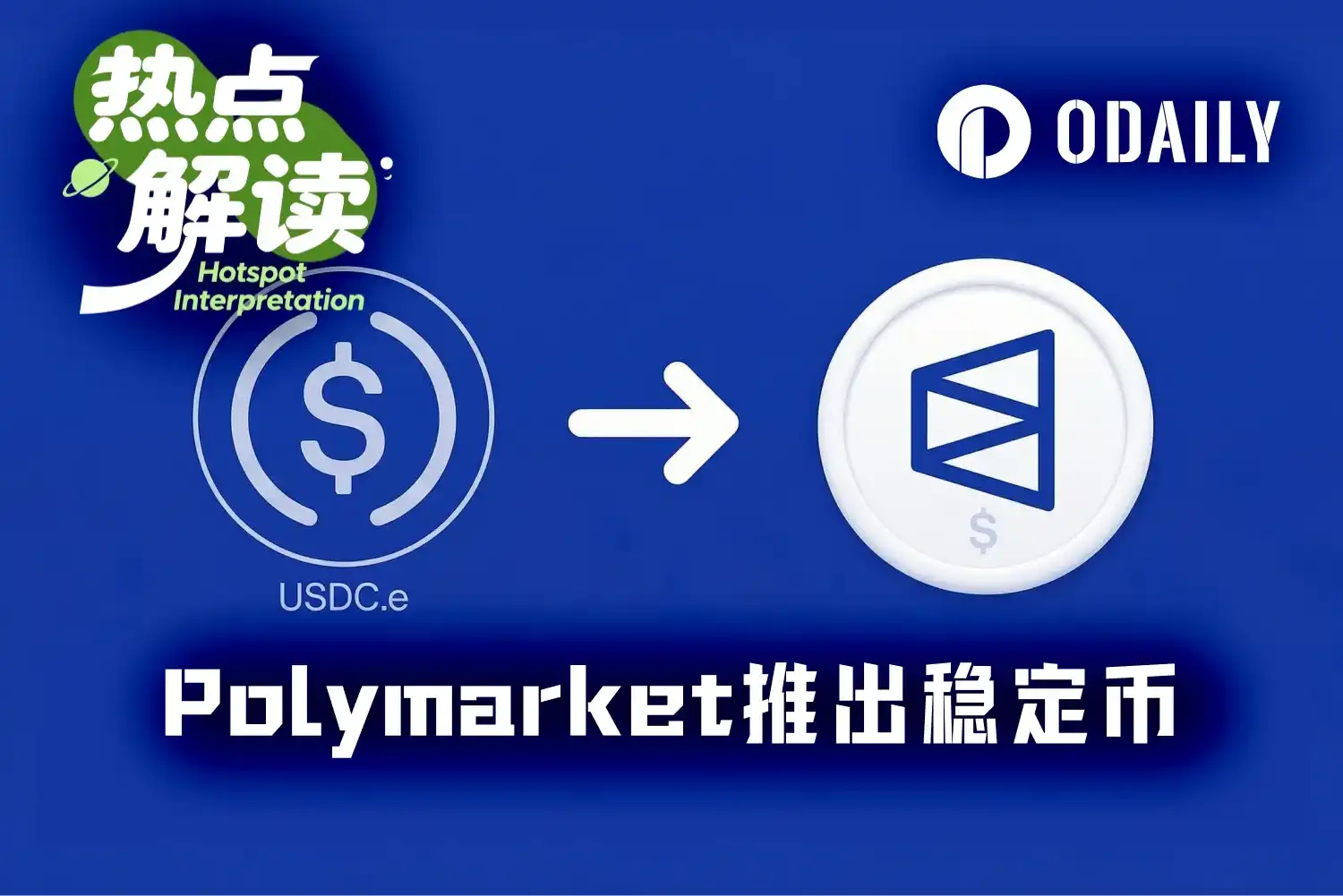
On April 6, Polymarket announced a major upgrade to the platform in the next 2 to 3 weeks, including upgrading both CTF and CLOB to V2, and replacing the platform collateral from USDC.e to the native stablecoin Polymarket USD.

According to the official introduction, Polymarket USD is 1:1 backed by USDC. For most users, the transition from USDC.e to Polymarket USD is seamless, with the frontend handling it automatically—users only need to confirm once. For advanced users and API-only traders, the transition process might be a bit more complex but still not difficult; they need to wrap their USDC or USDC.e into Polymarket USD through the wrap() function of the collateral access contract.

On the surface, it seems like Polymarket is just changing the trading collateral in the backend. As the platform grows, continuing to use USDC.e is indeed a potential risk. Back in February, Circle and Polymarket had already announced plans to migrate from bridged USDC.e to native USDC, and this is just a normal progression of that cooperation.

However, Polymarket did not choose to directly introduce native USDC to replace USDC.e; instead, it added an extra layer, aiming to pool USDC into its own fund pool. This layer is called Polymarket USD. Therefore, the emergence of Polymarket USD is definitely a "One more thing"(Odaily Note: "One more thing" is a classic tradition of Apple keynotes, now symbolizing a company's finale, industry-disrupting moves, etc.).

Polymarket Gains the Right to Mint Currency

The first layer of significance is that Polymarket can pool user funds.

Previously, the money users deposited into Polymarket would be converted into USDC.e. You can think of it as Polymarket being a huge trading venue—it only handles matching, pricing, and清算; the money flows through it, but the money itself does not belong to its system. Polymarket is not a treasury.

But that's about to change. When USDC.e is replaced with Polymarket USD, Polymarket can reach out to that money which was merely "passing through." As Polymarket officially stated, the daily user experience is unaffected, but the actual on-chain settlement path behind the scenes has been altered. This transformation is no less significant than an exchange transitioning from relying on third-party清算机构 to building its own清算 center.

Polymarket USD is 1:1 backed by USDC, meaning that in the future, for every Polymarket USD in the market, there will be a corresponding USDC in Polymarket's fund pool. Currently, every Yes/No share pair on Polymarket is backed by USDC.e. When players place bets or settle, USDC.e also moves on-chain. But after switching to Polymarket USD, although it will also flow on-chain with user operations, the USDC in Polymarket's fund pool won't move accordingly. Therefore, as long as users don't come to redeem, this money is essentially Polymarket's.

Polymarket has transformed from a use case for stablecoins to an entity that holds the on-chain minting right. Polymarket USD diverts user assets from the "open sea" to Polymarket's "internal lake." Once funds begin to pool, Polymarket is no longer just a prediction trading platform, and its business model no longer relies solely on trading fees, because it can start playing the oldest "money makes money" game in the financial markets.

Increasing Polymarket's Revenue Channels

The second layer of significance is the expansion of Polymarket's business.

The current business model of prediction markets is simple: charging transaction fees. After Polymarket adjusted its fee mechanism on March 30(Odaily Note: Expanding the taker fee scope to include Finance, Politics, Economics, Culture, Weather, and other market categories, in addition to the original Crypto and Sports categories), its daily fee income has exceeded $1 million.
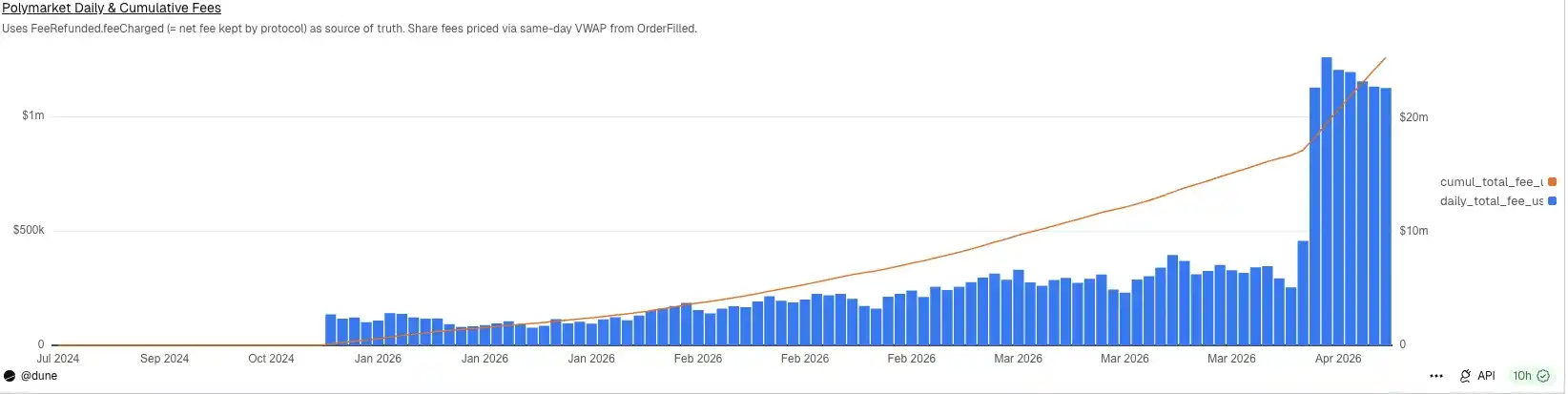
Polymarket's Daily Fee Income

Although impressive, it's not enough to satisfy Polymarket's ambitions. Prediction markets are currently the most sought-after赛道, but the business model ceiling isn't very high, the project's moat is relatively单一 (regulatory approval), and user stickiness isn't exceptionally strong. In the current landscape where everyone is doing prediction markets, how can Polymarket ensure it won't be surpassed by competitors in the future?

The answer it gives now is: I don't just match trades; I can also put players' money to work.

From a business essence perspective, the most attractive aspect of stablecoins over the years has never been fast payments and transfers, but the低调 yet highly profitable money-printing machine behind them—reserve asset yield. In 2025, the vast majority of Circle's income still came from reserve income. Polymarket understood this model, hence it launched Polymarket USD.

According to Dune data, the value of open interest on the Polymarket platform has exceeded $400 million. If all this money is converted into Polymarket USD, Polymarket simply needs to deposit the underlying collateral USDC into Circle's institutional account or place it in a U.S. Treasury protocol. At a risk-free rate of 4%-5%, it could earn tens of millions of dollars in "interest tax" annually just by sitting back.

Defillama founder 0xngmi even directly stated that Polymarket user wallets hold approximately $1.25 billion. If they keep this interest income, at current rates, they would gain an additional $54 million in annual revenue. Polymarket could even participate in DeFi wealth management with higher APYs, turning the idle funds on the prediction platform into active leverage and returning the到期收益 to users, effectively providing a hedge for users.
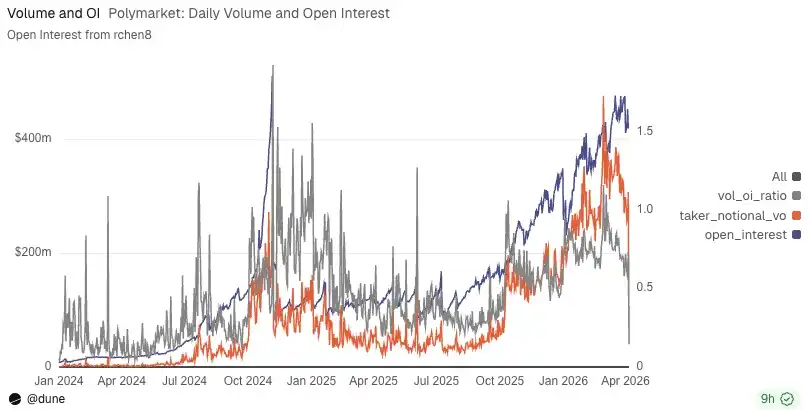
Polymarket's Daily OI and Trading Volume Curve

Prediction markets naturally have two characteristics: fund滞留 and high-frequency reallocation driven by events. Users' money doesn't truly enter and exit instantly like in a casino; it's either already in positions or sitting in accounts waiting for the next event, the next odds change. This type of money is most suitable for financial reprocessing, and for users, there's also a beautiful excuse: improving capital efficiency.

Of course, Polymarket hasn't publicly stated yet that it will definitely engage in yield extraction or on-chain wealth management after launching the stablecoin. But this path is almost a natural next step. As long as the scale of Polymarket USD grows larger in the future, it naturally gains the space to manage yields, expand collateral, and create financial combinations within the platform.

Some time ago, the《CLARITY Act》faced resistance for potentially prohibiting crypto companies from offering interest on stablecoins to users. If the outcome of the dispute remains a prohibition, all the above演绎 of Polymarket USD's potential would come to naught. But on April 6, according to U.S. media reports, the core disagreement between the U.S. crypto industry and banking over stablecoin yield mechanisms may be nearing resolution. Although details have not been disclosed, overall expectations are optimistic, and the《CLARITY Act》may enter the deliberation stage in committee in late April.

So, don't think Polymarket is far from this.

Polymarket Gains USDC Distribution Rights

The launch of the stablecoin by Polymarket has a third layer of significance: gaining USDC distribution rights.

As of today, Polymarket is still a major distribution scenario within the USDC ecosystem. Circle provides native USDC, Polymarket distributes USDC, and both sides are harmonious. Polymarket is currently experiencing strong growth momentum. Undoubtedly, the amount of USDC reserves沉淀 within its platform will grow larger in the future, potentially even becoming a distribution channel as important as Coinbase. When that time truly comes, the relationship between Polymarket and Circle might also change.

A reality in the stablecoin world is that distribution rights are as important as issuance rights, which is why Coinbase can take away over half of Circle's reserve income. Therefore, in the future, when Polymarket becomes a significant distributor of USDC, it will inevitably also gain bargaining power and be entitled to a large share of the reserve income. Furthermore, when Polymarket USD matures sufficiently, it could even explore multi-collateral backed stablecoins, not just relying solely on USDC.

This is also why I believe Polymarket USD is not an ordinary upgrade for Polymarket, but an identity update. Polymarket will evolve from "a platform collecting fees based on event volatility" to one that also兼具 "a platform organizing and清算 around the dollar".

The former is casino logic, while the latter is bank logic.

Polymarket's moat has thus gained another layer. It still maintains the beautiful narrative of information as the market and pricing facts early. But in terms of its business model, it is quietly moving itself to a more important position—no longer satisfied with being surface-level market traffic, no longer satisfied with仅仅 attracting users with odds, and no longer satisfied with continuing to cede the fattest part of the industry chain (asset reserve income) to others.


Câu hỏi Liên quan

QWhat is the primary reason Polymarket is introducing its native stablecoin, Polymarket USD?

APolymarket is introducing Polymarket USD to transition from using USDC.e as collateral to a native stablecoin that is 1:1 backed by USDC. This allows Polymarket to settle user funds within its own ecosystem, effectively enabling it to hold and potentially generate revenue from the underlying USDC reserves.

QHow does the introduction of Polymarket USD change the platform's business model beyond transaction fees?

ABeyond transaction fees, Polymarket USD enables Polymarket to generate revenue from the idle USDC reserves backing the stablecoin. By investing these reserves in low-risk assets like U.S. Treasury bonds or Circle's institutional accounts, Polymarket could earn significant interest income, estimated at tens of millions of dollars annually.

QWhat are the potential benefits for users in the transition to Polymarket USD, according to the article?

AFor most users, the transition to Polymarket USD is seamless and requires only a single confirmation on the front end. The change also opens the possibility for Polymarket to improve capital efficiency for users by leveraging idle funds for yield-generating activities, potentially offering returns that act as a hedge.

QHow does the article describe the strategic shift in Polymarket's role within the stablecoin ecosystem?

AThe article describes the shift as Polymarket evolving from a prediction market platform that relies on external stablecoins to one that controls the issuance and distribution of its own stablecoin. This grants Polymarket greater negotiating power with partners like Circle and positions it as a key distributor of USDC, similar to Coinbase.

QWhat regulatory consideration is mentioned regarding Polymarket's ability to generate yield from stablecoin reserves?

AThe article mentions the U.S. CLARITY Act, which initially proposed banning crypto companies from offering interest on stablecoin holdings. However, recent reports suggest that disagreements between crypto and banking sectors are nearing resolution, with expectations leaning towards allowing such practices, which would enable Polymarket to pursue yield generation.

Nội dung Liên quan

Giao dịch

Giao ngay
Hợp đồng Tương lai

Bài viết Nổi bật

$BANK là gì

Ngân Hàng AI: Một Bước Đột Phá Cách Mạng Trong Tương Lai Ngành Ngân Hàng Giới thiệu Trong một thời đại được đánh dấu bởi những tiến bộ nhanh chóng trong công nghệ, Ngân hàng AI đứng tại giao điểm của trí tuệ nhân tạo (AI) và dịch vụ ngân hàng. Dự án đổi mới này nhằm định hình lại cảnh quan tài chính, nâng cao hiệu quả hoạt động, các biện pháp an ninh và trải nghiệm của khách hàng thông qua sức mạnh của AI. Khi chúng ta bắt đầu cuộc khám phá về Ngân hàng AI, chúng ta sẽ tìm hiểu về nội dung của dự án, động lực hoạt động của nó, bối cảnh lịch sử và những cột mốc quan trọng. Ngân Hàng AI là gì? Về bản chất, Ngân hàng AI đại diện cho một sáng kiến biến đổi nhằm tích hợp trí tuệ nhân tạo vào các hoạt động ngân hàng khác nhau. Dự án này tận dụng khả năng của AI để tự động hóa quy trình, cải thiện các quy trình quản lý rủi ro và nâng cao tương tác với khách hàng thông qua các dịch vụ cá nhân hóa. Mục tiêu chính của Ngân hàng AI bao gồm: Tự động hóa các chức năng ngân hàng: Bằng cách tận dụng công nghệ AI, Ngân hàng AI nhằm tự động hóa các nhiệm vụ thường nhật, giảm gánh nặng cho nhân lực và nâng cao hiệu quả. Quản lý rủi ro nâng cao: Dự án sử dụng các thuật toán AI để dự đoán và xác định rủi ro, từ đó củng cố các biện pháp an ninh chống lại gian lận và các mối đe dọa khác. Cá nhân hóa dịch vụ ngân hàng: Ngân hàng AI tập trung vào việc cung cấp các sản phẩm và dịch vụ tài chính được điều chỉnh theo nhu cầu của từng khách hàng bằng cách phân tích dữ liệu và hành vi của họ. Cải thiện trải nghiệm khách hàng: Việc triển khai các giải pháp sử dụng AI như chatbot và trợ lý ảo nhằm cung cấp cho người dùng những tương tác giống như con người hơn, cách mạng hóa cách khách hàng tương tác với ngân hàng. Với những mục tiêu này, Ngân hàng AI định vị mình như một nhân tố quan trọng trong việc làm cho ngân hàng trở nên hiệu quả hơn, an toàn hơn và tập trung vào người dùng. Ai là người sáng tạo ra Ngân Hàng AI? Thông tin về người sáng tạo ra Ngân hàng AI vẫn chưa rõ ràng. Do đó, không có cá nhân hay tổ chức cụ thể nào được xác định trong thông tin hiện có. Sự ẩn danh xung quanh sự ra đời của dự án đặt ra nhiều câu hỏi nhưng không giảm bớt tầm nhìn và mục tiêu đầy tham vọng của nó. Ai là nhà đầu tư của Ngân Hàng AI? Tương tự như người sáng tạo của dự án, thông tin cụ thể về các nhà đầu tư hoặc các tổ chức hỗ trợ Ngân hàng AI chưa được công bố. Thiếu thông tin này, thật khó để nêu rõ sự hỗ trợ tài chính và hỗ trợ từ các tổ chức có thể thúc đẩy dự án tiến triển. Tuy nhiên, tầm quan trọng của việc có một nền tảng đầu tư vững chắc là rất quan trọng để duy trì sự phát triển trong một lĩnh vực đổi mới như vậy. Ngân Hàng AI hoạt động như thế nào? Ngân hàng AI hoạt động trên nhiều lĩnh vực đổi mới, tập trung vào những yếu tố độc đáo phân biệt nó với các khuôn khổ ngân hàng truyền thống. Dưới đây là các đặc điểm hoạt động chính: Tự động hóa: Bằng cách áp dụng các thuật toán học máy, Ngân hàng AI tự động hóa nhiều quy trình thủ công trong ngân hàng. Điều này dẫn đến việc giảm chi phí hoạt động và cho phép nhân viên chuyển hướng nỗ lực của họ vào các hoạt động chiến lược hơn. Quản lý rủi ro nâng cao: Việc tích hợp AI vào các thực hành quản lý rủi ro trang bị cho các ngân hàng các công cụ để dự đoán chính xác các mối đe dọa tiềm ẩn như gian lận, đảm bảo rằng thông tin và tài sản của khách hàng luôn được bảo vệ. Khuyến nghị tài chính được cá nhân hóa: Thông qua việc học liên tục từ các tương tác của khách hàng

Tổng lượt xem 122Xuất bản vào 2024.04.06Cập nhật vào 2024.12.03

$BANK là gì

Làm thế nào để Mua BANK

Chào mừng bạn đến với HTX.com! Chúng tôi đã làm cho mua Lorenzo Protocol (BANK) trở nên đơn giản và thuận tiện. Làm theo hướng dẫn từng bước của chúng tôi để bắt đầu hành trình tiền kỹ thuật số của bạn.Bước 1: Tạo Tài khoản HTX của BạnSử dụng email hoặc số điện thoại của bạn để đăng ký tài khoản miễn phí trên HTX. Trải nghiệm hành trình đăng ký không rắc rối và mở khóa tất cả tính năng. Nhận Tài khoản của tôiBước 2: Truy cập Mua Crypto và Chọn Phương thức Thanh toán của BạnThẻ Tín dụng/Ghi nợ: Sử dụng Visa hoặc Mastercard của bạn để mua Lorenzo Protocol (BANK) ngay lập tức.Số dư: Sử dụng tiền từ số dư tài khoản HTX của bạn để giao dịch liền mạch.Bên thứ ba: Chúng tôi đã thêm những phương thức thanh toán phổ biến như Google Pay và Apple Pay để nâng cao sự tiện lợi.P2P: Giao dịch trực tiếp với người dùng khác trên HTX.Thị trường mua bán phi tập trung (OTC): Chúng tôi cung cấp những dịch vụ được thiết kế riêng và tỷ giá hối đoái cạnh tranh cho nhà giao dịch.Bước 3: Lưu trữ Lorenzo Protocol (BANK) của BạnSau khi mua Lorenzo Protocol (BANK), lưu trữ trong tài khoản HTX của bạn. Ngoài ra, bạn có thể gửi đi nơi khác qua chuyển khoản blockchain hoặc sử dụng để giao dịch những tiền kỹ thuật số khác.Bước 4: Giao dịch Lorenzo Protocol (BANK)Giao dịch Lorenzo Protocol (BANK) dễ dàng trên thị trường giao ngay của HTX. Chỉ cần truy cập vào tài khoản của bạn, chọn cặp giao dịch, thực hiện giao dịch và theo dõi trong thời gian thực. Chúng tôi cung cấp trải nghiệm thân thiện với người dùng cho cả người mới bắt đầu và người giao dịch dày dạn kinh nghiệm.

Tổng lượt xem 758Xuất bản vào 2025.05.09Cập nhật vào 2025.05.09

Làm thế nào để Mua BANK

Thảo luận

Chào mừng đến với Cộng đồng HTX. Tại đây, bạn có thể được thông báo về những phát triển nền tảng mới nhất và có quyền truy cập vào thông tin chuyên sâu về thị trường. Ý kiến ​​của người dùng về giá của BANK (BANK) được trình bày dưới đây.

活动图片