Two Giants' Credit Expansion: Loan Balances of $9.9 Billion vs. $14.6 Billion, Brazil Emerges as the Main Battlefield

链捕手Xuất bản vào 2026-06-22Cập nhật gần nhất vào 2026-06-22

Tóm tắt

Title: Two Giants "Credit" Surge: Loan Balances of 99 Billion vs. 146 Billion USD, Brazil Emerges as Main Battlefield Summary: The article compares the rapid expansion of credit businesses by two major e-commerce and fintech players, Sea (via Monee) and Mercado Libre (via Mercado Pago), in overseas markets like Southeast Asia and Latin America, contrasting with a slowing domestic Chinese credit market. Using Q1 2026 financial data, it highlights their significant growth. Sea's Monee reached a loan balance of $99 billion, up 71% year-over-year (YoY), contributing 17.5% to Sea's total revenue. Mercado Pago's loan balance hit $146 billion, up 87% YoY, contributing 45% to its parent company's revenue. Both maintained stable risk metrics (e.g., Monee's 90+ day NPL at 1.1%) despite rapid scaling. Brazil is identified as a key and accelerating growth market for both. Sea's Brazilian operations saw loan volumes exceed $10 billion, growing 250% YoY, with SPayLater GMV penetration still low (~10%) indicating high potential. Sea also secured a key Brazilian financial credit license (SCFI). Mercado Libre's Brazil segment contributed over half (54%) of total group revenue, with its credit business there generating $11.24 billion in revenue, up 89% YoY and accounting for 12.7% of global revenue. Mercado Pago's credit portfolio, especially credit cards (46% of loans, +105% YoY), is a strategic focus, described as crucial as building logistics was a decade ago. Its net interest margin afte...

Author: Xiaohui, A Fintech Goose

While we see slow growth in the domestic credit market, with major lending platforms and consumer finance companies tightening strategies and adopting cautious volume control, the overseas credit track stands in stark contrast, experiencing a period of rapid expansion.

Southeast Asia and Latin America markets are particularly active, which are also the primary choices for Chinese fintech companies expanding overseas.

Over the past two years, "A Fintech Goose" has been consistently following two highly representative companies in Southeast Asia and Latin America:

1 Shopee's parent company Sea's Monee;

2 Mercado Libre's Mercado Pago fintech division.

Judging from the Q1 financial report data this year, the credit businesses of both companies continue to grow steadily, bringing more momentum to their respective group revenues.
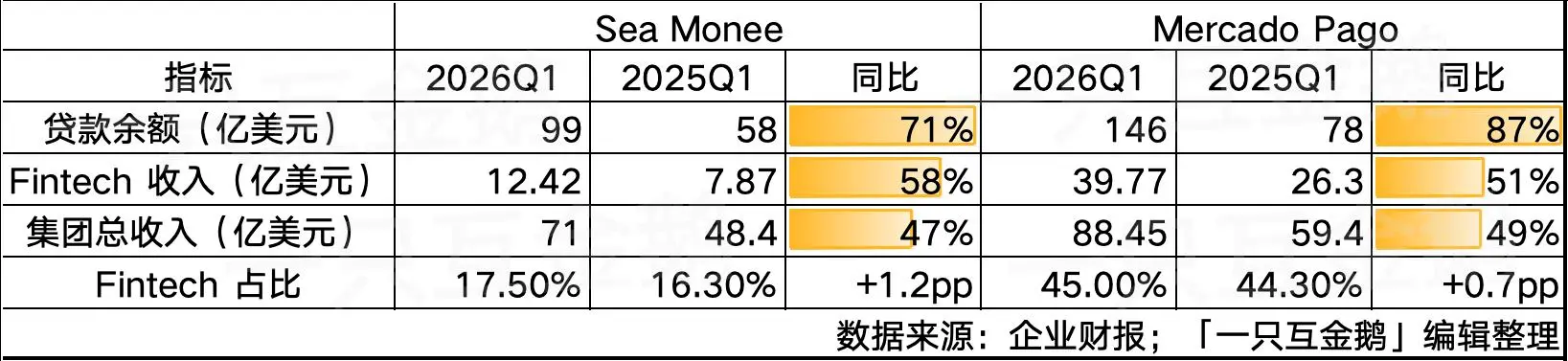
As of the end of Q1 2026:

  • Monee's loan balance reached $9.9 billion (approximately RMB 67 billion), up 71% year-on-year;

  • Mercado Pago's loan balance reached $14.6 billion (approximately RMB 98.7 billion), up 87% year-on-year.

For Q1 2026:

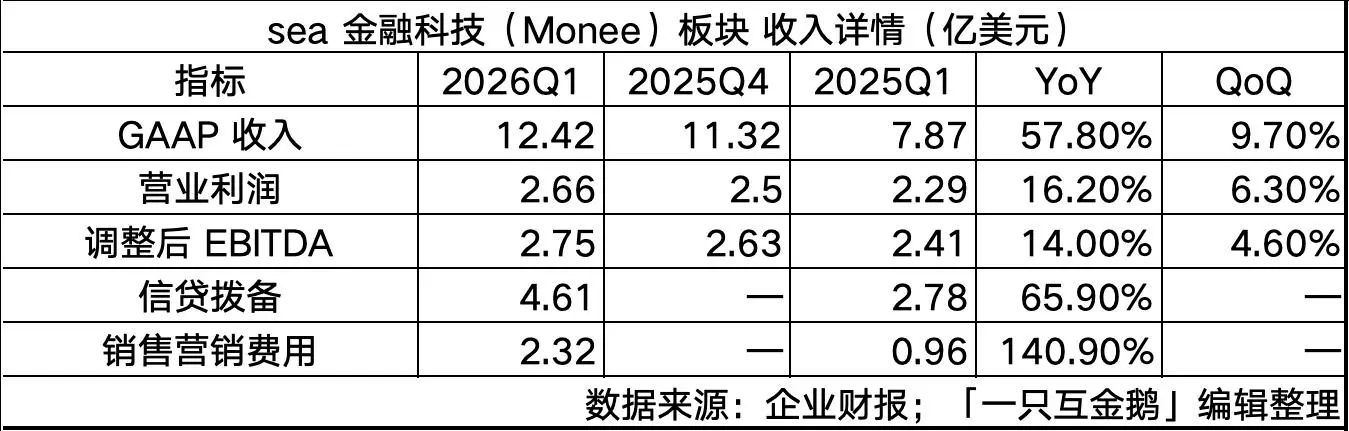
  • Monee's revenue reached $1.242 billion (approximately RMB 8.4 billion), accounting for 17.5% of Sea's total group revenue, up from 16.3% in Q1 2025;

  • Mercado Pago's revenue reached $3.977 billion (approximately RMB 26.9 billion), accounting for 45% of Mercado Libre's total group revenue, up from 44.3% in Q1 2025.

The development logic of "E-commerce + Fintech" for these two companies is not unfamiliar to us. Chinese giants like Ant, JD, and ByteDance all grew by following this path.

However, their differentiated approaches implemented in Southeast Asia and Latin America are also highly valuable as references for domestic fintech and internet giants expanding overseas.

Below, "A Fintech Goose" reviews the key data and development highlights for both giants in Q1 2026.

01 Sea's Monee: Obtained Financial Credit License in Brazil in Q1
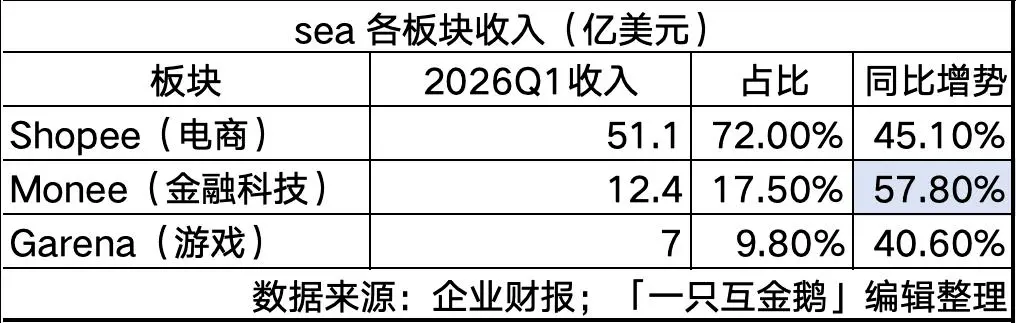
From the data, the fintech segment, i.e., Monee, significantly outperformed in revenue growth (+57.8% YoY) compared to the e-commerce segment Shopee (+45.1%) and the gaming segment Garena (+40.6%).

It's evident that the revenue contribution of the fintech segment Monee within the entire Sea group continues to increase.

Specific data for the fintech segment:

(1) Loan Balance
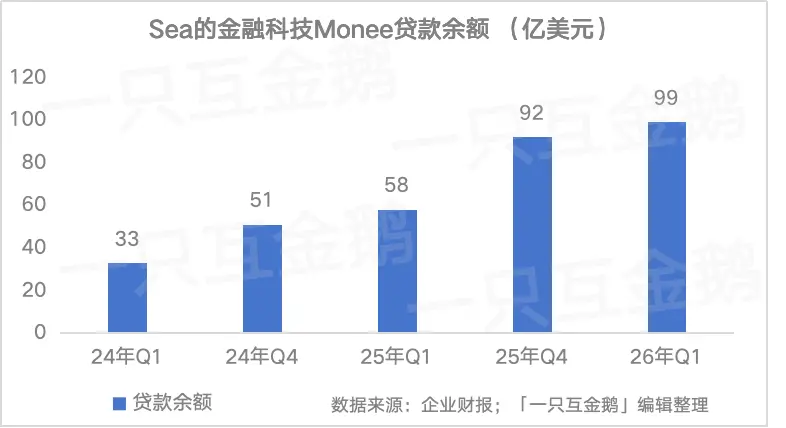
In just two years, the loan balance has grown from $3.3 billion to $9.9 billion, tripling in size.

Each quarter, the loan balance maintains high double-digit growth.

During the investor call, management mentioned that Q1 is typically a consumption off-season, but this year Q1, Sea Monee's loan balance still achieved a sequential growth of +7.5%.

(2) Risk Performance:
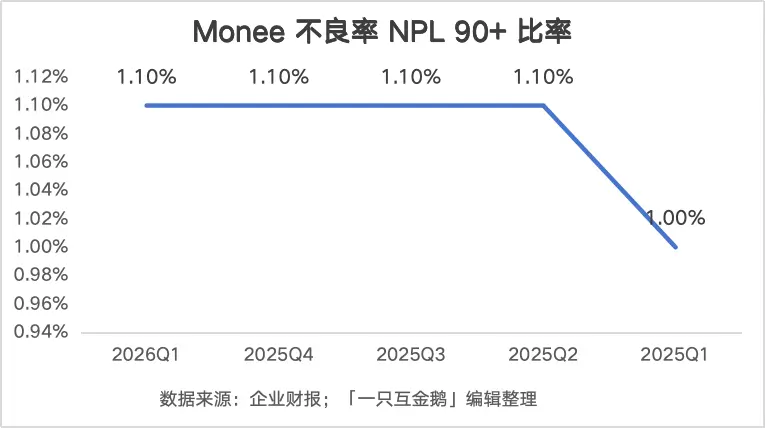
While the loan portfolio grew 71% within a year, the 90+ day NPL ratio only slightly increased from 1.0% to 1.1%, remaining stable at 1.1% for four consecutive quarters.

The stable NPL ratio indicates, to some extent, that their risk model has withstood the test of rapid credit expansion.

Important note on NPL ratio calculation: The denominator for the NPL 90+ ratio includes total loan principal from both "on-book + off-book" loans.

The financial report explains:

Off-book mainly refers to channeling arrangements, where cooperative financial institutions lend on the Sea platform.

(3) Three Growth Paths for Credit Business

Sea clearly outlined three growth paths for Monee's credit business in the conference call:

Path 1: Deepen relationships with existing users

Gradually increase credit limits as understanding of user repayment behavior deepens. This is reflected in the average loan balance per user increasing from $200 to $250 (+25%).

Path 2: Acquire high-quality new users

Launch targeted campaigns for customer segments with better risk scores and stronger spending power, attracting them with competitive pricing, higher credit limits, and longer repayment terms. Management explicitly stated "early signs show success."

Path 3: Expand credit scenarios outside the Shopee ecosystem (Off-Shopee)

This is the most promising growth direction.

In Thailand and Indonesia, Off-Shopee SPayLater loans exceeded 20% of the SPayLater portfolio by the end of Q1.

Notably, strong growth is seen in high-value categories in Indonesia (like electronics and two-wheelers), where installment credit plays a significant role in purchases.

(4) Brazil Market Shines Brightly

In Q1 2026, Brazil became Sea's fastest-growing market.

Both the e-commerce Shopee segment and the fintech Monee segment had highlights:

Shopee Brazil:

  • Q1 was the fastest-growing market while remaining profitable;

  • GMV growth exceeded market average, driven by active buyers, purchase frequency, and average order value;

  • Delivery times improved by over 1 day year-on-year;

  • 3 new fulfillment centers were built, bringing the total to 5;

  • ShopeeMall GMV more than doubled year-on-year, accounting for about 15% of Brazil's total GMV;

  • ShopeeVIP membership program launched in Brazil in April (already over 10 million members in Asia).

Brazil Fintech (Monee Brazil):

  • The combined SPayLater + cash loan credit product launched last year aligns well with Brazilian consumers' credit habits. This drove strong growth in user numbers and repurchase rates.

  • In Q1 2026, Brazil's loan portfolio exceeded $1 billion, up 250% year-on-year, becoming the fourth market with a loan portfolio over $1 billion.
    Note: The other three billion-dollar markets are Indonesia, Thailand, and Malaysia.

  • SPayLater GMV penetration in Brazil is only about 10%, far below mature markets, indicating huge growth potential;

  • Average loan balance per user in Brazil doubled year-on-year, showing extremely strong user stickiness.

  • Crucially – they secured a key license!

In Q1 2026, Sea was approved for Brazil's SCFI license (Sociedade de Crédito, Financiamento e Investimento), also known as the Brazilian financial credit license.

Obtaining this license broadens the range of financial services that can be offered in Brazil. It lays a compliant foundation for independently conducting more diversified credit business in Brazil in the future. This is a key milestone.

02 Mercado Libre: Brazil Credit Business Q1 Revenue $1.124 Billion (approx. ¥8 billion RMB)

Now let's look at Mercado Libre.

Like Sea, Brazil is a significant part of Mercado Libre's operations across all countries.
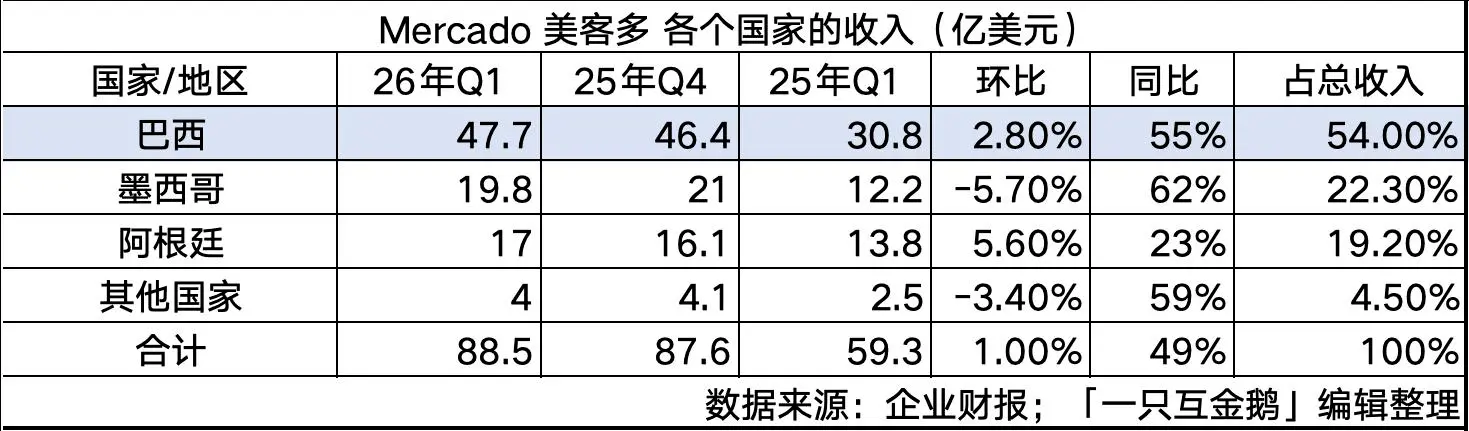
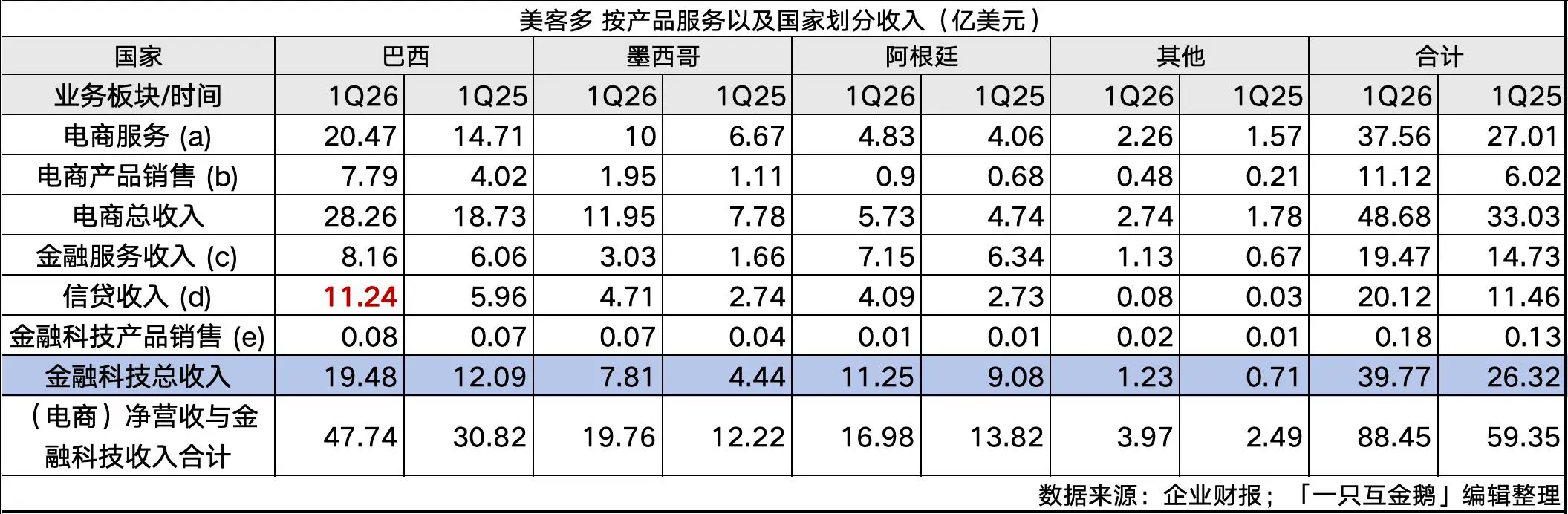
Looking at the Q1 2026 financial report, if revenue is broken down by country:

  • Brazil contributed over half of the total revenue, accounting for 54%;

  • Mexico was the fastest-growing market, with revenue up 62% year-on-year;

  • Argentina saw relatively moderate growth, with revenue up 23%, but considering Argentina's inflation and currency depreciation, the real local currency growth was high;

  • Other countries, including Chile, Colombia, Peru, etc., have a relatively small scale, collectively accounting for only 4.5%.

Looking at business segments in Q1 2026, the e-commerce segment declined slightly quarter-on-quarter (seasonal off-peak), but the Fintech segment bucked the trend with sequential growth of +4.1%.
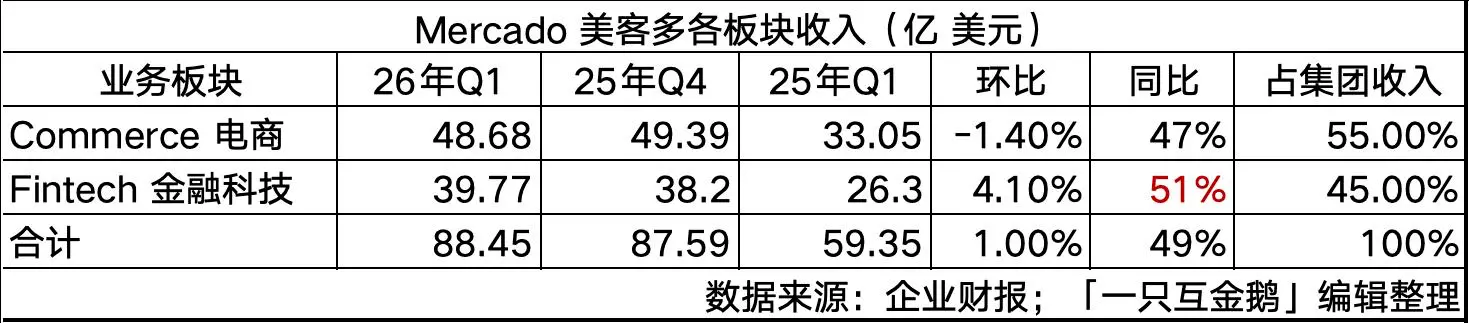
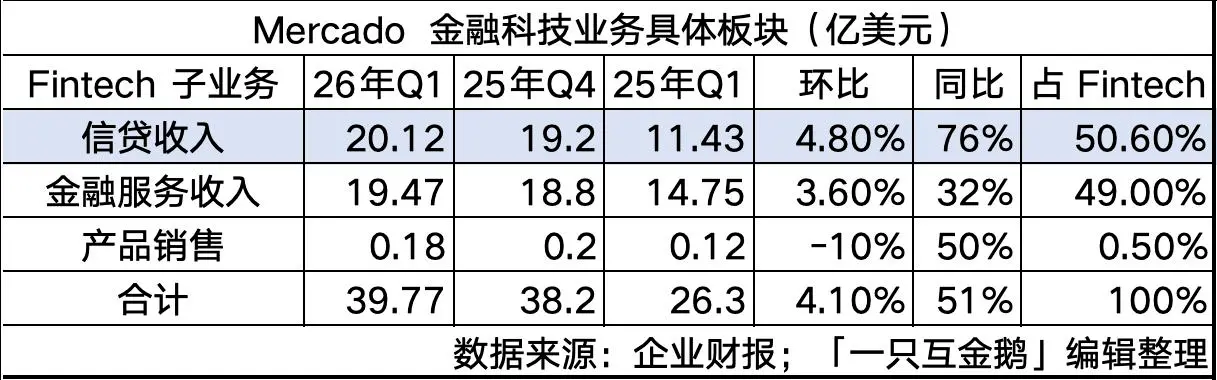
Interestingly, within the fintech segment, credit revenue surpassed financial services revenue for the first time, becoming the largest engine for Fintech.

In other words: the credit business supports the overall performance.

In previous articles, "A Fintech Goose" has detailed Mercado Libre's credit business.

Specifically, it includes:

1 Consumer loans; 2 Credit card business; 3 Merchant loans; 4 Auto loans.
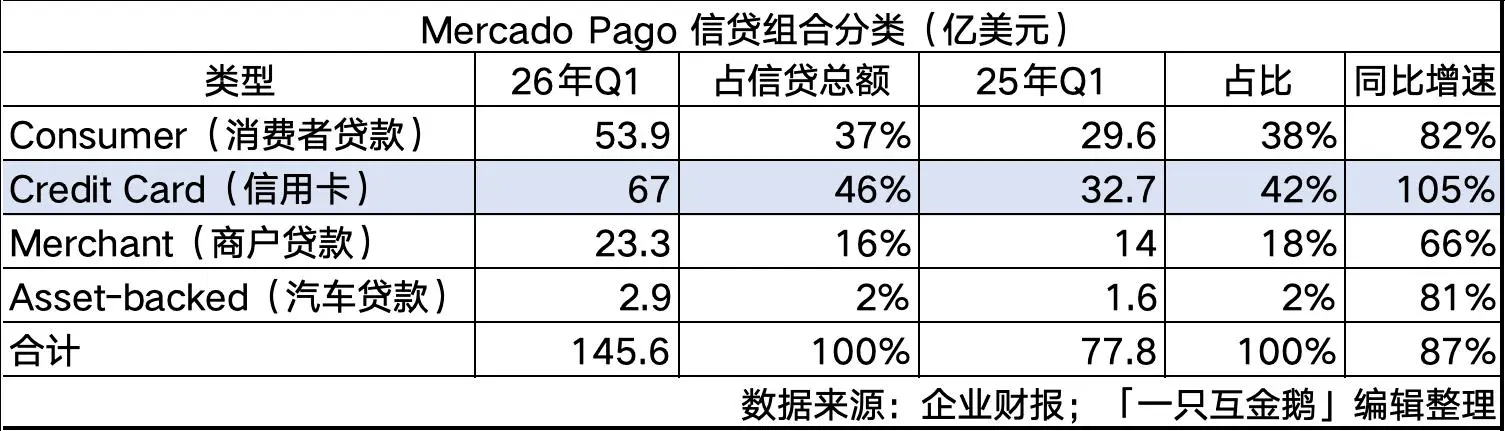
Looking at Q1 2026 data:

The credit card business showed significant loan portfolio growth (+105%), with its size accounting for 46%, taking the largest share.

No matter which country, credit cards are a business with an extremely long investment-return cycle.

In Latin America, Mercado Libre's credit card issuance incurs very high initial costs: zero annual fee + up to 40 days interest-free + up to 18 interest-free installments, plus substantial subsidies for customer acquisition. The required costs are extremely high.

Coupled with Brazilian users' habit of using interest-free installments, it takes a relatively long time from users "grabbing benefits" to "generating interest income."

(1) Strategic Significance of Credit Cards

During the investor call, management repeatedly mentioned the strategic significance of the credit card business.

They even used this phrase to describe it:"Investing in credit cards is as important for Mercado Pago as building our own logistics network was for the e-commerce platform ten years ago."

Key points summarizing Mercado Libre's credit card business:

  • Card issuance: Q1 saw 2.7 million new cards issued, credit card TPV grew 90% year-on-year, MAU grew 68% year-on-year.

  • Cross-selling flywheel: Many credit card users were previously only platform buyers and have now become active Fintech users.

  • Ecosystem effect: Credit cards improve platform conversion rates, GMV per user, and cross-ecosystem transaction volume.

  • 5-year investment in Brazil: Credit cards in Brazil have been invested in for 5 years. Older vintages are maturing as expected, gradually offsetting the dilution effect of new vintages.

  • Acceleration in Mexico: Credit card issuance in Mexico is accelerating, with an attractive payback period.

  • New start in Argentina: Credit cards were just launched in Argentina last August-September, with early performance similar to the initial stage in Brazil.

(2) Credit Risk Performance
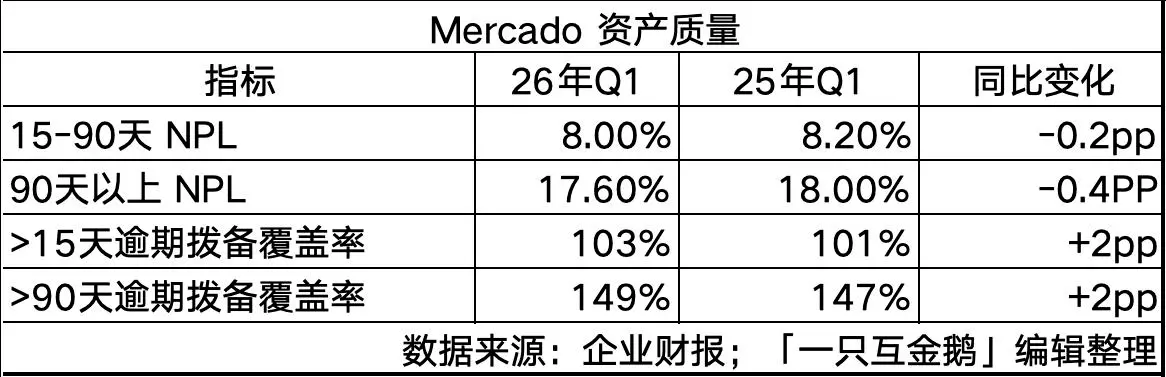
While the credit portfolio grew 87%, the NPL ratio declined year-on-year, and provisions for severely overdue loans exceeded by about 1.5x, strengthening the risk buffer.

Special note: An NPL ratio over 17% seems alarming, but lending rates in the local market are also higher than in China.

Based on Mercado Libre's NIMAL and public information from the Brazilian market, it's estimated:

Personal Loans: Annual interest rate 146%;

Payroll Loans: Annual interest rate 28% (secured, lowest rate);

Credit Card revolving interest annual rate 451% (Central Bank of Brazil, March 2026).

(3) Net Interest Margin Remains Impressive
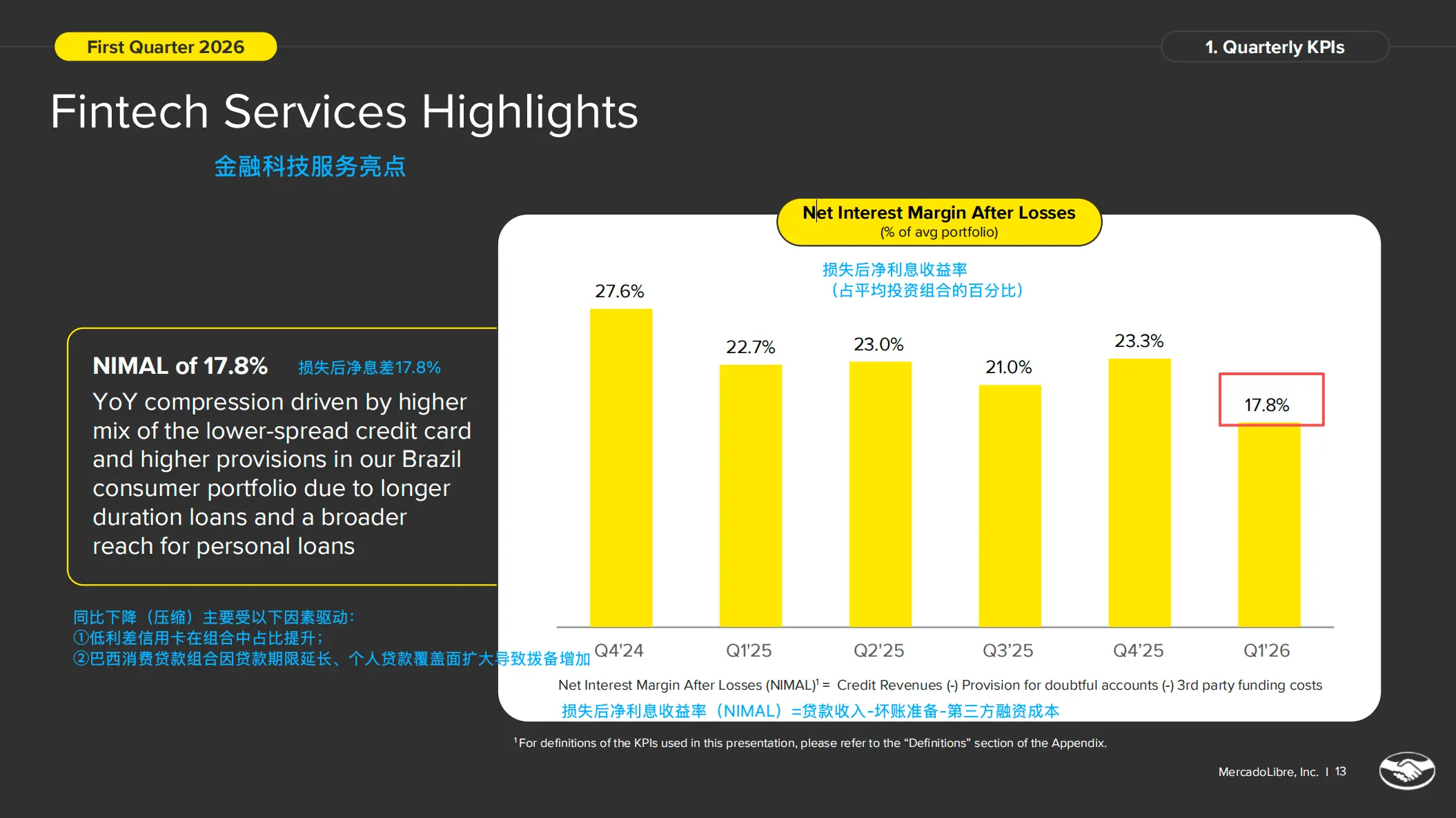
Screenshot from Mercado Libre Investor Report (Click image to enlarge)

Mercado Libre's net interest margin remains impressive.

It declined from 22.7% in Q1 2025 to 17.8% in Q1 2026, a drop of 4.9 percentage points, but this is still an extremely high level.

For comparison, in China, China Merchants Bank's Q1 2026 NIM was only 1.83%; WeBank, China's "profit king" among private banks, had an NIM of only 4.19% in 2025 (pre-provision basis).

Moreover, Mercado Libre's metric calculation is more stringent.

  • Mercado Libre NIMAL = Credit revenue - Bad debt provisions - Funding cost, i.e., Net Interest Margin after deducting bad debts.

  • Domestic bank NIM = (Interest income - Interest expense) / Interest-earning assets, i.e., before bad debt deduction.

Mercado Libre's investor call mentioned: The 4.9ppts year-on-year decline in NIMAL was primarily due to:

  • Increased proportion of credit cards (2/3 of the compression from this factor): Initial NIMAL for credit cards is lower because full expected loss provisions need to be booked at issuance;

  • Longer terms and broader coverage of consumer loans in Brazil (1/3 of the compression): Terms extended from 5 months to 8 months, reaching more credit score segments.

  • Notably, each sub-portfolio remains profitable. Consumer loan portfolio still maintains double-digit margins, merchant loans have the highest spread. Credit cards follow a "first loss, then profit" model, and older vintages in Brazil have already started generating profits.

(4) Brazil Market, the Biggest Surprise

Management expressed pleasant surprise and the importance of the Brazil market in the shareholder letter:

"Twenty-six years after launch, Mercado Libre is growing at startup rates across all of our major markets. Nowhere is this more evident than in Brazil, our largest and most established market, where growth is not just fast – it is accelerating."

Mercado Libre's e-commerce revenue in Q1 2026 was $2.826 billion, up 51% year-on-year.

Specifically in Q1, e-commerce GMV grew 38% year-on-year, items sold grew 56%, and active buyers grew 32%.

This growth primarily stemmed from the decision in 2025 to lower the free shipping threshold, which management called "one of the most important decisions in 2025" – lowering the free shipping threshold to R$19 (approximately RMB 25.49) greatly reduced the psychological barrier for first-time purchases.

Looking at the fintech segment –

  • Fintech in Brazil contributed $1.948 billion in revenue in Q1 2026, accounting for 22.0% of the group's total revenue;

  • Within that, credit-related revenue was $1.124 billion, accounting for 12.7% of the group's total revenue. This revenue was $596 million in Q1 last year, representing 89% year-on-year growth.

Currently, Brazil's credit business is undoubtedly a key growth engine for Mercado Libre.

The credit revenue from a single market already accounts for nearly one-eighth of Mercado Libre's global total revenue.
In short, while both Sea and Mercado Libre are betting big on Brazil, with growth rates often doubling, it is indeed an extremely tempting market.

However, this rapid growth seems to be reserved for the giants. Other fintech players—without e-commerce transaction scene data, without a payment loop to cultivate users—find it extremely difficult to operate credit businesses in Brazil. The local tax system is also particularly complex, making it hard for general players to establish themselves, and it's not recommended.


Câu hỏi Liên quan

QAccording to the article, how does the credit business performance of Sea's Monee and Mercado's Mercado Pago compare in Q1 2026?

AIn Q1 2026, both Monee and Mercado Pago showed strong growth in their credit businesses. Monee's loan book reached $9.9 billion, a year-on-year increase of 71%, while Mercado Pago's loan book reached $14.6 billion, a year-on-year increase of 87%. Mercado Pago's loan book was larger and grew at a faster rate.

QWhat were the three key growth paths identified for Sea Monee's credit business?

AThe three key growth paths for Sea Monee's credit business are: 1) Deepening relationships with existing users by increasing credit limits as repayment behavior is understood better. 2) Acquiring high-quality new users through targeted campaigns with competitive pricing, higher limits, and longer repayment terms. 3) Expanding credit scenarios outside the Shopee ecosystem (Off-Shopee), such as in Indonesia for high-value categories like electronics and two-wheelers.

QWhy is the Brazilian market considered a 'main battleground' for both Sea and Mercado Libre?

ABrazil is considered a main battleground because it is the fastest-growing and most significant market for both companies. For Sea, Brazil was its fastest-growing market in Q1 2026, with Monee's loan book there exceeding $1 billion and growing 250% year-on-year. For Mercado Libre, Brazil contributed over 54% of its total revenue, with its credit business in Brazil generating $1.124 billion in revenue, accounting for 12.7% of the group's total revenue and growing 89% year-on-year. Both see immense potential due to low credit penetration compared to mature markets.

QWhat strategic importance does the credit card business hold for Mercado Pago, as stated in the article?

AMercado Pago's management compared the strategic importance of investing in credit cards to the significance of building its own logistics network for its e-commerce platform a decade ago. The credit card business is crucial for driving cross-selling, increasing platform conversion rates, boosting per-user GMV, and expanding cross-ecosystem transaction volume. Although it has a long investment payback period, older batches in Brazil have already started to become profitable.

QDespite high delinquency rates, how does Mercado Pago maintain profitability in its credit business, especially in Brazil?

AMercado Pago maintains profitability despite high delinquency rates because the interest rates on its credit products in markets like Brazil are significantly higher than in regions like China. For example, personal loan annual rates can be around 146%, and credit card revolving interest rates can be as high as 451%. This high revenue potential, combined with prudent risk management like maintaining a 1.5x provision coverage for severely delinquent loans, allows the business to remain profitable even with a high NPL ratio.

Nội dung Liên quan

Bot MEV Khét Tiếng JaredFromSubway Bị Rút Cạn 7,5 Triệu Đô La

Một trong những bot MEV khét tiếng nhất trên Ethereum, có biệt danh JaredFromSubway, đã bị rút cạn khoảng 7,5 triệu USD sau khi các hợp đồng do kẻ tấn công kiểm soát đánh lừa hệ thống tự động của nó cấp phê duyệt token. Theo báo cáo từ công ty an ninh Blockaid, kẻ tấn công đã chuẩn bị bẫy bằng cách sử dụng các đường giao dịch hoặc hợp đồng giả mạo mà bot này diễn giải là cơ hội có lời. Một khi các phê duyệt được cấp, kẻ tấn công đã sử dụng chúng để chuyển tài sản bao gồm WETH, USDC và USDT ra khỏi hợp đồng của bot. Sự cố này nhấn mạnh một rủi ro trong các hệ thống giao dịch tự động: tốc độ có thể trở thành điểm yếu. Các bot cạnh tranh trên thị trường MEV cần hành động nhanh hơn nhưng điều đó cũng đồng nghĩa chúng có thể dễ bị tổn thương bởi các bẫy được thiết kế cẩn thận. Bài học kỹ thuật rộng hơn là bất kỳ hệ thống nào cấp phê duyệt token dựa trên tương tác hợp đồng tự động đều cần các biện pháp bảo vệ nghiêm ngặt, mô phỏng và xác minh đường giao dịch. Vụ việc có vẻ là một cuộc khai thác nhắm mục tiêu vào logic của một bot giao dịch cụ thể, không phải là sự kiện bảo mật ảnh hưởng đến toàn mạng lưới Ethereum. Tác động chính có khả năng là về mặt danh tiếng đối với cơ sở hạ tầng MEV và đối với các nhà vận hành bot, những người giờ đây cần xem xét logic phê duyệt của họ một cách thận trọng hơn.

bitcoinist1 giờ trước

Bot MEV Khét Tiếng JaredFromSubway Bị Rút Cạn 7,5 Triệu Đô La

bitcoinist1 giờ trước

Phân tích Báo cáo: JPMorgan Giải thích Chi tiết Tâm lý Người mua Trước Ngày Công bố Báo cáo Hàng quý của Micron, Tình hình Gần đây của Mảng Phần cứng

Phân tích báo cáo của J.P. Morgan: Tổng quan tâm lý nhà đầu tư trước báo cáo tài chính của Micron và tình hình ngành phần cứng. **Điểm chính:** 1. **Tâm lý tích cực về Micron & ngành bộ nhớ:** Bộ nhớ vẫn là lĩnh vực được kỳ vọng cao nhất trong AI. Nhu cầu AI mạnh mẽ và giá bán (ASP) tiếp tục tăng. Thị trường tập trung vào: khả năng duy trì biên lợi nhuận cao (>80%) của Micron, tiềm năng tăng ASP từ AI và mức độ chi tiết về các hợp đồng dài hạn (SCA) sắp được công bố. 2. **Nhu cầu phần cứng AI mạnh, cổ phiếu phân hóa:** Chuỗi cung ứng phần cứng cho thấy nhu cầu liên quan đến AI vẫn mạnh, nhưng tình hình các công ty khác nhau: * **Celestica (CLS):** Triển vọng biên lợi nhuận cải thiện, tự tin hơn về các dự án mạng AI. * **Western Digital & Seagate:** Hưởng lợi từ môi trường nguồn cung hạn chế và giá cả được cải thiện. * **Fabrinet (FN):** Khả năng dự báo tăng trưởng cho mô-đun quang AI được cải thiện. * **Teradyne (TER):** Doanh thu nửa cuối năm dự kiến giảm, nhưng Google có thể trở thành khách hàng mới quan trọng. 3. **Dự báo chi tiêu vốn AI được điều chỉnh tăng:** J.P. Morgan nâng dự báo tăng trưởng thị trường thiết bị sản xuất wafer (WFE) lên 28% cho năm 2026 và 29% cho năm 2027. DRAM, TSMC, Intel, Samsung Foundry là những nguồn tăng trưởng chính. Các điều kiện tài trợ cho cơ sở hạ tầng AI đang trở nên thuận lợi hơn. **Tín hiệu đáng chú ý từ Celestica:** Sự tự tin về khả năng chuyển chi phí và theo đuổi các dự án mạng AI cho thấy nhu cầu vẫn tập trung vào các nhà cung cấp hàng đầu, và khả năng phân bổ chuỗi cung ứng đang trở thành lợi thế cạnh tranh. **Các yếu tố cần theo dõi:** * Mức độ chi tiết về Hợp đồng Dài hạn (SCA) và triển vọng biên lợi nhuận từ Micron. * Khả năng Arista Networks điều chỉnh tăng hướng dẫn cả năm. * Tiến độ tăng doanh thu từ mô-đun quang cho Amazon của Fabrinet.

marsbit1 giờ trước

Phân tích Báo cáo: JPMorgan Giải thích Chi tiết Tâm lý Người mua Trước Ngày Công bố Báo cáo Hàng quý của Micron, Tình hình Gần đây của Mảng Phần cứng

marsbit1 giờ trước

Phân Tích Báo Cáo: Chủ Tịch Mới Của Fed Ra Mắt, Thay Người Lãnh Đạo Nhưng Kịch Bản Có Đổi?

Bài viết diễn giải báo cáo của Morgan Stanley về cuộc họp FOMC đầu tiên dưới thời Chủ tịch Fed mới Kevin Warsh. Báo cáo đưa ra ba kết luận chính. Thứ nhất, Chủ tịch Warsh đã cố ý không đưa ra lộ trình lãi suất rõ ràng, phù hợp với triết lý cá nhân về việc giảm "hướng dẫn triển vọng". Đồ thị điểm cho thấy dự báo tăng lãi suất một lần trong năm nay, nhưng nếu lạm phát cơ bản giảm mạnh hơn dự kiến, lý lẽ cho việc tăng lãi suất này có thể không còn vững chắc. Thứ hai, lộ trình thu hẹp bảng cân đối kế toán (QT) có thể tích cực hơn dự kiến của thị trường, nhưng tác động thực tế có thể nhỏ hơn lo ngại. Báo cáo chỉ ra các biện pháp như cắt giảm một nửa số dư tài khoản Kho bạc có thể giúp thu hẹp bảng cân đối khoảng 5000 tỷ USD với ít xáo trộn thị trường. Rủi ro chính là nếu Fed chủ động bán các chứng khoán được thế chấp bằng tài sản thế chấp (MBS). Thứ ba, khung chính sách cốt lõi của Fed đang được xem xét lại, nhưng mục tiêu lạm phát 2% trong ngắn hạn sẽ không thay đổi. Việc Fed tinh giản và sắp xếp lại thông cáo FOMC được xem là sự điều chỉnh về hình thức hơn là thay đổi cơ bản về chính sách. Tóm lại, báo cáo cho rằng những thay đổi trong cách Fed giao tiếp có thể bị đánh giá cao quá mức, và thị trường nên chú ý nhiều hơn đến khả năng lạm phát giảm mạnh và quy mô QT mở rộng, thay vì tập trung quá mức vào lộ trình lãi suất.

marsbit2 giờ trước

Phân Tích Báo Cáo: Chủ Tịch Mới Của Fed Ra Mắt, Thay Người Lãnh Đạo Nhưng Kịch Bản Có Đổi?

marsbit2 giờ trước

Tuần Lễ Đối Đầu Quyết Định: BTC Kiểm Tra Lại và Cuộc Chiến Giành Giữ Hỗ Trợ HYPE | Phân Tích Đặc Biệt

**Tuần đối đầu then chốt: BTC kiểm tra lại và cuộc chiến tại vùng hỗ trợ HYPE** Thị trường bước vào giai đoạn đối đầu quan trọng. Phân tích kỹ thuật chỉ ra rằng BTC đang trong giai đoạn kiểm tra lại (pullback) sau khi phá vỡ kênh tăng ngắn hạn (hỗ trợ ~64,500-65,000 USD). Kết quả của đợt kiểm tra này sẽ quyết định hướng đi tiếp theo: hoặc tiếp tục thử thách vùng kháng cự 69,500-70,500 USD, hoặc quay lại thử nghiệm vùng hỗ trợ chính 59,000-60,000 USD. Mô hình theo dõi vị thế hiện xác nhận cấu trúc thị trường nghiêng về phe bán. Đối với HYPE, giá đang hồi về vùng hỗ trợ then chốt 64-66 USD sau khi lập đỉnh cao mới. Kết quả tranh giành tại vùng này rất quan trọng: giữ vững hỗ trợ có thể mở đường cho đà tăng tiếp diễn, trong khi mất vùng này có thể kéo dài thời gian điều chỉnh về vùng 52-54 USD. **Chiến lược giao dịch tuần này:** * **BTC (Trung & Ngắn hạn):** Ưu tiên theo dõi các cơ hội bán ở vùng kháng cự (64,500-65,000 USD và 69,500-70,500 USD) nếu có tín hiệu đảo chiều, với kế hoạch A/B/C cụ thể. Quản lý rủi ro chặt chẽ. * **HYPE (Ngắn hạn):** Tập trung vào chiến lược mua khi giá hồi về và tìm điểm đảo chiều tại các vùng hỗ trợ chính (64-66 USD hoặc 52-54 USD), với khối lượng vừa phải. **Lưu ý đặc biệt:** Mọi phân tích và chiến lược đều cần được điều chỉnh linh hoạt theo diễn biến thị trường. Đây là nhật ký giao dịch cá nhân, không phải lời khuyên đầu tư. Luôn tuân thủ kỷ luật cắt lỗ và quản lý vốn.

marsbit2 giờ trước

Tuần Lễ Đối Đầu Quyết Định: BTC Kiểm Tra Lại và Cuộc Chiến Giành Giữ Hỗ Trợ HYPE | Phân Tích Đặc Biệt

marsbit2 giờ trước

Diễn giải báo cáo: Citi tham dự hội nghị AWS, lạc quan về việc tăng tốc kinh doanh đám mây nhưng quản trị dữ liệu vẫn là biến số then chốt

Phân tích từ Citigroup: AWS chuyển trọng tâm từ thử nghiệm sang triển khai AI quy mô lớn, nhưng quản trị dữ liệu vẫn là yếu tố then chốt. Sau khi tham dự AWS Summit New York và trao đổi với hơn 10 khách hàng, đối tác, nhóm phân tích Tyler Radke của Citigroup cho rằng hội nghị năm nay đánh dấu bước tiến của AWS trong việc đưa AI Agent (trí tuệ nhân tạo tác tử) vào "triển khai có thể mở rộng". Báo cáo nhấn mạnh ba điểm chính: 1. **Chuyển dịch chiến lược:** AWS đã chuyển từ giai đoạn chứng minh khái niệm sang tập trung vào triển khai quy mô doanh nghiệp. Các sản phẩm mới như AWS Context (xây dựng đồ thị tri thức tự động), Amazon Quick (trợ lý AI xuyên ứng dụng) và Continuum (an ninh) nhắm vào các điểm khó trong triển khai thực tế. 2. **Lợi ích cho hạ tầng dữ liệu:** Các công ty cung cấp hạ tầng dữ liệu như Snowflake, Elastic, Oracle và ClickHouse được hưởng lợi trực tiếp từ xu hướng mở rộng quy mô AI, khi nhu cầu lưu trữ, xử lý và phân tích dữ liệu phức tạp tăng lên. 3. **Quản trị dữ liệu là chìa khóa:** Khi số lượng AI Agent tăng từ hàng trăm lên hàng nghìn, việc đảm bảo mỗi Agent truy cập đúng dữ liệu với đúng quyền hạn trở thành vấn đề sống còn để AI có thể xử lý nghiệp vụ cốt lõi. AWS Context được xem là bước đi chiến lược của AWS trong việc cung cấp lớp cơ sở hạ tầng cho quản trị dữ liệu, một yếu tố quyết định việc chuyển đổi AI từ dự án thí điểm thành phần then chốt trong quy trình doanh nghiệp. Citigroup duy trì đánh giá "Mua" đối với Amazon, dự báo tốc độ tăng trưởng doanh thu AWS sẽ tăng tốc lên 37% vào năm tài chính 2027 (so với 30% của FY26). Các tín hiệu cần theo dõi bao gồm tốc độ tăng trưởng doanh thu AWS, tốc độ tăng trưởng khối lượng công việc trên AWS Bedrock AgentCore và tác động của biến động giá cả từ các nhà cung cấp hạ tầng dữ liệu đến nhu cầu thực tế.

marsbit2 giờ trước

Diễn giải báo cáo: Citi tham dự hội nghị AWS, lạc quan về việc tăng tốc kinh doanh đám mây nhưng quản trị dữ liệu vẫn là biến số then chốt

marsbit2 giờ trước

Giao dịch

Giao ngay
Hợp đồng Tương lai
活动图片