Michael Saylor Identifies the Next Financial Opportunity Worth Billions

cryptonews.ruXuất bản vào 2026-08-09Cập nhật gần nhất vào 2026-08-09

Tóm tắt

Michael Saylor, Executive Chairman of Strategy Inc. (Nasdaq: MSTR), identified digital credit as the next billion-dollar business opportunity in finance. In an August 7th post on X, he suggested entrepreneurs explore this category. Saylor's post included a chart showing the effective yields of four of Strategy's digital credit products as of 11:10 AM EDT. Leading was Stride Preferred Shares (STRD) with a 15.29% yield, followed by Stretch Preferred Shares (STRC) at 12.63%, Strike Preferred Shares (STRK) at 12.08%, and Strife Preferred Shares (STRF) at 10.38%. These preferred securities allow Strategy to raise capital from income-seeking investors, offering various dividend rates, risk levels, and positions in the company's capital structure. Strategy has developed a suite of preferred shares classified as digital credit instruments. For instance, the Stretch Preferred Shares (STRC) are perpetual, variable-rate securities. This approach applies established credit market structures to companies with digital asset-based balance sheets, connecting capital-seeking issuers with yield-seeking investors through Wall Street-like products. Saylor positioned these as a "digital credit stack," built upon but not backed by Strategy's bitcoin reserve, expanding the company's capital access while targeting yield-focused buyers. The billion-dollar potential lies in creating a scalable, replicable business model where issuers can raise capital via tailored income securities and investors ca...

Michael Saylor, Executive Chairman of Strategy Inc. (Nasdaq: MSTR), shared his view on the next billion-dollar business in finance in an August 7 post on X, pointing entrepreneurs towards digital credit as the financial category he would explore.

Saylor wrote on X:

"If I were looking for the next billion-dollar business in finance, I would study digital credit."

A chart attached to his post showed the effective yields of four securities from Strategy's suite of digital credit products as of 11:10 AM Eastern Time (EDT). Leading the way were Stride Preferred Shares (STRD) with a yield of 15.29%, followed by Stretch Preferred Shares (STRC) at 12.63%, Strike Preferred Shares (STRK) at 12.08%, and Strife Preferred Shares (STRF) at 10.38%.
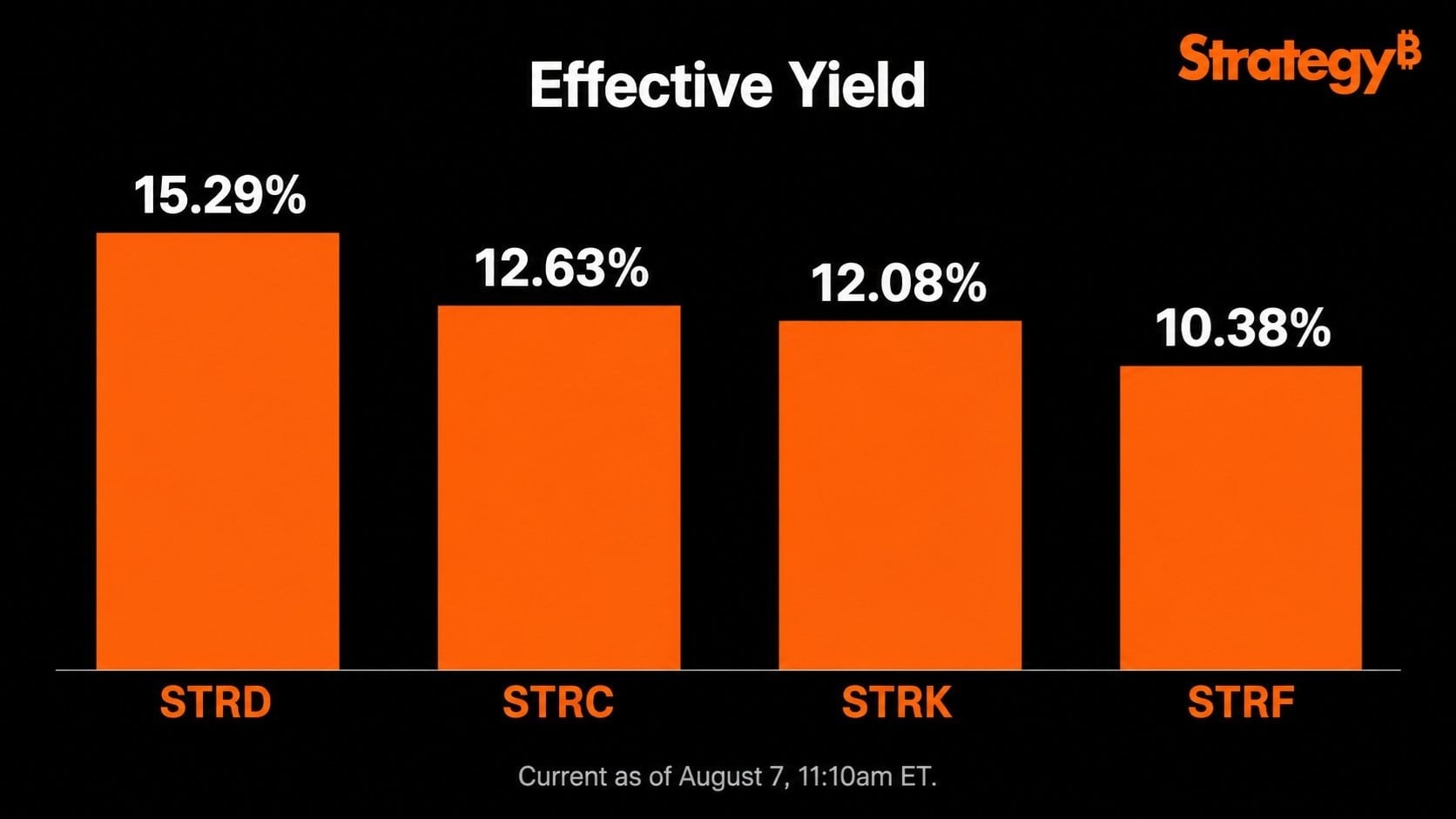
Effective yields of Strategy's credit products. Source: Strategy Inc.

Collectively, these four types of preferred securities allow Strategy to raise capital from yield-seeking investors while offering varying dividend rates, risk levels, and positions in the company's capital structure. These securities extend Strategy's financing options beyond common stock and debt obligations.

Strategy Creates Digital Credit Products Based on Capital Markets

Strategy has developed a set of preferred shares which it classifies as digital credit instruments. Its Stretch Preferred Shares (STRC) are perpetual preferred securities with a variable dividend rate, allowing Strategy to adjust payouts while offering investors a yield-oriented instrument.

The broader assortment targets investors with different yield and risk preferences, simultaneously extending familiar preferred share structures into digital asset markets. Preferred securities pay dividends and occupy a different position compared to common shares in a company's capital structure.

Growing dividend obligations have also influenced how Strategy manages its Bitcoin holdings and cash reserves. The company has sold Bitcoin to finance preferred share payments and build a US dollar reserve, ensuring liquidity for its expanding yield securities.

Why Saylor Considers the Digital Credit Market a Billion-Dollar Opportunity

The scale of this opportunity stems from applying established credit market structures to companies and balance sheets underpinned by digital assets. This model connects capital-seeking issuers with yield-seeking investors through securities that resemble familiar Wall Street products.

Saylor has defined these preferred securities as a "digital credit stack," positioning them as fixed-income alternatives built upon Strategy's Bitcoin reserve. These securities are not secured by Strategy's Bitcoin assets. This approach expands the company's access to capital while targeting yield-seeking buyers through publicly listed securities.

This model creates a potentially replicable business: issuers can raise capital using tailored yield securities, and investors can select products based on yield, risk, and capital priority. Strategy is already testing this concept through several offerings.

Digital Credit Extends Beyond a Single Product

Investor interest in Strategy's preferred securities has grown as the company expands its digital lending product line. STRC has become a significant part of this expansion; Saylor highlighted its growth while also outlining the potential scale of the digital lending market.

The broader opportunity lies in creating products for various capital pools rather than relying on a single offering. A scalable structure could give issuers more flexibility to align with market preferences for yield and risk.

For Strategy, this approach allows it to raise capital from buyers who want yield exposure without direct Bitcoin exposure, while maintaining its broader Bitcoin ownership strategy.

end-content

Câu hỏi Liên quan

QAccording to Michael Saylor, what financial category would he explore for the next billion-dollar business?

AMichael Saylor stated he would explore digital credit for the next billion-dollar business in finance.

QWhich Strategy preferred stock had the highest effective yield according to the chart in the article?

AAccording to the chart, the Stride (STRD) preferred stock had the highest effective yield at 15.29%.

QHow are Strategy's preferred securities classified, and what is one key feature of the Stretch (STRC) preferred stock?

AStrategy classifies its preferred securities as digital credit instruments. The Stretch (STRC) preferred stock is a perpetual preferred security with a variable dividend rate.

QWhy does Michael Saylor believe the digital credit market represents a billion-dollar opportunity?

AHe believes it represents a billion-dollar opportunity because it applies established credit market structures to companies and balance sheets underpinned by digital assets, creating scalable financial products for income-seeking investors.

QHow has the growth of dividend obligations impacted Strategy's management of its Bitcoin reserves and cash?

AThe growing dividend obligations have led Strategy to sell Bitcoin to finance preferred stock payments and build a U.S. dollar reserve, ensuring liquidity for its expanding income securities.

Nội dung Liên quan

Alexander Shokhin: Giới kinh doanh cần lãi suất dưới 10% và đồng đô la ở mức 90–95 rúp

Alexander Shokhin, Chủ tịch Liên minh Công nghiệp và Doanh nhân Nga (RSPP), cho rằng có thể sử dụng các công cụ "phi thị trường" để giữ đồng rúp trong một biên độ nhất định nhằm tránh biến động quá mức, dù ông thừa nhận đây là một chủ đề phức tạp cần thảo luận riêng. Ông Shokhin trước đó đã nhiều lần đề cập đến ý tưởng về một biên độ tỷ giá cho đồng rúp, lý do là thị trường ngoại hối hiện tại bị hạn chế về khối lượng và nhu cầu ngoại tệ giảm, khiến tỷ giá khó có thể coi là hoàn toàn theo cơ chế thị trường. Nhiều doanh nghiệp ủng hộ việc cố định biên độ, dù bằng các biện pháp không hoàn toàn thị trường, để tạo ra sự ổn định và dự báo được. Về các mục tiêu kinh tế, từ cuối năm 2025, Shokhin đã nêu ra những kỳ vọng của giới doanh nghiệp cho cuối năm 2026: lãi suất chính sách chính ở mức 12%, lạm phát trong khoảng 4-5% và tỷ giá USD/RUB ở mức 90-95. Tuy nhiên, ông cho biết mức lãi suất thực sự thoải mái cho hoạt động kinh doanh phải thấp hơn 10%. Ông nhấn mạnh tầm quan trọng của việc có một đồng tiền quốc gia ổn định và dự báo được đối với các quyết định đầu tư. Phân tích từ góc độ dữ liệu cho thấy, cơ chế biên độ tỷ giá không phải là mới đối với Nga. Cơ chế tương tự đã được áp dụng từ năm 1995 đến 1998, khi Ngân hàng Trung ương Nga (CBR) cố định tỷ giá USD trong một biên độ hẹp thông qua các can thiệp thường xuyên. Chế độ này kéo dài ba năm và sụp đổ sau cuộc khủng hoảng nợ tháng 8/1998, minh chứng cho tính mong manh của các mục tiêu cố định cứng nhắc khi đối mặt với các cú sốc bên ngoài. Mối liên hệ kinh tế vĩ mô ở đây rất rõ ràng: biên độ càng cứng nhắc thì càng cần nhiều dự trữ để bảo vệ nó khi đồng tiền chịu áp lực. Một khía cạnh kỹ thuật chưa được làm rõ là nguồn lực và quy mô can thiệp cụ thể trong điều kiện thanh khoản thị trường ngoại hối còn hạn chế. Liệu cuộc thảo luận hiện tại sẽ chỉ dừng lại ở lý thuyết hay sẽ chuyển thành các thông số biên độ cụ thể vẫn cần được theo dõi trong những tháng tới.

cryptonews.ru1 giờ trước

Alexander Shokhin: Giới kinh doanh cần lãi suất dưới 10% và đồng đô la ở mức 90–95 rúp

cryptonews.ru1 giờ trước

Chuyến tàu đến Bitcoin đã rời ga? Chỉ báo của người dùng không còn phát tín hiệu!

Giá Bitcoin tăng đã đưa chỉ báo AHR999, được các nhà đầu tư dài hạn theo dõi, ra khỏi vùng "mua khi đáy". Chỉ báo này đã trở lại phạm vi mua sắm bình thường sau khoảng 82 ngày. Theo dữ liệu từ các nguồn bên thứ ba, chỉ báo Ahr999 đạt mức 0,5073 sau đợt tăng giá gần đây của Bitcoin. Điều này đưa chỉ báo ra khỏi vùng "mua đáy" dưới 0,45 và chuyển nó vào vùng trung bình chi phí đô la (DCA) trong khoảng từ 0,45 đến 1,20. Trong chu kỳ hiện tại, khoảng thời gian chỉ báo Ahr999 duy trì dưới 0,45 bắt đầu từ ngày 29 tháng 5 và kết thúc vào ngày 19 tháng 8. Theo chỉ báo này, cửa sổ để mua Bitcoin ở mức thấp nhất kéo dài khoảng 82 ngày. Chỉ báo AHR999 đánh giá cả lợi nhuận ngắn hạn, ổn định từ việc mua Bitcoin và mức độ chênh lệch giữa giá hiện tại với định giá ước tính. Chỉ báo này đặc biệt hữu ích cho các nhà đầu tư sử dụng chiến lược mua dần dài hạn, giúp xác định các giai đoạn thị trường tương đối rẻ hoặc đắt. Theo lịch sử, chỉ số dưới 0,45 được hiểu là "mua khi đáy", trong khoảng 0,45 đến 1,20 là mua ổn định, và trên 1,20 là khu vực giá có thể tương đối cao. Tuy nhiên, bản thân chỉ báo này không được coi là tín hiệu mua hoặc bán rõ ràng. *Đây không phải là khuyến nghị đầu tư.

cryptonews.ru1 giờ trước

Chuyến tàu đến Bitcoin đã rời ga? Chỉ báo của người dùng không còn phát tín hiệu!

cryptonews.ru1 giờ trước

Vương quốc Bhutan chuyển 490 BTC trị giá 32,7 triệu USD sang các ví mới

Theo dữ liệu từ Onchain Lens, trong vòng 24 giờ qua, chính quyền Vương quốc Bhutan đã chuyển 490,87 Bitcoin, trị giá khoảng 32,74 triệu USD, sang các ví mới. Giao dịch lớn nhất là 485 BTC, tương đương gần 32,31 triệu USD, các giao dịch còn lại có giá trị nhỏ hơn. Trước đây, chính phủ Bhutan từng chuyển Bitcoin đến các địa chỉ không rõ hoặc ví liên quan đến các công ty giao dịch, nên mục đích thường khá rõ ràng. Tuy nhiên, lần này, các nhà phân tích chưa xác định được chủ sở hữu của các ví mới và cũng chưa thể khẳng định liệu các giao dịch này có liên quan đến việc bán coin hay không. Vào ngày 18 tháng 8, Vương quốc này đã chuyển 300 Bitcoin (trị giá 19,28 triệu USD) sang một địa chỉ khác để bán, tiếp tục làm giảm dự trữ tiền mã hóa hàng đầu của họ. Theo Arkham, vào tháng 10/2024, Bhutan nắm giữ hơn 13.000 BTC, nhưng đến tháng 3/2026, con số này chỉ còn 4.453 coin và đang tiếp tục giảm. Dự trữ Bitcoin quốc gia của Bhutan chủ yếu được tích lũy thông qua hoạt động khai thác (mining), nhờ nguồn điện giá rẻ từ các nhà máy thủy điện. Các giao dịch mới nhất diễn ra trong bối cảnh Bitcoin đang phục hồi, giao dịch quanh mức 77.600 USD tại thời điểm viết bài, tăng 7,8% trong ngày và 24% trong tuần theo số liệu từ CoinGecko.

cryptonews.ru3 giờ trước

Vương quốc Bhutan chuyển 490 BTC trị giá 32,7 triệu USD sang các ví mới

cryptonews.ru3 giờ trước

HYPE từ Hyperliquid vượt trội thị trường trong xu hướng giảm, giữa lúc AQAv2 chuẩn bị ra mắt

Mã token $HYPE của sàn phái sinh Hyperliquid được trader Pentosh1 đánh giá là "tài sản sinh lời nhất trong thị trường giảm", nhờ cơ chế phân phối doanh thu độc đáo. Gần như toàn bộ phí giao dịch từ thị trường phái sinh và spot được dùng để mua lại và đốt token $HYPE trên thị trường mở. Kể từ tháng 11/2024, 462 triệu token (trị giá ~1,27 tỷ USD) đã bị đốt, với khoảng 99% phí giao dịch dùng cho việc này. Một yếu tố thúc đẩy quan trọng khác là cơ chế AQAv2 (Aligned Quote Asset v2) dự kiến kích hoạt sau 6 ngày. Cơ chế này sẽ chuyển khoảng 90% thu nhập từ khoản dự trữ hơn 5 tỷ USD $USDC của nền tảng vào Quỹ Hỗ trợ Hyperliquid, ước tính tăng thêm 135-160 triệu USD cho hoạt động mua lại token hàng năm, bổ sung cho cơ chế hiện tại. Gần đây, giá $HYPE cũng biến động mạnh sau tuyên bố của cựu Tổng thống Donald Trump về nỗ lực hợp pháp hóa Hyperliquid tại Mỹ, khiến giá tăng 20-25% trong 24 giờ. Sự tăng trưởng của token được cho là dựa trên cơ chế mua lại và đốt token có khả năng mở rộng theo hoạt động giao dịch thực tế, thay vì phụ thuộc vào các chu kỳ hype thị trường.

cryptonews.ru3 giờ trước

HYPE từ Hyperliquid vượt trội thị trường trong xu hướng giảm, giữa lúc AQAv2 chuẩn bị ra mắt

cryptonews.ru3 giờ trước

Giao dịch

Giao ngay
活动图片