'Backstabbing' or 'Win-Win'? How Likely Is TradeXYZ to Break Away from Hyperliquid and Go Solo?

marsbitXuất bản vào 2026-07-31Cập nhật gần nhất vào 2026-07-31

Tóm tắt

The article discusses the growing debate over whether TradeXYZ, which dominates Hyperliquid's HIP-3 market with over 90% of its volume, might break away to build its own independent trading platform. This possibility is fueled by TradeXYZ's immense market influence and the common industry trend of successful projects seeking more control and profit capture. Key arguments for a potential split include TradeXYZ's overwhelming contribution to Hyperliquid's metrics and the financial incentive to retain all transaction fees, as it currently splits them 50/50 with Hyperliquid. The piece draws parallels to other cases, like Anthropic's "Claude Code" competing with its former partner Cursor, suggesting "betrayal" can occur when business leverage shifts. However, strong counterarguments suggest a split is unlikely or would be detrimental. TradeXYZ relies on Hyperliquid's high-performance infrastructure and its platform as a primary user acquisition channel. Building a comparable system would be challenging. Furthermore, the founders of both projects share a history of trust and mutual admiration. The analysis concludes that a separation would likely be a lose-lose scenario: Hyperliquid would lose a major growth narrative and trading volume, while TradeXYZ would face technical hurdles, user migration issues, and reputational damage, potentially allowing competitors to seize market share. The most rational path is seen as continued collaboration, with TradeXYZ potentially negotiating ...

Original | Odaily Planet Daily (@OdailyChina)

Author| Golem (@web3_golem)
As TradeXYZ's business scale continues to expand and it consistently holds over 90% of the market share in the Hyperliquid HIP-3 market, recent community discussions have been heating up around whether TradeXYZ might break away from Hyperliquid to build its own independent trading platform.

Former Messari researcher Sam posted on the X platform, stating that as an investor bullish on HYPE due to the explosion of the RWA perpetual contract market, one should ask themselves three questions: First, if TradeXYZ leaves Hyperliquid and launches its own exchange, where would users go to trade? Second, what impact would TradeXYZ launching its own stock/token have on HYPE's valuation? Third, how likely are the above two scenarios to actually happen?

Within just a few days, the post garnered over 470,000 views. The reason for the rapid rise in this discussion's popularity is essentially that more and more market participants are starting to realize that in the cooperative relationship between TradeXYZ and Hyperliquid, the value contribution of both sides is changing, and TradeXYZ is gradually accumulating stronger market influence and bargaining power compared to Hyperliquid.

In business partnerships, "backstabbing" often occurs when one party gradually gains more resources and market clout, and a significant imbalance in benefit distribution emerges between the two parties.

A recent example comes from the AI industry. Cursor was once the largest programming AI Coding tool on the market, built on top of Anthropic's Claude model. They were like a "golden partnership," until Anthropic delivered the backstab—launching Claude Code, a direct competitor to Cursor. By mid-2026, Claude Code's ARR officially surpassed Cursor's, pushing it off the table.

Similar examples exist in the blockchain industry, where individual products, after becoming large, often break away from their original infrastructure to build their own chain ecosystems, such as Uniswap and dYdX. Polymarket, one of the hottest projects this cycle, has also been rumored multiple times to be leaving the existing Polygon infrastructure to build its own.

Returning to the current question, how likely is it for TradeXYZ to leave Hyperliquid and become independent? If this were to actually happen, what impact would it have on both Hyperliquid and TradeXYZ? Odaily Planet Daily will provide a brief analysis in this article.

Is Going Solo Inevitable?

A phenomenon exists in the blockchain industry: projects start and grow on a certain public chain or infrastructure, and later, for reasons of performance, control, underlying fee capture, or larger narrative financing, they choose to independently build their own infrastructure (L2 or independent L1). TradeXYZ has indeed become large enough now.

According to flowscan data, as of now, the total trading volume on Hyperliquid HIP-3 exceeds $469.62 billion, with TradeXYZ contributing over $437.4 billion, accounting for 93%. As of the time of writing, the total Open Interest (OI) on Hyperliquid HIP-3 is $3.9 billion, with TradeXYZ contributing over $3.8 billion, a share of 99.7%.
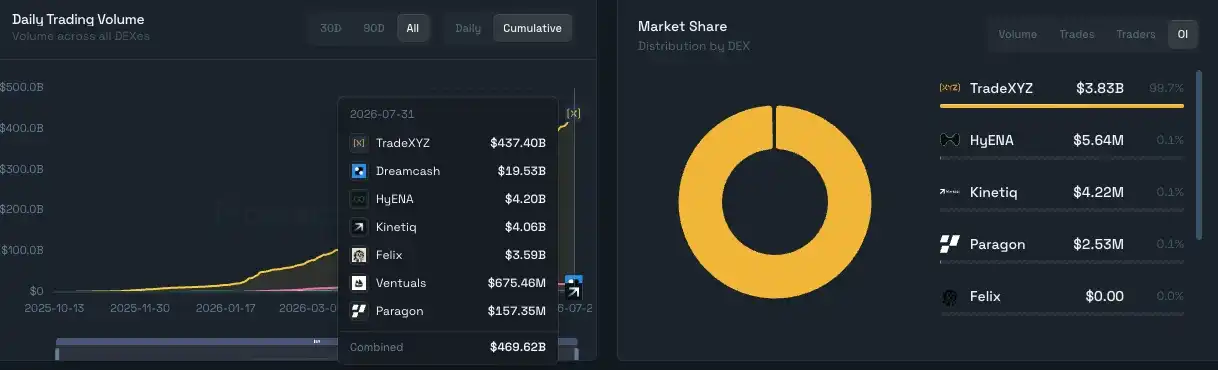
Hyperliquid HIP-3 Total Trading Volume and TradeXYZ's Share

The combined share of the remaining few trading platforms is less than 10%, indicating a massive Matthew Effect in the HIP-3 market. From this perspective, it's not an exaggeration to say that TradeXYZ essentially dominates the Hyperliquid HIP-3 market. The narrative premium that RWA on-chain contracts development has brought to Hyperliquid is, in essence, the narrative premium that TradeXYZ has brought to Hyperliquid.

From both valuation and protocol revenue perspectives, TradeXYZ is no longer just optional for Hyperliquid; it has become a crucial player holding up the fort, especially during a sluggish crypto market and shrinking trading volumes for Bitcoin and other crypto derivatives.

According to official data, HIP-3 now accounts for 71.92% of Hyperliquid's total trading volume, hitting a record high. Based on TradeXYZ's dominant position in HIP-3, this means TradeXYZ contributes to over 70% of Hyperliquid's total trading volume. HIP-3 accounts for 36% of Hyperliquid's total OI, which similarly implies TradeXYZ's contributed OI accounts for over 35% of Hyperliquid's total OI.
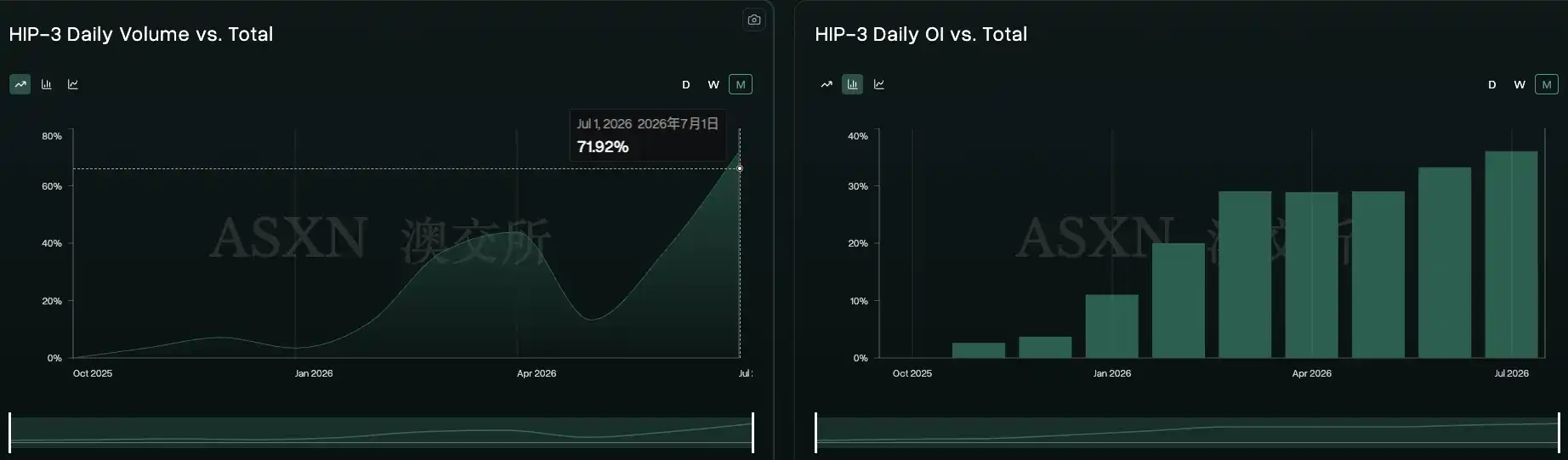
HIP-3's Share in Hyperliquid's Total Trading Volume and Total OI

Therefore, TradeXYZ has already leveraged Hyperliquid's infrastructure to grow into a behemoth capable of influencing traditional financial markets. Now, within its cooperative relationship with Hyperliquid, its leverage, influence, and bargaining power are starting to take a leading role. So, when a child grows up, should it become independent? Under what triggers might TradeXYZ choose to build its own infrastructure?

Setting aside unpredictable capital operation factors like financing and token issuance, and looking solely from a practical business perspective, if TradeXYZ were to truly choose independence, the most likely reason would be to capture the underlying transaction fees.

In Hyperliquid's HIP-3 market, the transaction fee split between TradeXYZ and Hyperliquid is fixed at 50/50. Furthermore, because the standard transaction fee for HIP-3 assets is twice that of the core perp market, the protocol fee Hyperliquid actually earns from each HIP-3 trade is the same as from the core perp market.

According to statistics, as of the time of writing, the total fee revenue generated by TradeXYZ is close to $50 million. According to the HIP-3 stipulated split ratio, TradeXYZ can take away at most $25 million.
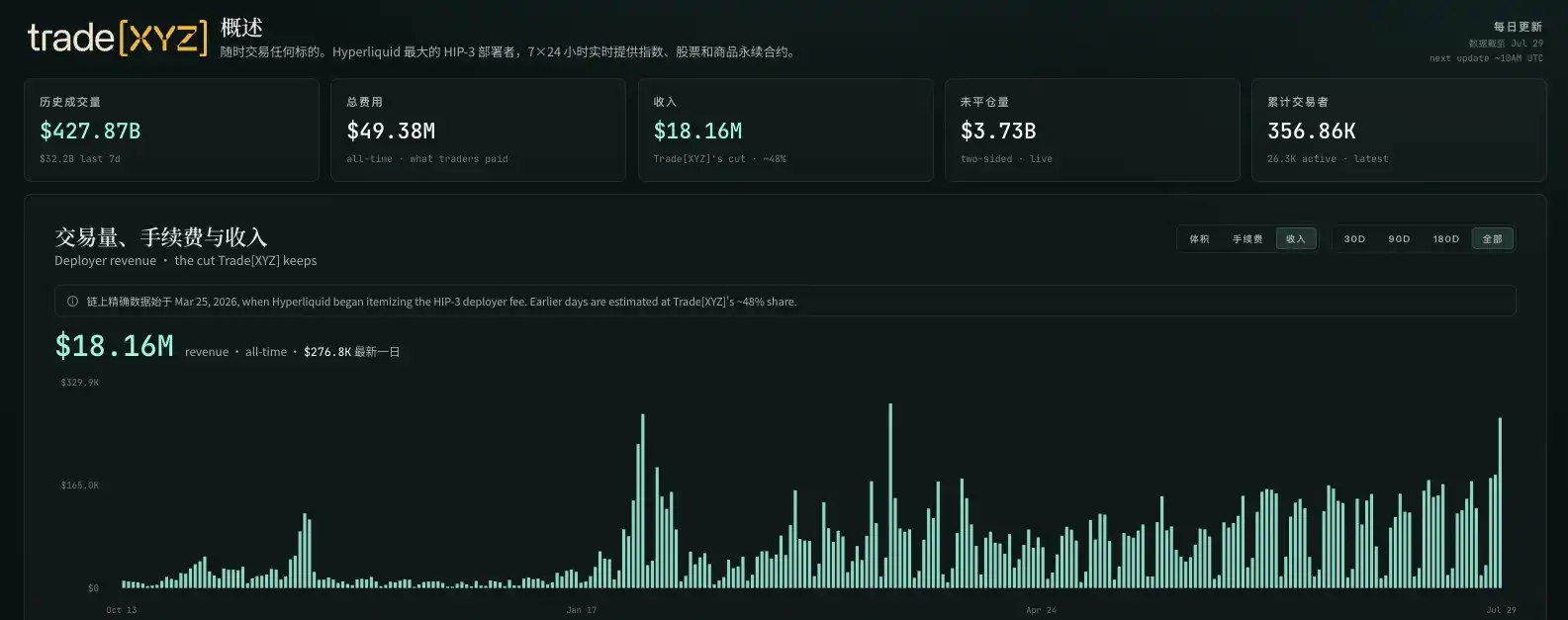
Fees Generated by TradeXYZ

It's hard to imagine that a project generating over $400 billion in trading volume has a total revenue that doesn't even reach one ten-thousandth of that volume. Handing over nearly half of its revenue is intolerable for most projects. Given TradeXYZ's current leverage and influence over Hyperliquid, it is entirely capable of negotiating with Hyperliquid to change the revenue split to 70/30 or higher. If an agreement cannot ultimately be reached, TradeXYZ could very well embark on the path of independence.

Why Wouldn't TradeXYZ Leave?

Of course, for TradeXYZ, independence is attractive, but there are also constraints.

The first constraint is Hyperliquid's powerful performance. TradXYZ's perpetual contracts are all deployed on Hyperliquid's HIP-3 platform. Their matching, order types, funds, liquidation, and auto-deleveraging are all managed by HyperCore. Technically, TradeXYZ manages only the oracle price, mark price, external price, and related components.

If TradXYZ chooses to become independent, they would need to assemble their own team to build the underlying infrastructure. This isn't a problem in itself, but constructing an L1 with performance as strong as Hyperliquid's in a short time is a challenge. Even TradeXYZ founder Shoku himself acknowledges the excellence of the Hyperliquid team. In March 2024, Shoku posted on X, saying he wasn't sure how large Hyperliquid as an L1 could ultimately become in terms of traditional metrics like TVL and trading volume, but he was completely certain that the quality and rigor of Hyperliquid's on-chain products and dApps would have no rivals across the entire crypto field.

These rivals, of course, include himself. If the infrastructure built by an independent TradXYZ cannot compete with Hyperliquid, it would negatively impact its product experience and the narrative of early price discovery ahead of traditional financial markets.

The second constraint is that channels and distribution are also crucial. Why is Circle willing to hand over over 50% of USDC's savings interest to Coinbase? The reason is that Coinbase has indeed made huge contributions to the market distribution and promotion of USDC. According to Coinbase's latest Q2 earnings report, over 30% of circulating USDC is stored on Coinbase. He who controls the channels and distribution controls everything, a rule that also applies between TradXYZ and Hyperliquid.

Essentially, Hyperliquid's frontend is just one interface for accessing TradeXYZ's liquidity market, but it's not the only way. Users can currently also access the TradXYZ liquidity market directly through the TradeXYZ official website, and the trading interface is highly similar to Hyperliquid's. To further facilitate users, TradeXYZ's internal accounts are even interoperable with Hyperliquid's, meaning connecting the same wallet on the TradeXYZ website allows direct use of any balance present on Hyperliquid.
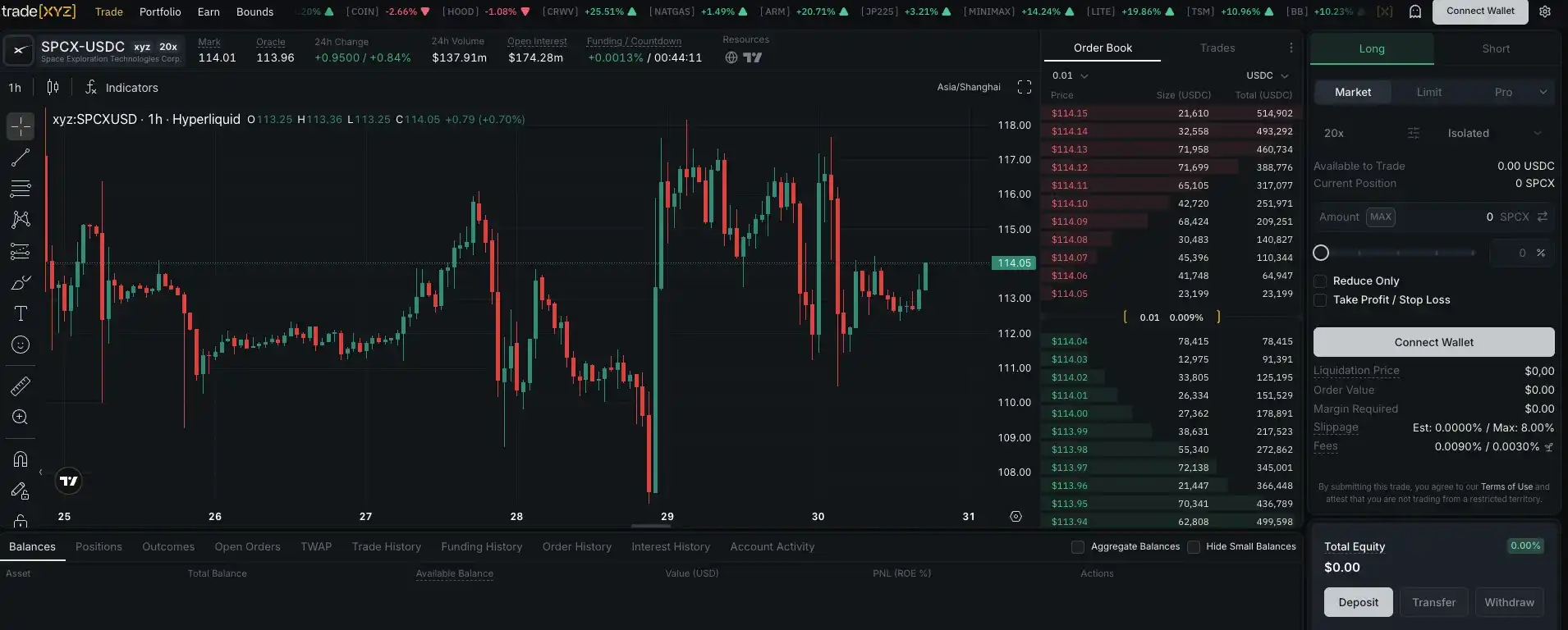
TradeXYZ's Own Trading Frontend

Even so, among TradeXYZ's over 350,000 trading users, most still access TradeXYZ's liquidity market through Hyperliquid's frontend. This is a usage habit cultivated over time among users and is not easy to change. There might even be a certain proportion of trading users who fundamentally don't understand the difference between TradeXYZ and Hyperliquid, trusting the Hyperliquid brand and passively choosing to trade TradeXYZ's products.

Therefore, Hyperliquid not only provides technical support for TradeXYZ but is also the primary channel for distributing TradeXYZ's liquidity. The cost and time of building infrastructure can be calculated, but the value of losing a channel cannot be measured.

The third constraint is the mutual trust and longstanding rapport between the founders of the two projects. Solana's well-known KOL Ansem believes the possibility of TradeXYZ going independent is almost zero, reasoning that tradexyz and Hyperliquid are the most compatible two teams in the cryptocurrency space. "The two founders are completely devoid of greed and are both very intelligent. I believe they can choose a development path that is most beneficial for both teams."

This view holds merit. Shoku was one of the earliest investors to bet on Hyperliquid. As early as 2023, Shoku connected with Jeff and began contributing to the Hyperliquid ecosystem. In 2024, he developed Unit, Hyperliquid's Bitcoin cross-chain bridge. He once confided to friends that Hyperliquid was one of the few exciting things in the crypto world. (Related reading:TradeXYZ's Mysterious Founder Shoku: A Man Forever Searching for Asymmetric Opportunities)

All signs indicate that Shoku greatly admires Hyperliquid and Jeff. From a human relationship perspective, the likelihood of a "backstab" is relatively low.

If TradeXYZ Goes Independent, The Result Would Be Lose-Lose

If we are to discuss this topic thoroughly, this article should not end here. We should also discuss an extremely low-probability event: if TradeXYZ truly does break away from Hyperliquid and become independent, what would the outcome be? The conclusion I've derived is a lose-lose situation.

Because in the current state, TradeXYZ and Hyperliquid are in a win-win situation. If TradeXYZ splits off, the immense uncertainty would bring harm to both sides. After TradeXYZ becomes independent, Hyperliquid could certainly support other participants in the HIP-3 market, but its relationship with TradeXYZ would shift from collaborators to competitors. This wouldn't significantly impact Hyperliquid's revenue, as over 70% of Hyperliquid's main revenue still comes from the core Perp market, with the HIP-3 market being only a smaller part. The biggest impact would be on its valuation.

First, after TradeXYZ migrates, Hyperliquid's total trading volume would decrease by over 50%, and HYPE's price might also be halved. This is because Hyperliquid would no longer be the leading on-chain RWA perpetual contract trading platform; it would be redefined as a crypto derivatives trading platform that has lost its biggest growth driver and narrative foundation.

TradeXYZ itself wouldn't fare much better. Infrastructure and user habits would need to be cultivated from scratch. The performance and channel constraints mentioned earlier would become major hindrances to TradeXYZ's development. Moreover, such a backstabbing act could very likely spark public controversy, further damaging TradeXYZ's credibility.

Additionally, TradeXYZ and Hyperliquid are not just competing with each other; the entire RWA trading market has other competitors. "When the snipe and the clam grapple, the fisherman profits." Hyperliquid would need time to cultivate new HIP-3 markets, and TradeXYZ would need time to build its infrastructure. By the time they look back, the market gap would likely already be filled by other competitors.

In summary, although TradeXYZ is becoming increasingly important to Hyperliquid, going independent is clearly irrational. Even if TradeXYZ wants to increase its profitability, the best approach might be to gradually shift focus to its own distribution and user ownership while preserving the existing integration advantages with Hyperliquid.


Tiền kỹ thuật số thịnh hành

Câu hỏi Liên quan

QWhat is the main reason why the crypto community is debating whether TradeXYZ might leave Hyperliquid?

AThe discussion stems from TradeXYZ's growing dominance and influence within the Hyperliquid ecosystem. It accounts for over 90% of the volume on Hyperliquid's HIP-3 market, which now represents a majority of Hyperliquid's total volume. This shift in value contribution and bargaining power has led to speculation about a potential power imbalance and the possibility of TradeXYZ seeking independence.

QAccording to the article, what is the primary business incentive that could drive TradeXYZ to build its own platform?

AThe primary business incentive is to capture the underlying transaction fees. Currently, TradeXYZ and Hyperliquid split fees from HIP-3 trades 50/50. With TradeXYZ generating nearly $5000 million in fees but only receiving half, the potential to retain all or a larger portion of this revenue by controlling its own infrastructure is a strong financial motivator.

QWhat are the main arguments against TradeXYZ leaving Hyperliquid, as presented in the article?

AThree main arguments are presented: 1) Technical Performance: Hyperliquid's high-performance infrastructure (HyperCore) would be difficult and time-consuming to replicate, potentially harming TradeXYZ's product experience. 2) Distribution & User Habit: Hyperliquid's front-end is the primary channel for users to access TradeXYZ's markets, and changing established user habits is challenging. 3) Founder Relationship: The founders have a history of mutual trust and admiration, making a hostile 'betrayal' less likely from a personal perspective.

QIf TradeXYZ did leave Hyperliquid, what is the predicted outcome for both parties, according to the article's analysis?

AThe article predicts a 'lose-lose' or double-loss scenario. Hyperliquid would lose its status as the leading RWA perpetuals platform, face a significant drop in total volume and potentially its token (HYPE) price, and see its growth narrative weakened. TradeXYZ would struggle with building new infrastructure, losing its primary user distribution channel, facing reputational damage, and potentially losing market share to other competitors during the transition period.

QWhat alternative path does the article suggest for TradeXYZ to increase its profitability without fully leaving Hyperliquid?

AThe article suggests that the best path for TradeXYZ to increase profitability is not a full separation. Instead, it should focus on gradually shifting its emphasis to its own token issuance and user ownership models, while preserving the existing integration and advantages of its partnership with Hyperliquid.

Nội dung Liên quan

Bitcoin trong tháng Tám: Các chuyên gia kỳ vọng thử nghiệm phạm vi, không phải đảo chiều nhanh chóng

Tháng 8 sẽ là thời điểm thử nghiệm các mức giá then chốt đối với Bitcoin hơn là một bước ngoặt tăng mạnh, theo đánh giá của nhiều chuyên gia. Dù phục hồi vào tháng 7, thị trường vẫn chưa sẵn sàng cho một đà tăng bền vững và nguy cơ giảm xuống dưới 60.000 USD vẫn tồn tại. Các nhà phân tích chỉ ra áp lực từ môi trường vĩ mô như lãi suất cao, lạm phát dai dẳng và đồng USD mạnh, khiến dòng vốn chảy vào tài sản rủi ro như tiền mã hóa bị hạn chế. Dòng tiền ròng ra khỏi các ETF Bitcoin trong nửa đầu năm cũng phản ánh tâm lý thận trọng này. Về mặt kỹ thuật, Bitcoin được dự báo sẽ tiếp tục dao động trong phạm vi, với ba kịch bản chính cho tháng 8: dao động chính trong khoảng 58.000-68.000 USD (xác suất 50%), giảm về 50.000-55.000 USD (30%), hoặc tăng lên 71.000-75.000 USD (20%). Mức hỗ trợ then chốt là quanh 60.000-61.000 USD. Các chuyên gia khuyến nghị nhà đầu tư có thể tích lũy dần ở các mức giá hiện tại cho dài hạn, nhưng cần thận trọng trước khả năng biến động ngắn hạn và ưu tiên các đồng coin mạnh thay vì meme coin. Sự bứt phá mạnh mẽ hơn có thể chỉ xuất hiện vào quý IV/2025.

cryptonews.ru10 phút trước

Bitcoin trong tháng Tám: Các chuyên gia kỳ vọng thử nghiệm phạm vi, không phải đảo chiều nhanh chóng

cryptonews.ru10 phút trước

Ví cứng Coldcard bị hack: Tin tặc rút 594 Bitcoin trong 25 phút

Ví phần cứng Coldcard bị xâm phạm: Lỗi phần mềm nghiêm trọng dẫn đến mất 594 BTC Ví phần cứng Coldcard của Coinkite, vốn được coi là phương pháp lưu trữ tiền điện tử an toàn nhất, đã bị xâm phạm nghiêm trọng vào ngày 30/7/2026. Tin tặc đã rút 594,5 Bitcoin (khoảng 40 triệu USD) từ hàng trăm địa chỉ chỉ trong 25 phút. Nguyên nhân chính là một lỗi phần mềm tồn tại suốt 5 năm mà không bị phát hiện. Một lỗi đánh máy trong mã nguồn từ tháng 3/2021 đã vô hiệu hóa chức năng tạo số ngẫu nhiên thực sự từ chip chuyên dụng của thiết bị. Thay vào đó, ví tạo ra seed phrase (cụm từ khôi phục) dựa trên dữ liệu có thể dự đoán được như số sê-ri CPU và thời gian hệ thống. Điều này làm giảm nghiêm trọng độ an toàn mật mã, khiến không gian tìm kiếm khóa bị thu hẹp đáng kể (xuống còn khoảng 40-bit hoặc 72-bit thay vì 128-bit theo yêu cầu). Tin tặc không cần truy cập vật lý vào thiết bị. Họ đã tận dụng thông số của bộ tạo số kém an toàn này để tạo ra hàng triệu seed phrase có thể có, sau đó kiểm tra chống với sổ cái công khai blockchain để tìm địa chỉ có số dư và ký các giao dịch chuyển tiền. Coinkite thừa nhận lỗi và xác nhận tất cả các thiết bị chạy firmware bị ảnh hưởng đều dễ bị tấn công. Công ty đã phát hành các bản cập nhật firmware an toàn mới. Tuy nhiên, việc cập nhật đơn thuần không bảo vệ seed phrase đã được tạo ra trước đó. Chủ sở hữu cần: 1. Cập nhật firmware lên phiên bản an toàn. 2. Tạo một seed phrase mới HOÀN TOÀN trên thiết bị đã được cập nhật. 3. Chuyển toàn bộ số tiền sang các địa chỉ mới được tạo từ seed phrase mới này. Sự việc này nhấn mạnh rằng ngay cả phần cứng chuyên dụng cũng cần được kiểm tra và đánh giá mã nguồn độc lập một cách liên tục, đặc biệt là các chức năng mật mã cốt lõi.

cryptonews.ru11 phút trước

Ví cứng Coldcard bị hack: Tin tặc rút 594 Bitcoin trong 25 phút

cryptonews.ru11 phút trước

Tether (USDT) công bố kết quả tài chính dự kiến cho quý II! Đây là tình hình và tài sản hiện tại của họ

Tether, công ty phát hành stablecoin lớn nhất thế giới, đã công bố báo cáo tài chính cho quý 2 năm 2026. Theo báo cáo được kiểm toán độc lập bởi BDO, lợi nhuận hoạt động ròng của công ty trong quý đạt khoảng 1,5 tỷ USD, với mức tài sản vượt trội so với nợ phải trả là 4,11 tỷ USD. Tính đến ngày 30/6/2026, lượng USDT đang lưu hành đạt khoảng 184,6 tỷ USD, tăng khoảng 446 triệu USD so với cuối quý 1 và chiếm hơn 60% thị phần stablecoin toàn cầu. Phần lớn lợi nhuận đến từ trái phiếu kho bạc Hoa Kỳ và các thỏa thuận mua lại. Tổng tài sản của Tether là khoảng 187,75 tỷ USD, trong khi tổng nợ phải trả là 183,64 tỷ USD, chủ yếu là nghĩa vụ từ các token số đã phát hành. Công ty đã giảm 15% (khoảng 2,38 tỷ USD) tỷ trọng cho vay thế chấp và tăng thêm 14 tấn dự trữ vàng vật chất, nâng tổng lượng vàng lên hơn 146 tấn. Tether tiếp tục là một trong những tổ chức nắm giữ trái phiếu kho bạc Hoa Kỳ lớn nhất và cho biết đã có thêm hơn 30 triệu người dùng mới trong quý. CEO Paolo Ardoino nhấn mạnh rằng USDT vẫn được đảm bảo đầy đủ bởi dự trữ, bất chấp biến động trên thị trường vàng và Bitcoin. Công ty cũng đang trải qua một cuộc kiểm toán độc lập toàn diện từ một trong bốn hãng kiểm toán lớn nhất thế giới.

cryptonews.ru52 phút trước

Tether (USDT) công bố kết quả tài chính dự kiến cho quý II! Đây là tình hình và tài sản hiện tại của họ

cryptonews.ru52 phút trước

Circle đạt được cột mốc quan trọng trong lĩnh vực quy định, nhận được giấy phép hoạt động ủy thác từ Bộ Dịch vụ Tài chính Bang New York (NYDFS)

Công ty dịch vụ tài chính và stablecoin Circle đã đạt được một cột mốc quan trọng trong nỗ lực trở thành một trong những công ty được quản lý chặt chẽ nhất trong ngành công nghiệp tiền mã hóa. Công ty thông báo đã nhận được Điều lệ Ủy thác với Mục đích Hạn chế từ Sở Dịch vụ Tài chính Tiểu bang New York (NYDFS), cho phép mở rộng hoạt động tại tiểu bang này. Theo điều lệ mới, Circle có thể cung cấp dịch vụ lưu ký tài sản, phát hành stablecoin được tiểu bang phê duyệt và quản lý các khoản dự trữ hỗ trợ chúng. NYDFS đã đăng ký Circle Internet Trust Company với tư cách là một công ty ủy thác có phạm vi hoạt động hạn chế. Đây là loại giấy phép mà các công ty như Mastercard và Galaxy Digital cũng mới nhận được gần đây. Circle coi đây là sự xác nhận cam kết của họ với các tiêu chuẩn cao nhất về bảo mật, minh bạch và tuân thủ. Đồng sáng lập kiêm Giám đốc điều hành Jeremy Allaire nhấn mạnh rằng việc có được giấy phép này là một mục tiêu lâu dài của Circle, và NYDFS là cơ quan quản lý tiêu chuẩn toàn cầu về tài sản kỹ thuật số. Việc phê duyệt giấy phép này diễn ra sau khi Circle nhận được sự chấp thuận từ Văn phòng Kiểm soát Tiền tệ Hoa Kỳ (OCC) để thành lập Circle National Trust, đưa hoạt động phát hành stablecoin của công ty dưới sự giám sát của liên bang.

cryptonews.ru1 giờ trước

Circle đạt được cột mốc quan trọng trong lĩnh vực quy định, nhận được giấy phép hoạt động ủy thác từ Bộ Dịch vụ Tài chính Bang New York (NYDFS)

cryptonews.ru1 giờ trước

Tiền điện tử giảm giá: Bitcoin ở Nga có thể trở nên rẻ hơn thị trường thế giới

Kể từ ngày 1 tháng 9 năm 2026, luật về tiền mã hóa có hiệu lực tại Nga, thiết lập một môi trường giao dịch được cấp phép với các sàn giao dịch, công ty môi giới và kho lưu ký kỹ thuật số chính thức. Tuy nhiên, mô hình này có thể dẫn đến việc Bitcoin và các tài sản số khác được giao dịch trong khuôn khổ hợp pháp của Nga với mức chiết khấu so với giá thị trường toàn cầu. Nguyên nhân chính của mức chiết khấu này là rủi ro trừng phạt. Các tài sản đi qua cơ sở hạ tầng được cấp phép của Nga có thể bị các dịch vị chống rửa tiền (AML) đánh dấu rủi ro cao, khiến các sàn giao dịch nước ngoài không muốn chấp nhận chúng. Điều này làm giảm thanh khoản và khiến chủ sở hữu phải bán với giá thấp hơn. Ngoài ra, việc các thợ đào (miner) có thể bán coin nhiều hơn trong nước và các hạn chế trong việc rút tiền ra nước ngoài cũng gây áp lực giảm giá. Về lý thuyết, chênh lệch giá tạo cơ hội cho giao dịch chênh lệch giá (arbitrage): mua rẻ ở Nga và bán đắt ở nước ngoài. Tuy nhiên, trên thực tế, việc này gặp nhiều khó khăn. Các nhãn rủi ro gắn với địa chỉ ví và lịch sử giao dịch, không dễ dàng xóa bỏ. Việc sử dụng các dịch vụ "trộn" tiền (mixer) để che giấu nguồn tiền thậm chí còn làm tăng rủi ro và có thể dẫn đến việc bị từ chối giao dịch. Hơn nữa, các chi phí như phí trung gian, quy trình tuân thủ phức tạp và thời gian xác minh có thể làm xói mòn toàn bộ lợi nhuận tiềm năng. Do đó, thị trường Nga có thể hình thành một "vòng tròn" riêng biệt, nơi tiền mã hóa được giao dịch với mức chiết khấu, nhưng việc kiếm lời ổn định từ chênh lệch này là rất khó khăn, chủ yếu phù hợp với một số ít các tổ chức tài chính hiện có.

cryptonews.ru1 giờ trước

Tiền điện tử giảm giá: Bitcoin ở Nga có thể trở nên rẻ hơn thị trường thế giới

cryptonews.ru1 giờ trước

Giao dịch

Giao ngay

Bài viết Nổi bật

Làm thế nào để Mua T

Chào mừng bạn đến với HTX.com! Chúng tôi đã làm cho mua Threshold Network Token (T) trở nên đơn giản và thuận tiện. Làm theo hướng dẫn từng bước của chúng tôi để bắt đầu hành trình tiền kỹ thuật số của bạn.Bước 1: Tạo Tài khoản HTX của BạnSử dụng email hoặc số điện thoại của bạn để đăng ký tài khoản miễn phí trên HTX. Trải nghiệm hành trình đăng ký không rắc rối và mở khóa tất cả tính năng. Nhận Tài khoản của tôiBước 2: Truy cập Mua Crypto và Chọn Phương thức Thanh toán của BạnThẻ Tín dụng/Ghi nợ: Sử dụng Visa hoặc Mastercard của bạn để mua Threshold Network Token (T) ngay lập tức.Số dư: Sử dụng tiền từ số dư tài khoản HTX của bạn để giao dịch liền mạch.Bên thứ ba: Chúng tôi đã thêm những phương thức thanh toán phổ biến như Google Pay và Apple Pay để nâng cao sự tiện lợi.P2P: Giao dịch trực tiếp với người dùng khác trên HTX.Thị trường mua bán phi tập trung (OTC): Chúng tôi cung cấp những dịch vụ được thiết kế riêng và tỷ giá hối đoái cạnh tranh cho nhà giao dịch.Bước 3: Lưu trữ Threshold Network Token (T) của BạnSau khi mua Threshold Network Token (T), lưu trữ trong tài khoản HTX của bạn. Ngoài ra, bạn có thể gửi đi nơi khác qua chuyển khoản blockchain hoặc sử dụng để giao dịch những tiền kỹ thuật số khác.Bước 4: Giao dịch Threshold Network Token (T)Giao dịch Threshold Network Token (T) dễ dàng trên thị trường giao ngay của HTX. Chỉ cần truy cập vào tài khoản của bạn, chọn cặp giao dịch, thực hiện giao dịch và theo dõi trong thời gian thực. Chúng tôi cung cấp trải nghiệm thân thiện với người dùng cho cả người mới bắt đầu và người giao dịch dày dạn kinh nghiệm.

Tổng lượt xem 625Xuất bản vào 2024.12.13Cập nhật vào 2026.06.02

Làm thế nào để Mua T

Thảo luận

Chào mừng đến với Cộng đồng HTX. Tại đây, bạn có thể được thông báo về những phát triển nền tảng mới nhất và có quyền truy cập vào thông tin chuyên sâu về thị trường. Ý kiến ​​của người dùng về giá của T (T) được trình bày dưới đây.

活动图片