Stock Trading Has Become 'Crypto Trading', Welcome Back to the Native Home

marsbitXuất bản vào 2026-07-30Cập nhật gần nhất vào 2026-07-30

Tóm tắt

"Stock Trading Becomes 'Coin Trading': A Market's Bizarre Reversal" The global stock market, particularly in tech sectors, is undergoing a radical transformation, increasingly mirroring the volatile, narrative-driven mechanics of the cryptocurrency world. This shift was starkly illustrated by the dramatic crash of South Korea's KOSPI index in July 2026, where leveraged ETFs tied to stocks like SK Hynix triggered massive, rapid liquidations, devastating hundreds of thousands of retail investors, many of them young. This "crypto-fication" of equities began as disillusioned cryptocurrency traders migrated to stock markets, bringing with them their speculative playbook: chasing high-beta narratives like AI and semiconductor cycles, relying on social media for investment cues, and employing heavy leverage. Ironically, while these traders sought the perceived safety of stocks with fundamentals, their methods turned parts of the equity market—especially in Korea, the US, and Japan—into arenas of extreme speculation. Stocks like SK Hynix experienced price collapses ("halving") in just over a month, a pace even faster than Bitcoin's historical crashes. The core of this change is the primacy of narrative over traditional valuation. Complex company analysis is reduced to viral slogans about AI's infinite demand, driving concentrated inflows into thematic sectors. This is amplified by leverage, particularly through risky single-stock leveraged ETFs, which create vicious cycles of forc...

Author: Dou Wan Le

July 13, 2026, Seoul.

The Korea Composite Stock Price Index (KOSPI) plummeted 8.95% in a single day, triggering its 7th trading halt of the year. SK Hynix, seen by Koreans as a "national destiny stock," plunged 15.37%, a drop not seen in nearly two decades. Samsung Electronics also fell over 10%.

Over 1.2 million leveraged accounts received margin calls, with broker systems automatically liquidating between 320,000 to 460,000 accounts. Even more heartbreaking, 62% of those wiped out were young people aged 20 to 30. Some lost their down payment for a home, others traded with borrowed money...

A man in his 20s in Busan, after losing money following a stock YouTuber's recommendation, stabbed the influencer with a knife.

In the past, these descriptions would likely have been used for scenes after a crypto market crash. Now, they are being reenacted in the markets of South Korea, the United States, and Japan following the tech stock downturn.

Sharp rises and falls are just the surface. What's truly changing is the pricing method: narrative outweighs valuation, leverage amplifies sentiment, and social media rapidly pushes consensus to extremes.

Global stock markets, especially tech stocks, are becoming more and more like the crypto sphere.

Returning to the Native Home

"Welcome back to the native home."

After the crash, crypto traders who had switched to stocks wrote numerous posts about their losses. Comments like the above were everywhere.
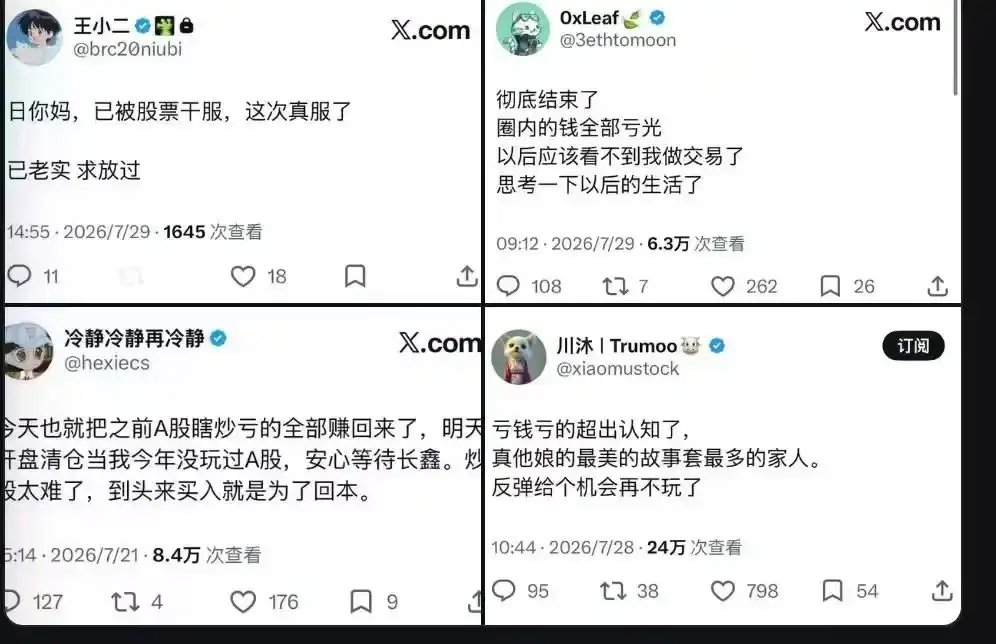
This "native home" refers to cryptocurrency. From the second half of 2025 to early 2026, a grand "departure from the native home" unfolded in the crypto world.

A group of KOLs and veterans who had been in the crypto market for years began losing confidence. Bitcoin was range-bound with low trading volume, meme coins were repeatedly harvested. Many felt "the scene is boring" and started turning their attention to US stocks.

This choice seemed very reasonable.

Stocks have revenue, profits, financial reports, and SEC regulation. Compared to crypto projects lacking cash flow and relying entirely on consensus pricing, US stocks at least seemed like a more mature, safer asset class.

The traders brought not just liquidity, but also their trading methods.

In the crypto market, they were accustomed to chasing new narratives, seeking high-volatility targets, using leverage, and rapidly switching positions based on social media sentiment. Entering the stock market, this method barely changed; only the trading objects switched from tokens to AI, memory chips, and leveraged ETFs, repeatedly achieving significant results.

Memory stocks quickly became the new collective consensus.

The logic wasn't complex: AI servers require more High Bandwidth Memory (HBM), supply can't meet demand, memory prices rise, so Micron, Samsung Electronics, and SK Hynix naturally become the most direct "shovel sellers." The phrase "there's never enough memory" became deeply ingrained.

Many crypto KOLs transformed, starting to talk about US stocks, memory cycles, and AI capital expenditures. Products like 2x leveraged ETFs on SK Hynix were also treated as "more efficient" betting tools than ordinary stocks.

Until the market reversed in July.

Bitcoin Becomes the "Low-Volatility Asset"

How long does it take to fall from peak to half?

Bitcoin took 268 days. Silver took 169 days for a similar magnitude of decline.

In contrast, SanDisk fell about 55% in just 36 days. SK Hynix fell about 53% in just 34 days.

Similarly "halving," Bitcoin took nearly nine months, while memory stocks took just over one month.
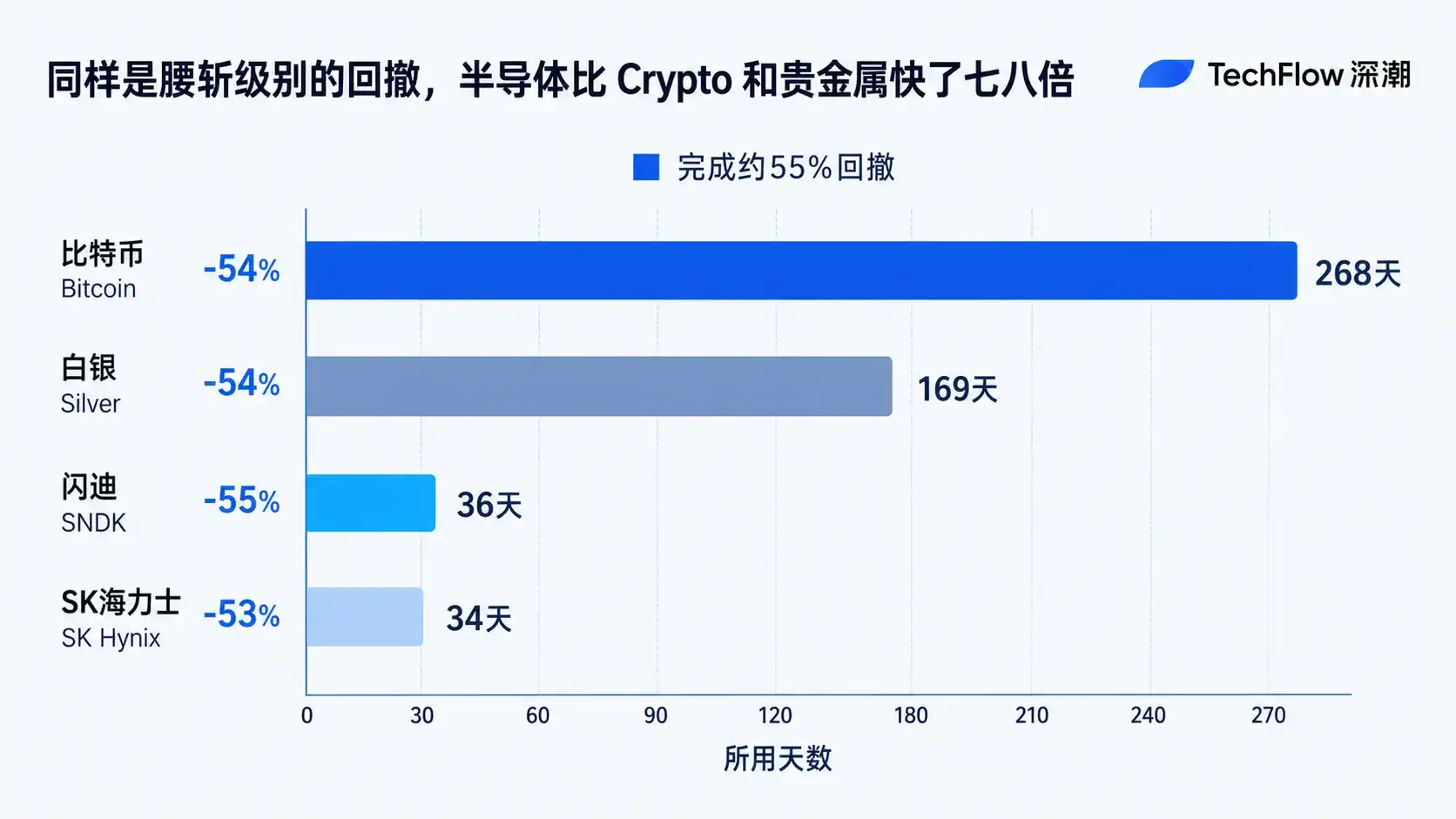
This is the perverse nature of this market cycle: In the past, investors worried Bitcoin would skyrocket or crash in days, while stocks adjusted slowly based on earnings and valuation. Now, some tech stocks are completing a full bubble burst in a shorter time than cryptocurrencies.

It's very counterintuitive. Compared to some tech stocks, Bitcoin is becoming relatively stable.

Charles Schwab statistics show Bitcoin's historical volatility in 2025 was about 42%, with a maximum drawdown of about 32%. Tesla's volatility in the same period was about 63% with a max drawdown of 48%, while Nvidia's volatility was about 50% with a max drawdown of 37%.

Bitcoin remains a high-risk asset, it's just that some large-cap tech stocks are even more volatile.

Bitwise even predicted in its 2026 outlook that Bitcoin's overall volatility might continue to be lower than Nvidia's.

So the current situation is quite absurd: Bitcoin is becoming more like tech stocks, while tech stocks are becoming more like Bitcoin.

When Narrative Becomes the Valuation Anchor

An old saying in crypto: Trading crypto is trading narratives.

In 2026, global tech stocks are turning this into reality.

AI is certainly not hot air. Nvidia, Microsoft, Google, and major cloud companies have real revenue and are investing real money building data centers.

But between "AI will indeed create value" and "any company associated with AI is worth buying at any price," there is a long road.

At the peak of the frenzy, the market simply skipped this road.

AI servers, optical modules, memory chips, data centers, power equipment, even nuclear energy companies—as long as they could be placed in the AI industrial chain, their stock prices could soar rapidly. Businesses were still in planning, orders not yet landed, but the market would price them based on the best-case scenario years in advance.

Korea's story was "AI semiconductors are tied to national destiny." As KOSPI kept hitting new highs, more families started opening stock accounts for their minor children, gifting them popular stocks like Samsung and SK Hynix as long-term presents.

A similar concentration appeared in the A-share market. In the first half of 2026, the TMT sector's market cap reached 41.78 trillion yuan, about 31.45% of the total A-share market cap; on some trading days, tech sector turnover once approached half of the entire market.

The US market long revolved around pricing a few large tech companies. When index gains rely increasingly on a handful of firms, when funds, options, and retail investors flood into the same stocks, seemingly diversified portfolios are actually betting on the same AI story.

This resembles the old crypto scene. Dogecoin's surge in 2021 wasn't due to technical breakthroughs, but because Elon Musk tweeted. The 2026 tech stock surge wasn't because all companies had explosive earnings, but because ChatGPT made everyone believe "AI will rewrite everything."

Narratives can dominate the market so quickly, also thanks to changes in dissemination methods.

In the past, stock information came mainly from financial reports, research reports, and institutional roadshows. Today, more people make investment decisions based on YouTube, X (Twitter), short videos, and paid communities.

Complex company research is compressed into a few phrases: Time will prove computing power and optical modules, AI computing power will never be enough...

Social media algorithms don't reward caution; overnight riches are always the traffic password: someone doubled their money overnight with options, an office worker achieved financial freedom by heavily investing in memory stocks, someone earned years of salary in months with leveraged ETFs.

Charts are the best advertising. Many mothers and aunts started investing their private savings, even selling properties to trade stocks, just like students dropping out to all-in on Web3 years ago...

Leverage Carnival

The most terrifying thing in crypto isn't volatility; it's the deadly combination of leverage plus volatility. In 2026, global stock markets are perfectly replicating it.

On May 27, 2026, the Korea Exchange approved the listing of 16 single-stock 2x leveraged ETFs, tracking Samsung Electronics and SK Hynix.

Retail investors went crazy. From approval to mid-July, Korean retail investors net purchased 14 trillion won (about 64 billion RMB) worth of these single-stock leveraged ETFs, while foreign investors bought only about 2 trillion won.

These ETFs have several fatal designs.

Such products rebalance daily. The more volatile the swings, the more severe the NAV erosion. If a stock first falls 10%, then rises 11.1%, the price returns to its origin. The corresponding 2x leveraged product would first fall 20%, then rise 22.2%, ultimately still losing about 2.2%.

During rapid declines, the problem is worse.

To maintain target leverage, the product must passively reduce risk exposure after a drop. Selling further depresses the underlying price, which triggers more de-leveraging, stop-losses, and margin pressure.

Goldman Sachs later noted that the "rapid de-leveraging" of these products was the main cause of KOSPI's intraday abnormal volatility, with 62% of institutional net selling coming from ETF-related liquidations.

Two months later, Korean regulators urgently halted all new single-stock leveraged ETF listings, significantly raising the minimum margin requirement from 10 million won to 30 million won, and only accepting cash.

But it was too late. 2.3 trillion won in forced liquidation amount, the wealth of hundreds of thousands of families vanished into thin air.

Even the deepest global market, the US stock market, is experiencing the backlash of leverage.

J.P. Morgan analysts recently pointed out that US stocks still have "de-leveraging space," needing three months to return to pre-April levels.

The ratio of memory chip stock leveraged ETF size to underlying market cap is three times the average of all stock ETFs. Even for broad leveraged stock index ETFs, their ratios are at historically high levels.

A Regression

"Stock markets turning crypto-like" doesn't mean stocks have become identical to cryptocurrencies.

Stocks still have companies, assets, revenue, and cash flow behind them, along with financial disclosure, auditing, and regulation. Even when market sentiment fades, a truly profitable company still has calculable value.

What's truly changing is the trading layer.

In the past, people bought a company's future profits. Now, more and more people are trading the hype of a theme.

The crypto-ification of stock markets is essentially a revolution of de-rationalization.

Traditional stock markets look at P/E, cash flow; crypto-ified stock markets look at narrative, imagination. Traditional stock volatility of 20% is considered high; crypto-ified stock markets see individual stock daily swings of 10% to 15% as normal.

Traditional stock leverage via margin financing; crypto-ified stock markets via ETFs, derivatives, quantitative strategies. Traditional stock information from research reports, financial statements; crypto-ified stock markets from Twitter, YouTubers, communities. Traditional markets have institutional rational pricing; crypto-ified markets have institutions acting like retail, quant funds chasing momentum...

What's even more laughable is that now Bitcoin is striving to become more like stocks, through ETFs, institutionalization, declining volatility, gradually gaining mainstream financial acceptance.

It's a surreal intersection.

Those who moved from crypto to stocks eventually found they never left their "native home"—it's the same mechanism repeating: grand stories, crowded trades, easily accessible leverage, and everyone believing they can exit before everyone else.

The sentence written by a Korean retail investor on a trading forum is worth remembering: I want to go back to the days before I traded stocks, give me my money back.

But the market never issues refunds.

Tiền kỹ thuật số thịnh hành

Câu hỏi Liên quan

QWhat is the core argument of the article regarding the relationship between the stock market and cryptocurrency markets?

AThe article argues that global stock markets, particularly in tech stocks, are becoming increasingly similar to the cryptocurrency market ('币圈化'). This is characterized by narrative-driven valuations, high volatility, amplified by leverage, and rapid consensus formation via social media, while Bitcoin itself is becoming relatively more stable.

QWhat does 'returning to the native family' refer to in the context of the article?

A'Returning to the native family' is a phrase used by cryptocurrency traders who moved to the stock market, only to experience severe losses similar to those in crypto. It refers to the cryptocurrency market itself, suggesting their trading experience in the volatile 2026 stock market felt like coming back to their risky, high-volatility 'home' (crypto).

QAccording to the article, what paradoxical development is noted about Bitcoin's volatility compared to some tech stocks?

AThe article notes a paradox: historically volatile Bitcoin is now exhibiting lower historical volatility and smaller maximum drawdowns than certain major tech stocks like Tesla and Nvidia. It states that compared to some tech stocks, Bitcoin is becoming a relatively stable asset.

QHow did leveraged ETFs contribute to the market crash in South Korea as described in the article?

ALeveraged ETFs on individual stocks like Samsung and SK Hynix, popular with Korean retail investors, amplified the crash. Their daily rebalancing mechanism caused significant volatility decay and forced selling during price drops. This selling pressure further depressed stock prices, triggering more liquidations and margin calls, creating a vicious cycle that exacerbated the market decline.

QWhat does the article identify as the key change in the 'trading layer' of stocks during this '币圈化' (crypto-ization) process?

AThe key change in the trading layer is a shift from valuing companies based on future profits, fundamentals (PE, cash flow), and institutional research to trading based on narratives, thematic hype, social media sentiment, and the use of complex leverage tools like derivatives and ETFs, mirroring crypto trading behaviors.

Nội dung Liên quan

Bitcoin đã chạm đáy, hay một 'cơn lốc' đang đến gần? Tình hình của XRP ra sao?

Nền tảng phân tích tiền mã hóa Santiment vừa chia sẻ những tín hiệu quan trọng về thị trường Bitcoin và altcoin. Phân tích cho thấy chỉ số MVRV (Market Value – Realized Value) 365 ngày của Bitcoin đã giảm xuống -26%, cho thấy các nhà đầu tư dài hạn đang chịu lỗ đáng kể. Mức MVRV âm sâu như vậy từng xuất hiện trong các đáy thị trường trước đây, báo hiệu khả năng tạo đáy và cơ hội mua vào dài hạn. Dữ liệu chuỗi khối cho thấy các "cá voi" (ví từ 10-10.000 BTC) đang tích lũy thêm khoảng 18.500 BTC trong 10 ngày qua. Trong khi đó, các nhà đầu tư nhỏ lẻ vẫn mua vào khi giá giảm, nhưng hành vi này đôi khi có thể dẫn đến rủi ro điều chỉnh hoặc "shaking" thị trường. Thị trường altcoin có diễn biến trái chiều. Ethereum có MVRV 365 ngày khoảng -33%, nhưng sự phục hồi gần đây kèm theo tâm lý quá lạc quan trên mạng xã hội có thể dẫn đến điều chỉnh ngắn hạn. XRP đang trong vùng quá bán với MVRV 30 ngày là -57,5% và MVRV 365 ngày là -45,5%, báo hiệu khả năng phục hồi mạnh trong trung và dài hạn. Solana được thảo luận tích cực, trong khi Cardano có tâm lý ổn định hơn. Triển vọng của Bitcoin và altcoin chịu ảnh hưởng bởi các yếu tố vĩ mô và pháp lý, như quyết định lãi suất của Cục Dự trữ Liên bang Mỹ (Fed) và quá trình thông qua Dự luật Rõ ràng tại Quốc hội Mỹ, có thể làm tăng biến động thị trường.

cryptonews.ru1 giờ trước

Bitcoin đã chạm đáy, hay một 'cơn lốc' đang đến gần? Tình hình của XRP ra sao?

cryptonews.ru1 giờ trước

Tin đồn lan truyền về altcoin: Cựu nhân viên lên tiếng về vấn đề này

Theo báo cáo từ Sandmark, nền tảng memecoin Pump.fun trên Solana đã bắt đầu sa thải nhân viên khoảng hai tháng trước thời điểm token $PUMP của họ được mở khóa. Ít nhất một cựu nhân viên bị tước quyền nhận token, với giá trị ước tính hơn 1 triệu USD theo thời giá hiện tại. Các tài liệu nội bộ cho thấy công ty chấm dứt hợp đồng với một số nhân viên vào đầu tháng 4, với lý do "phát triển quá nhanh". Nhân viên bị sa thải được đề nghị trợ cấp thôi việc, nhưng thiệt hại chính nằm ở việc mất quyền nhận token $PUMP theo thỏa thuận phân bổ ký năm 2025. Một nhân viên sa thải tháng 4 đã mất lượng token trị giá bảy con số. Một đợt sa thải thứ hai diễn ra vào giữa tháng 7, với cáo buộc rằng một số người bị sa thải chỉ một ngày trước khi token được mở khóa. Tổng số nhân viên bị sa thải trong hai tháng được cho là vượt quá 40 người. Các đồng sáng lập Pump.fun không đưa ra bình luận. Pump.fun, nền tảng tạo memecoin hàng đầu, đã tạo hơn 20,8 triệu token và có tổng doanh thu ước đạt 1,3 tỷ USD. Công ty dự kiến tăng quy mô nhân sự lên khoảng 100 người vào đầu năm 2026.

cryptonews.ru1 giờ trước

Tin đồn lan truyền về altcoin: Cựu nhân viên lên tiếng về vấn đề này

cryptonews.ru1 giờ trước

Trên Ethereum, hàng chờ stake đã hình thành với thời gian chờ 43 ngày: nhưng theo một chuyên gia, đây không phải là tín hiệu tăng giá thực sự

Số lượng người xác thực muốn đặt cọc token trong mạng Ethereum đã tăng mạnh, tạo ra hàng chờ kích hoạt khoảng 2,5 triệu ETH. Do tắc nghẽn hiện tại, người tham gia đặt cọc mới phải chờ khoảng 43 ngày. Tuy nhiên, Thomas Brunner từ Sygnum Bank cho rằng thời gian chờ dài này không phải là tín hiệu trực tiếp cho thấy xu hướng tăng giá mạnh. Ông giải thích rằng hàng chờ không chỉ phản ánh nhu cầu thể chế mà còn bị ảnh hưởng bởi các đặc điểm kỹ thuật của giao thức Ethereum, như giới hạn thông lượng hàng ngày sau bản cập nhật Dencun. Một phần lượng ETH trong hàng chờ là do phân bổ lại, bổ sung vào các trình xác thực hiện có và quá trình lãi kép. Brunner nêu bật rằng tín hiệu thị trường mạnh hơn là hàng chờ rút tiền gần như trống, cho thấy những người tham gia hiện tại đang tiếp tục giữ vị thế của họ. Ông nhấn mạnh sự tin tưởng thực sự này. Hiện có khoảng 41,2 triệu ETH được đặt cọc, tương đương 33,8% tổng nguồn cung lưu hành. Dù giá ETH giảm, các nhà đầu tư thể chế vẫn không từ bỏ việc đặt cọc, coi đó là đặc điểm cơ bản của Ethereum. Tuy nhiên, vấn đề riêng tư vẫn là rào cản chính vì các địa chỉ và giao dịch liên quan đến đặt cọc có thể bị theo dõi trên blockchain, khiến các thể chế thận trọng khi mở rộng hoạt động.

cryptonews.ru3 giờ trước

Trên Ethereum, hàng chờ stake đã hình thành với thời gian chờ 43 ngày: nhưng theo một chuyên gia, đây không phải là tín hiệu tăng giá thực sự

cryptonews.ru3 giờ trước

Ngân hàng Trung ương Hàn Quốc công bố kết quả thử nghiệm tiền gửi token hóa

Ngân hàng Trung ương Hàn Quốc (BOK) đã công bố kết quả thử nghiệm dự án tiền gửi được mã hóa (tokenized deposits) với sự tham gia của 28 ngân hàng trung ương và tổ chức tài chính quốc tế. Các ngân hàng Hàn Quốc tham gia gồm KB Kookmin Bank, NH NongHyup Bank, Shinhan Bank, Woori Bank và Hana Bank. Toàn bộ quy trình, từ lệnh thanh toán đến quyết toán cuối cùng, chỉ mất trung bình 1 phút 20 giây. Trong đợt thử nghiệm, 30 giao dịch đã được thực hiện theo 17 kịch bản khác nhau, bao gồm chuyển tiền doanh nghiệp và liên ngân hàng, với 6 loại tiền tệ như won Hàn Quốc, USD và euro. Tổng giá trị giao dịch đạt khoảng 995.000 USD. Nền tảng hoạt động ổn định, cho phép thanh toán nhanh chóng, minh bạch ngay cả trong môi trường kết nối một phần với cơ sở hạ tầng ngân hàng hiện có. BOK cũng đã thử nghiệm chuyển khoản nội bộ 20 triệu won (13.890 USD) giữa NH NongHyup Bank và Shinhan Bank thông qua nền tảng Project Agora, có kết nối thử với nền tảng CBDC của BOK. Ngoài ra, KB Kookmin Bank và MUFG Bank của Nhật Bản đã hoàn tất thử nghiệm thanh toán bằng token tiền gửi. Đây là các chứng chỉ số do ngân hàng phát hành trong dự án thí điểm, không phải do ngân hàng trung ương phát hành trực tiếp. BOK dự định tiếp tục thử nghiệm loại hình thanh toán này. Năm ngoái, chính quyền Hàn Quốc cam kết siết chặt quy định đối với stablecoin dựa trên won, yêu cầu phải có sự cho phép của BOK và Ủy ban Dịch vụ Tài chính (FSC).

cryptonews.ru3 giờ trước

Ngân hàng Trung ương Hàn Quốc công bố kết quả thử nghiệm tiền gửi token hóa

cryptonews.ru3 giờ trước

Giao dịch

Giao ngay

Bài viết Nổi bật

Làm thế nào để Mua HOME

Chào mừng bạn đến với HTX.com! Chúng tôi đã làm cho mua Defi.app (HOME) trở nên đơn giản và thuận tiện. Làm theo hướng dẫn từng bước của chúng tôi để bắt đầu hành trình tiền kỹ thuật số của bạn.Bước 1: Tạo Tài khoản HTX của BạnSử dụng email hoặc số điện thoại của bạn để đăng ký tài khoản miễn phí trên HTX. Trải nghiệm hành trình đăng ký không rắc rối và mở khóa tất cả tính năng. Nhận Tài khoản của tôiBước 2: Truy cập Mua Crypto và Chọn Phương thức Thanh toán của BạnThẻ Tín dụng/Ghi nợ: Sử dụng Visa hoặc Mastercard của bạn để mua Defi.app (HOME) ngay lập tức.Số dư: Sử dụng tiền từ số dư tài khoản HTX của bạn để giao dịch liền mạch.Bên thứ ba: Chúng tôi đã thêm những phương thức thanh toán phổ biến như Google Pay và Apple Pay để nâng cao sự tiện lợi.P2P: Giao dịch trực tiếp với người dùng khác trên HTX.Thị trường mua bán phi tập trung (OTC): Chúng tôi cung cấp những dịch vụ được thiết kế riêng và tỷ giá hối đoái cạnh tranh cho nhà giao dịch.Bước 3: Lưu trữ Defi.app (HOME) của BạnSau khi mua Defi.app (HOME), lưu trữ trong tài khoản HTX của bạn. Ngoài ra, bạn có thể gửi đi nơi khác qua chuyển khoản blockchain hoặc sử dụng để giao dịch những tiền kỹ thuật số khác.Bước 4: Giao dịch Defi.app (HOME)Giao dịch Defi.app (HOME) dễ dàng trên thị trường giao ngay của HTX. Chỉ cần truy cập vào tài khoản của bạn, chọn cặp giao dịch, thực hiện giao dịch và theo dõi trong thời gian thực. Chúng tôi cung cấp trải nghiệm thân thiện với người dùng cho cả người mới bắt đầu và người giao dịch dày dạn kinh nghiệm.

Tổng lượt xem 481Xuất bản vào 2025.06.10Cập nhật vào 2026.06.10

Làm thế nào để Mua HOME

Thảo luận

Chào mừng đến với Cộng đồng HTX. Tại đây, bạn có thể được thông báo về những phát triển nền tảng mới nhất và có quyền truy cập vào thông tin chuyên sâu về thị trường. Ý kiến ​​của người dùng về giá của HOME (HOME) được trình bày dưới đây.

活动图片