In the Second Half of 2026, Commodities Enter an Era of 'High-Frequency Black Swans'

marsbitXuất bản vào 2026-07-24Cập nhật gần nhất vào 2026-07-24

Tóm tắt

Heading into the second half of 2026, Citigroup warns that the commodities market is entering an era of "High-Frequency Black Swans," where extreme, paradigm-shifting events are becoming increasingly common. The report outlines major tail-risk scenarios beyond its baseline forecasts. The highest-impact scenario is a prolonged US-Iran conflict disrupting Gulf energy infrastructure and key shipping chokepoints, potentially causing a sustained 5-10 million barrel per day oil supply deficit and pushing crude prices above $200/barrel. Other geopolitical risks include stricter sanctions on Russian energy, which would hit gas markets harder than oil, particularly liquefied natural gas (LNG). A high-probability risk is a global scramble by governments to stockpile critical minerals. Large-scale strategic buying, particularly of copper, could drive prices above $20,000/ton. For gold, Citigroup sees near-term downside risk towards $3,800/ounce before a potential long-term rally to $6,000/ounce, supported by central bank demand and de-dollarization trends. An extreme El Niño weather pattern poses a medium-probability, high-impact threat to agriculture, potentially sending cocoa prices back to $10,000/ton and sugar above 20 cents/pound. The AI boom presents a dual-sided risk: a bust would hurt metals and power demand, while sustained growth would exacerbate structural deficits in copper and aluminum. Two other significant scenarios are the finalization of Russia's Power of Siberia 2 ...

Original Author: Bao Yilong

Original Source: Wall Street Insights

Amidst the interweaving of geopolitics, climate, and technological shocks, Citigroup believes that "black swan" events in the commodity markets are evolving from once-a-decade occurrences to a near-normal state.

Zhuifeng Trading Desk News, July 23 – Citigroup Research’s Eric G Lee team released a report, outlining potential extreme risk scenarios for the second half of 2026 and beyond, with price shocks large enough to render traditional supply-demand analysis frameworks obsolete.

The tail-risk scenarios covered by Citigroup Research include: U.S.-Iran conflict evolving from a temporary shock into a multi-year persistent disturbance; a key mineral stockpiling race; gold falling 15-20% first and then doubling; extreme El Niño weather impacting agricultural products; AI bubble bursting or sustained boom triggering two-way volatility, etc.

Since 2020, the commodity markets have already experienced unprecedented density of extreme events: the COVID-19 pandemic, Russia-Ukraine conflict, trade wars, central bank gold-buying waves, and repeatedly flaring Middle East conflicts.
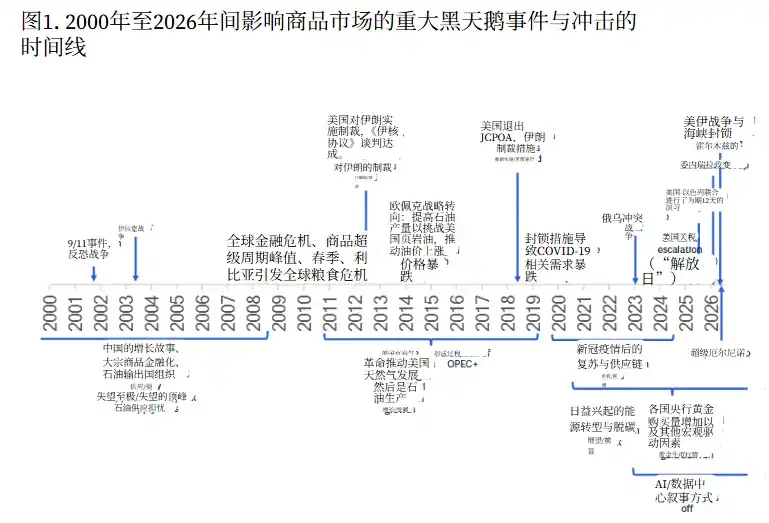
The report points out that these risk scenarios are not baseline forecasts, but rather "plausible events with high impact should they occur" tail scenarios, intended to supplement Citigroup's existing baseline forecast framework.

Highest Risk: U.S.-Iran Conflict Evolving into a Multi-Year Supply Crisis

Citigroup ranks the escalation of the U.S.-Iran conflict as the most impactful tail scenario, though its probability of occurrence is assessed as "low."

The report notes that from the "12-day war" in June 2025 when the U.S. and Israel jointly struck Iranian nuclear facilities, to the conflict resuming in February 2026, a fragile ceasefire agreement signed in June 2026, and renewed military escalation in July 2026, oil and refined product prices have already experienced multiple rounds of severe volatility.

If the conflict expands further, Iran could attack energy infrastructure in Gulf oil-producing countries. Combined with prolonged closures of the Strait of Hormuz and disruptions in the Bab el-Mandeb Strait, the world could face a sustained supply deficit of 5 to 10 million barrels per day.

Citigroup estimates that, assuming a demand elasticity of approximately -0.05, supply losses of this magnitude would drive oil prices up 100% to 200%, meaning flat price crude oil surpassing $200/barrel, with U.S. retail gasoline prices persistently remaining above $6/gallon.

Citing historical data, the report states, if global oil inventories excluding China fall below 70 days of consumption coverage, the corresponding actual Brent price has reached above $150/barrel.
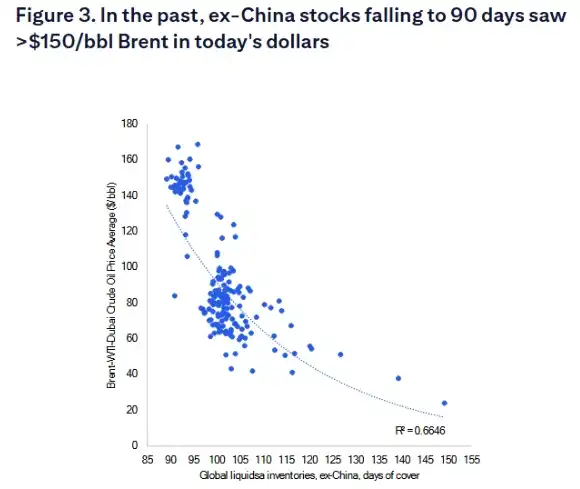
(Historically, if crude oil inventories in regions excluding China fell to the 90-day low point, Brent once reached above $150/barrel)

If the oil & gas expenditure's share of GDP were to repeat the 8% peak of the second oil crisis in the 1970s, the required oil price level would exceed $200/barrel.
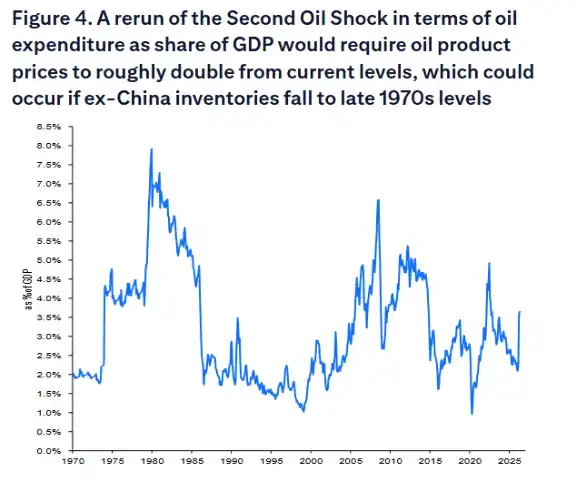
(If inventories outside China fall to levels seen in the late 1970s, oil product prices roughly double from current levels)

As of July 2026, total global oil inventories excluding China remain around 94 days of consumption. However, Citigroup predicts that if a global deficit of 7 to 8 million barrels per day persists, this metric could fall below 70 days by early 2027.

Russia-Ukraine Escalation: Natural Gas Market Impact Expected to Exceed Crude Oil

Citigroup rates the possibility of stricter restrictions on Russian energy exports as "medium probability," emphasizing its impact on the natural gas market would be greater than on crude oil.

For liquefied natural gas (LNG), Russia exported about 44 billion cubic meters (bcm) in 2025, accounting for approximately 7% of global LNG supply, mainly from the Yamal LNG and Sakhalin-2 projects.
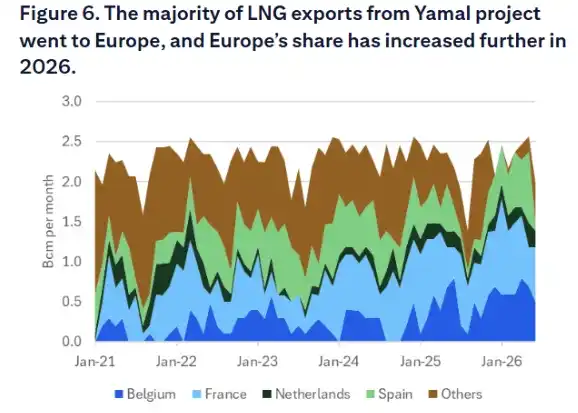
(Most LNG from the Yamal project is exported to Europe, with Europe's share set to rise further in 2026)

Of this, over 70% of Sakhalin-2 exports go to Japan and South Korea; around 90% of Yamal project exports are directed to Europe as of mid-2026.
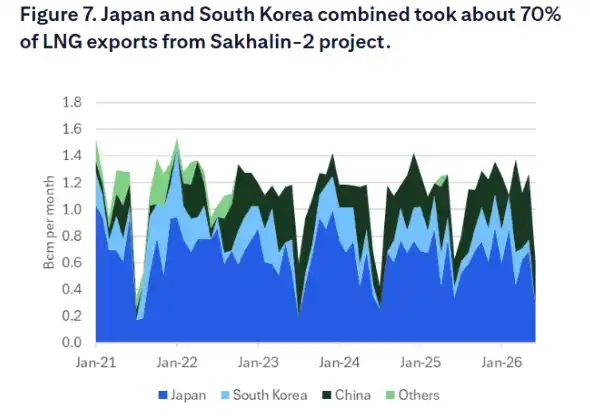
(Japan and South Korea together account for about 70% of LNG export share from the Sakhalin-2 project)

If a global ban on Russian LNG purchases were implemented, over 30 bcm of annual supply would need to be relocated. However, due to shipping and contractual limitations, the global LNG market would face a significant supply gap.

For pipeline gas, the damage from banning purchases of Russian pipeline gas would be even greater due to the physical constraints of pipelines limiting flexible redirection of gas flows.

Russia exports over 70 bcm of pipeline gas annually to markets outside China, with Europe and Turkey alone importing about 37 bcm combined.

Key Mineral Stockpiling: Copper Prices Could Break Through $20,000/Ton

Citigroup rates the probability of a key mineral stockpiling race as "high," with its impact varying by commodity and stockpiling scale. If governments engage in large-scale accumulation of strategic mineral stockpiles, copper prices could be pushed above $20,000 per ton.

The report points out that policy signals have emerged among major global economies such as the U.S. and the EU.

The U.S. "Project Vault" proposal plans to allocate $12 billion for stockpiling key industrial commodities, and the EU has announced a €3 billion fund for critical raw material security.

Citigroup uses the copper market as an example for calculation: if global refined copper inventories were to increase from the current ~1.3 months of consumption to 3 months, approximately 4 million tons of copper would need to be accumulated within two years.

Based on historical scrap copper supply elasticity, this would require copper prices to rise to around $23,000/ton. Citigroup's current benchmark scenario price for copper is around $13,500/ton.
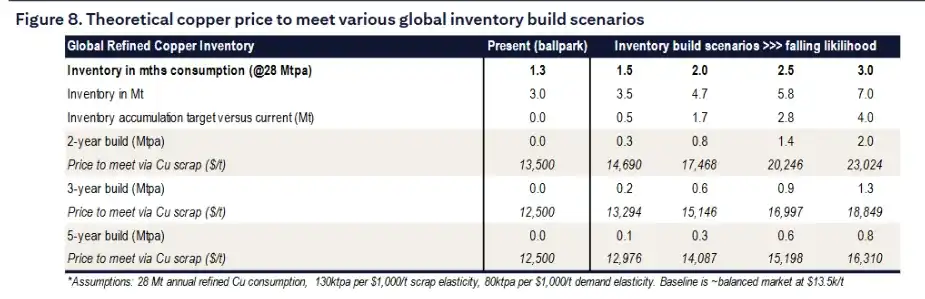
(Theoretical copper prices under various global inventory increase scenarios)

Gold: Could Fall Another 15-20% Short-Term, Then Double Later

Citigroup rates gold's tail risk as low probability, low direct impact, but highly significant within the scenario analysis framework.

Gold prices surged from $2,500/oz in January 2025 to a peak of $5,500/oz in February 2026, and have since retreated to around $4,000/oz.

The report believes the risk of a larger-than-expected decline is most concentrated in the next 4 to 6 weeks. Once prices fall below $3,800/oz, liquidation pressure from ETFs and leveraged positions could be triggered on a large scale.

Potential triggers include: a worsening Middle East situation pushing up real interest rates and the dollar, and equity/bond market adjustments triggering liquidity squeezes.

However, the report remains highly optimistic about gold's medium to long-term trend.

China's trade surplus exceeding $1.3 trillion, continued central bank purchases, global fiscal sustainability concerns, and de-dollarization trends constitute multiple supports for long-term gold demand.

Citigroup expects that, driven by major inflation declines and a new round of investor buying, gold has the potential to rise to $6,000/oz in the coming years, nearly doubling from current levels.

Extreme El Niño: Cocoa Prices Could Return to $10,000/Ton

The U.S. National Oceanic and Atmospheric Administration's (NOAA) updated July forecast raised the probability of a very strong El Niño event to 81%, with a 97% chance of persistence until Spring 2027. Citigroup rates this as a "medium probability, high impact" tail scenario.
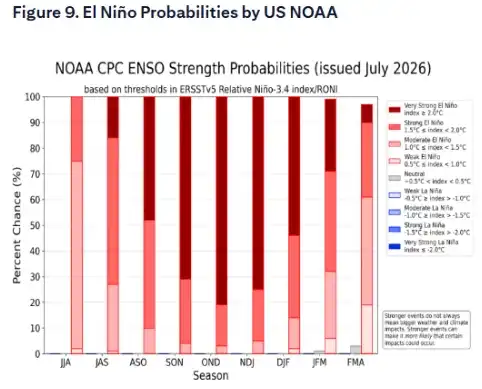
(NOAA's El Niño probability forecast)

The report notes that extreme El Niño impacts different agricultural products significantly. Cocoa, sugar, and Robusta coffee are most affected; soybeans are next; corn and wheat are relatively less affected.

If West Africa experiences a Harmattan wind season similar to 2023-2024, cocoa supply would be severely impacted. Cocoa prices could return to $10,000/ton or higher, having previously reached record highs in 2024-2025.

For sugar, below-average rainfall in India in June, coupled with potential dual risks of monsoon deficiency in Thailand and floods in Brazil, global sugar prices could rise above 20 cents/pound.

Corn and soybean prices may find some support because El Niño typically boosts yields in U.S. producing regions, though European heatwaves and a weaker Indian monsoon remain key downside risk sources.

AI Boom & Bust: Bidirectional Shocks Diverge Commodity Landscape

Citigroup characterizes the impact of AI scenarios on commodities as "low to medium probability, highly divergent impact."

AI infrastructure expansion is becoming a significant driver of demand for electricity, natural gas, uranium, and grid metals like copper and aluminum. The report projects U.S. data center power consumption will roughly double by 2030.

If the AI bubble bursts, data center construction will contract sharply. Actual and expected demand for copper, natural gas, and uranium would be simultaneously damaged, while a decline in global risk appetite would further trigger a contraction in commodity demand.

However, simultaneously, a weaker dollar could provide passive support for commodity prices, and significant Fed rate cuts would also cushion the market to some extent.

If AI productivity dividends materialize, accelerating energy consumption and advancing grid investment would further strengthen the structural deficit narrative for copper and aluminum. Citigroup views this as one pathway for copper prices to reach $17,000/ton in a bull scenario.

Gold is seen as the most asymmetric hedge instrument under AI scenarios, benefiting from logic in both boom and bust cycles.

Power of Siberia 2 & LNG Oversupply: 2030s Prices Could Fall Below $6/MMBtu

Citigroup rates the signing of a final agreement between Russia and China on the Power of Siberia 2 pipeline as a "medium probability, high impact" scenario.

The pipeline has an annual capacity of 50 bcm. If operational around 2030, it would significantly reduce China's LNG import needs, exacerbating the global LNG market's expected shift towards looser conditions from 2028 onward.

The report predicts that under this scenario, the JKM Asian LNG benchmark price could fall to $5-6/MMBtu, well below the current forward prices for 2029-2030 above $8, and far below the $7-10 breakeven range for most new LNG supply terminals.

Citigroup notes that the potential 50 bcm/year of new supply between China and Russia is almost equivalent to Russia's existing ~53 bcm/year of pipeline gas exports to Europe. Its impact on the global LNG oversupply situation would far outweigh the debate over whether Russian pipeline gas returns to Europe.

Extremization of the Monroe Doctrine: Blockade of Americas' Oil Could Trigger a 1973 Replay

If the U.S. pushes the "Monroe Doctrine" to an extreme, blockading oil exports from Latin America or even the entire Americas, the global oil price landscape would undergo severe distortion.

The Monroe Doctrine is a core U.S. foreign policy principle articulated in 1823. Its core assertion is that "the Americas are for the Americans," aimed at opposing European powers' interference in American affairs, while declaring U.S. non-interference in European internal matters.

Citigroup lists "U.S. blockade of all oil exports from the Americas" as a low probability, high impact scenario.

Under this assumption, Latin America (including Mexico), with approximately 9.8 million barrels/day of crude oil production (~10% of global total output), would see its exports cut off from global markets. The shock magnitude would match or even exceed the 1973 Arab oil embargo.
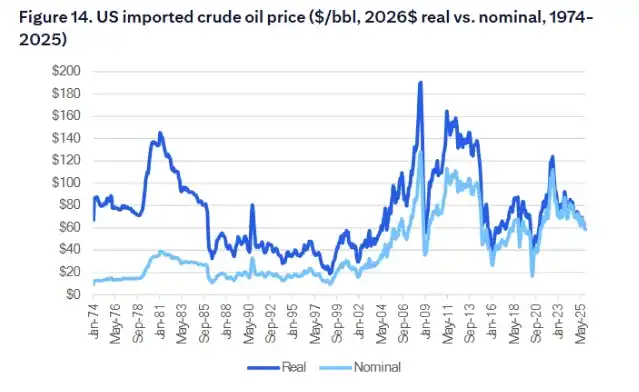
(U.S. imported crude oil price, 2026 real and nominal values, 1974-2025)

Back then, 7 OPEC member countries cut production by about 3.6 million barrels/day (~6% of global output), causing oil prices to surge from around $3/barrel to about $12/barrel in January 1974, a rise of approximately 300%.

Under this scenario, global benchmark crude prices (like Brent, Dubai) could surge above $100/barrel, while intra-Americas crude benchmarks (like WTI, WCS) could experience substantial discounts exceeding $30/barrel due to lack of outlets, creating a sharply divergent cross-regional price structure.


Tiền kỹ thuật số thịnh hành

Câu hỏi Liên quan

QAccording to Citi's report, what is the highest-impact tail risk scenario for the commodity market by 2026 H2, and what is its potential effect on oil prices?

AThe highest-impact tail risk scenario is an escalation and prolongation of the US-Iran conflict into a multi-year supply crisis. Citi estimates this could lead to a sustained global supply deficit of 5 to 10 million barrels per day. Assuming a demand elasticity of approximately -0.05, such a supply shock could drive oil prices up by 100% to 200%, pushing crude oil prices above $200 per barrel, with US retail gasoline consistently staying above $6 per gallon.

QWhat impact would a strategic stockpiling race for critical minerals have on copper prices according to Citi's analysis?

ACiti assesses the probability of a critical minerals stockpiling race as 'high'. Should governments undertake large-scale strategic stockpiling, it could push copper prices above $20,000 per tonne. Their modeling suggests that increasing global refined copper inventories from the current ~1.3 months of consumption to 3 months would require accumulating ~4 million tonnes of copper over two years, potentially requiring a price of around $23,000/tonne based on historical scrap supply elasticity.

QWhat is Citi's near-term and long-term outlook for gold prices in their tail risk analysis?

ACiti sees a heightened risk of gold declining by 15% to 20% in the next 4-6 weeks, potentially triggered by a break below $3,800/oz leading to ETF and leveraged position liquidations. However, their long-term outlook remains highly bullish. They expect gold could rise to around $6,000/oz in the coming years, nearly doubling from current levels, driven by factors like China's large trade surplus, sustained central bank buying, global fiscal sustainability concerns, and dedollarization trends.

QHow does Citi assess the potential impact of an extreme El Niño event on agricultural commodities, specifically cocoa and sugar?

ACiti rates an extreme El Niño as a 'medium probability, high impact' tail scenario. For agricultural commodities, cocoa, sugar, and Robusta coffee would be most affected. A severe Harmattan wind event in West Africa, similar to 2023-2024, could severely impact cocoa supply, potentially pushing prices back to $10,000/tonne or higher. For sugar, risks include deficient rainfall in India and potential monsoon issues in Thailand and Brazil, which could drive global sugar prices above 20 cents per pound.

QWhat are the two opposing potential impacts of AI development (boom vs. bust) on commodity markets, as outlined by Citi?

ACiti describes AI's impact as 'low to medium probability, highly differentiated impact'. In an AI boom scenario, infrastructure expansion drives demand for electricity, natural gas, uranium, and grid metals like copper and aluminum, reinforcing structural deficit narratives and potentially pushing copper to $17,000/tonne. In an AI bust scenario, data center construction contracts sharply, damaging actual and expected demand for copper, natural gas, and uranium, while a global risk-off sentiment further reduces commodity demand, though a weaker dollar and Fed rate cuts could provide some support. Gold is seen as an asymmetric hedge, benefiting in either scenario.

Nội dung Liên quan

Vụ ly hôn của Choi Tae-won chính thức kết thúc: Tiết lộ tuyến kế thừa ẩn sau đế chế nghìn tỷ SK Hynix

Vào tháng 11/2024, trong một sự kiện kỷ niệm, Chủ tịch SK Group Choi Tae-won đã cho các con xem hình ảnh AI tái hiện người cha quá cố của mình, nhấn mạnh về việc kế thừa di sản. Trong bối cảnh SK Hynix trở thành tài sản trị giá nhất Hàn Quốc, câu chuyện kế thừa thế hệ thứ ba của tập đoàn này lại không đi theo kịch bản truyền thống. Choi Yun-jung (sinh 1989), trưởng nữ, được coi là ứng viên kế thừa rõ ràng nhất. Cô có nền tảng học thuật về sinh học, từng làm tư vấn, hiện đang học tiến sĩ và giữ chức vụ lãnh đạo tại SK Bioscience và bộ phận hỗ trợ tăng trưởng của SK Inc. Cuộc hôn nhân của cô với một doanh nhân khởi nghiệp AI cũng phản ánh sự thay đổi trong các mối liên kết giữa các giới tinh hoa. Choi Min-jung (sinh 1991), con gái thứ, có hành trình khác biệt: học đại học tại Bắc Kinh, tình nguyện gia nhập Hải quân Hàn Quốc và từng làm việc tại SK Hynix ở Washington về các vấn đề chính sách quốc tế. Cô hiện là nhà sáng lập một công ty chăm sóc sức khỏe AI và kết hôn với một cựu sĩ quan Thủy quân Lục chiến Mỹ, cho thấy mạng lưới toàn cầu và an ninh chuỗi cung ứng ngày càng quan trọng đối với các tập đoàn bán dẫn. Choi In-geun (sinh 1995), con trai trưởng, có lộ trình học vấn tương đồng với cha (vật lý) và đang làm việc tại McKinsey sau thời gian ở SK E&S. Dù mang hình mẫu người kế thừa truyền thống, anh lại là người ít lộ diện công khai nhất. Cuộc chiến ly hôn kéo dài giữa Choi Tae-won và vợ cũ Roh So-young, với giá trị tài sản tranh chấp lên tới hàng nghìn tỷ won, là bối cảnh phức tạp mà thế hệ thứ ba phải đối mặt. Cả ba người con đều đã đệ đơn lên tòa án trong vụ việc này, dù nội dung không được tiết lộ. Tóm lại, trong kỷ nguyên AI khi SK Hynix trở thành tài sản địa chính trị toàn cầu, việc kế thừa tại SK Group không còn là chuyện nội bộ gia đình hay chỉ xoay quanh cổ phần và quyền trưởng nam. Thế hệ thứ ba được định vị thông qua năng lực chuyên môn, mạng lưới quốc tế và khả năng giải quyết những thách thức của thời đại công nghệ và địa chính trị mới.

marsbitHôm qua 09:10

Vụ ly hôn của Choi Tae-won chính thức kết thúc: Tiết lộ tuyến kế thừa ẩn sau đế chế nghìn tỷ SK Hynix

marsbitHôm qua 09:10

Các ngân hàng phản đối thỏa thuận lợi suất stablecoin – Liệu Đạo luật CLARITY có thể giành được 60 phiếu?

Viện Chính sách Ngân hàng Hoa Kỳ (BPI) đã phản đối dự thảo Đạo luật CLARITY mới, chỉ ra những thiếu sót về quy định lợi suất stablecoin và chống tài trợ bất hợp pháp. Ngành ngân hàng muốn cấm hoàn toàn mọi hình thức khuyến khích từ stablecoin, trong khi dự thảo hiện tại chỉ cho phép dựa trên hoạt động tài khoản, không phải số dư nhàn rỗi. Sự phản đối này ảnh hưởng đến cơ hội thông qua đạo luật tại Thượng viện, nơi cần 60 phiếu. Sự ủng hộ từ đảng Cộng hòa có thể giảm xuống còn 49 phiếu nếu các Thượng nghị sĩ John Curtis và John Cornyn rút lại hỗ trợ, đòi hỏi 11 phiếu từ đảng Dân chủ. Tuy nhiên, một số nhà lập pháp Dân chủ ủng hộ tiền mã hóa cũng phản đối dự luật do lo ngại về đạo đức và chống rửa tiền. Lãnh đạo đa số Thượng viện John Thune tỏ ra hoài nghi về khả năng thông qua dự luật trước kỳ nghỉ tháng Tám, chỉ còn hai tuần. Cố vấn trưởng về Tiền mã hóa của Nhà Trắng, Patrick Witt, kêu gọi tiến hành bỏ phiếu ngay. Kỳ vọng thị trường về việc thông qua đạo luật trong năm 2026 đã giảm xuống còn 32%.

ambcryptoHôm qua 09:04

Các ngân hàng phản đối thỏa thuận lợi suất stablecoin – Liệu Đạo luật CLARITY có thể giành được 60 phiếu?

ambcryptoHôm qua 09:04

Giá trị gia tăng từ 88 tỷ lên 680 tỷ chỉ sau 2 tháng! OpenRouter, trạm trung chuyển AI lớn nhất sắp được mua lại

Theo tờ Wall Street Journal và The Information, Stripe - nền tảng thanh toán hàng đầu - đang đàm phán mua lại startup AI OpenRouter với giá khoảng 10 tỷ USD. Chỉ hai tháng trước, định giá của OpenRouter là 1,3 tỷ USD, tức giá chào mua cao hơn gần 7 lần. Thương vụ có thể được công bố trong vòng một tháng nhưng vẫn có nguy cơ đổ vỡ. OpenRouter hoạt động như một "trung tâm chuyển tiếp" AI, cung cấp một API duy nhất để các nhà phát triển truy cập vào hơn 400 mô hình lớn (như GPT, Claude). Nó tự động lựa chọn mô hình phù hợp dựa trên độ phức tạp, chi phí và tốc độ, giúp các ứng dụng AI tối ưu hóa hiệu quả chi phí. Được đồng sáng lập bởi Alex Atallah (cựu đồng sáng lập OpenSea), OpenRouter hiện có hơn 1 triệu nhà phát triển và doanh thu hàng năm đạt 50 triệu USD, tăng gấp 5 lần trong nửa năm. Đây là bước đi chiến lược tiếp theo của Stripe trong việc mở rộng sang hạ tầng AI, sau khi họ mua lại nền tảng định giá theo lượng sử dụng Metronome vào cuối năm 2025. Mục tiêu của Stripe là kết hợp khả năng định tuyến mô hình của OpenRouter với hệ thống thanh toán và đo lường sử dụng hiện có, để trở thành "trung tâm điều phối và thu ngân" toàn diện cho nền kinh tế AI. Điều này cho phép doanh nghiệp quản lý toàn bộ việc sử dụng và hóa đơn AI qua một nhà cung cấp duy nhất.

链捕手Hôm qua 09:02

Giá trị gia tăng từ 88 tỷ lên 680 tỷ chỉ sau 2 tháng! OpenRouter, trạm trung chuyển AI lớn nhất sắp được mua lại

链捕手Hôm qua 09:02

Từ OpenSea Đến OpenRouter: Kịch Bản “Chốt Lời Đỉnh Cao” Của Alex Atallah Lại Lặp Lại?

Tác giả: Nancy, PANews Hơn bốn năm trước, Alex Atallah rời đi trước đỉnh bong bóng NFT; giờ đây, anh lại tỏa sáng trong cơn sốt AI và chuẩn bị bán nền tảng tổng hợp mô hình AI OpenRouter với giá cao. Ngày 23/7, theo Wall Street Journal, gã khổng lồ thanh toán Stripe đang đàm phán mua lại OpenRouter, với định giá giao dịch có thể lên tới gần 100 tỷ USD. Nếu thành công, đây sẽ là lần thứ hai Alex Atallah xây dựng một công ty trị giá hàng trăm tỷ USD, sau sàn giao dịch NFT OpenSea. OpenRouter, được mô tả là "Stripe của lĩnh vực AI", đã kết nối hơn 400 mô hình AI, có khoảng 10 triệu người dùng và xử lý hơn 200 nghìn tỷ token mỗi tháng. Tuy nhiên, mô hình kinh doanh chủ yếu dựa vào phí dịch vụ nền tảng (5%-5.5%) từ việc gọi API, với doanh thu hàng năm khoảng 50 triệu USD (tính đến tháng 4/2026). Đây là một mô hình kênh dẫn có quy mô lớn nhưng biên lợi nhuận hạn chế, dễ bị ảnh hưởng bởi sự cạnh tranh, mô hình nguồn mở và áp lực giảm giá. Giá trị thực sự của OpenRouter đối với các nhà mua tiềm năng như Stripe có thể nằm ở kho dữ liệu sử dụng AI thực tế khổng lồ mà nó tích lũy được, cung cấp insights quý giá về hiệu suất mô hình, sở thích nhà phát triển và quan hệ thay thế trên thị trường. Từ NFT đến AI, Alex Atallah hai lần bắt đúng xu hướng thời đại. Việc OpenRouter được định giá 100 tỷ USD đặt ra câu hỏi: đây là sự định giá lại giá trị cơ sở hạ tầng AI hay một tín hiệu đỉnh chu kỳ mới? Thời gian sẽ trả lời.

链捕手Hôm qua 08:45

Từ OpenSea Đến OpenRouter: Kịch Bản “Chốt Lời Đỉnh Cao” Của Alex Atallah Lại Lặp Lại?

链捕手Hôm qua 08:45

Pons V2 mang đến các cặp giao dịch RWA khi Robinhood Chain mở rộng tham vọng

Pons, một launchpad được xây dựng trên Robinhood Chain, đã ra mắt bản nâng cấp V2 với các thay đổi nhằm cải thiện thanh khoản, loại bỏ hạn chế giao dịch và hỗ trợ tài sản thực được mã hóa (RWA). Bản cập nhật này diễn ra trong bối cảnh Robinhood Chain tiếp tục tăng trưởng nhanh, vượt 300 triệu USD tổng giá trị bị khóa và nổi lên như một trong những mạng Lớp 2 Ethereum sôi động nhất cho giao dịch đầu cơ. Pons V2 giải quyết các phàn nàn chính của người dùng về thanh khoản bằng cách giới thiệu đường cong liên kết định danh bằng ETH, đồng thời cho phép hầu hết ví giao dịch tự do. Cấu trúc phí cũng được thiết kế lại để nhà phát triển có thể nhận phí bằng ETH mặc định. Robinhood Chain đã thu hút sự chú ý của thị trường, với khối lượng DEX tích lũy vượt 9 tỷ USD, trong đó 80% đến từ memecoin rủi ro cao. Tuy nhiên, lợi nhuận tập trung vào số ít, với 63% nhà giao dịch thua lỗ. Việc Pons V2 bổ sung các cặp giao dịch RWA tùy chỉnh trực tiếp hỗ trợ trọng tâm phát triển tài sản thực của Robinhood Chain, có thể thúc đẩy việc áp dụng mạng lưới một cách hữu cơ trong tương lai.

ambcryptoHôm qua 08:27

Pons V2 mang đến các cặp giao dịch RWA khi Robinhood Chain mở rộng tham vọng

ambcryptoHôm qua 08:27

Giao dịch

Giao ngay

Bài viết Nổi bật

Làm thế nào để Mua ERA

Chào mừng bạn đến với HTX.com! Chúng tôi đã làm cho mua Caldera (ERA) trở nên đơn giản và thuận tiện. Làm theo hướng dẫn từng bước của chúng tôi để bắt đầu hành trình tiền kỹ thuật số của bạn.Bước 1: Tạo Tài khoản HTX của BạnSử dụng email hoặc số điện thoại của bạn để đăng ký tài khoản miễn phí trên HTX. Trải nghiệm hành trình đăng ký không rắc rối và mở khóa tất cả tính năng. Nhận Tài khoản của tôiBước 2: Truy cập Mua Crypto và Chọn Phương thức Thanh toán của BạnThẻ Tín dụng/Ghi nợ: Sử dụng Visa hoặc Mastercard của bạn để mua Caldera (ERA) ngay lập tức.Số dư: Sử dụng tiền từ số dư tài khoản HTX của bạn để giao dịch liền mạch.Bên thứ ba: Chúng tôi đã thêm những phương thức thanh toán phổ biến như Google Pay và Apple Pay để nâng cao sự tiện lợi.P2P: Giao dịch trực tiếp với người dùng khác trên HTX.Thị trường mua bán phi tập trung (OTC): Chúng tôi cung cấp những dịch vụ được thiết kế riêng và tỷ giá hối đoái cạnh tranh cho nhà giao dịch.Bước 3: Lưu trữ Caldera (ERA) của BạnSau khi mua Caldera (ERA), lưu trữ trong tài khoản HTX của bạn. Ngoài ra, bạn có thể gửi đi nơi khác qua chuyển khoản blockchain hoặc sử dụng để giao dịch những tiền kỹ thuật số khác.Bước 4: Giao dịch Caldera (ERA)Giao dịch Caldera (ERA) dễ dàng trên thị trường giao ngay của HTX. Chỉ cần truy cập vào tài khoản của bạn, chọn cặp giao dịch, thực hiện giao dịch và theo dõi trong thời gian thực. Chúng tôi cung cấp trải nghiệm thân thiện với người dùng cho cả người mới bắt đầu và người giao dịch dày dạn kinh nghiệm.

Tổng lượt xem 847Xuất bản vào 2025.07.17Cập nhật vào 2026.06.02

Làm thế nào để Mua ERA

Thảo luận

Chào mừng đến với Cộng đồng HTX. Tại đây, bạn có thể được thông báo về những phát triển nền tảng mới nhất và có quyền truy cập vào thông tin chuyên sâu về thị trường. Ý kiến ​​của người dùng về giá của ERA (ERA) được trình bày dưới đây.

活动图片













