Send a Message to Transfer Coins? Telegram to 'Stuff' a Crypto Wallet into 1 Billion Users This Summer

marsbitXuất bản vào 2026-07-22Cập nhật gần nhất vào 2026-07-22

Tóm tắt

Telegram founder Pavel Durov has announced that a native, non-custodial wallet called Gram wallet will be built into every Telegram app this summer. This move aims to provide instant, fee-free cryptocurrency transfers for the platform's over 1 billion monthly active users. Durov described it as the largest deployment of a non-custodial crypto wallet in history. The new wallet, developed by Telegram itself, differs fundamentally from the existing third-party @wallet bot. It will be non-custodial from the start, meaning users will control their private keys. Following the announcement, the GRAM token (formerly Toncoin) saw a price increase of approximately 8%. This initiative is part of Telegram's renewed control over the TON blockchain and its "Make TON Great Again" roadmap, marking a return to the project after a 2018 SEC lawsuit. The launch comes as other super-apps like X Money and Meta are also expanding into digital payments, with Telegram opting for a crypto-native approach. However, key details remain unclear, including the exact launch date beyond "this summer," how the promised zero fees will be implemented technically, and how asset support and private key management will work for mainstream users.

Author: Claude, Deep Tide TechFlow

Deep Tide's Guide: Telegram founder Pavel Durov announced that this summer, a native non-custodial Gram wallet will be built into all Telegram apps, offering zero-fee instant transfers to over 1 billion users. GRAM subsequently rose about 8% to $1.53. This wallet differs from the existing third-party-operated @wallet bot; it is developed by Telegram itself, with users directly controlling their private keys. Amid a competitive window where super apps like X Money and Meta's stablecoin payments are entering the fray, Durov is betting on a crypto-native route. However, the promise of the "largest deployment in human history" still lacks technical details and a definitive timeline.
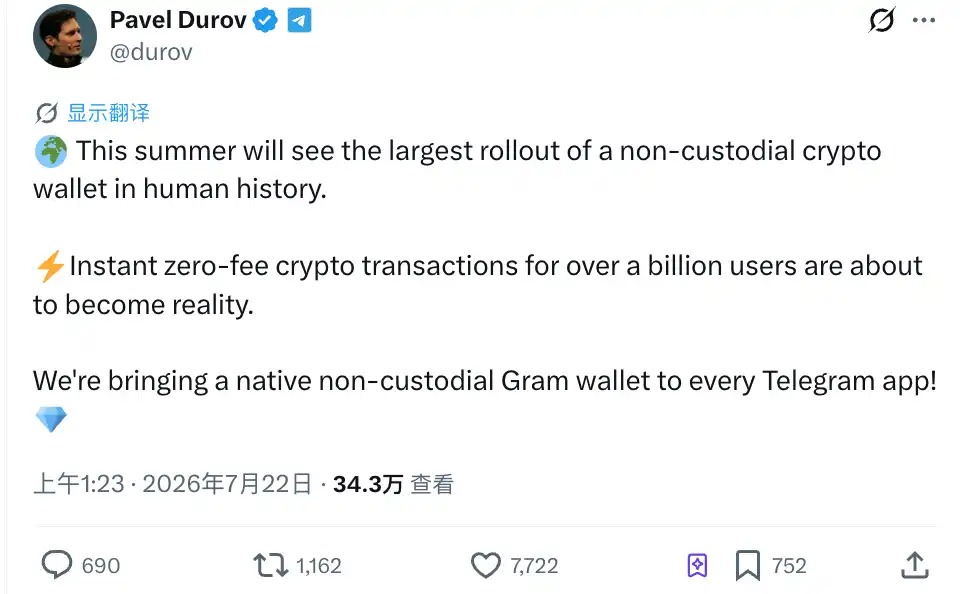
Telegram founder Pavel Durov announced in his Telegram channel on July 21 that this summer, a native non-custodial Gram wallet will be built into every Telegram application, providing instant, zero-fee cryptocurrency transfer services to over 1 billion monthly active users.

Durov characterized this launch as "the largest non-custodial crypto wallet deployment in human history." For comparison, the most widely used self-custody wallet in the crypto space, MetaMask, has tens of millions of users; no crypto wallet has ever started with a base of 1 billion users.

Completely Different from the Existing @wallet, Telegram Steps In Directly

This new wallet is fundamentally different from the existing @wallet bot within Telegram.

According to Decrypt, the existing @wallet is a mini-app developed and operated by the independent third-party company The Open Platform (TOP), and is not an official Telegram product. The service already boasts over 150 million registered users, with a default custodial model (meaning a third party holds user private keys), requiring users to actively switch to use its self-custody layer.

The new wallet announced by Durov is a feature natively embedded into the Telegram app, designed from the ground up as non-custodial, with users controlling their own private keys and assets. Non-custodial means there is no intermediary that can freeze, seize, or block transactions.

According to BeInCrypto, TOP founder Andrew Rogozov confirmed that the existing custodial @wallet service will continue to operate independently. However, key questions remain unanswered: whether the old and new wallets will ultimately coexist, which assets besides GRAM the new wallet will support, and how private key management will be handled for ordinary users who have never interacted with cryptocurrency.

GRAM Rises About 8%, But Still 88% Away from Previous High

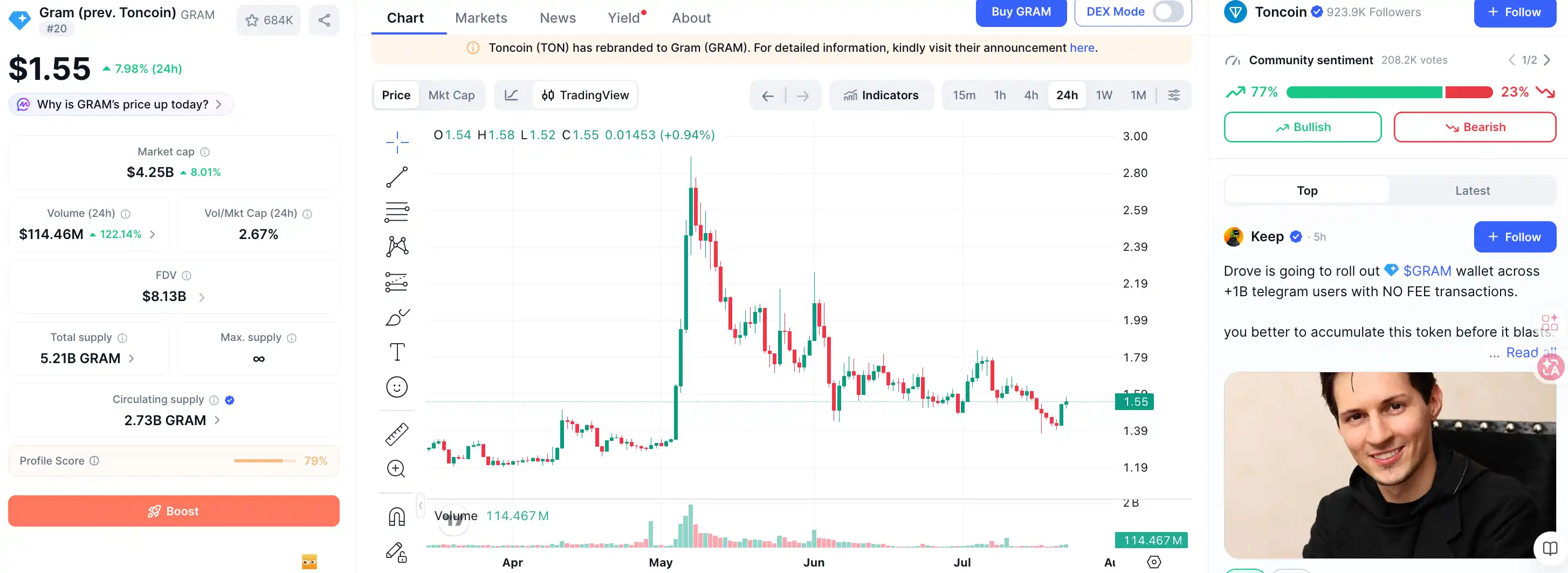
Following the announcement, GRAM (originally Toncoin, the native token of the TON blockchain) rose approximately 8.5% in 24 hours to around $1.53, with a market cap of about $4.18 billion. According to CoinMarketCap data, this partially offset a cumulative decline of about 25% since July, but significant reversal remains distant.

GRAM's 200-day exponential moving average is far above its current price, indicating a still bearish long-term trend. The token's all-time high was $8.25 (during the Telegram 'Tap-to-Earn' gaming frenzy in June 2024). It reached its yearly high of $2.89 in May 2026 when Telegram announced it was taking over the TON network. A return from the current price to the May high would require an increase of approximately 88%.
From SEC Lawsuit to 'Make TON Great Again', Durov's Seven-Year Comeback Battle

This wallet deployment is the latest chapter in a narrative that began in 2018.

In 2018, Telegram raised $1.7 billion for the TON blockchain project, planning to issue a token called Gram. The SEC subsequently sued, determining the token was an unregistered security. In 2020, Telegram settled with the SEC, refunding investors $1.2 billion and paying an $18.5 million fine, completely withdrawing from the project. Community developers took over, independently operating the token renamed as Toncoin for several years.

In 2026, Durov regained control of the TON network and launched a seven-step roadmap named "Make TON Great Again" (MTONGA). Publicly completed steps so far include: the Catchain 2.0 upgrade achieving a 10x speed increase and sub-second transaction confirmation; a 6x reduction in base transaction fees; Telegram becoming the network's largest validator; and the token name change (from Toncoin back to Gram) passed by 81% community vote on June 15. The built-in wallet is likely step five, with three remaining steps yet to be disclosed.

Super App Payments War Heats Up, Telegram Chooses Crypto-Native Route

Durov's wallet announcement comes during a dense window where multiple super apps are simultaneously deploying payment functions.

According to Glitchwire, Musk's X Money launched on June 26 for US Premium subscribers, offering 6% APY, Visa Direct peer-to-peer transfers, and 3% cashback, but currently only supports fiat currency. Crypto and stock trading features are on the roadmap but not yet live. Meta is also re-strategizing digital payments, reportedly sending partnership invitations to third-party stablecoin providers, planning to integrate stablecoin payments into WhatsApp, Instagram, and Facebook in the second half of 2026.

The route choices of the three super apps present a stark contrast: X Money takes a compliant fiat route (holding money transmitter licenses in over 40 states), Meta explores a stablecoin middle path, while Telegram directly bets on a crypto-native non-custodial wallet. Telegram's advantages lie in its user base (over 1 billion monthly active users) and natural affinity for the crypto community. The risks involve the user education costs associated with non-custodial models and regulatory uncertainty.

Zero-Fee Promise Still Lacks Key Details

Durov's promised "zero fees" is another issue requiring attention. Most crypto wallets still charge network fees, even if minimal. Telegram might bypass gas fees through internal subsidies or by using methods like off-chain settlement, but the specific technical solution has not been announced.

According to CryptoBriefing, in July 2025, Telegram launched a non-custodial TON Wallet to 87 million US users as a proof-of-concept. That deployment demonstrated that a messaging app could distribute wallet infrastructure at scale without the traditional friction of crypto onboarding, but a significant gap remained between the number of on-chain active wallets and the user base.

Beyond "this summer," Durov has not provided a more specific launch date.

Câu hỏi Liên quan

QWhat are the key differences between the new native Gram wallet announced by Telegram and the existing @wallet bot?

AThe new native Gram wallet is a core feature built directly into the Telegram app by Telegram itself, designed from the ground up as a self-custodial wallet where users control their private keys. In contrast, the existing @wallet bot is a third-party mini-app developed and operated by The Open Platform (TOP). It currently operates primarily as a custodial service (where TOP holds the keys), with a self-custodial layer available as an optional switch.

QWhat are some of the unanswered questions and uncertainties surrounding Telegram's planned Gram wallet deployment?

AKey unanswered questions include: a precise launch date beyond 'this summer'; technical details on how the promised 'zero-fee' transactions will be implemented; whether the new wallet will support assets beyond GRAM; how the wallet will manage the user experience and security for crypto-naive users among Telegram's billion-plus user base; and how the new official wallet will coexist with the existing third-party @wallet bot.

QHow has the announcement of the native Gram wallet affected the GRAM (TON) token's price and market position?

AFollowing the announcement, the GRAM token price rose approximately 8.5% to around $1.53. However, its overall market position remains challenging. The price is still about 88% below its year-to-date high of $2.89 from May 2026, and its 200-day exponential moving average is well above the current price, indicating a long-term bearish trend. It is also far from its all-time high of $8.25 set in June 2024.

QHow does Telegram's approach to payments compare with strategies from other 'super apps' like X (formerly Twitter) and Meta?

ATelegram, X, and Meta are taking distinct paths. X Money (on platform X) is pursuing a licensed, fiat-first approach in the US, offering features like yields and cashback, with crypto trading as a future roadmap item. Meta is reportedly exploring a partnership model with third-party stablecoin providers for integration into its apps. Telegram is taking a crypto-native route by directly building and integrating a self-custodial crypto wallet, leveraging its large user base and inherent appeal to the crypto community.

QWhat is the historical context of Telegram's involvement with the TON blockchain and the GRAM token?

ATelegram's history with TON and GRAM dates back to 2018 when it raised $1.7 billion for the TON blockchain project and planned to issue the Gram token. The SEC sued, alleging the token was an unregistered security. In 2020, Telegram settled, refunding investors and paying a fine, completely abandoning the project. Independent developers continued it as Toncoin. In 2026, under the 'Make TON Great Again' (MTONGA) roadmap, Durov and Telegram regained control, with key steps including network upgrades, fee reductions, Telegram becoming the top validator, and the community voting to rename Toncoin back to Gram.

Nội dung Liên quan

Sau ba quý liên tiếp suy giảm, thị trường tiền điện tử có thể đón cửa sổ ổn định trong quý III?

Thị trường tiền mã hóa vừa trải qua quý tồi tệ nhất kể từ năm 2022, với vốn hóa giảm 12.6% xuống 2.1 nghìn tỷ USD, khối lượng giao dịch sụt giảm và dòng tiền rút mạnh khỏi các quỹ ETF Bitcoin. Bitcoin và Ethereum lần lượt giảm 14.2% và 25.4% trong quý, đánh dấu sự đảo ngược so với mối tương quan trước đây với các tài sản rủi ro như Nasdaq. Dòng vốn ETF chứng khoán Mỹ ghi nhận dòng ròng rút khoảng 46.7 tỷ USD trong quý II, báo hiệu áp lực bán. Tuy nhiên, dấu hiệu tích cực ban đầu xuất hiện khi các nhà đầu tư dài hạn bắt đầu tích lũy trở lại và dòng ETF có đợt thu hút ngắn hạn. Toàn bộ thị trường hiện tập trung vào cuộc họp của Cục Dự trữ Liên bang Mỹ (FOMC) vào cuối tháng 7. Các tín hiệu chính sách tiền tệ sẽ quyết định xu hướng: tín hiệu ôn hòa có thể đẩy Bitcoin lên vùng 68,000-84,000 USD, trong khi lập trường cứng rắn có thể kéo giá về vùng 50,000-56,000 USD. Tiến trình pháp lý của Đạo luật CLARITY gần như đình trệ, làm giảm kỳ vọng và gia tăng phí rủi ro cho toàn ngành. Trong bối cảnh ảm đạm, hai lĩnh vực nổi bật là thị trường dự đoán (tăng trưởng 48.7%) và bộ sưu tập kỹ thuật số được mã hóa (tăng ~143%), cho thấy sự chuyển dịch nhu cầu thực tế. Nhìn chung, thị trường thiếu động lực cho một đợt tăng trưởng mạnh dựa trên tâm lý. Các quyết định giao dịch trong quý III sẽ chủ yếu xoay quanh diễn biến giá, lựa chọn chính sách và kỳ vọng lãi suất.

marsbit15 giờ trước

Sau ba quý liên tiếp suy giảm, thị trường tiền điện tử có thể đón cửa sổ ổn định trong quý III?

marsbit15 giờ trước

Giao Dịch SpaceX, Đã Mở Khóa: SPCXON Được Giao Dịch Trên WEEX

SpaceX đã thực hiện đợt IPO lớn nhất lịch sử vào tháng 6/2026, nhưng nhiều nhà giao dịch không thể tiếp cận do các rào cản như hạn chế môi giới và khu vực. Sàn giao dịch tiền điện tử WEEX đã giới thiệu SPCXON/USDT, một công cụ token hóa cho phép tiếp cận biến động giá của SpaceX thông qua tài khoản crypto được quyết toán bằng USDT, mà không cần môi giới Mỹ hay tài khoản ngân hàng. Sản phẩm này, xây dựng trên nền tảng cổ phiếu token hóa của Ondo, dành cho các nhà giao dịch bên ngoài Hoa Kỳ. Trường hợp đầu tư dựa trên đà tăng doanh thu Starlink và các cột mốc Starship, trong khi các yếu tố cần thận trọng bao gồm định giá cao, lượng cổ phiếu lưu hành công chúng ít và sự kiện mở khóa cổ phiếu nội bộ sắp tới. Lưu ý quan trọng: SPCXON cung cấp mức tiếp xúc với hiệu quả kinh tế, không phải quyền sở hữu cổ phiếu trực tiếp, và có thể giao dịch ở mức cao hơn hoặc thấp hơn giá trị tài sản ròng. WEEX tích hợp SPCXON cùng các sản phẩm TradFi token hóa khác như MicroStrategy (MSTRON) và Micron (MUON) vào một tài khoản thống nhất, cho phép luân chuyển giữa crypto và cổ phiếu dễ dàng. Sàn cũng đang chạy chiến dịch TradFi Trading Challenge với quỹ thưởng $50,000.

TheNewsCrypto15 giờ trước

Giao Dịch SpaceX, Đã Mở Khóa: SPCXON Được Giao Dịch Trên WEEX

TheNewsCrypto15 giờ trước

BIT Trading Hours: BTC Vẫn Chịu Áp Lực Từ Đường MA 200 Tuần, Bị Từ Chối Có Thể Tái Khởi Động Đợt Giảm, Ngành Lưu Trữ và Bán Dẫn Tăng Mạnh Đêm Qua Bắt Đầu Giảm Trong Khung Giờ Giao Dịch Ban Đêm

Bitcoin (BTC) hiện giao dịch quanh mức $66,000, đối mặt với vùng kháng cự mạnh gần $68,000 - nơi tập trung nhiều lệnh mua trước đó có thể chốt lời. Về mặt kỹ thuật, BTC đang nằm giữa đường trung bình động 200 tuần (MA ~$63,333) và đường trung bình động hàm mũ 200 tuần (EMA ~$68,328). Việc không thể vượt qua mức $68,000 có thể kéo giá về kiểm tra lại vùng hỗ trợ $63,000. Thị trường hiện có tính thanh khoản thấp và được xem là đang trong đợt phục hồi nhẹ. Trên thị trường chứng khoán Mỹ, các chỉ số tương lai giảm nhẹ. Nhóm cổ phiếu bán dẫn và lưu trữ, vốn tăng mạnh vào đêm trước, đã điều chỉnh giảm trong phiên giao dịch ngoài giờ. Tuy nhiên, Super Micro Computer (SMCI) tăng mạnh sau báo cáo doanh thu và đơn đặt hàng tích cực. Dầu thô tăng (trên $91) và lợi suất trái phiếu kho bạc Mỹ tăng cao tiếp tục gây áp lực lên thị trường cổ phiếu và làm dấy lên lo ngại lạm phát. Tại châu Á, thị trường Hàn Quốc phục hồi nhẹ cùng với cổ phiếu công nghệ, trong khi Nhật Bản thận trọng do đồng Yên yếu kỷ lục. Các sự kiện quan trọng sắp tới bao gồm báo cáo thu nhập từ các gã khổng lồ công nghệ như Alphabet, Tesla, IBM; sự kiện AI của AMD; và cuộc họp chính sách tiền tệ của Ngân hàng Trung ương châu Âu.

marsbit15 giờ trước

BIT Trading Hours: BTC Vẫn Chịu Áp Lực Từ Đường MA 200 Tuần, Bị Từ Chối Có Thể Tái Khởi Động Đợt Giảm, Ngành Lưu Trữ và Bán Dẫn Tăng Mạnh Đêm Qua Bắt Đầu Giảm Trong Khung Giờ Giao Dịch Ban Đêm

marsbit15 giờ trước

Chủ tịch CFTC cũ, Chủ tịch Circle Tarbert: Một mặt khuyên bạn chủ nghĩa dài hạn, mặt kia tự mình thoái vốn 30 triệu USD

Tác giả: Zen, PANews Trước tình cảnh cổ phiếu Circle (CRCL) giảm 70% so với đỉnh và bị hạ xếp hạng, Chủ tịch Heath Tarbert - cựu Chủ tịch CFTC - trong một cuộc phỏng vấn ngày 14/7 đã kêu gọi các nhà đầu tư kiên nhẫn và tập trung vào tầm nhìn dài hạn của công ty. Tuy nhiên, hành động của ông lại trái ngược hoàn toàn. Kể từ khi Circle IPO, Tarbert đã không ngừng bán cổ phiếu CRCL thông qua kế hoạch giao dịch 10b5-1 được lập trước, thu về tổng cộng khoảng 30 triệu USD. Ông chưa từng mua lại cổ phiếu trên thị trường mở, ngay cả khi giá cổ phiếu lao dốc. Bài viết nêu bật sự mâu thuẫn giữa lời nói "chủ nghĩa dài hạn" và hành động "thoái vốn" mạnh tay của Tarbert. Sự nghiệp của ông được mô tả là điển hình của "cánh cửa xoay" chính trị-thương mại Mỹ: từ các vị trí cấp cao tại Bộ Tài chính và CFTC, ông nghỉ hưu chỉ 27 ngày trước khi gia nhập Citadel Securities - một nhà tạo lập thị trường lớn - vào thời điểm công ty này đang đối mặt với cuộc điều tra của Quốc hội sau sự kiện GameStop. Sau đó, ông chuyển sang Circle, nơi ông được cho là đã sử dụng kinh nghiệm và quan hệ quản lý để giúp công ty vượt qua các rào cản pháp lý và niêm yết thành công. Bài báo đặt câu hỏi liệu Tarbert có thực sự tin vào tương lai dài hạn của Circle hay không, khi mà ông liên tục chốt lời trong khi lại khuyên các cổ đông nhỏ lẻ giữ vị thế. Nó gợi ý rằng mô hình của ông là tận dụng tối đa kiến thức về chu kỳ chính sách và cơ hội thị trường để biến các nguồn lực và uy tín tích lũy được thành lợi thế nghề nghiệp và tài chính cá nhân, trong khi rủi ro dài hạn được chuyển sang cho các nhà đầu tư tin tưởng vào những tường thuật công khai của ông.

marsbit15 giờ trước

Chủ tịch CFTC cũ, Chủ tịch Circle Tarbert: Một mặt khuyên bạn chủ nghĩa dài hạn, mặt kia tự mình thoái vốn 30 triệu USD

marsbit15 giờ trước

Gate Research: Làn sóng "phố Wall hóa" trong các sản phẩm tài chính tiền điện tử - Cạnh tranh hay Hội tụ?

Gate Research Institute: Sự hòa hợp hay cạnh tranh trong làn sóng "phố Wall hóa" các sản phẩm tài chính tiền mã hóa? Từ tầm nhìn ban đầu về một hệ thống tài chính phi tập trung, loại bỏ trung gian của Bitcoin, thị trường tiền mã hóa đang chứng kiến sự hội tụ mạnh mẽ với tài chính truyền thống (TradFi). Các quỹ ETF Bitcoin, tài sản thế giới thực được mã hóa (RWA) và trái phiếu chính phủ trên chuỗi cho thấy các tổ chức như BlackRock, Fidelity đang đưa tài sản mã hóa vào hệ thống phát hành, định giá, lưu ký và phân phối truyền thống. Tuy nhiên, đây không phải là một trò chơi tổng bằng không. Xu hướng này thể hiện sự bổ sung lẫn nhau: TradFi cung cấp khung pháp lý, mạng lưới phân phối rộng và sự tin cậy, trong khi Crypto mang lại tính mở, thanh khoản toàn cầu 24/7 và khả năng thanh toán lập trình được. Hai hướng đi tiêu biểu minh chứng cho sự hội tụ hai chiều: các sàn giao dịch tiền mã hóa (CEX) như Gate mở rộng sang giao dịch cổ phiếu thực, ETF thông qua cơ sở hạ tầng môi giới truyền thống; trong khi các công ty môi giới truyền thống như Robinhood tích hợp tài sản mã hóa và phát triển tài sản mã hóa (như cổ phiếu mã hóa) để thu hút người dùng. Mục tiêu chung của cả hai hướng là tranh giành "tài khoản tài chính tổng hợp" thế hệ tiếp theo - một điểm vào duy nhất nơi người dùng có thể giao dịch đa dạng tài sản từ cổ phiếu, tiền mã hóa đến RWA. Sự tăng trưởng mạnh mẽ của thị trường RWA, đặc biệt là cổ phiếu mã hóa, bất chấp xu hướng thị trường giảm, cho thấy đây là một xu hướng cấu trúc thực sự. Kết luận, "phố Wall hóa" không có nghĩa là thị trường tiền mã hóa bị TradFi thôn tính. Thay vào đó, đây là một sự chuyển đổi hai chiều, nơi cả hai hệ thống đang cùng nhau định hình lại thị trường vốn thành một cấu trúc hỗn hợp hiệu quả và toàn cầu hơn, với trải nghiệm người dùng liền mạch cho nhiều loại tài sản khác nhau.

marsbit15 giờ trước

Gate Research: Làn sóng "phố Wall hóa" trong các sản phẩm tài chính tiền điện tử - Cạnh tranh hay Hội tụ?

marsbit15 giờ trước

Giao dịch

Giao ngay
活动图片





