NFTs That Can Earn Stock Tokens? What Exactly is StonkBrokers?

Foresight NewsXuất bản vào 2026-07-21Cập nhật gần nhất vào 2026-07-21

Tóm tắt

Title: How StonkBrokers Connects NFTs to Stock Token Earnings StonkBrokers is an NFT project from the Web3 development team Clutch Labs (CLUTCH) built on Robinhood Chain. It consists of 4,444 "pixel broker" NFTs. Unlike typical NFTs, each one is linked to an ERC-6551 token-bound account, meaning it functions as its own wallet capable of holding assets like stock tokens. The project's ecosystem includes: 1. **STONKBROKER (ERC-20 Token)**: The fungible token connected to the NFTs via the Anvil AMM. Users can trade tokens for NFTs at a base rate of 666,666 STONKBROKER (plus ETH fees). 2. **NFT Activation & Rewards**: NFT holders must spend STONKBROKER tokens to "activate" their NFT into one of five tiers, which determines their weight in receiving stock token rewards. These rewards are funded by 70% of the ETH trading fees generated on the Anvil AMM. 3. **Lending**: NFTs can be used as collateral to borrow STONKBROKER tokens. 4. **Future Products**: The roadmap includes the Stonk Launcher (a token launchpad) and the Stonk Exchange (a "vote-directed DEX" based on Uniswap V3), scheduled for late July and August 2026, respectively. The project aims to provide NFTs with ongoing utility as active financial agents rather than static collectibles. Its token (STONKBROKER) and NFT collection have seen significant price increases recently. However, the project's long-term viability depends on successful product delivery, sustainable protocol revenue, and navigating risks like market vo...


Author: KarenZ, Foresight News


Most NFTs, once bought and sent to a wallet, have a primary job of "sitting around."


StonkBrokers, however, has assigned 4444 pixel brokers an on-chain job: each NFT comes with its own wallet capable of receiving stock tokens; holders can use the project's token to activate it, increase its reward weight, or pledge it for loans. Around these NFTs and the related token STONKBROKER, CLUTCH is also planning token issuance and decentralized exchange products.


The market has shown high enthusiasm for this design. According to GMGN data, the StonkBrokers token STONKBROKER once saw its market capitalization exceed $15 million, with a 24-hour increase of over 300%, rising more than 14 times in the past 2 days, and is currently oscillating around $13 million. OpenSea data shows the StonkBrokers NFT floor price has also risen to 1.88 ETH, up over 306% in 24 hours.
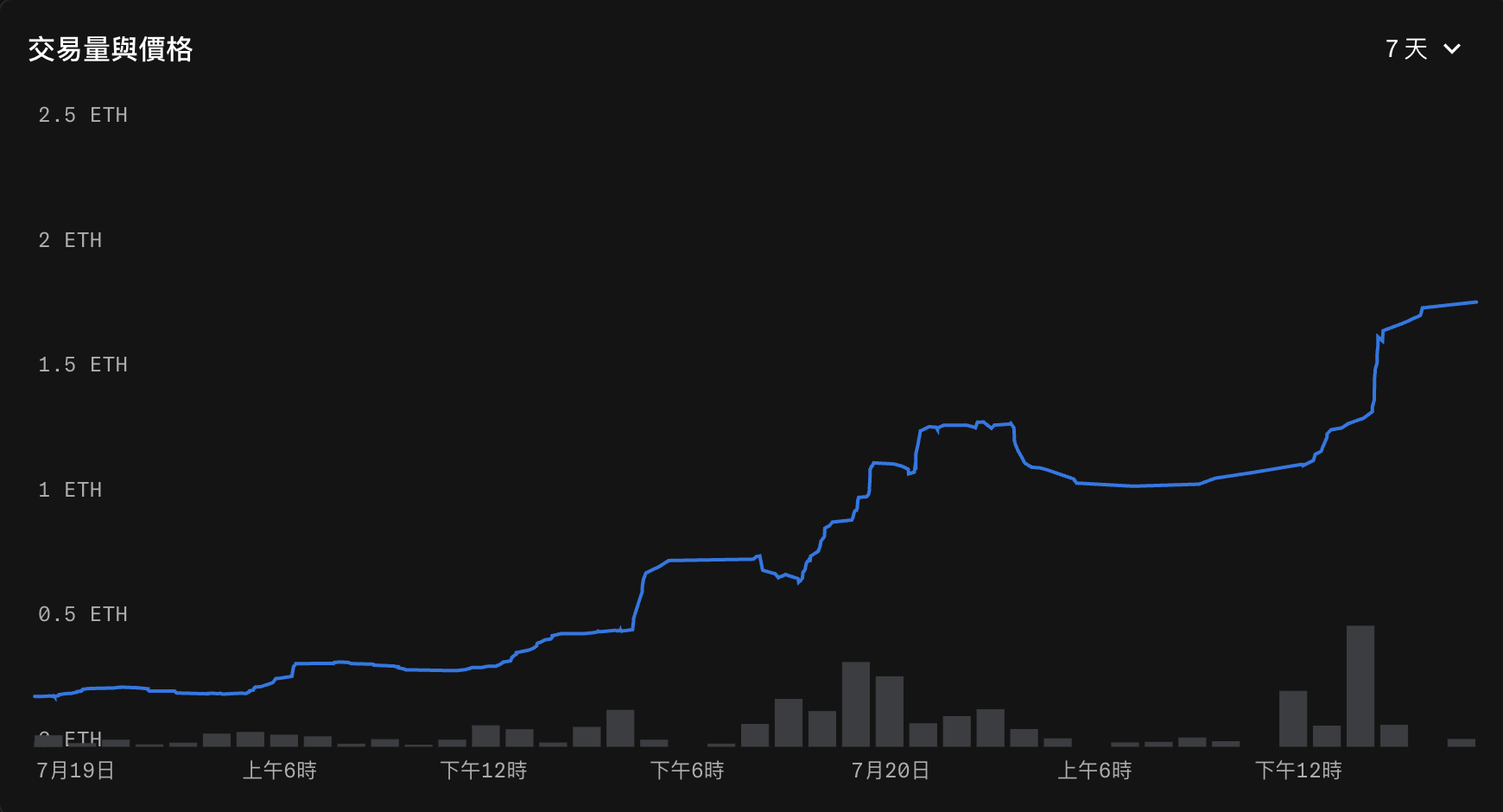

StonkBrokers NFT trading volume and price, Source: OpenSea


Who is CLUTCH, and What is StonkBrokers?


CLUTCH, more fully known as Clutch Labs, is an independent Web3 development team focused on on-chain market infrastructure. Its publicly disclosed products involve directions such as prediction markets, NFT liquidity protocols, perpetual contracts, on-chain games, and AI Agents.


The CLUTCH website lists 0xSimpleFarmer as a project builder, and their X account also introduces themself as the founder of Clutch Markets.


CLUTCH didn't start developing products with StonkBrokers. According to the timeline on its website, the team initially entered the market with on-chain parlay prediction markets and subsequently launched products like prediction markets, Clutch Puppies, Pixel Pups, an NFT marketplace, and the Anvil NFT AMM on networks such as Arbitrum, ApeChain, and Ethereum.


StonkBrokers can be understood as CLUTCH's combinatorial attempt, applying their previous experience with NFTs, AMMs, and DeFi on the Robinhood Chain.


The project was originally an experimental development by the team on the Robinhood Chain testnet during the Arbitrum Buildathon. 0xSimpleFarmer stated that this test version was showcased by the Robinhood Chain team at the event. About seven months later, the project launched on the Robinhood Chain mainnet on July 17, 2026, and completed the issuance of 4444 NFTs.


The mainnet launch of StonkBrokers was described by the project as a "free mint," but "free" here only refers to the NFT mint price being 0, not that all participants could obtain NFTs at zero cost. Users needed to burn the Pup Cup NFT on Ethereum or the Clutch Puppies NFT on ApeChain before the deadline to receive corresponding StonkBrokers minting slots, with one old NFT corresponding to one slot. This channel is now closed, and all 4,444 StonkBrokers have been minted. To obtain an NFT now, one must purchase it through the Anvil AMM or on the secondary market.


How Do NFTs, Bound Accounts, and the STONKBROKER Token Connect?


Each StonkBroker NFT is associated with an ERC-6551 Token-Bound Account.


In simple terms, an NFT is not just a picture in a wallet; it itself possesses an on-chain account. This account can hold ERC-20 tokens or other on-chain assets, and control of the account follows the transfer of NFT ownership: whoever owns the NFT can control its bound wallet.


The NFT receives initial stock tokens upon minting, and subsequent stock token rewards also go directly into the corresponding bound account. If a StonkBroker's bound account holds stock tokens, these assets will transfer along with the NFT to the new holder.


The StonkBroker NFT is a non-fungible ERC-721 asset, with a total supply of 4444; STONKBROKER is a freely divisible and transferable ERC-20 token. The two are connected via CLUTCH's Anvil NFT AMM.


The protocol sets a base redemption unit of 666,666 STONKBROKER tokens for each NFT. Users can pay 666,666 STONKBROKER plus a transaction fee in ETH to the Anvil treasury to redeem the next NFT from the treasury; if a specific token ID is desired, they can use the "snipe" function to select a designated NFT (with a higher ETH fee). The project's current documentation lists ETH transaction fees as 10% for regular redemption and 15% for designated NFT redemption. Relevant parameters should still be verified against the actual trading interface and contract calls.


This structure can, to some extent, address liquidity issues for certain NFTs. Traditional NFT trading relies on buyers and sellers placing orders; if an NFT temporarily has no buyer, the holder might find it difficult to exit immediately. Anvil establishes a protocol-based redemption channel between NFTs and ERC-20 tokens of the same series.


It's important to note that "each NFT corresponds to 666,666 tokens" should not be misinterpreted as a risk-free price guarantee. Both NFTs and STONKBROKER will fluctuate with market trading, and the actual value paid or received by users is also affected by token price, ETH fees, treasury inventory, and protocol parameters.


Furthermore, Anvil provides a protocol-level redemption channel with a 10%/15% ETH fee, which is better than having no liquidity, but it is not a low-cost, high-efficiency liquidity solution.


From Activation to Clock In: How Are Stock Token Rewards Generated?


However, initial stock token funding and subsequent rewards are two different mechanisms. Subsequent stock token rewards supported by Anvil trading fees will only be distributed to already activated StonkBrokers, with weights calculated based on activation level.


Merely holding a StonkBroker does not mean automatically receiving subsequent stock token rewards. Holders need to first activate the NFT using STONKBROKER tokens on the project's page to include it in the reward distribution system.


The current StonkBrokers documentation sets five activation tiers: the base tier requires 66,666 STONKBROKER, the highest tier requires 1,666,666, with corresponding reward weights increasing from 1x to approximately 3.33x.
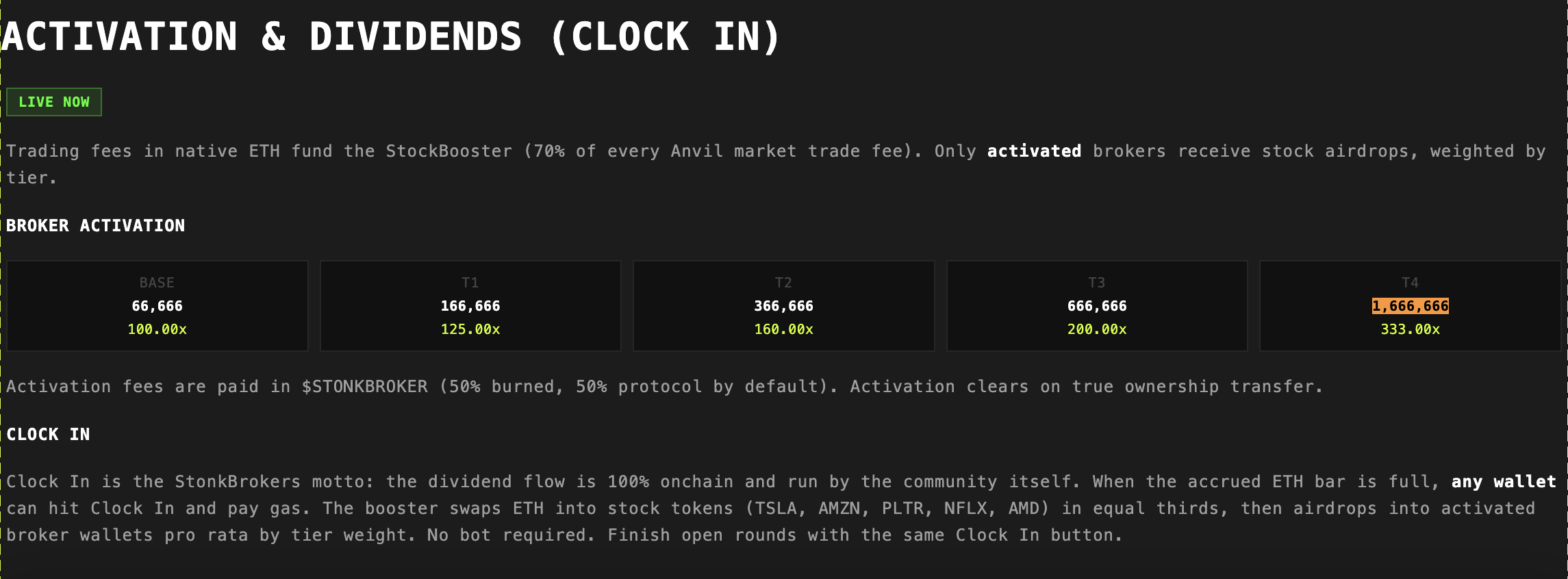


According to current contract parameters, the StonkBroker activation fee is set by default to 50% burned and 50% sent to the protocol; after a genuine ownership transfer of the NFT, the previous activation status is cleared, and the new holder needs to reactivate. However, stock tokens already deposited into the bound account are not cleared.


The funds for stock token rewards currently primarily come from Anvil's ETH transaction fees. According to the current documentation, 70% of these fees go to StockBooster, and 30% go to the protocol. When StockBooster accumulates to a set condition, any user can call the "Clock In" function and pay Gas, triggering the protocol to swap ETH for the currently configured stock tokens, which are then distributed to the bound wallets of each NFT based on activation level weights.


The whole process can be simplified as:


Trading NFTs on Anvil generates ETH fees → 70% of fees go to StockBooster → Community users call Clock In → ETH is swapped for stock tokens → Stock tokens enter the bound accounts of activated NFTs.


From NFT Lending to Launcher and vDEX


On top of this, StonkBrokers also offers NFT collateralized lending functionality. Holders can lock their NFT into the Loan Vault to borrow principal denominated in STONKBROKER. Documentation lists the principal benchmark as 666,666 STONKBROKER, with borrowing fees prepaid in ETH and calculated based on loan duration, a 15% annualized fee rate, and the ETH market value of the NFT.


Borrowing fees are also distributed with 70% going to StockBooster and 30% to the protocol. After the borrower repays the agreed amount of STONKBROKER, they can retrieve the NFT; if overdue, additional ETH fees must be paid, and persistent default may lead to loss of the pledged NFT.


Furthermore, StonkBrokers will subsequently launch the launch platform Stonk Launcher and Stonk Exchange on July 30.


Among these, the launch platform supports fixed-price, bonding curve, and custom launch configurations. According to the project design, this step will also automatically create LP positions, fee distribution contracts, and the token's own staking vault. Token holders can deposit newly issued tokens into the staking vault and share the corresponding LP fees proportionally.


The project describes Stonk Launcher as a launch platform governed by STONKBROKER holders and activated StonkBroker NFTs, sharing governance and fee streams. A portion of the fees and royalties generated by Launcher is planned to support stock token rewards. Specific allocation ratios and implementation methods still need to be verified against the officially deployed mainnet contracts.


The Stonk Exchange, accompanying Launcher, is scheduled to launch on August 29 at 8:00 PM Eastern Time, corresponding to the morning of August 30 Beijing time. The project calls it a "Vote Directed DEX," or vDEX for short, meaning a DEX where the flow of trading fees can be determined by voting.


At the basic trading level, Stonk Exchange plans to adopt the Uniswap V3 architecture. Users can perform token swaps, create concentrated liquidity pools, and allocate funds within custom price ranges. Unlike traditional AMMs that spread liquidity uniformly across the entire price range, Uniswap V3 liquidity providers can concentrate their capital in price ranges expected to be more active to improve capital efficiency. However, once the price moves outside the selected range, the LP position may stop earning trading fees and face risks like impermanent loss.


Project documentation outlines three tiers of trading fees: 0.05% primarily for relatively stable trading pairs, 0.3% for ordinary pairs, and 1% for assets with lower liquidity or higher volatility. STONKBROKER is planned as a governance tool, allowing holders to vote on the direction of some fee flows, such as which liquidity pools or ecosystem incentive programs receive support.


It's important to distinguish that existing information does not confirm that trading fees generated by Stonk Exchange will be fixedly directed to StockBooster or the stock token reward system. What can be confirmed currently is that the flow of these fees will be determined by STONKBROKER governance mechanisms; whether they are used for stock token rewards still depends on the contract design and governance outcomes at that time.


Conclusion


The most noteworthy aspect of StonkBrokers might not be "how much ETH an NFT rose to" or "how high the token's market cap climbed," but rather its attempt to answer a long-standing question plaguing the NFT market: beyond being a profile picture or community status symbol, can an NFT become a truly operable on-chain account and maintain an ongoing relationship with trading, lending, and RWA?


CLUTCH has already deployed part of the mechanism to the mainnet, but subsequent modules like Stonk Launcher and Stonk Exchange still await delivery. Whether StonkBrokers ultimately forms a sustainable on-chain financial system or merely completes a high-volatility product experiment under attention remains to be answered by real protocol revenue, subsequent product implementation, and more thorough security verification.


Simultaneously, the Robinhood Chain ecosystem is still in its early stages, with network activity, asset liquidity, and infrastructure maturity all requiring observation. StonkBrokers also faces uncertainties such as smart contract security, team delivery, governance parameter adjustments, and regulatory policy changes. Its NFTs, STONKBROKER token, and related stock tokens may all experience significant price volatility. The stock token rewards mentioned by the project are not equivalent to stable returns or traditional stock dividends, and participants still need to fully assess the associated risks.


Câu hỏi Liên quan

QWhat is StonkBrokers and how does it utilize NFTs?

AStonkBrokers is a Web3 project built on Robinhood Chain that utilizes 4,444 unique pixel broker NFTs. Each NFT is associated with an ERC-6551 Token-Bound Account, essentially giving it its own wallet capable of receiving tokenized stock rewards. These NFTs can be activated with the project's native token (STONKBROKER) to increase their reward weight, used as collateral for loans, and traded through the Anvil NFT AMM.

QWhat is the purpose of the STONKBROKER token within the ecosystem?

AThe STONKBROKER token is the ERC-20 utility and governance token of the StonkBrokers ecosystem. Its primary functions include: activating StonkBroker NFTs to qualify them for stock token rewards and increase their reward weight, serving as the quote asset for NFT/ERC-20 swaps on the Anvil AMM, and being the currency for governance votes that direct fee flows within the upcoming Stonk Exchange (vDEX).

QHow does the 'stock token' reward mechanism for activated NFTs work?

AStock token rewards for activated NFTs are funded primarily by ETH transaction fees generated from trading NFTs on the Anvil AMM. 70% of these fees go into a 'StockBooster' pool. When a user triggers the 'Clock In' function, the protocol swaps the accumulated ETH in the StockBooster for the configured stock tokens. These tokens are then distributed to the Token-Bound Accounts of all *activated* NFTs, with the amount each receives weighted by its activation level.

QWhat is the Stonk Exchange (vDEX), and how does it differ from a traditional DEX?

AStonk Exchange is a planned decentralized exchange (DEX) that the article calls a 'Vote Directed DEX' (vDEX). While it will be built on Uniswap V3 architecture for core trading functionality, its key differentiator is governance. Holders of STONKBROKER tokens can vote to direct where a portion of the trading fees generated on the exchange are allocated, such as to specific liquidity pools or ecosystem incentive programs.

QWhat are some of the key risks or challenges associated with StonkBrokers mentioned in the article?

AThe article highlights several risks: 1) The project's full vision (Stonk Launcher and Stonk Exchange) is not yet deployed. 2) The ecosystem is built on the early-stage Robinhood Chain, which may have limited network activity and liquidity. 3) The project faces standard Web3 risks like smart contract security, team execution, and potential regulatory changes. 4) All assets (NFTs, STONKBROKER, stock tokens) are subject to high price volatility, and stock token rewards are not guaranteed stable income or traditional dividends.

Nội dung Liên quan

Sau ba quý liên tiếp suy giảm, thị trường tiền điện tử có thể đón cửa sổ ổn định trong quý III?

Thị trường tiền mã hóa vừa trải qua quý tồi tệ nhất kể từ năm 2022, với vốn hóa giảm 12.6% xuống 2.1 nghìn tỷ USD, khối lượng giao dịch sụt giảm và dòng tiền rút mạnh khỏi các quỹ ETF Bitcoin. Bitcoin và Ethereum lần lượt giảm 14.2% và 25.4% trong quý, đánh dấu sự đảo ngược so với mối tương quan trước đây với các tài sản rủi ro như Nasdaq. Dòng vốn ETF chứng khoán Mỹ ghi nhận dòng ròng rút khoảng 46.7 tỷ USD trong quý II, báo hiệu áp lực bán. Tuy nhiên, dấu hiệu tích cực ban đầu xuất hiện khi các nhà đầu tư dài hạn bắt đầu tích lũy trở lại và dòng ETF có đợt thu hút ngắn hạn. Toàn bộ thị trường hiện tập trung vào cuộc họp của Cục Dự trữ Liên bang Mỹ (FOMC) vào cuối tháng 7. Các tín hiệu chính sách tiền tệ sẽ quyết định xu hướng: tín hiệu ôn hòa có thể đẩy Bitcoin lên vùng 68,000-84,000 USD, trong khi lập trường cứng rắn có thể kéo giá về vùng 50,000-56,000 USD. Tiến trình pháp lý của Đạo luật CLARITY gần như đình trệ, làm giảm kỳ vọng và gia tăng phí rủi ro cho toàn ngành. Trong bối cảnh ảm đạm, hai lĩnh vực nổi bật là thị trường dự đoán (tăng trưởng 48.7%) và bộ sưu tập kỹ thuật số được mã hóa (tăng ~143%), cho thấy sự chuyển dịch nhu cầu thực tế. Nhìn chung, thị trường thiếu động lực cho một đợt tăng trưởng mạnh dựa trên tâm lý. Các quyết định giao dịch trong quý III sẽ chủ yếu xoay quanh diễn biến giá, lựa chọn chính sách và kỳ vọng lãi suất.

marsbit23 giờ trước

Sau ba quý liên tiếp suy giảm, thị trường tiền điện tử có thể đón cửa sổ ổn định trong quý III?

marsbit23 giờ trước

Giao Dịch SpaceX, Đã Mở Khóa: SPCXON Được Giao Dịch Trên WEEX

SpaceX đã thực hiện đợt IPO lớn nhất lịch sử vào tháng 6/2026, nhưng nhiều nhà giao dịch không thể tiếp cận do các rào cản như hạn chế môi giới và khu vực. Sàn giao dịch tiền điện tử WEEX đã giới thiệu SPCXON/USDT, một công cụ token hóa cho phép tiếp cận biến động giá của SpaceX thông qua tài khoản crypto được quyết toán bằng USDT, mà không cần môi giới Mỹ hay tài khoản ngân hàng. Sản phẩm này, xây dựng trên nền tảng cổ phiếu token hóa của Ondo, dành cho các nhà giao dịch bên ngoài Hoa Kỳ. Trường hợp đầu tư dựa trên đà tăng doanh thu Starlink và các cột mốc Starship, trong khi các yếu tố cần thận trọng bao gồm định giá cao, lượng cổ phiếu lưu hành công chúng ít và sự kiện mở khóa cổ phiếu nội bộ sắp tới. Lưu ý quan trọng: SPCXON cung cấp mức tiếp xúc với hiệu quả kinh tế, không phải quyền sở hữu cổ phiếu trực tiếp, và có thể giao dịch ở mức cao hơn hoặc thấp hơn giá trị tài sản ròng. WEEX tích hợp SPCXON cùng các sản phẩm TradFi token hóa khác như MicroStrategy (MSTRON) và Micron (MUON) vào một tài khoản thống nhất, cho phép luân chuyển giữa crypto và cổ phiếu dễ dàng. Sàn cũng đang chạy chiến dịch TradFi Trading Challenge với quỹ thưởng $50,000.

TheNewsCryptoHôm qua 08:32

Giao Dịch SpaceX, Đã Mở Khóa: SPCXON Được Giao Dịch Trên WEEX

TheNewsCryptoHôm qua 08:32

BIT Trading Hours: BTC Vẫn Chịu Áp Lực Từ Đường MA 200 Tuần, Bị Từ Chối Có Thể Tái Khởi Động Đợt Giảm, Ngành Lưu Trữ và Bán Dẫn Tăng Mạnh Đêm Qua Bắt Đầu Giảm Trong Khung Giờ Giao Dịch Ban Đêm

Bitcoin (BTC) hiện giao dịch quanh mức $66,000, đối mặt với vùng kháng cự mạnh gần $68,000 - nơi tập trung nhiều lệnh mua trước đó có thể chốt lời. Về mặt kỹ thuật, BTC đang nằm giữa đường trung bình động 200 tuần (MA ~$63,333) và đường trung bình động hàm mũ 200 tuần (EMA ~$68,328). Việc không thể vượt qua mức $68,000 có thể kéo giá về kiểm tra lại vùng hỗ trợ $63,000. Thị trường hiện có tính thanh khoản thấp và được xem là đang trong đợt phục hồi nhẹ. Trên thị trường chứng khoán Mỹ, các chỉ số tương lai giảm nhẹ. Nhóm cổ phiếu bán dẫn và lưu trữ, vốn tăng mạnh vào đêm trước, đã điều chỉnh giảm trong phiên giao dịch ngoài giờ. Tuy nhiên, Super Micro Computer (SMCI) tăng mạnh sau báo cáo doanh thu và đơn đặt hàng tích cực. Dầu thô tăng (trên $91) và lợi suất trái phiếu kho bạc Mỹ tăng cao tiếp tục gây áp lực lên thị trường cổ phiếu và làm dấy lên lo ngại lạm phát. Tại châu Á, thị trường Hàn Quốc phục hồi nhẹ cùng với cổ phiếu công nghệ, trong khi Nhật Bản thận trọng do đồng Yên yếu kỷ lục. Các sự kiện quan trọng sắp tới bao gồm báo cáo thu nhập từ các gã khổng lồ công nghệ như Alphabet, Tesla, IBM; sự kiện AI của AMD; và cuộc họp chính sách tiền tệ của Ngân hàng Trung ương châu Âu.

marsbitHôm qua 08:31

BIT Trading Hours: BTC Vẫn Chịu Áp Lực Từ Đường MA 200 Tuần, Bị Từ Chối Có Thể Tái Khởi Động Đợt Giảm, Ngành Lưu Trữ và Bán Dẫn Tăng Mạnh Đêm Qua Bắt Đầu Giảm Trong Khung Giờ Giao Dịch Ban Đêm

marsbitHôm qua 08:31

Chủ tịch CFTC cũ, Chủ tịch Circle Tarbert: Một mặt khuyên bạn chủ nghĩa dài hạn, mặt kia tự mình thoái vốn 30 triệu USD

Tác giả: Zen, PANews Trước tình cảnh cổ phiếu Circle (CRCL) giảm 70% so với đỉnh và bị hạ xếp hạng, Chủ tịch Heath Tarbert - cựu Chủ tịch CFTC - trong một cuộc phỏng vấn ngày 14/7 đã kêu gọi các nhà đầu tư kiên nhẫn và tập trung vào tầm nhìn dài hạn của công ty. Tuy nhiên, hành động của ông lại trái ngược hoàn toàn. Kể từ khi Circle IPO, Tarbert đã không ngừng bán cổ phiếu CRCL thông qua kế hoạch giao dịch 10b5-1 được lập trước, thu về tổng cộng khoảng 30 triệu USD. Ông chưa từng mua lại cổ phiếu trên thị trường mở, ngay cả khi giá cổ phiếu lao dốc. Bài viết nêu bật sự mâu thuẫn giữa lời nói "chủ nghĩa dài hạn" và hành động "thoái vốn" mạnh tay của Tarbert. Sự nghiệp của ông được mô tả là điển hình của "cánh cửa xoay" chính trị-thương mại Mỹ: từ các vị trí cấp cao tại Bộ Tài chính và CFTC, ông nghỉ hưu chỉ 27 ngày trước khi gia nhập Citadel Securities - một nhà tạo lập thị trường lớn - vào thời điểm công ty này đang đối mặt với cuộc điều tra của Quốc hội sau sự kiện GameStop. Sau đó, ông chuyển sang Circle, nơi ông được cho là đã sử dụng kinh nghiệm và quan hệ quản lý để giúp công ty vượt qua các rào cản pháp lý và niêm yết thành công. Bài báo đặt câu hỏi liệu Tarbert có thực sự tin vào tương lai dài hạn của Circle hay không, khi mà ông liên tục chốt lời trong khi lại khuyên các cổ đông nhỏ lẻ giữ vị thế. Nó gợi ý rằng mô hình của ông là tận dụng tối đa kiến thức về chu kỳ chính sách và cơ hội thị trường để biến các nguồn lực và uy tín tích lũy được thành lợi thế nghề nghiệp và tài chính cá nhân, trong khi rủi ro dài hạn được chuyển sang cho các nhà đầu tư tin tưởng vào những tường thuật công khai của ông.

marsbitHôm qua 08:08

Chủ tịch CFTC cũ, Chủ tịch Circle Tarbert: Một mặt khuyên bạn chủ nghĩa dài hạn, mặt kia tự mình thoái vốn 30 triệu USD

marsbitHôm qua 08:08

Gate Research: Làn sóng "phố Wall hóa" trong các sản phẩm tài chính tiền điện tử - Cạnh tranh hay Hội tụ?

Gate Research Institute: Sự hòa hợp hay cạnh tranh trong làn sóng "phố Wall hóa" các sản phẩm tài chính tiền mã hóa? Từ tầm nhìn ban đầu về một hệ thống tài chính phi tập trung, loại bỏ trung gian của Bitcoin, thị trường tiền mã hóa đang chứng kiến sự hội tụ mạnh mẽ với tài chính truyền thống (TradFi). Các quỹ ETF Bitcoin, tài sản thế giới thực được mã hóa (RWA) và trái phiếu chính phủ trên chuỗi cho thấy các tổ chức như BlackRock, Fidelity đang đưa tài sản mã hóa vào hệ thống phát hành, định giá, lưu ký và phân phối truyền thống. Tuy nhiên, đây không phải là một trò chơi tổng bằng không. Xu hướng này thể hiện sự bổ sung lẫn nhau: TradFi cung cấp khung pháp lý, mạng lưới phân phối rộng và sự tin cậy, trong khi Crypto mang lại tính mở, thanh khoản toàn cầu 24/7 và khả năng thanh toán lập trình được. Hai hướng đi tiêu biểu minh chứng cho sự hội tụ hai chiều: các sàn giao dịch tiền mã hóa (CEX) như Gate mở rộng sang giao dịch cổ phiếu thực, ETF thông qua cơ sở hạ tầng môi giới truyền thống; trong khi các công ty môi giới truyền thống như Robinhood tích hợp tài sản mã hóa và phát triển tài sản mã hóa (như cổ phiếu mã hóa) để thu hút người dùng. Mục tiêu chung của cả hai hướng là tranh giành "tài khoản tài chính tổng hợp" thế hệ tiếp theo - một điểm vào duy nhất nơi người dùng có thể giao dịch đa dạng tài sản từ cổ phiếu, tiền mã hóa đến RWA. Sự tăng trưởng mạnh mẽ của thị trường RWA, đặc biệt là cổ phiếu mã hóa, bất chấp xu hướng thị trường giảm, cho thấy đây là một xu hướng cấu trúc thực sự. Kết luận, "phố Wall hóa" không có nghĩa là thị trường tiền mã hóa bị TradFi thôn tính. Thay vào đó, đây là một sự chuyển đổi hai chiều, nơi cả hai hệ thống đang cùng nhau định hình lại thị trường vốn thành một cấu trúc hỗn hợp hiệu quả và toàn cầu hơn, với trải nghiệm người dùng liền mạch cho nhiều loại tài sản khác nhau.

marsbitHôm qua 08:06

Gate Research: Làn sóng "phố Wall hóa" trong các sản phẩm tài chính tiền điện tử - Cạnh tranh hay Hội tụ?

marsbitHôm qua 08:06

Giao dịch

Giao ngay
活动图片




