Mining Stocks Are Moving Further Away from Crypto

链捕手Xuất bản vào 2026-07-17Cập nhật gần nhất vào 2026-07-17

Tóm tắt

Title: Mining Stocks Are Drifting Away from Crypto Summary: Despite Bitcoin (BTC) falling approximately 46% over the past year, leading Bitcoin mining stocks (e.g., HUT, WULF, IREN) have surged significantly. This divergence stems from a fundamental shift in how the market values these companies. Their stock prices are no longer tied primarily to crypto prices, mining output, or hash rates. Instead, investors are now pricing them as AI infrastructure plays. Mining companies possess critical assets for AI data centers: pre-permitted land, grid-connected power capacity, and operational expertise for high-load facilities—resources facing severe shortages and long lead times for new entrants. For example, CleanSpark signed a 20-year, ~$6.6 billion infrastructure lease for an AI data center, while Marathon Digital acquired a project with up to 2 GW of planned power capacity. Analysts note a strong correlation between a mining company's market valuation and its contracted or potential AI power capacity in North America. CoinShares predicts that by year-end, up to 70% of revenue for listed miners could come from AI/HPC, compared to about 30% at the start of 2026. However, this re-rating introduces new risks: 1) Valuation volatility linked to the broader AI/semiconductor sector, 2) Potentially low baseline return rates (estimated at 4-5% for some firms), and 3) Execution risks including massive financing needs, regulatory permits, and tenant quality. This strategic pivot is also ...

Author: Zhou, ChainCatcher

According to RootData market data, over the past year, BTC has fallen by 46.12% cumulatively, yet Bitcoin mining stocks have not declined in sync. Among them, HUT is up 363.26%, WULF up 268.95%, IREN up 121.14%, RIOT up 59.90%, and CLSK up 12.41%.
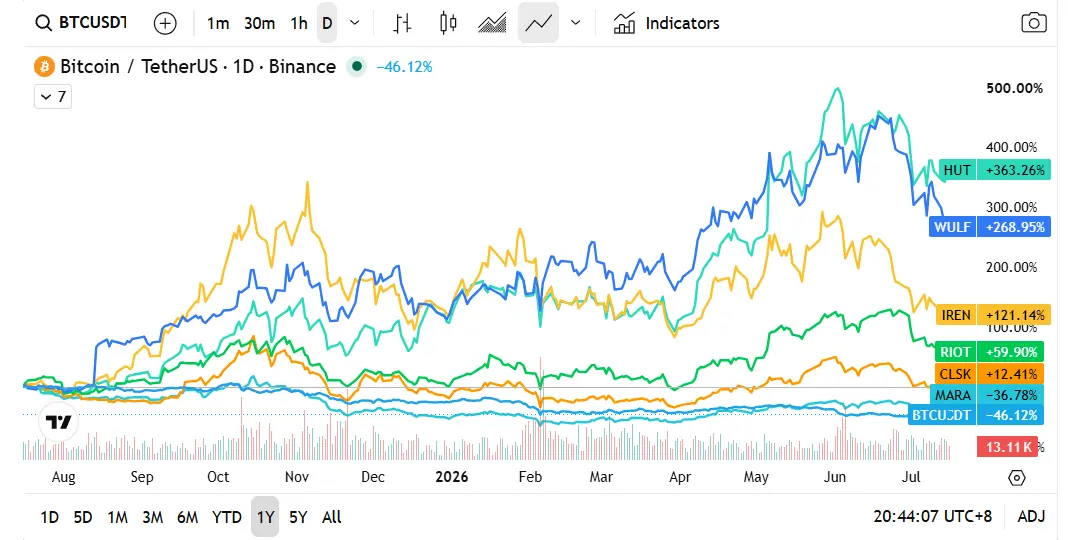
This round of gains is not built upon an improvement in the fundamentals of mining. June operational data shows that, despite consecutive downward adjustments in mining difficulty, CleanSpark, BitFuFu, and Canaan still saw month-on-month production declines ranging from 9% to 29%.

It is not difficult to see that the market's focus has shifted. Since July, CleanSpark signed a 20-year infrastructure lease with an initial period contract value of $6.6 billion, TeraWulf planned to raise $3.5 billion to expand a data center campus, and MARA acquired a Texas project company with a planned power capacity of up to 2 GW for up to $600 million.

Mining stock prices no longer revolve solely around coin prices, production output, and hashrate; the market has begun valuing them by a different set of logic.

The Source of Mining Stock Volatility Is No Longer On-Chain

At the beginning of the month, a typical dislocation occurred in the market, with mining stocks experiencing an overall pullback of about 20%, while BTC remained stable around $64,000.

On the production side, in June, CleanSpark produced 614 BTC, lower than 671 BTC in May, down 9% month-on-month. Its nominal hashrate was 50 EH/s, while its average operational hashrate was only 42.6 EH/s. The gap widened from 3.8 EH/s in May to 7.4 EH/s, indicating downtime or load reduction.

BitFuFu produced 125 BTC, down 29.4% month-on-month. Its total hashrate dropped from 19.5 EH/s to 15.3 EH/s, primarily dragged down by a reduction in third-party hosted hashrate from 16.3 EH/s to 11.8 EH/s.

Canaan produced 64 BTC, down 29% month-on-month, attributing part of the reason to grid maintenance at mining facilities.

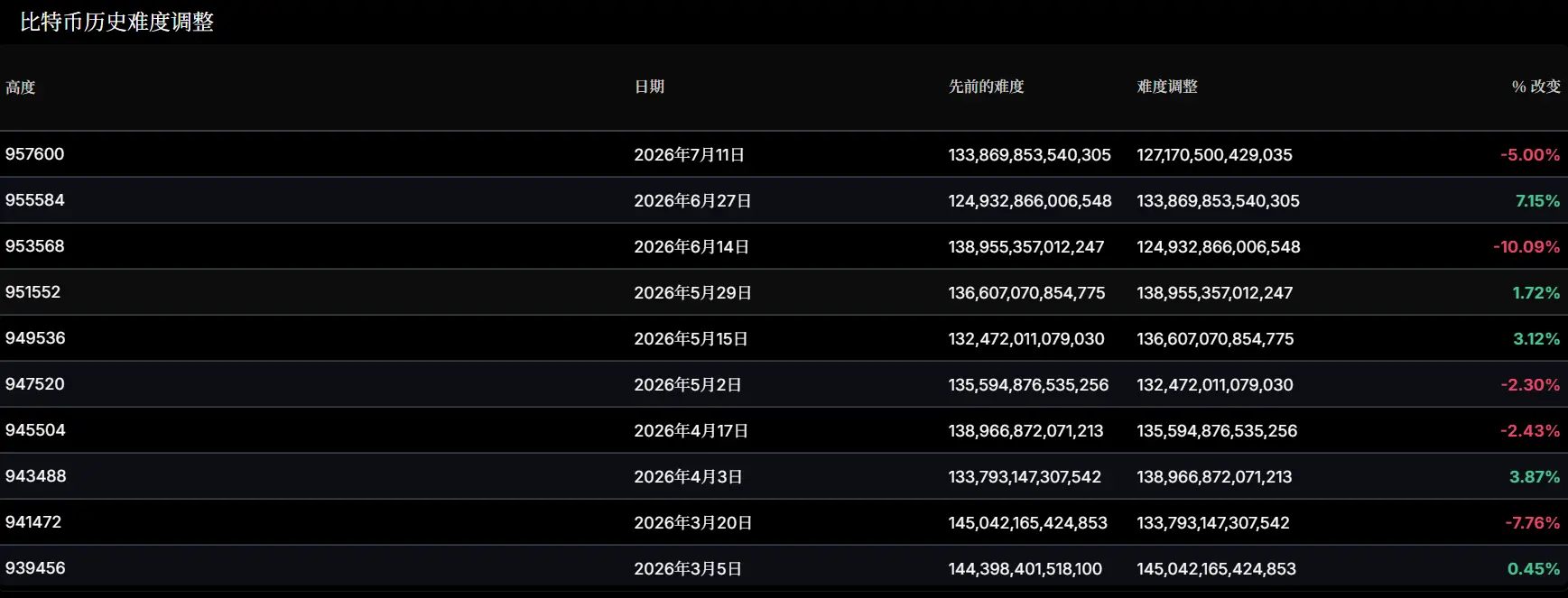
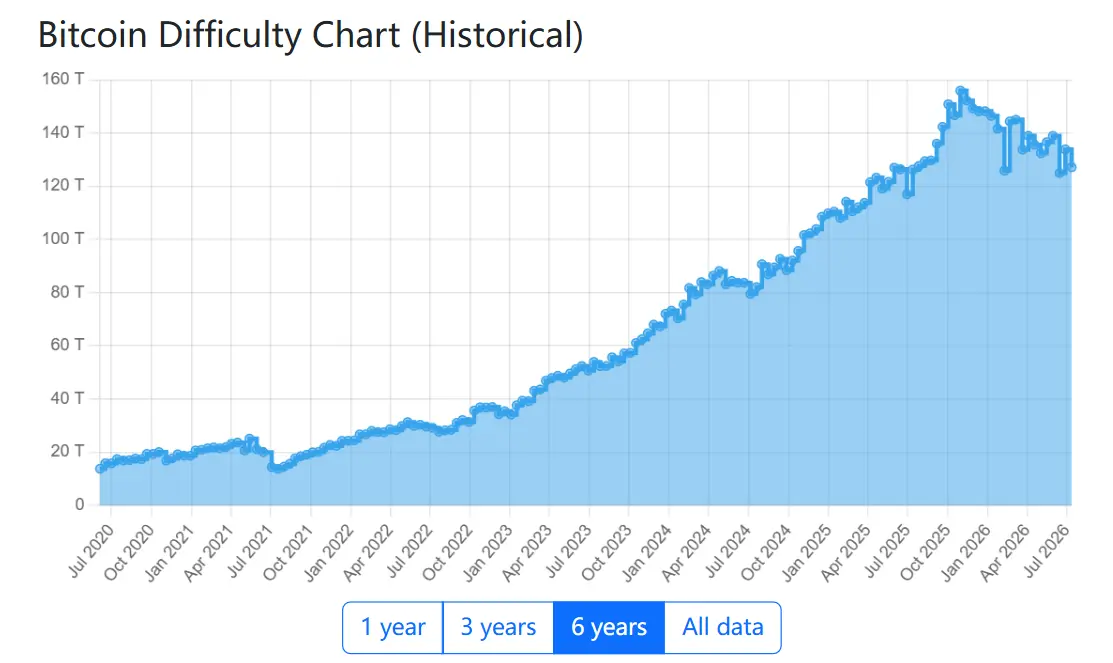
This round of production decline occurred after consecutive difficulty reductions. On June 14th, the Bitcoin network difficulty decreased by 10.09%, the second-largest negative adjustment in 2026. On July 11th, it dropped another 5% to 127.17 T, a cumulative decline of about 18% from the high point of around 155 T in November 2025.

A decrease in difficulty should allow miners remaining in the network to mine more coins per unit of hashrate, yet production output continues to decline.
On the other hand, amidst market downturn and pressure on profitability, some miners are continuously exiting the network or shutting down equipment. Galaxy Research states that miners are entering a capitulation period, representing the largest drawdown since China's comprehensive crackdown on Bitcoin mining in 2021.

The reason for the shakeout is straightforward. According to CoinShares' Q1 2026 mining report, the average cash production cost for listed miners had risen to about $79,995 in Q4 2025. JPMorgan estimates the current production cost at around $78,000, while BTC is currently trading near $64,000. The price gap has persisted for five months, with about 20% of miners operating at a loss.

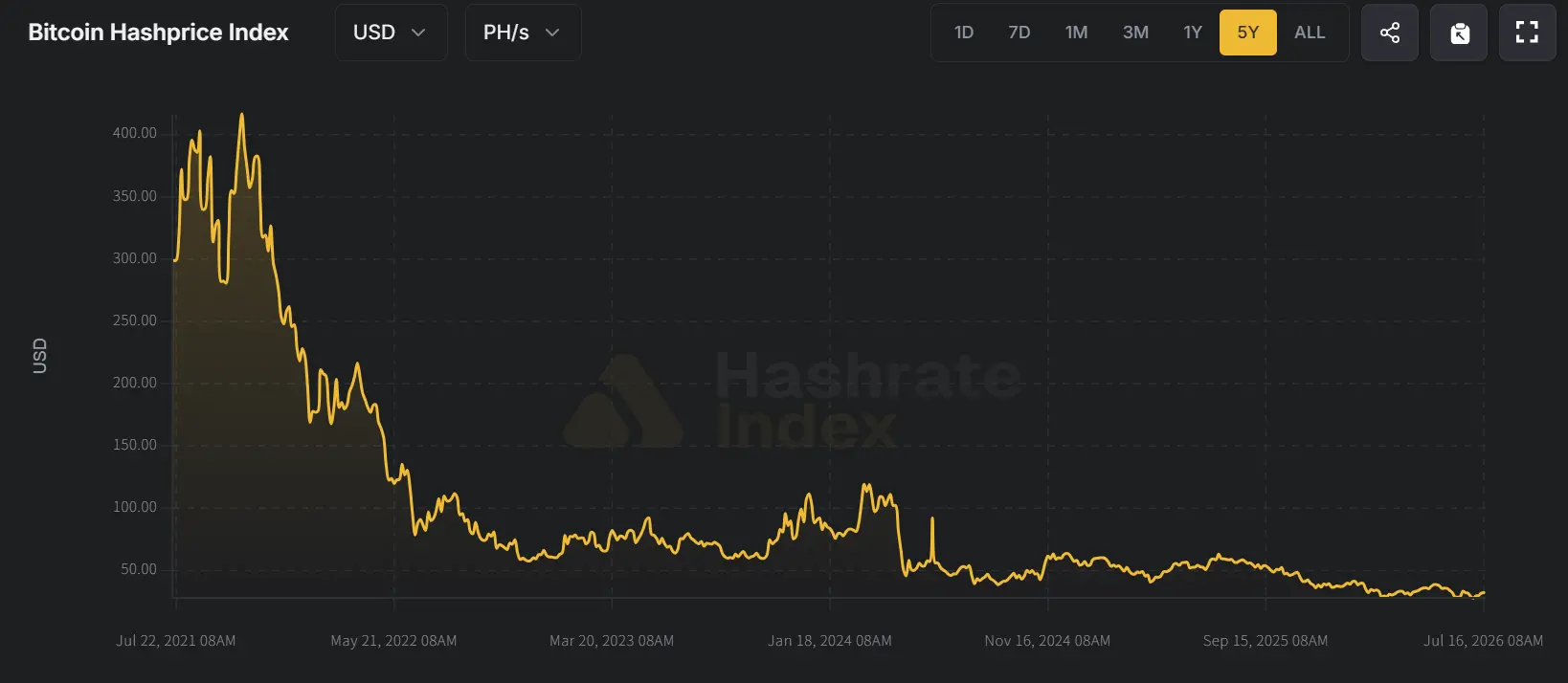
According to Hashrate Index data, around March 2026, the hashprice once fell to a post-halving low of $28 to $30 per PH/s per day. It is currently around $32, still within the lowest historical range.
Reclassified into the AI Infrastructure Valuation Framework

The new logic is not complicated. What AI data centers currently lack the most are grid-connected power capacity, contiguous land, cooling systems, and building shells – resources that miners happen to possess.

They have large-scale grid connection capabilities, sites that can be retrofitted, existing operational systems, and are more familiar with the construction pace of high-load facilities.

PJM data shows that AI infrastructure projects put into operation in 2025 took over seven years on average, with about three years to secure an Interconnection Service Agreement and another four years waiting for grid connection. An already grid-connected mining site essentially skips these seven years, and this is where the value of mining companies lies.

Take CleanSpark for example. On July 14th, the company announced signing a 20-year triple-net lease with an undisclosed, highly investment-grade technology company for its Sandersville campus in Georgia. The initial term contract revenue is about $6.6 billion, corresponding to 175 MW of critical IT load, with delivery starting in Q4 2027. The market reaction was strong, with CLSK rising up to 22% intraday.

Also in July, MARA spent up to $600 million to acquire a Texas campus project company with a planned power capacity of up to 2 GW. However, this company holds a Letter of Intent with a power company. The gap between a Letter of Intent and actual power connection is precisely those seven years.

Furthermore, the credit market is also pricing them with new metrics. According to Bloomberg, TeraWulf plans to raise $3.5 billion led by Morgan Stanley, including leveraged loans and high-yield bonds, to expand its Justified Data campus in Horse Cave, Kentucky. This marks its first foray into the leveraged loan market. Lenders are also beginning to examine miners' balance sheets as infrastructure assets.

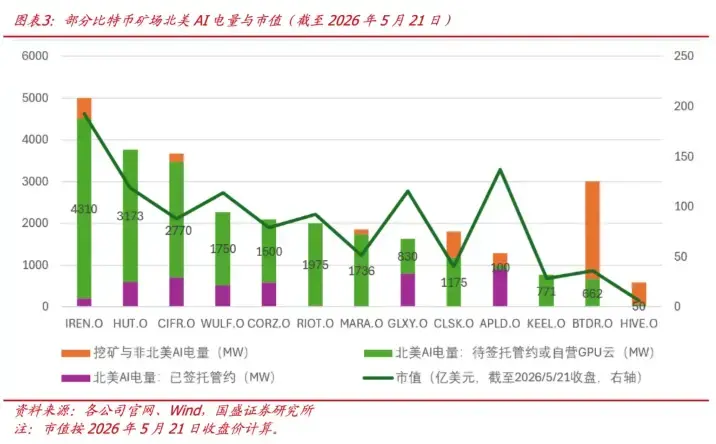
According to Guosheng Securities research, as of early May 2026, signed site hosting, bare metal, and cloud contracts within the sector totaled approximately 3,201 MW of critical IT load, with a total contract value exceeding $91.4 billion. The agency also found that the market capitalization of companies in the sector showed a clear positive correlation with their AI power capacity reserves in North America and their already contracted AI power capacity.
CoinShares expects that by the end of 2026, up to 70% of revenue for listed miners will come from AI and HPC, compared to about 30% at the beginning of the year. TeraWulf has already arrived first; its Q1 HPC leasing revenue was $21 million, surpassing its mining business revenue of less than $13 million for the first time.

The Cost of Revaluation: Three Layers of Risk

The first layer of risk comes from valuation.

If miners are revalued as AI infrastructure, it also means they must bear the overall volatility of the AI narrative.

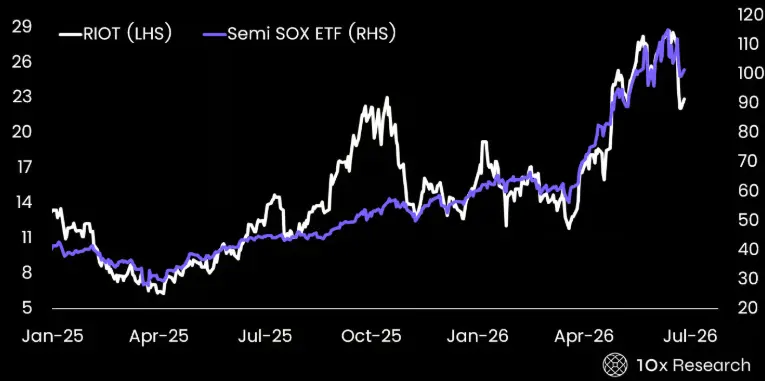
A 10x Research report stated that Bitcoin mining stocks have largely decoupled from the coin price trend. Since April 2026, RIOT's stock price has shown increased correlation with the Philadelphia Semiconductor ETF.

Bitcoin mining companies are now deeply tied to the AI theme. Currently, the AI theme revolves more around the global supply chain and competition rather than crypto adoption or financial digitization. Moreover, the performance of Chinese LLM concept stocks and the prospects of the South Korean semiconductor supply chain are directly affecting Bitcoin mining stock trends.
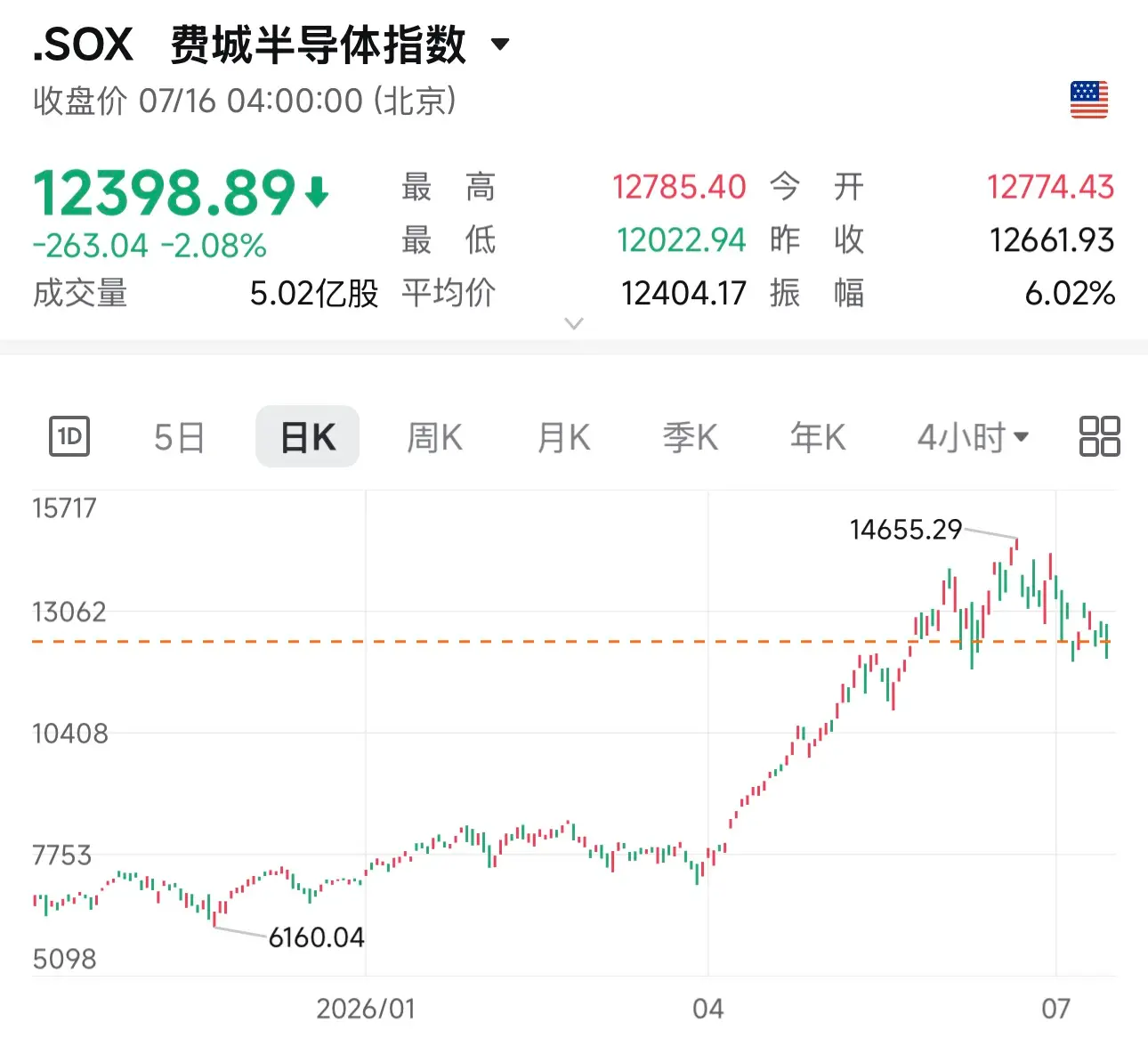
After a significant rally in these sectors, risk appetite is contracting. The Philadelphia Semiconductor Index fell 10.8% over ten trading sessions, with Reuters estimating an evaporation of about $1.3 trillion in market cap across the industry. The root causes identified include doubts about AI infrastructure investment returns, dot-com bubble-level valuations, and a more hawkish Fed.
The second layer of risk comes from return rates.

According to a Bernstein report, Core Scientific's five-year average return on assets from its cooperation with CoreWeave reached 75%, but the driver was the capital expenditure structure rather than the deal terms, with the tenant covering $750 million of the $855 million total cost through revenue prepayments. Riot achieved a 23% return by retrofitting existing mining sites.

However, these two are not industry benchmarks. The report notes that the industry baseline return rate actually falls at TeraWulf 5%, Cipher 4%, CleanSpark 4%.

A report on July 1st stated that Meta plans to launch Meta Compute, selling excess AI training and inference computing power to enterprise clients. That day, the Philadelphia Semiconductor Index fell 6.3%. The next day, SK Hynix CEO Kwak Noh-Jung announced that the SK Group will invest 100 trillion won in South Korea to build AI data centers in phases, starting with 5 GW and eventually expanding to 15 GW.

Meta, as the largest buyer, saying it has excess capacity, and chipmakers saying they will build their own facilities, while miners sign 15 to 20-year long-term contracts, not realized revenue. That's how the 20% pullback in mining stocks at the beginning of the month occurred.

The third layer of risk comes from execution.

Miners are now priced based on the future, not realized revenue. Taking CleanSpark as an example, the company just signed a $6.6 billion long-term contract, but its current revenue still entirely comes from Bitcoin mining; the AI business has not yet generated substantial revenue, with the first delivery not until Q4 2027.

Valuation has moved ahead first, but realization must overcome three major hurdles:

The first hurdle is financing capability. According to CleanSpark's 8-K filing, the campus construction cost is $10 to $12 million per megawatt. For 175 MW, this corresponds to $1.75 to $2.1 billion in capital expenditure, which has not yet been raised. The filing also explicitly states that failure to meet any of the financing, construction, or delivery milestones will trigger rent reductions or even lease termination.

The second hurdle is regulatory approvals. On July 14th, New York Governor Kathy Hochul signed an executive order suspending the issuance of state-level permits for large data centers, with the threshold being a grid demand of over 50 MW. The New York State Department of Environmental Conservation has suspended all discretionary permits not deemed complete before July 14th. The suspension period is tied to the completion of a Generic Environmental Impact Statement rather than a fixed date, up to one year.

The third hurdle is tenant quality. Bernstein points out that tenant quality directly affects the valuation level of miners. Hyperscale cloud providers bring more stable cash flows and lower financing costs, while small GPU cloud service providers correspond to higher operational risks and capital costs.

Miners' Selling Logic Decouples from Coin Price

With the change in valuation logic, miners' behavior has also changed. However, a more direct impact of this shift on the crypto space is reflected in how miners sell coins.

According to industry reports, listed miners collectively sold approximately 32,000 BTC in Q1 2026, a scale that has already exceeded the full year of 2025. Among them, Riot produced 1,473 BTC in Q1 but sold 3,778 BTC in the same period, more than double its production. Its holdings dropped to 15,680 BTC, down 18% year-on-year.

In the past, miners sold coins mainly based on mining cash flow logic – to pay electricity bills, repay loans, and maintain daily operations – holding back during low prices and waiting for a rebound to sell. Now, there is an additional layer of transformation financing logic. Selling coins also makes room for building stations, acquiring land, covering capex, and longer-term AI construction plans.

Therefore, even if the coin price does not experience extreme volatility, miners may continue selling coins.

The same logic also determines whether the hashrate that has left will return.

In the past, hashrate exiting the network was assumed to return when coin prices rebounded and difficulty dropped. After China's comprehensive crackdown on mining in 2021, difficulty plunged 46% but recovered within half a year. But now, what's leaving may not just be mining machines, but also the supporting power supply and capital expenditure.
Current mainstream AI contracts are mostly long-term agreements of over 10 years. Once miners lock their sites, power, and financing structures into such contracts, these resources are unlikely to return flexibly to BTC mining as they did before.

Therefore, mining companies are moving further away from crypto. More accurately, the capital market has already begun valuing them based on their form after leaving the pure mining framework.

They will still affect the Bitcoin network and still generate revenue from mining, but the pursuit of power, land, and long-term leases is turning them into a different type of company.


Tiền kỹ thuật số thịnh hành

Câu hỏi Liên quan

QWhat is the main argument of the article regarding the relationship between Bitcoin mining stocks and the cryptocurrency market?

AThe article argues that Bitcoin mining stocks are increasingly decoupling from the cryptocurrency market. Their prices and valuations are now driven less by Bitcoin's price, mining output, and network hash rate, and more by their potential as infrastructure providers for AI and high-performance computing, leveraging their access to power, land, and existing facilities.

QWhat evidence does the article provide to show the divergence between mining stock performance and Bitcoin's price?

AThe article cites RootData showing that over the past year, BTC price fell by 46.12%, while major mining stocks saw significant gains: HUT (+363.26%), WULF (+268.95%), IREN (+121.14%), RIOT (+59.90%), and CLSK (+12.41%). It also highlights an instance where mining stocks corrected by ~20% while BTC remained stable around $64,000.

QAccording to the article, what new valuation framework is being applied to Bitcoin mining companies?

AThe market is now valuing mining companies as AI infrastructure providers. Their assets—grid-connected power capacity, land parcels, cooling systems, and existing building shells—are highly sought after for building AI data centers. Their valuation is becoming correlated with their AI power reserve capacity and signed contracts rather than just crypto metrics.

QWhat are the three key risks associated with this shift in valuation logic, as outlined in the article?

A1. Valuation Risk: Mining stocks are now exposed to the broader volatility of the AI investment narrative and semiconductor sector performance. 2. Return Risk: The baseline financial returns on these AI infrastructure projects for many miners are relatively low (e.g., 4-5%), and competition from large tech companies building their own capacity threatens demand. 3. Execution Risk: Future revenue is not guaranteed and depends on successful financing, obtaining regulatory permits, and the quality/reliability of the tenant companies signing the long-term leases.

QHow has the shift in business focus affected the selling behavior of mining companies regarding their Bitcoin holdings?

AMining companies are selling Bitcoin more aggressively, not just for operational cash flow but also to fund their transition and capital expenditures for AI infrastructure projects. For example, Riot sold 3,778 BTC in Q1 2026 while producing only 1,473, reducing its holdings. This selling pressure can persist even without extreme Bitcoin price movements, driven by long-term transformation goals.

Nội dung Liên quan

Sau ba quý liên tiếp suy giảm, thị trường tiền điện tử có thể đón cửa sổ ổn định trong quý III?

Thị trường tiền mã hóa vừa trải qua quý tồi tệ nhất kể từ năm 2022, với vốn hóa giảm 12.6% xuống 2.1 nghìn tỷ USD, khối lượng giao dịch sụt giảm và dòng tiền rút mạnh khỏi các quỹ ETF Bitcoin. Bitcoin và Ethereum lần lượt giảm 14.2% và 25.4% trong quý, đánh dấu sự đảo ngược so với mối tương quan trước đây với các tài sản rủi ro như Nasdaq. Dòng vốn ETF chứng khoán Mỹ ghi nhận dòng ròng rút khoảng 46.7 tỷ USD trong quý II, báo hiệu áp lực bán. Tuy nhiên, dấu hiệu tích cực ban đầu xuất hiện khi các nhà đầu tư dài hạn bắt đầu tích lũy trở lại và dòng ETF có đợt thu hút ngắn hạn. Toàn bộ thị trường hiện tập trung vào cuộc họp của Cục Dự trữ Liên bang Mỹ (FOMC) vào cuối tháng 7. Các tín hiệu chính sách tiền tệ sẽ quyết định xu hướng: tín hiệu ôn hòa có thể đẩy Bitcoin lên vùng 68,000-84,000 USD, trong khi lập trường cứng rắn có thể kéo giá về vùng 50,000-56,000 USD. Tiến trình pháp lý của Đạo luật CLARITY gần như đình trệ, làm giảm kỳ vọng và gia tăng phí rủi ro cho toàn ngành. Trong bối cảnh ảm đạm, hai lĩnh vực nổi bật là thị trường dự đoán (tăng trưởng 48.7%) và bộ sưu tập kỹ thuật số được mã hóa (tăng ~143%), cho thấy sự chuyển dịch nhu cầu thực tế. Nhìn chung, thị trường thiếu động lực cho một đợt tăng trưởng mạnh dựa trên tâm lý. Các quyết định giao dịch trong quý III sẽ chủ yếu xoay quanh diễn biến giá, lựa chọn chính sách và kỳ vọng lãi suất.

marsbit21 giờ trước

Sau ba quý liên tiếp suy giảm, thị trường tiền điện tử có thể đón cửa sổ ổn định trong quý III?

marsbit21 giờ trước

Giao Dịch SpaceX, Đã Mở Khóa: SPCXON Được Giao Dịch Trên WEEX

SpaceX đã thực hiện đợt IPO lớn nhất lịch sử vào tháng 6/2026, nhưng nhiều nhà giao dịch không thể tiếp cận do các rào cản như hạn chế môi giới và khu vực. Sàn giao dịch tiền điện tử WEEX đã giới thiệu SPCXON/USDT, một công cụ token hóa cho phép tiếp cận biến động giá của SpaceX thông qua tài khoản crypto được quyết toán bằng USDT, mà không cần môi giới Mỹ hay tài khoản ngân hàng. Sản phẩm này, xây dựng trên nền tảng cổ phiếu token hóa của Ondo, dành cho các nhà giao dịch bên ngoài Hoa Kỳ. Trường hợp đầu tư dựa trên đà tăng doanh thu Starlink và các cột mốc Starship, trong khi các yếu tố cần thận trọng bao gồm định giá cao, lượng cổ phiếu lưu hành công chúng ít và sự kiện mở khóa cổ phiếu nội bộ sắp tới. Lưu ý quan trọng: SPCXON cung cấp mức tiếp xúc với hiệu quả kinh tế, không phải quyền sở hữu cổ phiếu trực tiếp, và có thể giao dịch ở mức cao hơn hoặc thấp hơn giá trị tài sản ròng. WEEX tích hợp SPCXON cùng các sản phẩm TradFi token hóa khác như MicroStrategy (MSTRON) và Micron (MUON) vào một tài khoản thống nhất, cho phép luân chuyển giữa crypto và cổ phiếu dễ dàng. Sàn cũng đang chạy chiến dịch TradFi Trading Challenge với quỹ thưởng $50,000.

TheNewsCrypto21 giờ trước

Giao Dịch SpaceX, Đã Mở Khóa: SPCXON Được Giao Dịch Trên WEEX

TheNewsCrypto21 giờ trước

BIT Trading Hours: BTC Vẫn Chịu Áp Lực Từ Đường MA 200 Tuần, Bị Từ Chối Có Thể Tái Khởi Động Đợt Giảm, Ngành Lưu Trữ và Bán Dẫn Tăng Mạnh Đêm Qua Bắt Đầu Giảm Trong Khung Giờ Giao Dịch Ban Đêm

Bitcoin (BTC) hiện giao dịch quanh mức $66,000, đối mặt với vùng kháng cự mạnh gần $68,000 - nơi tập trung nhiều lệnh mua trước đó có thể chốt lời. Về mặt kỹ thuật, BTC đang nằm giữa đường trung bình động 200 tuần (MA ~$63,333) và đường trung bình động hàm mũ 200 tuần (EMA ~$68,328). Việc không thể vượt qua mức $68,000 có thể kéo giá về kiểm tra lại vùng hỗ trợ $63,000. Thị trường hiện có tính thanh khoản thấp và được xem là đang trong đợt phục hồi nhẹ. Trên thị trường chứng khoán Mỹ, các chỉ số tương lai giảm nhẹ. Nhóm cổ phiếu bán dẫn và lưu trữ, vốn tăng mạnh vào đêm trước, đã điều chỉnh giảm trong phiên giao dịch ngoài giờ. Tuy nhiên, Super Micro Computer (SMCI) tăng mạnh sau báo cáo doanh thu và đơn đặt hàng tích cực. Dầu thô tăng (trên $91) và lợi suất trái phiếu kho bạc Mỹ tăng cao tiếp tục gây áp lực lên thị trường cổ phiếu và làm dấy lên lo ngại lạm phát. Tại châu Á, thị trường Hàn Quốc phục hồi nhẹ cùng với cổ phiếu công nghệ, trong khi Nhật Bản thận trọng do đồng Yên yếu kỷ lục. Các sự kiện quan trọng sắp tới bao gồm báo cáo thu nhập từ các gã khổng lồ công nghệ như Alphabet, Tesla, IBM; sự kiện AI của AMD; và cuộc họp chính sách tiền tệ của Ngân hàng Trung ương châu Âu.

marsbit21 giờ trước

BIT Trading Hours: BTC Vẫn Chịu Áp Lực Từ Đường MA 200 Tuần, Bị Từ Chối Có Thể Tái Khởi Động Đợt Giảm, Ngành Lưu Trữ và Bán Dẫn Tăng Mạnh Đêm Qua Bắt Đầu Giảm Trong Khung Giờ Giao Dịch Ban Đêm

marsbit21 giờ trước

Chủ tịch CFTC cũ, Chủ tịch Circle Tarbert: Một mặt khuyên bạn chủ nghĩa dài hạn, mặt kia tự mình thoái vốn 30 triệu USD

Tác giả: Zen, PANews Trước tình cảnh cổ phiếu Circle (CRCL) giảm 70% so với đỉnh và bị hạ xếp hạng, Chủ tịch Heath Tarbert - cựu Chủ tịch CFTC - trong một cuộc phỏng vấn ngày 14/7 đã kêu gọi các nhà đầu tư kiên nhẫn và tập trung vào tầm nhìn dài hạn của công ty. Tuy nhiên, hành động của ông lại trái ngược hoàn toàn. Kể từ khi Circle IPO, Tarbert đã không ngừng bán cổ phiếu CRCL thông qua kế hoạch giao dịch 10b5-1 được lập trước, thu về tổng cộng khoảng 30 triệu USD. Ông chưa từng mua lại cổ phiếu trên thị trường mở, ngay cả khi giá cổ phiếu lao dốc. Bài viết nêu bật sự mâu thuẫn giữa lời nói "chủ nghĩa dài hạn" và hành động "thoái vốn" mạnh tay của Tarbert. Sự nghiệp của ông được mô tả là điển hình của "cánh cửa xoay" chính trị-thương mại Mỹ: từ các vị trí cấp cao tại Bộ Tài chính và CFTC, ông nghỉ hưu chỉ 27 ngày trước khi gia nhập Citadel Securities - một nhà tạo lập thị trường lớn - vào thời điểm công ty này đang đối mặt với cuộc điều tra của Quốc hội sau sự kiện GameStop. Sau đó, ông chuyển sang Circle, nơi ông được cho là đã sử dụng kinh nghiệm và quan hệ quản lý để giúp công ty vượt qua các rào cản pháp lý và niêm yết thành công. Bài báo đặt câu hỏi liệu Tarbert có thực sự tin vào tương lai dài hạn của Circle hay không, khi mà ông liên tục chốt lời trong khi lại khuyên các cổ đông nhỏ lẻ giữ vị thế. Nó gợi ý rằng mô hình của ông là tận dụng tối đa kiến thức về chu kỳ chính sách và cơ hội thị trường để biến các nguồn lực và uy tín tích lũy được thành lợi thế nghề nghiệp và tài chính cá nhân, trong khi rủi ro dài hạn được chuyển sang cho các nhà đầu tư tin tưởng vào những tường thuật công khai của ông.

marsbit21 giờ trước

Chủ tịch CFTC cũ, Chủ tịch Circle Tarbert: Một mặt khuyên bạn chủ nghĩa dài hạn, mặt kia tự mình thoái vốn 30 triệu USD

marsbit21 giờ trước

Gate Research: Làn sóng "phố Wall hóa" trong các sản phẩm tài chính tiền điện tử - Cạnh tranh hay Hội tụ?

Gate Research Institute: Sự hòa hợp hay cạnh tranh trong làn sóng "phố Wall hóa" các sản phẩm tài chính tiền mã hóa? Từ tầm nhìn ban đầu về một hệ thống tài chính phi tập trung, loại bỏ trung gian của Bitcoin, thị trường tiền mã hóa đang chứng kiến sự hội tụ mạnh mẽ với tài chính truyền thống (TradFi). Các quỹ ETF Bitcoin, tài sản thế giới thực được mã hóa (RWA) và trái phiếu chính phủ trên chuỗi cho thấy các tổ chức như BlackRock, Fidelity đang đưa tài sản mã hóa vào hệ thống phát hành, định giá, lưu ký và phân phối truyền thống. Tuy nhiên, đây không phải là một trò chơi tổng bằng không. Xu hướng này thể hiện sự bổ sung lẫn nhau: TradFi cung cấp khung pháp lý, mạng lưới phân phối rộng và sự tin cậy, trong khi Crypto mang lại tính mở, thanh khoản toàn cầu 24/7 và khả năng thanh toán lập trình được. Hai hướng đi tiêu biểu minh chứng cho sự hội tụ hai chiều: các sàn giao dịch tiền mã hóa (CEX) như Gate mở rộng sang giao dịch cổ phiếu thực, ETF thông qua cơ sở hạ tầng môi giới truyền thống; trong khi các công ty môi giới truyền thống như Robinhood tích hợp tài sản mã hóa và phát triển tài sản mã hóa (như cổ phiếu mã hóa) để thu hút người dùng. Mục tiêu chung của cả hai hướng là tranh giành "tài khoản tài chính tổng hợp" thế hệ tiếp theo - một điểm vào duy nhất nơi người dùng có thể giao dịch đa dạng tài sản từ cổ phiếu, tiền mã hóa đến RWA. Sự tăng trưởng mạnh mẽ của thị trường RWA, đặc biệt là cổ phiếu mã hóa, bất chấp xu hướng thị trường giảm, cho thấy đây là một xu hướng cấu trúc thực sự. Kết luận, "phố Wall hóa" không có nghĩa là thị trường tiền mã hóa bị TradFi thôn tính. Thay vào đó, đây là một sự chuyển đổi hai chiều, nơi cả hai hệ thống đang cùng nhau định hình lại thị trường vốn thành một cấu trúc hỗn hợp hiệu quả và toàn cầu hơn, với trải nghiệm người dùng liền mạch cho nhiều loại tài sản khác nhau.

marsbit21 giờ trước

Gate Research: Làn sóng "phố Wall hóa" trong các sản phẩm tài chính tiền điện tử - Cạnh tranh hay Hội tụ?

marsbit21 giờ trước

Giao dịch

Giao ngay

Bài viết Nổi bật

Làm thế nào để Mua DATA

Chào mừng bạn đến với HTX.com! Chúng tôi đã làm cho mua DATA Network (DATA) trở nên đơn giản và thuận tiện. Làm theo hướng dẫn từng bước của chúng tôi để bắt đầu hành trình tiền kỹ thuật số của bạn.Bước 1: Tạo Tài khoản HTX của BạnSử dụng email hoặc số điện thoại của bạn để đăng ký tài khoản miễn phí trên HTX. Trải nghiệm hành trình đăng ký không rắc rối và mở khóa tất cả tính năng. Nhận Tài khoản của tôiBước 2: Truy cập Mua Crypto và Chọn Phương thức Thanh toán của BạnThẻ Tín dụng/Ghi nợ: Sử dụng Visa hoặc Mastercard của bạn để mua DATA Network (DATA) ngay lập tức.Số dư: Sử dụng tiền từ số dư tài khoản HTX của bạn để giao dịch liền mạch.Bên thứ ba: Chúng tôi đã thêm những phương thức thanh toán phổ biến như Google Pay và Apple Pay để nâng cao sự tiện lợi.P2P: Giao dịch trực tiếp với người dùng khác trên HTX.Thị trường mua bán phi tập trung (OTC): Chúng tôi cung cấp những dịch vụ được thiết kế riêng và tỷ giá hối đoái cạnh tranh cho nhà giao dịch.Bước 3: Lưu trữ DATA Network (DATA) của BạnSau khi mua DATA Network (DATA), lưu trữ trong tài khoản HTX của bạn. Ngoài ra, bạn có thể gửi đi nơi khác qua chuyển khoản blockchain hoặc sử dụng để giao dịch những tiền kỹ thuật số khác.Bước 4: Giao dịch DATA Network (DATA)Giao dịch DATA Network (DATA) dễ dàng trên thị trường giao ngay của HTX. Chỉ cần truy cập vào tài khoản của bạn, chọn cặp giao dịch, thực hiện giao dịch và theo dõi trong thời gian thực. Chúng tôi cung cấp trải nghiệm thân thiện với người dùng cho cả người mới bắt đầu và người giao dịch dày dạn kinh nghiệm.

Tổng lượt xem 114Xuất bản vào 2026.07.01Cập nhật vào 2026.07.01

Làm thế nào để Mua DATA

Thảo luận

Chào mừng đến với Cộng đồng HTX. Tại đây, bạn có thể được thông báo về những phát triển nền tảng mới nhất và có quyền truy cập vào thông tin chuyên sâu về thị trường. Ý kiến ​​của người dùng về giá của DATA (DATA) được trình bày dưới đây.

活动图片












