Hyperliquid Pre-IPO Contract Priced at $7.2 for CXMT, Foreign Capital Intervenes in Chinese Storage Narrative via DeFi

marsbitXuất bản vào 2026-07-16Cập nhật gần nhất vào 2026-07-16

Tóm tắt

On the eve of Changxin Technologies' (CXMT) highly anticipated STAR Market IPO, a novel DeFi platform is enabling a pre-market price discovery. Trade.xyz has deployed a CXMT perpetual contract on the Hyperliquid blockchain, currently trading around $7.2 USDC (implying a market cap of ~$482B). This marks the first time such a "pre-IPO" derivative has targeted a Chinese A-share company. The article highlights several key drivers: overseas investors, restricted by China's 500,000 yuan (~$69,000) STAR Market access threshold, are using this contract as a direct entry point to bet on the "China storage substitution" narrative. Changxin, the world's fourth-largest DRAM supplier, is seen as a major beneficiary of the current AI-driven memory chip shortage. Furthermore, the 24/7, leveraged, and shortable nature of the perpetual contract contrasts with A-shares' T+1 settlement and lack of short-selling mechanisms for such stocks, potentially offering a hedging tool. While the $3.5 trillion implied valuation aligns with optimistic analyst projections, the article notes a critical divergence from similar contracts for U.S. listings like SpaceX: due to capital controls, direct arbitrage between the A-share and the on-chain contract is virtually impossible, meaning a price gap may persist. Nonetheless, the very existence of this parallel market underscores intense global investor interest in China's semiconductor rise, complementing the landmark IPO itself, which aims to raise up to $92...

Author: Claude, Shenchao TechFlow

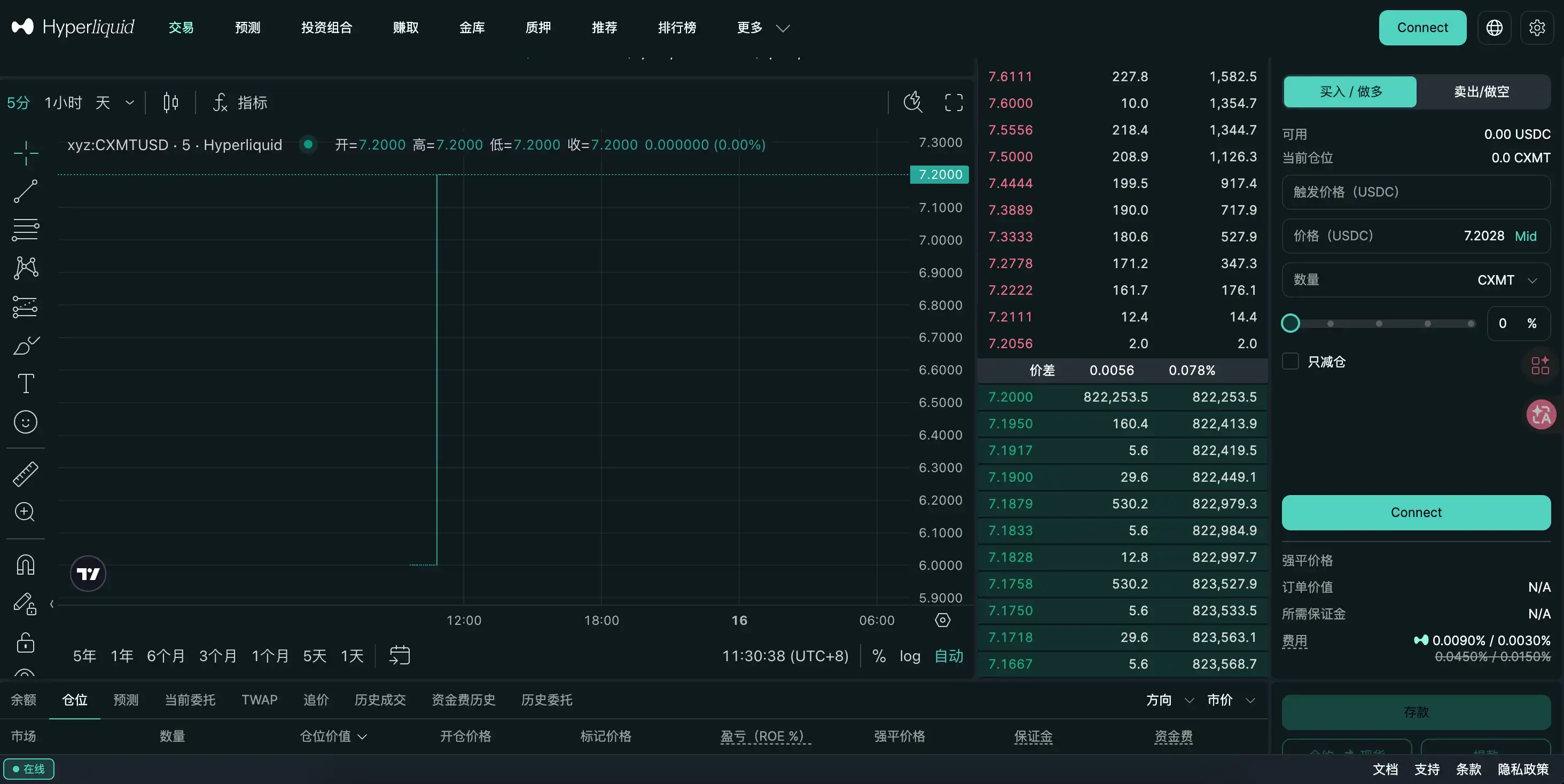
Shenchao Guide: Changxin Technology's STAR Market IPO is priced at 8.66 yuan/share, raising 57.9 billion yuan, with subscriptions starting on July 16. On the eve of subscription, Trade.xyz deployed a CXMT perpetual contract on Hyperliquid. The current trading price is 7.2 USDC (approximately 52 yuan/share). The 24-hour trading volume is $1.32 million, open interest is $2.41 million, and the implied market cap is about 3.5 trillion yuan, at the upper end of institutional expectations of 2-3 trillion yuan. This is the first time a pre-IPO contract on-chain has targeted a STAR Market IPO, and it's the most direct entry point for overseas investors to intervene in the "Chinese Storage Substitution" narrative.
Changxin Technology hasn't rung the bell at the Shanghai Stock Exchange, but price discovery in the crypto market has already begun.

According to a Bloomberg report on July 15, Trade.xyz deployed a Changxin Technology (CXMT) perpetual contract on the Hyperliquid blockchain, with contract code xyz:CXMTUSD. As of writing, the contract's 24-hour trading volume is approximately $1.32 million, open interest is about $2.41 million, and the funding rate is 0.0014%. The price has risen from an initial mark price of around $6 to $7.2, a 20% increase in 24 hours.

This is not Hyperliquid's first attempt at pre-IPO pricing. In May this year, before AI chip company Cerebras went public, the Hyperliquid pre-IPO contract price differed from the Nasdaq opening price by only 1.3%. In June, on SpaceX's IPO day, the on-chain contract saw a single-day trading volume of $1.38 billion. However, targeting a STAR Market-listed company is a first.

$7.2 Equals Approximately 52 Yuan/Share, Implied Market Cap of ~3.5 Trillion Yuan

The contract tracks the per-share price in USDC, using the same logic as the pre-IPO contracts for SpaceX and Cerebras.

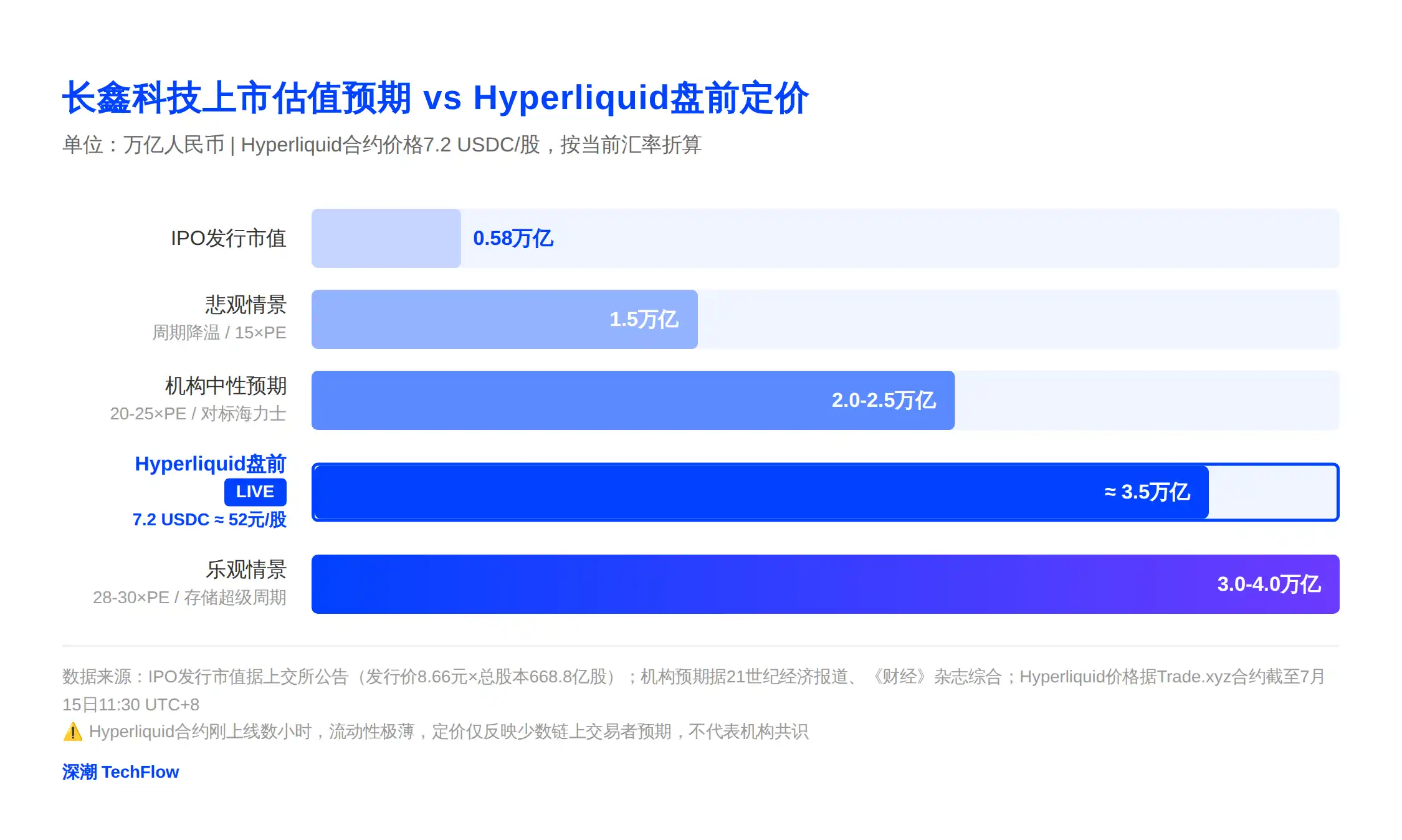
Converted at the current exchange rate, $7.2 is approximately 52 yuan/share. Multiplying by the total post-issuance shares of 66.88 billion, the implied total market capitalization is about 3.5 trillion yuan, roughly 6 times the IPO issuance market cap of 579.2 billion yuan.

This pricing falls within the optimistic range of sell-side institutional expectations. The 21st Century Business Herald quoted investment banking sources saying that Changxin Technology's post-listing valuation is expected to reach 2 to 2.5 trillion yuan; Caijing Magazine, synthesizing calculations from multiple institutions, gave an optimistic scenario of 3 to 4+ trillion yuan. Hyperliquid's pre-market pricing of 3.5 trillion yuan sits between the upper end of the neutral range and the lower end of the optimistic range.

Another interpretation: If these on-chain traders' judgment is accurate, Changxin Technology's stock price may open around 50 yuan on its first trading day, about 6 times the 8.66 yuan issue price. The average first-day gain for STAR Market IPOs in the first half of this year was 489%, so a 6x opening is not unrealistic.

With less than 24 hours since the contract launched, the $1.32 million trading volume and $2.41 million open interest represent preliminary liquidity for the on-chain market, but there's still an order-of-magnitude gap compared to the $1.38 billion single-day trading volume on SpaceX's listing day. This price reflects the directional judgment of early participants, not institutional-grade pricing.
A-Shares Can't Be Sold on Purchase Day, No Short Selling: Perpetual Contracts Naturally Fill the Gap

Why would crypto traders care about a Chinese A-share? The views of some investors on overseas social media platforms might explain. The structural limitations of the A-share market are precisely the opportunity for perpetual contracts.

There are two structural limitations in the A-share market. T+1 settlement means you cannot sell on the same day you buy, and short selling (securities lending) is not available for individual STAR Market stocks. For a stock like Changxin Technology, which may experience massive volatility on its first trading day, A-share holders face an awkward situation: even if they profit from the daily limit-up, they cannot lock in that profit on the same day, fully exposed to the risk of a high-open low-close the next day.

The perpetual contracts on Hyperliquid don't have these restrictions. They trade 24/7, allow both long and short positions, and leverage is adjustable. In theory, investors holding Changxin Technology A-shares could open short positions on Hyperliquid to hedge overnight risks.

However, the absence of an arbitrage path is a real issue. Cerebras and SpaceX listed on Nasdaq, allowing global investors to freely arbitrage between the underlying stock and the contract, leading to rapid price convergence. Changxin Technology is listing on the Shanghai Stock Exchange's STAR Market. The 500,000 yuan asset threshold and QFII quota restrictions prevent the vast majority of overseas retail investors from directly buying the underlying shares.

A price gap may persist long-term between the contract price and the actual A-share trading price, for which investors need to price in an additional premium.

Foreign Capital Can't Buy A-Shares, DeFi Becomes the Entry Point for the "Chinese Storage Substitution" Narrative

Blockchain.News explicitly stated in its report: The CXMT contract provides overseas traders with a channel to bypass the STAR Market's 500,000 yuan threshold.

This demand isn't fabricated. Changxin Technology is the world's fourth-largest DRAM supplier, with a 7.7% global market share in Q1. SemiAnalysis predicts it may surpass Micron to become the world's third-largest by year-end. Apple has begun testing Changxin Technology's DRAM chips for devices in the Chinese market (according to the Financial Times report on July 8). Expected net profit attributable to shareholders for the first half of 2026 is 50 to 57 billion yuan, with a profit margin of about 70%, on par with SK Hynix's 73% and Samsung's 81%.

For a company like this going public, global storage industry investors are paying attention, but most can't buy it. Crypto research firm Citrini has repeatedly recommended Hyperliquid's perpetual contract scenario in paid research reports, while also being bullish on Changxin Technology.

Given foreign capital's inability to directly participate in A-shares, the Hyperliquid contract may become the most convenient channel for them to engage with the "Chinese Storage Substitution" theme.

From a broader perspective, this is the first time DeFi infrastructure is being used to create a parallel pricing market for a STAR Market target. Hyperliquid's HIP-3 framework allows any entity staking 500,000 HYPE tokens (worth approximately $28 million) to deploy a perpetual contract. Trade.xyz, utilizing this mechanism, has successively launched pre-IPO contracts for companies like SpaceX, Cerebras, OpenAI, and Anthropic, generating over $1.46 billion in cumulative trading volume. After TradingView integrated data sources from Hyperliquid and Trade.xyz on July 2, price charts for on-chain perpetual contracts have entered mainstream market terminals.

It's worth noting that Hyperliquid's Policy Center and TradeXYZ recently met with the SEC's Crypto Assets and Cyber Unit to discuss cryptocurrency regulation. Based on the current regulatory trajectory, US regulation is the primary compliance focus for the platform; the Chinese regulatory risk brought by A-share targets is not currently within its consideration.

(Note: Hyperliquid is not available to users in China.)

57.9B in Fundraising, 66B H1 Net Profit: Changxin Technology Itself is the Event of the Year

Returning to the A-share context, even without the Hyperliquid contract, Changxin Technology's IPO itself is already a landmark event in the 2026 Chinese capital market.

The issue price is 8.66 yuan/share. Based on the initial issuance of 6.688 billion shares, it's expected to raise 57.9 billion yuan, nearly double the original plan of 29.5 billion yuan. If the over-allotment option is fully exercised, the fundraising amount will reach 66.6 billion yuan, making it the largest IPO in Asia this year and the largest semiconductor IPO in A-share history. The price-to-earnings (P/E) ratio is 308.92x, far exceeding the industry average of 76.32x. However, the market isn't concerned because the Q1 net profit of 33 billion yuan is rapidly diluting the valuation. The company expects revenue of 110 to 120 billion yuan and net profit attributable to shareholders of 50 to 57 billion yuan for the first half of 2026, representing year-over-year growth exceeding 2244%.

More importantly, timing. The global DRAM market is in a rare super-cycle boom. Samsung, SK Hynix, and Micron are shifting significant capacity to HBM high-bandwidth memory required for AI servers, leading to tight supply of consumer-grade DRAM. In Q1, DRAM contract prices surged 90% to 95% quarter-over-quarter, the largest single-quarter increase in history. Changxin Technology focuses on consumer-grade DDR5 and LPDDR5X products, with a monthly capacity of 200,000 to 300,000 wafers. It is one of the few global manufacturers expanding production of consumer-grade DRAM against the trend, capturing the capacity gap strategically left by the three giants.

On the A-share IPO subscription side, all 71 new IPOs in the first half of this year rose on their debut, with STAR Market IPOs averaging a 489% first-day gain. Retail investors can participate in the online subscription on July 16, subscription code 787825, with an estimated listing date of July 27.

For A-share investors, the July 16 subscription is the main gate. For overseas investors, Hyperliquid's CXMT contract has opened a side door. After the official listing on July 27, whether the contract price can quickly converge to the actual trading price like Cerebras will be a key test to see if this model can be replicated for A-shares. But even if the price doesn't converge, the mere existence of this parallel market itself demonstrates that global capital's interest in the Chinese storage substitution narrative is more than just talk.


Câu hỏi Liên quan

QWhat is the key innovation highlighted in the article regarding Hyperliquid's deployment of the CXMT perpetual contract?

AThe key innovation is that it's the first time a pre-listing perpetual contract on-chain has targeted a company (Changxin Technology) conducting an IPO on China's A-share STAR Market, creating a parallel pricing market for overseas investors unable to access it directly.

QAccording to the article, what are the two main structural limitations of China's A-share market that create an opportunity for the CXMT perpetual contract on Hyperliquid?

AThe two main limitations are the T+1 settlement rule (preventing same-day selling of purchased shares) and the inability to short sell stocks on the STAR Market. These create hedging needs that the 24/7, two-way trading on Hyperliquid can address.

QWhat does the current CXMT contract price of 7.2 USDC imply for Changxin Technology's potential post-IPO market capitalization, and how does this compare to institutional expectations?

AThe 7.2 USDC price (~52 RMB/share) implies a total market capitalization of approximately 3.5 trillion RMB. This figure is at the upper end of institutional expectations, which ranged from 2-2.5 trillion RMB to an optimistic 3-4 trillion RMB or more.

QHow does the article suggest the CXMT perpetual contract serves overseas investors interested in the 'China storage substitution' narrative?

AThe article suggests the contract provides the most direct and accessible entry point for overseas investors to gain exposure to the 'China storage substitution' narrative, as they are largely unable to directly invest in Changxin Technology's A-shares due to the STAR Market's 500,000 RMB asset threshold and QFII quota restrictions.

QWhat is the significance of the convergence (or lack thereof) between the CXMT contract price on Hyperliquid and the actual trading price on the STAR Market after July 27th, according to the article?

AThe convergence (or lack thereof) will be a key test for whether this model of on-chain pre-listing contracts can be successfully replicated for A-share stocks. Successful convergence would validate the price discovery mechanism, but even without convergence, the existence of this parallel market demonstrates significant global capital interest in the narrative.

Nội dung Liên quan

Sau ba quý liên tiếp suy giảm, thị trường tiền điện tử có thể đón cửa sổ ổn định trong quý III?

Thị trường tiền mã hóa vừa trải qua quý tồi tệ nhất kể từ năm 2022, với vốn hóa giảm 12.6% xuống 2.1 nghìn tỷ USD, khối lượng giao dịch sụt giảm và dòng tiền rút mạnh khỏi các quỹ ETF Bitcoin. Bitcoin và Ethereum lần lượt giảm 14.2% và 25.4% trong quý, đánh dấu sự đảo ngược so với mối tương quan trước đây với các tài sản rủi ro như Nasdaq. Dòng vốn ETF chứng khoán Mỹ ghi nhận dòng ròng rút khoảng 46.7 tỷ USD trong quý II, báo hiệu áp lực bán. Tuy nhiên, dấu hiệu tích cực ban đầu xuất hiện khi các nhà đầu tư dài hạn bắt đầu tích lũy trở lại và dòng ETF có đợt thu hút ngắn hạn. Toàn bộ thị trường hiện tập trung vào cuộc họp của Cục Dự trữ Liên bang Mỹ (FOMC) vào cuối tháng 7. Các tín hiệu chính sách tiền tệ sẽ quyết định xu hướng: tín hiệu ôn hòa có thể đẩy Bitcoin lên vùng 68,000-84,000 USD, trong khi lập trường cứng rắn có thể kéo giá về vùng 50,000-56,000 USD. Tiến trình pháp lý của Đạo luật CLARITY gần như đình trệ, làm giảm kỳ vọng và gia tăng phí rủi ro cho toàn ngành. Trong bối cảnh ảm đạm, hai lĩnh vực nổi bật là thị trường dự đoán (tăng trưởng 48.7%) và bộ sưu tập kỹ thuật số được mã hóa (tăng ~143%), cho thấy sự chuyển dịch nhu cầu thực tế. Nhìn chung, thị trường thiếu động lực cho một đợt tăng trưởng mạnh dựa trên tâm lý. Các quyết định giao dịch trong quý III sẽ chủ yếu xoay quanh diễn biến giá, lựa chọn chính sách và kỳ vọng lãi suất.

marsbitHôm qua 08:39

Sau ba quý liên tiếp suy giảm, thị trường tiền điện tử có thể đón cửa sổ ổn định trong quý III?

marsbitHôm qua 08:39

Giao Dịch SpaceX, Đã Mở Khóa: SPCXON Được Giao Dịch Trên WEEX

SpaceX đã thực hiện đợt IPO lớn nhất lịch sử vào tháng 6/2026, nhưng nhiều nhà giao dịch không thể tiếp cận do các rào cản như hạn chế môi giới và khu vực. Sàn giao dịch tiền điện tử WEEX đã giới thiệu SPCXON/USDT, một công cụ token hóa cho phép tiếp cận biến động giá của SpaceX thông qua tài khoản crypto được quyết toán bằng USDT, mà không cần môi giới Mỹ hay tài khoản ngân hàng. Sản phẩm này, xây dựng trên nền tảng cổ phiếu token hóa của Ondo, dành cho các nhà giao dịch bên ngoài Hoa Kỳ. Trường hợp đầu tư dựa trên đà tăng doanh thu Starlink và các cột mốc Starship, trong khi các yếu tố cần thận trọng bao gồm định giá cao, lượng cổ phiếu lưu hành công chúng ít và sự kiện mở khóa cổ phiếu nội bộ sắp tới. Lưu ý quan trọng: SPCXON cung cấp mức tiếp xúc với hiệu quả kinh tế, không phải quyền sở hữu cổ phiếu trực tiếp, và có thể giao dịch ở mức cao hơn hoặc thấp hơn giá trị tài sản ròng. WEEX tích hợp SPCXON cùng các sản phẩm TradFi token hóa khác như MicroStrategy (MSTRON) và Micron (MUON) vào một tài khoản thống nhất, cho phép luân chuyển giữa crypto và cổ phiếu dễ dàng. Sàn cũng đang chạy chiến dịch TradFi Trading Challenge với quỹ thưởng $50,000.

TheNewsCryptoHôm qua 08:32

Giao Dịch SpaceX, Đã Mở Khóa: SPCXON Được Giao Dịch Trên WEEX

TheNewsCryptoHôm qua 08:32

BIT Trading Hours: BTC Vẫn Chịu Áp Lực Từ Đường MA 200 Tuần, Bị Từ Chối Có Thể Tái Khởi Động Đợt Giảm, Ngành Lưu Trữ và Bán Dẫn Tăng Mạnh Đêm Qua Bắt Đầu Giảm Trong Khung Giờ Giao Dịch Ban Đêm

Bitcoin (BTC) hiện giao dịch quanh mức $66,000, đối mặt với vùng kháng cự mạnh gần $68,000 - nơi tập trung nhiều lệnh mua trước đó có thể chốt lời. Về mặt kỹ thuật, BTC đang nằm giữa đường trung bình động 200 tuần (MA ~$63,333) và đường trung bình động hàm mũ 200 tuần (EMA ~$68,328). Việc không thể vượt qua mức $68,000 có thể kéo giá về kiểm tra lại vùng hỗ trợ $63,000. Thị trường hiện có tính thanh khoản thấp và được xem là đang trong đợt phục hồi nhẹ. Trên thị trường chứng khoán Mỹ, các chỉ số tương lai giảm nhẹ. Nhóm cổ phiếu bán dẫn và lưu trữ, vốn tăng mạnh vào đêm trước, đã điều chỉnh giảm trong phiên giao dịch ngoài giờ. Tuy nhiên, Super Micro Computer (SMCI) tăng mạnh sau báo cáo doanh thu và đơn đặt hàng tích cực. Dầu thô tăng (trên $91) và lợi suất trái phiếu kho bạc Mỹ tăng cao tiếp tục gây áp lực lên thị trường cổ phiếu và làm dấy lên lo ngại lạm phát. Tại châu Á, thị trường Hàn Quốc phục hồi nhẹ cùng với cổ phiếu công nghệ, trong khi Nhật Bản thận trọng do đồng Yên yếu kỷ lục. Các sự kiện quan trọng sắp tới bao gồm báo cáo thu nhập từ các gã khổng lồ công nghệ như Alphabet, Tesla, IBM; sự kiện AI của AMD; và cuộc họp chính sách tiền tệ của Ngân hàng Trung ương châu Âu.

marsbitHôm qua 08:31

BIT Trading Hours: BTC Vẫn Chịu Áp Lực Từ Đường MA 200 Tuần, Bị Từ Chối Có Thể Tái Khởi Động Đợt Giảm, Ngành Lưu Trữ và Bán Dẫn Tăng Mạnh Đêm Qua Bắt Đầu Giảm Trong Khung Giờ Giao Dịch Ban Đêm

marsbitHôm qua 08:31

Chủ tịch CFTC cũ, Chủ tịch Circle Tarbert: Một mặt khuyên bạn chủ nghĩa dài hạn, mặt kia tự mình thoái vốn 30 triệu USD

Tác giả: Zen, PANews Trước tình cảnh cổ phiếu Circle (CRCL) giảm 70% so với đỉnh và bị hạ xếp hạng, Chủ tịch Heath Tarbert - cựu Chủ tịch CFTC - trong một cuộc phỏng vấn ngày 14/7 đã kêu gọi các nhà đầu tư kiên nhẫn và tập trung vào tầm nhìn dài hạn của công ty. Tuy nhiên, hành động của ông lại trái ngược hoàn toàn. Kể từ khi Circle IPO, Tarbert đã không ngừng bán cổ phiếu CRCL thông qua kế hoạch giao dịch 10b5-1 được lập trước, thu về tổng cộng khoảng 30 triệu USD. Ông chưa từng mua lại cổ phiếu trên thị trường mở, ngay cả khi giá cổ phiếu lao dốc. Bài viết nêu bật sự mâu thuẫn giữa lời nói "chủ nghĩa dài hạn" và hành động "thoái vốn" mạnh tay của Tarbert. Sự nghiệp của ông được mô tả là điển hình của "cánh cửa xoay" chính trị-thương mại Mỹ: từ các vị trí cấp cao tại Bộ Tài chính và CFTC, ông nghỉ hưu chỉ 27 ngày trước khi gia nhập Citadel Securities - một nhà tạo lập thị trường lớn - vào thời điểm công ty này đang đối mặt với cuộc điều tra của Quốc hội sau sự kiện GameStop. Sau đó, ông chuyển sang Circle, nơi ông được cho là đã sử dụng kinh nghiệm và quan hệ quản lý để giúp công ty vượt qua các rào cản pháp lý và niêm yết thành công. Bài báo đặt câu hỏi liệu Tarbert có thực sự tin vào tương lai dài hạn của Circle hay không, khi mà ông liên tục chốt lời trong khi lại khuyên các cổ đông nhỏ lẻ giữ vị thế. Nó gợi ý rằng mô hình của ông là tận dụng tối đa kiến thức về chu kỳ chính sách và cơ hội thị trường để biến các nguồn lực và uy tín tích lũy được thành lợi thế nghề nghiệp và tài chính cá nhân, trong khi rủi ro dài hạn được chuyển sang cho các nhà đầu tư tin tưởng vào những tường thuật công khai của ông.

marsbitHôm qua 08:08

Chủ tịch CFTC cũ, Chủ tịch Circle Tarbert: Một mặt khuyên bạn chủ nghĩa dài hạn, mặt kia tự mình thoái vốn 30 triệu USD

marsbitHôm qua 08:08

Gate Research: Làn sóng "phố Wall hóa" trong các sản phẩm tài chính tiền điện tử - Cạnh tranh hay Hội tụ?

Gate Research Institute: Sự hòa hợp hay cạnh tranh trong làn sóng "phố Wall hóa" các sản phẩm tài chính tiền mã hóa? Từ tầm nhìn ban đầu về một hệ thống tài chính phi tập trung, loại bỏ trung gian của Bitcoin, thị trường tiền mã hóa đang chứng kiến sự hội tụ mạnh mẽ với tài chính truyền thống (TradFi). Các quỹ ETF Bitcoin, tài sản thế giới thực được mã hóa (RWA) và trái phiếu chính phủ trên chuỗi cho thấy các tổ chức như BlackRock, Fidelity đang đưa tài sản mã hóa vào hệ thống phát hành, định giá, lưu ký và phân phối truyền thống. Tuy nhiên, đây không phải là một trò chơi tổng bằng không. Xu hướng này thể hiện sự bổ sung lẫn nhau: TradFi cung cấp khung pháp lý, mạng lưới phân phối rộng và sự tin cậy, trong khi Crypto mang lại tính mở, thanh khoản toàn cầu 24/7 và khả năng thanh toán lập trình được. Hai hướng đi tiêu biểu minh chứng cho sự hội tụ hai chiều: các sàn giao dịch tiền mã hóa (CEX) như Gate mở rộng sang giao dịch cổ phiếu thực, ETF thông qua cơ sở hạ tầng môi giới truyền thống; trong khi các công ty môi giới truyền thống như Robinhood tích hợp tài sản mã hóa và phát triển tài sản mã hóa (như cổ phiếu mã hóa) để thu hút người dùng. Mục tiêu chung của cả hai hướng là tranh giành "tài khoản tài chính tổng hợp" thế hệ tiếp theo - một điểm vào duy nhất nơi người dùng có thể giao dịch đa dạng tài sản từ cổ phiếu, tiền mã hóa đến RWA. Sự tăng trưởng mạnh mẽ của thị trường RWA, đặc biệt là cổ phiếu mã hóa, bất chấp xu hướng thị trường giảm, cho thấy đây là một xu hướng cấu trúc thực sự. Kết luận, "phố Wall hóa" không có nghĩa là thị trường tiền mã hóa bị TradFi thôn tính. Thay vào đó, đây là một sự chuyển đổi hai chiều, nơi cả hai hệ thống đang cùng nhau định hình lại thị trường vốn thành một cấu trúc hỗn hợp hiệu quả và toàn cầu hơn, với trải nghiệm người dùng liền mạch cho nhiều loại tài sản khác nhau.

marsbitHôm qua 08:06

Gate Research: Làn sóng "phố Wall hóa" trong các sản phẩm tài chính tiền điện tử - Cạnh tranh hay Hội tụ?

marsbitHôm qua 08:06

Giao dịch

Giao ngay
活动图片




