Lin Fangzhou reports from O'Feisi
In Chenzhou, Hunan, a China Mobile business hall is labeled as an "Embodied Data Collection 5S Store." Ordinary customers can receive a set of grippers, gloves, and a head-mounted camera. After simple training, they can collect robot training data while doing household chores.
The first batch of 1,000 sets of equipment, at full capacity, can collect 1 million hours of data per year. I can almost hear the merchant's calculation: they get both data and attention—4A advertising agencies should really learn from this. (doge)
There are quite a few similar "gimmicks" in embodied data collection: some offer free cleaning services to collect data (welcome to my home), some turn data collection into VR games, and others connect robots to the internet, allowing collectors to "cloud control" remotely without having to go to data collection factories.
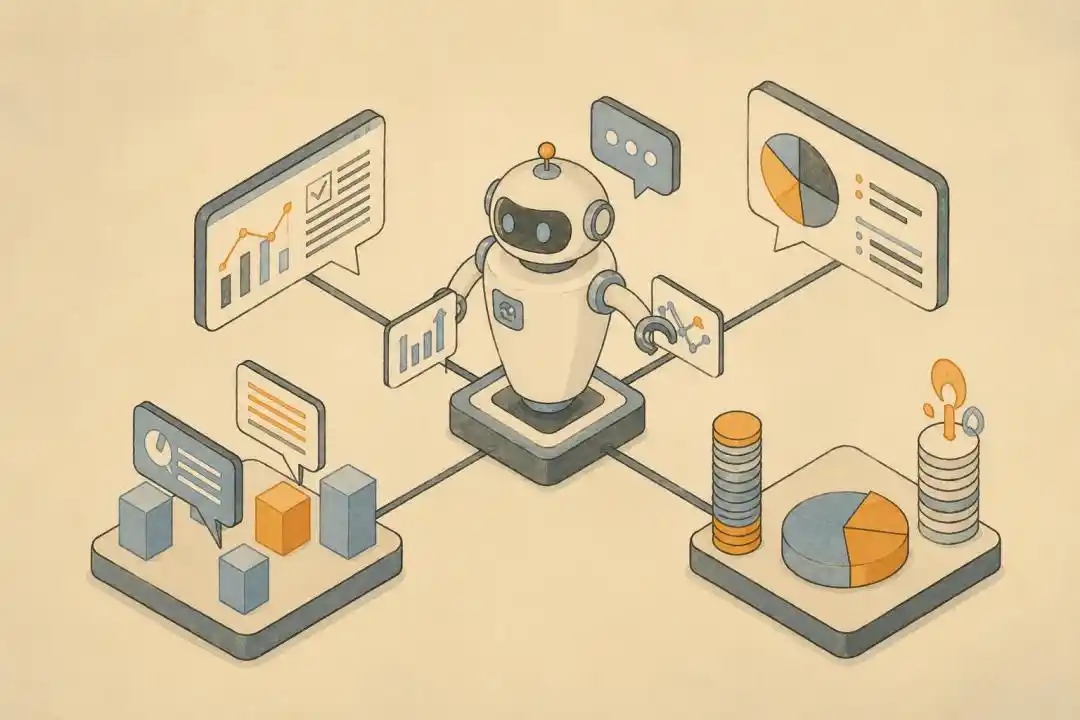
Embodied Data Collection
However, it's best to just laugh off the above examples—actually collecting data that meets requirements is not that simple. The reason so many "gimmicks" keep emerging is that robots are simply too data-starved.
Right now, everyone is going all out to collect data, but few have comprehensively mapped out this industry's landscape.
Qbit has incompletely counted the situations of 97 domestic embodied data players, of which 70 are engaged in data collection and 27 in data infrastructure.
In the past year (July 1, 2025 to July 1, 2026), 15 independent embodied data service providers that "do not make hardware, do not train models, only do data" have raised a total of approximately 4.47 billion yuan in financing.
Given the current capital frenzy over embodied intelligence, this number isn't actually that high. Qbit previously reported that in the first half of this year, embodied "brain faction" companies raised 22.3 billion yuan in just six months.
To help you understand the embodied data industry, we've summarized the following ten industry current states.
How is Data Collected?
Current State 1: Data collection technical routes are divided into four major categories, and the cross-route collection track is the most crowded
Currently, mainstream embodied data collection technical routes can be divided into four major categories:
Physical Teleoperation: Humans control real robots to perform tasks, simultaneously collecting motion, state, and sensor data.
Body-less Collection: Humans directly provide demonstrations, collecting actions through motion capture, gripper mapping, first-person view cameras, etc., without robot involvement.
Simulation Synthesis: Batch generation of robot interaction data in virtual environments for model training.
Internet Video Distillation: Extracting human motion knowledge from internet videos and converting it into data learnable by embodied models.
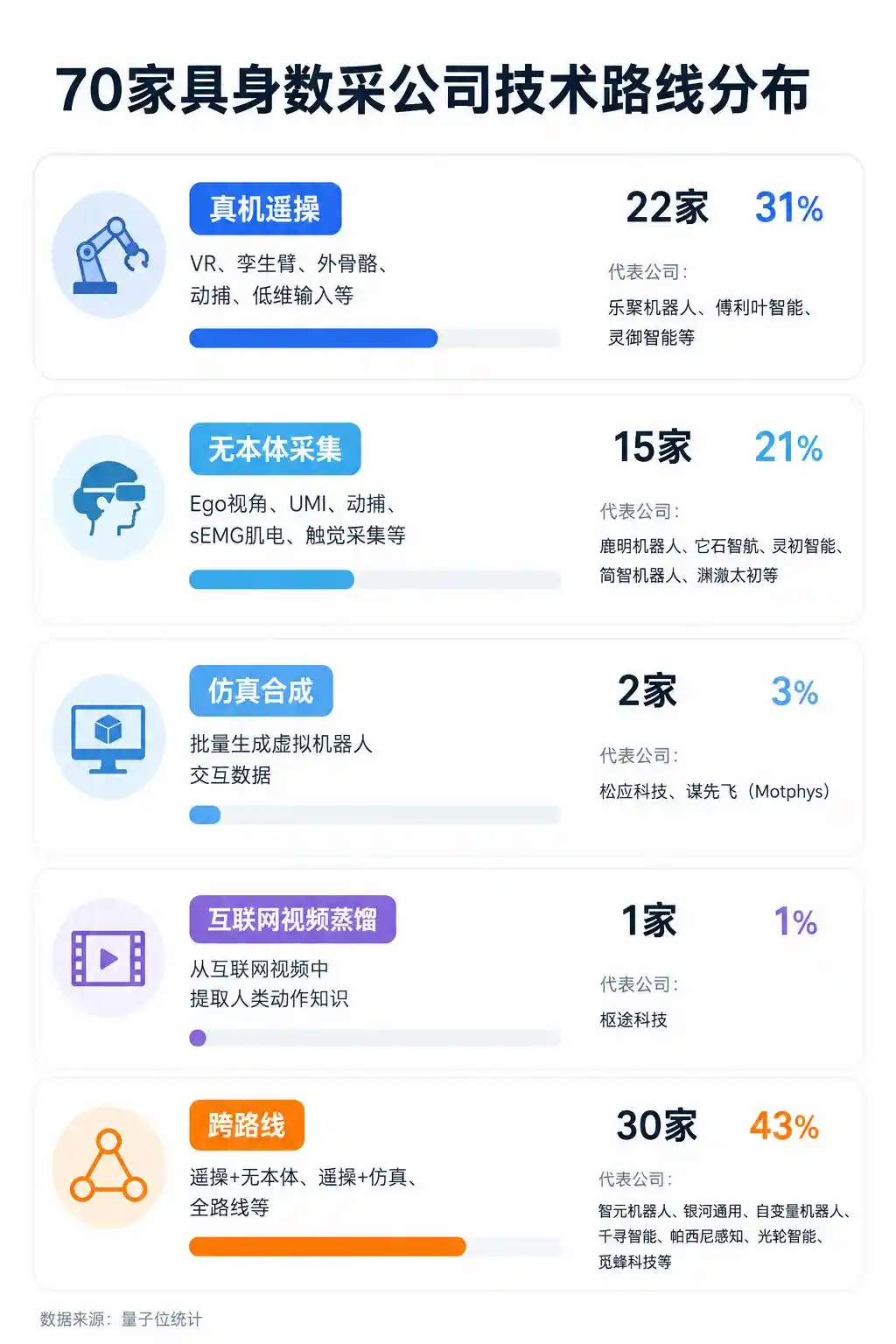
Among the 70 data collection companies/platforms incompletely counted by Qbit, 30 adopt multiple collection routes simultaneously, accounting for 43%, e.g., Physical Teleoperation + Body-less, Physical Teleoperation + Simulation, Body-less + Simulation, All Routes, etc.
Players adopting cross-route collection schemes outnumber those betting on any single route alone.
The industry often uses a data pyramid to describe the data structure required for robot training. Currently, no single data collection method can alone meet all the training needs of robots.
△
Current State 2: Players betting solely on the Physical Teleoperation route are the most numerous
Analyzing each technical route in order.
Players betting solely on the Physical Teleoperation route are the most numerous, with 22, accounting for 31%.
Among these 22 players, 13 are state-owned data platforms, 7 are robot companies (producing robot hardware or developing embodied large models), 1 transitioned from the AI data labeling industry, and 1 crossed over from the industrial equipment manufacturing field.
Robot companies have hardware advantages and real demands, making physical teleoperation collection a natural choice.
State-owned data platforms, on the other hand, have the advantage of "not fearing heavy assets." Teleoperation is a capital-intensive route requiring hardware purchases, venue rentals, and hiring operators—resources that state-owned platforms can easily mobilize.
Companies betting solely on the Body-less collection route number 15, accounting for 21%.
This track has the youngest companies, with the vast majority founded after September 2024.
The Body-less collection route also has the richest technological variety, with subcategories including: Ego perspective, UMI, Motion Capture, sEMG (surface Electromyography), Tactile Collection...
Players betting solely on Simulation Synthesis number only 2: Songying Technology and Mou Xian Fei (Motphys).
Formerly well-known players in the simulation track have now chosen to put their eggs in multiple baskets.
For example, Guanglun Intelligence, which once focused on simulation data, has also begun collecting human data; Galaxy General, once one of the staunchest simulation advocates, released a full-body teleoperation system in June this year, gaining teleoperation data collection capabilities.
The reasons are twofold: externally, the supply of physical robot data and human data is rapidly increasing, prices continue to fall, thinning the scale and cost advantages of simulation data; internally, the sim2real gap still lacks good solutions, making it difficult to faithfully replicate real-world friction, deformation, force feedback, and tactile feedback.
Only one company is betting solely on the Internet Video Distillation route: Shutu Technology.
This company extracts multimodal robot training data from internet monocular RGB videos, claiming it can reduce comprehensive collection costs to 0.5% of the industry average.

Embodied Data Collection
Who Are the Players?
Current State 3: Independent data service providers have become the largest player group
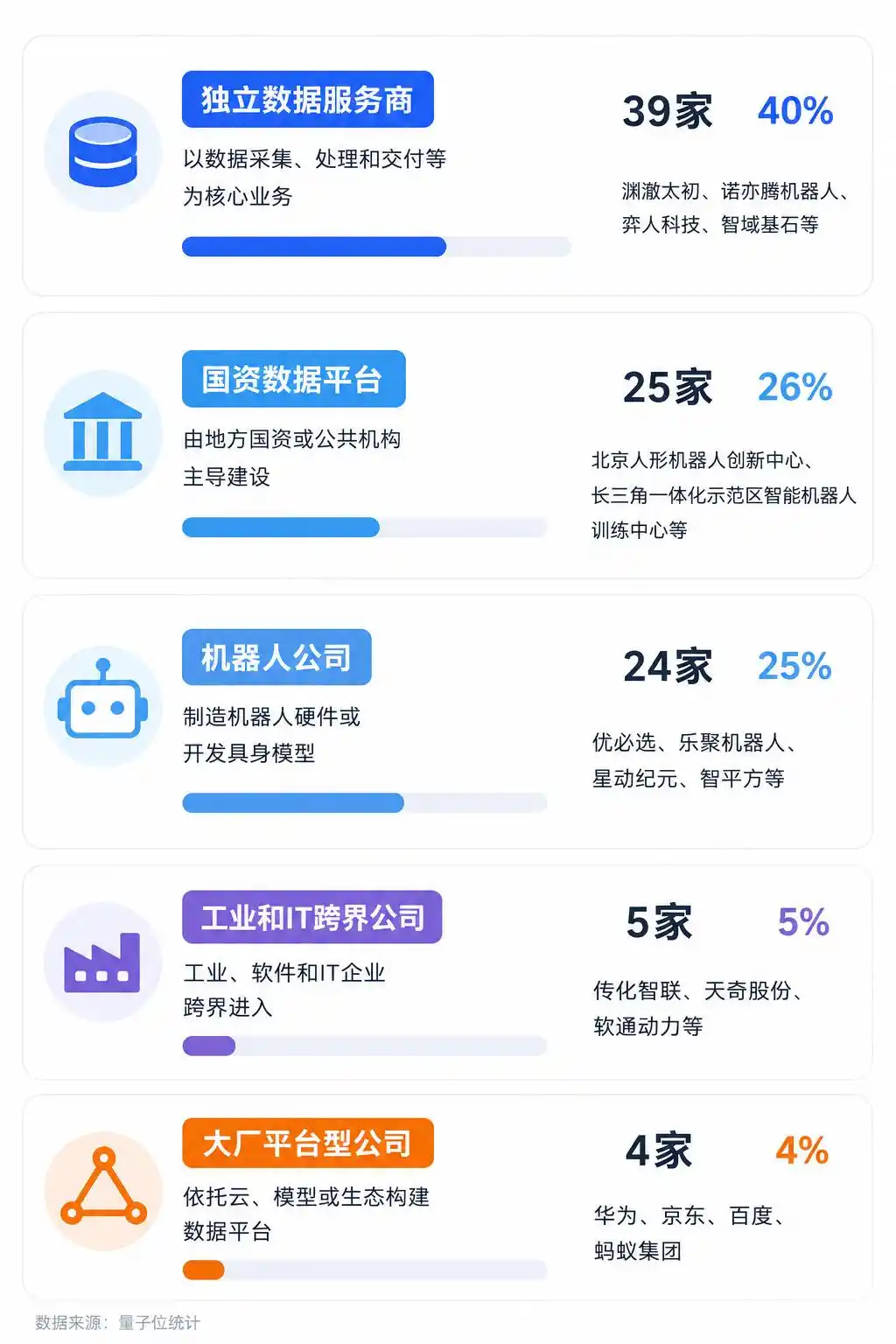
If not categorized by technical route but by identity, the 97 players can be divided into 5 categories:
Independent data service providers: 39, accounting for 40%;
State-owned data platforms: 25, accounting for 26%;
Robot companies: 24, accounting for 25%;
Industrial and IT crossover companies: 5, accounting for 5%, e.g., companies from logistics, equipment manufacturing, automation engineering, etc.;
Major platform-type companies: 4, accounting for 4%, e.g., Huawei, JD.com, etc.
It can be seen that the largest player group is independent data service providers.
This indicates: Embodied data has grown into an independent track, no longer just an ancillary department of robot companies.
△
Current State 4: Two-thirds of players are "Embodied Native", one-third are "Cross-over Transformed"
Using another classification, all embodied data industry players are divided into "Embodied Native" and "Cross-over Transformed" categories.
"Embodied Native" companies were founded with their main business being embodied data or embodied intelligence-related; "Cross-over Transformed" companies mostly transitioned from AI data labeling, autonomous driving, motion capture, or industrial fields.
Among the 97 players, 65 are "Embodied Native", accounting for 67%; 32 are "Cross-over Transformed", accounting for 33%.
Breaking it down further, the composition of data collection companies and data infrastructure companies is completely opposite.
Among the 70 data collection companies, 57 are "Embodied Native", about 80%; among the 27 data infrastructure companies, 19 are "Cross-over Transformed", about 70%.
Why does infrastructure attract transition companies, while the collection industry has mostly new players?
Many embodied data infrastructure players are AI data labeling companies, e.g., Hi-Tech Speech, Datatang, Yunce Data, etc. Their accumulated capabilities in pipelines, quality inspection, and delivery are well-suited for migrating to the embodied data infrastructure segment.
Since embodied data has no existing data, the collection segment must build assets from scratch. Established players have no advantage here, while new companies can start fresh more easily.
Embodied Data Collection
Production Capacity and Layout
Current State 5: Whole industry annual capacity is 1.6 to 1.8 million hours, short-term goal is 15 to 20 times expansion
What is the current embodied data production capacity? How large is the gap from market demand?
Qbit incompletely estimates the industry's current annual production capacity as: 1.6 to 1.8 million hours + 70 to 80 million data items.
The industry's short-term goal is: Within the next 1-3 years, produce 25 to 35 million hours + billions of items of data. Looking at hours alone, the short-term goal is 15-20 times the current capacity.
It should be noted that due to different disclosure standards among institutions, there is currently no unified conversion standard between hours and item counts, so they are listed here in parallel.
These figures only count physical teleoperation data and body-less collection data, excluding simulation synthesis data. Capacity is conservatively estimated based on disclosed company/platform data; actual numbers may be higher.
The total demand for robot training data remains unknown. However, a reference point can be Large Language Models (LLMs): LLMs can consume all existing internet text corpora, but data for robots must be collected item by item. One statistic claims that by the beginning of this year, the total global volume of high-quality real-world physical interaction data was only about 500,000 hours—less than 1/20,000th of LLM training data volume.
Put another way, even if all short-term capacity goals are met, compared to LLM data volumes, it might just be reaching the starting line. A huge gap between capacity and demand still exists.

Embodied Data Collection
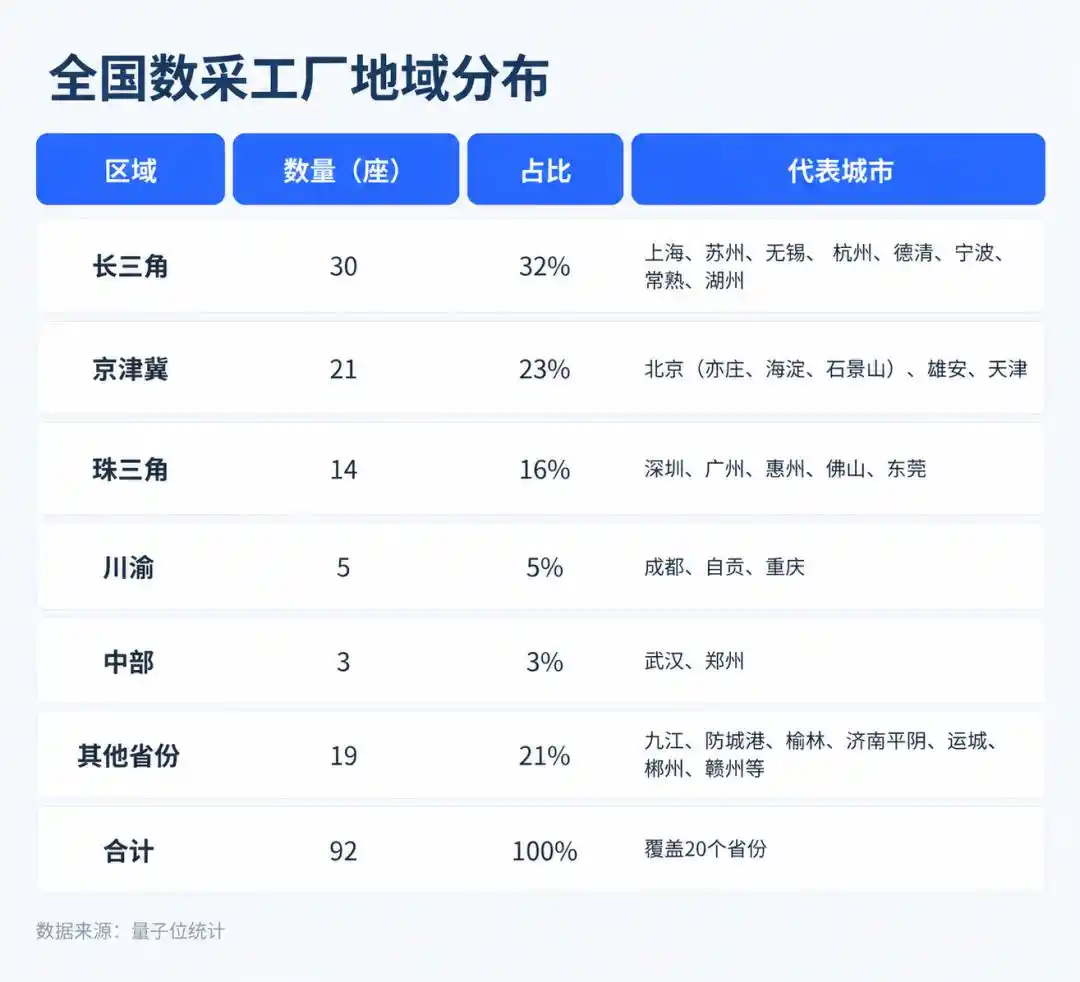
Current State 6: Data collection factories are built in 60% of China's provinces, currently concentrated most in the Yangtze River Delta
Where is all this data collected?
Qbit incompletely counts data collection factories already spread across 20 provinces in China, with state-owned background data collection factories covering 16 provinces.
Data collection factories are mainly distributed in the Yangtze River Delta, Beijing-Tianjin-Hebei, and Pearl River Delta regions. Among them, the Yangtze River Delta leads with 30 factories.
Many third- and fourth-tier cities with lower labor costs have also become sites for data collection factories, e.g., Suqian, Zigong, Chenzhou, Yuncheng, Deqing, etc.
The distribution pattern is related to technical routes. Teleoperation-type data collection factories are scattered across provinces, while asset-light body-less route companies cluster in first-tier cities.
Many cities are building their reputation as data collection hubs.
For example, Wuxi is the first city in China to propose the concept of city-wide data collection. The most important thing it does is: encourage manufacturing and service industry enterprises to open production lines and platforms, using real scenarios as data collection factories to gather the most scarce and practical data for robots.
△
Where is the Money Flowing?
Current State 7: 15 independent embodied data service providers raised about 4.47 billion yuan in the past year
Now let's look at the most telling indicator: money.
Since the data business of robot companies cannot be separated from overall financing, we have singled out 15 "Independent Embodied Data Service Providers" that have financing records in the past year. Their financing situation is highly representative in the industry.
First, an explanation: the screening criteria for "Independent Embodied Data Service Provider" are threefold: do not make general-purpose robot hardware, do not train embodied models, and have embodied data as their core business.
Qbit incompletely counts that in the past year (July 1, 2025 to July 1, 2026), these 15 "Independent Embodied Data Service Providers" completed a total of 34 financing rounds, raising approximately 4.47 billion yuan.
The financing timeframe is highly concentrated. More than 40% of the financing events occurred within the three months from April to June 2026. This is closely related to the capital frenzy in the embodied intelligence industry in the first half of this year.
Qbit previously reported that in the first half of 2026, the entire embodied intelligence industry raised about 43.8 billion yuan.
The amount raised by the embodied data track in one year is just a fraction of the half-year financing for the entire embodied intelligence industry, indicating that, at least for now, this track is not "sexy" enough.
Embodied Data Collection
Current State 8: Independent embodied data service providers can be divided into 3 tiers, with clear differentiation
Digging deeper, the development within the embodied data industry is not balanced.
These 15 "Independent Embodied Data Service Providers" can be divided into three tiers:
The first tier is most prominent, represented by Guanglun Intelligence.
This company completed 6 financing rounds in the past year, raising a total of 3.1 billion yuan, accounting for about 70% of the total financing amount.
It is also the only "Independent Embodied Data Service Provider" to disclose its valuation. Its latest valuation exceeds $2 billion, approximately over 13.5 billion yuan, making it the world's first embodied data unicorn.
The second tier includes 11 companies, such as Jianzhi Robot, Noitom Robot, Yuanche Taichu, Mifeng Technology, etc.
Companies in the second tier raised cumulative financing ranging from tens of millions to hundreds of millions of yuan in the past year. Most financing stages are Pre-A round or earlier, with only a few earlier-founded AI data labeling transition companies breaking through to A round.
The third tier includes 3 companies: Shutu Technology, Zhiyu Jishi, Butianshi Technology.
Their cumulative financing in the past year is at the tens of millions of yuan level, with financing rounds at the Angel stage, and their businesses are still in the early verification phase.

△
Current State 9: 69 investment institutions have made moves, none have heavily invested
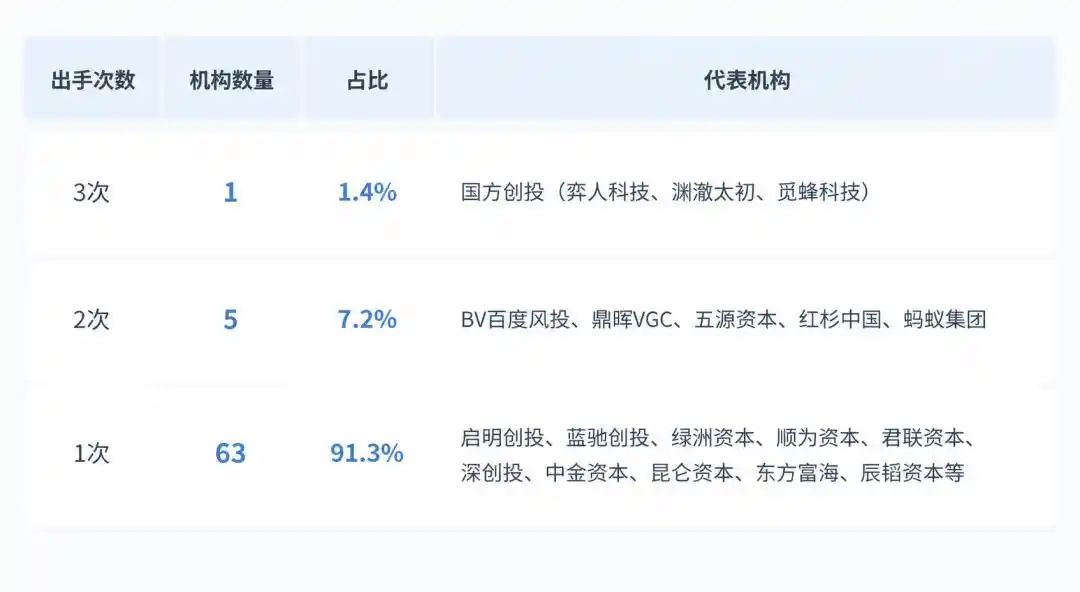
From a capital perspective, in the past year, a total of 69 investment institutions have invested in these 15 "Independent Embodied Data Service Providers."
The most active, Guofang Chuangtou, invested 3 times; 5 investment institutions invested twice; the remaining 63 institutions invested only once.
Compared to the scene during the embodied model financing frenzy where leading institutions rushed to grab shares and continuously increased investments, currently, although there is consensus on the direction of the embodied data track, there is no consensus on targets, and no investment institution truly dares to heavily invest.
Capital's caution is justified: Compared to the immensely imaginative embodied "brain," embodied data is a "labor-intensive" business where prices will get increasingly competitive, and customer demand has relatively clear expectations—there is a visible ceiling.
However, some investors told Qbit that the embodied data industry has some potential for extended imagination: on one hand, it's a global business with a large overseas market; on the other hand, data collection capabilities can also migrate to model evaluation, etc., becoming the infrastructure for physical AI.
△
Current State 10: Over half of "independent embodied data service providers" are less than a year old
Overall, the independent embodied data industry is still in a relatively early stage.
Company development is early-stage. Over half of the "independent embodied data service providers" that have raised funds in the past year are less than a year old.
Financing is early-stage. Among the 15 "independent embodied data service providers," 13 companies' latest financing rounds are at A round or earlier.
Business models are early-stage. No company has disclosed profits. Only Yiren Technology claims to be profitable but hasn't disclosed specific profit figures.

Embodied Data Collection
Finally, summarizing the above ten current states into three sentences:
First, the embodied data industry has grown into an independent track, attracting a large number of players and is becoming a reservoir for new employment positions in the AI field and a new engine for local economic vitality.
Second, this track is still in an early stage. Many problems remain unsolved, many consensuses unformed, and many variables unconverged.
Third, capital's attitude is the most honest. Few companies have proven that "selling pure data" is a profitable business. VCs are still in the casting-a-wide-net stage; no one can see which fish is the biggest.
The next year or two will likely be the verification window for this business. Whether production capacity will be realized, how low prices will go, and who can show their profit statement first will determine whether embodied data merchants can truly become profitable "shovel sellers."
This article is from the WeChat public account "QbitAI," author: Focus on Frontier Technology