Strategy's Accounting Gimmick: The Cap on BTC Sales Far Exceeds $1.25 Billion

Odaily星球日报Xuất bản vào 2026-07-10Cập nhật gần nhất vào 2026-07-10

Tóm tắt

The article, originally from Bankless, discusses how MicroStrategy's (MSTR) recent Bitcoin (BTC) sales reveal a much larger potential selling capacity than the widely reported $1.25 billion "reserve-building" cap. On July 7, MicroStrategy disclosed a sale of 3,588 BTC (~$216M) to pay dividends for its STRAT (STRC) preferred shares and replenish its USD Reserve. Crucially, the company stated this sale did not count against its stated $1.25 billion "reserve-building capacity." The analysis explains that MicroStrategy's "BTC Monetization Plan," part of its broader "Digital Credit Capital Framework," actually outlines three main purposes for selling BTC, only one of which has the $1.25B cap: 1. **Building the USD Reserve** (capped at $1.25B). 2. **Covering preferred share/ debt costs** (replenishing the reserve after payments). 3. **Funding buybacks** (up to $10B for preferred shares and $10B for MSTR common stock). The key nuance is the accounting distinction between "building" the reserve (selling BTC before making payments) and "replenishing" it (selling BTC after using reserve funds for payments). While functionally the same—converting BTC to cash for obligations—only "building" counts against the publicized $1.25B limit. This means sales for "replenishing" and the $20B+ buyback pool allow for total potential sales exceeding $30B. The article frames this as part of MicroStrategy's shift from a simple "buy and hold" Bitcoin narrative to an "active capital management" mo...

This article is from:Bankless

Compiled by|Odaily Planet Daily (@OdailyChina); Translator|Azuma (@azuma_eth)

On July 7th, Strategy disclosed that the company sold 3,588 BTC between June 29th and July 5th, worth approximately $216 million.

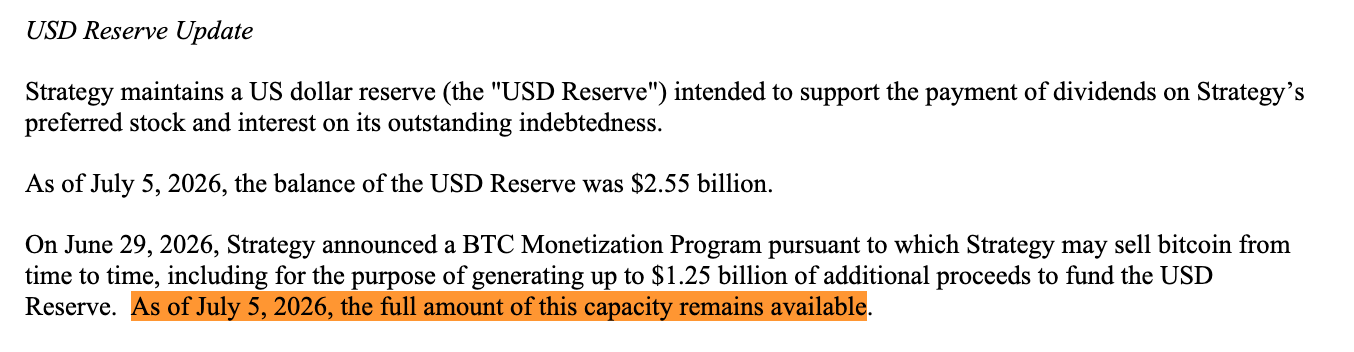
These funds were used to pay STR C dividends and replenish the USD Reserve previously used for dividend payments. Despite completing this sale, Strategy stated that its full $1.25 billion reserve-building capacity remains intact.

  • Odaily Note: In the "self-help plan" announced last week, Strategy had indicated it authorized the company to sell BTC to build a USD reserve of up to $1.25 billion.

In other words, the $216 million worth of BTC sold to replenish the reserve is not counted against the previously disclosed reserve-building capacity.

Strictly speaking, there is a technical distinction: one is "replenishing," and the other is "building." However, in practice, both types of sales ultimately flow into the same reserve pool for the same purpose, just categorized for different uses.

From another perspective, the previously disclosed "BTC Monetization Program" never limited Strategy to selling only $1.25 billion worth of Bitcoin in total; it only capped one specific funding pool — the sale of BTC to "build" the USD reserve.

The plan also permits Strategy to sell BTC for other purposes, which is exactly what we are seeing now.
Three Funding Pools

On June 29th, after weeks of pressure on MSTR and STR C, Strategy launched the aforementioned BTC "Monetization Program" as part of its broader "Digital Credit Capital Framework."

This plan allows Strategy to sell Bitcoin and actually mentions three primary uses:

  • First, to Build the reserve: Sell up to $1.25 billion worth of BTC to establish a USD Reserve.
  • Second, to Cover the preferreds: Sell BTC to cover Strategy's fixed dividend and interest obligations on its preferred shares and debt. If management deems it "more advantageous to sell BTC than issue common stock," they may also sell BTC to replenish reserve funds previously used to cover these obligations.
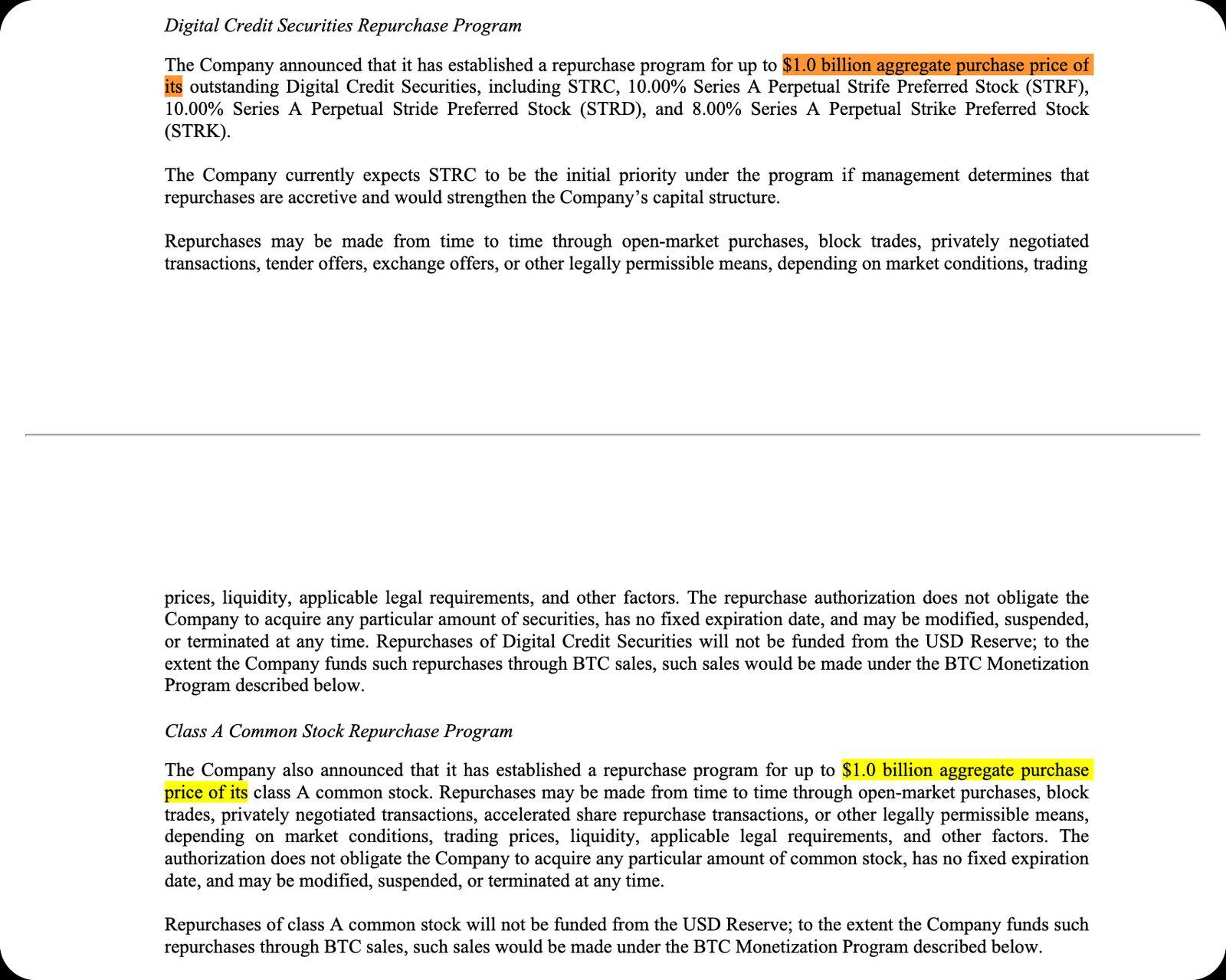
  • Third, to Fund buybacks: Sell BTC to repurchase up to $1 billion worth of preferred shares and up to $1 billion worth of MSTR common stock. Additionally, proceeds from BTC sales may also cover related taxes, fees, and other expenses.

At the time, the entire market discussion focused on the $1.25 billion cap for the first funding pool, but the reality is far more complex.

Looking solely at the third pool, it adds an additional $2 billion in potential sales. Therefore, even calculating only the parts with explicit caps, Strategy's currently designed BTC sale plan already exceeds $3 billion. This does not include the funding pool for paying dividends, interest, and replenishing the reserve — for which there is no disclosed cap.
Building vs. Replenishing

This is where it gets truly subtle.

The purpose of the USD Reserve is to pay these preferred share dividends and debt interest obligations. Under the current policy framework, it cannot be used for stock buybacks.

As of June 28th, Strategy's USD Reserve stood at $2.55 billion, sufficient to cover the company's annual obligations of approximately $1.76 billion for debt and preferred shares, providing about 17 months of coverage. The board has set a minimum requirement to maintain 12 months of coverage unless board-approved reductions occur.

This is why the distinction between "building" and "replenishing" the reserve is noteworthy.

  • Selling BTC before paying dividends to add cash to the reserve: This is defined as "building."
  • Using the reserve to pay dividends, then selling BTC to refill the reserve: This is defined as "replenishing."

The plan treats these as different categories, but they essentially accomplish the same thing — converting BTC into cash to cover preferred share dividends and interest payments.

These details were already disclosed in the documents, but the recent sale made this categorical distinction more apparent. Strategy sold $216 million worth of BTC, using the funds to pay dividends and replenish the reserve, while simultaneously announcing that its $1.25 billion reserve-building capacity remains intact.

Now, the market needs to start understanding Strategy's "proprietary language": "Building" and "replenishing" are essentially accounting classifications, but they determine whether Strategy's BTC sales count against the "public cap" the market sees.

From Hoarding to Active Capital Management

In the June 29th announcement, Michael Saylor stated that this framework reflects Strategy's need for "liquidity, discipline, and active capital management."

Strategy CEO Phong Le was more direct: "Strategy is shifting from a one-way capital issuance model to an active capital management model."

As Matt Walsh and Jeff Dorman from Castle Island explained in a podcast last week, Strategy has essentially evolved into an actively managed hedge fund.

The past Strategy narrative was simple: sell MSTR stock → buy Bitcoin → provide investors with leveraged BTC exposure. But the logic has now changed.

Today, Strategy is buying and selling different components within its own capital structure to manage the pressures between common stock (MSTR), preferred shares, the USD Reserve, and Bitcoin assets (BTC).

This dynamic also introduces new conflicts of interest. Walsh and Dorman pointed out:

  • Selling common stock can support preferred share dividends but depress MSTR's premium relative to its underlying BTC holdings.
  • Selling Bitcoin can extend the cash runway but further erode the core "never sell" narrative.
  • Supporting the preferred share system can maintain market confidence but depletes cash reserves.
  • Cutting preferred share dividends can protect liquidity but may cause preferred share prices to crash.

The so-called "reserve loophole" is an embodiment of this shift. Bitcoin is no longer just an asset for Strategy to accumulate; it is becoming a balance-sheet lever used to keep the preferred share system operational.

What We Will Ultimately See

Now, investors must assess Saylor's ability to operate this "machine" — each adjustment to one lever in the capital structure helps one part while potentially threatening another.

This is the most significant takeaway following the July 6th filing disclosure. Strategy is not out of options. It likely has more room to maneuver than what is apparent on the surface.

Don't continue to mistakenly believe that the $1.25 billion cap represents the total ceiling for Strategy's Bitcoin sales.

Today, Strategy has become an institution that the market must relearn to understand. Now, every proprietary term matters more:

  • Build
  • Replenish
  • Issue
  • Repurchase
  • Defend

Just as Fed watchers parse every punctuation mark in policy statements, the market must also deconstruct every term Strategy uses to gauge what it implies for future BTC sales.

By rolling out this plan, Strategy has secured greater flexibility for itself, but the underlying contradictions persist. This is no longer a simple "leveraged Bitcoin play." It has now become a bet on active capital management prowess.

Can Strategy consistently manage to "sell BTC," "replenish reserves," "issue securities," "repurchase stock," and "maintain the capital structure" without any one action undermining the others?

Personally, I wouldn't want to bet on it.

Tiền kỹ thuật số thịnh hành

Câu hỏi Liên quan

QWhat are the three main purposes for which MicroStrategy's BTC Monetization Program allows the company to sell Bitcoin, according to the article?

AAccording to the article, MicroStrategy's BTC Monetization Program allows the company to sell Bitcoin for three main purposes: 1) To build a USD reserve (up to $1.25 billion). 2) To cover the costs of preferred shares and debt (covering fixed dividend and interest obligations). 3) To fund buyback programs (up to $1 billion for preferred shares and up to $1 billion for MSTR common stock).

QWhat is the key difference between 'building' and 'replenishing' the USD reserve, and why is this distinction important in understanding MicroStrategy's potential Bitcoin sales?

AThe key difference is an accounting classification. 'Building' refers to selling BTC and adding cash to the USD reserve *before* using it to pay obligations. 'Replenishing' refers to using the reserve cash to pay obligations (like dividends) first and *then* selling BTC to refill the reserve. This distinction is crucial because the publicly announced $1.25 billion cap applies only to 'building' the reserve. Sales for 'replenishing' do not count against this public limit, meaning the total potential BTC sales for reserve purposes is effectively uncapped.

QAccording to the article, what is the new narrative for MicroStrategy, shifting away from its previous simple model?

AThe article states that MicroStrategy's narrative has shifted from a simple model of 'selling MSTR stock → buying Bitcoin → providing leveraged BTC exposure' to becoming an 'actively managed hedge fund.' It is now actively buying and selling different components of its capital structure (common stock, preferred shares, USD reserve, Bitcoin assets) to manage the pressure and conflicts between them.

QWhat core conflict or dilemma does the article highlight regarding MicroStrategy's use of Bitcoin as a 'balance-sheet lever'?

AThe article highlights that Bitcoin is no longer just an asset for perpetual accumulation but has become a 'balance-sheet lever' used to maintain the preferred share system. This creates a core conflict: selling Bitcoin can extend cash flow and support the preferred share system, but it simultaneously weakens the foundational 'never sell' narrative that was central to the company's original investment thesis.

QWhat is the main conclusion or warning the article provides to investors regarding the $1.25 billion reserve-building capacity?

AThe main conclusion and warning is that investors should not mistake the $1.25 billion reserve-building capacity as the total upper limit for MicroStrategy's Bitcoin sales. When including the other authorized purposes (like funding buybacks and covering obligations without a stated cap), the designed potential sales exceed $3 billion, and sales for 'replenishing' the reserve are effectively unlimited within the framework. The company has given itself far more flexibility to sell BTC than the headline $1.25 billion figure suggests.

Nội dung Liên quan

Vụ ly hôn của Choi Tae-won chính thức kết thúc: Tiết lộ tuyến kế thừa ẩn sau đế chế nghìn tỷ SK Hynix

Vào tháng 11/2024, trong một sự kiện kỷ niệm, Chủ tịch SK Group Choi Tae-won đã cho các con xem hình ảnh AI tái hiện người cha quá cố của mình, nhấn mạnh về việc kế thừa di sản. Trong bối cảnh SK Hynix trở thành tài sản trị giá nhất Hàn Quốc, câu chuyện kế thừa thế hệ thứ ba của tập đoàn này lại không đi theo kịch bản truyền thống. Choi Yun-jung (sinh 1989), trưởng nữ, được coi là ứng viên kế thừa rõ ràng nhất. Cô có nền tảng học thuật về sinh học, từng làm tư vấn, hiện đang học tiến sĩ và giữ chức vụ lãnh đạo tại SK Bioscience và bộ phận hỗ trợ tăng trưởng của SK Inc. Cuộc hôn nhân của cô với một doanh nhân khởi nghiệp AI cũng phản ánh sự thay đổi trong các mối liên kết giữa các giới tinh hoa. Choi Min-jung (sinh 1991), con gái thứ, có hành trình khác biệt: học đại học tại Bắc Kinh, tình nguyện gia nhập Hải quân Hàn Quốc và từng làm việc tại SK Hynix ở Washington về các vấn đề chính sách quốc tế. Cô hiện là nhà sáng lập một công ty chăm sóc sức khỏe AI và kết hôn với một cựu sĩ quan Thủy quân Lục chiến Mỹ, cho thấy mạng lưới toàn cầu và an ninh chuỗi cung ứng ngày càng quan trọng đối với các tập đoàn bán dẫn. Choi In-geun (sinh 1995), con trai trưởng, có lộ trình học vấn tương đồng với cha (vật lý) và đang làm việc tại McKinsey sau thời gian ở SK E&S. Dù mang hình mẫu người kế thừa truyền thống, anh lại là người ít lộ diện công khai nhất. Cuộc chiến ly hôn kéo dài giữa Choi Tae-won và vợ cũ Roh So-young, với giá trị tài sản tranh chấp lên tới hàng nghìn tỷ won, là bối cảnh phức tạp mà thế hệ thứ ba phải đối mặt. Cả ba người con đều đã đệ đơn lên tòa án trong vụ việc này, dù nội dung không được tiết lộ. Tóm lại, trong kỷ nguyên AI khi SK Hynix trở thành tài sản địa chính trị toàn cầu, việc kế thừa tại SK Group không còn là chuyện nội bộ gia đình hay chỉ xoay quanh cổ phần và quyền trưởng nam. Thế hệ thứ ba được định vị thông qua năng lực chuyên môn, mạng lưới quốc tế và khả năng giải quyết những thách thức của thời đại công nghệ và địa chính trị mới.

marsbit2 ngày trước 09:10

Vụ ly hôn của Choi Tae-won chính thức kết thúc: Tiết lộ tuyến kế thừa ẩn sau đế chế nghìn tỷ SK Hynix

marsbit2 ngày trước 09:10

Các ngân hàng phản đối thỏa thuận lợi suất stablecoin – Liệu Đạo luật CLARITY có thể giành được 60 phiếu?

Viện Chính sách Ngân hàng Hoa Kỳ (BPI) đã phản đối dự thảo Đạo luật CLARITY mới, chỉ ra những thiếu sót về quy định lợi suất stablecoin và chống tài trợ bất hợp pháp. Ngành ngân hàng muốn cấm hoàn toàn mọi hình thức khuyến khích từ stablecoin, trong khi dự thảo hiện tại chỉ cho phép dựa trên hoạt động tài khoản, không phải số dư nhàn rỗi. Sự phản đối này ảnh hưởng đến cơ hội thông qua đạo luật tại Thượng viện, nơi cần 60 phiếu. Sự ủng hộ từ đảng Cộng hòa có thể giảm xuống còn 49 phiếu nếu các Thượng nghị sĩ John Curtis và John Cornyn rút lại hỗ trợ, đòi hỏi 11 phiếu từ đảng Dân chủ. Tuy nhiên, một số nhà lập pháp Dân chủ ủng hộ tiền mã hóa cũng phản đối dự luật do lo ngại về đạo đức và chống rửa tiền. Lãnh đạo đa số Thượng viện John Thune tỏ ra hoài nghi về khả năng thông qua dự luật trước kỳ nghỉ tháng Tám, chỉ còn hai tuần. Cố vấn trưởng về Tiền mã hóa của Nhà Trắng, Patrick Witt, kêu gọi tiến hành bỏ phiếu ngay. Kỳ vọng thị trường về việc thông qua đạo luật trong năm 2026 đã giảm xuống còn 32%.

ambcrypto2 ngày trước 09:04

Các ngân hàng phản đối thỏa thuận lợi suất stablecoin – Liệu Đạo luật CLARITY có thể giành được 60 phiếu?

ambcrypto2 ngày trước 09:04

Giá trị gia tăng từ 88 tỷ lên 680 tỷ chỉ sau 2 tháng! OpenRouter, trạm trung chuyển AI lớn nhất sắp được mua lại

Theo tờ Wall Street Journal và The Information, Stripe - nền tảng thanh toán hàng đầu - đang đàm phán mua lại startup AI OpenRouter với giá khoảng 10 tỷ USD. Chỉ hai tháng trước, định giá của OpenRouter là 1,3 tỷ USD, tức giá chào mua cao hơn gần 7 lần. Thương vụ có thể được công bố trong vòng một tháng nhưng vẫn có nguy cơ đổ vỡ. OpenRouter hoạt động như một "trung tâm chuyển tiếp" AI, cung cấp một API duy nhất để các nhà phát triển truy cập vào hơn 400 mô hình lớn (như GPT, Claude). Nó tự động lựa chọn mô hình phù hợp dựa trên độ phức tạp, chi phí và tốc độ, giúp các ứng dụng AI tối ưu hóa hiệu quả chi phí. Được đồng sáng lập bởi Alex Atallah (cựu đồng sáng lập OpenSea), OpenRouter hiện có hơn 1 triệu nhà phát triển và doanh thu hàng năm đạt 50 triệu USD, tăng gấp 5 lần trong nửa năm. Đây là bước đi chiến lược tiếp theo của Stripe trong việc mở rộng sang hạ tầng AI, sau khi họ mua lại nền tảng định giá theo lượng sử dụng Metronome vào cuối năm 2025. Mục tiêu của Stripe là kết hợp khả năng định tuyến mô hình của OpenRouter với hệ thống thanh toán và đo lường sử dụng hiện có, để trở thành "trung tâm điều phối và thu ngân" toàn diện cho nền kinh tế AI. Điều này cho phép doanh nghiệp quản lý toàn bộ việc sử dụng và hóa đơn AI qua một nhà cung cấp duy nhất.

链捕手2 ngày trước 09:02

Giá trị gia tăng từ 88 tỷ lên 680 tỷ chỉ sau 2 tháng! OpenRouter, trạm trung chuyển AI lớn nhất sắp được mua lại

链捕手2 ngày trước 09:02

Từ OpenSea Đến OpenRouter: Kịch Bản “Chốt Lời Đỉnh Cao” Của Alex Atallah Lại Lặp Lại?

Tác giả: Nancy, PANews Hơn bốn năm trước, Alex Atallah rời đi trước đỉnh bong bóng NFT; giờ đây, anh lại tỏa sáng trong cơn sốt AI và chuẩn bị bán nền tảng tổng hợp mô hình AI OpenRouter với giá cao. Ngày 23/7, theo Wall Street Journal, gã khổng lồ thanh toán Stripe đang đàm phán mua lại OpenRouter, với định giá giao dịch có thể lên tới gần 100 tỷ USD. Nếu thành công, đây sẽ là lần thứ hai Alex Atallah xây dựng một công ty trị giá hàng trăm tỷ USD, sau sàn giao dịch NFT OpenSea. OpenRouter, được mô tả là "Stripe của lĩnh vực AI", đã kết nối hơn 400 mô hình AI, có khoảng 10 triệu người dùng và xử lý hơn 200 nghìn tỷ token mỗi tháng. Tuy nhiên, mô hình kinh doanh chủ yếu dựa vào phí dịch vụ nền tảng (5%-5.5%) từ việc gọi API, với doanh thu hàng năm khoảng 50 triệu USD (tính đến tháng 4/2026). Đây là một mô hình kênh dẫn có quy mô lớn nhưng biên lợi nhuận hạn chế, dễ bị ảnh hưởng bởi sự cạnh tranh, mô hình nguồn mở và áp lực giảm giá. Giá trị thực sự của OpenRouter đối với các nhà mua tiềm năng như Stripe có thể nằm ở kho dữ liệu sử dụng AI thực tế khổng lồ mà nó tích lũy được, cung cấp insights quý giá về hiệu suất mô hình, sở thích nhà phát triển và quan hệ thay thế trên thị trường. Từ NFT đến AI, Alex Atallah hai lần bắt đúng xu hướng thời đại. Việc OpenRouter được định giá 100 tỷ USD đặt ra câu hỏi: đây là sự định giá lại giá trị cơ sở hạ tầng AI hay một tín hiệu đỉnh chu kỳ mới? Thời gian sẽ trả lời.

链捕手2 ngày trước 08:45

Từ OpenSea Đến OpenRouter: Kịch Bản “Chốt Lời Đỉnh Cao” Của Alex Atallah Lại Lặp Lại?

链捕手2 ngày trước 08:45

Pons V2 mang đến các cặp giao dịch RWA khi Robinhood Chain mở rộng tham vọng

Pons, một launchpad được xây dựng trên Robinhood Chain, đã ra mắt bản nâng cấp V2 với các thay đổi nhằm cải thiện thanh khoản, loại bỏ hạn chế giao dịch và hỗ trợ tài sản thực được mã hóa (RWA). Bản cập nhật này diễn ra trong bối cảnh Robinhood Chain tiếp tục tăng trưởng nhanh, vượt 300 triệu USD tổng giá trị bị khóa và nổi lên như một trong những mạng Lớp 2 Ethereum sôi động nhất cho giao dịch đầu cơ. Pons V2 giải quyết các phàn nàn chính của người dùng về thanh khoản bằng cách giới thiệu đường cong liên kết định danh bằng ETH, đồng thời cho phép hầu hết ví giao dịch tự do. Cấu trúc phí cũng được thiết kế lại để nhà phát triển có thể nhận phí bằng ETH mặc định. Robinhood Chain đã thu hút sự chú ý của thị trường, với khối lượng DEX tích lũy vượt 9 tỷ USD, trong đó 80% đến từ memecoin rủi ro cao. Tuy nhiên, lợi nhuận tập trung vào số ít, với 63% nhà giao dịch thua lỗ. Việc Pons V2 bổ sung các cặp giao dịch RWA tùy chỉnh trực tiếp hỗ trợ trọng tâm phát triển tài sản thực của Robinhood Chain, có thể thúc đẩy việc áp dụng mạng lưới một cách hữu cơ trong tương lai.

ambcrypto2 ngày trước 08:27

Pons V2 mang đến các cặp giao dịch RWA khi Robinhood Chain mở rộng tham vọng

ambcrypto2 ngày trước 08:27

Giao dịch

Giao ngay

Bài viết Nổi bật

Làm thế nào để Mua CAP

Chào mừng bạn đến với HTX.com! Chúng tôi đã làm cho mua Cap (CAP) trở nên đơn giản và thuận tiện. Làm theo hướng dẫn từng bước của chúng tôi để bắt đầu hành trình tiền kỹ thuật số của bạn.Bước 1: Tạo Tài khoản HTX của BạnSử dụng email hoặc số điện thoại của bạn để đăng ký tài khoản miễn phí trên HTX. Trải nghiệm hành trình đăng ký không rắc rối và mở khóa tất cả tính năng. Nhận Tài khoản của tôiBước 2: Truy cập Mua Crypto và Chọn Phương thức Thanh toán của BạnThẻ Tín dụng/Ghi nợ: Sử dụng Visa hoặc Mastercard của bạn để mua Cap (CAP) ngay lập tức.Số dư: Sử dụng tiền từ số dư tài khoản HTX của bạn để giao dịch liền mạch.Bên thứ ba: Chúng tôi đã thêm những phương thức thanh toán phổ biến như Google Pay và Apple Pay để nâng cao sự tiện lợi.P2P: Giao dịch trực tiếp với người dùng khác trên HTX.Thị trường mua bán phi tập trung (OTC): Chúng tôi cung cấp những dịch vụ được thiết kế riêng và tỷ giá hối đoái cạnh tranh cho nhà giao dịch.Bước 3: Lưu trữ Cap (CAP) của BạnSau khi mua Cap (CAP), lưu trữ trong tài khoản HTX của bạn. Ngoài ra, bạn có thể gửi đi nơi khác qua chuyển khoản blockchain hoặc sử dụng để giao dịch những tiền kỹ thuật số khác.Bước 4: Giao dịch Cap (CAP)Giao dịch Cap (CAP) dễ dàng trên thị trường giao ngay của HTX. Chỉ cần truy cập vào tài khoản của bạn, chọn cặp giao dịch, thực hiện giao dịch và theo dõi trong thời gian thực. Chúng tôi cung cấp trải nghiệm thân thiện với người dùng cho cả người mới bắt đầu và người giao dịch dày dạn kinh nghiệm.

Tổng lượt xem 234Xuất bản vào 2026.06.26Cập nhật vào 2026.06.26

Làm thế nào để Mua CAP

Thảo luận

Chào mừng đến với Cộng đồng HTX. Tại đây, bạn có thể được thông báo về những phát triển nền tảng mới nhất và có quyền truy cập vào thông tin chuyên sâu về thị trường. Ý kiến ​​của người dùng về giá của CAP (CAP) được trình bày dưới đây.

活动图片