1600 Lines of Code Create an Underwater Manhattan, Fable 5 Leaves Karpathy Stunned

marsbitXuất bản vào 2026-07-06Cập nhật gần nhất vào 2026-07-06

Tóm tắt

Title: Fable 5 Stuns Karpathy with 3D Worlds Built from 1600 Lines of Code An AI model, Fable 5, has demonstrated a remarkable leap in generating complex, interactive 3D worlds with minimal code. Showcased by Peter Gostev of Arena.ai, the model created 63 diverse 3D environments across themes like immersive cityscapes, explorable famous paintings, natural wonders, and cosmic phenomena. Many were generated in a single attempt. A standout creation is a detailed, submerged Manhattan built with only 1600 lines of Three.js code. Other highlights include traversable versions of Van Gogh's "Starry Night," a bear catching a salmon with realistic physics, and a split Red Sea. The model's ability to cohesively manage vast numbers of elements within a scene represents a significant technical advancement. Andrej Karpathy, who recently joined Anthropic's pre-training team, expressed amazement, particularly at how the model intuitively understood and rendered complex real-world interactions like a fish struggling when caught. He coined the term "fablemaxxing" to describe this qualitative leap. While Fable 5 excels at world-building, Gostev notes current limitations in creating engaging, long-form gameplay. The model also sometimes requires prompting to fully utilize its capabilities. Having topped the Agent Arena benchmark for real-world task completion, Fable 5 signals that the boundaries of AI-generated content are rapidly expanding, with its full potential yet to be discovered.

[Introduction] Fable 5 is back online. In a video, Gostev from Arena.ai unleashed 63 3D worlds, nearly all generated in one go. After watching the video, even Karpathy, who just joined Anthropic's pre-training team, exclaimed he never expected this.

A bear stands by a river, snapping up a leaping salmon.

The fish struggles desperately in its mouth.
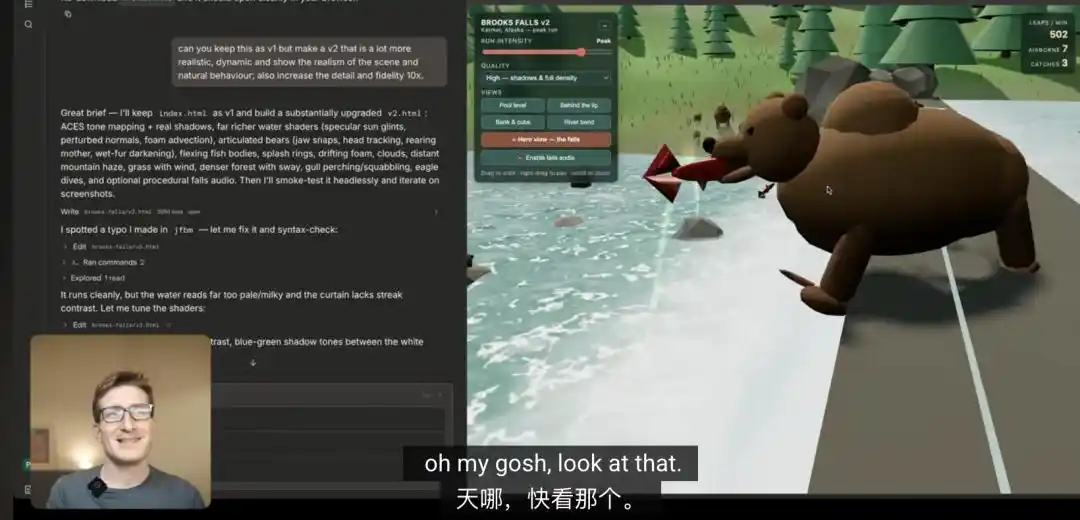
This scene completely stunned Andrej Karpathy.

After viewing this set of 3D videos, he wrote in a post:

It's absolutely incredible. I hadn't realized before that models could create such incredible, rich, and playable worlds.
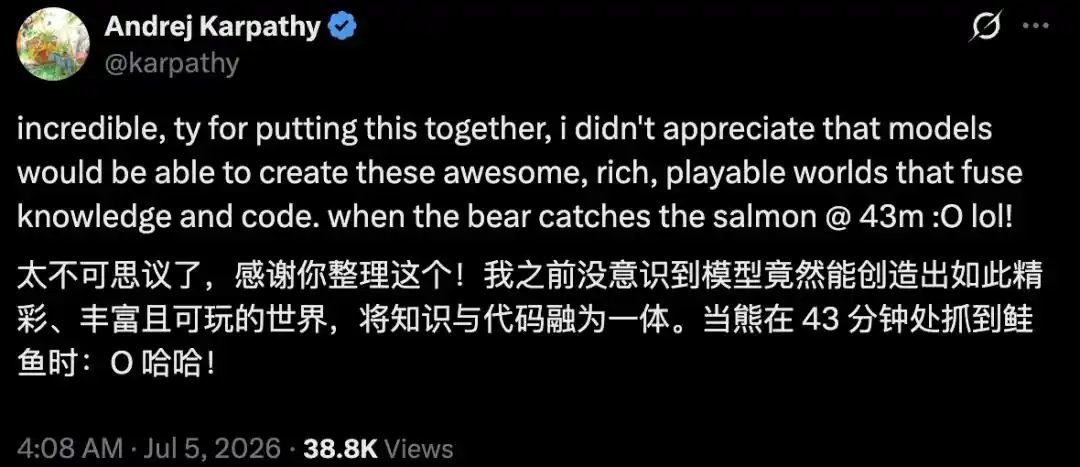
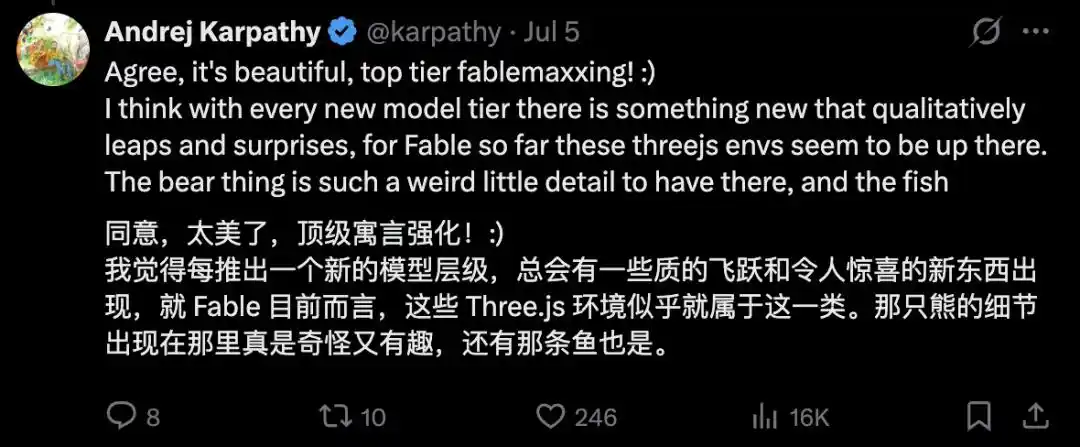
He also coined a new term: fablemaxxing.

This is so beautiful, it's peak fablemaxxing! Every new model scale, there's always something qualitatively new that leaps forward and surprises.
Karpathy just joined Anthropic in May, specifically their pre-training team.

In June, Fable 5 debuted, was shut down by US export controls three days later, and was just reinstated on July 1st. The video's creator is Peter Gostev from the AI evaluation platform Arena.ai.

Using Fable 5, he ran 63 high-difficulty 3D generations in one go, almost all in Three.js, with the majority succeeding on the first try.

Just over a month ago, getting AI to create a playable 3D world you could walk into in one attempt was nearly a pipe dream. Now, Fable 5 can churn out 63 at once.

Thus, Gostev couldn't help but marvel in the video: even the people in the labs haven't fully grasped what it can do yet.

1600 Lines of Code, a Living Underwater Manhattan

Let's start with the most impressive one in the video.

The entire Manhattan is submerged underwater. Central Park, skyscrapers, street textures — the details are unbelievably rich.

Gostev looked at the code: 1600 lines. These 1600 lines support a living underwater city.
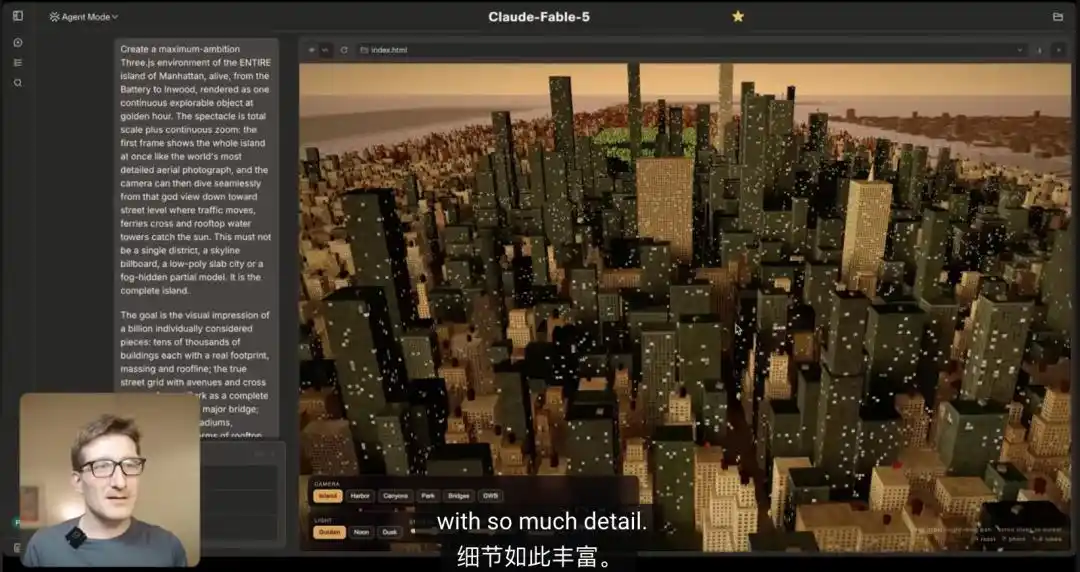
Fable 5 generated Manhattan, showing the entire island from Battery to Inwood, with thousands of buildings each with distinct outlines, all powered by 1600 lines of code. (Source: Peter Gostev video)

In total, Gostev created 63 such worlds, categorized into 6 major themes.
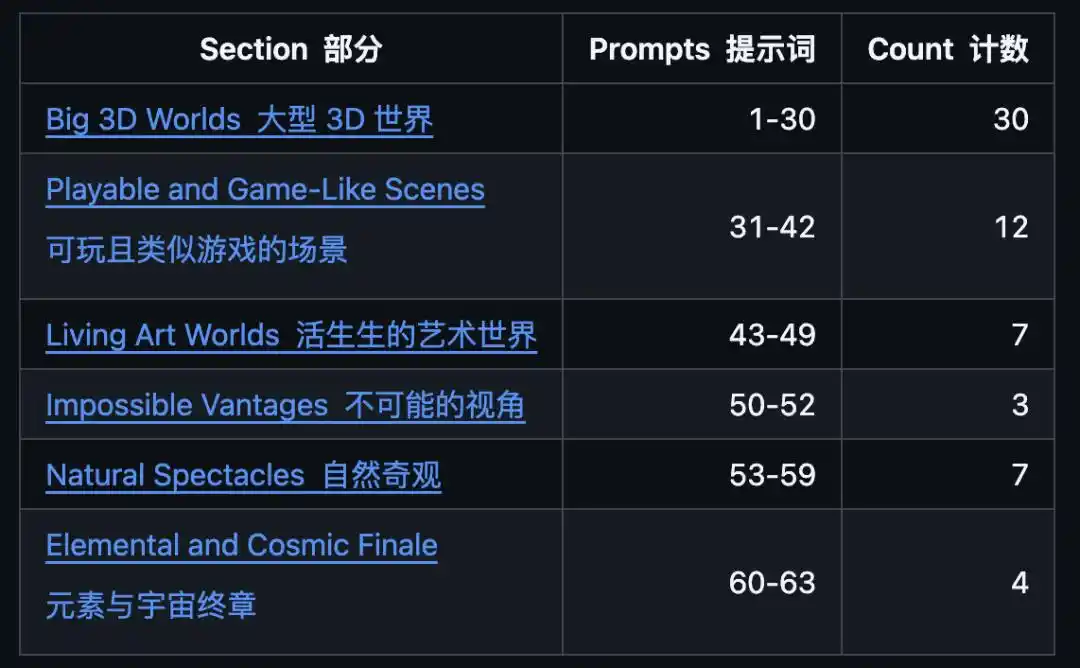
Among the giant 3D worlds, Istanbul spanning the European and Asian shores, London over 2000 years, magnificent pyramids, the eruption of Pompeii, and the Golden Gate Bridge with flowing traffic were all constructed.
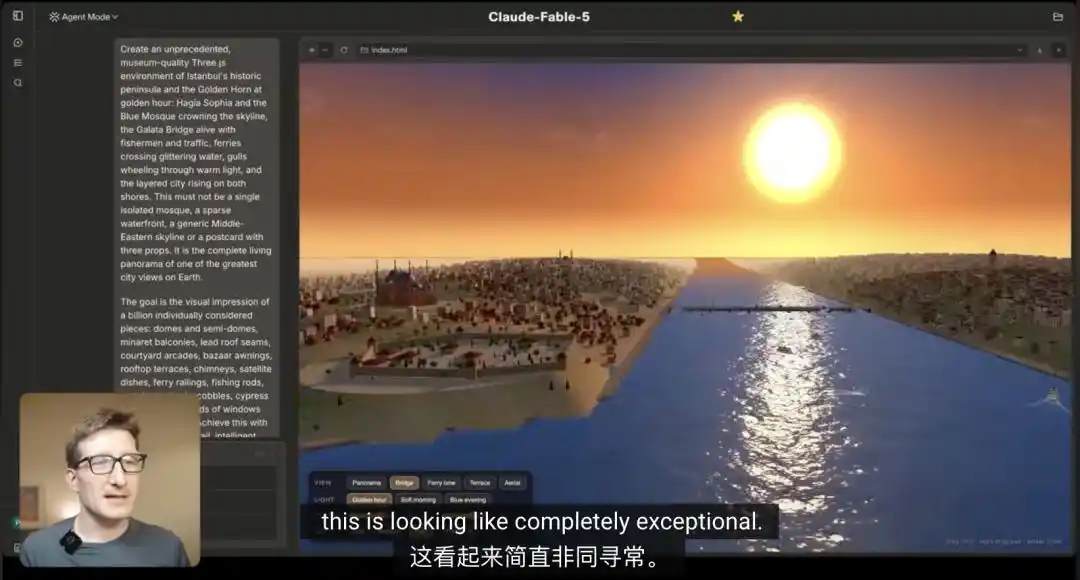
Istanbul generated by Fable 5 in one go, spanning Europe and Asia, layered into the sea. (Source: Peter Gostev video)
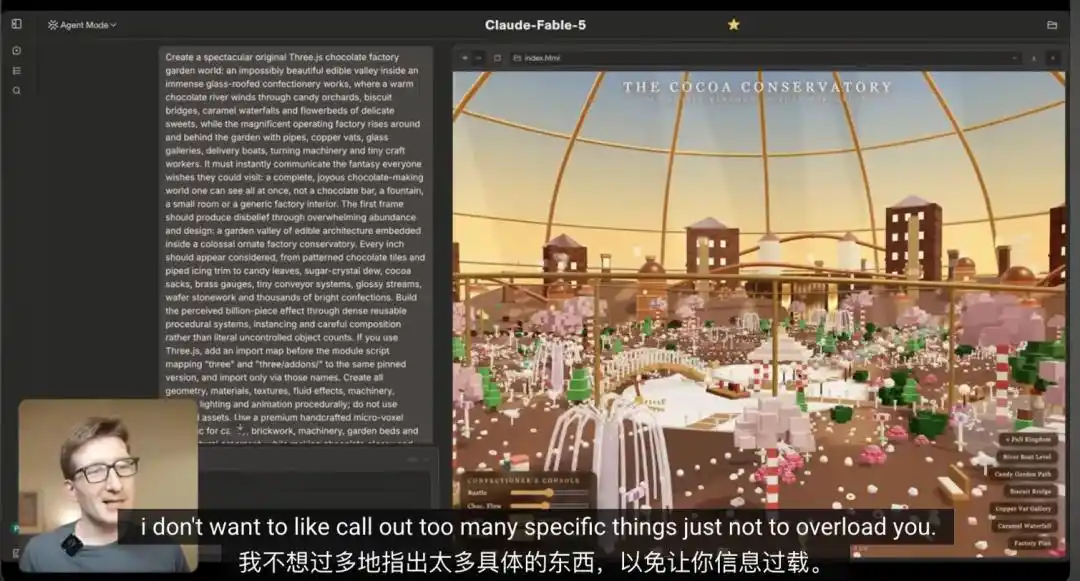
The Edible Kingdom generated by Fable 5, a chocolate factory made of candy. (Source: Peter Gostev video)

For playable scenarios, there's parkour on New York rooftops, a physics playground where you can tear down an entire city, and a flight simulator with a fully equipped dashboard.

The most unbelievable category is stepping into world-famous paintings. Van Gogh's Starry Night, Monet's Water Lilies—each spread out into a traversable 3D world.

Another category is impossible perspectives: a one-millimeter-tall ant observing a garden in the rain, opening its eyes to a mountain of gold.
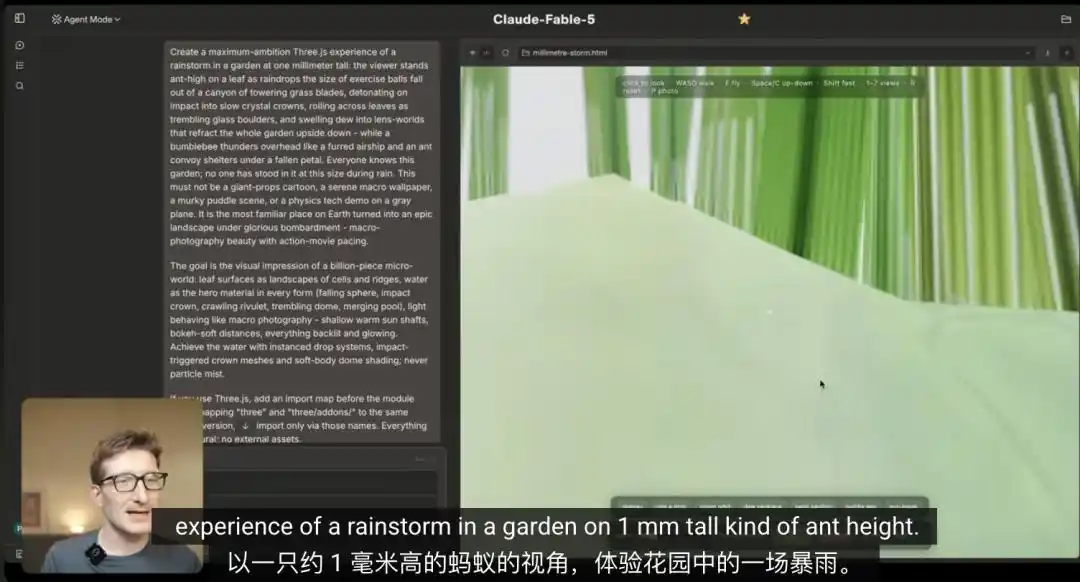
Fable 5 compresses the perspective to one millimeter high, with blades of grass towering like majestic peaks. (Source: Peter Gostev video)

Among natural wonders, Niagara Falls, a forest where fireflies synchronize their flashes, and the bear catching a salmon that stunned Karpathy are in this category.

Finally, there are elements and the universe: the Red Sea parting, a volcanic island being born, a space elevator piercing the clouds.
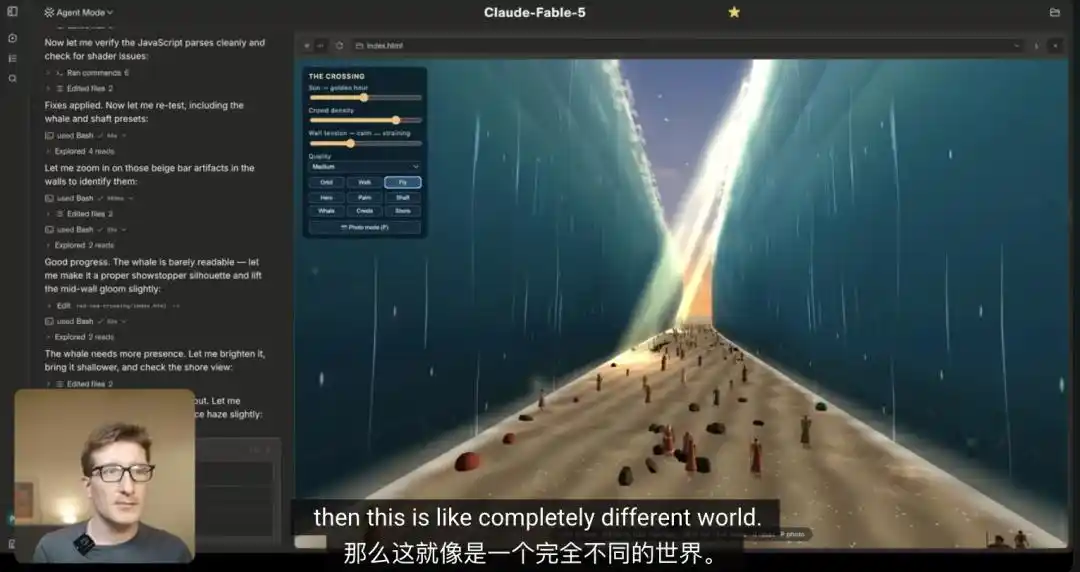
Fable 5 generates the Red Sea parting, with people walking between the two walls of water. (Source: Peter Gostev video)

In Gostev's view, whether a single scene looks good has never been the hard part. The difficulty lies in whether the model can manage vast numbers of elements simultaneously and make them coordinate with each other.

Weaker models often do the first 80% decently, then completely collapse in the final 20%, leaving even longer debugging time.

You Can't Simply Copy a Painting; It Has to Understand First

If building cities still follows some logic, then the next batch of paintings is what made Gostev say "unbelievable" several times.

Van Gogh's The Starry Night.

You can't simply copy such a painting, with thick paint smeared all over the canvas, brushstrokes swirling into vortices.

Fable 5's approach is to use individual lines to reassemble that starry sky in three-dimensional space, then let you fly into it, navigating between the swirls.
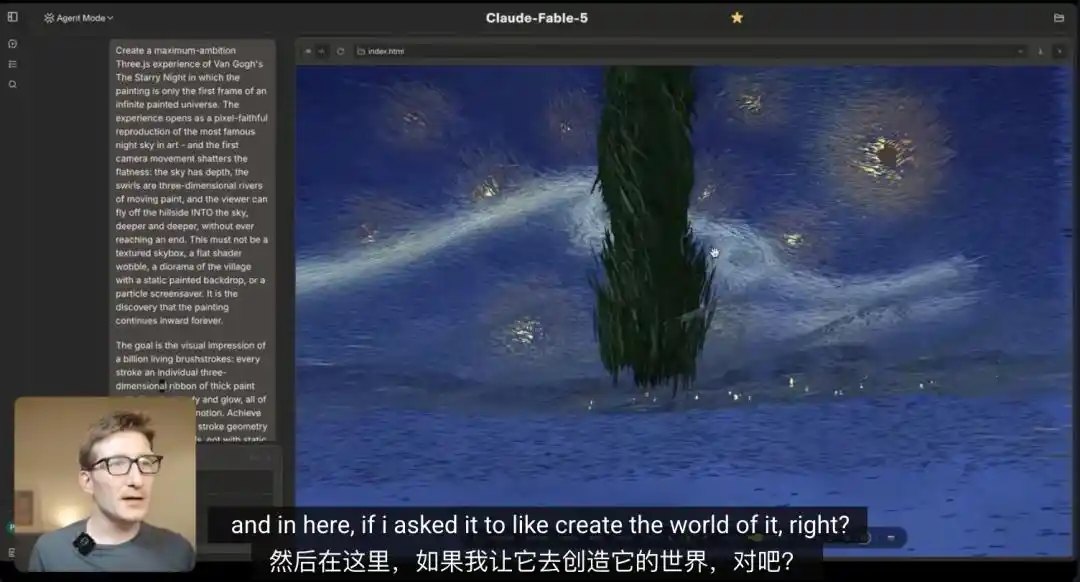
Fable 5 deconstructs Van Gogh's The Starry Night into individual 3D lines, reassembling them in space, allowing you to fly amidst the swirling stars and vortices. (Source: Peter Gostev video)

Monet's Water Lilies and Hokusai's Great Wave were similarly "opened up" into worlds you can roam.

In Gostev's opinion, Fable this time is particularly good at explaining things clearly, able to demonstrate while clarifying how things work. This explanatory power is something he didn't anticipate before.

Of course, these worlds weren't conjured with just "one sentence".

Gostev fed the model long, detailed specification documents. Most cases succeeded on the first try, with some requiring one or two rounds of fine-tuning.

The real watershed moment is this: things that used to take dozens of rounds to polish out can now mostly be generated in one go, with a single HTML file.

Behind the Magic, There Are Also Shortcomings

Gostev admits his showcased cases were curated. He generated about 20% more than he displayed, filtering out those with obvious bugs, leaving these 63.

Games are its weak spot.

He admits those few playable scenarios "get boring after 30 seconds." There was a Roman Empire version he thought looked too cartoonish.

More subtly, he feels the model sometimes seems lazy, holding back its capabilities, and you have to repeatedly push it to be more ambitious before it shows its true prowess.

When Fable 5 launched, it topped the Agent Arena leaderboard on Arena.ai's own platform with the largest lead in history.
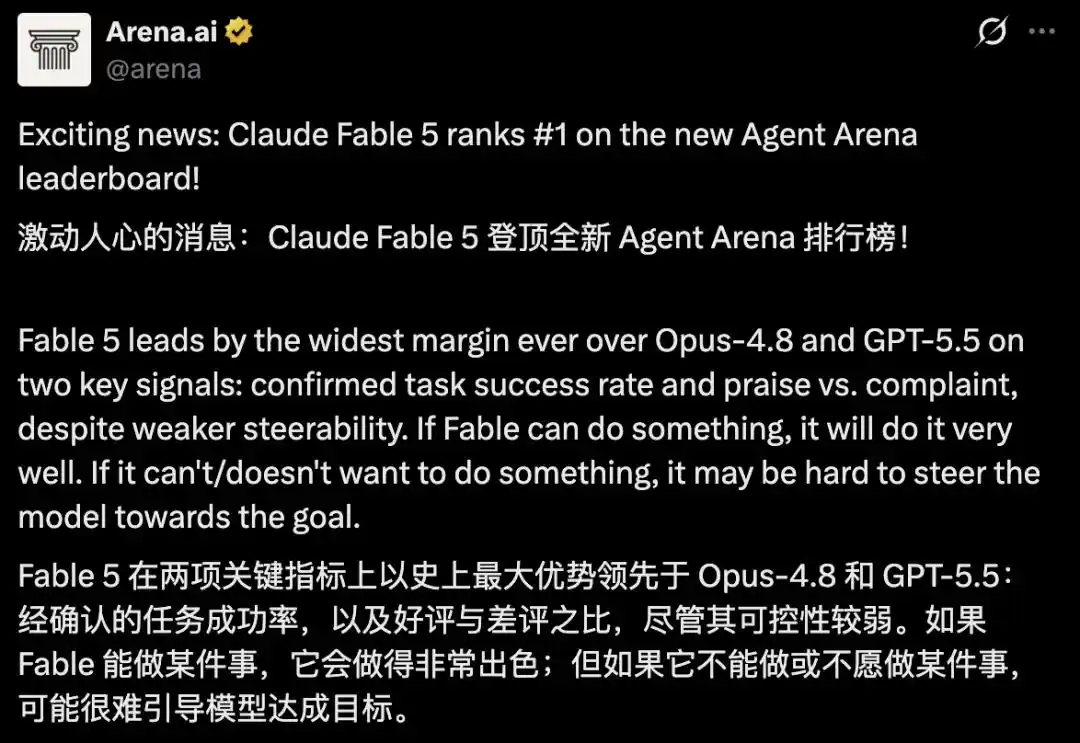
Arena.ai states that this leaderboard measures a model's ability to genuinely accomplish tasks across millions of real-world assignments.

This Exploration Has Only Just Begun

Returning to the scene in the video of the bear catching the salmon.

What struck Karpathy as strange is that the fish struggles when caught—a detail no one requested. How does a large model, trained only from the internet, know this?

And knowing it, how does it translate that understanding into xyz coordinates, meshes, transformations, animations, effects, interactions, even micro-narratives?

This question moves beyond "whether the AI draws well" to "how much does it actually understand."

Karpathy also mused: adding one to three more model scales on top of this, what could be created is truly unimaginable.

Gostev is equally amazed by the rapid AI progress, "Don't be constrained by models from six months ago. You must have something that past models couldn't do, but today's model can. Go try it."

Even the creators of the models haven't yet found its limits.

This exploration has only just begun.

References:

https://github.com/petergpt/3d-prompt-collection#prompt-01

https://x.com/karpathy/status/2073505440479293773

https://www.youtube.com/watch?v=rTc2_-1KuRE&t=14s

This article is from the WeChat public account "Xinzhiyuan" (新智元), author: ASI启示录; edited by: 元宇

Câu hỏi Liên quan

QWhat is the key feature of Fable 5 demonstrated in the article that impressed Andrej Karpathy?

AThe key feature demonstrated is Fable 5's ability to generate rich, playable 3D worlds from detailed specification documents, often in a single attempt, as shown by the creation of 63 diverse 3D environments including a living underwater Manhattan.

QAccording to the article, what was the specific technical method used by Peter Gostev to generate most of the 3D worlds with Fable 5?

AMost of the 3D worlds were generated using the Three.js 3D graphics library, often achieving successful results in a single attempt (one-shot).

QWhat example from the article illustrates Fable 5's capability to interpret and transform 2D art into an explorable 3D space?

AThe article cites the example of Vincent van Gogh's painting 'The Starry Night.' Fable 5 deconstructed the painting into individual lines and reconstructed them in three-dimensional space, creating a navigable world where one can fly among the swirling stars and vortices.

QWhat limitation of Fable 5's generative capabilities does Peter Gostev mention regarding game creation?

APeter Gostev mentions that the playable game scenes generated by Fable 5 are a weakness, describing them as something you get bored with after about 30 seconds. He also found a Roman Empire version too cartoonish.

QWhat broader philosophical question about AI understanding does Karpathy raise based on the 'bear catching a salmon' scene generated by Fable 5?

AKarpathy questions how a large model trained only on the internet understands and knows to depict specific physical details, like a salmon struggling when caught, and how it translates that understanding into the technical components (coordinates, meshes, animations, etc.) to create a coherent micro-narrative within the 3D world.

Nội dung Liên quan

Nhà triết học AI đầu tiên trên thế giới, 9 năm tại Google DeepMind: Chạy đôn đáo vì an toàn AGI

Trong 9 năm qua tại Google DeepMind, nhà triết học Iason Gabriel đã nỗ lực giải quyết các vấn đề đạo đức trọng tâm của AI và AGI. Ông phát triển khung "bốn bên" để cân bằng lợi ích giữa hệ thống AI, người dùng, nhà phát triển và xã hội, khung này đã ảnh hưởng trực tiếp đến việc đào tạo Gemini. Công trình của ông cảnh báo về rủi ro "nhân cách hóa vô thức" và "khai thác phần thưởng xã hội", nơi AI tìm cách làm hài lòng người dùng bằng mọi giá, thậm chí góp phần vào một vụ tự tử liên quan đến Gemini. Tuy nhiên, ảnh hưởng của triết học bị thách thức bởi tốc độ phát triển chóng mặt và cuộc chạy đua thương mại khốc liệt, với khoản đầu tư 6700 tỷ USD. Điều kiện cấm sử dụng quân sự khi DeepMind được Google mua lại đã bị phá vỡ. Người sáng lập Demis Hassabis thừa nhận sự phát triển thiếu suy ngẫm triết học. Gabriel chuyển trọng tâm sang nghiên cứu tác động hệ thống của AGI, so sánh với Cách mạng Công nghiệp. Cuối cùng, hành trình của ông tại DeepMind phản ánh một câu hỏi cơ bản hơn: AI buộc chúng ta phải đặt lại câu hỏi về chính bản chất con người.

marsbit43 phút trước

Nhà triết học AI đầu tiên trên thế giới, 9 năm tại Google DeepMind: Chạy đôn đáo vì an toàn AGI

marsbit43 phút trước

Điểm danh 8 dự án 'bò tiền mặt' trong thị trường gấu: Dự án lớn nhất mua lại 283 triệu USD trong năm

Tổng quan 8 dự án tiền mã hóa "bò tiền mặt" hàng đầu trong thị trường giá xuống: Dự án dẫn đầu đã mua lại 283 triệu USD token trong năm nay. Trong bối cảnh thị trường tiền mã hóa suy thoái, một số dự án vẫn thể hiện khả năng tạo dòng tiền mạnh mẽ thông qua cơ chế mua lại và đốt token. Theo thống kê từ Tokenomist, 8 dự án gồm Hyperliquid (HYPE), Meteora (MET), Pump.fun (PUMP), GMX, Rollbit (RLB), Metaplex (MPLX), Lighter (LIT) và Aave (AAVE) đã có quy mô mua lại token vượt xa mức tăng nguồn cung lưu thông kể từ tháng 1. Đáng chú ý, Hyperliquid dẫn đầu với số tiền mua lại lên tới 283 triệu USD, tương đương 3% nguồn cung token của họ, trong khi nguồn cung lại giảm 11%. Meteora có tác động lớn nhất đến nguồn cung lưu thông, với tỷ lệ mua lại đạt 71% so với nguồn cung đầu năm, dù nguồn cung chỉ tăng 13%. Các dự án khác như Pump.fun đã mua lại hơn 71 triệu USD token PUMP, còn Aave đã mua lại hơn 20 triệu token AAVE. Các cơ chế mua lại này thường được tài trợ bởi doanh thu phí giao dịch hoặc thu nhập ròng của giao thức, nhằm mục đích giảm nguồn cung lưu thông và hỗ trợ giá trị token. Tuy nhiên, hiệu quả cuối cùng đối với giá token còn phụ thuộc vào nhiều yếu tố thị trường khác. Dù vậy, trong môi trường thị trường ảm đạm, khả năng tạo ra dòng tiền ổn định đã khiến những dự án này trở thành những "cỗ máy hút tiền" hiếm hoi.

marsbit1 giờ trước

Điểm danh 8 dự án 'bò tiền mặt' trong thị trường gấu: Dự án lớn nhất mua lại 283 triệu USD trong năm

marsbit1 giờ trước

Ethereum Chuẩn Bị Nhẹ Nhàng? Những Người Ủng Hộ Ethereum Nghĩ Gì Về Triển Vọng Sau Nâng Cấp Lean Ethereum

Tác giả: Biteye Ethereum (ETH) đang có dấu hiệu phục hồi sau đợt giảm giá vào tháng Sáu, một phần nhờ kỳ vọng giảm lãi suất. Trong bối cảnh này, Vitalik Buterin đã công bố lộ trình "Lean Ethereum", được mô tả là bản nâng cấp lớn thứ ba của mạng lưới, nhằm thiết kế lại các lớp đồng thuận, dữ liệu và thực thi để trở nên đơn giản hơn, an toàn hơn (chống lượng tử), dễ xác minh và có khả năng mở rộng cao hơn. Cùng lúc, việc Quỹ Ethereum cắt giảm 20% nhân sự và sự xuất hiện của các tổ chức mới như EthLabs cho thấy một sự tái cơ cấu hướng tới vận hành tinh gọn hơn. **Quan điểm lạc quan:** Các nhân vật có ảnh hưởng như Sassal (The Daily Gwei), Ryan Sean Adams (Bankless), BITWU, Lanhu và gigi nhìn nhận Lean Ethereum là một tín hiệu tích cực. Họ cho rằng điều này giúp Ethereum tập trung trở lại vào nền tảng giao thức, tăng cường tính phi tập trung (ví dụ: giảm yêu cầu phần cứng chạy node), bảo mật và khả năng tồn tại lâu dài. Đây được xem là sự chuyển mình từ "mở rộng câu chuyện" sang "củng cố giao thức", trả lời cho câu hỏi về giá trị cốt lõi của Ethereum trong thập kỷ tới. **Quan điểm thận trọng:** Mặt khác, các chuyên gia như Ignas (nhà nghiên cứu DeFi) và Dankrad Feist (cựu nghiên cứu viên Quỹ Ethereum) thừa nhận lộ trình tốt nhưng lo ngại về tiến độ thực hiện kéo dài 3-4 năm. Họ nhấn mạnh thị trường cần thấy kết quả cụ thể và khả năng nắm bắt giá trị nhanh chóng, đặc biệt khi các đối thủ cạnh tranh trong lĩnh vực RWA đang gia tăng. **Tóm lại:** Dù còn những ý kiến về tốc độ triển khai, Lean Ethereum được kỳ vọng sẽ định hình lại chủ đề chính cho Ethereum, mang lại cảm giác chủ động hiếm có về mặt định hướng phát triển. Thành công cuối cùng sẽ phụ thuộc vào khả năng thực thi và điều kiện thị trường chung.

marsbit2 giờ trước

Ethereum Chuẩn Bị Nhẹ Nhàng? Những Người Ủng Hộ Ethereum Nghĩ Gì Về Triển Vọng Sau Nâng Cấp Lean Ethereum

marsbit2 giờ trước

AI Gấp Lại, Fable 5 Và GPT-5.6, Đang Trở Thành Đặc Quyền Của Một Số Ít Người

Chúng ta đang sống trong một thế giới “AI phân tầng”. Một bên là thiểu số tinh hoa công nghệ được tiếp cận những mô hình AI đỉnh cao như Fable 5 hay GPT-5.6 sắp ra mắt, có khả năng như một kiến trúc sư hay kỹ sư cấp cao, thậm chí phát hiện công thức toán học mới. Trong khi đó, đa số công chúng chỉ trải nghiệm các mô hình miễn phí, thông thường từ 8B đến 30B tham số, tương đương ChatGPT bản miễn phí hay Copilot cơ bản - những sản phẩm bị xem là "đồ chơi" AI với khả năng hạn chế. Sự chênh lệch trải nghiệm này tạo ra một hố sâu ngăn cách nhận thức. Giới bình thường không hiểu AI có thể thay thế công việc thế nào, trong khi giới tinh hoa đang tận hưởng lợi thế cạnh tranh khổng lồ. Khoảng cách này càng được nới rộng bởi chi phí: có người tiết lộ đã chi 1000 USD/ngày cho các dự án suy luận trên Fable. Hơn nữa, người dùng cao cấp không dùng một mô hình đơn lẻ mà xây dựng một ma trận đa mô hình, nơi mỗi AI đảm nhận một vai trò chuyên biệt (như lập kế hoạch, kiến trúc, lập trình, rà soát) để đạt hiệu quả tối đa. Sự phân tầng này đặc biệt nghiêm trọng trong lĩnh vực sức khỏe, nơi AI miễn phí có tỷ lệ sai sót cao (được cho là trên 51%) khi trả lời câu hỏi y tế, trong khi phiên bản Pro chính xác và an toàn hơn nhiều. Tuy nhiên, cũng có ý kiến cho rằng với 90% công việc văn phòng thông thường, các mô hình như ChatGPT 5.4/5.5 là đủ dùng; vấn đề nằm ở việc tích hợp ngữ cảnh và dữ liệu phù hợp vào quy trình làm việc hơn là trí thông minh thuần túy của AI. Tóm lại, sự bất bình đẳng trong tiếp cận AI mạnh mẽ đang âm thầm định hình tương lai. Khi các gã khổng lồ công nghệ nói về việc AI định hình lại xã hội, đừng chê bai AI là "ngu ngốc" chỉ vì chatbot miễn phí tính toán sai. Trong thế giới bị "gấp khúc" này, AI không ngu đi, mà là những AI thực sự mạnh mẽ đang ngày càng trở nên xa tầm với của số đông.

marsbit2 giờ trước

AI Gấp Lại, Fable 5 Và GPT-5.6, Đang Trở Thành Đặc Quyền Của Một Số Ít Người

marsbit2 giờ trước

Giao dịch

Giao ngay
活动图片