A former Oracle director named Michael Hahn has recently started a business exposing fake AI bills.
His company, Vaudit, examined AI bills totaling approximately $34 million from 60 companies, primarily for the use of Claude Code, and identified about $1.7 million in overcharges.
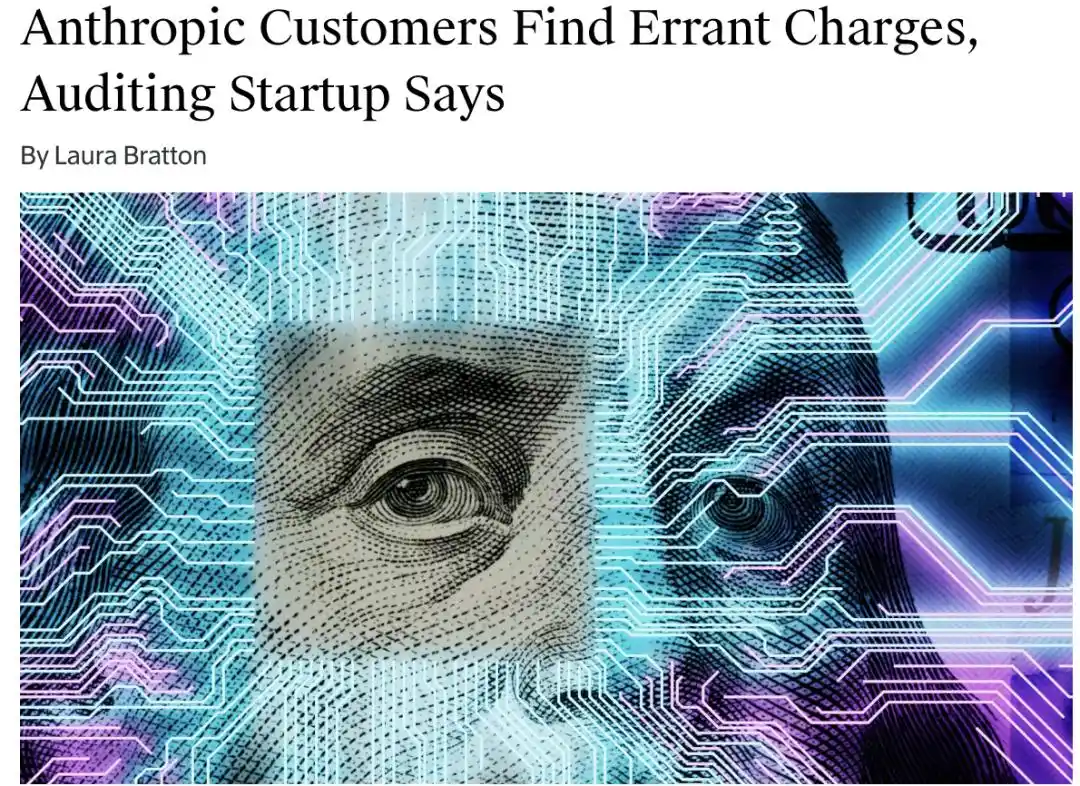
The Information reported: The auditing firm Vaudit stated that it identified about $1.7 million in suspected overcharges in the corporate AI bills it handled, mainly involving Claude Code.
The audited client list included major corporations such as Panasonic, HP, and Honda.
But if you ask the two AI giants on the other side of the bills, you get a different version.
Anthropic says it does not charge for unfulfilled requests or errors, nor does it secretly route requests to older models, and overcharging does not appear to be a widespread phenomenon.
OpenAI is more direct: there is no evidence that these issues occurred with its customers.
Both sides claim there is no problem.
However, after rounds of appeals by Vaudit and its clients, about 80% of these disputed amounts were ultimately refunded by Amazon, Google, Microsoft, Anthropic, and OpenAI.
Hahn says these companies were very cooperative when issues arose, agreeing to refund the money but refusing to admit any mistake.
Thus, the situation becomes strange: the auditing firm points to the ledger saying "I found it," about 80% of the overcharges were refunded, yet the model vendors collectively shrug and say "nothing happened."
If everyone claims there's no mistake, how did these refunds come about?
How Did This 1.7 Million Become "Excess"?
First, let's see what Vaudit uncovered.
Michael listed three of the most common overcharging methods, each hidden in inconspicuous corners of the bill where no one would normally check line by line.
The first: model misassignment.
The client actually called an older, cheaper model, but the bill was calculated based on a newer, more expensive tier.
For example, you bought an economy-class seat but were charged a first-class price. It's unnoticeable once or twice, but after millions of calls, the price difference becomes apparent.
The second: paying for failure.
An agent or chatbot that fails to complete a request, or even directly returns an error, is still included in the bill.
The third is the most insidious. Hahn calls it a "retry storm." An agent task fails, and it silently retries repeatedly in the background. The user has no idea money is being burned in the background, and the costs stack up layer by layer.
None of these three are caused by the user "actively using more."

The third one is the most frightening.
In the past, when you used software, you monitored it step by step, and could immediately stop it if it went haywire.
But the selling point of AI agents is precisely "let it work on its own," with the human stepping out of the process.
This means that when an AI agent hits a wall, retries, hits another wall, and burns tokens like crazy in the background, the person who would normally call a stop doesn't know about it, and the bill doesn't arrive until the end of the month.
Anthropic, OpenAI: We Didn't Overcharge
The point of this matter is not "who cheated whom."
Vaudit found it, but Anthropic and OpenAI didn't admit it. This is just the auditing firm's version. One cannot simply label the two companies as overchargers based on the phrase "found 1.7 million."
But they did cooperate when it came to refunds. The fact that 80% was refunded at once precisely shows that this 80% shouldn't have been charged in the first place.
Refunds are error corrections. The money is back, but the account is still a mess.
The reason for this "refund without admission" stalemate lies in the inherent algorithm of the AI billing business itself.
Why AI Bills Are Inherently Incomprehensible
The problem might not be "miscalculation," but "inherently impossible to calculate clearly."
Because it charges based on token usage—the more you use, the more you pay; the more complex the usage, the more you pay. Yet tokens are essentially invisible in the infrastructure dashboards you commonly use.
What's more troublesome is that it can fluctuate wildly. Asking the same question, depending on which model is used, how the prompt is written, and how the agent is orchestrated, the tokens burned can differ by orders of magnitude.
The more models move towards being "agentic," the more tokens they consume. An agent running a task for you could involve dozens or even hundreds of model calls in the background, each burning money.
Inherently unpredictable and hard to explain—this is how the ambiguous zone of "overcharging" emerges.
Hahn's words hit the nail on the head: AI bills are becoming increasingly opaque. This statement precisely hits the soft spot of the entire industry.
AI has evolved from the earliest "per-call billing" to today's "multi-model + multi-agent + cloud intermediary," stretching the billing chain longer and longer: the model vendor charges once, the cloud vendor charges once, and the SDK agent in the middle adds another layer.
Each layer looks reasonable on its own, but when the three are stacked together, it's hard to see at a glance where the money was actually spent.
What's even more critical is that money is often not burned where you can see it.
The scenarios that truly eat up the bill are almost all hidden in the background, and each one has publicly available GitHub issues or incident reports that can be checked.

After looking at these eight scenarios, you'll find that either the context is repeatedly retransmitted, or sub-agents run idly overnight with no one watching, and the bill just grows larger and larger on its own, out of sight.
$200 Subscription, $50,000 Bill
This is not the first time Anthropic has faced challenges with AI billing.
On June 15, a client from Washington D.C., Karl Kahn, sued Anthropic in federal court, accusing it of failing to deliver on high-priced subscriptions.
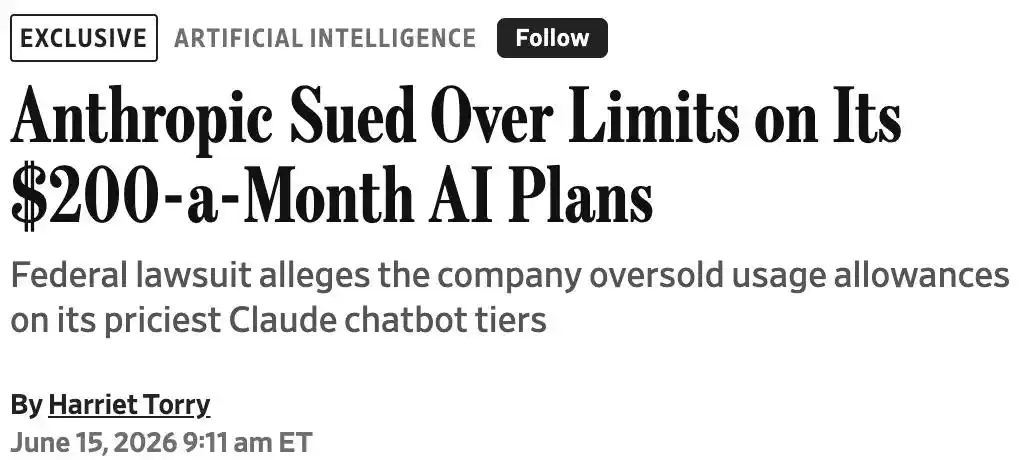
According to The Wall Street Journal, Anthropic's Max 5x costs $100 per month, and Max 20x costs $200 per month. The advertised selling point was 5 times and 20 times the usage limits of the Pro plan, respectively.
But Kahn says the actual usable amount is far lower than advertised.
He upgraded to Max 20x in April this year, but within weeks, he hit the weekly usage ceiling. One 5-hour sprint directly burned through 15% of his weekly quota.
He was left with only three options: stop work, use sparingly, or pay more for additional purchases.
The basis of this lawsuit is primarily a batch of emails sent by Anthropic in July 2025 to subscribers of different tiers, which specified the approximate weekly usage for each tier.
The plaintiff used these black-and-white emails to compare against the actual quotas received, concluding they were "far below the advertised amount."
The lawsuit seeks class-action status, covering all individuals who purchased these two tiers since April 2025.
Finding Errors in AI Bills Is Becoming a Business
Vaudit, which "exposes" AI bills, was founded in 2023 and has a team of about 30 people.
Founder Hahn is a former Oracle director. His old trade was auditing bills for logistics, transportation, advertising, and cloud services—essentially, he specialized in helping people "check accounts and save money."
Earlier this year, he applied this skill directly to AI bills.

Vaudit's website states that it monitors and recovers every penny of your AI spending, having audited over $1 billion to date.
Vaudit's method is straightforward:
Clients install a piece of software into their AI environment, typically via a Software Development Kit (SDK), which quietly captures raw data on AI usage. This data is then compared line by line with invoices and bills. If they don't match, Vaudit files appeals on the client's behalf.
The fee structure is also direct: 1% of the audited amount, plus 30% of the recovered money. The more they recover for you, the more they earn themselves.
The fact that specializing in finding errors in AI bills can become a business in itself shows: AI billing has become so complex that hiring a "third-party auditor" is now necessary.
And all of this happens at a微妙 (subtle) point in time.
Both Anthropic and OpenAI are sprinting toward IPOs, rushing to pack new features for customers. On one side is the狂奔 (galloping) valuation and revenue, and on the other side are paying users frowning at incomprehensible bills.
Thus, a completely new profession has emerged: the "bill tax accountant" of the AI era.
And who has calculated that AI bill in your hand?
References:
https://www.theinformation.com/newsletters/applied-ai/anthropic-customers-find-errant-charges-auditing-startup-says?rc=epv9gi
This article is from the WeChat public account "New Zhiyuan," author: ASI Apocalypse.