STRC Trading at Significant Discount, mNAV Falls Below Break-Even, Strategy's Valuation Logic Has Been Rewritten

Foresight NewsXuất bản vào 2026-06-26Cập nhật gần nhất vào 2026-06-26

Tóm tắt

Title: STRC Deeply Discounted, mNAV Falls Below Break-even, Strategy's Valuation Logic Redefined The recent volatility in MSTR and STRC highlights the need to reassess the core business model of Bitcoin reserve companies. These entities function more like leveraged, single-asset banks rather than software/tech firms. Consequently, they should be valued using banking metrics, not based on their total Bitcoin holdings. The key valuation metric is mNAV (market net asset value), akin to a price-to-book ratio. It compares the company's market capitalization to the equity value of its Bitcoin holdings after deducting all senior debt and preferred equity (like STRC). As of June 24, Strategy's mNAV was 1.10x. The focus should be on "net Bitcoin per share" (the Bitcoin claim per share after senior claims) and its growth rate, equivalent to a bank's book value and return on assets. Given STRC's 19% discount to its $100 par value (yielding 14.2%), issuing new MSTR equity at the current price to buy more Bitcoin is inefficient. It slightly dilutes the widely watched "total Bitcoin per share" metric while providing minimal improvement to the more critical "net Bitcoin per share." The article analyzes four potential uses for $1 billion in new equity: 1. **Buy Bitcoin:** Least effective. Improves net Bitcoin per share only marginally while diluting total Bitcoin per share. 2. **Repurchase STRC:** Most effective for balance sheet repair. The discount creates immediate value, increasing...


Author: Khing Oei

Compiled by: Chopper, Foresight News


Recently, the markets for MSTR and STRC have experienced significant volatility. We should look beyond short-term price fluctuations and revisit the underlying logic: Bitcoin reserve companies are essentially single-asset, leveraged holding entities, with a business model closer to that of a bank rather than a software technology company.


From a valuation perspective, the market would never price a bank based solely on its total assets. A bank's loan assets are prioritized for repayment by depositors and debt holders, with common shareholders only entitled to residual equity. Therefore, the core valuation metric for banks is the price-to-book ratio (P/B), which is the value of shareholders' equity after deducting senior debt from total assets. This is also the primary reference metric for investment bank and brokerage analysts.


For Bitcoin reserve companies, the equivalent P/B metric is mNAV: it equals the company's market capitalization divided by the equity net asset value, where equity net asset value refers to Bitcoin reserves minus debt and preferred stock senior to common shares. As of the previous close, Strategy's mNAV was 1.10x. (Translator's Note: The "previous close" data mentioned in this article refers to June 24th data.) The underlying per-share fundamental is the net Bitcoin per share—the actual amount of Bitcoin owned per share after settling priority claims. This is equivalent to the per-share book value denominated in Bitcoin. The industry-wide focus—the per-share Bitcoin growth rate—represents the return on this book value. For a capital management company, this is almost equivalent to an earnings metric.


This set of metrics is not my invention; it simply applies the traditional bank financial analysis framework to a Bitcoin balance sheet:


  • Market cap per unit of equity / Net asset value = Price-to-Book Ratio
  • Net Bitcoin holding per share = Book value per share
  • Bitcoin holding growth per share = Return on book assets


This is the valuation logic common to all leveraged financial institutions and is fully applicable to these Bitcoin reserve companies.


MSTR closed yesterday at $94.13 per share, below the total net Bitcoin value per share of $143.76, resulting in a rough total net value multiple of only 0.65x. Viewed solely through this lens, the stock trades at nearly a one-third discount to its Bitcoin asset value, making a stock issuance to buy more Bitcoin seem dilutive. However, after deducting the approximately 40% of Bitcoin equity occupied by debt and preferred stock, the current stock price represents 1.1 times the Bitcoin assets actually held by common equity. The two perspectives lead to completely opposite conclusions, and the banking valuation framework is the correct benchmark, which also determines how the company should use any new capital raised at present.


Simulating Four Use Cases for $1 Billion in New Capital


Assuming a $1 billion equity issuance at the current stock price, we simulate the effects of four potential uses for the funds: 1) Increase Bitcoin holdings; 2) Repurchase STRC; 3) Boost cash reserves; 4) A 50/50 split between repurchasing STRC and boosting cash reserves. The issuance price is $94.13 per share; yesterday's STRC closing price was $80.84, a 19% discount to its par value, translating to an actual annualized yield of 14.2%. For every $1 spent on repurchases, $1.24 of STRC at par value can be retired, simultaneously eliminating the 11.5% perpetual dividend.
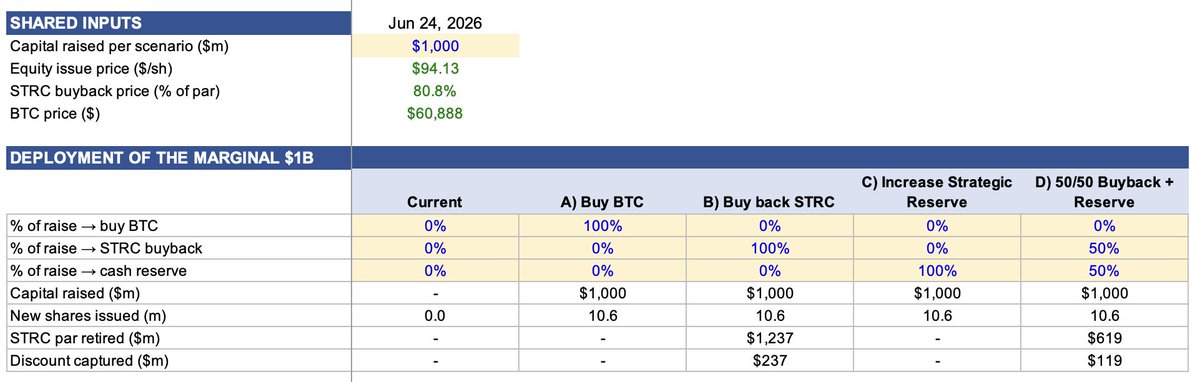


Impact of the Four Scenarios on the Balance Sheet


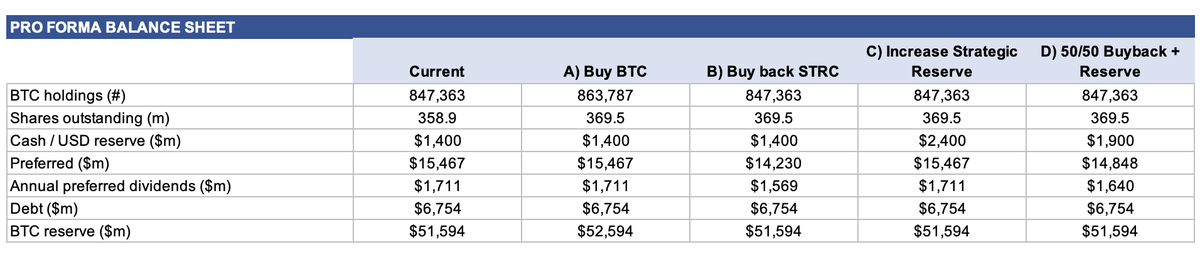
Three of the four scenarios do not increase Bitcoin holdings; they only adjust the structure of the senior claims layer:


Repurchase STRC: Buying back at a 19% discount, $1 billion can retire $1.24 billion of STRC at par value. Annual preferred stock dividend payments decrease from $1.711 billion to $1.569 billion.

Boost Cash Reserves: Cash reserves increase from $1.4 billion to $2.4 billion, with dividend payments unchanged.

50/50 Split Scenario: Cash increases to $1.9 billion, dividend payments decrease to $1.640 billion, and $619 million of STRC at par value is retired.

Increase Bitcoin Holdings: The only scenario that increases Bitcoin reserves, raising total holdings from 847,363 BTC to 863,787 BTC. This is also the weakest choice for improving core metrics.


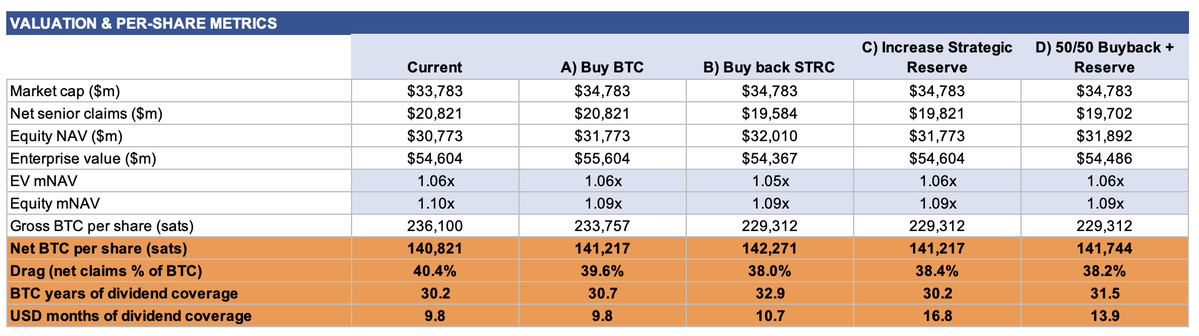
Calculating total Bitcoin value per share, all four scenarios show dilution. Even if you use the entire $1 billion to purchase Bitcoin, the per-share value decreases from 236,100 satoshis to 233,757 satoshis; in the three scenarios where stock is issued but no Bitcoin is purchased, the per-share value drops even further to 229,312 satoshis. Based on this, you would conclude: the company should do nothing.


However, in terms of net Bitcoin value per share, every option results in an increase:


  • Repurchase STRC: Net Bitcoin per share rises to 142,271 satoshis (+1.0%). Debt-to-assets ratio decreases from 40.4% to 38.0%. This provides the strongest balance sheet repair.
  • 50/50 Split Scenario: Net Bitcoin per share becomes 141,744 satoshis, with a debt-to-assets ratio of 38.2%. Cash coverage for debt service is significantly enhanced.
  • Purely Boosting Cash Reserves or Increasing Bitcoin Holdings: Both result in 141,217 satoshis per share, showing the smallest increase.


The logic for Bitcoin purchases being the least effective is clear. You are issuing stock at 1.1 times net asset value but purchasing assets at 1 times net asset value. This only slightly increases net Bitcoin per share while diluting the widely followed total Bitcoin holdings metric. In contrast, repurchasing STRC at a discount creates immediate value.


The market's current key concern is the dividend cash coverage in months. Strategy currently has $1.4 billion in cash reserves and annual STRC dividend payments of $1.711 billion, meaning cash covers only 9.8 months of dividends:


  • Increase Bitcoin Holdings: Coverage remains at 9.8 months.
  • Repurchase STRC: Improves to 10.7 months.
  • Purely Boost Cash Reserves: Significantly improves to 16.8 months.
  • 50/50 Split Scenario: Improves to 13.9 months.


This is another core banking metric: the liquidity coverage ratio. No one pays attention during loose funding cycles, but during funding contractions, it becomes crucial for corporate survival. The fact that STRC is trading below par is a direct signal of market funding channel tightening.


Company's Own Financial Data Also Confirms This Conclusion


The above analysis is not a subjective judgment; Strategy's Q1 earnings report provides the same break-even threshold. According to the company's own framework, selling MSTR to buy Bitcoin only increases Bitcoin per share when mNAV is above 1.22x. At the current multiple of 1x, such a move directly erodes value by 48 basis points. The company's current EV is 1.06x and mNAV is 1.10x, both below its internal break-even line.


The two core assumptions behind the company's conventional expansion path have now completely failed. Previously, it was assumed that STRC could be issued at par normally and that cash reserves could cover 1.5 years of dividends. Now, STRC trades at $81 and cannot be issued at par, and cash reserves cover less than 10 months of dividends.


What Should Strategy Do?


Within the current valuation range, issuing new equity and deploying the capital into channels that tangibly optimize core financial metrics is key. Both boosting cash reserves and repurchasing STRC at a discount can increase net Bitcoin per share, reduce the debt burden, and repair the market's concern over liquidity coverage. The 50/50 split scenario can achieve all these objectives simultaneously.


Continuing to add Bitcoin at present would only optimize the superficial metrics widely followed by the public, while neglecting the core balance sheet risk of the company carrying $15 billion in priority debt amidst tightening funding channels.


Investors focused solely on the total Bitcoin holdings metric miss the positive feedback loop. Repurchasing STRC directly supports token buy-side pressure and signals confidence in liquidity safety. Once market panic subsides, STRC prices should recover toward the $100 par value; price appreciation corresponds to lower yields, and the current high yield of 14.2% would continue to narrow. A complete positive cycle thus forms: repairing the balance sheet → STRC price recovery → dividend yield declines → the previously closed channel for par-value issuance reopens.


The STRC discount is not something that can only be passively waited out for repair; the current deep discount represents the lowest-cost capital the company can access and is key to restarting other funding channels.


To evaluate Bitcoin reserve companies, one should apply banking valuation standards: price-to-book ratio, per-share book value, and debt servicing capacity under stress environments.


Tiền kỹ thuật số thịnh hành

Câu hỏi Liên quan

QWhat is the core valuation framework proposed by the author for Bitcoin reserve companies like Strategy, and why is it applicable?

AThe author proposes applying a traditional bank valuation framework. The core logic is that these companies are leveraged holders of a single asset (Bitcoin), similar to banks. The key valuation metric is the Price-to-Book ratio, represented as mNAV (market NAV), which is the company's market capitalization divided by its equity net asset value (Bitcoin reserves minus priority debt and preferred stock). This framework is applicable because it focuses on the residual equity value for common shareholders after satisfying priority claims, which is the standard way to value leveraged financial institutions.

QAccording to the author's analysis, what is the least effective use of $1 billion in new equity capital for Strategy at the current valuation, and why?

AUsing the new capital to buy more Bitcoin is the least effective option. The logic is that the company would be issuing equity at a price of 1.1x its net asset value (mNAV) but buying an asset (Bitcoin) priced at 1x its underlying value. This results in only a minimal increase in the key metric of 'Net Bitcoin per share' while diluting the more widely watched 'Total Bitcoin per share' metric. In contrast, using the capital to repurchase discounted STRC preferred shares creates immediate value by reducing debt burden and dividend obligations.

QWhat are the two core assumptions of Strategy's original expansion plan that the author states have now failed?

AThe two failed core assumptions are: 1) That STRC (the company's preferred shares) could be issued continuously at its $100 par value. Currently, it trades at a 19% discount ($81), closing this funding channel. 2) That the company's cash reserves would be sufficient to cover 1.5 years of dividend payments on those preferred shares. Currently, the cash covers less than 10 months of dividends, indicating a liquidity coverage problem.

QWhat positive feedback loop does the author describe as a potential outcome if Strategy uses new capital to repurchase STRC shares?

AThe positive feedback loop is: Repairing the balance sheet by repurchasing discounted STRC → This action supports STRC's market price → As STRC's price rises toward its $100 par value, its dividend yield falls → The previously closed channel for issuing new STRC at par value reopens. This cycle allows the company to improve its financial health and regain access to lower-cost capital.

QWhat key banking metric does the author highlight as crucial during periods of financing tightening, and what is Strategy's current situation regarding this metric?

AThe author highlights 'Liquidity Coverage' or specifically the 'Cash Dividend Coverage Months' as a crucial banking metric during financing tightening. It measures how many months of dividend payments (for priority securities like STRC) the company's cash reserves can cover. Strategy's current cash reserve of $1.4 billion covers only 9.8 months of its $1.711 billion annual STRC dividend, signaling potential liquidity stress in a tighter funding environment.

Nội dung Liên quan

Các Nhà Phân Tích Nhìn Thấy XRP Và BNB Đuổi Theo Vị Thế Vốn Hóa Thị Trường 100 Tỷ USD Vào Cuối Năm 2026

**TL;DR** Các nhà phân tích dự đoán XRP và BNB có thể gia nhập hoặc tái gia nhập câu lạc bộ vốn hóa thị trường 100 tỷ USD vào nửa cuối năm 2026. Dự báo này dựa trên phân tích biểu đồ lịch sử và cơ bản dự án, không phải là kết quả tài chính được đảm bảo. **Tóm tắt** Một báo cáo từ Finbold chỉ ra XRP và BNB là những ứng cử viên chính để đạt mốc vốn hóa 100 tỷ USD vào cuối năm 2026. Thông tin này đóng vai trò như một thước đo tâm lý thị trường, cho thấy nơi mà sự thèm ăn rủi ro có thể đang dịch chuyển. Tuy nhiên, cần nhấn mạnh đây là suy đoán từ các nhà phân tích, không phải sự đảm bảo. Thị trường tiền điện tử thường biến một điểm dữ liệu nhỏ thành một câu chuyện lan rộng. Bài viết lưu ý rằng câu chuyện này không chỉ ảnh hưởng đến riêng XRP hay BNB. Nó có thể tác động lan tỏa đến các giao dịch liên quan, tâm lý altcoin và định vị của các tổ chức, đặc biệt trong bối cảnh thanh khoản mỏng. Điều quan trọng tiếp theo là theo dõi liệu các luồng dữ liệu tiếp theo (như số liệu on-chain, lãi suất mở) có củng cố xu hướng này hay không, hay nó sẽ chỉ là một tín hiệu ngắn hạn. Cần đọc thông tin này cùng với các điều kiện thị trường rộng hơn về thanh khoản, vĩ mô và phái sinh.

bitcoinist14 phút trước

Các Nhà Phân Tích Nhìn Thấy XRP Và BNB Đuổi Theo Vị Thế Vốn Hóa Thị Trường 100 Tỷ USD Vào Cuối Năm 2026

bitcoinist14 phút trước

Vốn Hóa Thị Trường Altcoin Quay Về Gần 900 Ngày Khi Nhà Phân Tích Chỉ Ra Vùng Hỗ Trợ Chính

Nhà phân tích Michaël van de Poppe chỉ ra rằng vốn hóa thị trường altcoin đã mất gần như toàn bộ mức tăng trưởng tích lũy trong gần **900 ngày**, quay trở lại vùng giá đột phá từ cuối năm 2023. Điều này cho thấy một đợt điều chỉnh mạnh, khiến tâm lý thị trường trở nên tiêu cực vì nhiều altcoin về cơ bản không có lãi sau một thời gian dài. Mặt tích cực là đợt điều chỉnh sâu này đưa thị trường về một vùng hỗ trợ quan trọng. Vùng giá đột phá trước đây thường thu hút sự chú ý của những người mua dài hạn và có thể trở thành khu vực tích lũy, tạo nền tảng cho đợt tăng tiếp theo nếu được giữ vững. Tuy nhiên, đây cũng là một điểm quyết định: nếu vùng hỗ trợ này thất bại, triển vọng sẽ ảm đạm hơn. Altcoin rất nhạy cảm với thanh khoản và mức độ ưa thích rủi ro. Do đó, các nhà giao dịch cần theo dõi tín hiệu phục hồi bền vững của vốn hóa thị trường altcoin từ vùng này, đi kèm với khối lượng giao dịch được cải thiện và sự tham gia rộng rãi trên nhiều lĩnh vực (L1, DeFi, cơ sở hạ tầng, token AI...), chứ không chỉ các đợt bơm giá riêng lẻ. Tóm lại, thị trường altcoin đang ở thời điểm cần chứng minh bản thân: giữ được hỗ trợ sẽ mở ra cơ hội tích lũy, ngược lại sẽ làm trầm trọng thêm câu chuyện "gần 900 ngày không có tiến triển".

bitcoinist14 phút trước

Vốn Hóa Thị Trường Altcoin Quay Về Gần 900 Ngày Khi Nhà Phân Tích Chỉ Ra Vùng Hỗ Trợ Chính

bitcoinist14 phút trước

Chainlink tăng 8,000 chủ sở hữu mới – LINK có thể phá vỡ xu hướng giảm của nó không?

Chainlink (LINK) đã chứng kiến sự gia tăng mạnh về số lượng ví nắm giữ, với hơn 8.000 ví mới trong 5 ngày, nâng tổng số lên 892.8K ví. Điều này cho thấy sự áp dụng mạng lưới tiếp tục mở rộng bất chấp giá cả còn yếu, có thể nhờ vào sự quan tâm xung quanh token hóa tài sản thực và các sáng kiến blockchain thể chế. Hoạt động trên sàn giao dịch cho thấy dòng tiền ròng rút ra chiếm ưu thế, phản ánh việc giảm nguồn cung bán ngay lập tức khi nhà đầu tư chuyển token vào ví lưu trữ dài hạn, một dấu hiệu của việc tích lũy. Về mặt kỹ thuật, LINK vẫn giao dịch trong một kênh giảm giá, nhiều lần phòng thủ thành công vùng hỗ trợ quan trọng quanh mức 7.00 USD nhưng chưa đủ sức thử thách vùng kháng cự phía trên. Chỉ số RSI cho thấy áp lực bán đã giảm nhưng sức mua vẫn còn yếu. Đáng chú ý, tỷ lệ tài trợ (Funding Rate) vẫn duy trì ở vùng tích cực, cho thấy nhà giao dịch phái sinh vẫn giữ niềm tin vào triển vọng tăng giá trong tương lai. Tóm lại, mặc dù xu hướng giảm giá vẫn chiếm ưu thế, Chainlink đang xây dựng nền tảng vững chắc với sự gia tăng người nắm giữ, dấu hiệu tích lũy và tâm lý phái sinh lạc quan. Sự phục hồi mạnh mẽ hơn có thể xảy ra nếu nhu cầu mua spot tăng cường, giúp LINK thoát khỏi kênh giảm giá hiện tại.

ambcrypto18 phút trước

Chainlink tăng 8,000 chủ sở hữu mới – LINK có thể phá vỡ xu hướng giảm của nó không?

ambcrypto18 phút trước

Chainlink Thêm 6.100 Ví Trong Hai Ngày Trong Đợt Bùng Nổ Tăng Trưởng Mạnh Nhất Năm 2026

Chainlink đã báo cáo việc bổ sung 6.100 địa chỉ ví mới trong hai ngày, đánh dấu đợt tăng trưởng ví mạnh mẽ nhất của mạng lưới này trong năm 2026. Sự tăng trưởng này là một tín hiệu đáng chú ý, diễn ra trong bối cảnh thị trường tiền điện tử phụ (altcoin) nói chung và LINK nói riêng vẫn đang gặp nhiều khó khăn. Nó cho thấy sự quan tâm của người dùng hoặc nhà đầu tư vẫn tồn tại ngay cả khi tâm lý thị trường còn yếu. Đối với Chainlink, một dự án cơ sở hạ tầng, sự tăng trưởng về số lượng ví đặc biệt có ý nghĩa vì phản ánh mức độ tham gia vào hệ sinh thái. Số ví tăng không tự động chứng minh việc áp dụng công nghệ, nhưng là dấu hiệu cho thấy mạng lưới vẫn thu hút sự chú ý. Tuy nhiên, chi tiết về loại ví mới (ví cá nhân nhỏ, người dùng mới hay ví sàn giao dịch) là rất quan trọng để có đánh giá toàn diện. Dù vậy, trong một thị trường suy yếu, việc số lượng ví tăng lên vẫn là tín hiệu tích cực hơn so với viện nó đứng im hoặc thu hẹp. Tóm lại, đây là một tín hiệu tích cực về mặt áp dụng mạng lưới, cung cấp cơ sở để những người lạc quan tham khảo. Tuy nhiên, nó không đảm bảo cho sự phục hồi về giá. Giá token vẫn phụ thuộc vào thanh khoản, nhu cầu và chu kỳ thị trường. Cần theo dõi thêm các yếu tố xác nhận như hoạt động giao dịch, cấu trúc giá và dòng tiền để có bức tranh hoàn chỉnh hơn.

bitcoinist59 phút trước

Chainlink Thêm 6.100 Ví Trong Hai Ngày Trong Đợt Bùng Nổ Tăng Trưởng Mạnh Nhất Năm 2026

bitcoinist59 phút trước

Vị Thế Mở Dogecoin Dao Động Quanh 959 Triệu Đô La Khi Nhà Giao Dịch Chờ Tín Hiệu Phục Hồi

Dogecoin (DOGE) được ghi nhận có số dư lãi mở (open interest) trong các hợp đồng phái sinh dao động quanh mức **959 triệu USD** vào cuối tuần giao dịch trầm lắng. Con số này cho thấy lượng tiền lớn vẫn đang được neo giữ trong các vị thế phái sinh, làm tăng độ nhạy cảm của thị trường với các biến động mạnh. Điều quan trọng cần lưu ý là số dư lãi mở cao tự nó không chỉ ra hướng đi của giá cả. Nó phản ánh mức độ định vị thị trường đáng kể, nhưng để đánh giá liệu điều này hỗ trợ phục hồi hay cảnh báo rủi ro, cần xem xét thêm hành động giá, tỷ lệ tài trợ, khối lượng giao dịch và các mức thanh lý. Bối cảnh hiện tại cho thấy Dogecoin - một tài sản lớn chịu ảnh hưởng mạnh bởi tâm lý - vẫn thu hút được sự tham gia đáng kể từ thị trường phái sinh. Câu hỏi then chốt cho một sự phục hồi bền vững là liệu DOGE có thu hút được nhu cầu mua thực tế (spot demand) đi kèm hay không. Đòn bẩy có thể thúc đẩy một đợt biến động, nhưng không thể thay thế dòng tiền mua thật. Tóm lại, thị trường chưa đưa ra tín hiệu phục hồi rõ ràng, nhưng sự tham gia tích cực từ phía phái sinh khiến cho bước di chuyển tiếp theo được xác nhận (bởi giá cả, dòng tiền và hành vi thị trường) có thể có tác động mạnh mẽ hơn so với vẻ ngoài trầm lắng của cuối tuần.

bitcoinist1 giờ trước

Vị Thế Mở Dogecoin Dao Động Quanh 959 Triệu Đô La Khi Nhà Giao Dịch Chờ Tín Hiệu Phục Hồi

bitcoinist1 giờ trước

Giao dịch

Giao ngay

Bài viết Nổi bật

Làm thế nào để Mua VERONA

Chào mừng bạn đến với HTX.com! Chúng tôi đã làm cho mua VERONA (VERONA) trở nên đơn giản và thuận tiện. Làm theo hướng dẫn từng bước của chúng tôi để bắt đầu hành trình tiền kỹ thuật số của bạn.Bước 1: Tạo Tài khoản HTX của BạnSử dụng email hoặc số điện thoại của bạn để đăng ký tài khoản miễn phí trên HTX. Trải nghiệm hành trình đăng ký không rắc rối và mở khóa tất cả tính năng. Nhận Tài khoản của tôiBước 2: Truy cập Mua Crypto và Chọn Phương thức Thanh toán của BạnThẻ Tín dụng/Ghi nợ: Sử dụng Visa hoặc Mastercard của bạn để mua VERONA (VERONA) ngay lập tức.Số dư: Sử dụng tiền từ số dư tài khoản HTX của bạn để giao dịch liền mạch.Bên thứ ba: Chúng tôi đã thêm những phương thức thanh toán phổ biến như Google Pay và Apple Pay để nâng cao sự tiện lợi.P2P: Giao dịch trực tiếp với người dùng khác trên HTX.Thị trường mua bán phi tập trung (OTC): Chúng tôi cung cấp những dịch vụ được thiết kế riêng và tỷ giá hối đoái cạnh tranh cho nhà giao dịch.Bước 3: Lưu trữ VERONA (VERONA) của BạnSau khi mua VERONA (VERONA), lưu trữ trong tài khoản HTX của bạn. Ngoài ra, bạn có thể gửi đi nơi khác qua chuyển khoản blockchain hoặc sử dụng để giao dịch những tiền kỹ thuật số khác.Bước 4: Giao dịch VERONA (VERONA)Giao dịch VERONA (VERONA) dễ dàng trên thị trường giao ngay của HTX. Chỉ cần truy cập vào tài khoản của bạn, chọn cặp giao dịch, thực hiện giao dịch và theo dõi trong thời gian thực. Chúng tôi cung cấp trải nghiệm thân thiện với người dùng cho cả người mới bắt đầu và người giao dịch dày dạn kinh nghiệm.

Tổng lượt xem 80Xuất bản vào 2026.06.22Cập nhật vào 2026.06.22

Làm thế nào để Mua VERONA

Làm thế nào để Mua NES

Chào mừng bạn đến với HTX.com! Chúng tôi đã làm cho mua Nesa (NES) trở nên đơn giản và thuận tiện. Làm theo hướng dẫn từng bước của chúng tôi để bắt đầu hành trình tiền kỹ thuật số của bạn.Bước 1: Tạo Tài khoản HTX của BạnSử dụng email hoặc số điện thoại của bạn để đăng ký tài khoản miễn phí trên HTX. Trải nghiệm hành trình đăng ký không rắc rối và mở khóa tất cả tính năng. Nhận Tài khoản của tôiBước 2: Truy cập Mua Crypto và Chọn Phương thức Thanh toán của BạnThẻ Tín dụng/Ghi nợ: Sử dụng Visa hoặc Mastercard của bạn để mua Nesa (NES) ngay lập tức.Số dư: Sử dụng tiền từ số dư tài khoản HTX của bạn để giao dịch liền mạch.Bên thứ ba: Chúng tôi đã thêm những phương thức thanh toán phổ biến như Google Pay và Apple Pay để nâng cao sự tiện lợi.P2P: Giao dịch trực tiếp với người dùng khác trên HTX.Thị trường mua bán phi tập trung (OTC): Chúng tôi cung cấp những dịch vụ được thiết kế riêng và tỷ giá hối đoái cạnh tranh cho nhà giao dịch.Bước 3: Lưu trữ Nesa (NES) của BạnSau khi mua Nesa (NES), lưu trữ trong tài khoản HTX của bạn. Ngoài ra, bạn có thể gửi đi nơi khác qua chuyển khoản blockchain hoặc sử dụng để giao dịch những tiền kỹ thuật số khác.Bước 4: Giao dịch Nesa (NES)Giao dịch Nesa (NES) dễ dàng trên thị trường giao ngay của HTX. Chỉ cần truy cập vào tài khoản của bạn, chọn cặp giao dịch, thực hiện giao dịch và theo dõi trong thời gian thực. Chúng tôi cung cấp trải nghiệm thân thiện với người dùng cho cả người mới bắt đầu và người giao dịch dày dạn kinh nghiệm.

Tổng lượt xem 52Xuất bản vào 2026.06.24Cập nhật vào 2026.06.24

Làm thế nào để Mua NES

Làm thế nào để Mua CAP

Chào mừng bạn đến với HTX.com! Chúng tôi đã làm cho mua Cap (CAP) trở nên đơn giản và thuận tiện. Làm theo hướng dẫn từng bước của chúng tôi để bắt đầu hành trình tiền kỹ thuật số của bạn.Bước 1: Tạo Tài khoản HTX của BạnSử dụng email hoặc số điện thoại của bạn để đăng ký tài khoản miễn phí trên HTX. Trải nghiệm hành trình đăng ký không rắc rối và mở khóa tất cả tính năng. Nhận Tài khoản của tôiBước 2: Truy cập Mua Crypto và Chọn Phương thức Thanh toán của BạnThẻ Tín dụng/Ghi nợ: Sử dụng Visa hoặc Mastercard của bạn để mua Cap (CAP) ngay lập tức.Số dư: Sử dụng tiền từ số dư tài khoản HTX của bạn để giao dịch liền mạch.Bên thứ ba: Chúng tôi đã thêm những phương thức thanh toán phổ biến như Google Pay và Apple Pay để nâng cao sự tiện lợi.P2P: Giao dịch trực tiếp với người dùng khác trên HTX.Thị trường mua bán phi tập trung (OTC): Chúng tôi cung cấp những dịch vụ được thiết kế riêng và tỷ giá hối đoái cạnh tranh cho nhà giao dịch.Bước 3: Lưu trữ Cap (CAP) của BạnSau khi mua Cap (CAP), lưu trữ trong tài khoản HTX của bạn. Ngoài ra, bạn có thể gửi đi nơi khác qua chuyển khoản blockchain hoặc sử dụng để giao dịch những tiền kỹ thuật số khác.Bước 4: Giao dịch Cap (CAP)Giao dịch Cap (CAP) dễ dàng trên thị trường giao ngay của HTX. Chỉ cần truy cập vào tài khoản của bạn, chọn cặp giao dịch, thực hiện giao dịch và theo dõi trong thời gian thực. Chúng tôi cung cấp trải nghiệm thân thiện với người dùng cho cả người mới bắt đầu và người giao dịch dày dạn kinh nghiệm.

Tổng lượt xem 22Xuất bản vào 2026.06.26Cập nhật vào 2026.06.26

Làm thế nào để Mua CAP

Thảo luận

Chào mừng đến với Cộng đồng HTX. Tại đây, bạn có thể được thông báo về những phát triển nền tảng mới nhất và có quyền truy cập vào thông tin chuyên sâu về thị trường. Ý kiến ​​của người dùng về giá của M (M) được trình bày dưới đây.

活动图片