Why Is DeFi Insurance Unpopular?

Foresight NewsXuất bản vào 2026-06-23Cập nhật gần nhất vào 2026-06-23

Tóm tắt

The article explores the core reasons why DeFi insurance remains largely unutilized despite its potential to eliminate traditional insurance inefficiencies and malicious claim denials through automated smart contracts. Key points include: 1. **Low Adoption & Minimal Payouts:** Leading provider Nexus Mutual has paid only ~$18M in claims since 2019, dwarfed by single hack losses (e.g., Kelp DAO's $292M loss). 2. **High Correlation Risk:** Unlike traditional insurance (e.g., house fires), DeFi risks (oracle failures, bridge hacks) are systemic and can simultaneously impact multiple protocols, threatening to drain entire insurance pools. 3. **Prohibitive Cost vs. Reward:** For many protocols (Aave, Morpho, Compound), insurance premiums (1.5%-6%) consume a significant portion or even all of the native yield (3%-4%), leaving investors with meager returns. In some cases (Maple Finance, Ethena), premiums can even result in net-negative yields. 4. **Inadequate Capacity:** The total DeFi insurance pool (e.g., Nexus Mutual's $81.56M) is minuscule compared to the hundreds of billions in total value locked (TVL), creating a massive supply-demand gap. 5. **Structural Flaws:** The claims assessment model (e.g., Nexus Mutual's member voting) creates a conflict of interest, as voters bear the loss if a claim is paid. There is also no regulatory mandate forcing DeFi protocols to obtain insurance. The industry is adapting by focusing on preventative measures (e.g., bug bounty coverage) a...


Authored by: Thejaswini M A

Compiled by: Luffy, Foresight News


"Insurance is nothing but a scam," is almost a consensus in the market.


People think this way for a reason. Cigna, a U.S. insurance company, developed an algorithm that could directly deny claims without reviewing medical records. UnitedHealth, when the time set by its algorithm expired, directly stopped paying for care, completely disregarding the opinions of attending physicians. The traditional insurance business model has always been: collect client funds first, take a hefty cut, and then set up barriers at every step to impede claims.


Today, bank deposits are insured by the Federal Deposit Insurance Corporation (FDIC), but the coverage limit is only $250,000, a standard that has remained largely unchanged since its establishment in 1934. Brokerage accounts are protected by the Securities Investor Protection Corporation (SIPC) with a limit of $500,000; once account assets exceed this figure, the protection becomes meaningless. The public perception of security is far lower than reality, with coverage limits set entirely at the discretion of insurance companies.


DeFi insurance was supposed to completely solve this pain point: eliminate intermediaries, with payouts automatically executed as long as the smart contract's preset conditions are triggered, completely removing the possibility of malicious claim denials.


But the reality is that almost no one is buying. Insurance premiums would severely erode investment returns, and after deducting premiums, the remaining yield simply cannot match the investment risks users bear.


This article will explain this market situation and why, even though everyone wants to solve the problem, it's difficult to reverse the core root cause of the predicament.


Nexus Mutual is currently the largest DeFi insurance provider. Since its launch in 2019, its total cumulative claims paid amount to just over $18 million.
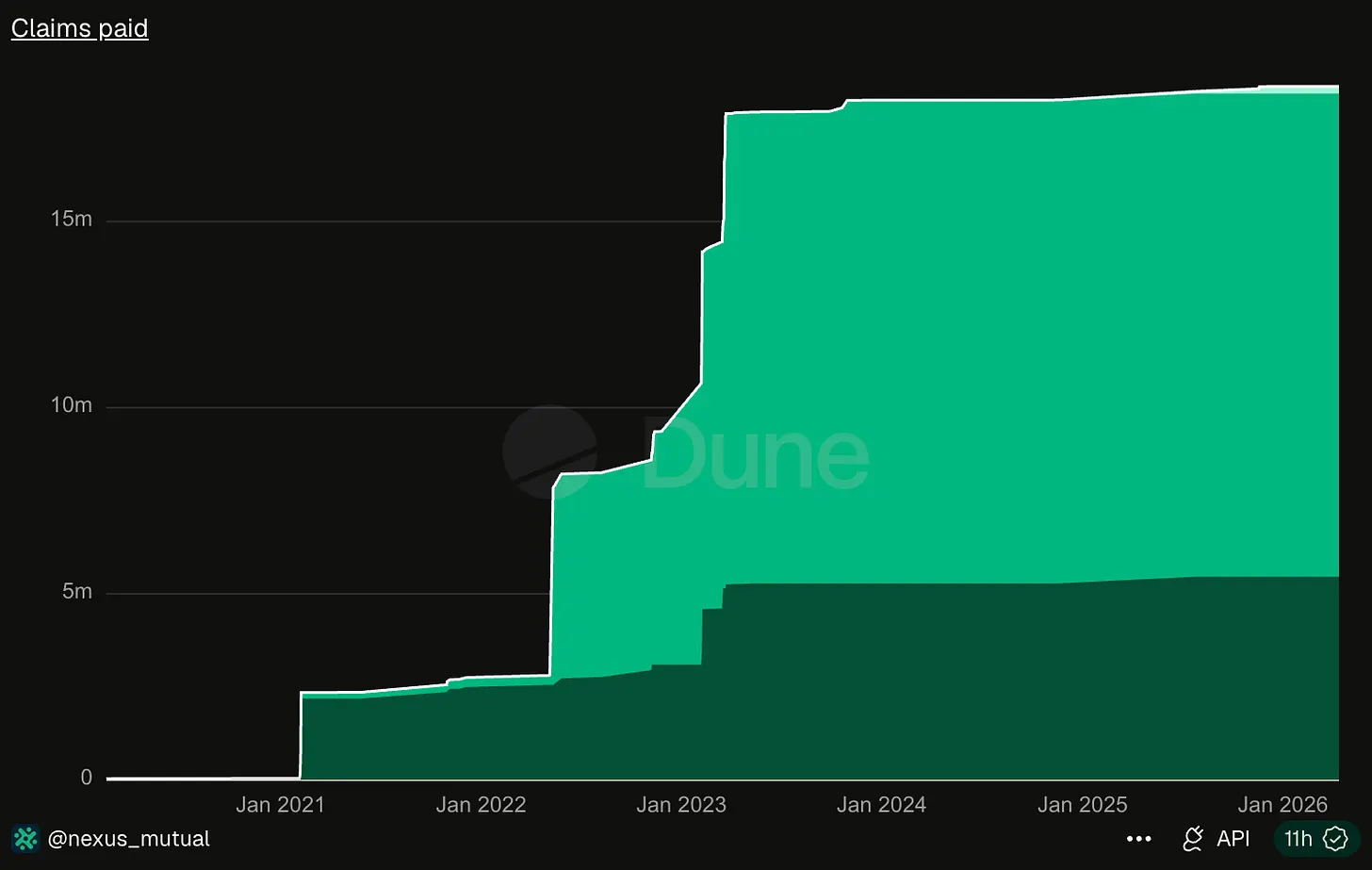

Data source: Dune Analytics


In April 2026, Kelp DAO suffered a hack, resulting in losses of up to $292 million. The amount stolen in this single incident alone is equivalent to 16 times the total claims paid by this leading insurance institution over seven years.


This forms an extreme contrast with the current situation of traditional insurance's frantic claim denials. Traditional insurance collects high premiums but goes to great lengths to obstruct claims; DeFi insurance, however, generates meager premium income because almost no investors are willing to purchase coverage.


The stable operation of traditional insurance relies on the principle of uncorrelated risks. One house catching fire doesn't cause other houses to be damaged. An insurance company can sell policies to 1 million users, and a single fire claim can be covered by the premiums collected from all. However, DeFi lacks this risk isolation mechanism: security incidents like oracle failures or cross-chain bridge vulnerabilities can chain-react, impacting all lending protocols and liquidity pools built on that underlying asset. The USDC de-pegging event in March 2023 affected all protocols that used USDC as collateral on that day. For a DeFi insurance pool, risks are highly correlated. The underwriter can only bet that losses from security incidents are controllable and that the pool's funds are sufficient to cover them.


In March 2023, Euler Finance was hacked for $197 million, and the risk spread rapidly: Angle Protocol lost $17 million due to holding Euler liquidity tokens, Yield Protocol shut down operations urgently, and other platforms like Inverse Finance were also affected.


Once a protocol has a security vulnerability, it often affects multiple projects. A single extreme incident in one day could even directly deplete the entire claim reserve of an insurance pool.


I compiled the current premium rates for Nexus Mutual and InsurAce and compared them to the native annual percentage yield (APY) of the protocols they insure: Aave V3's USDC deposit APY is about 3.14%, while the insurance premium range is 1.5%–2.5%. After deducting premiums, the net yield is only 0.6%–1.6%. Investors bear on-chain security risks only to end up with returns slightly higher than ordinary bank savings.
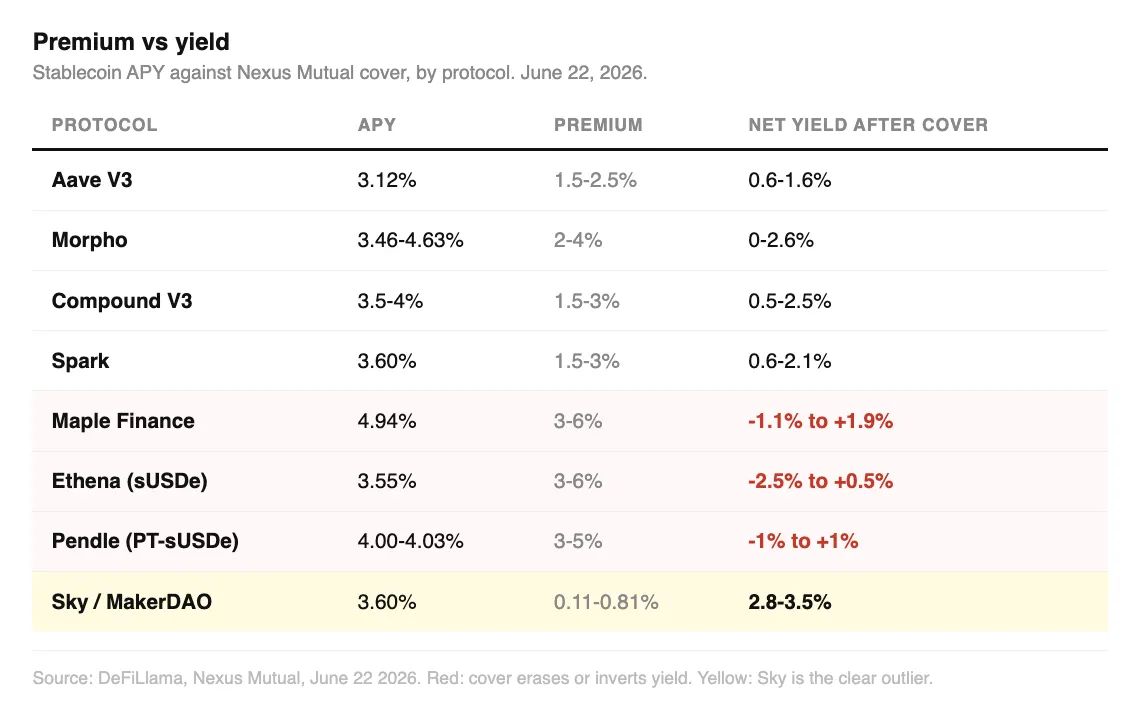


Morpho, Compound, and Spark show similar situations, with native APYs of 3.5%–4%. Premiums consume one-third to half of the yield, leaving minimal profits but with extremely low cost-effectiveness.


Maple Finance's institutional lending pools offer APYs of 4.77%–4.90%, but insurance premiums are as high as 3%–6%. The net yield after insurance ranges from -1.1% to 1.9%. Ethena staking offers APYs of 3.6%–4%, with premiums also at 3%–6%, resulting in net yields of -2.4% to 1%. Purchasing insurance on these two types of platforms can, in extreme cases, lead to losses on the principal for investors.


Only the original MakerDAO (Sky) stands out. Its savings product offers a 3.6% APY, with the lowest insurance premium being only 0.11%. It is widely recognized as the lowest-risk entity within DeFi, retaining a net yield of 2.8%–3.5% after insurance, preserving most of the returns.


Premium pricing strictly corresponds to risk levels, but premiums for emerging platforms are too high, directly consuming the high yields users seek when entering the market.


</p

Crypto investors choose to forgo insurance not out of laziness or recklessness; they understand that in most cases, purchasing insurance equates to zero returns. Even if all DeFi depositors collectively chose full coverage tomorrow, the entire industry could not meet the demand: Nexus Mutual's total pool size is about $81.56 million, and the entire industry's effective coverage capacity is at most a few hundred million dollars. In contrast, the total value locked (TVL) in major protocols amounts to hundreds of billions, a gap of astronomical proportions.


A single large-scale security incident like Kelp DAO would directly drain the vast majority of the industry's insurance reserves.


The historical claims total of $18 million precisely exposes the fragility of the industry's capital pools; the market has never experienced a catastrophic risk event capable of breaching underwriting reserves.


After a user submits a claim to Nexus Mutual, all token-holding members of the platform must vote on whether to pay. Members who vote in favor of paying a claim risk having their own assets directly impaired if the claim ultimately fails to be paid. This mechanism naturally fosters a tendency to deny claims. Traditional insurance employs dedicated underwriters and claims adjusters to balance conflicts, whereas DeFi insurance design merges all responsibilities onto the same group.


Before the 2008 financial crisis, financial risk pricing agencies generally believed a nationwide U.S. housing price collapse was impossible, as they had never experienced it. Insurance giant AIG massively sold risk protection contracts but was completely unable to pay when the market crisis truly erupted.


Before the U.S. government introduced FDIC deposit insurance, ordinary savers had no asset safety net. The Great Depression forced the government to mandate bank insurance, making coverage a hard cost for banks to operate.


In the DeFi space, no one can force protocols like Aave or Morpho to purchase insurance. Smart contract deployment is completely permissionless; there is no entity that can mandate projects to configure risk protection. This also leads to a lack of a safety net to withstand extreme market conditions in the industry.


The three largest claims in Nexus Mutual's history are: the FTX collapse, paid in two installments totaling about $7.3 million; the TribeDAO hack, a $5 million payout; and the Euler Finance hack, a $3.4 million payout. The sum of these three amounts almost equals the platform's total cumulative claims of $18.6 million over seven years.


Now, this mutual insurance platform is shifting towards proactive risk prevention. It has partnered with security audit agencies like Immunefi, Cantina, and Sherlock to launch bug bounty protection products. The protocol only needs to bear 20% of the critical bug bounty cost, with Nexus Mutual covering the rest, pre-funding incentives for white-hat hackers to identify vulnerabilities and avoid theft incidents at the source. Meanwhile, Nexus Mutual is expanding into compliant insurance tranches, attempting to connect crypto risks to reinsurance capital pools and introduce larger external capital to supplement underwriting capacity.


In March 2025, Cantina took a step further by launching an independent native protocol protection product, ensuring users can still receive payouts even if a vulnerability is not discovered early by bounty hunters and the protocol is hacked.


Both of these strategic shifts essentially acknowledge a core reality: on-chain native capital is insufficient to cover on-chain risks. Three fundamental flaws are irreparable: the insurance pool size is too small, risks are highly correlated, and the claim adjudicators and capital providers are the same group.


Nexus Mutual has $81.56 million in Total Value Locked (TVL) according to DeFiLlama, capturing 85% of the DeFi insurance market share. Other players are continuously shrinking: InsurAce peaked at $150 million TVL and is now only $132,000, having completed only one major claim after the UST de-peg in 2022; Sherlock's pool shrank from $60 million to $505,000 within a year; Unslashed Finance has millions of dollars trapped in outdated, un-updated code since late 2024. Other insurance projects have either shut down completely or pivoted to different business models.


A lighthouse warns all ships of hidden reefs but cannot charge passing vessels a fee, making it difficult for anyone to voluntarily fund its construction. The benefits are shared by all, but the cost is borne by the builder alone.


The value of DeFi insurance lies in preventing the spread of chain-reaction liquidation stampedes. Crypto market assets are highly interconnected; only when everyone simultaneously obtains coverage can overall market stability be maintained. But if everyone expects others to buy insurance as a safety net while unwilling to bear the premium cost themselves, ultimately no one will configure insurance, and the risk protection system becomes useless. Protection that no one actively underpins ultimately safeguards no assets.


Tiền kỹ thuật số thịnh hành

Câu hỏi Liên quan

QWhat is the core reason why DeFi insurance has low adoption, as explained in the article?

AThe core reason is that insurance premiums heavily erode user yields. After deducting premiums, the net returns often barely exceed or even fall below traditional savings rates, making insurance an unattractive cost for risk-seeking DeFi users.

QHow does the risk profile in DeFi differ from traditional insurance, and why is this a problem?

AIn traditional insurance, risks are largely uncorrelated (e.g., one house fire doesn't affect others). In DeFi, risks are highly correlated—a single oracle failure or bridge hack can impact multiple protocols and their underlying assets simultaneously, threatening to drain an entire insurance pool from one event.

QWhat specific example does the article use to illustrate the insufficiency of DeFi insurance pool sizes?

AThe article cites the Kelp DAO hack in April 2026, which resulted in a loss of $292 million. This single loss was 16 times greater than the total historical claims paid out by Nexus Mutual, the largest DeFi insurer, over seven years (~$18 million).

QWhat is a key structural flaw in the claims process for platforms like Nexus Mutual?

AA key flaw is that the same group of token holders who provide the capital for the insurance pool also vote on whether to pay out claims. Since their own assets are at risk if a claim is approved and paid, the system has a built-in incentive to deny claims.

QWhat fundamental economic dilemma does the 'lighthouse' analogy at the end of the article highlight for DeFi insurance?

AThe 'lighthouse' analogy highlights a public goods dilemma. DeFi insurance provides stability and prevents cascading liquidations for the entire ecosystem (a shared benefit), but the cost is borne individually by those who pay premiums. If everyone relies on others to buy insurance, no one will, and the protective system fails.

Nội dung Liên quan

Các Nhà Phân Tích Nhìn Thấy XRP Và BNB Đuổi Theo Vị Thế Vốn Hóa Thị Trường 100 Tỷ USD Vào Cuối Năm 2026

**TL;DR** Các nhà phân tích dự đoán XRP và BNB có thể gia nhập hoặc tái gia nhập câu lạc bộ vốn hóa thị trường 100 tỷ USD vào nửa cuối năm 2026. Dự báo này dựa trên phân tích biểu đồ lịch sử và cơ bản dự án, không phải là kết quả tài chính được đảm bảo. **Tóm tắt** Một báo cáo từ Finbold chỉ ra XRP và BNB là những ứng cử viên chính để đạt mốc vốn hóa 100 tỷ USD vào cuối năm 2026. Thông tin này đóng vai trò như một thước đo tâm lý thị trường, cho thấy nơi mà sự thèm ăn rủi ro có thể đang dịch chuyển. Tuy nhiên, cần nhấn mạnh đây là suy đoán từ các nhà phân tích, không phải sự đảm bảo. Thị trường tiền điện tử thường biến một điểm dữ liệu nhỏ thành một câu chuyện lan rộng. Bài viết lưu ý rằng câu chuyện này không chỉ ảnh hưởng đến riêng XRP hay BNB. Nó có thể tác động lan tỏa đến các giao dịch liên quan, tâm lý altcoin và định vị của các tổ chức, đặc biệt trong bối cảnh thanh khoản mỏng. Điều quan trọng tiếp theo là theo dõi liệu các luồng dữ liệu tiếp theo (như số liệu on-chain, lãi suất mở) có củng cố xu hướng này hay không, hay nó sẽ chỉ là một tín hiệu ngắn hạn. Cần đọc thông tin này cùng với các điều kiện thị trường rộng hơn về thanh khoản, vĩ mô và phái sinh.

bitcoinist19 phút trước

Các Nhà Phân Tích Nhìn Thấy XRP Và BNB Đuổi Theo Vị Thế Vốn Hóa Thị Trường 100 Tỷ USD Vào Cuối Năm 2026

bitcoinist19 phút trước

Vốn Hóa Thị Trường Altcoin Quay Về Gần 900 Ngày Khi Nhà Phân Tích Chỉ Ra Vùng Hỗ Trợ Chính

Nhà phân tích Michaël van de Poppe chỉ ra rằng vốn hóa thị trường altcoin đã mất gần như toàn bộ mức tăng trưởng tích lũy trong gần **900 ngày**, quay trở lại vùng giá đột phá từ cuối năm 2023. Điều này cho thấy một đợt điều chỉnh mạnh, khiến tâm lý thị trường trở nên tiêu cực vì nhiều altcoin về cơ bản không có lãi sau một thời gian dài. Mặt tích cực là đợt điều chỉnh sâu này đưa thị trường về một vùng hỗ trợ quan trọng. Vùng giá đột phá trước đây thường thu hút sự chú ý của những người mua dài hạn và có thể trở thành khu vực tích lũy, tạo nền tảng cho đợt tăng tiếp theo nếu được giữ vững. Tuy nhiên, đây cũng là một điểm quyết định: nếu vùng hỗ trợ này thất bại, triển vọng sẽ ảm đạm hơn. Altcoin rất nhạy cảm với thanh khoản và mức độ ưa thích rủi ro. Do đó, các nhà giao dịch cần theo dõi tín hiệu phục hồi bền vững của vốn hóa thị trường altcoin từ vùng này, đi kèm với khối lượng giao dịch được cải thiện và sự tham gia rộng rãi trên nhiều lĩnh vực (L1, DeFi, cơ sở hạ tầng, token AI...), chứ không chỉ các đợt bơm giá riêng lẻ. Tóm lại, thị trường altcoin đang ở thời điểm cần chứng minh bản thân: giữ được hỗ trợ sẽ mở ra cơ hội tích lũy, ngược lại sẽ làm trầm trọng thêm câu chuyện "gần 900 ngày không có tiến triển".

bitcoinist19 phút trước

Vốn Hóa Thị Trường Altcoin Quay Về Gần 900 Ngày Khi Nhà Phân Tích Chỉ Ra Vùng Hỗ Trợ Chính

bitcoinist19 phút trước

Chainlink tăng 8,000 chủ sở hữu mới – LINK có thể phá vỡ xu hướng giảm của nó không?

Chainlink (LINK) đã chứng kiến sự gia tăng mạnh về số lượng ví nắm giữ, với hơn 8.000 ví mới trong 5 ngày, nâng tổng số lên 892.8K ví. Điều này cho thấy sự áp dụng mạng lưới tiếp tục mở rộng bất chấp giá cả còn yếu, có thể nhờ vào sự quan tâm xung quanh token hóa tài sản thực và các sáng kiến blockchain thể chế. Hoạt động trên sàn giao dịch cho thấy dòng tiền ròng rút ra chiếm ưu thế, phản ánh việc giảm nguồn cung bán ngay lập tức khi nhà đầu tư chuyển token vào ví lưu trữ dài hạn, một dấu hiệu của việc tích lũy. Về mặt kỹ thuật, LINK vẫn giao dịch trong một kênh giảm giá, nhiều lần phòng thủ thành công vùng hỗ trợ quan trọng quanh mức 7.00 USD nhưng chưa đủ sức thử thách vùng kháng cự phía trên. Chỉ số RSI cho thấy áp lực bán đã giảm nhưng sức mua vẫn còn yếu. Đáng chú ý, tỷ lệ tài trợ (Funding Rate) vẫn duy trì ở vùng tích cực, cho thấy nhà giao dịch phái sinh vẫn giữ niềm tin vào triển vọng tăng giá trong tương lai. Tóm lại, mặc dù xu hướng giảm giá vẫn chiếm ưu thế, Chainlink đang xây dựng nền tảng vững chắc với sự gia tăng người nắm giữ, dấu hiệu tích lũy và tâm lý phái sinh lạc quan. Sự phục hồi mạnh mẽ hơn có thể xảy ra nếu nhu cầu mua spot tăng cường, giúp LINK thoát khỏi kênh giảm giá hiện tại.

ambcrypto23 phút trước

Chainlink tăng 8,000 chủ sở hữu mới – LINK có thể phá vỡ xu hướng giảm của nó không?

ambcrypto23 phút trước

Chainlink Thêm 6.100 Ví Trong Hai Ngày Trong Đợt Bùng Nổ Tăng Trưởng Mạnh Nhất Năm 2026

Chainlink đã báo cáo việc bổ sung 6.100 địa chỉ ví mới trong hai ngày, đánh dấu đợt tăng trưởng ví mạnh mẽ nhất của mạng lưới này trong năm 2026. Sự tăng trưởng này là một tín hiệu đáng chú ý, diễn ra trong bối cảnh thị trường tiền điện tử phụ (altcoin) nói chung và LINK nói riêng vẫn đang gặp nhiều khó khăn. Nó cho thấy sự quan tâm của người dùng hoặc nhà đầu tư vẫn tồn tại ngay cả khi tâm lý thị trường còn yếu. Đối với Chainlink, một dự án cơ sở hạ tầng, sự tăng trưởng về số lượng ví đặc biệt có ý nghĩa vì phản ánh mức độ tham gia vào hệ sinh thái. Số ví tăng không tự động chứng minh việc áp dụng công nghệ, nhưng là dấu hiệu cho thấy mạng lưới vẫn thu hút sự chú ý. Tuy nhiên, chi tiết về loại ví mới (ví cá nhân nhỏ, người dùng mới hay ví sàn giao dịch) là rất quan trọng để có đánh giá toàn diện. Dù vậy, trong một thị trường suy yếu, việc số lượng ví tăng lên vẫn là tín hiệu tích cực hơn so với viện nó đứng im hoặc thu hẹp. Tóm lại, đây là một tín hiệu tích cực về mặt áp dụng mạng lưới, cung cấp cơ sở để những người lạc quan tham khảo. Tuy nhiên, nó không đảm bảo cho sự phục hồi về giá. Giá token vẫn phụ thuộc vào thanh khoản, nhu cầu và chu kỳ thị trường. Cần theo dõi thêm các yếu tố xác nhận như hoạt động giao dịch, cấu trúc giá và dòng tiền để có bức tranh hoàn chỉnh hơn.

bitcoinist1 giờ trước

Chainlink Thêm 6.100 Ví Trong Hai Ngày Trong Đợt Bùng Nổ Tăng Trưởng Mạnh Nhất Năm 2026

bitcoinist1 giờ trước

Vị Thế Mở Dogecoin Dao Động Quanh 959 Triệu Đô La Khi Nhà Giao Dịch Chờ Tín Hiệu Phục Hồi

Dogecoin (DOGE) được ghi nhận có số dư lãi mở (open interest) trong các hợp đồng phái sinh dao động quanh mức **959 triệu USD** vào cuối tuần giao dịch trầm lắng. Con số này cho thấy lượng tiền lớn vẫn đang được neo giữ trong các vị thế phái sinh, làm tăng độ nhạy cảm của thị trường với các biến động mạnh. Điều quan trọng cần lưu ý là số dư lãi mở cao tự nó không chỉ ra hướng đi của giá cả. Nó phản ánh mức độ định vị thị trường đáng kể, nhưng để đánh giá liệu điều này hỗ trợ phục hồi hay cảnh báo rủi ro, cần xem xét thêm hành động giá, tỷ lệ tài trợ, khối lượng giao dịch và các mức thanh lý. Bối cảnh hiện tại cho thấy Dogecoin - một tài sản lớn chịu ảnh hưởng mạnh bởi tâm lý - vẫn thu hút được sự tham gia đáng kể từ thị trường phái sinh. Câu hỏi then chốt cho một sự phục hồi bền vững là liệu DOGE có thu hút được nhu cầu mua thực tế (spot demand) đi kèm hay không. Đòn bẩy có thể thúc đẩy một đợt biến động, nhưng không thể thay thế dòng tiền mua thật. Tóm lại, thị trường chưa đưa ra tín hiệu phục hồi rõ ràng, nhưng sự tham gia tích cực từ phía phái sinh khiến cho bước di chuyển tiếp theo được xác nhận (bởi giá cả, dòng tiền và hành vi thị trường) có thể có tác động mạnh mẽ hơn so với vẻ ngoài trầm lắng của cuối tuần.

bitcoinist1 giờ trước

Vị Thế Mở Dogecoin Dao Động Quanh 959 Triệu Đô La Khi Nhà Giao Dịch Chờ Tín Hiệu Phục Hồi

bitcoinist1 giờ trước

Giao dịch

Giao ngay

Bài viết Nổi bật

Làm thế nào để Mua VERONA

Chào mừng bạn đến với HTX.com! Chúng tôi đã làm cho mua VERONA (VERONA) trở nên đơn giản và thuận tiện. Làm theo hướng dẫn từng bước của chúng tôi để bắt đầu hành trình tiền kỹ thuật số của bạn.Bước 1: Tạo Tài khoản HTX của BạnSử dụng email hoặc số điện thoại của bạn để đăng ký tài khoản miễn phí trên HTX. Trải nghiệm hành trình đăng ký không rắc rối và mở khóa tất cả tính năng. Nhận Tài khoản của tôiBước 2: Truy cập Mua Crypto và Chọn Phương thức Thanh toán của BạnThẻ Tín dụng/Ghi nợ: Sử dụng Visa hoặc Mastercard của bạn để mua VERONA (VERONA) ngay lập tức.Số dư: Sử dụng tiền từ số dư tài khoản HTX của bạn để giao dịch liền mạch.Bên thứ ba: Chúng tôi đã thêm những phương thức thanh toán phổ biến như Google Pay và Apple Pay để nâng cao sự tiện lợi.P2P: Giao dịch trực tiếp với người dùng khác trên HTX.Thị trường mua bán phi tập trung (OTC): Chúng tôi cung cấp những dịch vụ được thiết kế riêng và tỷ giá hối đoái cạnh tranh cho nhà giao dịch.Bước 3: Lưu trữ VERONA (VERONA) của BạnSau khi mua VERONA (VERONA), lưu trữ trong tài khoản HTX của bạn. Ngoài ra, bạn có thể gửi đi nơi khác qua chuyển khoản blockchain hoặc sử dụng để giao dịch những tiền kỹ thuật số khác.Bước 4: Giao dịch VERONA (VERONA)Giao dịch VERONA (VERONA) dễ dàng trên thị trường giao ngay của HTX. Chỉ cần truy cập vào tài khoản của bạn, chọn cặp giao dịch, thực hiện giao dịch và theo dõi trong thời gian thực. Chúng tôi cung cấp trải nghiệm thân thiện với người dùng cho cả người mới bắt đầu và người giao dịch dày dạn kinh nghiệm.

Tổng lượt xem 80Xuất bản vào 2026.06.22Cập nhật vào 2026.06.22

Làm thế nào để Mua VERONA

Làm thế nào để Mua NES

Chào mừng bạn đến với HTX.com! Chúng tôi đã làm cho mua Nesa (NES) trở nên đơn giản và thuận tiện. Làm theo hướng dẫn từng bước của chúng tôi để bắt đầu hành trình tiền kỹ thuật số của bạn.Bước 1: Tạo Tài khoản HTX của BạnSử dụng email hoặc số điện thoại của bạn để đăng ký tài khoản miễn phí trên HTX. Trải nghiệm hành trình đăng ký không rắc rối và mở khóa tất cả tính năng. Nhận Tài khoản của tôiBước 2: Truy cập Mua Crypto và Chọn Phương thức Thanh toán của BạnThẻ Tín dụng/Ghi nợ: Sử dụng Visa hoặc Mastercard của bạn để mua Nesa (NES) ngay lập tức.Số dư: Sử dụng tiền từ số dư tài khoản HTX của bạn để giao dịch liền mạch.Bên thứ ba: Chúng tôi đã thêm những phương thức thanh toán phổ biến như Google Pay và Apple Pay để nâng cao sự tiện lợi.P2P: Giao dịch trực tiếp với người dùng khác trên HTX.Thị trường mua bán phi tập trung (OTC): Chúng tôi cung cấp những dịch vụ được thiết kế riêng và tỷ giá hối đoái cạnh tranh cho nhà giao dịch.Bước 3: Lưu trữ Nesa (NES) của BạnSau khi mua Nesa (NES), lưu trữ trong tài khoản HTX của bạn. Ngoài ra, bạn có thể gửi đi nơi khác qua chuyển khoản blockchain hoặc sử dụng để giao dịch những tiền kỹ thuật số khác.Bước 4: Giao dịch Nesa (NES)Giao dịch Nesa (NES) dễ dàng trên thị trường giao ngay của HTX. Chỉ cần truy cập vào tài khoản của bạn, chọn cặp giao dịch, thực hiện giao dịch và theo dõi trong thời gian thực. Chúng tôi cung cấp trải nghiệm thân thiện với người dùng cho cả người mới bắt đầu và người giao dịch dày dạn kinh nghiệm.

Tổng lượt xem 52Xuất bản vào 2026.06.24Cập nhật vào 2026.06.24

Làm thế nào để Mua NES

Làm thế nào để Mua CAP

Chào mừng bạn đến với HTX.com! Chúng tôi đã làm cho mua Cap (CAP) trở nên đơn giản và thuận tiện. Làm theo hướng dẫn từng bước của chúng tôi để bắt đầu hành trình tiền kỹ thuật số của bạn.Bước 1: Tạo Tài khoản HTX của BạnSử dụng email hoặc số điện thoại của bạn để đăng ký tài khoản miễn phí trên HTX. Trải nghiệm hành trình đăng ký không rắc rối và mở khóa tất cả tính năng. Nhận Tài khoản của tôiBước 2: Truy cập Mua Crypto và Chọn Phương thức Thanh toán của BạnThẻ Tín dụng/Ghi nợ: Sử dụng Visa hoặc Mastercard của bạn để mua Cap (CAP) ngay lập tức.Số dư: Sử dụng tiền từ số dư tài khoản HTX của bạn để giao dịch liền mạch.Bên thứ ba: Chúng tôi đã thêm những phương thức thanh toán phổ biến như Google Pay và Apple Pay để nâng cao sự tiện lợi.P2P: Giao dịch trực tiếp với người dùng khác trên HTX.Thị trường mua bán phi tập trung (OTC): Chúng tôi cung cấp những dịch vụ được thiết kế riêng và tỷ giá hối đoái cạnh tranh cho nhà giao dịch.Bước 3: Lưu trữ Cap (CAP) của BạnSau khi mua Cap (CAP), lưu trữ trong tài khoản HTX của bạn. Ngoài ra, bạn có thể gửi đi nơi khác qua chuyển khoản blockchain hoặc sử dụng để giao dịch những tiền kỹ thuật số khác.Bước 4: Giao dịch Cap (CAP)Giao dịch Cap (CAP) dễ dàng trên thị trường giao ngay của HTX. Chỉ cần truy cập vào tài khoản của bạn, chọn cặp giao dịch, thực hiện giao dịch và theo dõi trong thời gian thực. Chúng tôi cung cấp trải nghiệm thân thiện với người dùng cho cả người mới bắt đầu và người giao dịch dày dạn kinh nghiệm.

Tổng lượt xem 22Xuất bản vào 2026.06.26Cập nhật vào 2026.06.26

Làm thế nào để Mua CAP

Thảo luận

Chào mừng đến với Cộng đồng HTX. Tại đây, bạn có thể được thông báo về những phát triển nền tảng mới nhất và có quyền truy cập vào thông tin chuyên sâu về thị trường. Ý kiến ​​của người dùng về giá của M (M) được trình bày dưới đây.

活动图片