Breaking: Google Gemini Co-Head Poached by OpenAI

marsbitXuất bản vào 2026-06-18Cập nhật gần nhất vào 2026-06-18

Tóm tắt

In a significant industry move, Noam Shazeer, a former DeepMind researcher and co-lead of Google's Gemini project, has officially joined OpenAI as the Lead for Architecture Research. Shazeer is a legendary figure in AI, best known as a core author of the seminal 2017 paper "Attention Is All You Need," which introduced the Transformer architecture foundational to modern models like GPT and Gemini. Shazeer announced his move on social media, expressing excitement to join OpenAI's team while also thanking his former colleagues at Google. His career spans over 18 years at Google, where he contributed to key technologies including the Mixture of Experts (MoE) architecture, Mesh TensorFlow, and the LaMDA model. He left Google in 2021 to co-found the conversational AI company Character.AI, which achieved a multi-billion dollar valuation. In 2024, he returned to Google's DeepMind via a major technology licensing deal to help lead the Gemini project. His departure is viewed as a substantial loss for Google and a major talent acquisition for OpenAI, which is intensifying its competition with rivals like Anthropic. At OpenAI, Shazeer will focus on exploring next-generation AI model architectures and the evolution beyond the current Transformer paradigm. The move underscores the fierce competition for top AI research talent as companies race to develop advanced AI systems.

June 19, ZHIDONGSHE News, Today, Google DeepMind researcher and Gemini co-head Noam Shazeer has officially joined OpenAI, where he will serve as the Lead for Architecture Research. He will be responsible for exploring next-generation AI model architectures and driving the further evolution of the Transformer architecture.

Shazeer himself announced his move to OpenAI in a post on the overseas social platform X, stating: "I'm thrilled to join OpenAI and look forward to working with the exceptional team here."
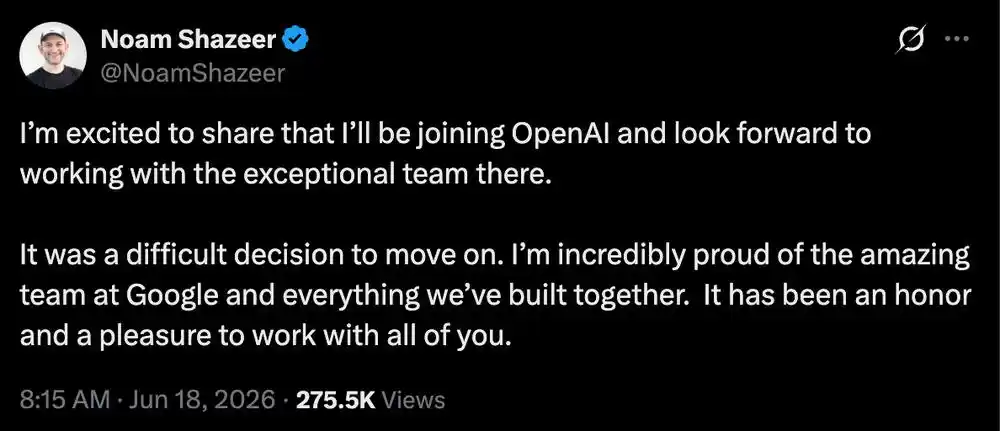
Simultaneously, he expressed gratitude to the Google team: "Leaving was a difficult decision. I'm immensely proud of the Google team and everything we've accomplished together. It has been a privilege to work with you all." A Google spokesperson, in a response to Reuters, stated that the company is grateful for Shazeer's significant contributions over the years and wishes him all the best in his future endeavors.

Noam Shazeer is one of the legendary figures in the AI field. He is one of the core authors of the seminal 2017 paper 'Attention Is All You Need', which first proposed the Transformer architecture, directly establishing the technical foundation for modern large models like the GPT series, Gemini, and Claude.
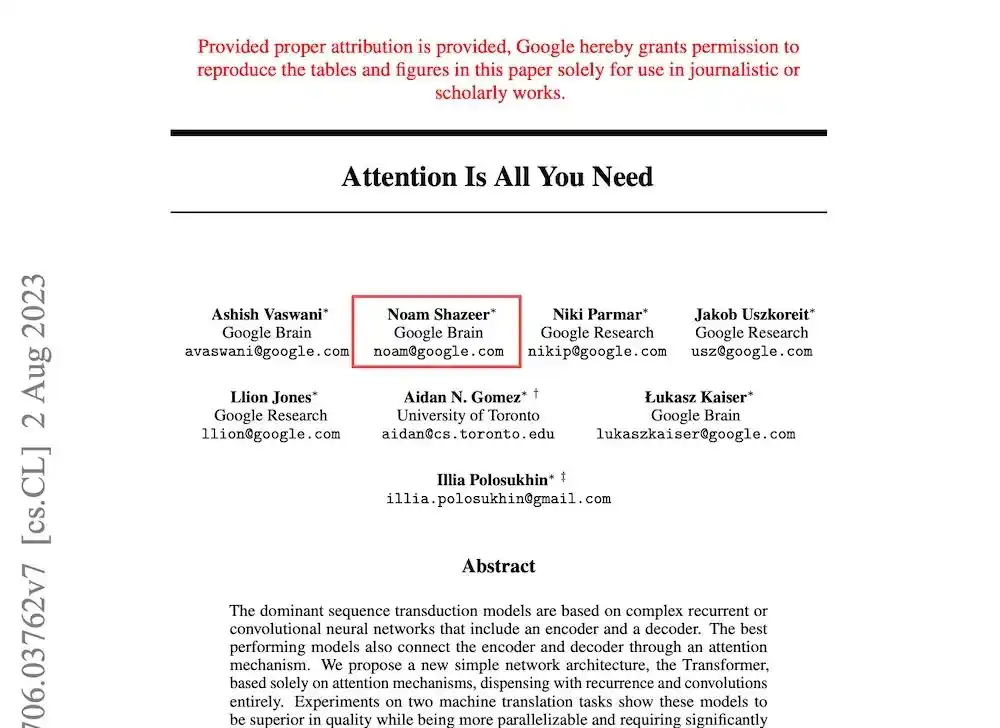
'Attention Is All You Need'

Before joining OpenAI, Shazeer had left Google in 2021 to found Character.AI. In fact, Shazeer is best known as the Co-founder and CEO of Character.AI.

This company bet on the "AI companionship"赛道 even earlier than the ChatGPT explosion, allowing users to engage in long-term conversations with various AI characters. It once became one of the fastest-growing consumer AI applications globally. By 2023, Character.AI's valuation had exceeded $1 billion (approximately RMB 6.765 billion).

In 2024, Google reached a technology licensing agreement with Character.AI valued at approximately $2.7 billion (about RMB 18.266 billion), bringing Noam Shazeer and part of the core team back into DeepMind. Noam Shazeer was appointed as a Gemini co-head, involved in the pre-training R&D of the next-generation Gemini models.

For OpenAI, which is fiercely competing with Anthropic, this is viewed externally as one of the most significant top-tier talent acquisitions in recent years. Following the announcement, OpenAI's senior leadership and several renowned researchers immediately left welcoming messages on X.

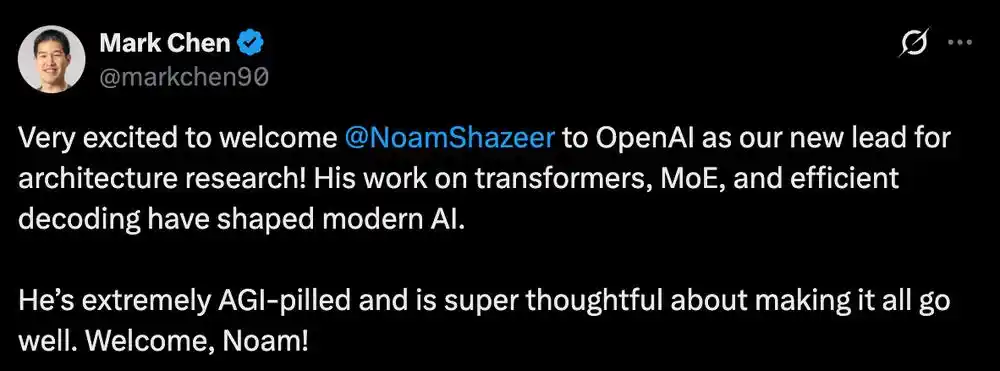
OpenAI's Chief Research Officer, Mark Chen, posted: "Very excited to welcome Noam Shazeer to OpenAI as our Lead for Architecture Research. His work on Transformers, MoE, and efficient decoding has shaped modern AI."
Subsequently, numerous AI researchers also offered congratulations in the comments section, including Google DeepMind researcher and Chinese member of the Gemini Thinking and Coding team, Yuchen Zhuang; OpenAI researcher and core contributor to the o-series reasoning models, Noam Brown; and former Microsoft AI VP, now OpenAI researcher, Sebastien Bubeck, among others.

Google DeepMind Chinese researcher Yuchen Zhuang

OpenAI o-series reasoning model core contributor Noam Brown

OpenAI researcher Sebastien Bubeck

Meanwhile, netizens lamented: "Losing a Transformer author and Gemini co-head is undoubtedly a heavy blow for Google."

01. Renowned Transformer Author, Worked at Google for Nearly 18 Years

From the perspective of the history of generative AI, Noam Shazeer has participated in nearly every key milestone. He joined Google in 2000, serving as a Software Engineer and later Principal Software Engineer, accumulating over 18 years of work experience.
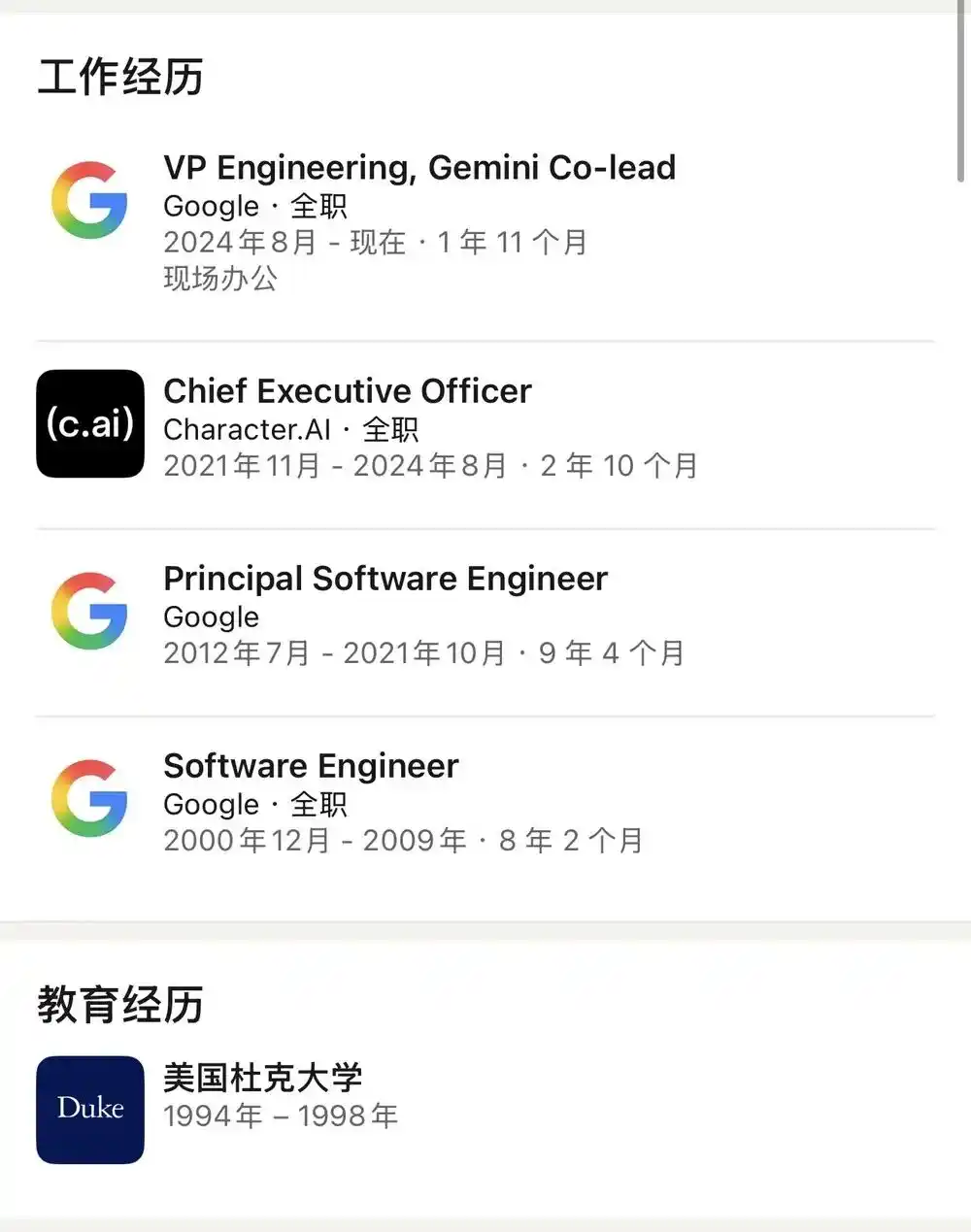
Noam Shazeer's Work Experience and Education Background (Source: LinkedIn)

In 2017, he, along with Ashish Vaswani, Jakob Uszkoreit, and six other Google researchers, co-authored the seminal paper 'Attention Is All You Need', proposing the Transformer architecture. Compared to the then-dominant RNN and LSTM models, the Transformer could process long text more efficiently and possessed greater scalability.

Over the past few years, models such as OpenAI's GPT series, Google's Gemini, Anthropic's Claude, as well as DeepSeek and Llama, are almost all built upon the Transformer architecture at their core. In other words, today's global wave of large models largely rests on the technical foundation laid by this paper.

However, the Transformer is just one of Noam Shazeer's many notable contributions.

During his tenure at Google, he also contributed to the advancement of numerous influential large model technologies. In 2017, as the first author, he proposed the Sparse Gated Mixture of Experts (MoE) architecture, providing crucial technical ideas for later models like GPT-4, Gemini, and DeepSeek-V3; in 2018, he participated in developing Mesh TensorFlow, providing foundational tools for super-large-scale Transformer training; subsequently, he was also involved in key project R&D such as the T5 model and Google's dialogue model LaMDA.

02. Left Google to Start a Company, Then Bought Back for $18.2B

In 2021, Shazeer left Google and co-founded Character.AI with Daniel De Freitas.

At that time, large language models had not yet experienced their "ChatGPT moment," but Character.AI was already pioneering efforts to bring chatbot products to the mass market, rapidly accumulating a large user base.

In 2024, Google reincorporated Shazeer and his core team into the DeepMind ecosystem through a cooperation deal worth approximately $2.7 billion (about RMB 18.266 billion). He subsequently became one of the key leaders of the Gemini project, participating in the pre-training of the next-generation Gemini models.

Shazeer's return coincided with a period of immense pressure on Google's AI business. ChatGPT had exploded in popularity, and Gemini was still in a catch-up phase. After returning to DeepMind, Shazeer participated in model R&D and eventually assumed the role of Gemini co-head, becoming one of the leading figures in Google's AI technology.

Following this, the Gemini 3 series models ranked at the forefront in multiple benchmark tests such as coding and reasoning, becoming a significant asset in Google's competition with OpenAI and Anthropic.

From Google researcher, to entrepreneur, to Gemini co-head, Shazeer has witnessed nearly every major turning point in Google's AI development over the past decade. Therefore, his departure from Google to join OpenAI is regarded by many industry insiders as one of the most significant talent loss events for Google in recent years.

03. OpenAI's Talent Battle Continues to Escalate

Shazeer's joining unfolds against the backdrop of increasingly fierce talent competition in the AI industry.

Over the past year, competition between OpenAI and Anthropic has continued to intensify. The two are not only competing over model capabilities but are also constantly vying for top researchers and core engineers.

The UK's Financial Times reported that OpenAI internally views Shazeer's addition as a major reinforcement. In the future, he will focus on researching new architectural directions beyond the Transformer, and on further enhancing model capabilities.

It's worth noting that the Transformer has dominated the AI field for nearly a decade. With the development of reasoning models, multi-agent systems, and world models, more and more researchers are beginning to ponder: Will the Transformer undergo its next major architectural upgrade?

And Shazeer is precisely one of the most qualified individuals to answer that question.

For Google, this means losing a Transformer author, a Gemini co-head, and one of its most seasoned AI architecture designers. For OpenAI, its laboratory welcomes someone who has personally shaped the modern AI technology stack.

04. Conclusion: A Significant Talent Move in the Transformer Era

As technology gradually approaches the frontier, top researchers themselves have become one of the scarcest resources. The trajectory of Noam Shazeer's career almost connects four key nodes: Transformer, Character.AI, Gemini, and OpenAI.

Now, this Transformer author's departure from Google and joining of OpenAI is not only a talent movement but also reflects the increasingly fierce competitive landscape among current AI giants.

Especially at a time when OpenAI and Anthropic are engaged in a white-hot competition over next-generation models, the enterprise market, and top research talent, and Google is also catching up through Gemini. Losing a Transformer founder and Gemini co-head at this juncture is undoubtedly a significant loss for Google.

For the entire industry, a subsequent question worth following is: When a Transformer author personally researches "architectures beyond the Transformer," where will the next generation of AI models head.

This article is from the WeChat public account "Zhixidongxi" (ID: zhidxcom), author: Jiang Yu, editor: Li Shuiqing

Câu hỏi Liên quan

QWho is Noam Shazeer and what is his significance in the AI field?

ANoam Shazeer is a renowned AI researcher, a core author of the seminal 2017 paper 'Attention Is All You Need' which introduced the Transformer architecture, and the former co-lead of Google's Gemini project. His work laid the technical foundation for modern large language models like GPT, Gemini, and Claude.

QWhat new role did Noam Shazeer take at OpenAI and what will he be responsible for?

ANoam Shazeer joined OpenAI as the Lead for Architecture Research. He will be responsible for exploring next-generation AI model architectures and driving the further evolution of the Transformer architecture.

QWhat was the nature of the significant deal between Google and Character.AI involving Shazeer in 2024?

AIn 2024, Google reached a technology licensing deal with Character.AI valued at approximately $2.7 billion (RMB 18.266 billion). This deal brought Noam Shazeer and part of the core team back into Google DeepMind, where he was appointed co-lead of the Gemini project.

QWhy is Shazeer's move to OpenAI considered a significant loss for Google?

AShazeer's departure is considered a significant loss for Google because he is a Transformer author, a former Gemini co-lead, and one of its most senior AI architecture designers. Losing such a key figure in the midst of intense competition with OpenAI and Anthropic is a substantial setback.

QWhat broader industry trend does Shazeer's career move highlight according to the article?

AShazeer's move highlights the increasingly fierce competition for top-tier AI research talent among major tech companies like OpenAI, Google, and Anthropic. As technology pushes the frontier, these researchers themselves become among the most scarce and valuable resources.

Nội dung Liên quan

Đừng chỉ chú ý đến việc sa thải, cấu trúc mới của Ethereum Foundation mới là điều đáng suy ngẫm

以太坊基金会 (EF) đã công bố cơ cấu tổ chức mới, tập trung vào việc thu hẹp ranh giới và ưu tiên các vấn đề cốt lõi. Thay vì chỉ chú ý đến việc cắt giảm 20% nhân sự (54 người), điểm đáng chú ý hơn là sự tái phân bổ nguồn lực. Cơ cấu mới chia thành 8 nhóm, với **Tầng giao thức (Protocol) - 57 người** là lớn nhất, tiếp theo là Tầng truy cập (Access). Điều này cho thấy EF tập trung nguồn lực trở lại các phần nền tảng và khó ủy thác nhất: phát triển giao thức, bảo mật, quyền riêng tư và lớp truy cập. Các ưu tiên kỹ thuật dài hạn được làm rõ bao gồm bảo mật hậu lượng tử, zkEVM, xác minh hình thức và kiến trúc tổng thể (do Vitalik Buterin và Justin Drake phụ trách). EF cũng thay đổi triết lý an toàn, hướng tới giảm độ phức tạp không cần thiết, kết hợp xác minh hình thức, nghiên cứu hỗ trợ AI và các client chuyên biệt, thay vì chỉ dựa vào mô hình đa client truyền thống. Về tài chính, EF đặt mục tiêu cắt giảm khoảng 40% ngân sách năm nay, chuyển từ mức tiêu thụ trung bình 15% quỹ còn lại/năm (trước 2026) xuống còn khoảng 5%/năm (sau 2030) để trở thành một tổ chức bền vững như quỹ tài trợ. Song song đó, EF thúc đẩy mô hình "đa nút" trong hệ sinh thái, chuyển giao một số công việc như áp dụng ứng dụng, công cụ phát triển và truyền thông cho các tổ chức bên ngoài như EthLabs, EAG, EEZ. Mục tiêu là để EF tập trung vào các nhiệm vụ cốt lõi trong khi tăng tính linh hoạt và sức chịu đựng cho toàn bộ mạng lưới. Tóm lại, đợt tái cấu trúc này không phải là thu hẹp tham vọng, mà là xác định lại ranh giới rõ ràng hơn: EF sẽ tập trung giải quyết những vấn đề khó, dài hạn và khó thay thế nhất, đồng thời chia sẻ trách nhiệm xây dựng hệ sinh thái với nhiều tổ chức khác.

Foresight News28 phút trước

Đừng chỉ chú ý đến việc sa thải, cấu trúc mới của Ethereum Foundation mới là điều đáng suy ngẫm

Foresight News28 phút trước

Giải Mã Báo Cáo: Khi CPO Bùng Nổ, Coherent Đang Đi Những Nước Cờ Nào

J.P. Morgan phân tích Samik Chatterjee giữ nguyên xếp hạng Overweight (Mua) cho Coherent (COHR), nhấn mạnh thị trường đánh giá thấp triển vọng tăng trưởng của công ty. Lý do chính đến từ ba trụ cột: bộ thu phát quang cho trung tâm dữ liệu, chip CPO (Co-Packaged Optics) và lĩnh vực laser công nghiệp cùng giải pháp tản nhiệt. Bộ thu phát 1.6T của Coherent đang được cầu cao, với môi trường giá ổn định. CPO không thay thế mà ngược lại, thúc đẩy nhu cầu linh kiện quang học cao cấp hơn. Với danh mục sản phẩm quang học toàn diện, COHR nắm giữ vị thế vững để nắm bắt giá trị lớn hơn từ mỗi chip CPO. Hệ thống chuyển mạch quang OCS cũng là cơ hội tăng trưởng tiềm năng. Coherent đang mở rộng mạnh mẽ công suất sản xuất chip InP, đồng thời tận dụng vị thế độc quyền tương đối trong laser bơm để chuyển dịch lên bán giải pháp hệ thống có giá trị cao hơn. Mục tiêu biên lợi nhuận gộp trên 42% được củng cố nhờ sản phẩm cao cấp, cải thiện chi phí từ quy trình 6-inch và các sản phẩm mới như CPO. Mảng công nghiệp tiếp tục tăng trưởng ổn định 5-10%. Tóm lại, vị thế then chốt trong chuỗi cung ứng hạ tầng kết nối quang, cùng với các động lực tăng trưởng mới và cải thiện biên lợi nhuận, là cơ sở cho đánh giá tích cực về cổ phiếu COHR.

marsbit52 phút trước

Giải Mã Báo Cáo: Khi CPO Bùng Nổ, Coherent Đang Đi Những Nước Cờ Nào

marsbit52 phút trước

Dan Koe bài viết mới: Thoát khỏi số phận người làm công ăn lương, làm thế nào để tồn tại trong cơn sóng thay thế của AI?

Tóm tắt: Bài viết của Dan Koe phản bác quan điểm bi quan về AI sẽ cướp hết việc làm, và chỉ ra mối đe dọa thực sự là việc con người phó mặc hạnh phúc và sinh kế của mình cho người khác. Để thoát khỏi số phận "công cụ kiếm tiền" và tồn tại trong làn sóng AI, giải pháp duy nhất là xây dựng sự nghiệp của riêng bạn. Tác giả cho rằng nhiều công việc nhàm chán khiến con người mất đi động lực nội tại, và mô hình "chủ - nhân viên" hiện đại thực chất là một hình thức nô lệ tài chính tinh vi. Để tự do, bạn cần làm chủ 5 yếu tố then chốt: tính chủ động, gu thẩm mỹ/khả năng đánh giá, kỹ năng thuyết phục, sự kiên trì và khả năng lặp lại cải tiến. Con đường thực tế là tự biến mình thành "người không thể bị thuê", bắt đầu bằng việc thay đổi triệt để môi trường sống và thói quen để định hình lại căn tính. Hai kỹ năng đòn bẩy mạnh mẽ nhất là viết code và sáng tạo nội dung (media), trong đó kỹ năng làm nội dung được đánh giá cao hơn vì giá trị chủ quan và khả năng kết nối của nó. Bài viết kết thúc bằng một hướng dẫn hành động cụ thể trong 15 phút: (1) Khai quật "nguyên liệu thô" từ trải nghiệm và sở thích sâu nhất của bản thân. (2) Xác định góc nhìn "phản đồng thuận" độc đáo của bạn về một vấn đề. (3) Ngay lập tức xuất bản ý tưởng đầu tiên của bạn để nhận phản hồi thực tế và bắt đầu quá trình học hỏi, điều chỉnh. Hành động thực tế là liều thuốc giải duy nhất.

marsbit59 phút trước

Dan Koe bài viết mới: Thoát khỏi số phận người làm công ăn lương, làm thế nào để tồn tại trong cơn sóng thay thế của AI?

marsbit59 phút trước

Sau khi cắt giảm 20% nhân sự, EF có những điểm nhấn nào trong cấu trúc mới?

Theo thông báo chính thức vào ngày 23/6, Quỹ Ethereum (EF) đã hoàn tất đợt tái cấu trúc tổ chức, cắt giảm 54 nhân viên (chiếm khoảng 20%) và tổ chức lại hoạt động thành năm nhóm trụ cột chính: Giao thức (Protocol), Truy cập (Access), Người dùng (User), Cộng đồng (Community) và Thể chế (Institutional). Động thái này được mô tả là nhằm hiện thực hóa các tuyên bố sứ mệnh trước đó, tập trung vào các nguyên tắc cốt lõi (CROPS): Chống kiểm duyệt, Mã nguồn mở & Tự do, Quyền riêng tư và Bảo mật. Trọng tâm vẫn là nhóm Giao thức, đảm nhiệm nghiên cứu và phát triển lõi Ethereum. Nhóm Truy cập nhấn mạnh đảm bảo người dùng luôn có lựa chọn "zero option" - không phụ thuộc vào trung gian. Các nhóm còn lại phụ trách kết nối với người dùng thực tế, cộng đồng rộng lớn và các tổ chức truyền thống. EF cho biết sẽ hỗ trợ tài chính và chuyển đổi công việc trong hệ sinh thái cho nhân viên bị ảnh hưởng. Tuy nhiên, tổ chức không công bố phân bổ ngân sách chi tiết hay KPI cụ thể cho từng nhóm mới. Động thái này diễn ra trong bối cảnh EF có nhiều thay đổi nhân sự cấp cao gần đây, làm dấy lên các thảo luận về áp lực quản trị và hiệu quả điều hành. Mặc dù được EF trình bày như một bước đi tập trung vào sứ mệnh dài hạn, giới quan sát thị trường đặt câu hỏi về tác động thực tế đến tiến độ nâng cấp giao thức, hỗ trợ tài trợ cho hệ sinh thái, và cách thức EF tương tác với các cơ quan quản lý trong tương lai.

marsbit1 giờ trước

Sau khi cắt giảm 20% nhân sự, EF có những điểm nhấn nào trong cấu trúc mới?

marsbit1 giờ trước

Chiếc bot MEV hạng nhất bị đánh cắp 7,5 triệu đô la: Có phải Approval mới là rủi ro chết người dễ bị bỏ qua nhất trên blockchain?

Một bot MEV lâu năm trên Ethereum, vốn chuyên "săn" các giao dịch thông thường, cuối cùng đã rơi vào một cái bẫy "tùy chỉnh" trị giá 7,5 triệu USD. Vào ngày 21/6, bot Jaredfromsubway.eth nổi tiếng với chiến lược tấn công sandwich đã bị tấn công, với tài sản như WETH, USDC bị chuyển đi, thiệt hại ước tính hơn 7,5 triệu USD. Điểm đáng chú ý là cuộc tấn công này không liên quan đến lộ khóa riêng tư hay lỗ hổng hợp đồng thông minh truyền thống. Thay vào đó, kẻ tấn công đã bỏ công sức trong nhiều tuần để tạo ra một môi trường giao dịch giả mạo, bao gồm các token, nhóm thanh khoản và hợp đồng phụ trợ độc hại. Chúng đánh lừa bot MEV, khiến nó tự động cấp phép (Approval) ERC-20 cho các hợp đồng độc hại này, từ đó "hợp pháp" chuyển đi tài sản của bot. Sự kiện này một lần nữa gióng lên hồi chuông cảnh báo về rủi ro tiềm ẩn lớn từ cơ chế Approval – một thao tác cơ bản nhưng dễ bị đánh giá thấp trong hệ sinh thái EVM. Approval cho phép hợp đồng thông minh chi tiêu token thay mặt người dùng, tương tự như tính năng thanh toán tự động. Tuy nhiên, các thói quen như cấp phép vô hạn (unlimited approval), không thu hồi phép khi ngừng sử dụng DApp, hay việc hợp đồng được ủy quyền sau này có thể bị xâm phạm, đều tạo ra lỗ hổng bảo mật lâu dài. Để quản lý rủi ro Approval, người dùng nên tuân thủ nguyên tắc "quyền tối thiểu" – chỉ cấp phép đủ số lượng cần thiết cho giao dịch. Nên tách biệt ví lưu trữ chính và ví tương tác với các DApp mới/rủi ro. Quan trọng nhất là cần thường xuyên kiểm tra và thu hồi (revoke) các ủy quyền không còn cần thiết thông qua các công cụ như Revoke.cash hoặc tính năng quản lý ủy quyền trong ví (ví dụ: imToken). Về phía các nhà cung cấp ví, cần nâng cao khả năng phòng thủ chủ động bằng cách cảnh báo rủi ro, phân tích cấu trúc và hiển thị nội dung ký (signing) một cách dễ đọc cho người dùng, hướng tới tiêu chuẩn "ký gì thấy đó" (What You See Is What You Sign). Tóm lại, bảo mật trong Web3 không chỉ là bảo vệ khóa riêng tư, mà còn là việc quản lý chủ động và hiểu biết về các ủy quyền hợp đồng – những "cánh cửa sau" có thể vẫn mở ngay cả khi người dùng đã lãng quên chúng.

marsbit1 giờ trước

Chiếc bot MEV hạng nhất bị đánh cắp 7,5 triệu đô la: Có phải Approval mới là rủi ro chết người dễ bị bỏ qua nhất trên blockchain?

marsbit1 giờ trước

Giao dịch

Giao ngay
Hợp đồng Tương lai
活动图片