How Difficult is Chip Making? A Division Error Costs 475 Million Dollars

marsbitXuất bản vào 2026-06-15Cập nhật gần nhất vào 2026-06-15

Tóm tắt

How Hard Is It to Make a Chip? A Division Error Cost $475 Million Chip expert Shi Kan, a researcher at the Chinese Academy of Sciences and a popular tech creator, explains the immense challenges of chip development. Chips are foundational to modern technology, but their creation is extraordinarily difficult. The journey from sand to a functional chip involves complex design and manufacturing, but a critical bottleneck is verification—ensuring the design works flawlessly before costly production. A single, undetected bug can have catastrophic consequences, as illustrated by the infamous 1994 Intel Pentium FDIV bug. A flaw in the floating-point division unit forced a recall costing $475 million. Unlike software, chips cannot be easily patched after manufacture, making "first-time success" paramount. However, industry surveys show only 24% of chip projects achieve this; over three-quarters require at least one costly re-spin due to design flaws. Verification has thus become the dominant phase, consuming up to 70% of the design cycle. The core challenge is a "verification impossible triangle" between high performance, good debuggability, and low cost. Exhaustively verifying a modern CPU core could take 15,000 years with software simulation, or 30 years with advanced hardware emulation—timeframes utterly impractical for development. Despite being essential, verification is often seen as unglamorous "dirty work," receiving less academic attention than fields like AI. Shi and hi...

Hello everyone, I'm Shi Kan from the Institute of Computing Technology at the Chinese Academy of Sciences, a 'slash technology worker'. I have over a decade of experience in the chip industry, and currently, I conduct academic research related to chips at the Chinese Academy of Sciences; at the same time, I am also a science and technology Bilibili UP host 'Lao Shi Tan Xin', and my viewers call me 'Lao Shi'.

Chips: The Cornerstone of Modern Society

When it comes to chips, everyone surely knows their importance.
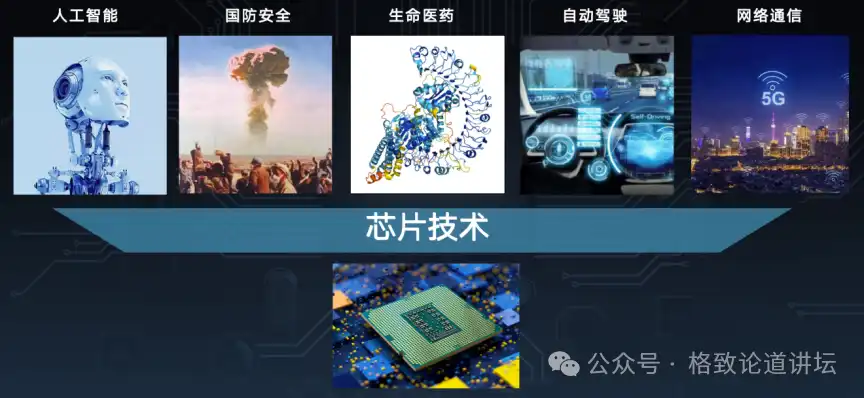
Whether it's the currently hot artificial intelligence, life sciences and medicine, autonomous driving, network communications, and so on, almost all the technologies of modern society you can imagine are inseparable from chips—this foundational technology of the information age.

I have been involved in chip work for a long time, and the chip development process is actually a very interesting one, mainly due to two aspects.

Firstly, the applications of chips are extremely wide-ranging. Once you enter this industry, you probably don't have to worry about unemployment because many industries require chip technology.

The second reason might be more important: chip development is a very difficult endeavor. As chip engineers, we need to constantly learn and enrich ourselves to face and embrace this era full of opportunities and challenges.

So the question arises: what exactly makes chip technology so difficult?

Why Are Chips So Difficult?

Completed: 10%//////////

Everyone might know that the manufacturing process of a chip is essentially an evolution journey of a grain of sand. Sand might be something inexhaustible and abundant on this planet; but turning low-value sand into high-value chips adds up to nothing but human intelligence.
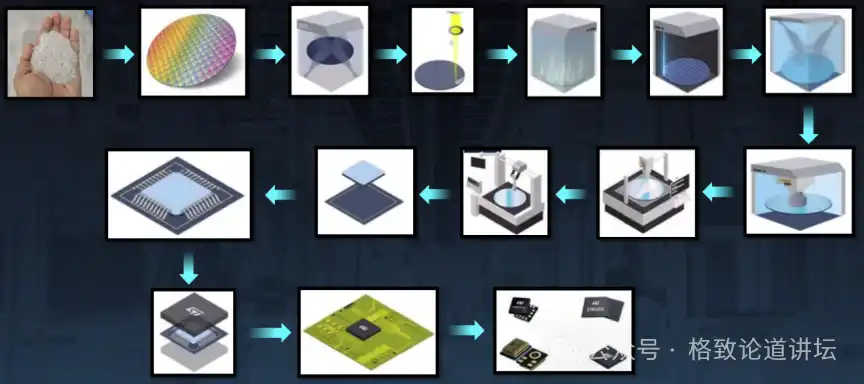
Starting from sand, we need to purify it to obtain wafers. Then, through a series of steps such as photolithography, ion implantation, etching, packaging, and so on, the abundant, inexhaustible sand is transformed into the final tiny chip.

So, having said all that, with so many steps, chip manufacturing is actually only part of the entire chip development process; it does not equal chip development itself.
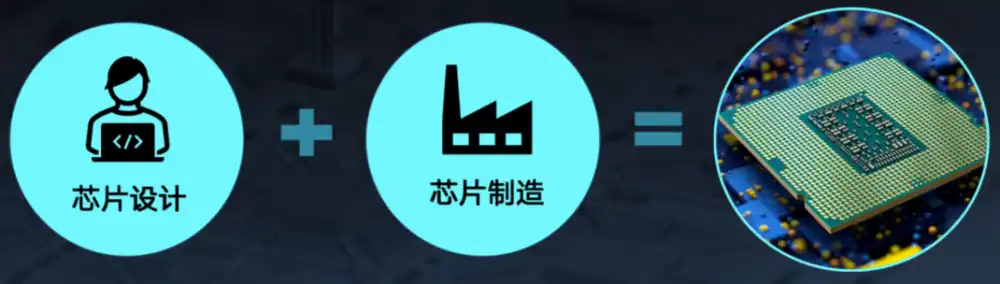
There is another crucial step, which is chip design. It refers to completing the circuit design according to requirements and making the circuit function properly. Then, we hand over the designed circuit to chip manufacturers for the later stages of manufacturing, ultimately obtaining the physical chip.

But there is another question here: how do you ensure that the chip's functionality matches your initial design?
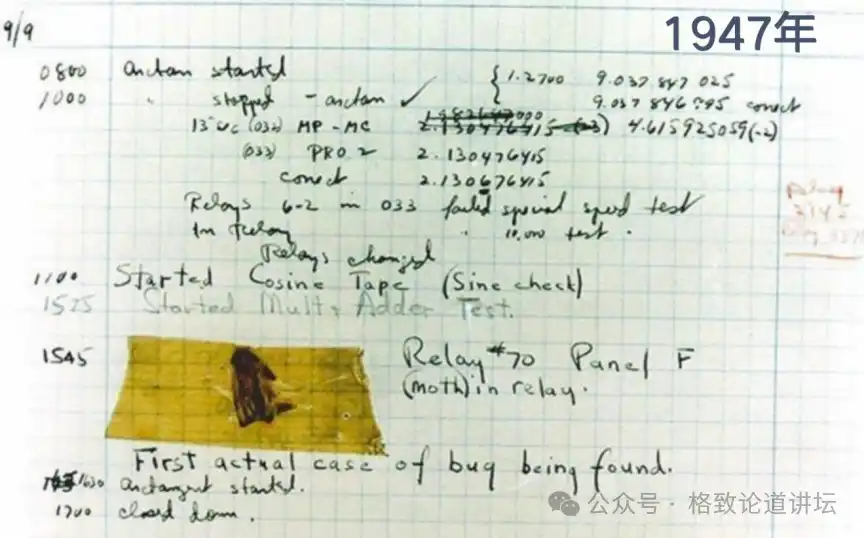
There is an interesting little story here. In 1947, a very famous female programmer named Grace Hopper found her computer wasn't working. After careful investigation and exploration, she discovered that a moth had flown into a relay of the computer. So, she carefully used tweezers to remove this moth and taped it onto a piece of paper.

This might be the first 'bug' discovered in the entire history of computer development, meaning a vulnerability.

If the previous example seems too distant, we actually have more examples. Here's a math problem for everyone: What is the final result of this expression? Actually, this problem is simple because the numerator and denominator in the later part are the same and can cancel out; then the numbers before and after the minus sign are also the same, so subtracting the same number should result in 0. However, in actual computers and chips, the result might not be this.
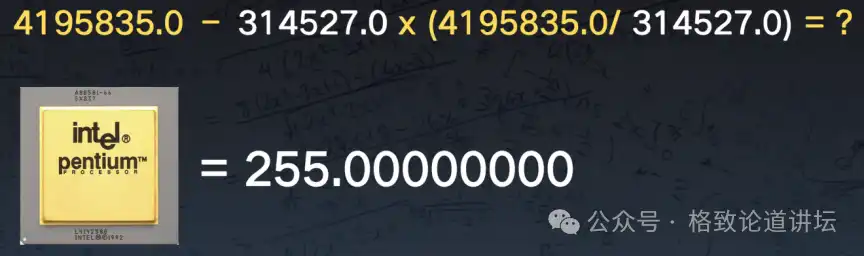
For example, in an Intel Pentium chip, the result was 255.00000000. What happened? It turned out that when an American scientist was conducting scientific research, he kept getting incorrect calculations when running this expression. Finally, he discovered that there was an undetected design flaw in a floating-point division unit of this chip.

Don't underestimate this design flaw; its consequences were actually very serious. In the 1990s, Intel spent $475 million to recall all problematic Pentium chips worldwide.

So, returning to the earlier question: what exactly makes chip technology so difficult?

In my view, the difficulty of chips lies in the need to succeed on the first try. Making chips is not like software, where you can patch and fix various problems later. In contrast, once a chip completes the evolution journey from sand to chip, you may have already spent tens of thousands, millions, or even hundreds of millions to complete the tape-out and manufacturing, making it very difficult to modify afterwards.

Then, the next question is: how many chip projects today can achieve success on the first try?

The 'Bottleneck' of Chip Verification

Completed: 40%//////////

According to survey data, only 24% of chip projects can achieve success on the first try. That is to say, 3/4 of chip projects, due to various major and minor undetected design flaws, require at least one more tape-out, which consumes a lot of time and money.
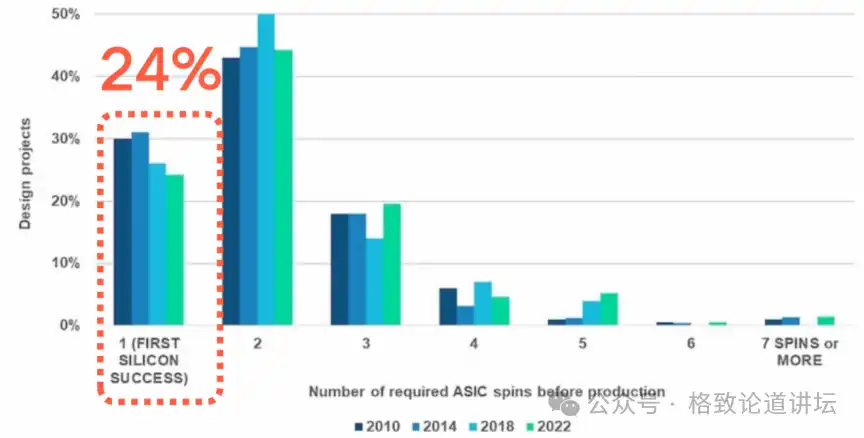
Therefore, the key question is: how can we ensure, as much as possible, that chips have as few or no bugs/design flaws as possible before tape-out and manufacturing? This is the direction I have been dedicated to researching over the past few years.
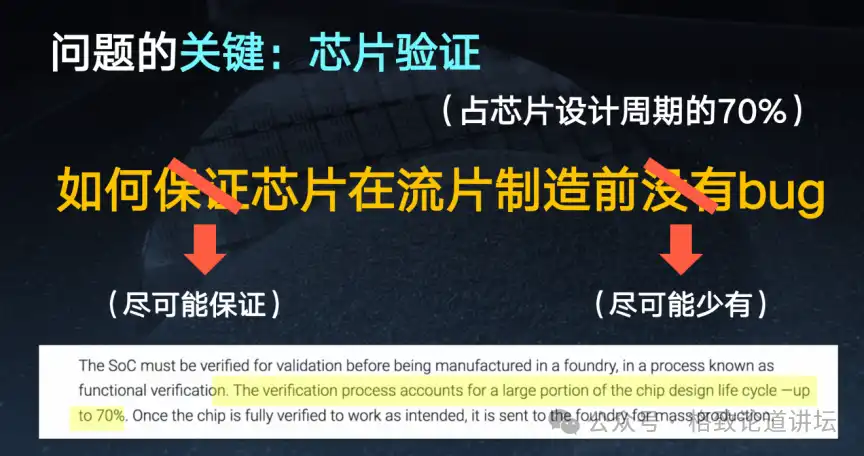
Also according to this research data, throughout the entire chip development process, especially with the current development of AI and various high-tech fields, chips are becoming increasingly complex. As a result, chip verification has become a very high proportion of the entire chip development cycle, even exceeding half, reaching 70% of the entire chip design cycle.

But unfortunately, chip verification is also a difficult task. I list some astronomical numbers here, such as the Earth's circumference, the possible number of stars in the Milky Way, or the length of a light-year.

In chip verification, there is also an astronomical number, which is the number of cycles needed to fully verify a CPU core. What exactly does this astronomical number represent?

If we use the most advanced software simulation technology available today to fully verify a CPU core, it would take at least 15,000 years. Using the most advanced hardware emulation technology can slightly reduce this time to 30 years. But we all know that developing a chip cannot wait 15,000 years, nor can it wait 30 years.
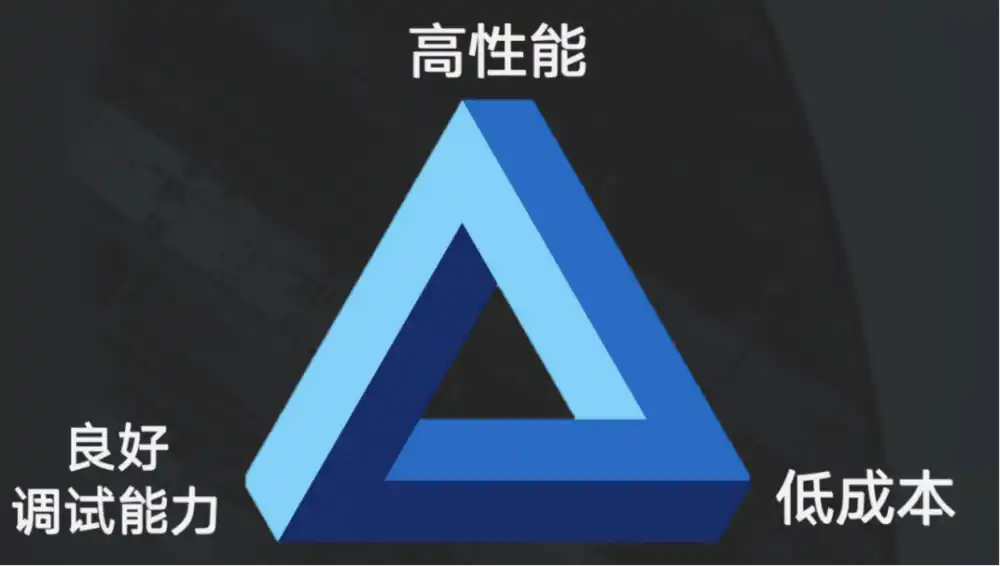
So, what is the essence of the problem? We have actually been researching this over the past few years. We found that in chip verification, there exists a so-called 'impossible triangle', namely the high performance of chip verification, good debugging capability, and low cost; these three factors crucial to chip verification cannot be satisfied simultaneously. For current mainstream research or methods, at most, two out of the three can be achieved, and this is the fundamental reason for the low efficiency of chip verification.

Someone Must Do Something Different

Completed: 60%//////////

Due to these reasons, chip verification has not seen significant development over the past period.

In chip companies, chip engineers may spend more time writing test cases and running regression verification. Essentially, it's dirty and tiring work. The same goes for academia; very few scholars are devoted to chip verification research, especially compared to current hot fields like artificial intelligence, research related to chip verification is very scarce.

So, an academic leader once told me that in the same amount of time, they could publish three or even more papers in the field of artificial intelligence, but in chip verification, they might not even publish one.

Unfortunately, what they said is true.

However, someone must do something different.

Therefore, over the past few years, I have led a team in conducting research related to chip verification and have built an agile verification research system from scratch. The core of this research system is a verification platform called ENCORE, which is based on a special chip—the Field-Programmable Gate Array (FPGA). ENCORE can significantly improve verification efficiency while achieving good verification debuggability.
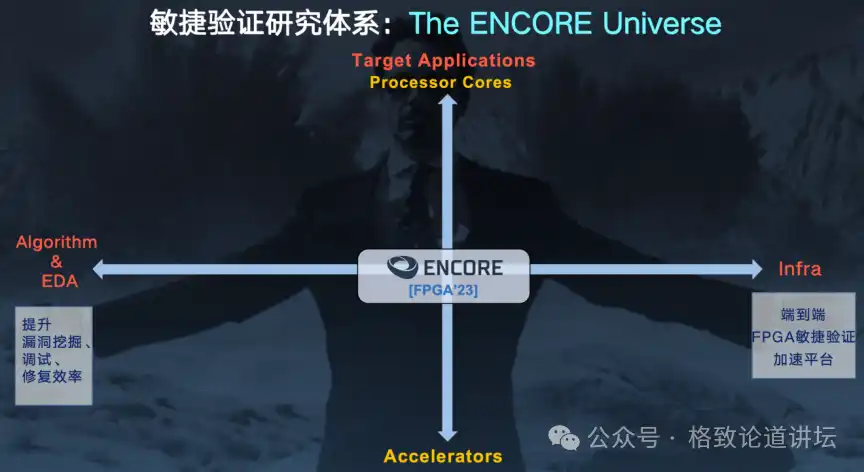
To build this agile verification research system, on one hand, we need to continuously optimize the efficiency of vulnerability mining, debugging, and repair at the algorithmic level; on the other hand, we also hope to build an end-to-end agile verification acceleration platform based on programmable logic chips (FPGAs). At the application level, we hope this platform can be suitable for both general-purpose processor verification, such as CPUs or GPUs, and specialized chip verification, such as the currently very popular AI accelerators.
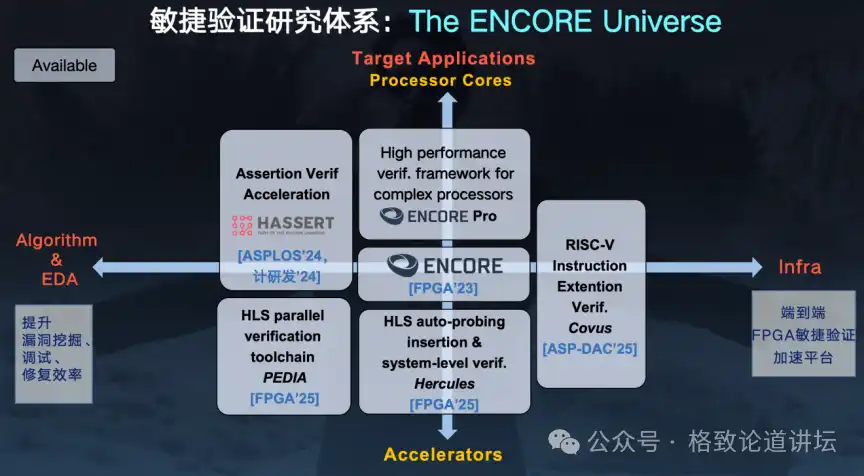
Over the past period, we have done a lot of cutting-edge exploratory work in this field, including the aforementioned ENCORE and many new research projects. We have also published these research results at many internationally renowned academic conferences.
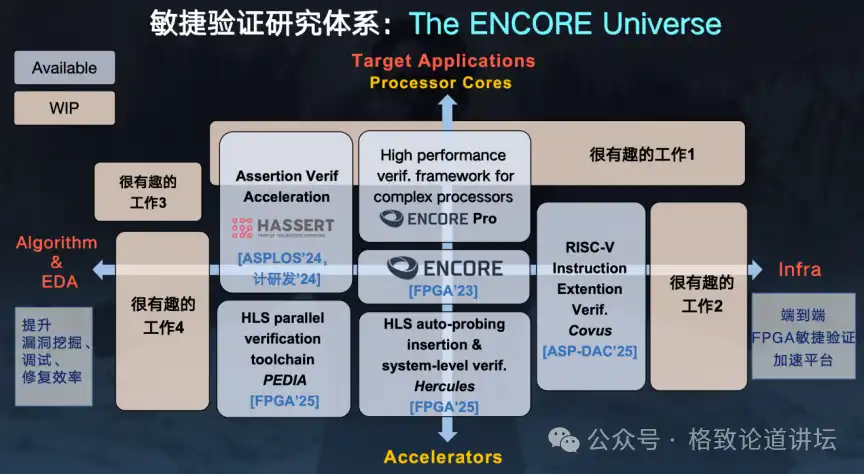
We are actually working on some interesting projects afterwards, but since these works have not been published yet, I won't show them to you one by one for now.

Letting More People Understand Chips

Completed: 80%//////////

However, during the research process, I gradually realized that these scientific or academic achievements are mainly for people within our small circle who only understand chip verification and related fields. So, how can we let more people see our work, understand our research, and even participate in our endeavors?

Naturally, I thought of chip science popularization, which also feels very interesting to me. I have been engaged in science popularization for four or five years, starting from text initially to later making videos on Bilibili. Chip science popularization has not only brought me many gains but also helped me meet many like-minded friends, as well as viewers who like and support me.
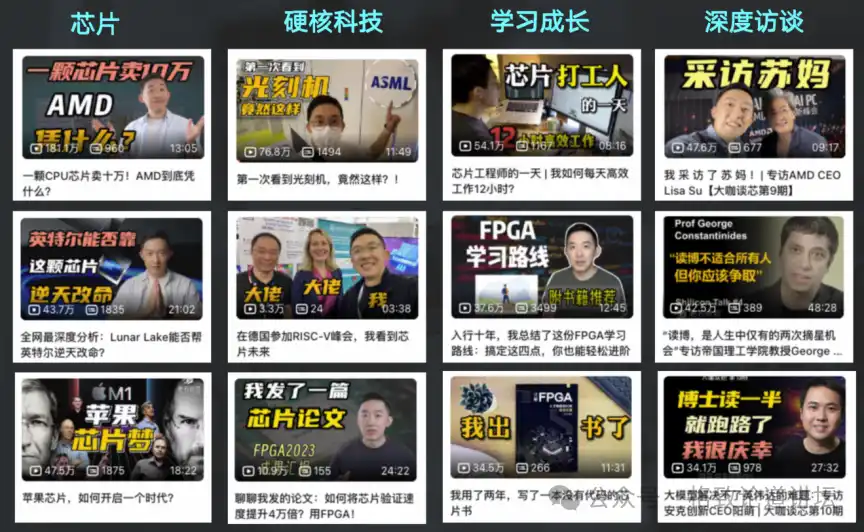
However, making chip science popularization videos is not a simple task, especially in today's era of short video proliferation. A fellow science popularization blogger and leader told me that in the same amount of time it takes me to produce one long, hardcore chip science popularization video, they could make 10 or even more short videos related to hot topics, and the traffic could be many times greater than mine.

Unfortunately, what they said is also true.

But based on this, I think there still needs to be people who persist in doing difficult things. I hope to combine chip science popularization and chip verification—two equally difficult but equally interesting things—and use video and text formats to show everyone what we have done, the papers we have published, and the open-source chip projects our entire large team is researching.

Besides chips, I will also share hardcore technologies like artificial intelligence and computers with everyone, as well as share my growth experiences, the books I have read, and the knowledge I have acquired. I know that I am not a genius myself, nor am I a so-called all-around expert or guru. I would rather be a 'guide' for everyone, sharing the path I have walked.

So, returning to the question I wanted to share with everyone today: chip research and chip science popularization, which one is more interesting? Of course, for me, both are equally interesting. The reason is simple: because they are equally difficult. At the same time, they both require me to persist very long-term and enduringly.

Many people say we need to do difficult and right things. But the problem actually is: how do you judge if something is right before you do it? If something is seen as sitting on a cold bench in others' eyes, or seen as doing dirty, tiring work, would you still persist in doing it?

Therefore, I prefer to do difficult and long-term things, such as academic research in chip verification, or making long hardcore chip science popularization videos. Because if something is difficult and requires long-term persistence, then it is probably right.

That's all I wanted to share with you today. I am Lao Shi, thank you, everyone!

This article comes from the WeChat public account: Gezhi Lundaotan , Author: Shi Kan, Original Title: 'How Difficult is Chip Making? A Division Error Costs 475 Million Dollars | Shi Kan'


Câu hỏi Liên quan

QWhat was the main point of the story about the Intel Pentium chip flaw mentioned in the article?

AThe story illustrated a critical design bug in the Pentium chip's floating-point division unit. A calculation that should have resulted in '0' instead produced '255.00000000'. This seemingly minor error forced Intel to spend $475 million on a global recall of the faulty chips in the 1990s, highlighting the high cost of failure in chip development.

QAccording to the article, why is chip development so difficult, especially compared to software development?

AChip development is exceptionally difficult because it requires 'first-time success'. Unlike software, which can be patched and updated after release, a physical chip cannot be easily modified once manufactured (or 'taped out'). The entire expensive process, from sand to finished silicon, costing potentially hundreds of millions, must be redone to fix design flaws.

QWhat percentage of chip projects achieve first-time success according to the survey data cited by the author?

AAccording to the survey data presented by the author, only 24% of chip projects achieve first-time success. This means approximately three-quarters (76%) of projects require at least one re-spin or re-fabrication due to various undetected design bugs, leading to significant extra time and cost.

QWhat is the 'impossible triangle' in chip verification, as explained in the article?

AIn chip verification, the 'impossible triangle' refers to the three crucial factors—high performance, good debuggability, and low cost. The article states that these three factors cannot be satisfied simultaneously with current mainstream methods. Engineers and researchers can only achieve a maximum of two out of these three, which fundamentally limits verification efficiency.

QWhat are the two 'hard but long-term' pursuits that the author, Shi Kan ('Lao Shi'), is committed to?

AThe author is committed to two challenging, long-term endeavors. First, he leads academic research in chip verification, specifically developing an agile verification framework called ENCORE based on FPGAs. Second, he creates hardcore, long-form chip and technology popular science content (like his Bilibili channel videos), aiming to make complex topics accessible to a wider audience beyond academic circles.

Nội dung Liên quan

Hướng dẫn Đăng ký và Gửi bài cho Chuyên mục PANews

**Hướng dẫn Đăng ký và Đăng bài Chuyên mục PANews** Bài viết cung cấp hướng dẫn toàn diện để trở thành tác giả chuyên mục và đăng bài trên PANews. **Yêu cầu về Nội dung Chuyên mục:** * Tập trung vào nội dung sâu về Crypto, Web3, dữ liệu, quan điểm phân tích. * **Không chấp nhận:** Nội dung quảng bá sản phẩm/thương hiệu là chính (nên liên hệ bộ phận thương mại) hoặc nội dung được tạo hàng loạt bằng AI. **Cách Đăng ký Chuyên mục:** * **Trên web:** Truy cập trang chủ PANews, cuộn xuống cuối trang và nhấp "申请专栏" (Đăng ký chuyên mục). Đăng ký bằng số điện thoại/email (chỉ cần mã xác minh để đăng nhập sau này). Điền tên chuyên mục, mô tả, tải lên ảnh đại diện và gửi liên kết đến các bài viết mẫu đã xuất bản. * **Trên điện thoại:** Vào mục "我的" (Của tôi), chọn "投稿与创作" (Đóng góp & Sáng tạo) và điền thông tin. **Hướng dẫn Đăng bài:** 1. Đăng nhập trên trang web. 2. Vào **Trang cá nhân** -> **Trung tâm Sáng tạo**. 3. Sử dụng trình biên tập để tạo và đăng bài viết mới. **Nhúng Video:** * Chỉ hỗ trợ nhúng mã từ nền tảng bên thứ ba (ví dụ: Bilibili). * Sao chép mã nhúng từ video, trong trình biên tập bài viết, chọn **Chèn/Chỉnh sửa phương tiện** -> tab **Nhúng** -> dán mã. * Có thể điều chỉnh kích thước hiển thị video (đề xuất: rộng 100%, cao 560px). **Công cụ Hỗ trợ: PANews Skills** * Bộ kỹ năng AI chính thức của PANews, cho phép các AI Agent tương tác với nền tảng. * **Ba kỹ năng chính:** 1. `panews`: Theo dõi xu hướng, lấy bảng xếp hạng bài đọc bắt buộc, bài viết nổi bật, động thái gọi vốn. 2. `panews-creator`: **Quan trọng cho đăng bài** - Hỗ trợ quản lý chuyên mục, xuất bản bài viết, tải lên hình ảnh. 3. `panews-web-viewer`: Phân tích cú pháp trang web PANews sang Markdown. * **Cách sử dụng `panews-creator`:** * Cài đặt từ GitHub: `https://github.com/panewslab/skills`. * Cần lấy giá trị `authorization` từ tài khoản chuyên mục của bạn: Đăng nhập vào PANews, mở Công cụ Nhà phát triển trình duyệt (F12), vào tab **Network**, tìm một yêu cầu API và sao chép giá trị `authorization` từ phần **Request Headers**.

marsbit3 phút trước

Hướng dẫn Đăng ký và Gửi bài cho Chuyên mục PANews

marsbit3 phút trước

Tôi dùng AI tự dựng cho mình một bàn làm việc đầu tư

Trong nửa tháng qua, tôi đã sử dụng Vibe Coding (lập trình bằng ngôn ngữ tự nhiên với AI) để tự xây dựng một bảng điều khiển đầu tư cá nhân, biến những ý tưởng lâu nay thành hiện thực. Tôi đã phát triển bốn công cụ nhỏ: 1. **Bảng điều khiển tài sản đa thị trường:** Tổng hợp tất cả danh mục đầu tư (chứng khoán Mỹ, Crypto, HK, A-share) vào một trang duy nhất, hiển thị tổng tài sản, lãi/lỗ trong ngày, cùng các tính năng giám sát biến động lớn và ghi chú. 2. **Giám sát cá cược thị trường dự đoán (PM):** Tập trung theo dõi các vụ cá cược về sự kiện tương lai (như định giá công ty, sự kiện vĩ mô), so sánh biến động xác suất với tin tức và thị trường thứ cấp để tìm kiếm cơ hội chênh lệch thông tin. 3. **Hệ thống quản lý công việc viết lách:** Một backend đơn giản trên đám mây để quản lý danh sách chủ đề, tiến độ bài viết và ý tưởng. 4. **Công cụ định dạng tự động:** Giúp chuyển đổi bài viết sang các định dạng phù hợp cho nhiều nền tảng khác nhau một cách nhanh chóng. Trải nghiệm này cho thấy AI đang thay đổi cách nghiên cứu đầu tư của người bình thường. Chúng ta không cần phải tạo ra các mô hình phức tạp ngay lập tức, mà có thể từ từ tích lũy các hệ thống cơ bản của riêng mình: * Hệ thống quan sát tài sản. * Hệ thống giám sát tín hiệu thị trường. * Hệ thống sơ đồ mối quan hệ ngành/lĩnh vực. * Hệ thống tổng kết, đánh giá lại quyết định. Sức mạnh của AI và Vibe Coding nằm ở việc cắt giảm đáng kể sự phiền phức trong quá trình thực hiện, cho phép vòng lặp "ý tưởng - hiện thực hóa - sử dụng - phản hồi - chỉnh sửa" diễn ra nhanh chóng, giúp duy trì động lực và không để các ý tưởng bị lãng quên.

marsbit19 phút trước

Tôi dùng AI tự dựng cho mình một bàn làm việc đầu tư

marsbit19 phút trước

Sau khi tài sản được token hóa, làm thế nào để thoát?

Tóm tắt: Bài viết phân tích ba mô hình thanh khoản để giải quyết vấn đề "thoát lệnh" (exit) cho tài sản được mã hóa (RWA), giúp người nắm giữ chuyển đổi thành stablecoin ngay lập tức thay vì chờ đợi quy trình thanh toán cơ bản kéo dài. 1. **Mô hình Bảng cân đối kế toán (Grove Basin):** Một thực thể có vốn mạnh (ví dụ: Sky) dùng bảng cân đối riêng để cung cấp thanh khoản tức thì. Phù hợp với tài sản thanh toán nhanh (ví dụ: trái phiếu kho bạc), nhưng dung lượng bị giới hạn bởi một bảng cân đối duy nhất. 2. **Mô hình Kho chuyên dụng (Upshift Clear):** Mỗi tài sản được hỗ trợ có một kho vốn riêng từ các nhà cung cấp thanh khoản độc lập. Linh hoạt hơn nhưng vốn bị phân mảnh và cô lập theo từng tài sản, kém hiệu quả. 3. **Lớp thanh khoản dùng chung (Symbiotic Liquid Lane):** Một lớp vốn chung từ nhiều nguồn có thể hỗ trợ đồng thời nhiều loại RWA. Vốn không nhàn rỗi mà có thể tạo ra lợi nhuận từ nhiều nguồn (cho vay, phí thoát lệnh). Giá thoát lệnh được xác định qua thị trường RFQ cạnh tranh. Mô hình này nhấn mạnh tính hiệu quả vốn cao, khả năng mở rộng và phù hợp với các tài sản kém thanh khoản hơn như tín dụng riêng. Bài viết kết luận rằng Symbiotic Liquid Lane hướng tới trở thành cơ sở hạ tầng thanh khoản chia sẻ, bền vững cho thị trường RWA, thay vì chỉ là các giải pháp riêng lẻ.

marsbit28 phút trước

Sau khi tài sản được token hóa, làm thế nào để thoát?

marsbit28 phút trước

Sau khi tài sản được token hóa, làm thế nào để thoát lệnh?

**Tóm tắt (Tiếng Việt):** Bài viết phân tích vấn đề "thoát lối" (exit) – cách thức người nắm giữ chuyển đổi tài sản thế giới thực được mã hóa (RWA) trở lại thành tiền mặt thanh khoản – một thách thức quan trọng còn tồn tại trong lĩnh vực token hóa tài sản. Trong khi việc phát hành và chuyển giao token diễn ra ngay lập tức, quy trình thanh toán cơ bản thường kéo dài nhiều ngày hoặc tháng, tạo ra khoảng cách thanh khoản. Ba mô hình kiến trúc thanh khoản tức thời nổi bật đang được phát triển, với sự khác biệt cốt lõi về cấu trúc vốn và cơ chế giải quyết: 1. **Mô hình Bảng cân đối kế toán (Ví dụ: Grove Basin):** Một thực thể duy nhất (ví dụ: Sky) dùng vốn từ bảng cân đối của chính mình để cung cấp thanh khoản ngay lập tức cho người nắm giữ, sau đó tự xử lý việc thanh toán cơ bản. Mô hình này đơn giản và hiệu quả cho tài sản có kỳ hạn ngắn (như trái phiếu kho bạc) nhưng bị giới hạn bởi quy mô của một bảng cân đối kế toán duy nhất. 2. **Mô hình Kho tiền chuyên dụng cho từng tài sản (Ví dụ: Upshift Clear):** Các nhà cung cấp thanh khoản độc lập (LP) cung cấp vốn vào các kho tiền riêng biệt, mỗi kho chỉ hỗ trợ một loại tài sản RWA cụ thể. Mô hình này mở rộng nguồn vốn ra các LP nhưng dẫn đến việc phân mảnh vốn, kém hiệu quả vì mỗi tài sản mới cần một nhóm vốn riêng. 3. **Mô hình Tầng thanh khoản dùng chung (Ví dụ: Symbiotic Liquid Lane):** Đây là mô hình được giới thiệu là tiến bộ hơn. Một nhóm vốn chung từ các kho tiền có thể hỗ trợ đồng thời nhiều loại tài sản RWA khác nhau. Vốn này không nhàn rỗi mà liên tục tạo ra lợi nhuận từ nhiều nguồn (cho vay, phí,...) trong thời gian chờ nhu cầu rút tiền. Khi có yêu cầu "thoát lối", một thị trường RFQ mở cho phép các nhà tạo lập thị trường cạnh tranh để định giá và xử lý giao dịch ngay lập tức trên chuỗi. Bài viết kết luận rằng mô hình tầng thanh khoản dùng chung như Liquid Lane hướng tới việc trở thành cơ sở hạ tầng bền vững cho thị trường RWA, với ưu điểm vượt trội về hiệu quả vốn (một khoản tiền gửi phục vụ nhiều mục đích), khả năng mở rộng (dung lượng tăng khi nhiều người tham gia) và tính linh hoạt, từ đó có thể hỗ trợ đắc lực cho các tài sản kém thanh khoản hơn như tín dụng tư nhân hay bất động sản.

链捕手43 phút trước

Sau khi tài sản được token hóa, làm thế nào để thoát lệnh?

链捕手43 phút trước

Giao dịch

Giao ngay
Hợp đồng Tương lai

Bài viết Nổi bật

Làm thế nào để Mua CHIP

Chào mừng bạn đến với HTX.com! Chúng tôi đã làm cho mua USD.AI (CHIP) trở nên đơn giản và thuận tiện. Làm theo hướng dẫn từng bước của chúng tôi để bắt đầu hành trình tiền kỹ thuật số của bạn.Bước 1: Tạo Tài khoản HTX của BạnSử dụng email hoặc số điện thoại của bạn để đăng ký tài khoản miễn phí trên HTX. Trải nghiệm hành trình đăng ký không rắc rối và mở khóa tất cả tính năng. Nhận Tài khoản của tôiBước 2: Truy cập Mua Crypto và Chọn Phương thức Thanh toán của BạnThẻ Tín dụng/Ghi nợ: Sử dụng Visa hoặc Mastercard của bạn để mua USD.AI (CHIP) ngay lập tức.Số dư: Sử dụng tiền từ số dư tài khoản HTX của bạn để giao dịch liền mạch.Bên thứ ba: Chúng tôi đã thêm những phương thức thanh toán phổ biến như Google Pay và Apple Pay để nâng cao sự tiện lợi.P2P: Giao dịch trực tiếp với người dùng khác trên HTX.Thị trường mua bán phi tập trung (OTC): Chúng tôi cung cấp những dịch vụ được thiết kế riêng và tỷ giá hối đoái cạnh tranh cho nhà giao dịch.Bước 3: Lưu trữ USD.AI (CHIP) của BạnSau khi mua USD.AI (CHIP), lưu trữ trong tài khoản HTX của bạn. Ngoài ra, bạn có thể gửi đi nơi khác qua chuyển khoản blockchain hoặc sử dụng để giao dịch những tiền kỹ thuật số khác.Bước 4: Giao dịch USD.AI (CHIP)Giao dịch USD.AI (CHIP) dễ dàng trên thị trường giao ngay của HTX. Chỉ cần truy cập vào tài khoản của bạn, chọn cặp giao dịch, thực hiện giao dịch và theo dõi trong thời gian thực. Chúng tôi cung cấp trải nghiệm thân thiện với người dùng cho cả người mới bắt đầu và người giao dịch dày dạn kinh nghiệm.

Tổng lượt xem 425Xuất bản vào 2026.04.21Cập nhật vào 2026.06.02

Làm thế nào để Mua CHIP

Thảo luận

Chào mừng đến với Cộng đồng HTX. Tại đây, bạn có thể được thông báo về những phát triển nền tảng mới nhất và có quyền truy cập vào thông tin chuyên sâu về thị trường. Ý kiến ​​của người dùng về giá của CHIP (CHIP) được trình bày dưới đây.

活动图片