The 800V Voltage Standard Championed by Nvidia: Which Infrastructure Providers Stand to Benefit?

marsbitXuất bản vào 2026-06-15Cập nhật gần nhất vào 2026-06-15

Tóm tắt

NVIDIA is actively promoting the 800VDC architecture as a key direction for its next-generation AI factories and high-power racks, particularly for the upcoming Rubin and Kyber platforms. The primary driver is the rapidly increasing power density of AI racks, with designs like GB200/GB300 NVL72 reaching 120-140kW and future systems potentially hitting 180-220kW. At such high power levels, traditional low-voltage power delivery becomes inefficient due to massive current, leading to significant copper use, cable bulk, heat, and power loss. The 800VDC standard aims to increase efficiency by transmitting power at higher voltage and lower current to the rack before stepping it down locally for GPUs. NVIDIA claims this can improve efficiency by up to 5%, reduce total cost of ownership (TCO) by up to 30%, and cut copper usage by approximately 45%. This shift redefines infrastructure roles, pushing power engineering to the forefront alongside GPU performance. Key beneficiaries and ecosystem partners highlighted include: 1. **Power Infrastructure Providers:** Companies like Vertiv, Schneider Electric, Delta Electronics (台达电), and Korean firms LS Electric and HD Hyundai Electric are involved in designing next-gen AI factory power distribution, rack power supplies, and backup systems. 2. **Power Semiconductors:** Suppliers of SiC/GaN devices, such as Infineon and STMicroelectronics, are better suited for high-voltage, high-efficiency conversion in this new architecture. 3. **Connec...

TL;DR

Over the past few years, the star of AI infrastructure has been the GPU. Those who secured more H100s or B200s had a stronger supply of computing power. But as we move into the Rubin and subsequent platforms, investors need to look one level deeper: Can the GPUs fit into the rack? Can the rack receive stable power? Can the heat be dissipated? Can the systems be fully loaded and tested before leaving the factory?

This is precisely why 800VDC is now being discussed in the market. Since 2025, Nvidia has consistently and publicly advocated for 800VDC architecture, incorporating it into the design direction for next-generation AI factories and high-power racks. On the surface, this is a shift in voltage specification from traditional low voltage to high-voltage DC. Looking deeper, AI servers are no longer just assemblies of boards and chips; they are increasingly resembling power engineering projects.

Ordinary investors can think of it this way: a full rack of AI servers is like a small building with extremely high electricity consumption. Past power delivery methods could still support racks of several dozen or even a hundred kilowatts. But as power continues to increase, the problem is no longer just "how many GPUs to buy," but rather how to deliver the electricity, how to dissipate the heat, and how to run the machines at full load continuously before they leave the factory.

High-Power Racks Are Approaching the Limits of Low-Voltage Power Supply

The starting point for this change is the rapid rise in AI rack power. Traditional server racks might only consume a few to tens of kilowatts. With Nvidia's GB200/GB300 generation, whole-rack power has entered the hundred-kilowatt range. According to Tom’s Hardware, the GB200/GB300 NVL72 consumes approximately 120-140kW.

Power density could climb further post-Rubin. Some supply chain and industry estimates suggest the Rubin NVL72 might reach approximately 180-220kW. This range is not officially confirmed by Nvidia and should still be considered third-party estimates, but the direction is clear: leading-edge AI racks are becoming higher-density power consumption units.

The power issue can be explained by a formula: Power equals Voltage multiplied by Current. To deliver the same 600kW of power, if the voltage is lower, a larger current is required. A larger current necessitates thicker cables and busbars, causes more severe heat generation, and leads to higher power loss in the lines.

Traditional low-voltage power supply is like using a very thick water pipe to slowly move a large volume of water. It works, but the pipe gets thicker, heavier, and takes up more space. Rack space, which should be reserved for GPUs, memory, networking, and cooling structures, gets crowded out by power shelves, cables, and busbars. At power levels of several hundred kilowatts and beyond, continuing to rely on low-voltage, high-current systems becomes increasingly uneconomical.
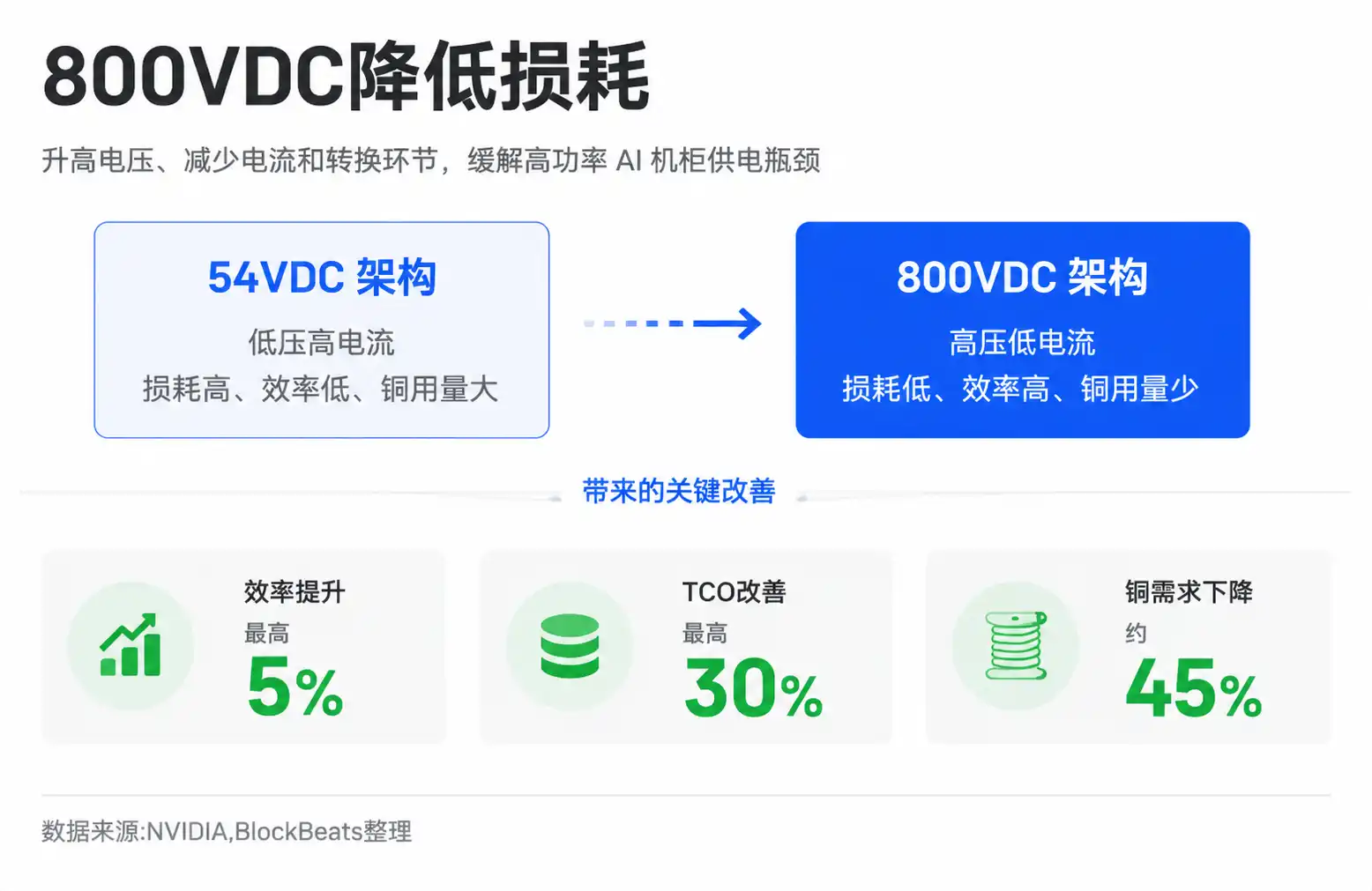
The idea behind 800VDC is to increase the voltage, deliver power more efficiently to the vicinity of the rack, and then step it down locally for use by the GPUs. It's akin to increasing water pressure to use narrower pipes to deliver the same amount of water. Nvidia's official materials state that 800VDC can reduce current, copper usage, cable volume, and conversion stages, potentially increasing efficiency by up to 5% and improving TCO by up to 30%. Some third-party and partner calculations also mention that copper usage could drop by about 45%, with actual benefits depending on the data center and rack integration methods.
This isn't just about saving copper. For Nvidia, the core value of 800VDC is to enable continued increases in compute density for next-generation AI racks. Low-voltage systems aren't unusable, but in the highest-density AI factories, they are beginning to approach engineering limits.

Nvidia Redefines Infrastructure Roles with Reference Architecture

What's significant about Nvidia is not just proposing a voltage solution, but using a reference architecture to redefine the division of labor within the ecosystem. Since 2025, Nvidia has publicly introduced the 800VDC architecture multiple times, showcasing its design direction for high-power systems like Rubin and Kyber racks in technical blogs and at forums like OCP.

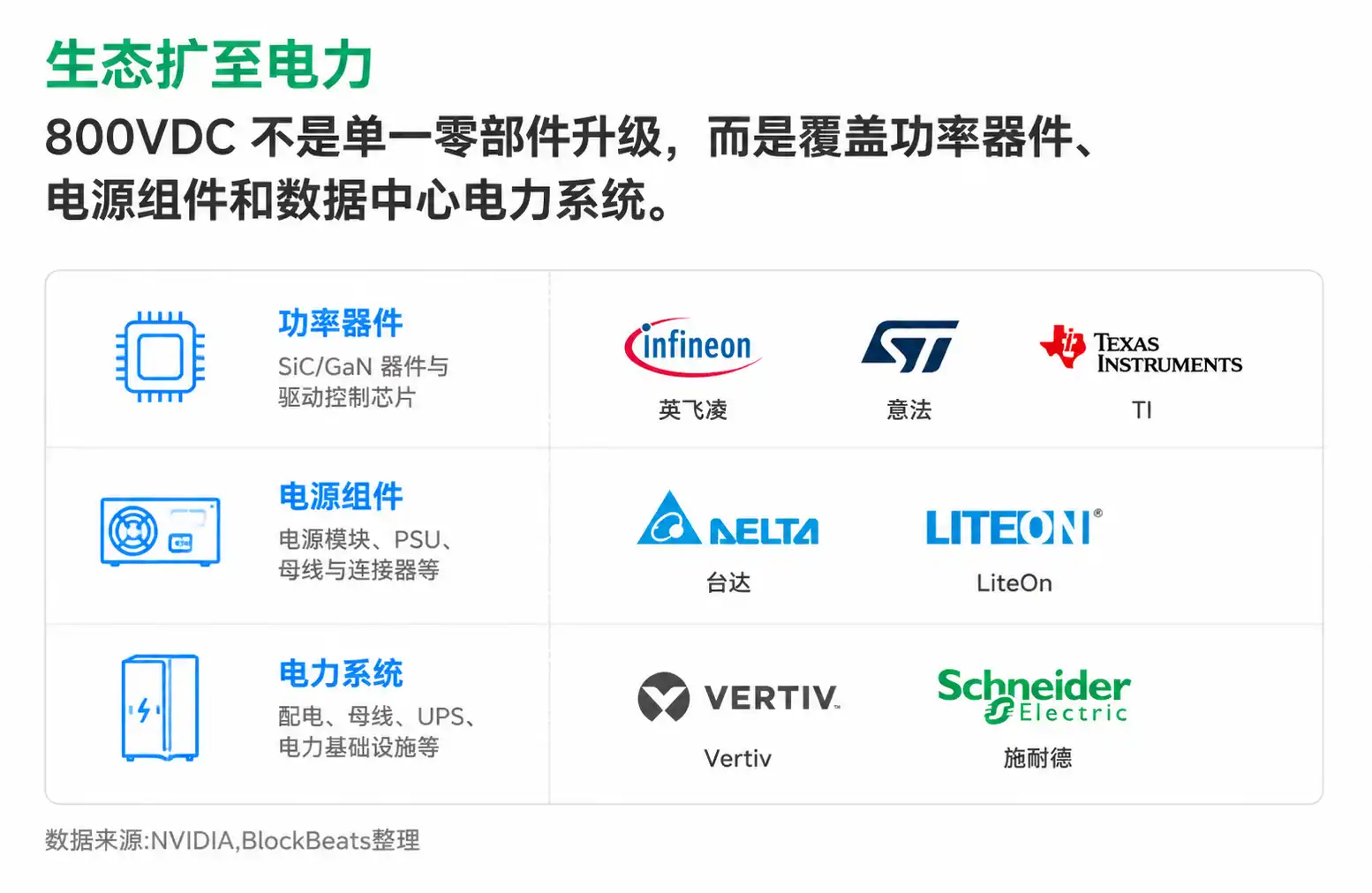
According to Nvidia's official blog, its 800VDC ecosystem partners include Delta Electronics, Schneider Electric, Vertiv, Infineon, STMicroelectronics, as well as companies like ABB, Eaton, GE Vernova, Hitachi Energy, Siemens, Navitas, and Texas Instruments. It's more accurate to describe this as ecosystem collaboration and adaptation, not to be directly interpreted as confirmed orders.
800VDC involves not a single component upgrade, but a change across an entire chain: from data center power distribution and rack power supplies to backup batteries, power devices, connectors, and whole-rack integration. Previously, power conversion might have been distributed across multiple stages like UPS, PDU, server PSUs, and motherboard power delivery. Under a high-voltage DC architecture, power is delivered closer to the rack, then stepped down by modules within or near the GPU.
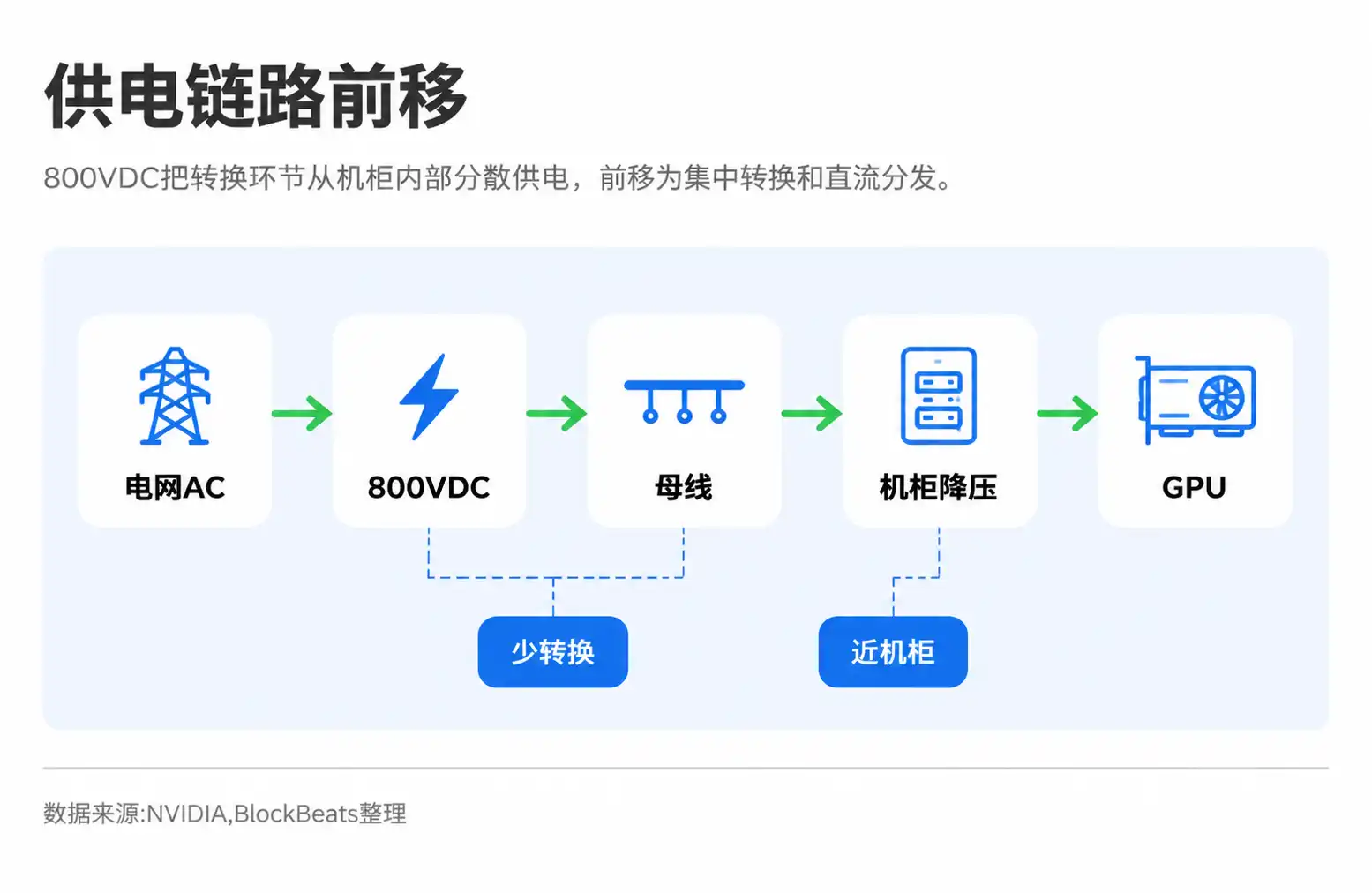
The weighting within the value chain will also shift accordingly. In the traditional server era, investors focused more on GPUs, CPUs, memory, and system integrators. In the era of high-power AI racks, power shelves, busbars, connectors, power semiconductors, liquid cooling systems, and whole-rack validation capabilities are all becoming part of the delivery capability.

Boundaries must also be clarified. 800VDC is more like an important reference architecture for leading-edge, high-density AI factories, not a standard that all data centers will immediately switch to. Many existing data centers will continue using traditional AC or hybrid architectures. New projects will also adopt it in layers based on power density, cost, owner willingness to retrofit, and safety regulations. What the market is truly trading on is not that everything will switch to 800V this year, but that the infrastructure rules for the highest-density AI racks post-2027 are changing.

Power Supplies, Connectors, Liquid Cooling, and Whole-Rack Testing Move to the Forefront

From an investment perspective, the most direct impact of 800VDC is bringing infrastructure segments that were previously in the background to the forefront.

The first category is power infrastructure companies, such as Vertiv, Schneider Electric, Delta Electronics, and some South Korean and Taiwanese power equipment manufacturers. They are not just selling traditional data center power equipment; they need to participate in the design of power distribution, rack power supply, backup batteries, and high-voltage DC systems for the new generation of AI factories. According to Asia Business Daily, Nvidia has communicated with South Korean power equipment companies like LS Electric, HD Hyundai Electric, and Hyosung regarding 800VDC data center infrastructure. This report is based on industry insider information and should not be equated with confirmed orders, but it illustrates that power equipment providers are being included in the AI factory ecosystem.

The second category is power devices, namely next-generation power switches like SiC/GaN (Silicon Carbide/Gallium Nitride). These are better suited than traditional silicon devices for high-voltage, high-frequency, high-efficiency scenarios. They were often discussed in the context of electric vehicles, charging piles, and industrial power supplies, but are now spilling over into AI data centers. Companies like Infineon and STMicroelectronics are therefore coming into investors' view. However, the benefits for power semiconductors also depend on specific designs, supply share, pricing, and yield, and cannot be simply equated to "800VDC concept stocks."

The third category is connection and mechanical structures, including busbars, power busways, high-voltage connectors, high-end backplanes, and some thick-copper, multi-layer PCBs. When voltage increases and current decreases, copper loss pressure eases, but requirements for insulation, safety, connection reliability, and structural design become higher. Low-end copper materials do not inherently benefit; what's truly valuable are connection and power delivery materials that can adapt to high-power, high-reliability racks.

The fourth category is liquid cooling and whole-rack ODM. As power increases, heat dissipation is no longer a secondary issue. For servers to run stably in customer data centers, they must undergo whole-rack level testing before leaving the factory, including power supply, cooling, networking, and GPU full-load stability. Whole-rack deliverers like Dell, Wiwynn, and Wistron are competing not just on assembly efficiency, but also on whether they have sufficient power, space, liquid cooling testing, and system tuning capabilities.

Design Direction is Clear, but Delivery Capability Requires Real-World Testing

Nvidia has provided a clear technical direction, but supply chain execution won't automatically be smooth. The tension here is precisely what investors need to track.

Independent supply chain analyst Dan Nystedt has recently cited Taiwanese media and industry information multiple times: AI server ODM revenues are strong, Rubin-related production preparations are advancing, but components, power infrastructure, and whole-rack burn-in testing (full-load aging tests) are becoming real constraints. Burn-in can be understood as stress testing of servers before they leave the factory. The power supply, cooling, and system stability of a whole rack of GPUs running at full load for extended periods must all pass together.

If a single rack requires continuous power at the 100-200kW level, the testing facility itself needs power and cooling capacity approaching that of a small data center. Such supply chain signals cannot be written as the industry already commonly having its own power generation, nor can they be directly interpreted as power supply having replaced GPUs as the biggest bottleneck. It's more of a reminder: Delivery in the Rubin era is not just about GPU arrival and motherboard assembly, but about power, liquid cooling, testing, and whole-rack stability all being in place simultaneously.

The logic behind the revaluation of some ODMs, power equipment, and liquid cooling companies is also here. Their value doesn't just come from participating in AI servers, but from their ability to reliably deliver high-power racks to cloud providers. In the future, if everyone gets the same Nvidia reference design, what truly differentiates them might be testing facilities, power capacity, liquid cooling debugging experience, and delivery yield.

For AI cloud providers like CoreWeave and Nebius, 800VDC is not a direct component-benefit logic, but a variable affecting capital expenditure efficiency and deployment speed. Whether high-density racks can be deployed on time impacts computing power delivery, depreciation schedules, and revenue realization. High-speed interconnect or optical module chains, like those involving Marvell or Lumentum, belong more to a parallel logic of AI cluster expansion and should not be confused with direct beneficiaries of 800VDC.

2027 to See Kyber Racks and Order Fulfillment

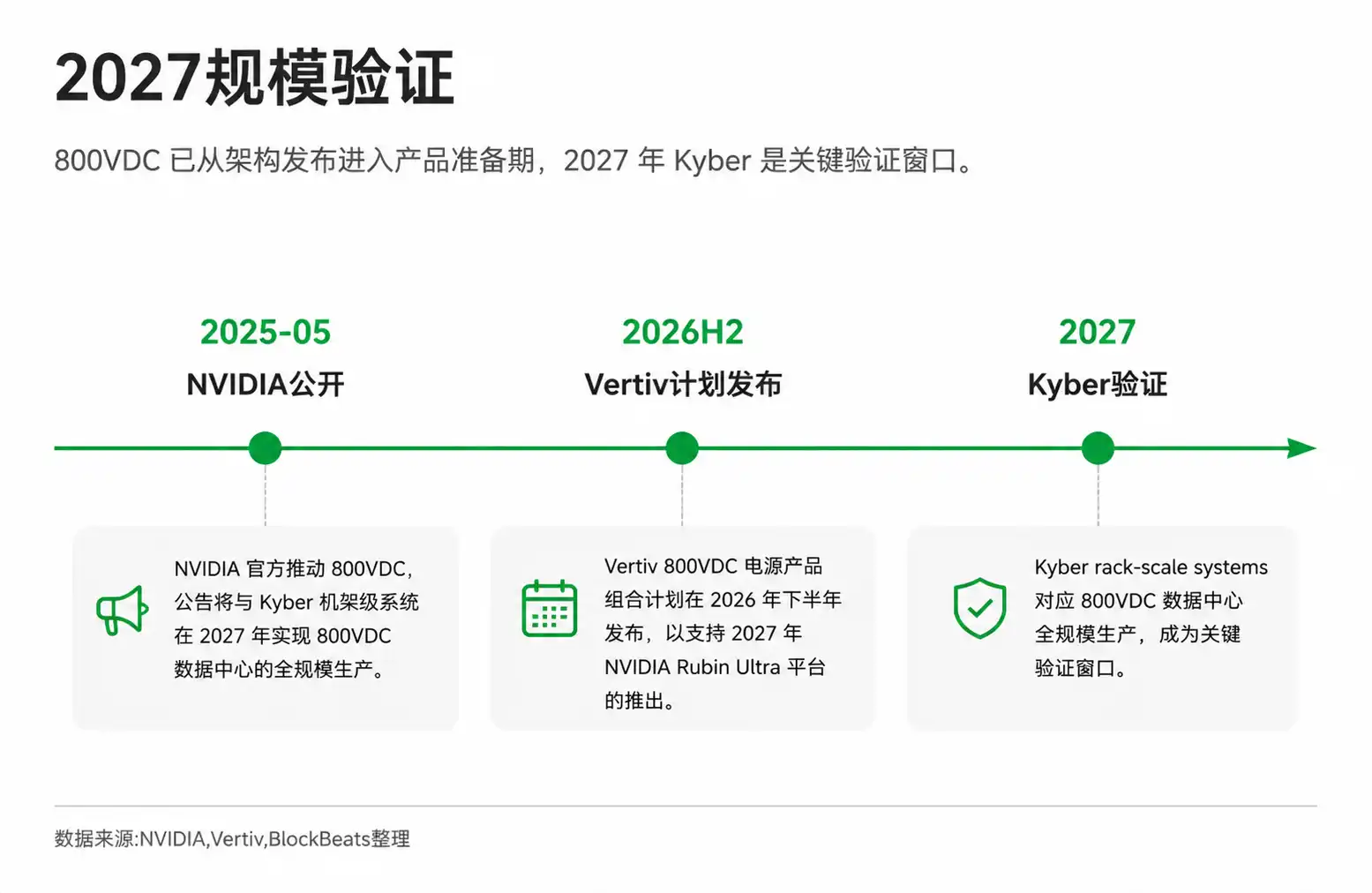
The direction of 800VDC is much clearer than a year ago: Nvidia is officially promoting it, partners are adapting, physical constraints exist, and leading-edge high-density AI factories need more efficient power delivery. But it is still in the preparation and early deployment window. Nvidia officially states that full-scale production for 800VDC will correspond with the 2027 Kyber rack-scale systems; true validation will depend on whether subsequent products and customer projects materialize.

What's most worth watching next is not whether a company mentions "AI power" in its announcements, but whether it has clearly entered into 800VDC-related products, customer validation, and order fulfillment. Whether ODMs disclose stronger whole-rack testing capabilities, the reliability of liquid cooling systems under prolonged full load, and whether data center owners are willing to retrofit power distribution and safety regulations for high-voltage DC architecture will all influence the rhythm of this trade.

If Rubin-related racks ramp up smoothly and 800VDC component orders move from samples and validation to volume procurement, the market will continue to increase the weighting placed on power supply, liquid cooling, connectors, and whole-rack delivery capabilities. Conversely, if power consumption configurations are lower than expected, customers adopt more conservative hybrid architectures, or testing power and liquid cooling reliability slow down delivery, the 800VDC trade will also shift from directional judgment back to verifying orders and timing. GPUs remain the core, but post-Rubin, the ability to stably deliver a whole rack of high-power systems is beginning to become a variable in asset pricing.

Câu hỏi Liên quan

QAccording to the article, why is NVIDIA promoting the 800VDC standard for future AI infrastructure?

ANVIDIA is promoting the 800VDC standard because the power requirements of high-density AI server racks are pushing the limits of traditional low-voltage power delivery. By moving to higher voltage, 800VDC can deliver the same power with lower current, which reduces copper usage, cable size, and power loss, improves efficiency, and allows for continued increases in computing density within a rack.

QWhat are the four main categories of infrastructure companies that the article suggests are brought to the forefront due to the 800VDC push?

AThe four main categories are: 1) Power infrastructure companies (e.g., Vertiv, Schneider Electric, Delta Electronics) involved in design for new AI factories; 2) Power semiconductor companies (e.g., Infineon, STMicroelectronics) producing SiC/GaN devices for efficient high-voltage switching; 3) Connector and structural companies handling busbars, high-voltage connectors, and specialized PCBs; and 4) Liquid cooling and rack-level ODM companies responsible for full rack integration and pre-deployment burn-in testing.

QWhat new challenge for server manufacturers (ODMs) does the article highlight in relation to high-power AI racks like those for Rubin?

AThe article highlights that delivering high-power AI racks requires new capabilities beyond assembly. A key challenge is conducting full rack-level burn-in testing, where an entire rack of GPUs is run at full load for an extended period. This requires the ODM to have access to substantial electrical power and advanced cooling (like liquid cooling) in their testing facilities to ensure system stability before shipment.

QWhat is the key timeline that the article associates with the full-scale production of 800VDC architecture?

AAccording to the article, NVIDIA states that full-scale production for the 800VDC architecture is aligned with the launch of the "Kyber rack-scale systems," which is expected in 2027. True validation will depend on the subsequent product rollouts and customer project implementations.

QHow does the article caution investors about interpreting the list of NVIDIA's 800VDC ecosystem partners?

AThe article cautions that the list of NVIDIA's 800VDC ecosystem partners (including companies like Delta, Schneider, Vertiv, Infineon, etc.) represents collaboration and design adaptation, and should not be directly interpreted as confirmed orders already being placed. The market's focus should shift to tracking which companies secure concrete orders, pass customer validation, and demonstrate actual delivery capabilities.

Nội dung Liên quan

Các giao dịch M&A trên thị trường tiền mã hóa đang diễn ra sôi động bất thường

Thị trường mua bán và sáp nhập (M&A) trong lĩnh vực tiền mã hóa đang trở nên sôi động bất thường. Theo số liệu từ RootData, trong tháng này, số vụ M&A đã lên tới 10, trong khi số vòng gọi vốn chỉ là 14. Tỷ lệ M&A trong tổng số giao dịch thị trường sơ cấp đã đạt khoảng 42%, mức cao nhất từ trước đến nay. Hiện tượng này phản ánh trước hết là sự suy giảm kéo dài của thị trường gọi vốn. Kể từ tháng 11/2024, số lượng giao dịch M&A hàng tháng duy trì ở mức 10-20 vụ, trong khi giao dịch gọi vốn giảm mạnh từ khoảng 100 xuống còn khoảng 50 vụ. Điều này có nghĩa là M&A không thay thế cho sự sôi động của thị trường vốn, mà trở thành hình thức giao dịch ổn định hơn khi thị trường vốn thu hẹp. Các công ty lớn như Coinbase, Kraken, Ripple, MoonPay... đang tận dụng thời kỳ giá trị định thấp để mua lại các đội ngũ, giấy phép, công nghệ với chi phí thấp hơn, ít cạnh tranh hơn và có thêm quyền thương lượng. Bốn lý do chính thúc đẩy M&A là: định giá đủ rẻ, tiết kiệm chi phí thời gian và thử sai, tiếp cận nguồn lực giấy phép/tuân thủ, và hợp nhất chuỗi giá trị thượng-nhượng nguồn. Các lĩnh vực trọng tâm của M&A hiện nay bao gồm: cơ sở hạ tầng giao dịch (đặc biệt là phái sinh), thanh toán & stablecoin, giấy phép tuân thủ, và phát hành/phân phối tài sản (RWA). Làn sóng M&A này đang viết lại logic thoái vốn cho thị trường sơ cấp, cung cấp một lối thoát khác ngoài việc phụ thuộc vào phát hành token. Nó buộc các dự án phải chú trọng hơn vào giá trị sản phẩm, doanh thu thực và khả năng tích hợp chiến lược thay vì chỉ đóng gói câu chuyện để gọi vốn. Tuy nhiên, xu hướng này cũng cho thấy ngành công nghiệp tiền mã hóa đang trở nên tập trung hơn. Các nền tảng lớn dần nắm giữ tài sản, thanh khoản và giấy phép, khiến việc gia nhập thị trường của các startup mới ngày càng khó khăn, đánh dấu sự kết thúc của thời kỳ khởi nghiệp dễ dàng.

链捕手31 phút trước

Các giao dịch M&A trên thị trường tiền mã hóa đang diễn ra sôi động bất thường

链捕手31 phút trước

Giao dịch mua lại và sáp nhập trên thị trường tiền mã hóa đang diễn ra cực kỳ sôi động

Thị trường M&A trong lĩnh vực tiền mã hóa đang hoạt động sôi động một cách bất thường, với tỷ lệ giao dịch mua lại chiếm khoảng 42% tổng số giao dịch thị trường sơ cấp, mức cao nhất từ trước đến nay. Điều này phản ánh xu hướng suy giảm rõ rệt của thị trường gọi vốn. Các giao dịch M&A không thực sự thay thế sự sôi động của thị trường vốn, mà trở thành hình thức giao dịch ổn định khi thị trường gọi vốn thu hẹp. Các công ty hàng đầu như Coinbase, Kraken, Ripple, MoonPay đang tích cực mua lại để bổ sung năng lực cốt lõi với chi phí thấp hơn. Động lực chính bao gồm: định giá mục tiêu rẻ hơn, tiết kiệm thời gian và chi phí thử sai, tiếp cận giấy phép/tài nguyên tuân thủ, và tích hợp chuỗi giá trị. Các lĩnh vực trọng tâm của M&A là: cơ sở hạ tầng giao dịch (đặc biệt là phái sinh), thanh toán & stablecoin, RWA & phát hành tài sản. Điều này cho thấy các gã khổng lồ đang mở rộng từ sản phẩm đơn lẻ sang mô hình tập đoàn tài chính. Sự gia tăng M&A đang viết lại logic thoát vốn cho thị trường sơ cấp, cung cấp một lối thoát thay thế ngoài việc phụ thuộc vào token, khuyến khích các startup tập trung vào giá trị sản phẩm và năng lực tích hợp thực tế. Tuy nhiên, nó cũng cho thấy ngành công nghiệp đang trở nên tập trung hơn, với rào cản gia nhập ngày càng cao do yếu tố tuân thủ và sức mạnh của các nền tảng lớn.

marsbit32 phút trước

Giao dịch mua lại và sáp nhập trên thị trường tiền mã hóa đang diễn ra cực kỳ sôi động

marsbit32 phút trước

Bức tranh toàn cảnh về hệ sinh thái bảo mật Solana: Chồng bảo mật hoàn chỉnh từ Máy tính đến AI

Solana vẫn đang ở giai đoạn đầu trong việc phát triển hệ sinh thái bảo mật, tập trung vào các lĩnh vực như Ngân hàng mới (Neobanks) và DeFi riêng tư. Bài viết cung cấp cái nhìn toàn cảnh về hệ sinh thái này, từ cơ sở hạ tầng tính toán đến các ứng dụng AI. **Cơ sở hạ tầng Tính toán Riêng tư:** Hai dự án chính là Arcium (sử dụng MPC - Tính toán Đa bên) và Magic Block (sử dụng TEE - Môi trường Thực thi Tin cậy) cung cấp nền tảng cho tính toán bảo mật trên Solana. Chúng cho phép tạo lập sổ lệnh, nhóm thanh khoản kín và các giao thức DeFi riêng tư. **Chuyển khoản & Số dư Riêng tư:** Các ứng dụng như Umbra (trên Arcium), Privacy Cash và Hush cung cấp giải pháp cho giao dịch và số dư riêng tư thông qua các kỹ thuật như mã hóa, nhóm che giấu (shielding pools) và bằng chứng không kiến thức (ZK-proof). **Giao dịch không để lại dấu vết:** Các giao thức như encifherio và VanishTrade bảo vệ chiến lược giao dịch khỏi front-running và MEV bằng cách ẩn chi tiết đặt lệnh thông qua mã hóa hoặc định tuyến thanh khoản được che giấu. Darklake phát triển cơ sở hạ tầng thanh khoản và nhóm giao dịch kín (dark pool) dựa trên ZK. **Ứng dụng Nâng cao:** Các thị trường dự đoán riêng tư (ví dụ: Melee Markets) sử dụng cơ sở hạ tầng như của Arcium để mã hóa sổ lệnh, bảo vệ chiến lược của người tham gia. Trong lĩnh vực AI, Loyal tạo ra các giao thức thông minh bảo mật, lưu trữ dữ liệu người dùng (hội thoại, truy vấn) ở dạng mã hóa trên Solana với các quy tắc truy cập nghiêm ngặt. Tầm nhìn cuối cùng là một "ngăn xếp bảo mật hoàn chỉnh" nơi các công nghệ như ZK và FHE (Mã hóa Đồng cấu hình Đầy đủ) kết hợp để mang lại tính bảo mật mạnh mẽ và có thể kết hợp trên quy mô lớn.

Foresight News38 phút trước

Bức tranh toàn cảnh về hệ sinh thái bảo mật Solana: Chồng bảo mật hoàn chỉnh từ Máy tính đến AI

Foresight News38 phút trước

7 câu hỏi then chốt về "DeepSeek hoàn thành vòng gọi vốn hơn 500 tỷ NDT"

DeepSeek, công ty trí tuệ nhân tạo (AI) nổi tiếng với các nguyên tắc "không gọi vốn, không lên sàn, không thương mại hóa", được báo cáo đã hoàn thành vòng gọi vốn đầu tiên trị giá hơn 50 tỷ nhân dân tệ (tương đương hơn 500 nghìn tỷ VND), đưa định giá công ty lên trên 50 tỷ USD. Theo nguồn tin từ The Information ngày 16/6, vòng gọi vốn bắt đầu từ tháng 4/2024 và thu hút các nhà đầu tư lớn bao gồm Tencent, CATL, JD.com, NetEase, Quỹ đầu tư ngành công nghiệp AI quốc gia và IDG Capital. Người sáng lập Liang Wenfeng cũng đầu tư 20 tỷ nhân dân tệ. Điểm đặc biệt là cơ cấu gọi vốn được thiết kế để bảo vệ quyền kiểm soát tuyệt đối của Liang Wenfeng. Hầu hết các nhà đầu tư phải chuyển tiền vào một quỹ đối tác hữu hạn do ông kiểm soát, chịu thời gian khóa 5 năm, không có quyền biểu quyết nhưng được ưu tiên thông tin tài chính và quyền đầu tư ở các vòng sau. Ngoại lệ duy nhất là Quỹ đầu tư ngành công nghiệp AI quốc gia, được đầu tư trực tiếp 1 tỷ nhân dân tệ, có quyền biểu quyết và không bị khóa. Động lực đầu tư của các bên khác nhau: Tencent nhằm tăng cường hợp tác chiến lược, CATL tập trung vào cơ hội từ nhu cầu năng lượng cho các trung tâm dữ liệu AI, trong khi sự tham gia của "đội ngũ quốc gia" phản ánh tầm quan trọng chiến lược của DeepSeek. Sau vòng gọi vốn, DeepSeek dự kiến sẽ phát triển các phiên bản mô hình mới, hỗ trợ doanh nghiệp, tăng cường đầu tư vào cơ sở hạ tầng (như xây dựng trung tâm dữ liệu ở Nội Mông) và thu hút nhân tài, với mục tiêu dài hạn là hướng tới Trí tuệ nhân tạo phổ quát (AGI). Vòng gọi vốn này đánh dấu sự khởi đầu cho một chặng đường dài, nơi Liang Wenfeng phải cân bằng giữa lý tưởng công nghệ, mục tiêu phổ cập AGI và kỳ vọng về lợi nhuận từ các nhà đầu tư.

marsbit1 giờ trước

7 câu hỏi then chốt về "DeepSeek hoàn thành vòng gọi vốn hơn 500 tỷ NDT"

marsbit1 giờ trước

Giao dịch

Giao ngay
Hợp đồng Tương lai

Bài viết Nổi bật

Làm thế nào để Mua T

Chào mừng bạn đến với HTX.com! Chúng tôi đã làm cho mua Threshold Network Token (T) trở nên đơn giản và thuận tiện. Làm theo hướng dẫn từng bước của chúng tôi để bắt đầu hành trình tiền kỹ thuật số của bạn.Bước 1: Tạo Tài khoản HTX của BạnSử dụng email hoặc số điện thoại của bạn để đăng ký tài khoản miễn phí trên HTX. Trải nghiệm hành trình đăng ký không rắc rối và mở khóa tất cả tính năng. Nhận Tài khoản của tôiBước 2: Truy cập Mua Crypto và Chọn Phương thức Thanh toán của BạnThẻ Tín dụng/Ghi nợ: Sử dụng Visa hoặc Mastercard của bạn để mua Threshold Network Token (T) ngay lập tức.Số dư: Sử dụng tiền từ số dư tài khoản HTX của bạn để giao dịch liền mạch.Bên thứ ba: Chúng tôi đã thêm những phương thức thanh toán phổ biến như Google Pay và Apple Pay để nâng cao sự tiện lợi.P2P: Giao dịch trực tiếp với người dùng khác trên HTX.Thị trường mua bán phi tập trung (OTC): Chúng tôi cung cấp những dịch vụ được thiết kế riêng và tỷ giá hối đoái cạnh tranh cho nhà giao dịch.Bước 3: Lưu trữ Threshold Network Token (T) của BạnSau khi mua Threshold Network Token (T), lưu trữ trong tài khoản HTX của bạn. Ngoài ra, bạn có thể gửi đi nơi khác qua chuyển khoản blockchain hoặc sử dụng để giao dịch những tiền kỹ thuật số khác.Bước 4: Giao dịch Threshold Network Token (T)Giao dịch Threshold Network Token (T) dễ dàng trên thị trường giao ngay của HTX. Chỉ cần truy cập vào tài khoản của bạn, chọn cặp giao dịch, thực hiện giao dịch và theo dõi trong thời gian thực. Chúng tôi cung cấp trải nghiệm thân thiện với người dùng cho cả người mới bắt đầu và người giao dịch dày dạn kinh nghiệm.

Tổng lượt xem 512Xuất bản vào 2024.12.13Cập nhật vào 2026.06.02

Làm thế nào để Mua T

Thảo luận

Chào mừng đến với Cộng đồng HTX. Tại đây, bạn có thể được thông báo về những phát triển nền tảng mới nhất và có quyền truy cập vào thông tin chuyên sâu về thị trường. Ý kiến ​​của người dùng về giá của T (T) được trình bày dưới đây.

活动图片