Super-Rich Hoarded Record Cash in February, Stock Market Hit New Highs Four Months Later: Who's Getting Fooled?

marsbitXuất bản vào 2026-06-15Cập nhật gần nhất vào 2026-06-15

Tóm tắt

In February, the total assets in US money market funds reached a record high of approximately $8.25 trillion, a trend highlighted by high-net-worth individuals increasing their cash holdings. Notably, Warren Buffett's Berkshire Hathaway amassed a $381.7 billion cash pile ahead of his 2025 retirement, while other prominent figures like Peter Thiel sold tech stocks, fueling narratives of wealthy investors seeking safety. However, by June, the trend reversed. Money market fund assets fell to around $7.87 trillion, indicating a flow of capital back into equities. Concurrently, the S&P 500 and Nasdaq reached all-time highs, with the S&P 500 surpassing 7600 points. This market surge occurred despite the earlier defensive moves, highlighting a potential opportunity cost for those who retreated to cash. Analysis shows that since early 2022, the S&P 500's total return significantly outpaced that of prime money market funds. The capital shifted from equities appears to have been partly reallocated into alternative investments like real estate, art, and private credit, especially among ultra-high-net-worth individuals. Meanwhile, major investment banks like Goldman Sachs and Morgan Stanley have raised their year-end targets for the S&P 500, citing AI-driven earnings growth, while also cautioning about risks including market concentration and economic fragility beneath the surface rally.

Author: Claude, Deep Tide TechFlow

Deep Tide Introduction: In February of this year, US money market funds surged to a historical peak of about $8.25 trillion. Buffett left behind $381.7 billion in cash before retirement, and rumors swirled that the super-rich were fleeing the stock market.

But now in June, the plot has reversed: the S&P 500 repeatedly hits new highs, breaching the 7600-point level for the first time on June 2nd, while money market fund assets have fallen back to $7.87 trillion as of June 10th. Money is flowing from cash back into stocks. The safe-haven bet placed by the wealthiest group is now being proven wrong by the market.

The Story in February: Cash in the Hands of the Rich Piled Up to a Record High

Let's rewind to the beginning of the year.

According to a Goldman Sachs survey from October 2025, high-net-worth individuals with over $1 million in investable assets held, on average, about 20% of their net worth in cash and cash equivalents—a proportion considered high for traditional allocation.

The most symbolic figure was Buffett.

As reported by Bloomberg, before his retirement on December 31, 2025, the former CEO of Berkshire Hathaway had built the company's cash reserves to approximately $381.7 billion as of the end of the third quarter of 2025. This cash pile even ended up making money—despite market turmoil, Buffett's personal net worth still grew by about $21 billion last year.

He wasn't the only one reducing holdings. According to Reuters' disclosures of holdings documents, PayPal co-founder Peter Thiel, through his hedge fund Thiel Macro, sold about $100 million worth of Nvidia stock in Q3 2025. Nvidia rose nearly 35% in 2025; Thiel exiting at a high point added fuel to concerns about an "AI bubble."

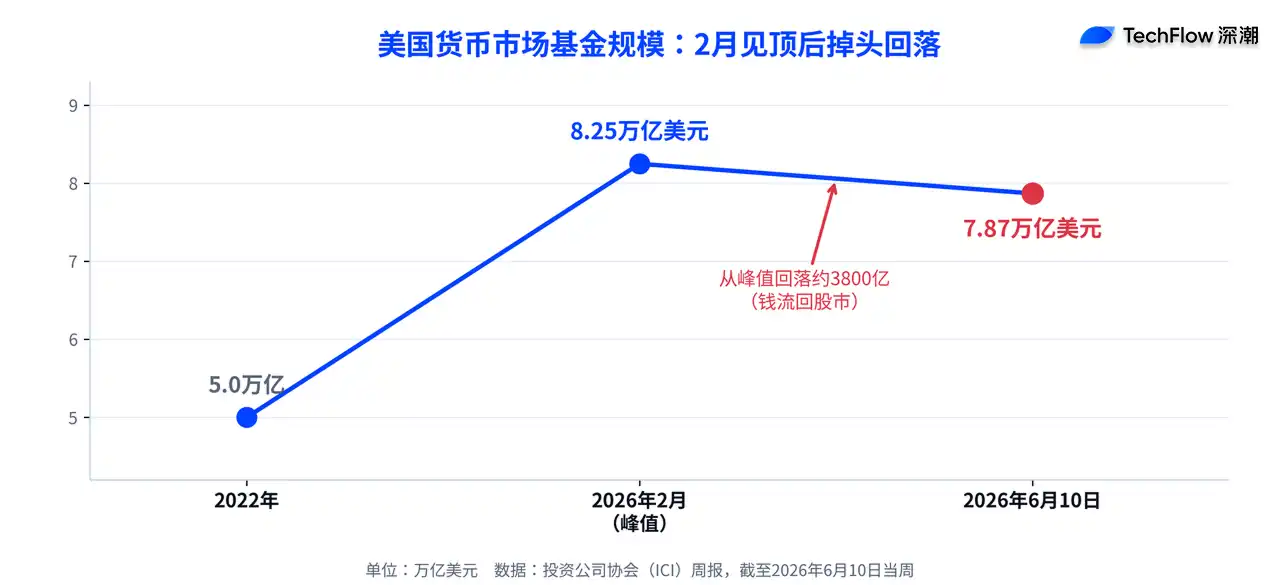
The market direction was the same. According to data from the Investment Company Institute (ICI), US money market fund assets surged to a historical peak of about $8.25 trillion at the end of February this year, a 65% increase from about $5 trillion in 2022. The narrative back then was clear: smart money was hiding in cash.
The June Reversal: Money is Flowing from Cash Back into Stocks

The problem is, it's June now, and the story has flipped.

According to official ICI data, as of the week ending June 10th, money market fund assets dropped to $7.87 trillion, with a single-week outflow of $21.48 billion; the previous week, June 4th, it was $7.89 trillion. From the February peak of $8.25 trillion, assets have shrunk by about $380 billion. Money is flowing *out* of cash, not in.

Where is it going? Stocks. According to CNBC, the S&P 500 closed at 7609.78 points on June 2nd, breaking above the 7600-point level for the first time in history, marking its ninth consecutive day of gains; the Nasdaq also hit new highs. Nvidia surged over 6% in a single day after releasing its new generation of PC chips, boosting Dell and HP. In short, the money that hid in cash back in February is now watching the market hit new highs without them.

There was an early signal behind this. According to investingLive reports, Bank of America (BofA) warned as early as late May that as the market surged to new highs and bullish sentiment peaked, cash levels were actually declining. The $8.25 trillion record was old news from February; by June, the market landscape was a different story.

The Cost of Hoarding Cash: Lagging Stocks by More Than Double

Why is the wealthy's safe-haven move being proven wrong? Look at the return gap.

According to calculations by The Motley Fool, if one had held from the point before the 2022 bear market when cash was flowing into money market funds all the way to the present, the total return for the S&P 500 would be about 42%, while the Vanguard Federal Money Market Fund returned only 18% over the same period—a gap of more than double. Hiding in cash seems safe, but the cost is missing a big chunk of the rally.

This is also why many analysts remain skeptical of the "pile into cash at the first sign of trouble" approach:

Historically, events like geopolitical conflicts are often short-term and can instead be buying opportunities at low points, not reasons to sell out.

Those Who Moved Money Out of Stocks Went into Real Estate and Art

The money freed up by those who did reduce stock holdings hasn't been idle. The Goldman Sachs survey shows that among those with $1 million to $5 million in investable assets, nearly 40% hold alternative investments; among those with over $10 million, this proportion reaches 80%. The greater the assets, the more they move beyond traditional stocks.

Art is one destination. According to UBS's 2025 Art Market Report, high-net-worth collectors allocated an average of about 20% of their wealth to art in 2025. Real estate, private credit, and hedge funds are also absorbing funds flowing out of the stock market. The logic is that in an environment of sticky inflation, high interest rates, and uncertain tariff prospects, these asset classes resemble safer harbors. But even safe harbors have a cost, as the earlier set of return numbers demonstrates.

Major Banks Are Still Doubling Down: Goldman Sachs, Morgan Stanley Raise Price Targets

If the wealthy's moves in February leaned defensive, Wall Street banks' stance in June is the opposite.

According to Bloomberg, Goldman Sachs' strategy team (led by Ben Snider) raised its year-end target for the S&P 500 from 7600 points to 8000 points in late May, citing AI-driven earnings growth. Goldman increased its 2026 S&P 500 earnings-per-share forecast to $340, representing a 24% year-on-year growth, and believes AI infrastructure beneficiaries will contribute about half of this year's index earnings growth. However, Goldman also cautioned: "AI sentiment and interest rates present risks in both directions."

Morgan Stanley is even more bullish. Chief Investment Officer for Wealth Management Lisa Shalett, in an outlook on May 20th, set a one-year target of 8300 points for the S&P 500, implying about 11% to 12% upside. But she also listed five risks: gains excessively concentrated in a few large-cap AI stocks, deteriorating US consumer finances, corporate profits reliant on price hikes rather than productivity, pressure on long-term interest rates, and better performance outside the US (Japan and some emerging markets). Shalett's core judgment is that the market's surface is stronger than the underlying economy.


Tiền kỹ thuật số thịnh hành

Câu hỏi Liên quan

QAccording to the article, what significant record did U.S. money market funds reach in February, and what was the narrative at that time?

AIn February, U.S. money market funds surged to a historical peak of approximately $8.25 trillion. The prevailing narrative at that time was that smart money was seeking shelter in cash, with super-wealthy individuals appearing to withdraw from the stock market.

QHow has the situation changed by June, specifically regarding the flow of funds and stock market performance?

ABy June, the situation reversed. Money market fund assets had decreased to $7.87 trillion by June 10, indicating an outflow of cash. Conversely, the stock market reached new highs, with the S&P 500 closing above 7600 points for the first time on June 2, marking a nine-day winning streak.

QWhat was the performance gap between holding cash (in a money market fund) and holding stocks (the S&P 500) from the start of the 2022 bear market to the present, as cited in the article?

AFrom the start of the 2022 bear market to the present, the S&P 500 delivered a total return of approximately 42%, while the Vanguard Federal Money Market Fund returned only about 18%. Holding cash thus resulted in missing more than double the returns of the stock market over that period.

QWhere are wealthy individuals, who reduced their stock holdings, reallocating their capital according to the Goldman Sachs survey mentioned in the article?

AAccording to the Goldman Sachs survey, wealthy individuals who reduced stock holdings are reallocating capital into alternative investments. This includes areas such as real estate, art, private credit, and hedge funds. Nearly 40% of those with $1-5 million in investable assets and 80% of those with over $10 million hold such alternative investments.

QWhat are the updated year-end price targets for the S&P 500 from Goldman Sachs and Morgan Stanley, and what are their primary reasons for these bullish forecasts?

AGoldman Sachs, led by strategist Ben Snider, raised its year-end target for the S&P 500 to 8000 points from 7600, citing AI-driven earnings growth. Morgan Stanley's Chief Investment Officer Lisa Shalett set a one-year target of 8300 points, forecasting about 11-12% upside, based on continued market strength, though she also listed several underlying economic risks.

Nội dung Liên quan

Tại sao Bitcoin duy trì mức 64.000 USD sau lần tạm dừng cứng rắn của Fed

Bitcoin duy trì quanh mức 64.000 USD sau cuộc họp của Fed. Dù Fed giữ lãi suất trong khoảng 3,50–3,75%, ba thành viên ủy ban đã bỏ phiếu ủng hộ tăng lãi suất, gửi đi tín hiệu chính sách thắt chặt hơn dự kiến. Bitcoin phản ứng biến động nhưng cuối cùng ổn định quanh 64.000 USD, với vùng hỗ trợ 63.000–63.500 USD và kháng cự ở 66.000 USD. ETF Bitcoin ghi nhận dòng vốn ròng chảy vào 32,1 triệu USD, chấm dứt chuỗi rút tiền, trong khi ETF Ethereum tiếp tục thất thoát 18,65 triệu USD. Điều này cho thấy sự luân chuyển vốn sang Bitcoin giữa bối cảnh bất ổn vĩ mô. Ethereum giao dịch quanh 1.900 USD, áp lực bán tăng nhưng mạng lưới vẫn mạnh với lượng ETH chờ staking cao. Các altcoin khác di chuyển không đồng nhất. Về pháp lý, dự luật CLARITY Act bị trì hoãn đến sau kỳ nghỉ tháng 8 của Thượng viện Mỹ, khiến thị trường thận trọng hơn về khả năng thông qua vào năm 2026. Tóm lại, thị trường tiền mã hóa đang trong trạng thái chờ đợi, với Bitcoin thể hiện sự kiên cường nhờ dòng vốn ETF. Các nhà đầu tư trung hạn cần theo dõi khả năng giữ trên 63.000 USD của Bitcoin, mức 1.860 USD của Ethereum và dòng vốn thể chế để tìm tín hiệu cho sự phục hồi trong nửa cuối năm 2026.

cryptonews.ru1 giờ trước

Tại sao Bitcoin duy trì mức 64.000 USD sau lần tạm dừng cứng rắn của Fed

cryptonews.ru1 giờ trước

Parker Lewis Lý Giải Tại Sao Bitcoin Vẫn Là Đồng Tiền Tốt Nhất

Nhà phân tích Bitcoin uy tín Parker Lewis chỉ trích mạnh mẽ các chiến lược tiếp thị của các công ty tự xưng là kho bạc tiền mã hóa. Ông cho rằng việc các công ty này huy động vốn thông qua việc bán "tín dụng số" dưới dạng cổ phiếu ưu đãi vĩnh viễn đã làm sai lệch bản chất của tiền mã hóa đầu tiên. Lewis nhấn mạnh Bitcoin không có lợi suất định sẵn, và việc hứa hẹn cổ tức thường xuyên là một trò chơi rủi ro cao, dựa chủ yếu vào việc thu hút nhà đầu tư mới trên thị trường tăng trưởng. Ông dẫn chứng sự chênh lệch lớn giữa thị trường tín dụng toàn cầu (300 nghìn tỷ USD) và thị trường cổ phiếu ưu đãi vĩnh viễn (1 nghìn tỷ USD) để chứng minh rủi ro của các công cụ phái sinh này, thường được chuyển cho các nhà đầu tư nhỏ lẻ. Lewis bác bỏ quan điểm cho rằng Bitcoin quá biến động, lập luận rằng biến động là hệ quả tự nhiên của việc chấp nhận một loại tài sản mới. Với nguồn cung cứng và không co giãn, mỗi làn sóng người dùng mới sẽ dẫn đến biến động giá mạnh. Thay vì mua cổ phiếu phái sinh của các công ty như MicroStrategy, ông khuyên nên mua Bitcoin trực tiếp, vì điều này an toàn hơn về mặt toán học so với việc giao tiền cho các nhà quản lý tập đoàn. Việc chuyển hướng sang các công cụ phái sinh làm mất tập trung vào mối đe dọa thực sự: sự mất giá nhanh chóng của tiền pháp định. Lewis đưa ra "Chỉ số thịt bò" của riêng mình, cho thấy mức lạm phát tiêu dùng thực tế khoảng 12-13% mỗi năm, cao hơn nhiều so với số liệu chính thức. Ông kết luận rằng chiến lược tài chính an toàn và hiệu quả nhất trong bối cảnh lạm phát toàn cầu là sở hữu trực tiếp Bitcoin và tự kiểm soát khóa riêng tư, thay vì theo đuổi lợi nhuận đầy rủi ro từ cổ phiếu kho bạc tiền mã hóa.

cryptonews.ru1 giờ trước

Parker Lewis Lý Giải Tại Sao Bitcoin Vẫn Là Đồng Tiền Tốt Nhất

cryptonews.ru1 giờ trước

Bắt giữ các thành viên trong âm mưu lừa đảo với XRP, chiếm đoạt 9 triệu đô la từ 71 nhà đầu tư

Vào ngày 30/7, Cảnh sát Thủ đô Seoul thông báo đã bắt giữ ba nghi phạm trong một vụ lừa đảo đầu tư liên quan đến tiền điện tử XRP. Nhóm này bị cáo buộc vận hành nền tảng đầu tư gian lận Fxrpntwork.com, thu hút 71 nhà đầu tư chuyển khoảng 3,4 triệu đô la XRP trong một tuần (từ 16-23/10) trước khi đóng cửa trang web và biến mất. Các nghi phạm quảng bá trang web thông qua blog, bài báo trực tuyến và video YouTube, hứa hẹn bảo toàn vốn gốc và lợi nhuận hàng tháng từ 1,5% đến 1,8%. Họ hướng dẫn nạn nhân chuyển XRP từ các sàn giao dịch Hàn Quốc qua nền tảng nước ngoài rồi vào ví do nhóm kiểm soát. Cảnh sát Seoul cảnh báo các nhà đầu tư cần kiểm tra kỹ nguồn thông tin chính thức trước khi chuyển tiền. Các đối tượng đã sao chép thương hiệu của Flare Network và FXRP để tạo vẻ ngoài hợp pháp. Ripple và Interpol cảnh báo đây là thủ đoạn phổ biến, với các mạng lưới tội phạm xuyên quốc gia ngày càng có tổ chức. Việc hứa hẹn lợi nhuận đảm bảo vẫn là dấu hiệu phổ biến của lừa đảo tiền điện tử. Hai nghi phạm 29 tuổi đã bị bắt, một người 34 tuổi khác bị đề nghị truy tố, và một nghi phạm 29 tuổi khác đang bị truy nã ở nước ngoài với thông báo đỏ của Interpol. Cảnh sát cũng đã phong tỏa tài sản ảo trị giá 17,3 tỷ won và đang điều tra các chuyển khoản liên quan trị giá 27,3 tỷ won để xác định thêm nạn nhân và đồng phạm.

cryptonews.ru1 giờ trước

Bắt giữ các thành viên trong âm mưu lừa đảo với XRP, chiếm đoạt 9 triệu đô la từ 71 nhà đầu tư

cryptonews.ru1 giờ trước

Giao dịch

Giao ngay

Bài viết Nổi bật

Làm thế nào để Mua SUPER

Chào mừng bạn đến với HTX.com! Chúng tôi đã làm cho mua SuperFarm (SUPER) trở nên đơn giản và thuận tiện. Làm theo hướng dẫn từng bước của chúng tôi để bắt đầu hành trình tiền kỹ thuật số của bạn.Bước 1: Tạo Tài khoản HTX của BạnSử dụng email hoặc số điện thoại của bạn để đăng ký tài khoản miễn phí trên HTX. Trải nghiệm hành trình đăng ký không rắc rối và mở khóa tất cả tính năng. Nhận Tài khoản của tôiBước 2: Truy cập Mua Crypto và Chọn Phương thức Thanh toán của BạnThẻ Tín dụng/Ghi nợ: Sử dụng Visa hoặc Mastercard của bạn để mua SuperFarm (SUPER) ngay lập tức.Số dư: Sử dụng tiền từ số dư tài khoản HTX của bạn để giao dịch liền mạch.Bên thứ ba: Chúng tôi đã thêm những phương thức thanh toán phổ biến như Google Pay và Apple Pay để nâng cao sự tiện lợi.P2P: Giao dịch trực tiếp với người dùng khác trên HTX.Thị trường mua bán phi tập trung (OTC): Chúng tôi cung cấp những dịch vụ được thiết kế riêng và tỷ giá hối đoái cạnh tranh cho nhà giao dịch.Bước 3: Lưu trữ SuperFarm (SUPER) của BạnSau khi mua SuperFarm (SUPER), lưu trữ trong tài khoản HTX của bạn. Ngoài ra, bạn có thể gửi đi nơi khác qua chuyển khoản blockchain hoặc sử dụng để giao dịch những tiền kỹ thuật số khác.Bước 4: Giao dịch SuperFarm (SUPER)Giao dịch SuperFarm (SUPER) dễ dàng trên thị trường giao ngay của HTX. Chỉ cần truy cập vào tài khoản của bạn, chọn cặp giao dịch, thực hiện giao dịch và theo dõi trong thời gian thực. Chúng tôi cung cấp trải nghiệm thân thiện với người dùng cho cả người mới bắt đầu và người giao dịch dày dạn kinh nghiệm.

Tổng lượt xem 379Xuất bản vào 2024.12.11Cập nhật vào 2026.06.02

Làm thế nào để Mua SUPER

Thảo luận

Chào mừng đến với Cộng đồng HTX. Tại đây, bạn có thể được thông báo về những phát triển nền tảng mới nhất và có quyền truy cập vào thông tin chuyên sâu về thị trường. Ý kiến ​​của người dùng về giá của SUPER (SUPER) được trình bày dưới đây.

活动图片












