The Largest IPO in History Ignites Heated Debate: Is SpaceX Worth $1.77 Trillion?

marsbitXuất bản vào 2026-06-11Cập nhật gần nhất vào 2026-06-11

Tóm tắt

SpaceX's potential IPO is priced at $135 per share, aiming to raise $75 billion and valuing the company at approximately $1.77 trillion, which would make it the largest IPO in history. This valuation has sparked intense debate among investors. Bullish analysts, including major underwriters Goldman Sachs and Morgan Stanley, argue the valuation is justified by SpaceX's long-term potential. They see it not just as a rocket company but as a future leader in space infrastructure, with key growth drivers being Starlink satellite internet, low-cost rocket launches, and future AI-related ventures. They project revenues reaching hundreds of billions to trillions of dollars by 2030-2040. ARK Invest's model suggests a 2030 enterprise value could reach $2.5 trillion. Bearish analysts from independent research firms like Morningstar, PitchBook, and New Constructs contend the IPO price is excessively high, already pricing in unrealistic future growth. Using DCF and sum-of-the-parts models, they estimate fair value between $780 billion and $1.7 trillion, significantly below the IPO target. They highlight risks such as the speculative nature of AI projections, over-dependence on Elon Musk, high growth expectations, and corporate governance concerns. Trefis set a target price of just $79 per share. While both sides acknowledge SpaceX's unique position in commercial space, the core disagreement centers on whether the $135 share price offers a reasonable margin of safety or is overly optimis...

Original Author: Biteye

Currently, the SpaceX IPO pricing is preliminarily set at $135 per share, with a planned fundraising scale of approximately $75 billion, corresponding to a fully diluted valuation of about $1.77 trillion. This essentially secures its position as the largest IPO in the history of capital markets.

If this scale is ultimately achieved, Musk's net worth is expected to surge by over $220 billion, challenging for the title of the world's first trillionaire.

However, heavy is the head that wears the crown. The reason the SpaceX IPO attracts such attention is not only its potential to become the largest IPO ever but also because the capital markets are already fiercely debating its valuation.

Is SpaceX really worth $1.77 trillion? With an extra $220 billion in his wallet, will Musk be able to sleep soundly?

🌟 The Bull Case: Underwriters Weave a Long-Term Story with Starlink + Rocket Launches + AI

Bulls believe investing in SpaceX is not merely about backing a rocket company but rather about getting an early stake in the future gateway to space infrastructure.

The $1.77 trillion valuation seems high, but if Starlink, low-cost launches, and AI businesses continue to deliver, $135 has a long-term story to support it.

Goldman Sachs @GoldmanSachs

X Followers: 1.132M | XHunt Rank: 12015 | Global top-tier investment bank, one of the core underwriters for the SpaceX IPO.

Core View: SpaceX's valuation should not be understood solely as a traditional aerospace company; Starlink and future AI business must be incorporated into the long-term growth model.

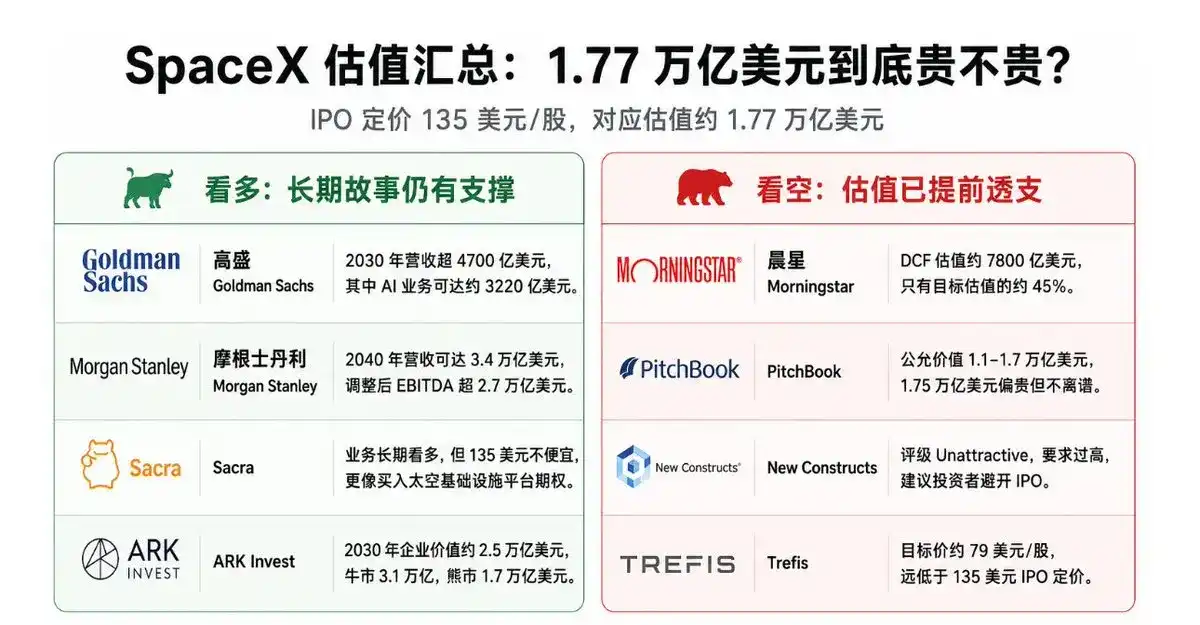
Goldman Sachs expects SpaceX's revenue in 2028 to be around $160 billion, exceeding $470 billion by 2030.

The AI division is considered the most aggressive part. Goldman Sachs projects SpaceX's AI-related revenue could reach approximately $322 billion by 2030.

Morgan Stanley @MorganStanley

X Followers: 742K | XHunt Rank: 32049 | Global top-tier investment bank, one of the core underwriters for the SpaceX IPO.

Core View: SpaceX's long-term value stems from the compound growth of "Space + AI," with a future revenue ceiling far higher than traditional aerospace companies.

Morgan Stanley similarly expects SpaceX's 2028 revenue to be around $160 billion.

More aggressive is the long-term forecast: by 2040, Morgan Stanley projects SpaceX's revenue could reach $3.4 trillion, with adjusted EBITDA exceeding $2.7 trillion.

If you're buying the gateway to space infrastructure for the next decade+, $135 is undervalued, but it will take a long time to realize.

Sacra

An independent research firm focused on private tech companies, specializing in deep-dive company analysis and valuation breakdowns.

Core View: Bullish on the business long-term, but $135 is not a low valuation; it's more like paying upfront for an option on SpaceX transforming from an aerospace company into a space infrastructure platform.

Sacra estimates SpaceX's 2025 revenue at approximately $18.7 billion, with Starlink contributing $11.4 billion, already becoming the company's most important profit center.

It believes SpaceX's core advantage lies in vertical integration: building its own rockets, launching them, deploying its own satellites, and controlling terminals and ground networks, creating a cost advantage difficult for competitors to replicate.

If only considering the current Starlink and rocket launch businesses, $135 is not cheap. If one believes SpaceX can further expand from an aerospace company into a comprehensive platform covering satellite internet, low-cost launches, and more space infrastructure, this price becomes easier to accept.

ARK Invest @ARKInvest

X Followers: 816K | XHunt Rank: 1637 | Innovation-focused investment firm led by Cathie Wood, long-term tracker of disruptive technology assets.

Core View: While SpaceX's $1.77 trillion valuation is high, it's not entirely without support when considering the long-term opportunity through 2030.

ARK Invest's open-source valuation model for SpaceX shows an expected enterprise value of approximately $2.5 trillion by 2030. According to its model, the bull case scenario is around $3.1 trillion, and the bear case scenario is around $1.7 trillion.

ARK's core logic is that SpaceX's value comes not just from rocket launches but from Starlink's global satellite internet network, low-cost launch capability, and future space infrastructure businesses.

Based on ARK's projections, the IPO subscription price of $135 still has some upside potential.

🌟 The Bear Case: Independent Firms Believe IPO Valuation is Already Severely Overextended

The bear camp does not deny that SpaceX is one of the world's most unique commercial aerospace assets, nor do they deny Starlink's long-term value.

However, they believe the $1.77 trillion IPO valuation has already priced in too much future growth, especially given the significant uncertainty surrounding the AI business.

Morningstar @MorningstarInc

X Followers: 238K | XHunt Rank: 98209 | Globally renowned independent investment research firm, commonly using fundamental analysis and DCF models to assess company value.

Core View: SpaceX is a good company, but the IPO valuation is clearly on the high side.

Using a DCF model, Morningstar gives SpaceX a fair value estimate of approximately $780 billion, only about 45% of the IPO target valuation of $1.77 trillion.

In Morningstar's breakdown, the valuation for SpaceX's core launch business + Starlink is approximately $611 billion, with the xAI / AI-related business valued at around $170 billion on a probability-weighted basis.

Morningstar also highlights two risks: Musk is a key figure at SpaceX, and the company's valuation carries a significant "Musk premium." After the IPO, selling pressure may arise as lock-up periods expire for early shareholders and employees.

Morningstar believes the $135 price is clearly expensive and not suitable for rushing into the IPO; there may be better buying opportunities post-IPO.

PitchBook @PitchBook

X Followers: 48K | XHunt Rank: 49174 | Global platform for private equity, venture capital, and private company data, covering valuations and financing information for numerous private companies.

Core View: Around $1.5 trillion is acceptable, $1.75 trillion is expensive, but not entirely irrational.

PitchBook uses a Sum-of-the-Parts model to estimate SpaceX's fair value range between $1.1 trillion and $1.7 trillion, primarily focusing on the launch business and Starlink, not entirely reliant on the xAI narrative.

The $135 price is already near or slightly above the upper end of PitchBook's valuation range – not cheap, but not completely outrageous if one takes a long-term view on Starship and Starlink execution.

New Constructs @NewConstructs

X Followers: 5675 | XHunt Rank: - | Independent equity research firm focusing on financial quality, valuation risks, and reverse DCF analysis.

Core View: SpaceX is not worth participating in at a $1.75 trillion valuation; it advises investors to avoid the IPO.

New Constructs rates SpaceX as Unattractive. They argue that the $1.75 trillion valuation implies excessively high future growth and profit requirements. SpaceX would need to simultaneously become one of the highest revenue and profit-generating companies in the U.S. stock market to justify this price.

Risks cited include: inadequate internal accounting controls at SpaceX, public investors having almost no voting rights, a large portion of IPO proceeds potentially used to repay debt, potentially misleading non-GAAP metrics, and related-party transaction risks.

To justify a $1.75 trillion valuation, SpaceX's revenue may need to reach $1.1 trillion by 2035, implying an average annual growth rate of about 50% over the next decade. New Constructs believes such growth rates have almost no historical precedent.

New Constructs' judgment is the most direct: the risk-reward at this price is unfavorable, and they recommend not participating in the IPO.

Trefis @Trefis

X Followers: 2661 | XHunt Rank: - | Independent U.S. stock valuation platform that derives target prices by breaking down business models.

Core View: SpaceX is an exceptionally unique company, but the $135 offering price is clearly overvalued.

Trefis acknowledges SpaceX's long-term advantages in commercial aerospace, Starlink satellite internet, and low-cost launches but argues these advantages do not mean investors should ignore price.

Trefis gives SpaceX a target price of approximately $79 per share, far below the $135 IPO price.

🌟 Final Thoughts

Whether from the bull or bear side, most essentially acknowledge that SpaceX is one of the world's most unique commercial aerospace companies.

The real point of contention is whether the $135 price offers any margin of safety.

📈 Bulls believe buying SpaceX is about the long-term story of Starlink, low-cost launches, AI, and future space infrastructure.

📉 Bears argue that $135 has already priced in expectations to the fullest.

Currently, the $SPCX IPO subscription is already oversubscribed by 4 times, indicating that despite the valuation debate, capital enthusiasm for SpaceX remains high.

🙋 So the question is: Will you participate in the $SPCX IPO? Do you think Musk's $220 billion gain is well-deserved, or will it keep him up at night?
Câu hỏi Liên quan

QWhat is SpaceX's proposed IPO share price and what would the corresponding fully diluted valuation be?

ASpaceX's proposed IPO price is $135 per share, which would result in a fully diluted valuation of approximately $1.77 trillion.

QAccording to Goldman Sachs and Morgan Stanley, what is the core narrative supporting the bullish case for SpaceX's high valuation?

AThe bullish case, as presented by Goldman Sachs and Morgan Stanley, revolves around SpaceX being a long-term investment in future space infrastructure, combining growth from Starlink, low-cost launch services, and future AI-related business segments.

QWhat is Morningstar's fair value estimate for SpaceX and how does it compare to the proposed IPO valuation?

AMorningstar's fair value estimate for SpaceX is approximately $780 billion, which is only about 45% of the proposed $1.77 trillion IPO valuation.

QWhat are some of the key risks associated with SpaceX's IPO as highlighted by New Constructs?

ANew Constructs highlighted several key risks: the valuation implies extremely high future growth requirements, insufficient internal accounting controls, minimal voting rights for public investors, the possibility of IPO proceeds being used to repay debt, potentially misleading non-GAAP metrics, and risks related to related-party transactions.

QWhat is the main point of contention between the bullish and bearish perspectives on SpaceX's IPO according to the article's conclusion?

AThe main point of contention is whether the IPO price of $135 per share provides a reasonable margin of safety. Bulls see it as justified by long-term growth in space infrastructure, while bears believe it already fully prices in optimistic future expectations.

Nội dung Liên quan

Sam Bankman-Fried Muốn Một Token Mới Để Bồi Thường Nạn Nhân FTX, Nhưng Liệu Điều Đó Có Thể Xảy Ra?

Sam Bankman-Fried (SBF) một lần nữa xuất hiện trên các tiêu đề sau khi được cho là bày tỏ hy vọng về một dự án token mới có thể bồi thường cho các nạn nhân của FTX. Tuy nhiên, tuyên bố này cần được hiểu là một mong muốn cá nhân, hoàn toàn tách biệt với thực tế pháp lý khắc nghiệt mà ông đang đối mặt. Điều quan trọng cần nhấn mạnh là vào ngày 12 tháng 6 năm 2026, một tòa phúc thẩm Mỹ đã giữ nguyên bản án 25 năm tù dành cho SBF. Với tư cách là một phạm nhân, ông phải đối mặt với hàng loạt rào cản pháp lý hiển nhiên trong việc điều hành công ty, huy động vốn hay phát hành token. Hiện không hề có bất kỳ dự án token nào đã được xác minh là khả thi về mặt pháp lý. Lý do khiến thông tin này thu hút sự chú ý nằm ở quy mô và ảnh hưởng của vụ sụp đổ FTX trong lịch sử crypto. Bất kỳ đề cập nào về việc bồi thường nạn nhân đều khơi gợi ký ức về thiệt hại khổng lồ và sự tổn hại niềm tin trong cộng đồng. Tuy nhiên, góc độ an toàn và chính xác để đưa tin không phải là việc SBF đang phát hành token, mà là sự tương phản giữa hy vọng cá nhân của ông về một con đường dựa trên token và nghịch lý pháp lý hiện tại. Quá trình bồi thường thực tế cho các chủ nợ của FTX vẫn sẽ phải tuân theo các thủ tục pháp lý, cơ cấu phá sản và cơ chế thu hồi tài sản chính thức, chứ không phải từ một ý tưởng token xuất phát từ trong tù.

bitcoinist1 giờ trước

Sam Bankman-Fried Muốn Một Token Mới Để Bồi Thường Nạn Nhân FTX, Nhưng Liệu Điều Đó Có Thể Xảy Ra?

bitcoinist1 giờ trước

BlackRock Ra Mắt Quỹ ETF Bitcoin Covered-Call Với Mã Chứng Khoán BITA

BlackRock đã ra mắt iShares Bitcoin Premium Income ETF (BITA), một quỹ ETF bitcoin mới sử dụng chiến lược covered-call để tạo thu nhập. Không giống như các quỹ spot bitcoin thông thường, BITA bán quyền chọn mua (call options) dựa trên danh mục nắm giữ bitcoin, nhằm thu phí bảo hiểm và phân phối thu nhập hàng tháng cho nhà đầu tư. Sản phẩm này phù hợp với những nhà đầu tư tin tưởng vào triển vọng bitcoin nhưng muốn có một công cụ tạo thu nhập ổn định hơn trong danh mục truyền thống, thay vì chỉ dựa vào việc tăng giá. Tuy nhiên, có sự đánh đổi: trong thị trường đi ngang hoặc biến động, chiến lược này có thể hấp dẫn, nhưng nó sẽ hạn chế phần lợi nhuận nếu giá bitcoin tăng mạnh vượt quá mức giá thực hiện của quyền chọn đã bán. Việc ra mắt BITA cho thấy thị trường ETF bitcoin đang phát triển vượt ra ngoài các sản phẩm spot đơn giản, hướng tới các chiến lược phức tạp hơn như tạo thu nhập, phòng ngừa rủi ro và tích hợp vào danh mục. Điều này giúp bitcoin dần được coi như một thành phần thị trường có thể kết hợp trong cấu trúc quỹ rộng hơn, thu hút thêm các nhà đầu tư tổ chức.

bitcoinist3 giờ trước

BlackRock Ra Mắt Quỹ ETF Bitcoin Covered-Call Với Mã Chứng Khoán BITA

bitcoinist3 giờ trước

Nhật Bản tăng lãi suất, tại sao cả thế giới đều lo lắng?

Vào tháng 6/2026, Ngân hàng Trung ương Nhật Bản (BoJ) nâng lãi suất chính sách lên 1%, mức cao nhất kể từ năm 1995. Dù mức này vẫn thấp hơn nhiều so với Mỹ hay châu Âu, nó lại khiến thị trường toàn cầu chú ý. Lý do nằm ở vai trò đặc biệt của Nhật Bản trong nhiều thập kỷ: là trung tâm cung cấp vốn vay chi phí cực thấp cho thế giới. Suốt hơn 20 năm, Nhật Bản duy trì lãi suất gần 0% hoặc âm, tạo điều kiện cho các nhà đầu tư quốc tế thực hiện "giao dịch carry trade" bằng đồng Yên. Họ vay Yên rẻ, đổi sang các đồng tiền khác để đầu tư vào tài sản có lợi suất cao hơn như cổ phiếu Mỹ, trái phiếu mới nổi. Dòng vốn Yên giá rẻ này trở thành một nguồn thanh khoản quan trọng, góp phần đẩy giá nhiều loại tài sản toàn cầu. Việc BoJ bắt đầu chu kỳ tăng lãi suất, dù nhỏ, đang làm lung lay kỳ vọng rằng Nhật Bản sẽ mãi mãi là nguồn vốn rẻ. Điều này buộc các nhà đầu tư phải tính toán lại chi phí vay và điều chỉnh các chiến lược đầu tư dựa trên đòn bẩy. Nguy cơ là nhiều quỹ có thể đồng loạt giảm đòn bẩy (deleverage), dẫn đến thu hồi vốn từ các thị trường tài sản rủi ro trên thế giới, gây biến động. Động thái của Nhật Bản phản ánh sự thay đổi cơ bản trong nền kinh tế nội địa: lạm phát đã vượt mục tiêu 2%, và quan trọng hơn là tiền lương tăng trưởng liên tục (trên 5% trong "shunto" - đàm phán lao động mùa xuân), tạo ra vòng xoáy tích cực "lương - lạm phát" mà nước này long đợi từ lâu. Áp lực từ đồng Yên yếu (từng gần chạm 160 Yên/USD) cũng góp phần thúc đẩy việc thắt chặt chính sách. Tuy nhiên, hướng đi cuối cùng của dòng vốn toàn cầu vẫn phụ thuộc lớn vào Cục Dự trữ Liên bang Mỹ (Fed). Chênh lệch lãi suất Mỹ-Nhật vẫn rộng. Chỉ khi Fed bắt đầu chu kỳ cắt giảm lãi suất trong khi BoJ tiếp tục tăng, chênh lệch này mới thu hẹp đáng kể, và khi đó tác động mạnh mẽ hơn đến dòng vốn và tỷ giá hối đoái mới thực sự rõ rệt. Tóm lại, thị trường lo ngại không phải vì mức lãi suất 1%, mà vì sự thay đổi trong một xu hướng đã tồn tại suốt 30 năm. Sự kết thúc của kỷ nguyên vốn vay cực rẻ từ Nhật Bản có thể định nghĩa lại logic định giá tài sản và dòng chảy vốn toàn cầu trong tương lai.

marsbit5 giờ trước

Nhật Bản tăng lãi suất, tại sao cả thế giới đều lo lắng?

marsbit5 giờ trước

Quốc Hội Thông Qua Lệnh Cấm CBDC Cho Đến Năm 2030 Thông Qua Dự Luật Cải Cách Nhà Ở Lớn

Các nhà lập pháp Hoa Kỳ đã thông qua một dự luật cải cách nhà ở lớn, trong đó có điều khoản cấm tạm thời Cục Dự trữ Liên bang (Fed) phát hành tiền kỹ thuật số của ngân hàng trung ương (CBDC) cho đến ngày 31 tháng 12 năm 2030. Điều khoản này, nằm trong Đạo luật Con đường Nhà ở Thế kỷ 21, phân loại CBDC là tài sản kỹ thuật số được định giá bằng đô la, là nghĩa vụ trực tiếp của Fed và phải có thể tiếp cận được với mọi công dân Mỹ. Những người ủng hộ lệnh cấm cho rằng nó cung cấp thêm thời gian để đánh giá tác động tiềm năng của đồng đô la kỹ thuật số, đồng thời phản ánh mối quan ngại về quyền riêng tư, giám sát tài chính và sự can thiệp của chính phủ. Lệnh cấu áp dụng cho mọi nỗ lực phát hành CBDC bán lẻ, dù trực tiếp hay thông qua trung gian, nhưng không hạn chế các mạng lưới blockchain không cần cấp phép. Mặc dù trọng tâm của dự luật là giải quyết thách thức về nguồn cung nhà ở, nhưng ngôn ngữ liên quan đến CBDC lại thu hút sự chú ý đáng kể từ cộng đồng tiền mã hóa, vì nó sẽ ảnh hưởng đến tương lai của các hệ thống thanh toán kỹ thuật số. Các bước tiếp theo trong quy trình lập pháp sẽ quyết định số phận của lệnh cấm này trong thập kỷ tới.

TheNewsCrypto6 giờ trước

Quốc Hội Thông Qua Lệnh Cấm CBDC Cho Đến Năm 2030 Thông Qua Dự Luật Cải Cách Nhà Ở Lớn

TheNewsCrypto6 giờ trước

Giao dịch

Giao ngay
Hợp đồng Tương lai
活动图片