Zcash Bug Could Have Minted Unlimited ZEC Undetected

bitcoinistXuất bản vào 2026-06-05Cập nhật gần nhất vào 2026-06-05

Tóm tắt

A critical vulnerability in Zcash's Orchard shielded pool, discovered by researcher Taylor Hornby on May 29, 2026, could have allowed an attacker to create an unlimited amount of undetectable counterfeit ZEC. The flaw, involving an under-constrained element in the Orchard circuit, existed from the pool's 2022 activation until an emergency fix was deployed by June 2, 2026. Hornby identified the bug using AI-assisted auditing tools and confirmed its exploitability in a test environment. Due to Orchard's privacy features, which hide transaction amounts and history, there is no cryptographic way to prove whether the vulnerability was exploited before the fix. While Shielded Labs assesses prior exploitation as unlikely, this uncertainty has sparked a debate on proving supply integrity in privacy-preserving systems. In response, Shielded Labs and other developers are exploring a network upgrade, potentially involving a new shielded pool and formal verification of the circuit rules to prevent future vulnerabilities and allow verification of the ZEC supply's integrity. ZEC's price fell nearly 45% following the disclosure.

A critical vulnerability in Zcash’s Orchard shielded pool could have allowed an attacker to create an unlimited amount of counterfeit ZEC without detection, according to a new disclosure from Zooko Wilcox, Jason McGee and security researcher Taylor Hornby. The flaw was discovered on May 29, remediated through an emergency ecosystem response completed by June 2, and has now triggered a broader debate over how Zcash can prove supply integrity in a privacy-preserving system.

Orchard Flaw Puts Zcash Supply Integrity Under Scrutiny

The vulnerability was found by Hornby, an experienced security engineer hired by Shielded Labs in April 2026 to conduct ongoing security research on the Zcash protocol. According to the disclosure, the mandate was straightforward: find protocol-level weaknesses before adversaries did. Hornby began reviewing Zcash with a combination of traditional security research and newer AI-assisted auditing methods.

The timing was unusually compressed. Shortly after Anthropic released its Opus 4.8 model on May 28, Hornby used it in a targeted review of the Orchard circuit. One day later, he found a critical counterfeiting flaw and disclosed it to Zcash Open Development Lab, or ZODL, whose engineers coordinated the emergency response with other ecosystem participants.

“The vulnerability could have been exploited to undetectably create an unlimited amount of counterfeit ZEC within Orchard,” the Shielded Labs post said. “Because of the privacy properties of Orchard, there is no way to cryptographically prove whether the vulnerability was exploited before it was remediated. However, a network upgrade can be deployed to protect users and prove the integrity of the Zcash supply.”

The disclosure states that the bug was “real and exploitable.” Hornby, with the help of Opus 4.8, wrote a complete exploit and tested it in a local regtest environment, where it generated unlimited counterfeit ZEC that could not be detected. The authors said that had the same tool been run on mainnet, it would have generated unlimited, undetectable counterfeit ZEC in Hornby’s mainnet wallet.

Technically, the issue involved an under-constrained element of the Orchard circuit. That made it possible to feed arbitrary false inputs into an elliptic curve multiplication while still passing the multiplication check. The vulnerability existed from Orchard’s activation in May 2022 until the emergency fix was deployed on June 1, 2026.

That timeline is central to the concern. In a transparent ledger, supply irregularities can generally be audited by inspecting public balances and transaction values. Orchard is different by design: it hides amounts and transaction history. That privacy model means the system depends heavily on the correctness of the circuit rules that define valid shielded transactions.

Josh Swihart, founder and CEO of Zcash Open Development Lab, the team behind the creation and launch of Zcash and builder of the Zodl wallet, framed the issue in those terms in a separate post. “A shielded Zcash transaction includes a proof that it followed the protocol’s rules, as defined in the rulebook (the circuit) that defines what constitutes a valid transaction. The Orchard vulnerability was in one of the rules, written loosely enough that it would accept false information and still pass. As a result, the engine could be convinced that a fake transaction was valid.”

Swihart added that the flaw was not in Zcash’s underlying cryptography or the proof engine itself, but in the handwritten rules. In his words, “This was a flaw in the handwritten rules, not in the underlying cryptography or the engine that creates proofs.”

Shielded Labs said prior exploitation appears unlikely, while emphasizing that users should not be asked to rely on that assessment alone. The authors pointed to several reasons for their view: the flaw had evaded years of scrutiny by leading cryptographers, Hornby was specifically hired to find such vulnerabilities, and the response window after discovery was sharply narrowed by the speed of ZODL and the broader Zcash ecosystem.

“The discovery was not accidental—it was the result of a deliberate effort to identify vulnerabilities of this kind before malicious actors could,” the post said. “Taylor is one of the most skilled people in the world at this. He used the most recent AI tools, available only to white-hat security researchers, along with a sophisticated custom-built AI harness and prompts, and worked hard to outrace the attackers. We think he probably succeeded.”

Still, the authors acknowledged the unresolved cryptographic uncertainty. Because of Orchard’s privacy properties and the nature of the bug, they said there is no definitive way to prove solely through cryptography whether the vulnerability was exploited before the fix.

Shielded Labs Eyes New Pool And Formal Verification

To address that, Shielded Labs is exploring a proposed network upgrade with other Zcash developers. The plan would deploy a new shielded pool and enforce turnstile accounting on coins moving from the existing Orchard pool, with the goal of allowing anyone to verify the integrity of the Zcash supply and prove the non-existence of counterfeit ZEC in Orchard. A follow-up post is expected next week with more details, including tradeoffs and implementation mechanics. Any major upgrade would still need community support and the standard governance process before activation.

Swihart said a second Orchard pool could, in principle, be targeted for NU7 at the end of July, though he did not take a fixed position on whether that path should be pursued. He argued that the larger issue is preventing this class of failure from recurring, with formal verification as the strongest answer.

“Formal verification fixes this,” Swihart wrote. “A mathematical proof can be constructed to reduce the parts humans must review to a concise, readable statement of the rules. A computer then checks the entire rulebook to ensure it matches. AI tools can now do the work of writing these proofs.”

Shielded Labs said it is already accelerating proactive security work with Hornby and Anthropic, initiating a project to formally verify the Orchard circuit, and opening searches for a Head of Security and a Cryptographer. The episode leaves Zcash with a difficult but clear path: repair the trust assumptions around Orchard, prove supply integrity where possible, and move future shielded design closer to machine-checked guarantees rather than human-reviewed complexity.

Over the past 24 hours, ZEC has fallen nearly 45% amid the uncertainty. At press time, it was trading at $337.
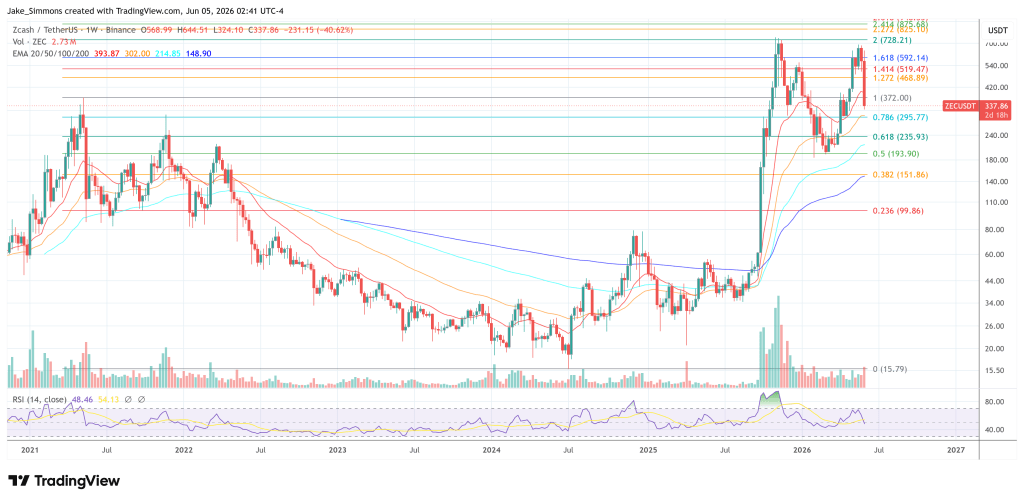
ZEC trades below the 1.618 Fib again, 1-week chart | Source: ZECUSDT on TradingView.com

Câu hỏi Liên quan

QWhat was the nature of the critical vulnerability discovered in Zcash's Orchard shielded pool?

AThe vulnerability was a critical counterfeiting flaw. An under-constrained element in the Orchard circuit allowed an attacker to feed arbitrary false inputs into an elliptic curve multiplication while still passing the multiplication check, potentially enabling the creation of an unlimited amount of counterfeit ZEC that could not be detected.

QWho discovered the vulnerability, and what tools aided in its discovery?

AThe vulnerability was discovered by security researcher Taylor Hornby, who was hired by Shielded Labs. He used a combination of traditional security research and newer AI-assisted auditing methods, specifically employing Anthropic's Opus 4.8 model released on May 28 in a targeted review of the Orchard circuit, which led to the discovery the next day.

QWhy is it impossible to cryptographically prove whether the Orchard vulnerability was exploited before it was fixed?

ADue to the privacy properties of the Orchard shielded pool, which hides transaction amounts and history by design. This means supply irregularities cannot be audited by inspecting public data, unlike transparent ledgers. The system relies on the correctness of the circuit rules, and the bug's nature leaves no definitive cryptographic trace of prior exploitation.

QWhat proposed solution is Shielded Labs exploring to address the supply integrity concerns raised by the Orchard bug?

AShielded Labs is exploring a proposed network upgrade to deploy a new shielded pool. This plan would enforce turnstile accounting on coins moving from the existing Orchard pool, with the goal of allowing anyone to verify the integrity of the Zcash supply and prove the non-existence of counterfeit ZEC in Orchard.

QAccording to Josh Swihart, what is the strongest long-term solution to prevent this class of failure from recurring?

AJosh Swihart identified formal verification as the strongest answer. This involves constructing a mathematical proof to reduce the human-reviewed parts to a concise statement of the rules, and then using a computer to check that the entire rulebook matches those rules, with AI tools now capable of writing these proofs.

Nội dung Liên quan

Anthropic ra mắt 'mô hình mạnh nhất', nhưng đa số người dùng không thể tiếp cận

Vào tháng 4, Anthropic giới thiệu bản xem trước mô hình Mythos, không mở công khai do có khả năng khám phá lỗ hổng bảo mật mạnh mẽ. Đến tháng 6, họ chính thức ra mắt Fable 5 và Mythos 5, chia sẻ cùng một mô hình nền tảng nhưng có cách tiếp cận khác nhau: Mythos 5 bị hạn chế trong "Dự án Glasswing" dành cho các đối tác bảo mật, còn Fable 5 dành cho người dùng phổ thông với một bộ phân loại an toàn tự động chuyển sang mô hình cũ Opus 4.8 khi phát hiện yêu cầu nhạy cảm. Về hiệu suất, Fable 5 thể hiện sự vượt trội trong các bài kiểm tra kỹ thuật phần mềm như SWE-Bench Pro (80.3%) và FrontierCode Diamond (29.3%), cho thấy khả năng tạo mã chất lượng sản xuất và xử lý tác vụ dài tốt hơn. Tuy nhiên, cơ chế tự động hạ cấp đôi khi được kích hoạt quá mức, ảnh hưởng đến trải nghiệm. Đáng chú ý, Fable 5 có giá API đắt gấp đôi Opus 4.8 và từ ngày 23/6 sẽ bị loại khỏi gói đăng ký, buộc người dùng phải trả thêm phí theo lượng sử dụng. Động thái này được cho là nhằm sàng lọc người dùng cao cấp sẵn sàng trả giá cho công nghệ đỉnh cao, trong khi các mô hình Trung Quốc như DeepSeek lại giảm giá mạnh để mở rộng thị trường. Bài viết kết luận rằng ngành AI đang phân tầng: khả năng phổ thông sẽ ngày càng rẻ, trong khi công nghệ tiên phong sẽ đắt đỏ và chỉ dành cho những người dùng có nhu cầu và khả năng chi trả cao, giống như lộ trình phát triển của điện toán đám mây trước đây.

marsbit13 phút trước

Anthropic ra mắt 'mô hình mạnh nhất', nhưng đa số người dùng không thể tiếp cận

marsbit13 phút trước

Giao dịch

Giao ngay
Hợp đồng Tương lai

Bài viết Nổi bật

Làm thế nào để Mua ZEC

Chào mừng bạn đến với HTX.com! Chúng tôi đã làm cho mua Zcash (ZEC) trở nên đơn giản và thuận tiện. Làm theo hướng dẫn từng bước của chúng tôi để bắt đầu hành trình tiền kỹ thuật số của bạn.Bước 1: Tạo Tài khoản HTX của BạnSử dụng email hoặc số điện thoại của bạn để đăng ký tài khoản miễn phí trên HTX. Trải nghiệm hành trình đăng ký không rắc rối và mở khóa tất cả tính năng. Nhận Tài khoản của tôiBước 2: Truy cập Mua Crypto và Chọn Phương thức Thanh toán của BạnThẻ Tín dụng/Ghi nợ: Sử dụng Visa hoặc Mastercard của bạn để mua Zcash (ZEC) ngay lập tức.Số dư: Sử dụng tiền từ số dư tài khoản HTX của bạn để giao dịch liền mạch.Bên thứ ba: Chúng tôi đã thêm những phương thức thanh toán phổ biến như Google Pay và Apple Pay để nâng cao sự tiện lợi.P2P: Giao dịch trực tiếp với người dùng khác trên HTX.Thị trường mua bán phi tập trung (OTC): Chúng tôi cung cấp những dịch vụ được thiết kế riêng và tỷ giá hối đoái cạnh tranh cho nhà giao dịch.Bước 3: Lưu trữ Zcash (ZEC) của BạnSau khi mua Zcash (ZEC), lưu trữ trong tài khoản HTX của bạn. Ngoài ra, bạn có thể gửi đi nơi khác qua chuyển khoản blockchain hoặc sử dụng để giao dịch những tiền kỹ thuật số khác.Bước 4: Giao dịch Zcash (ZEC)Giao dịch Zcash (ZEC) dễ dàng trên thị trường giao ngay của HTX. Chỉ cần truy cập vào tài khoản của bạn, chọn cặp giao dịch, thực hiện giao dịch và theo dõi trong thời gian thực. Chúng tôi cung cấp trải nghiệm thân thiện với người dùng cho cả người mới bắt đầu và người giao dịch dày dạn kinh nghiệm.

Tổng lượt xem 414Xuất bản vào 2024.12.12Cập nhật vào 2026.06.02

Làm thế nào để Mua ZEC

Thảo luận

Chào mừng đến với Cộng đồng HTX. Tại đây, bạn có thể được thông báo về những phát triển nền tảng mới nhất và có quyền truy cập vào thông tin chuyên sâu về thị trường. Ý kiến ​​của người dùng về giá của ZEC (ZEC) được trình bày dưới đây.

活动图片