Privacy Coin Crisis of Confidence! ZEC Plunges Over 56% in a Single Day

链捕手Xuất bản vào 2026-06-05Cập nhật gần nhất vào 2026-06-05

Tóm tắt

Zcash (ZEC), a leading privacy-focused cryptocurrency, experienced a severe crash on June 5th, plummeting over 56% in a single day and erasing nearly two months of gains. The flash crash was triggered by the disclosure of a critical zero-knowledge proof vulnerability within Zcash's Orchard privacy pool, which had existed since the pool's launch in May 2022. The flaw theoretically allowed an attacker to forge unlimited ZEC undetectably due to the pool's privacy features. The vulnerability was discovered on May 29th by independent security researcher Taylor Hornby during a proactive audit commissioned by Shielded Labs, utilizing AI-assisted analysis. The Zcash development team responded swiftly, implementing an emergency soft fork to disable Orchard transactions on June 2nd and executing a permanent hard fork fix (NU6.2) on June 3rd. Despite the technical fix, a major crisis of confidence emerged. The core issue is that Orchard's privacy design makes it cryptographically impossible to prove whether the vulnerability was exploited over the past four years, casting permanent doubt on the historical supply integrity of ZEC. While Shielded Labs argues exploitation was unlikely, the inability to provide definitive proof has severely damaged market trust. This sentiment was exacerbated when BitMEX co-founder Arthur Hayes, a prominent ZEC supporter, announced he was selling his entire position. He stated that privacy assets require "perfect security" rather than "probable safety." ...

Author: Zhou, ChainCatcher

On June 5th, the leading privacy coin ZEC experienced a maximum intraday drop exceeding 56%, erasing nearly two months of gains, with its market cap shedding approximately $5 billion at one point.

Data shows that the total ZEC contract liquidations across all platforms reached about $100 million in the past 24 hours, with long position liquidations exceeding $76 million, second only to BTC and ETH in liquidation volume.
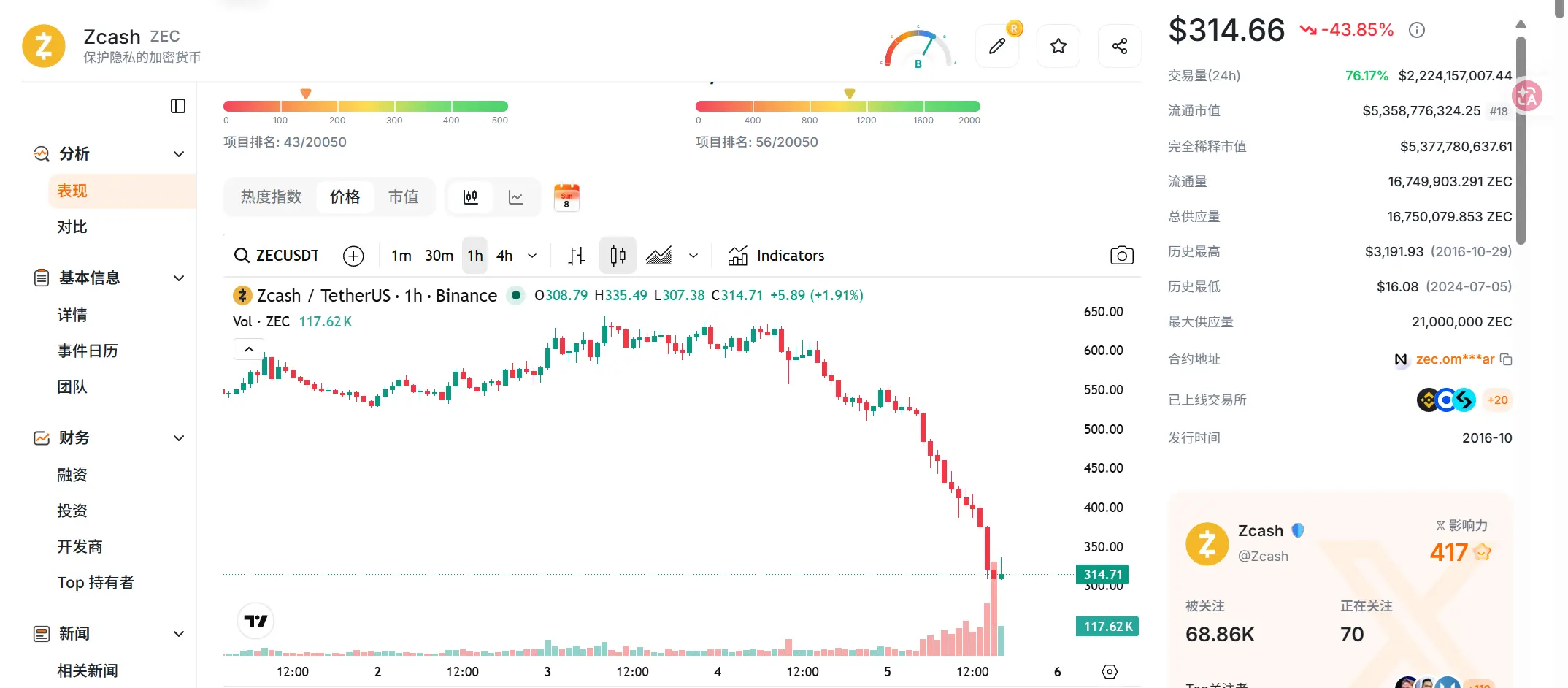
Image Source: RootData

The crash was triggered by a zero-knowledge proof vulnerability that had been latent for four years in Zcash's latest privacy transaction pool, Orchard. Theoretically, it allowed attackers to forge infinite ZEC under privacy protection, making detection extremely difficult.

The good news is the vulnerability was permanently fixed via a hard fork on June 3rd. The bad news is, due to the privacy features of the Orchard pool, no one can cryptographically prove that this vulnerability was never exploited over the past four years, leading to market doubts about ZEC's supply integrity during that period.

BitMEX co-founder Arthur Hayes announced he had liquidated all his ZEC holdings, on-chain whales profited handsomely from short positions, and market confidence was visibly shaken.

How the Vulnerability Arose and Was Discovered

The Orchard pool is Zcash's third-generation privacy transaction layer launched in May 2022. Due to insufficiently strict constraint conditions on one circuit element, attackers could input false values in elliptic curve multiplication operations yet still pass circuit verification, thereby generating unlimited forged ZEC within the pool. Because of Orchard's inherent privacy design, this forgery would leave no detectable on-chain trace.

The vulnerability was discovered by independent security researcher Taylor Hornby on May 29th. In April this year, the Zcash ecosystem independent security organization Shielded Labs had commissioned him to conduct a targeted security audit of the Zcash protocol, aiming to find potential vulnerabilities before attackers.

On May 28th, Anthropic released the Claude Opus 4.8 model. The next day, Hornby integrated it into his customized AI audit framework to conduct targeted analysis of the Orchard circuit, pinpointing the vulnerability that very day. He wrote a complete exploit program in a local test environment, verifying the technical feasibility of infinite minting. That evening, he responsibly disclosed the issue to the Zcash Open Developer Laboratory (ZODL).

ZODL engineers confirmed the vulnerability within hours and immediately activated emergency procedures. In the early hours of June 2nd, Zcash pushed an emergency soft fork via Zebra 4.5.3, temporarily disabling all Orchard transactions. On June 3rd, at 12:05 Beijing time, the mainnet completed the NU6.2 hard fork at block height 3,364,600, deploying the patched circuit and permanently closing the vulnerability.

From discovery to hard fork completion took about five days. The Zcash Foundation stated this was only the second time in Zcash's history since its 2016 launch that a protocol upgrade was triggered by a security issue. No known exploits occurred throughout the process, network total supply safeguarding mechanisms confirmed the total supply remained intact, and user privacy along with Sapling and transparent transactions were unaffected.
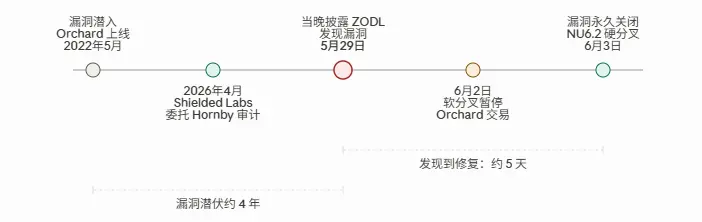
Image Source: Claude

After the Fix, Doubts Remain

Due to Orchard's privacy design, if an attacker never transfers forged tokens to the transparent pool, no existing mechanism can detect anomalies on-chain. This means the conclusion of an 'intact total supply' is based on currently observable data, not strict cryptographic proof. The vulnerability has existed since May 2022, and no one can rule out the possibility it was exploited over the past four years.

Shielded Labs believes the likelihood of exploitation is low, citing three reasons: the fact it remained undiscovered for four years indicates an extremely high technical barrier; its discovery resulted from a proactive targeted audit, not a passive exposure; and the short window from discovery to fix gave attackers very limited time to exploit. However, this very explanation itself shows the problem cannot be completely disproven.

To address this gap, Shielded Labs is collaborating with various developers to explore a new network upgrade proposal. The plan is to deploy a new privacy pool and enforce mandatory turnstile accounting scrutiny for all tokens migrating out of Orchard, allowing anyone to publicly verify supply integrity. The specific proposal is expected to be announced next week and will still need to go through community governance processes.

Crypto investor Simon Dedic pointed out that this event reveals two concurrent shifts in perception: privacy is not always an advantage; it can also be a risk in protocol design. The involvement of AI tools means vulnerabilities of similar scale can now be discovered with a lower barrier to entry, increasing the security audit pressure faced by the entire crypto industry.

On-chain analyst Haotian described the core issue of this event as 'unclearable.' Even if Shielded Labs introduces a new turnstile audit scheme, it can only prove the current supply is less than the total amount that entered the pool, still failing to cover potential historical hidden depreciation. He also noted the inherent contradiction between verifiable supply and privacy black boxes is a structural dilemma ZEC struggles to circumvent.

Concentrated Release of Market Panic

Although the technical crisis has passed, the market has not fully digested the true nature of the vulnerability.

This morning, Zcash founder Zooko Wilcox, Shielded Labs, and Taylor Hornby jointly published a detailed article comprehensively disclosing the exploitability of the vulnerability, the technical feasibility of infinite ZEC forgery, and the fact that 'cryptographic proof of historical non-exploitation is impossible' due to Orchard's privacy features, which truly ignited market panic.

On the same day, Arthur Hayes announced liquidating all his ZEC holdings, stating that while the probability of malicious minting is extremely low, it cannot be formally excluded at the cryptographic level. The value proposition of the privacy narrative demands 'perfect security,' not 'probable safety.' Hayes also indicated he might consider buying back at lower prices if subsequent assumptions are disproven.

Hayes was previously one of ZEC's most prominent public supporters, even listing it as his second-largest personal holding. He once stated ZEC should reach 10% of BTC's price, with the current rally 'having plenty of upside left.' His public departure now inevitably impacts market sentiment.

The combination of these two events caused ZEC's price to plummet rapidly. According to on-chain analyst monitoring, when ZEC fell below $400, the leveraged short position opened at $626.47 by 'insider whale' Garrett Jin resulted in floating profits reaching tens of millions of dollars.

However, some hold the view that the sharp price drop was not solely driven by the vulnerability. Crypto KOL OzLion pointed out that ZEC's previous rally already showed signs of large capital involvement. The vulnerability news might have merely provided an exit timing, with a massive influx of spot sell-offs on the day being a more direct price driver. He lamented that a 'strong-consensus blue-chip' with a $12 billion market cap losing $6 billion in a single day shows that building consensus in the crypto world is difficult, breaking it is easy, and repairing it is an even longer process.


Câu hỏi Liên quan

QWhat was the main event that triggered the price crash of ZEC on June 5th?

AThe main trigger was the public disclosure of a zero-knowledge proof vulnerability in the Orchard privacy pool, which theoretically allowed unlimited undetectable minting of ZEC for four years, severely damaging market confidence.

QWhat is the core dilemma highlighted by the ZEC incident regarding privacy features?

AThe incident highlights the inherent contradiction between verifiable supply integrity and the privacy features of 'black box' systems. While privacy is a core value proposition, it creates a scenario where past exploits or supply inflation cannot be cryptographically proven or disproven, undermining trust.

QHow did Arthur Hayes' actions impact the market following the vulnerability disclosure?

AArthur Hayes, a prominent public supporter of ZEC, announced he was liquidating his entire ZEC holdings. He stated that while the probability of malicious minting was low, it couldn't be cryptographically ruled out, and 'perfect security' is required for a privacy narrative. His departure significantly impacted market sentiment and contributed to the sell-off.

QWhat was the role of AI in the discovery and handling of the Zcash vulnerability?

ASecurity researcher Taylor Hornby integrated the newly released Claude Opus 4.8 AI model into a customized audit framework. This AI-assisted analysis targeted the Orchard circuit and located the critical vulnerability within a single day on May 29th, demonstrating how AI tools can lower the barrier for discovering complex vulnerabilities.

QWhat measures are being proposed to address the trust issue after the ZEC vulnerability was fixed?

AShielded Labs is exploring a new network upgrade proposal. The plan involves deploying a new privacy pool and implementing a mandatory 'revolving door' accounting review for all funds migrating out of the Orchard pool. This would allow public verification of supply integrity going forward, though it cannot retroactively prove the historical supply was untouched.

Nội dung Liên quan

Anthropic ra mắt 'mô hình mạnh nhất', nhưng đa số người dùng không thể tiếp cận

Vào tháng 4, Anthropic giới thiệu bản xem trước mô hình Mythos, không mở công khai do có khả năng khám phá lỗ hổng bảo mật mạnh mẽ. Đến tháng 6, họ chính thức ra mắt Fable 5 và Mythos 5, chia sẻ cùng một mô hình nền tảng nhưng có cách tiếp cận khác nhau: Mythos 5 bị hạn chế trong "Dự án Glasswing" dành cho các đối tác bảo mật, còn Fable 5 dành cho người dùng phổ thông với một bộ phân loại an toàn tự động chuyển sang mô hình cũ Opus 4.8 khi phát hiện yêu cầu nhạy cảm. Về hiệu suất, Fable 5 thể hiện sự vượt trội trong các bài kiểm tra kỹ thuật phần mềm như SWE-Bench Pro (80.3%) và FrontierCode Diamond (29.3%), cho thấy khả năng tạo mã chất lượng sản xuất và xử lý tác vụ dài tốt hơn. Tuy nhiên, cơ chế tự động hạ cấp đôi khi được kích hoạt quá mức, ảnh hưởng đến trải nghiệm. Đáng chú ý, Fable 5 có giá API đắt gấp đôi Opus 4.8 và từ ngày 23/6 sẽ bị loại khỏi gói đăng ký, buộc người dùng phải trả thêm phí theo lượng sử dụng. Động thái này được cho là nhằm sàng lọc người dùng cao cấp sẵn sàng trả giá cho công nghệ đỉnh cao, trong khi các mô hình Trung Quốc như DeepSeek lại giảm giá mạnh để mở rộng thị trường. Bài viết kết luận rằng ngành AI đang phân tầng: khả năng phổ thông sẽ ngày càng rẻ, trong khi công nghệ tiên phong sẽ đắt đỏ và chỉ dành cho những người dùng có nhu cầu và khả năng chi trả cao, giống như lộ trình phát triển của điện toán đám mây trước đây.

marsbit2 phút trước

Anthropic ra mắt 'mô hình mạnh nhất', nhưng đa số người dùng không thể tiếp cận

marsbit2 phút trước

Cardano Và 67,5 Triệu USD Bitcoin, Chuyện Gì Đã Xảy Ra Với 1.090 BTC?

Chuyên gia kiện tụng Thomas Braziel đã đặt câu hỏi với Tổ chức Cardano về số tiền 1.090 BTC (tương đương 67,5 triệu USD) mà tổ chức tiền nhiệm của nó, Tổ chức Isle of Man, được cho là đã nhận trước khi giải thể vào năm 2025. Các tài liệu cho thấy số Bitcoin này có liên quan đến đợt ICO của Cardano, nơi huy động được khoảng 108.000 BTC. Braziel chỉ ra rằng, tại thời điểm ICO diễn ra, chỉ có Tổ chức Isle of Man tồn tại với sự tham gia của nhà sáng lập Charles Hoskinson và những người khác. Ông nêu lên các vấn đề về quản trị, khi phần lớn ADA và số Bitcoin huy động được từ ICO sau đó được phân bổ cho các thực thể phát triển vì lợi nhuận có liên quan. Braziel thắc mắc ai là người đàm phán các thỏa thuận này thay mặt những người tham gia ICO và cách đánh giá sự công bằng khi cùng một nhóm người vừa quản lý Quỹ vừa kiểm soát các thực thể nhận lợi ích. Ông nhấn mạnh không cáo buộc hành vi sai trái mà chỉ yêu cầu Tổ chức Cardano giải trình số phận của 1.090 BTC và liệu đã có các đánh giá độc lập hay biện pháp bảo vệ người tham gia ICO hay không. Trong bối cảnh này, giá ADA đang giao dịch quanh mức 0,16 USD.

bitcoinist4 giờ trước

Cardano Và 67,5 Triệu USD Bitcoin, Chuyện Gì Đã Xảy Ra Với 1.090 BTC?

bitcoinist4 giờ trước

Giao dịch

Giao ngay
Hợp đồng Tương lai

Bài viết Nổi bật

Làm thế nào để Mua ZEC

Chào mừng bạn đến với HTX.com! Chúng tôi đã làm cho mua Zcash (ZEC) trở nên đơn giản và thuận tiện. Làm theo hướng dẫn từng bước của chúng tôi để bắt đầu hành trình tiền kỹ thuật số của bạn.Bước 1: Tạo Tài khoản HTX của BạnSử dụng email hoặc số điện thoại của bạn để đăng ký tài khoản miễn phí trên HTX. Trải nghiệm hành trình đăng ký không rắc rối và mở khóa tất cả tính năng. Nhận Tài khoản của tôiBước 2: Truy cập Mua Crypto và Chọn Phương thức Thanh toán của BạnThẻ Tín dụng/Ghi nợ: Sử dụng Visa hoặc Mastercard của bạn để mua Zcash (ZEC) ngay lập tức.Số dư: Sử dụng tiền từ số dư tài khoản HTX của bạn để giao dịch liền mạch.Bên thứ ba: Chúng tôi đã thêm những phương thức thanh toán phổ biến như Google Pay và Apple Pay để nâng cao sự tiện lợi.P2P: Giao dịch trực tiếp với người dùng khác trên HTX.Thị trường mua bán phi tập trung (OTC): Chúng tôi cung cấp những dịch vụ được thiết kế riêng và tỷ giá hối đoái cạnh tranh cho nhà giao dịch.Bước 3: Lưu trữ Zcash (ZEC) của BạnSau khi mua Zcash (ZEC), lưu trữ trong tài khoản HTX của bạn. Ngoài ra, bạn có thể gửi đi nơi khác qua chuyển khoản blockchain hoặc sử dụng để giao dịch những tiền kỹ thuật số khác.Bước 4: Giao dịch Zcash (ZEC)Giao dịch Zcash (ZEC) dễ dàng trên thị trường giao ngay của HTX. Chỉ cần truy cập vào tài khoản của bạn, chọn cặp giao dịch, thực hiện giao dịch và theo dõi trong thời gian thực. Chúng tôi cung cấp trải nghiệm thân thiện với người dùng cho cả người mới bắt đầu và người giao dịch dày dạn kinh nghiệm.

Tổng lượt xem 414Xuất bản vào 2024.12.12Cập nhật vào 2026.06.02

Làm thế nào để Mua ZEC

Thảo luận

Chào mừng đến với Cộng đồng HTX. Tại đây, bạn có thể được thông báo về những phát triển nền tảng mới nhất và có quyền truy cập vào thông tin chuyên sâu về thị trường. Ý kiến ​​của người dùng về giá của ZEC (ZEC) được trình bày dưới đây.

活动图片