Goldman Sachs Research Report Analysis: Chip Shortage to Persist Until 2028, Maintain Buy Recommendations

marsbitXuất bản vào 2026-06-01Cập nhật gần nhất vào 2026-06-01

Tóm tắt

Goldman Sachs Research Report Summary: Memory Shortage Until 2028, Maintain Buy Recommendations Goldman Sachs' latest Asia-Pacific equities report, "The 720," forecasts a sustained memory chip upcycle extending into 2028, driven by strong AI server demand visibility, limited supply growth, and binding long-term agreements. The firm believes the market significantly underestimates the cycle's duration, as evidenced by low P/E ratios for memory stocks. Key sector calls include raising 12-month price targets for Samsung Electronics and SK Hynix, and upgrading Kioxia from Hold to Buy, citing higher and more sustainable peak profits over the next 2-3 years. The report also highlights the broader AI hardware supply chain benefiting from hyperscaler capex acceleration. Recommendations include: * MediaTek (Buy) for its data center/ASIC pivot. * Eoptolink (Buy) on 1.6T optical module ramp-up. * Biren (Buy) for its AI chip migration. * Huaqin (Buy, newly covered) for its shift from consumer electronics ODM to AI data centers. * Lenovo (Buy) on the AI PC refresh cycle. Other notable mentions include China property developers (under an optimistic scenario), BYD for its affordable city NOA strategy, and select Japanese semiconductor equipment makers. A macro theme notes the divergence between AI-boom beneficiaries (e.g., Korea, Taiwan) and energy-importing economies facing inflationary pressure. The report concludes with standard disclaimers, noting that price targets are f...

Author: Tidal Research

On June 1st, Goldman Sachs released its daily Asia-Pacific stock summary, "The 720," featuring a long list of names on the cover including Samsung, SK Hynix, Kioxia, MediaTek, Lenovo, and BYD. It appears to be a comprehensive shopping list, but a closer read reveals its absolute core: memory chips.
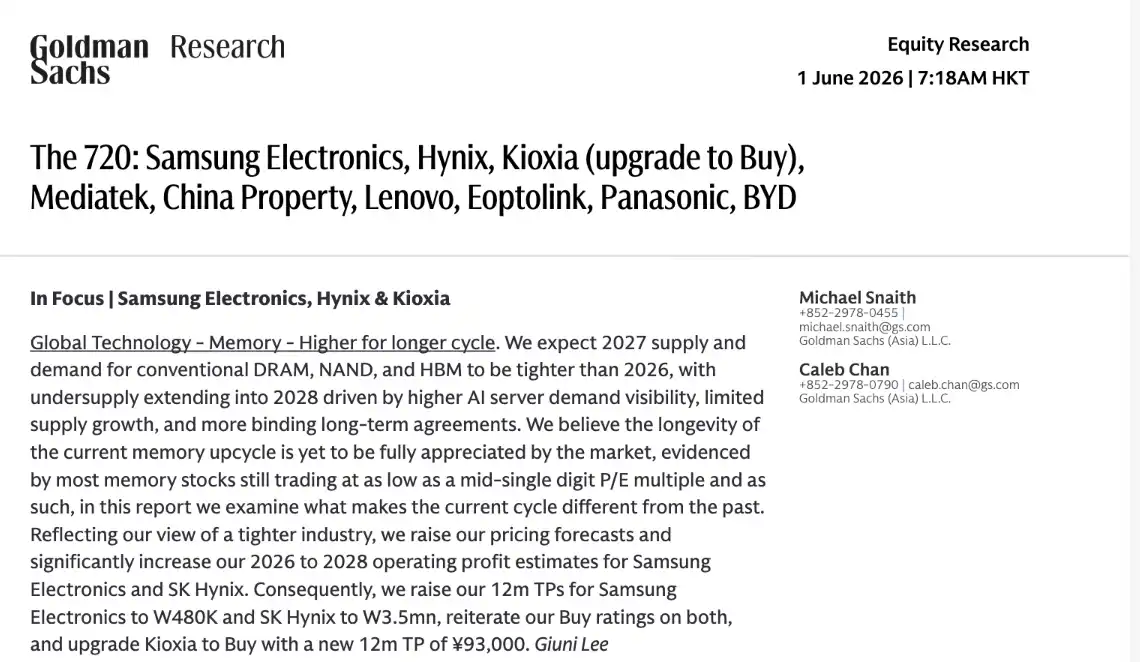
One of the most significant judgments in this Goldman Sachs report is that the current memory upcycle "will last longer" (higher for longer), with the shortage expected to persist all the way until 2028, a length vastly underestimated by the market. The evidence lies in valuations: most memory stocks are still trading at mid-single-digit price-to-earnings ratios, as if the market believes this is just another ordinary cyclical rebound, but Goldman Sachs sees it differently.

Below, we break it down by importance, concluding with a quick-reference table of targets.

Main Event: Memory Shortage to Last Until 2028, Three Companies Collectively Upgraded

Goldman Sachs compares this cycle to past ones and concludes this time is different. The reasons are threefold: higher visibility of AI server demand, limited supply growth, and increasingly firm long-term supply agreements (locking in orders and prices). Combined, these factors suggest that DRAM, NAND, and HBM supply-demand will be even tighter in 2027 than in 2026, with shortages extending into 2028.

The most intuitive evidence is Goldman's DRAM supply-demand chart. Negative numbers represent supply shortage; the deeper the deficit, the stronger the price support. Goldman has now revised its forecasts for 2026 to 2028 deeper into shortage territory. Specifically, the 2027 forecast was revised from an earlier -2.5% to -5.9%, more than doubling. In plain language: Goldman believes memory manufacturers will face increasing shortages in the next few years, meaning price increases can be sustained longer.

Regarding specific companies, three were collectively adjusted:

  • Samsung Electronics: 12-month price target raised to 480,000 KRW, Buy rating maintained.
  • SK Hynix: 12-month price target raised to 3.5 million KRW, Buy rating maintained.
  • Kioxia: Upgraded from Neutral to Buy, new price target set at 9,300 JPY.

Kioxia is the only rating upgrade in this report, and Goldman's logic is worth noting separately: it believes the profit peak of this cycle is higher than previously anticipated and can be maintained for two to three years, rather than surging and then falling back quickly. Based on this, Goldman has raised its operating profit forecasts for Kioxia for fiscal years 2027 to 2029 by 16% to 48% in one go and expects gross margins to remain at a high level around 80%. Predicting three years of sustainably high profits for a company in the strongly cyclical memory business is a very strong statement.

AI Computing Chain "Full Package": From Chips to Optical Modules to Data Centers

Beyond memory, this report touches upon nearly the entire AI hardware supply chain in China and Asia, unified by one main thread: global cloud hyperscaler capital expenditures are accelerating, and money is flowing down this chain.

  • MediaTek: Buy, price target set at 5,000 TWD. The highlight is its transition from mobile chips to data centers and custom ASICs (AI chips tailor-made for specific clients). The company's target is to achieve $2 billion in data center/AI ASIC revenue by 2026 and capture a 10% to 15% share of the $70-80 billion ASIC market by 2027.
  • Eoptolink: Buy, price target raised to 841 RMB. It manufactures optical modules, critical components for high-speed data transmission in AI data centers. Goldman is bullish on its 1.6T optical modules ramping up starting Q2 and accelerating in the second half, along with capacity expansion in Thailand. It raised profit forecasts for 2027 and 2028 by 5% and 6%, respectively.
  • Biren: Buy, price target raised to 70.7 HKD. A domestic Chinese AI chip manufacturer, its Bili166 product has received a first-tier security and reliability rating. Goldman expects it to turn profitable by 2027 as its product portfolio migrates to higher-performance, more expensive AI chips. Revenue forecasts for 2026 to 2030 were raised by 4% to 28%.
  • Huaqin: Buy, a newly covered target in this report. A-share price target set at 149 RMB, with simultaneous first-time coverage of its H-shares, target set at 127.76 HKD. The logic is its move from consumer electronics ODM into AI data centers, with expected revenue CAGR of 32% from 2025 to 2027.
  • Data Center Duo: GDS maintains Buy rating, but its ADR target is lowered to $49 (due to slower move-in rates, lower monthly service revenue, partially offset by higher valuation for overseas DayOne business); VNET maintains Buy rating, target raised to $16 (due to Q1 earnings beat, strong execution of capacity ramp-up, and removal of strategic investor overhang).
  • Lenovo: Buy, price target raised from 27 HKD to 31 HKD. The bet is on the AI PC refresh cycle. Goldman expects its notebook market share to expand to 28% by 2028, with AI notebook penetration reaching 66%, lifting overall average selling prices. Its profit forecasts for Lenovo's FY2027 and FY2028 are 22% and 25% higher than the Bloomberg consensus, indicating significant divergence.

Stocks Mentioned Outside the AI Main Theme

  • Chinese Real Estate (COLI, CR Land): Goldman is assessing the sustainability of the recent real estate sector rebound. It assumes an optimistic scenario where 15 key cities follow Shanghai and Shenzhen's property price recovery, leading to a 15% price increase by the end of 2028. Under this premise, it estimates cash profits for COLI and CR Land could expand by over 30% and over 50%, respectively, by 2028. Using a sum-of-the-parts valuation, Goldman suggests further upside potential of 52% for COLI and 76% for CR Land, maintaining a positive view on these stronger state-owned developers. Key point: this calculation is based on an optimistic assumption, not the base case forecast.
  • BYD: Buy, price target set at 137 RMB / 134 HKD. The highlight is its "Tianshen Eye B" City Navigation Guided Pilot (City NOA) becoming a 12,000 RMB option across its lineup at its Intelligent Driving Strategy Conference, making its entry-level City NOA-equipped model the cheapest in China at 78,800 RMB. It also unveiled its first self-developed 4nm intelligent driving chip, "Xuánjī A3," which is already in mass production. Goldman believes these engineering capabilities can boost high-end intelligent driving penetration, lower costs, and improve margins.
  • Japanese Semiconductor Equipment: Goldman maintains Buy ratings on Lasertec, Ebara, Disco, and Tokyo Electron. The only contrarian move was downgrading vacuum equipment manufacturer Ulvac (6728.T) from Buy to Neutral, lowering the target to 9,400 JPY, citing weak high-margin power semiconductor orders and slower-than-expected gross margin expansion.
  • Panasonic HD: Buy, price target raised from 4,000 JPY to 4,220 JPY, bullish on generative AI-related businesses (backup power, copper-clad laminate CCL, high-performance capacitors).
  • NTT: Buy, price target slightly raised from 176 JPY to 179 JPY, focusing on domestic IT service demand and the safety margin provided by a shareholder total return rate of around 5%.

A Macro Theme: AI Boom Clashes with Energy Crisis

Stringing together the individual stocks is Goldman's macro judgment: Emerging markets are being pulled in two by two opposing forces. On one side is the AI investment boom, and on the other is energy supply contraction due to the blockade of the Strait of Hormuz.

Tech-exporting economies like South Korea and Taiwan benefit from surging exports and current account surpluses; while energy-importing countries face rising inflation, weaker currencies, and fuel subsidies straining their finances. Goldman expects the Q4 average Brent crude price to be $90/barrel, continuing pressure on heavily oil-import-dependent economies. It recommends overweighting stocks in China, South Korea, Brazil, and South Africa. This line connects with the recent macro background of the Iran situation and oil prices.

Two other points directly affecting A-share capital flows:

Chinese imports surged 23.6% year-on-year in the first four months of this year, but Goldman believes this is a highly concentrated phenomenon, with gold and semiconductors accounting for about 65% of the import growth increment, not indicative of a continuous worsening of the external balance.

Regarding the CSI and CNI index semi-annual rebalancing, Goldman estimates it will trigger over $48 billion in two-way passive fund flows. The technology hardware & semiconductor and capital goods sectors are expected to see the largest inflows (approximately $3.1 billion and $1.4 billion, respectively), while healthcare and banks see the largest outflows. Newly added constituents "expected to receive the largest net passive inflows" include Huagong Tech, Yuanjie Tech, Huahong Semiconductor, GigaDevice, VeriSilicon, etc. For index rebalancing arbitrage funds, this is a clear signal.

Finally, as usual, Goldman left an Easter egg: 2026 World Cup winning probability forecast: Spain leads at 26%, followed by France at 19%, Argentina at 14%, Brazil at 8%, and England at 5%. The model penalized the defending champion Argentina; take it as a bit of fun.

Quick Reference Table of Targets
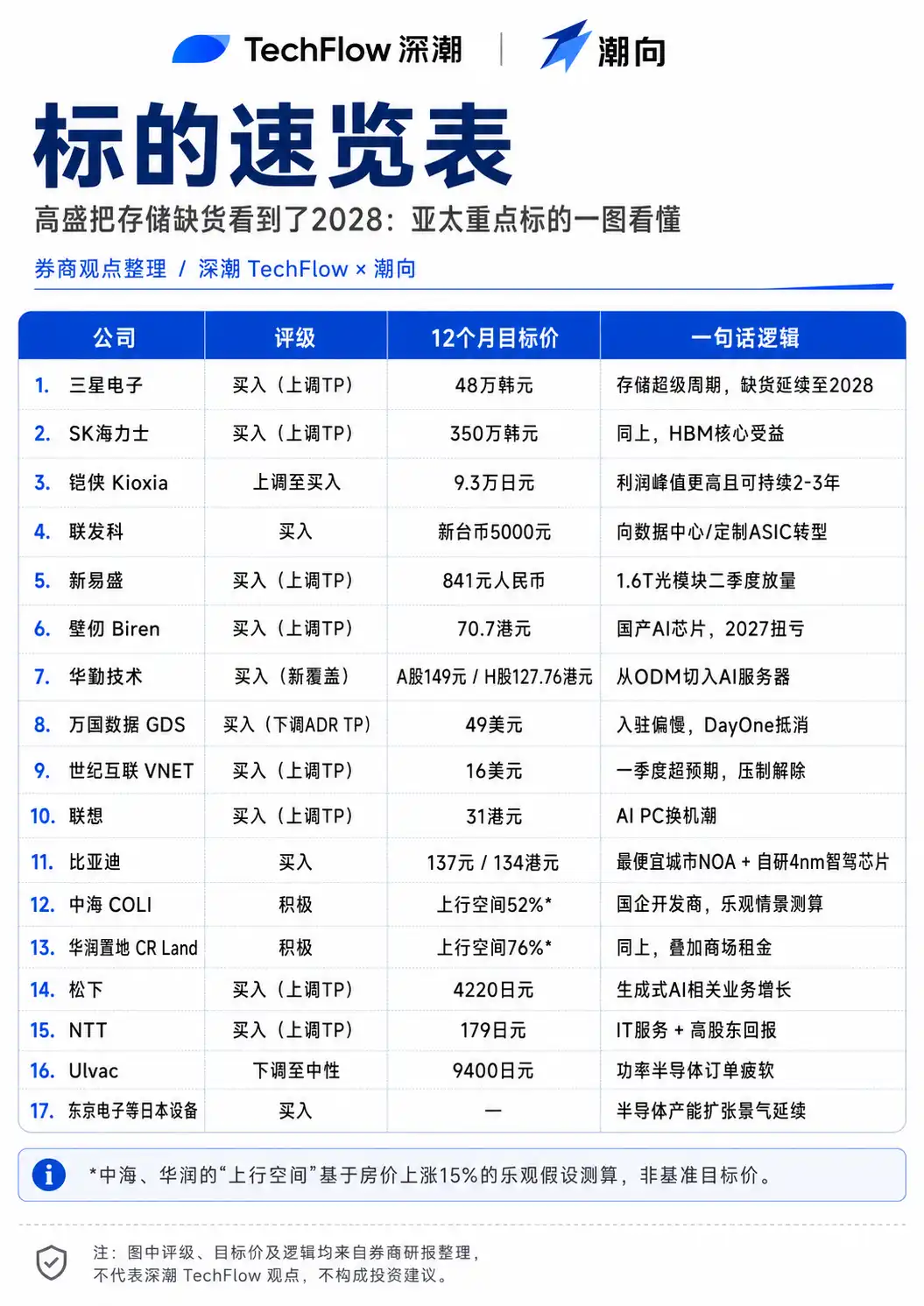
This article is TechFlow's compilation and interpretation of a third-party brokerage research report. The ratings, price targets, profit forecasts, and related judgments cited herein represent the views of the report's analysts and their affiliated institutions only. They do not represent the views of TechFlow and do not constitute any investment advice.

Please note the following three points when reading:

1. Price targets are analysts' expectations for a future period (typically 12 months). They are forecasts, not promises, and are subject to frequent adjustment based on company performance and market conditions.

2. Sell-side research reports are inherently bullish. It is common for brokerages to issue "Buy" ratings on covered companies, and some covered companies may have investment banking or other business relationships with the brokerage. A list predominantly featuring "Buy" ratings should be read with this inherent bias in mind.

3. The value of a research report lies in its mainline logic and the underlying assumptions it depends on, not any single price target. The logic for related targets holds only if the main theme holds; if the main theme is disproven, the entire chain of targets will come loose together. Focus on the logic, not just the price.

Markets involve risks; decisions should be made independently. This article should not be used as the basis for buying or selling any securities.
Câu hỏi Liên quan

QAccording to the Goldman Sachs report, what is the core reason for the prolonged shortage in the memory chip sector until 2028?

AThe report cites three core reasons: higher visibility of AI server demand, limited supply growth, and increasingly binding long-term supply agreements (LTA) that lock in orders and prices. The combination of these factors leads to a projected tighter supply-demand situation for DRAM, NAND, and HBM in 2027 than in 2026, extending the shortage into 2028.

QWhich memory company received a rating upgrade from Goldman Sachs in this report, and what was the key rationale?

AKioxia received a rating upgrade from Neutral to Buy. The key rationale is Goldman Sachs' belief that the profit peak in this cycle will be higher and more sustainable than previously thought, lasting two to three years. Consequently, they significantly raised Kioxia's operating profit forecasts for FY2027 to FY2029 by 16% to 48% and expect its gross margin to remain around a high level of 80%.

QWhat is the primary macro theme Goldman Sachs uses to connect the various stock recommendations in the report?

AThe primary macro theme is that emerging markets are being pulled in two opposite directions. On one side is the AI investment boom, benefiting tech-exporting economies. On the other side is energy supply contraction due to the blockade of the Strait of Hormuz, which pressures energy-importing countries with higher inflation, weaker currencies, and strained finances. This leads to a recommended overweight stance on stocks in China, South Korea, Brazil, and South Africa.

QBesides memory chips, what other major sector or theme did Goldman Sachs focus on for its stock recommendations, and name one related company.

ABesides memory chips, Goldman Sachs focused extensively on the AI compute hardware supply chain. One related company is MediaTek. The report highlights its transition from mobile chips to data centers and custom AI ASICs, with a company target of $2 billion in data center/AI ASIC revenue in 2026 and aiming for a 10%-15% share of the $70-80 billion ASIC market by 2027.

QWhat important disclaimer does the article provide regarding the investment ratings and target prices mentioned from the Goldman Sachs report?

AThe article states that the ratings, target prices, profit forecasts, and related judgments cited are solely the views of the Goldman Sachs analysts and represent the position of their institution. They do not represent the views of the publishing platform (Shenchao TechFlow) and do not constitute any investment advice. It reminds readers that target prices are predictions subject to change, that sell-side research has a natural bullish bias, and that the value lies in the core logic and its underlying assumptions, not just the price targets.

Nội dung Liên quan

a16z chuyển hướng toàn cầu hóa: VC đang trở thành "động lực thúc đẩy" của liên minh công nghệ Mỹ

Biên tập: Thông báo của Ben Horowitz cho thấy một bước chuyển quan trọng trong chiến lược toàn cầu hóa của a16z: họ không chỉ tìm kiếm dự án ở nước ngoài hay mở rộng đầu tư quốc tế, mà còn đặt mình vào khuôn khổ cạnh tranh công nghệ và hợp tác đồng minh rộng lớn hơn. Trong bối cảnh AI, robot, công nghệ quốc phòng, an ninh mạng và tái cấu trúc chuỗi cung ứng trở thành trọng tâm cạnh tranh quốc gia, con đường quốc tế hóa của startup trở nên phức tạp hơn. A16z đang phản ứng với sự thay đổi này thông qua việc thành lập văn phòng Tokyo, bổ nhiệm Anne Neuberger phụ trách các vấn đề toàn cầu, và nâng cấp nhóm quan hệ nhà đầu tư thành nhóm đối tác toàn cầu. Tín hiệu quan trọng nhất là a16z gắn kết mạng lưới toàn cầu của mình với năng lực lãnh đạo công nghệ của "Mỹ và các đồng minh". Đối với a16z, mạng lưới đầu tư mạo hiểm trong tương lai không chỉ giúp nhà sáng lập gọi vốn, tuyển dụng, bán hàng mà còn hỗ trợ họ tiếp cận thị trường trọng điểm, kết nối với chính phủ và các tổ chức chiến lược, cũng như hiểu rõ môi trường chính sách và quy định của các quốc gia khác nhau. Điều này có nghĩa vai trò của các tổ chức đầu tư mạo hiểm hàng đầu đang được định nghĩa lại. Họ không còn chỉ là trung gian vốn, mà là người tổ chức kết nối công ty khởi nghiệp, năng lực quốc gia, nguồn lực ngành, hệ thống đồng minh và vốn toàn cầu. Chiến lược toàn cầu hóa lần này của a16z có thể được xem như một sự chủ động định vị của vốn Silicon Valley trong cuộc cạnh tranh công nghệ toàn cầu mới.

marsbit8 phút trước

a16z chuyển hướng toàn cầu hóa: VC đang trở thành "động lực thúc đẩy" của liên minh công nghệ Mỹ

marsbit8 phút trước

Kalshi, MTS và Tham vọng của a16z

Bài viết phân tích tầm quan trọng của thị trường dự đoán (prediction markets), tập trung vào Kalshi, và tầm nhìn của quỹ đầu tư mạo hiểm a16z trong việc xây dựng một đế chế truyền thông mới. Tác giả điểm qua lịch sử tư tưởng đằng sau thị trường dự đoán, từ lý thuyết của Hayek về việc thị trường tổng hợp tri thức phân tán, đến cơ chế khuyến khích của Robin Hanson (LMSR) và ý tưởng "Futarchy". Trọng tâm bài viết là việc a16z đầu tư mạnh vào Kalshi (định giá 220 tỷ USD) và cách họ diễn giải giá trị cốt lõi của nó: mang lại "cảm giác hiện diện" (presence). Trong một thế giới mà con người ngày càng thụ động và xa cách với thực tại, thị trường dự đoán cho phép họ tham gia tích cực bằng cách dùng tiền thật để đặt cược vào các sự kiện, từ đó cảm thấy mình là người quan sát và dự báo lịch sử. a16z coi đây là mảnh ghép quan trọng cho tham vọng "truyền thông mới" của họ - một hệ thống toàn diện từ định hình narrative, tài trợ sản phẩm, đến tiếp cận khách hàng với tốc độ cực cao, nhằm "tiếp quản dòng thời gian". Công ty truyền thông MTS (Monitoring The Situation) là một ví dụ điển hình cho triết lý này. Bài viết kết luận rằng sức mạnh thực sự của Kalshi và thị trường dự đoán nằm ở "trường lực bẻ cong hiện thực" - khả năng định nghĩa tính xác thực và tầm quan trọng của sự kiện thông qua khối lượng giao dịch bằng tiền thật, từ đó giành được quyền giải thích tối cao về tương lai, một thứ quyền lực hiếm khi nằm trong tay một công ty tư nhân.

链捕手12 phút trước

Kalshi, MTS và Tham vọng của a16z

链捕手12 phút trước

Giải mã sự thật về thương mại, thanh toán và cơ sở hạ tầng cho Agent

Tác giả, có kinh nghiệm xây dựng cơ sở hạ tầng cho nền kinh tế Agent trong một năm, chia sẻ những hiểu biết thực tế về thương mại, thanh toán và cơ sở hạ tầng Agent. **Thực trạng nhu cầu:** Nhu cầu thực sự từ người dùng cuối hiện còn rất hạn chế. Các số liệu từ Stripe, Visa, Coinbase cho thấy khối lượng giao dịch thực tế qua Agent còn rất nhỏ, chủ yếu là giao dịch thử nghiệm. Các doanh nghiệp tham gia chủ yếu vì lo ngại bị bỏ lại phía sau (tối ưu hóa cho Agent - AEO), chứ không phải do nhu cầu cấp thiết hiện tại. **Phân tích bốn lĩnh vực:** 1. **Agent với Người mua (B2C):** Trải nghiệm mua sắm qua chat kém hơn giao diện thị giác truyền thống cho hầu hết mặt hàng. Cơ hội tồn tại trong các giao dịch tần suất cao, ít cần quyết định (như đặt đồ ăn) hoặc ở những website có UI phức tạp, nhưng bị cản trở bởi chi phí, thiếu API mở và thách thức trong phân phối đến người dùng phổ thông. 2. **Agent với API (Thanh toán vi mô):** Nhu cầu thanh toán tức thời cho API là có thật, nhưng thị trường chủ yếu là dài hạn và các nhà cung cấp SaaS lớn thích mô hình hợp đồng doanh nghiệp. Các giải pháp tiền mã hóa phù hợp với thị trường ngách này, nhưng quy mô nhỏ và đối tượng nhà phát triển thường ít sẵn sàng chi trả. 3. **Agent với Agent (M2M):** Đây là tầm nhìn dài hạn hứa hẹn khối lượng giao dịch khổng lồ với tốc độ cao, nhưng hiện chưa có khối lượng thực tế đáng kể. Đây là một cuộc đặt cược dài hạn về cơ sở hạ tầng thanh toán chuyên dụng. 4. **Agent với Tài chính:** Đây là lĩnh vực có nhu cầu thực sự và sẵn sàng chi trả ngay hiện tại, từ quản lý quỹ đến DeFi. Tuy nhiên, thách thức nằm ở môi trường cạnh tranh khốc liệt với các định chế tài chính lớn đã có sẵn quan hệ khách hàng và nền tảng tuân thủ. **Điểm mấu chốt thực sự:** Vấn đề cốt lõi không chỉ là thanh toán. Thanh toán chỉ là một phần của quá trình "thanh toán bù trừ", bản thân nó lại chỉ là một phần của bài toán lớn hơn: **sự phối hợp** giữa Agent và con người, xác minh công việc và tính toán kết quả. Các công ty giải quyết được vấn đề phối hợp quy mô lớn sẽ chiếm lĩnh thị trường, chứ không phải ngược lại. Các công ty khởi nghiệp cần tìm thị trường thực sự hiện tại, thay vì chờ đợi tương lai.

marsbit12 phút trước

Giải mã sự thật về thương mại, thanh toán và cơ sở hạ tầng cho Agent

marsbit12 phút trước

Thị trường chứng khoán Mỹ hứng chịu đợt lao dốc tồi tệ nhất từ năm 2025, ba ngòi nổ kích hoạt đánh giá lại định giá cổ phiếu công nghệ

Ngày 5/6, thị trường chứng khoán Mỹ trải qua một ngày sụt giảm mạnh nhất kể từ sau cuộc khủng hoảng thuế quan tháng 4/2025. Chỉ số Nasdaq Composite lao dốc 4,18%, S&P 500 giảm 2,64% và Dow Jones mất 695 điểm. Sự đảo chiều đột ngột này chỉ sau 48 giờ được thúc đẩy bởi ba yếu tố chính. **Thứ nhất: Báo cáo tài chính của Broadcom làm rạn nứt câu chuyện AI.** Dù doanh thu chip AI của Broadcom tăng 143%, nhưng dự báo cho quý tới thấp hơn kỳ vọng, làm dấy lên lo ngại tốc độ tăng trưởng AI có thể đang chậm lại. Điều này kích hoạt đợt bán tháo trên toàn ngành bán dẫn. **Thứ hai: Dữ liệu việc làm Mỹ quá mạnh.** Báo cáo phi nông nghiệp tháng 5 cho thấy 172.000 việc làm mới, gấp đôi dự báo, củng cố kỳ vọng Cục Dự trữ Liên bang (Fed) có thể không giảm lãi suất mà thậm chí còn tăng. Kỳ vọng lãi suất cao hơn gây áp lực lên định giá cổ phiếu công nghệ. **Thứ ba: Bóng ma lạm phát từ cuộc chiến Iran.** Giá dầu duy trì trên 90 USD/thùng do tình hình căng thẳng leo thang từ tháng 2 tiếp tục đè nặng lên áp lực lạm phát, khiến công cụ chính sách của Fed trở nên phức tạp hơn. Ba yếu tố trên cùng lúc làm suy yếu niềm tin vào các câu chuyện thị trường then chốt: tăng trưởng AI vô hạn, Fed sắp cắt giảm lãi suất và lạm phát đã được kiểm soát. Sự sụt giảm nhanh chóng lan rộng sang thị trường toàn cầu. Đây có thể là một đợt điều chỉnh định giá lại đối với các cổ phiược được định giá quá cao, chứ chưa hẳn là sự kết thúc của câu chuyện AI. Hướng đi tiếp theo của thị trường sẽ phụ thuộc vào cuộc họp sắp tới của Fed, các báo cáo tài chính từ các công ty AI khác và diễn biến tình hình địa chính trị.

marsbit4 giờ trước

Thị trường chứng khoán Mỹ hứng chịu đợt lao dốc tồi tệ nhất từ năm 2025, ba ngòi nổ kích hoạt đánh giá lại định giá cổ phiếu công nghệ

marsbit4 giờ trước

Giao dịch

Giao ngay
Hợp đồng Tương lai

Bài viết Nổi bật

Làm thế nào để Mua CHIP

Chào mừng bạn đến với HTX.com! Chúng tôi đã làm cho mua USD.AI (CHIP) trở nên đơn giản và thuận tiện. Làm theo hướng dẫn từng bước của chúng tôi để bắt đầu hành trình tiền kỹ thuật số của bạn.Bước 1: Tạo Tài khoản HTX của BạnSử dụng email hoặc số điện thoại của bạn để đăng ký tài khoản miễn phí trên HTX. Trải nghiệm hành trình đăng ký không rắc rối và mở khóa tất cả tính năng. Nhận Tài khoản của tôiBước 2: Truy cập Mua Crypto và Chọn Phương thức Thanh toán của BạnThẻ Tín dụng/Ghi nợ: Sử dụng Visa hoặc Mastercard của bạn để mua USD.AI (CHIP) ngay lập tức.Số dư: Sử dụng tiền từ số dư tài khoản HTX của bạn để giao dịch liền mạch.Bên thứ ba: Chúng tôi đã thêm những phương thức thanh toán phổ biến như Google Pay và Apple Pay để nâng cao sự tiện lợi.P2P: Giao dịch trực tiếp với người dùng khác trên HTX.Thị trường mua bán phi tập trung (OTC): Chúng tôi cung cấp những dịch vụ được thiết kế riêng và tỷ giá hối đoái cạnh tranh cho nhà giao dịch.Bước 3: Lưu trữ USD.AI (CHIP) của BạnSau khi mua USD.AI (CHIP), lưu trữ trong tài khoản HTX của bạn. Ngoài ra, bạn có thể gửi đi nơi khác qua chuyển khoản blockchain hoặc sử dụng để giao dịch những tiền kỹ thuật số khác.Bước 4: Giao dịch USD.AI (CHIP)Giao dịch USD.AI (CHIP) dễ dàng trên thị trường giao ngay của HTX. Chỉ cần truy cập vào tài khoản của bạn, chọn cặp giao dịch, thực hiện giao dịch và theo dõi trong thời gian thực. Chúng tôi cung cấp trải nghiệm thân thiện với người dùng cho cả người mới bắt đầu và người giao dịch dày dạn kinh nghiệm.

Tổng lượt xem 396Xuất bản vào 2026.04.21Cập nhật vào 2026.06.02

Làm thế nào để Mua CHIP

Thảo luận

Chào mừng đến với Cộng đồng HTX. Tại đây, bạn có thể được thông báo về những phát triển nền tảng mới nhất và có quyền truy cập vào thông tin chuyên sâu về thị trường. Ý kiến ​​của người dùng về giá của CHIP (CHIP) được trình bày dưới đây.

活动图片