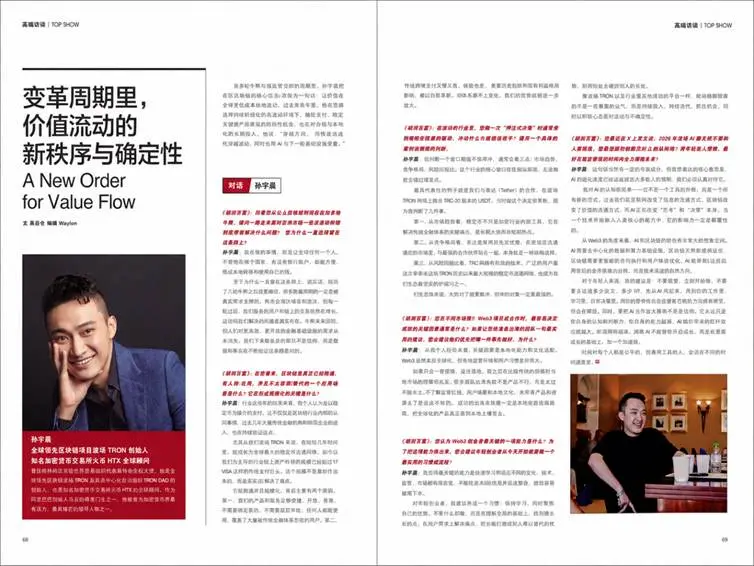
Hurun Report Interview with Justin Sun: New Paradigm of Value Circulation in the Web3 Transformation Cycle

链捕手Xuất bản vào 2026-05-29Cập nhật gần nhất vào 2026-05-29

Tóm tắt

In an interview with *Hurun Report*, Justin Sun, founder of TRON, discussed the evolution of the Web3 industry as it transitions from early-stage exploration to large-scale adoption. He emphasized that the fundamental goal of blockchain technology is to build an open and inclusive internet of value, enabling low-cost, efficient fund transfer for anyone globally, regardless of location or access to banking. Sun highlighted stablecoins as the most mature and scalable application within Web3, noting that TRON has grown into one of the world's largest stablecoin networks, with over $86.3 billion in USDT circulation. He attributed this growth to genuine user demand in cross-border payments and daily transactions, reflecting a structural shift where blockchain's openness and efficiency are naturally supplementing traditional financial systems. Regarding strategy, Sun outlined a framework combining data-driven iteration, rapid execution, and user-centricity. He pointed to TRON's partnership with Tether for TRC-20 USDT as a key decision that leveraged market trends and network effects to build a competitive moat. He also stressed the importance of globalization, noting that success in different markets depends on deep local compliance, cultural adaptation, and partnership networks. Sun expressed strong interest in the convergence of AI and blockchain, viewing AI as a transformative force that can enhance blockchain's intelligence and user experience, while blockchain provides dece...

Against the backdrop of the Web3 industry entering a deep-water zone and the accelerated global restructuring of financial infrastructure, blockchain is transitioning from early exploration to large-scale application. As an authoritative institution with extensive influence in business and investment, an in-depth interview by the renowned magazine, Hurun Report, is regarded as a significant industry barometer. Recently, Justin Sun, founder of TRON, in an exclusive interview with Hurun Report, systematically elaborated his judgment on industry evolution and long-term value around core issues such as stablecoin payments, globalization path, and AI integration trends. His views also reflect the critical stage where Web3 infrastructure is moving from "feasibility verification" to "global adoption".
Stablecoins Building a Global Value Circulation Network, Web3 Infrastructure Enters Scaling Phase

In the interview with Hurun Report, Justin Sun summarized the core goal he has long been committed to in extremely concise terms: "To enable any person in the world, regardless of location or whether they have a bank account, to transfer and use their funds at low cost and high efficiency." This statement fundamentally reveals the value essence of blockchain technology — constructing an open and inclusive value internet.

He further pointed out that after the blockchain industry has gone through multiple bull and bear cycles, projects truly capable of weathering these cycles must be built upon real demand and practical usage. The continuous growth of on-chain user scale and transaction volume is an important basis for his judgment of industry direction. In this context, the on-chain payment system centered around stablecoins has become the most mature and capable application scenario for scaling currently.

In the Hurun Report interview, Justin Sun mentioned that TRON has rapidly developed into one of the world's largest stablecoin circulation networks, with its on-chain asset transfer volume even surpassing that of some traditional payment networks. This growth is not driven by short-term market sentiment but based on the continuous use by real users in scenarios such as cross-border transfers, value storage, and daily payments. Official data shows that the current circulation of USDT on the TRON chain has exceeded $86.3 billion, a scale reflecting strong network effects driven by real user demand.

From a structural advantage perspective, the scaling of stablecoin payments benefits from two factors: on one hand, blockchain networks possess openness and permissionless characteristics, enabling them to cover user groups difficult for the traditional financial system to reach; on the other hand, the limitations of traditional cross-border payment systems in efficiency, cost, and user experience provide significant substitution space for new-generation infrastructure. Sun believes this trend is essentially a "natural substitution" of existing financial systems by technological progress, not short-term competition.

Globalization Strategy and Technology Convergence Advance in Parallel, Building Long-term Competitive Advantage for Web3

When discussing enterprise growth and strategic decision-making, Justin Sun presented a highly systematic methodology in the Hurun Report interview. He summarized the success factors as the combination of "data-driven iteration, rapid execution, and user orientation," emphasizing that in a rapidly changing technological environment, single-dimensional capabilities can no longer support long-term competitiveness; the synergy of these three is necessary to achieve efficient trial-and-error and precise decision-making.

At the organizational level, he proposed a management framework of "clear direction, layered support, and a sense of ownership among all members" to avoid deviation and loss of control during rapid expansion. This organizational structure, emphasizing flatness and agility, is seen as an important foundation for Web3 enterprises to maintain competitiveness in highly uncertain environments.

Regarding key strategic decisions, Sun reviewed the case of TRON's partnership with Tether to launch TRC-20 USDT in the Hurun Report interview. He stated that this decision was based on a comprehensive assessment of market trends, competitive landscape, and risk-reward ratio: stablecoins represent a long-term trend in financial system evolution, top assets possess significant network effects, and the upside potential in this field far outweighs the potential risks. It has been proven that this cooperation became a crucial growth engine for the TRON ecosystem and built its core competitive moat in the stablecoin domain.

Regarding global expansion, Sun emphasized that while Web3 has inherent cross-border properties, its actual implementation remains highly dependent on local compliance and cultural adaptation. In the Hurun Report interview, he noted that different markets have significant differences in regulatory frameworks, user habits, and business environments. The success of a project often depends on the depth of understanding of these differences and the ability to build local partnership networks.

Furthermore, Justin Sun expressed a clear judgment on the development of AI technology. In the interview, he stated that AI is not merely a tool upgrade but a reconstruction of "thinking and decision-making capabilities." Its integration with blockchain in data, computing power, and intelligent execution will become a crucial direction for the next stage of technological evolution. Blockchain provides decentralized infrastructure for AI, while AI enhances the intelligence and user experience of blockchain systems; the convergence of the two holds long-term strategic value.

For industry participants and young entrepreneurs, the core advice Justin Sun gave in the Hurun Report interview is: in a highly uncertain environment, continuous learning and rapid adaptation are the most critical abilities. Simultaneously, one should focus investments based on an understanding of the overall industry landscape, building irreplaceable core strengths rather than dispersing resources across multiple tracks.

From early-stage technical verification and market exploration, gradually entering the large-scale application phase represented by stablecoins, and extending towards AI convergence and global compliant implementation. In this process, TRON is continuously advancing the implementation and evolution of the value internet through infrastructure capabilities, globalization strategy, and forward-looking technological layout.


Tiền kỹ thuật số thịnh hành

Nội dung Liên quan

Năm 2026, ngành công nghiệp tiền mã hóa đã có những thay đổi cấu trúc nào?

**Tóm tắt** Vào năm 2026, ngành công nghiệp tiền mã hóa toàn cầu đang trải qua những thay đổi cấu trúc quan trọng, được phân tích từ góc độ tuân thủ tài chính và thuế. Những thay đổi này chủ yếu thể hiện ở bốn khía cạnh sau: 1. **Stablecoin thay đổi phương thức chuyển giá trị:** Quy mô stablecoin (chủ yếu bằng USD) đã vượt 3000 tỷ USD. Chúng dần mở rộng từ công cụ giao dịch nội bộ sang phương tiện chuyển giá trị xuyên biên giới và công cụ thanh toán hậu cần cho các sản phẩm thanh toán truyền thống (ví dụ: thẻ, ứng dụng). Chuỗi nghiệp vụ kéo dài khiến việc xử lý kế toán và thuế trở thành vấn đề toàn quy trình. 2. **Quy định toàn cầu thay đổi ranh giới hoạt động:** Các khung quy định toàn diện (như MiCA của EU) đang được hình thành và chuyển từ giai đoạn xây dựng sang ràng buộc hoạt động thực tế. Giấy phép quyết định việc tiếp tục cung cấp dịch vụ. Các quy tắc chống rửa tiền (như Travel Rule) ngày càng được áp dụng rộng rãi, với trọng tâm tiếp theo là thực thi và hợp tác xuyên biên giới. 3. **AI Agent trở thành chủ thể giao dịch mới:** Các giao thức như Coinbase x402 cho phép AI Agent thực hiện thanh toán tự động bằng stablecoin cho các dịch vụ số, với đặc điểm là khối lượng giao dịch nhỏ, tần suất cao. Điều này đặt ra yêu cầu mới về việc xác định ủy quyền giao dịch, quy kết trách nhiệm thuế và lưu trữ bằng chứng kiểm toán. 4. **Minh bạch thuế bước vào giai đoạn triển khai:** Các sáng kiến như CARF (OECD), DAC8 (EU) và Form 1099-DA (Mỹ) đang được thúc đẩy, yêu cầu các nền tảng (RCASP) phải trực tiếp thu thập, phân loại và báo cáo dữ liệu giao dịch của người dùng cho cơ quan thuế từ năm 2026. Sự khác biệt giữa dữ liệu trên chuỗi và yêu cầu báo cáo thuế đòi hỏi sự kết nối với thông tin người dùng và logic nghiệp vụ. Nhìn chung, tuân thủ trong lĩnh vực tiền mã hóa đang trở thành một phần của cơ sở hạ tầng thiết yếu, đòi hỏi các doanh nghiệp phải xây dựng một hệ thống dữ liệu và kiểm soát nhất quán, xuyên suốt để đáp ứng các yêu cầu về hoạt động xuyên biên giới, báo cáo quy định và kiểm toán.

marsbit11 phút trước

Năm 2026, ngành công nghiệp tiền mã hóa đã có những thay đổi cấu trúc nào?

marsbit11 phút trước

Coldcard cảnh báo lỗ hổng Mk3 khi chuyên gia phân tích vụ rút 38 triệu USD từ ví Bitcoin

Nhà sản xuất phần cứng Bitcoin Coinkite (Canada) đã cảnh báo người dùng thiết bị ký giao dịch Coldcard Mk3 của họ nên chuyển tiền từ các ví được tạo bằng cụm seed (cụm từ khôi phục) được tạo ra trên các phiên bản firmware bị ảnh hưởng. Vấn đề ảnh hưởng đến các ví có seed được tạo trên Mk3 chạy firmware từ phiên bản 4.0.1 (phát hành tháng 3/2021) trở lên cho đến phiên bản 5.0.3 cuối cùng cho Mk3. Cảnh báo được đưa ra trong bối cảnh các chuyên gia bảo mật Bitcoin đang điều tra một vụ rút tiền phối hợp không rõ nguyên nhân, liên quan đến 594,48 BTC (tương đương khoảng 38,3 triệu USD) từ các địa chỉ ví chữ ký đơn. Tuy nhiên, chưa có bằng chứng công khai nào khẳng định vấn đề của Mk3 trực tiếp gây ra các giao dịch này. Coinkite khuyến cáo người dùng bị ảnh hưởng tạo một seed mới trên thiết bị không bị ảnh hưởng, xác minh bản sao lưu và địa chỉ nhận, gửi giao dịch thử nghiệm nhỏ trước khi chuyển toàn bộ số tiền còn lại. Các chuyên gia phân tích ban đầu nghi ngờ nguyên nhân có thể là do lỗi sinh số ngẫu nhiên entropy thấp trong quá trình tạo seed ví, khiến chúng không đủ độ ngẫu nhiên. Giả thuyết cho rằng kẻ tấn công biết được lỗ hổng có thể đã dùng kịch bản AI để dò tìm các ví bị ảnh hưởng. Nếu giả thuyết này đúng, ngay cả những ví chỉ bị rút một phần tiền vẫn có nguy cơ bị tấn công tiếp, và các loại địa chỉ ví khác cũng có thể gặp rủi ro nếu phạm vi dò tìm được mở rộng. Cuộc điều tra kỹ thuật chính thức từ Coinkite vẫn đang được tiến hành.

cointelegraph15 phút trước

Coldcard cảnh báo lỗ hổng Mk3 khi chuyên gia phân tích vụ rút 38 triệu USD từ ví Bitcoin

cointelegraph15 phút trước

Altseason sắp tới của Crypto có thể có ít nhà vô địch hơn: Wintermute

Theo báo cáo của Wintermute, mùa altcoin tiếp theo trong crypto có thể có ít token chiến thắng hơn do hoạt động của các nhà đầu tư tổ chức ngày càng tập trung vào một nhóm tài sản kỹ thuật số hẹp hơn. Dữ liệu OTC 6 tháng đầu năm 2026 cho thấy đối tác tổ chức tạo ra 72% dòng tiền giao ngay, mức cao kỷ lục. Thanh khoản đang tập trung vào các tài sản được tổ chức ưa chuộng, trong khi hoạt động ở các token "đuôi dài" suy yếu. Số token giao dịch duy nhất từ tổ chức chỉ tăng 24% (so với 76% ở khách bán lẻ) và động lực của họ sau đợt tăng giá thường phai mờ sau khoảng một ngày. Xu hướng này phù hợp với các dấu hiệu trên thị trường rộng hơn. CryptoQuant ghi nhận khối lượng giao dịch cặp altcoin/Bitcoin ở mức yếu nhất kể từ 2021 và 10 altcoin lớn nhất (không phải stablecoin) chiếm khoảng 80,5% vốn hóa thị trường non-Bitcoin. Kaiko cũng báo cáo sự tập trung tương tự trên các sàn giao dịch. Các chuyên gia nhận định vốn đang khan hiếm và các đợt tăng giá altcoin trong tương lai sẽ có tính chọn lọc cao hơn, có lợi cho các dự án "blue-chip" hoặc tài sản được mã hóa từ thế giới thực.

cointelegraph16 phút trước

Altseason sắp tới của Crypto có thể có ít nhà vô địch hơn: Wintermute

cointelegraph16 phút trước

Giao dịch

Giao ngay

Bài viết Nổi bật

Làm thế nào để Mua SUN

Chào mừng bạn đến với HTX.com! Chúng tôi đã làm cho mua SUN (SUN) trở nên đơn giản và thuận tiện. Làm theo hướng dẫn từng bước của chúng tôi để bắt đầu hành trình tiền kỹ thuật số của bạn.Bước 1: Tạo Tài khoản HTX của BạnSử dụng email hoặc số điện thoại của bạn để đăng ký tài khoản miễn phí trên HTX. Trải nghiệm hành trình đăng ký không rắc rối và mở khóa tất cả tính năng. Nhận Tài khoản của tôiBước 2: Truy cập Mua Crypto và Chọn Phương thức Thanh toán của BạnThẻ Tín dụng/Ghi nợ: Sử dụng Visa hoặc Mastercard của bạn để mua SUN (SUN) ngay lập tức.Số dư: Sử dụng tiền từ số dư tài khoản HTX của bạn để giao dịch liền mạch.Bên thứ ba: Chúng tôi đã thêm những phương thức thanh toán phổ biến như Google Pay và Apple Pay để nâng cao sự tiện lợi.P2P: Giao dịch trực tiếp với người dùng khác trên HTX.Thị trường mua bán phi tập trung (OTC): Chúng tôi cung cấp những dịch vụ được thiết kế riêng và tỷ giá hối đoái cạnh tranh cho nhà giao dịch.Bước 3: Lưu trữ SUN (SUN) của BạnSau khi mua SUN (SUN), lưu trữ trong tài khoản HTX của bạn. Ngoài ra, bạn có thể gửi đi nơi khác qua chuyển khoản blockchain hoặc sử dụng để giao dịch những tiền kỹ thuật số khác.Bước 4: Giao dịch SUN (SUN)Giao dịch SUN (SUN) dễ dàng trên thị trường giao ngay của HTX. Chỉ cần truy cập vào tài khoản của bạn, chọn cặp giao dịch, thực hiện giao dịch và theo dõi trong thời gian thực. Chúng tôi cung cấp trải nghiệm thân thiện với người dùng cho cả người mới bắt đầu và người giao dịch dày dạn kinh nghiệm.

Tổng lượt xem 810Xuất bản vào 2024.12.12Cập nhật vào 2025.03.21

Làm thế nào để Mua SUN

Thảo luận

Chào mừng đến với Cộng đồng HTX. Tại đây, bạn có thể được thông báo về những phát triển nền tảng mới nhất và có quyền truy cập vào thông tin chuyên sâu về thị trường. Ý kiến ​​của người dùng về giá của SUN (SUN) được trình bày dưới đây.

活动图片