'ASIC Giant' Marvell Sets Record Quarterly Revenue, Raises Guidance Again, CEO Says Data Center Business Is 'On Fire'

marsbitXuất bản vào 2026-05-28Cập nhật gần nhất vào 2026-05-28

Tóm tắt

Marvell Technology, a leading player in custom AI chips and data center connectivity, reported record revenue for its fiscal Q1 2027, driven by explosive demand in its data center business. Revenue reached $2.418 billion, slightly surpassing expectations, though GAAP net income fell year-over-year due to acquisition-related costs. Crucially, data center revenue hit $1.83 billion, making up 76% of the total and growing 27% YoY. The company significantly raised its full-year and next-year guidance, citing "exceptionally strong AI-related orders." Revenue is now projected at ~$11.5 billion for FY2027 and ~$16.5 billion for FY2028. CEO Matt Murphy emphasized that growth in the data center segment is accelerating. The AI Interconnect business, now expected to grow over 70% annually, saw its forecast lifted again due to rising network demands in complex AI models. Additionally, Marvell's custom chip (XPU) business is on a steep growth path, with FY2028 revenue anticipated to double and a target of over $10 billion by FY2029. The company also expanded its strategic collaboration with NVIDIA, focusing on silicon photonics, system integration, and AI-RAN solutions. To secure supply for surging demand, Marvell plans about $1 billion in supplier prepayments this fiscal year, highlighting its long-term capacity planning. Despite the strong results, the stock dipped slightly in after-hours trading.

Marvell delivered a seemingly brilliant report card with record revenue and a significant guidance raise.

After the U.S. market closed on May 27th, AI custom chip, optical communication, and data center interconnect leader Marvell released its Q1 FY2027 financial results and held an earnings call. The data center business continued its explosive growth, leading the company to once again significantly raise its full-year guidance. CEO Matt Murphy directly stated on the call, "Our data center business is on fire", and "orders are exceptionally strong."

Marvell's Q1 FY2027 revenue was $2.418 billion, up 28% year-over-year and 9% quarter-over-quarter, slightly exceeding analyst expectations of $2.41 billion. Non-GAAP earnings per share were $0.80, in line with analyst estimates. However, GAAP net profit was $34.5 million, a significant decline from $177.9 million in the same period last year, primarily due to one-time costs and non-cash amortization related to the acquisitions of Celestial AI and XConn.

The data center business contributed $1.83 billion in revenue, accounting for 76% of total revenue, up 27% year-over-year and 11% quarter-over-quarter.

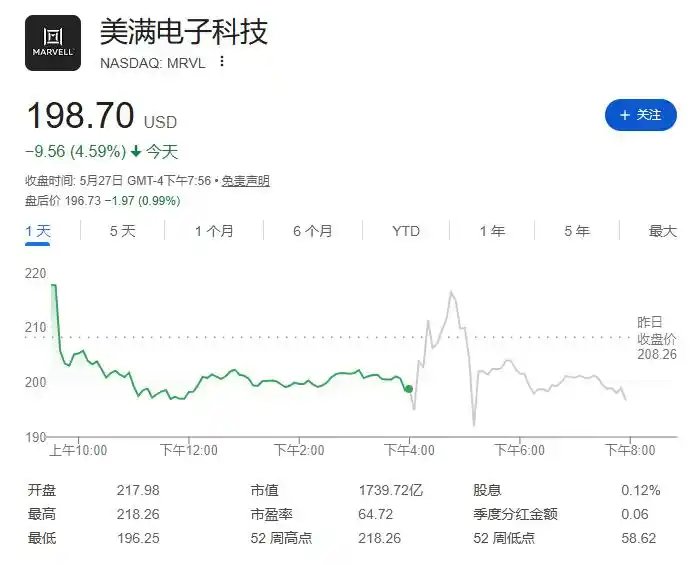
Following the earnings report and call, the company's stock price fell slightly by about 1%. Year-to-date, the stock had already more than doubled ahead of the earnings report. Against high expectations, merely "meeting expectations" may no longer be enough to impress the market.
01

"AI-Related Orders Are Exceptionally Strong," Marvell Raises Guidance Again

This marks Marvell raising its guidance for multiple consecutive quarters.

For the Q2 FY2027 guidance, the company expects revenue of approximately $2.7 billion (plus or minus 5%), representing year-over-year growth of about 35%, higher than the analyst consensus estimate of $2.6 billion. The non-GAAP EPS guidance range is $0.88 to $0.98, compared to the analyst consensus of $0.90.

For the full-year guidance, Marvell raised its FY2027 revenue expectation to approximately $11.5 billion, representing growth of about 40% year-over-year. Three months ago, the company's guidance was "approaching $11 billion."

More attention-grabbing is the outlook for FY2028. Marvell raised its FY2028 revenue target to approximately $16.5 billion, about $1.5 billion higher than the guidance provided last quarter, representing year-over-year growth of about 45%.

CEO Matt Murphy stated in the earnings release: "We are seeing exceptionally strong AI-related orders, and as a result, we are significantly raising our revenue expectations for Marvell's FY2027 and FY2028, showing substantial improvement compared to the guidance provided last quarter."

02

Data Center: Accounts for 76% of Revenue, Growth Still Accelerating

Q1 data center revenue was $1.83 billion, up 27% year-over-year and 11% quarter-over-quarter, accounting for 76% of total revenue.

Marvell's growth forecasts for this business are:

FY2026: +46% (already achieved)

FY2027: approximately +50%

FY2028: approximately +55%

Murphy stated:

The data center business is on fire, and we expect growth rates to accelerate this year and next, starting from an already high base.

03

Interconnect Business: Growth Rate from 30%→50%→70%, CEO Says "There's Room for Upside"

The AI Data Center Interconnect business is the largest segment within Marvell's data center portfolio, covering optical interconnect, DCI modules, coherent optics, and other product lines.

The expected annual growth rate for this business has been raised consecutively over the past few quarters: around 30% around September last year, later raised to 50%, and now raised again to over 70%.

When pressed by analysts, Murphy said directly:

I think there is a lot of potential for upside here. Our traditional DSP business will see a significant jump next year, the 1.6T product line has higher value content, DCI is accelerating, along with new businesses like retimers, AEC, and scale-up optics... This is the beginning of a major growth cycle for us.

Why has the interconnect business suddenly become so important? Murphy provided a clear logic:

Early generative AI primarily addressed compute and memory bottlenecks, with network interconnect being a secondary concern. However, with the deployment of more complex architectures like inference models and Mixture of Experts (MoE) models, the volume of data transmission within AI clusters has increased dramatically, significantly elevating the importance of network interconnect.

Some key numbers:

TIA and Driver Chips: Expected to surpass an annualized revenue run rate of $1 billion in the coming quarters.

DCI Module Business: Already shipping to all five major U.S. hyperscale cloud providers. Expected to surpass an annualized revenue run rate of $1 billion in FY2028, approximately double that of FY2026 (~$500 million).

Scale-up optics (NPO/CPO Optical Interconnect): Previously expected to be around $150 million; now raised, expected to exceed $300 million in FY2028.

04

Custom Chips (XPU): Doubling Next Year, Targeting Over $10 Billion by FY2029

Marvell's custom chip (Custom/XPU) business is another important growth line and a major focus for the market.

Current Progress:

FY2027 Custom Chip Revenue: Growth exceeding 20% year-over-year.

FY2028 Custom Chip Revenue: Expected to double year-over-year, higher than last quarter's expectation.

FY2029 Target: Exceed $10 billion (previous target was approximately $8 billion).

Analyst Vivek Arya (Bank of America Securities) pressed during the call: Does this mean FY2028 custom chip revenue will be over $4 billion, then jump to $10 billion in FY2029, implying a single-year incremental revenue of $5-6 billion?

Murphy's response was: Yes, you heard that correctly.

Three drivers for FY2028 custom chip growth:

Continued growth from existing flagship XPU projects.

More than ten XPU satellite projects (NIC, CXL, etc.) entering higher-volume production stages, with demand consistently exceeding expectations.

A new leading XPU project entering production — Murphy stated, "The project is progressing smoothly, and the full-year production plan is in place."

Murphy also revealed that while newly won design projects typically require about a two-year development cycle before contributing revenue, the significance of these projects lies in providing security for longer-term growth, which he referred to as "insurance policies."

05

Expanding Collaboration with NVIDIA, Three Key Directions Materializing

This quarter, Marvell announced an expanded strategic collaboration with NVIDIA. Murphy detailed three core directions on the call:

1. Optical Interconnect Collaboration: Marvell has long provided DSP, TIA, and drivers to NVIDIA. The two companies are now further collaborating on developing silicon photonics technology, considered a key enabling technology for scale-up networks.

2. NVLink Fusion Integration: Allows Marvell to build custom chips and network semiconductors that seamlessly interface with NVIDIA's infrastructure. Murphy stated this provides hyperscale cloud providers with greater flexibility to freely mix and match between custom chips and NVIDIA chips. "Marvell uniquely provides the bridge between these two architectures," creating new market opportunities for both companies.

3. AI-RAN: Marvell will enhance its Octeon base station processors to enable them to work directly in tandem with NVIDIA GPUs, running both 5G/6G wireless workloads and AI applications on the same hardware platform.

06

Supply Chain: Locking in Capacity Early, ~$1 Billion in Prepayments Planned This Year

Facing continuously climbing demand, supply chain management has become a critical variable.

CFO Willem Meintjes revealed on the call that the company plans to make approximately $1 billion in supplier prepayments during FY2027, with the first payments starting in Q2. These prepayments will be credited against future material purchases.

COO Chris Koopmans explained Marvell's supply chain strategy in response to analyst questions:

Everything related to AI has been supply-constrained from day one. Our approach is to build extremely close relationships with a small number of core suppliers, provide them with five-year demand forecasts, deliver on our promises every time, and back up our forecasts with action and prepayments.

Financially, Q1 operating cash flow reached a record $639 million. The company repurchased $200 million worth of stock in the quarter and paid $54 million in dividends. As of the end of Q1, total debt stood at $4.96 billion, with net debt/EBITDA at 0.32x.

This article is from the WeChat public account "Wall Street Insights Max," author: Long Yue

Câu hỏi Liên quan

QWhat was the key factor behind Marvell's significant increase in its revenue guidance for fiscal years 2027 and 2028?

AThe key factor was exceptionally strong AI-related orders, which led the company to significantly raise its revenue outlook compared to the guidance provided the previous quarter.

QWhat percentage of Marvell's total Q1 revenue came from its Data Center segment, and what was its growth rate?

AMarvell's Data Center segment contributed 76% of its total Q1 revenue, with a year-over-year growth of 27% and a sequential growth of 11%.

QHow did Marvell describe the growth trajectory for its AI Data Center Interconnect (Interconnect) business?

AMarvell described the growth trajectory as accelerating significantly, with the annual growth rate expectation being raised from around 30% to 50%, and now to over 70%. The CEO indicated there is substantial upside potential remaining.

QWhat is Marvell's stated revenue target for its Custom Chip (XPU) business by fiscal year 2029, and what major driver was mentioned for growth in fiscal year 2028?

AMarvell's stated revenue target for its Custom Chip (XPU) business by fiscal year 2029 is over $10 billion. A major driver for growth in fiscal year 2028 is the expected doubling of its custom chip revenue, aided by a new major XPU project entering production.

QWhat are the three core areas of Marvell's expanded strategic collaboration with NVIDIA, as detailed in the earnings call?

AThe three core areas are: 1) Collaboration on optical interconnect and silicon photonics technology. 2) NVLink Fusion Integration, allowing Marvell to build custom chips and networking semiconductors that interface seamlessly with NVIDIA infrastructure. 3) AI-RAN, enhancing Marvell's Octeon base station processors to work directly with NVIDIA GPUs for simultaneous 5G/6G and AI workloads.

Nội dung Liên quan

TIN VỠ: Mastercard Vừa Mở Cổng Mạng Thanh Toán Toàn Cầu Cho Tiền Mã Hóa — Những Altcoin Nào Được Lựa Chọn?

Vào ngày 3/6, Mastercard thông báo sẽ mở rộng cơ sở hạ tầng thanh toán toàn cầu của mình để hỗ trợ thanh toán trên chuỗi bằng cách sử dụng tiền điện tử thông qua các stablecoin được quản lý. Điều này cho phép các giao dịch thẻ được thanh toán 24/7, kể cả cuối tuần và ngày lễ, lần đầu tiên trong lịch sử mạng lưới. Sáu stablecoin được quản lý được hỗ trợ trong đợt triển khai đầu tiên: USDC của Circle, PYUSD của PayPal, USDG và USDP của Paxos, RLUSD của Ripple và SoFiUSD của SoFi. Việc thanh toán sẽ hoạt động trên tám mạng blockchain: Ethereum, Solana, Polygon, Base, Arbitrum, XRP Ledger, Canton và Tempo. Đây là một bước phát triển ở lớp thanh toán hậu kỳ, không phải là sự thay đổi sản phẩm hướng đến người tiêu dùng. Các đơn vị phát hành và ngân hàng trên mạng Mastercard giờ đây có thể chọn thanh toán các giao dịch thẻ bằng stablecoin trên chuỗi, thay vì thông qua các kênh ngân hàng truyền thống. Cả hai tùy chọn chạy song song. Người dùng thẻ không cần thay đổi cách thanh toán. Sự thay đổi nằm ở cơ sở hạ tầng phụ trợ, giờ có thể hoạt động trên mạng blockchain suốt ngày đêm, loại bỏ các điểm tắc nghẽn do giờ ngân hàng và ngày nghỉ gây ra trong nhiều thập kỷ. Sự kiện này được coi là sự xác nhận thể chế rõ ràng nhất cho nền kinh tế stablecoin cho đến nay.

bitcoinist1 giờ trước

TIN VỠ: Mastercard Vừa Mở Cổng Mạng Thanh Toán Toàn Cầu Cho Tiền Mã Hóa — Những Altcoin Nào Được Lựa Chọn?

bitcoinist1 giờ trước

Hoskinson Cảnh Báo Về 'Làn Sóng Thất Bại' Ở Cardano Sau Khi TapTools Đóng Cửa

Charles Hoskinson, người sáng lập Cardano, đã cảnh báo về một "làn sóng thất bại" có thể xảy ra trong hệ sinh thái Cardano sau khi nền tảng phân tích dữ liệu TapTools thông báo sẽ ngừng hoạt động trong hai tuần tới. Nguyên nhân được nêu ra là do sự ra đi của nhiều lãnh đạo chủ chốt và mô hình kinh tế nền tảng gặp khó khăn. Trong buổi phát trực tiếp ngày 2/6, Hoskinson nhấn mạnh đây không phải là một thất bại riêng lẻ mà là triệu chứng của những vấn đề sâu xa hơn về tài trợ, phối hợp và động lực trong hệ sinh thái. Ông tiên đoán sẽ có thêm nhiều dự án gặp khó khăn trong nửa cuối năm nay, dẫn JPEG Store và TapTools làm ví dụ. Hoskinson cho biết ông đã đề xuất nhiều cơ chế để giải quyết vấn đề, chẳng hạn như quỹ đầu tư của Cardano hoặc mua lại chiến lược, nhưng các ý tưởng này không nhận được đủ sự ủng hộ hoặc bị chỉ trích là tập trung quyền lực. Ông bày tỏ thất vọng khi cơ chế quản trị hiện tại chưa tạo ra cách hiệu quả để sử dụng nguồn lực từ kho bạc nhằm hỗ trợ cơ sở hạ tầng thương mại. Đồng thời, Hoskinson phủ nhận việc ông có quyền kiểm soát đơn phương đối với Cardano, nói rằng ông không có khóa quản trị, không thể khởi xướng một hard fork, và không kiểm soát kho bạc hay thương hiệu. Ông kêu gọi cộng đồng bỏ phiếu (DReps và delegators) cần lựa chọn rõ ràng về lãnh đạo và tầm nhìn để thúc đẩy tăng trưởng, thậm chí đưa ra các lựa chọn cực đoan như cải cách hiến pháp hoặc khởi động một Cardano mới nếu cần thiết.

bitcoinist2 giờ trước

Hoskinson Cảnh Báo Về 'Làn Sóng Thất Bại' Ở Cardano Sau Khi TapTools Đóng Cửa

bitcoinist2 giờ trước

Đợt Tăng Giá Không Thành

Tình hình thị trường Bitcoin hiện tại cho thấy các dấu hiệu yếu kém rõ rệt sau đợt giảm giá gần đây. Giá đã giảm khoảng 13% xuống vùng 67.000 USD, phá vỡ dưới mức trung bình thị trường thực (True Market Mean) ở 77,8k USD, củng cố nhận định rằng thị trường gấu vẫn đang chiếm ưu thế. Phân tích on-chain cho thấy cấu trúc đang xấu đi. Giá hiện giao dịch gần điểm giữa của vùng giá trị thị trường gấu. Lợi nhuận thực tế từ các giao dịch đang bị áp đảo bởi các khoản lỗ, một mô hình thường thấy ở các đỉnh cục bộ trong thị trường gấu. Các nhà đầu tư mới mua ở vùng đỉnh gần 78k-82k USD đang chịu áp lực lớn, và hành động của họ sẽ quyết định liệu mức giá hiện tại có đủ sức hấp thụ áp lực bán hay không. Tổng lỗ thực tế hàng ngày đã tăng mạnh lên 1,35 tỷ USD, cho thấy cả nhà đầu tư dài hạn và ngắn hạn đều đang chốt lỗ. Về off-chain, dòng tiền từ ETF Mỹ đã chứng kiến ba tuần rút vốn liên tiếp, với áp lực bán gia tăng khi giá bị từ chối ở mức giá trung bình của các nhà đầu tư ETF (khoảng 83k USD). Lực mua trên thị trường giao ngay (spot) đã biến mất, và một sự kiện thanh lý lớn đã xóa sổ hơn 400 triệu USD vị thế mua ký quỹ. Thị trường quyền chọn phản ánh tâm lý thận trọng, với nhu cầu bảo vệ trước rủi ro giảm giá (put options) vẫn ở mức cao và phí biến động (volatility premium) gần mức cao nhất trong ba tháng. Tóm lại, thị trường Bitcoin đang trong vị thế mong manh với áp lực bán từ nhiều phía. Một sự phục hồi bền vững cần có sự trở lại của lực mua giao ngay mạnh mẽ, việc giá vượt lại mức trung bình của ETF, và dấu hiệu áp lực bán giảm bớt. Cho đến khi đó, rủi ro tiếp tục điều chỉnh hoặc củng cố trong cấu trúc thị trường gấu vẫn còn hiện hữu.

insights.glassnode3 giờ trước

Đợt Tăng Giá Không Thành

insights.glassnode3 giờ trước

WLFI Cảnh Báo: Ví Bị Trừng Phạt Có Thể Kích Hoạt Khóa Chuyển Giao Tiền Mã Hóa

Thượng nghị sĩ Elizabeth Warren và Jack Reed đã theo dõi sát World Liberty Financial (WLFI) trước cả thông báo tuân thủ hôm thứ Ba, kêu gọi giới chức Mỹ năm ngoái rà soát việc các địa chỉ ví liên quan đến Nga, Triều Tiên và dịch vụ trộn tiền Tornado Cash bị cấm có vượt qua được quy trình sàng lọc từ đợt bán trước của dự án hay không. WLFI bác bỏ cáo buộc, nói rằng họ áp dụng các biện pháp chống rửa tiền và xác minh danh tính nghiêm ngặt. Tuy nhiên, dự án thừa nhận hợp đồng thông minh của họ có quyền đóng băng, hạn chế hoặc đốt số dư ví, điều này làm dấy lên sự giám sát mới về tính phi tập trung mà họ từng quảng bá. Thông báo tuân thủ đăng trên X hôm thứ Ba nói rõ rằng WLFI, dự án tiền mã hóa có liên quan đến cựu Tổng thống Donald Trump, cảnh báo các giao dịch liên quan đến các cá nhân, tổ chức hoặc địa chỉ ví bị trừng phạt có thể bị trì hoãn, hạn chế hoặc từ chối. Các biện pháp kiểm soát này nhằm đáp ứng yêu cầu quy định về các giao dịch bị cấm. Cảnh báo được đưa ra cùng ngày Bộ Tài chính Mỹ trừng phạt một số nền tảng tiền mã hóa của Iran, bao gồm sàn giao dịch lớn nhất Nobitex. Bộ trưởng Tài chính Bessent cho biết các nền tảng này đã xử lý giao dịch cho Lực lượng Vệ binh Cách mạng Hồi giáo Iran. WLFI khuyến cáo người dùng kiểm tra kỹ nguồn tiền và địa chỉ ví không có liên quan đến hoạt động bị cấm trước khi chuyển tiền. Tư thế tuân thủ này tạo ra một số mâu thuẫn với hình ảnh phi tập trung (DeFi) mà dự án từng thể hiện, khi lớp ứng dụng vẫn phải tuân theo các quy định liên bang.

bitcoinist3 giờ trước

WLFI Cảnh Báo: Ví Bị Trừng Phạt Có Thể Kích Hoạt Khóa Chuyển Giao Tiền Mã Hóa

bitcoinist3 giờ trước

Giao dịch

Giao ngay
Hợp đồng Tương lai
活动图片