On the Eve of the Tech IPO Boom, Polymarket Joins Forces with NASDAQ to Seize 'Valuation Authority'

marsbitXuất bản vào 2026-05-20Cập nhật gần nhất vào 2026-05-20

Tóm tắt

At the dawn of a major tech IPO wave, prediction market platform Polymarket is forming an exclusive partnership with Nasdaq Private Market (NPM) to launch contracts predicting the valuations of pre-IPO giants like OpenAI, Anthropic, and SpaceX. This move aims to capture the "valuation adjudication right" in the booming but opaque private market, where accurate valuation data is scarce for retail investors. Facing stiff competition from rival Kalshi, which holds an 89% US market share and full regulatory approval, Polymarket's deal with NPM is a strategic counterattack. NPM provides crucial, real-time secondary market transaction data from employee stock sales to settle the new prediction contracts. In return, Polymarket's market-generated probability data becomes a valuable "institutional signal" for NPM's clients. This follows Polymarket's broader strategy of monetizing its prediction data through partnerships with giants like ICE (Intercontinental Exchange) and Dow Jones, integrating its signals into mainstream financial data feeds and media. The Nasdaq deal specifically targets the lucrative and high-profile arena of pre-IPO tech valuations, potentially raising the entry barrier for competitors in this niche.

In this wave of tech IPO frenzy, everyone wants to 'get on board,' including Polymarket.

The soonest SpaceX could list on Nasdaq is in 23 days, an IPO poised to break all records in human IPO history.

OpenAI's last round valuation was $5 trillion, Anthropic is rumored to be worth $4 trillion, and SpaceX $17.5 trillion. Globally, there are 1,600 unicorn companies with a cumulative valuation of $5 trillion. The returns from this sector have historically been available only to institutions and accredited investors. Directly buying shares in these companies requires a six-figure minimum, a one-year lock-up period, accredited investor certification, and a network of connections. Ordinary people have no access.

Furthermore, private companies are not obligated to disclose their valuations. Funding round valuations are lagging, secondary market quotes are scattered, and the actual transaction prices of employee stock are highly sensitive internal information. This, precisely, is the perfect entry point for prediction markets.

On May 19th, just before this critical timing, Polymarket announced an exclusive partnership with NASDAQ, launching a batch of prediction contracts targeting the market valuations of pre-IPO companies. Users can bet on whether OpenAI's valuation will break through $10 trillion by year-end, whether Anthropic will reach $11 trillion by December 31st, and if SpaceX can touch $15 trillion before June 30th. NASDAQ, as the data source, is responsible for the final settlement of the contracts.

Polymarket previously had a market on OpenAI's closing market cap on its first day. Bloomberg reported that it accumulated $1.6 million in trading volume since last September. On Kalshi, existing IPO contracts are even more concentrated: Cerebras Systems' probability of an IPO before 2027 is priced at 95%, Kraken at 83%, Databricks at 70%, Discord at 70%. OpenAI and Anthropic also have contracts.
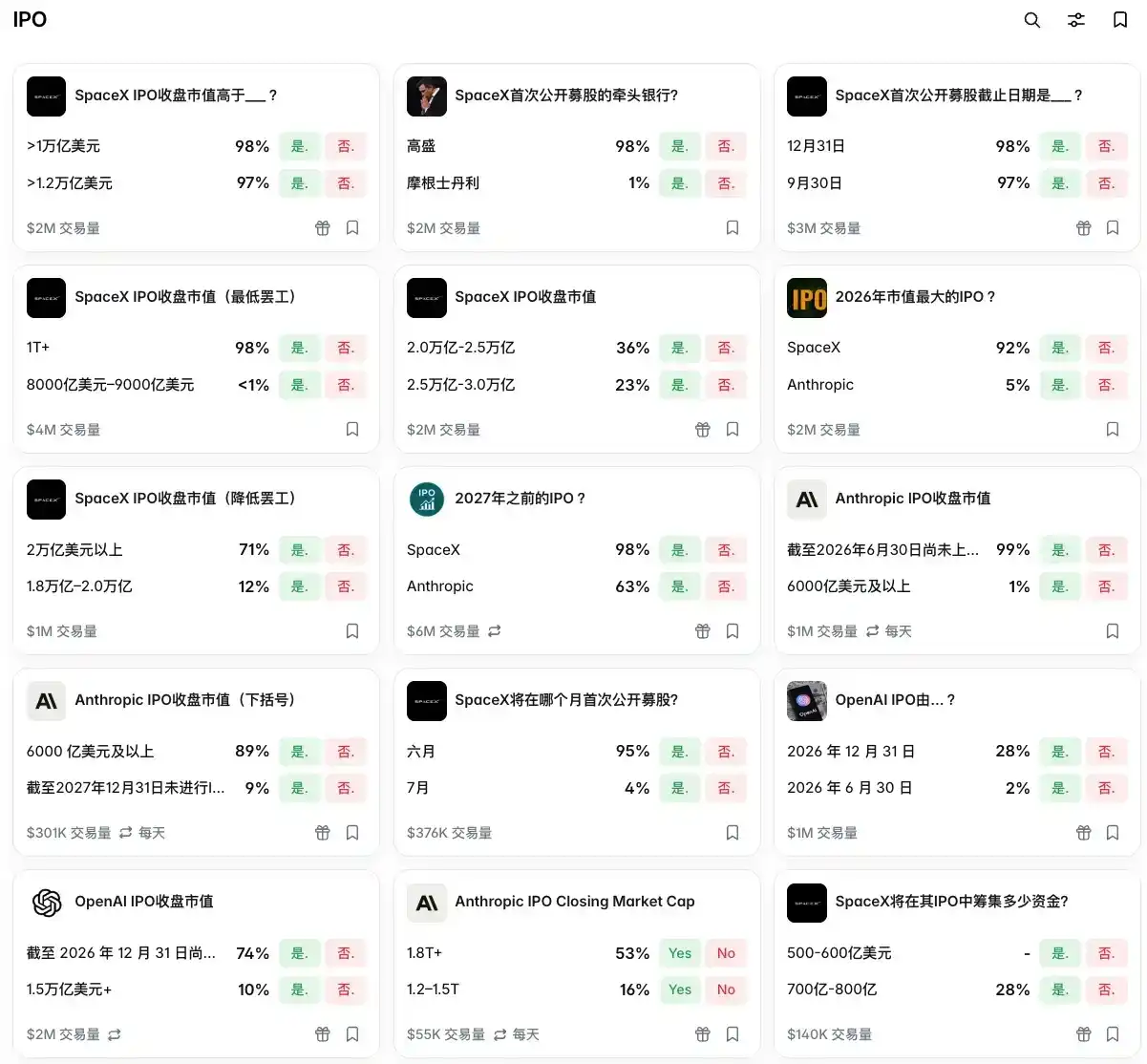
Both competing platforms are placing significant emphasis on this wave of pre-IPO frenzy.

Polymarket's Comeback Fight

Over the past eight months, Polymarket has been surpassed by Kalshi on nearly every visible metric.

In April, Kalshi's monthly trading volume was $14.8 billion, a 13% increase month-over-month. Polymarket's global volume plus the US App volume totaled $10.2 billion, a month-over-month decline of 8.9%. Active traders dropped from 733,000 in March to 643,000 in April, a 12% decrease. In valuation, Kalshi's latest round is $22 billion, while Polymarket is reportedly in talks for $15 billion.

A Bank of America report in April noted that among US-based prediction markets, Kalshi has captured approximately 89% of the market share.

Kalshi's journey over the past few years has been smoother than Polymarket's. In 2020, the CFTC granted it a Designated Contract Market (DCM) license, the first in the US and still the only one specifically issued to an event contract platform. This means Kalshi can accept USD, issue 1099 tax forms, integrate SDKs with platforms like Robinhood, and have its probability data cited by CNN and CNBC. In February of this year, Kalshi was selected by TIME for its TIME100 Most Influential Companies list, and its App Store ranking once approached that of ChatGPT.

Polymarket, fined $1.4 million by the CFTC in 2022, withdrew from the US market. It wasn't until July 2025 that the CFTC and the Department of Justice concluded a new round of investigations against it, allowing it to acquire a compliant trading license through the acquisition of QCEX.

However, Polymarket's partnership with NASDAQ this time is likely a signal of a counteroffensive.

The specific partner for Polymarket is Nasdaq Private Market (referred to as NPM), a company incubated by NASDAQ that specializes in serving private companies. Its main businesses are two-fold:

First, organizing secondary market liquidity programs for employee stock. Employees of companies like OpenAI, SpaceX, and Anthropic hold a large number of options or restricted stock units. Since the companies are not public, they cannot sell on the open market. NPM helps companies organize tender offers, allowing employees to sell their shares to approved external investors. NPM itself has disclosed facilitating nearly $80 billion in such transactions, covering over 1,000 company-sponsored liquidity programs and serving more than 200,000 employee shareholders.

Second, building a valuation database for private companies. NPM daily sees the transaction prices of employee stock for companies like OpenAI, Anthropic, and SpaceX on the secondary market. This data was previously sold only to institutional clients for a hefty annual fee.

The key step in this partnership is NPM's agreement to, for the first time, provide these valuation data to Polymarket for use.

Rodolfo Sanchez, NPM's Data Vice President, made a crucial statement in the press release: "The data flows in both directions." NPM provides data to Polymarket for contract settlement, while Polymarket's contract price curves become, in turn, "institutional signals" available to NPM's clients. Institutional clients buying NPM data also receive a probability curve priced in real-time by hundreds of thousands of retail traders.

Selling Data, Seizing Authority, Capturing Retail

This is not Polymarket's first time selling its data.

In October 2025, ICE announced an investment of up to $2 billion at an $8 billion pre-money valuation. The significance of this deal wasn't just the valuation, but the terms. ICE secured global exclusive distribution rights for Polymarket's data. The sales channels of the parent company of NYSE began selling Polymarket's probability data to global institutional clients.

In January 2026, an exclusive partnership with Dow Jones. Polymarket's prediction data was integrated into The Wall Street Journal, Barron's, MarketWatch, and Investor's Business Daily. The financial media matrix under News Corp began embedding Polymarket's probability signals as standard modules in their layouts, similar to the Dow Jones Index or VIX.

In February 2026, ICE formally launched the 'Polymarket Signals and Sentiment' product. Real-time quotes from thousands of contracts on Polymarket were standardized into structured data streams and distributed to institutional clients via the ICE Consolidated Feed, flowing through the same pipeline as NYSE stock data, bond prices, and corporate announcements. ICE President Ben Jackson mentioned this product alongside Reddit and Dow Jones in the Q1 earnings call, calling it one of the three pillars of ICE's alternative data services.

And this new partnership is about seizing the authority to determine valuations in this year's hottest private market.

We speculate Kalshi won't sit idle; its next move will likely involve partnering with a private market data provider to implement a similar structure. However, mainstream private data providers like Forge and PitchBook have smaller scales and cover fewer companies compared to NPM. NPM has already been exclusively secured by Polymarket. The cost for Kalshi to enter this track will be higher.


Tiền kỹ thuật số thịnh hành

Câu hỏi Liên quan

QWhat is the key collaboration between Polymarket and Nasdaq, and what specific data is being shared?

APolymarket has launched an exclusive collaboration with Nasdaq, specifically its incubated company Nasdaq Private Market (NPM). The key aspect of this partnership is that NPM is providing its private company valuation database to Polymarket for use in settling prediction contracts. This database contains real-time transaction data on employee stock sales from pre-IPO companies like OpenAI, Anthropic, and SpaceX. In return, Polymarket's prediction market price curves serve as a 'crowd-sourced signal' for NPM's institutional clients.

QAccording to the article, how does Polymarket's current position compare to its competitor Kalshi in the US prediction market?

AAccording to the article, Kalshi currently holds a dominant position in the US prediction market. A Bank of America report cited in the article states that Kalshi has captured approximately 89% of the US market share. Key metrics for April show Kalshi with a monthly trading volume of $14.8 billion, compared to Polymarket's combined global and US app volume of $10.2 billion. Furthermore, Kalshi is reported to have a higher valuation and possesses a crucial regulatory advantage with its CFTC-issued Designated Contract Market (DCM) license.

QWhat are the two main business functions of Nasdaq Private Market (NPM) mentioned in the article?

ANasdaq Private Market (NPM) primarily serves two key functions for private companies: 1) Facilitating secondary market liquidity programs for employee shares. It organizes tender offers that allow employees of companies like OpenAI and SpaceX to sell their stock options or restricted shares to approved external investors. 2) Building a valuation database for private companies. NPM collects data on the transaction prices of employee stock sales, creating a valuable proprietary dataset on private company valuations.

QWhat previous steps has Polymarket taken to commercialize its prediction market data prior to the Nasdaq deal?

APrior to the Nasdaq collaboration, Polymarket had already taken significant steps to commercialize its data. In October 2025, Intercontinental Exchange (ICE) invested in Polymarket and secured the global exclusive distribution rights for its data. In January 2026, Polymarket entered an exclusive partnership with Dow Jones, integrating its prediction data into major financial publications like The Wall Street Journal. In February 2026, ICE formally launched the 'Polymarket Signals and Sentiment' product, streaming structured prediction data to institutional clients alongside traditional market data feeds.

QWhy is the pre-IPO company valuation market considered a significant opportunity for prediction markets like Polymarket?

AThe pre-IPO valuation market is a significant opportunity because it addresses a major information gap. Private companies are not obligated to disclose their valuations, and data from funding rounds is often lagging or incomplete. Secondary market quotes are fragmented, and internal transaction prices for employee stock are highly sensitive. This lack of transparent, real-time valuation data creates an ideal environment for prediction markets to aggregate crowd-sourced beliefs about a company's worth, providing an alternative signal that is otherwise inaccessible to the general public.

Nội dung Liên quan

Nhờ việc tung xúc xắc, chìa khóa Bitcoin được lưu trữ offline, nhưng không phải ai cũng muốn làm điều này

Cảm biến từ cuộc tranh cãi gần đây xung quanh lỗ hổng trong ví phần cứng Coldcard, bài viết thảo luận về phương pháp tạo seed (cụm từ khôi phục) cho ví Bitcoin bằng cách xúc xắc vật lý. Mỗi lần xúc xắc công bằng cung cấp khoảng 2,6 bit entropy (thước đo tính ngẫu nhiên). Để đạt mức entropy an toàn cho một seed 12 từ (128 bit), cần khoảng 50 lần xúc xắc; Coldcard khuyến nghị 99 lần để đạt mức bảo mật cao hơn. Lợi thế chính của phương pháp này là tách biệt hoàn toàn với bất kỳ lỗi phần cứng hoặc phần mềm nào trong trình tạo số ngẫu nhiên của thiết bị, từ đó bảo vệ seed chính của ví. Tuy nhiên, bài viết cảnh báo rằng trong sự cố Coldcard, các chức năng phụ khác của thiết bị (như tạo ví giấy, khóa đa chữ ký, mật mã phiên USB) vẫn có thể bị ảnh hưởng nếu chúng dựa vào trình tạo số lỗi, ngay cả khi seed chính được tạo an toàn bằng xúc xắc. Nhược điểm lớn của việc dùng xúc xắc là quá trình thủ công, dễ xảy ra sai sót, tốn thời gian và không thực tế cho đa số người dùng mới. Người dùng có thể ghi chép sai, sử dụng xúc xắc gian lận, hoặc để lộ chuỗi kết quả. Do đó, mặc dù có nền tảng toán học vững chắc, phương pháp này đòi hỏi sự tỉ mỉ cao và không phải là giải pháp khả thi cho việc áp dụng Bitcoin rộng rãi. Bài viết kết luận rằng mục tiêu dài hạn vẫn là phát triển phần cứng/phần mềm tạo số ngẫu nhiên mạnh mẽ và đáng tin cậy, trong khi vẫn giữ phương pháp thủ công như một tùy chọn cho người dùng có kinh nghiệm. Cuối cùng, bài viết đưa ra khuyến nghị cho chủ sở hữu Coldcard: cập nhật firmware, kiểm tra các chức năng phụ đã sử dụng và xem xét các biện pháp bảo mật bổ sung như ví đa chữ ký kết hợp nhiều nhà sản xuất để giảm thiểu rủi ro từ một điểm yếu đơn lẻ.

cryptonews.ru1 giờ trước

Nhờ việc tung xúc xắc, chìa khóa Bitcoin được lưu trữ offline, nhưng không phải ai cũng muốn làm điều này

cryptonews.ru1 giờ trước

Michael Saylor tuyên bố, bản cập nhật Bitcoin mà ông phản đối đã không thể được thông qua!

Michael Saylor tuyên bố rằng về mặt toán học, BIP-110 không thể đạt ngưỡng hỗ trợ 55% từ các tình nguyện viên trong chu kỳ điều chỉnh độ khó khai thác Bitcoin hiện tại. Dữ liệu của ông cho thấy, trong tổng số 946 khối được tạo ra tính đến khối 960.561, chỉ 24 khối chứa tín hiệu ủng hộ BIP-110 trong trường phiên bản tiêu đề khối. Tất cả các tín hiệu này đều đến từ thợ đào DATUM chia sẻ phần thưởng thông qua nhóm khai thác OCEAN, và không có tín hiệu nào từ các thợ đào bên ngoài OCEAN. Saylor nhấn mạnh rằng trong tình huống này, BIP-110 sẽ không đạt được mức hỗ trợ tự nguyện 55% trong chu kỳ xem xét, và các tín hiệu hiện tại không thể được coi là sự đồng thuận chung của các thợ đào. BIP-110 là một đề xuất nhằm gây khó khăn cho việc thêm ảnh, văn bản hoặc các loại dữ liệu lớn khác vào mạng Bitcoin, ngoài giao dịch chuyển tiền. Người ủng hộ cho rằng Bitcoin chỉ nên được dùng để chuyển tiền và không nên làm tắc nghẽn mạng bằng dữ liệu không cần thiết. Tuy nhiên, Michael Saylor phản đối BIP-110. Ông lập luận rằng mạng Bitcoin không nên quyết định giao dịch nào là cần thiết, luật lệ không nên thay đổi theo ý muốn của một số ít người, và tỷ lệ hỗ trợ cao có thể không phản ánh đúng sự ủng hộ thực sự của thợ đào do một phần mềm tự động hóa quá trình báo hiệu.

cryptonews.ru2 giờ trước

Michael Saylor tuyên bố, bản cập nhật Bitcoin mà ông phản đối đã không thể được thông qua!

cryptonews.ru2 giờ trước

Số lượng bình luận tiêu cực về Bitcoin đạt mức cao nhất lịch sử: Điều này có nghĩa là gì?

Công ty phân tích tiền mã hóa Santiment thông báo rằng tình cảm tiêu cực đối với Bitcoin trên mạng xã hội đã đạt mức cao kỷ lục. Tỷ lệ bình luận tích cực/tiêu cực về Bitcoin trên các nền tảng như X, Reddit, Telegram đã giảm xuống mức thấp nhất kể từ khi công ty triển khai hệ thống giám sát hiện đại. Một lỗ hổng bảo mật trong phần sụn của ví cứng Coldcard được xác định là nguyên nhân chính gây lo ngại, làm dấy lên nghi ngờ về tính an toàn của phương pháp lưu trữ lạnh vốn được coi là an toàn nhất. Santiment lưu ý rằng, khác với các cuộc khủng hoảng lớn trước đây như sự sụp đổ của FTX hay Mt. Gox, cuộc thảo luận lần này tập trung vào rủi ro bảo mật phần cứng và ví lạnh nói chung, thay vì chỉ trích các sàn giao dịch tập trung. Theo dữ liệu, hiện chỉ có 0,58 bình luận tích cực cho mỗi bình luận tiêu cực về Bitcoin, cho thấy "nỗi sợ hãi" đang áp đảo "lòng tham" ở mức đáng kể. Mặc dù dữ liệu chỉ trong một ngày, mức độ hoảng loạn hiện tại được đánh giá là cao hơn cả đỉnh lo ngại về chiến tranh đầu năm và các cuộc khủng hoảng tiền mã hóa lớn trong quá khứ.

cryptonews.ru3 giờ trước

Số lượng bình luận tiêu cực về Bitcoin đạt mức cao nhất lịch sử: Điều này có nghĩa là gì?

cryptonews.ru3 giờ trước

SUI đang đứng trước ngưỡng cửa đột phá mới khi 'phe bò' nhắm mục tiêu tăng lên 20 USD

Ngày 1/8, mạng Sui đã mở khóa khoảng 13,72 triệu token SUI, trị giá khoảng 9,9 triệu USD, tương đương 0,34% nguồn cung lưu thông. Số token này được phân bổ cho quỹ dự trữ cộng đồng, người tham gia sớm và kho bạc của Mysten Labs. Khác với hình thức mở khóa ồ ạt, Sui áp dụng cơ chế giải phóng từ từ hàng ngày nhằm giảm áp lực bán. Nhà giao dịch nổi tiếng CryptoPatel nhận định vùng giá hiện tại của SUI (khoảng 0,68 USD) là khu vực tích lũy với mục tiêu dài hạn lần lượt là 5, 10 và 20 USD. Tuy nhiên, giá token đã giảm hơn 5% trong những phiên gần đây, và tâm lý thị trường ngắn hạn đang trở nên thận trọng. Về mặt cơ bản, mạng Sui ghi nhận một số phát triển tích cực: Quỹ đầu tư Mubadala Capital của Abu Dhabi đã phát hành phiên bản token hóa quỹ thị trường tư nhân trị giá 75 triệu USD trên nền tảng Sui, hướng đến các nhà đầu tư tổ chức. Ngoài ra, mạng thử nghiệm Hashi cho phép sử dụng Bitcoin làm tài sản thế chấp đã ra mắt, cùng với việc triển khai chuyển khoản ổn định miễn phí trong mạng. Việc giảm giá gần đây được cho là chủ yếu do áp lực từ đợt mở khóa token và điều kiện thị trường chung, không phải từ sự cố nào của chính giao thức Sui.

cryptonews.ru3 giờ trước

SUI đang đứng trước ngưỡng cửa đột phá mới khi 'phe bò' nhắm mục tiêu tăng lên 20 USD

cryptonews.ru3 giờ trước

Giao dịch

Giao ngay

Bài viết Nổi bật

Làm thế nào để Mua POL

Chào mừng bạn đến với HTX.com! Chúng tôi đã làm cho mua Polygon Ecosystem Token (POL) trở nên đơn giản và thuận tiện. Làm theo hướng dẫn từng bước của chúng tôi để bắt đầu hành trình tiền kỹ thuật số của bạn.Bước 1: Tạo Tài khoản HTX của BạnSử dụng email hoặc số điện thoại của bạn để đăng ký tài khoản miễn phí trên HTX. Trải nghiệm hành trình đăng ký không rắc rối và mở khóa tất cả tính năng. Nhận Tài khoản của tôiBước 2: Truy cập Mua Crypto và Chọn Phương thức Thanh toán của BạnThẻ Tín dụng/Ghi nợ: Sử dụng Visa hoặc Mastercard của bạn để mua Polygon Ecosystem Token (POL) ngay lập tức.Số dư: Sử dụng tiền từ số dư tài khoản HTX của bạn để giao dịch liền mạch.Bên thứ ba: Chúng tôi đã thêm những phương thức thanh toán phổ biến như Google Pay và Apple Pay để nâng cao sự tiện lợi.P2P: Giao dịch trực tiếp với người dùng khác trên HTX.Thị trường mua bán phi tập trung (OTC): Chúng tôi cung cấp những dịch vụ được thiết kế riêng và tỷ giá hối đoái cạnh tranh cho nhà giao dịch.Bước 3: Lưu trữ Polygon Ecosystem Token (POL) của BạnSau khi mua Polygon Ecosystem Token (POL), lưu trữ trong tài khoản HTX của bạn. Ngoài ra, bạn có thể gửi đi nơi khác qua chuyển khoản blockchain hoặc sử dụng để giao dịch những tiền kỹ thuật số khác.Bước 4: Giao dịch Polygon Ecosystem Token (POL)Giao dịch Polygon Ecosystem Token (POL) dễ dàng trên thị trường giao ngay của HTX. Chỉ cần truy cập vào tài khoản của bạn, chọn cặp giao dịch, thực hiện giao dịch và theo dõi trong thời gian thực. Chúng tôi cung cấp trải nghiệm thân thiện với người dùng cho cả người mới bắt đầu và người giao dịch dày dạn kinh nghiệm.

Tổng lượt xem 449Xuất bản vào 2024.12.11Cập nhật vào 2026.06.02

Làm thế nào để Mua POL

Thảo luận

Chào mừng đến với Cộng đồng HTX. Tại đây, bạn có thể được thông báo về những phát triển nền tảng mới nhất và có quyền truy cập vào thông tin chuyên sâu về thị trường. Ý kiến ​​của người dùng về giá của POL (POL) được trình bày dưới đây.

活动图片












