Perspective: Tokens on alt.fun are double-layered leverage

marsbitXuất bản vào 2026-05-18Cập nhật gần nhất vào 2026-05-18

Tóm tắt

**Title:** Tokens on alt.fun are Double-Layered Leverage **Summary:** Tokens on alt.fun (like ALT) are not simple 5x leveraged bets on HYPE. Instead, they represent a **double layer of leverage**. The core mechanism involves HyperSwap V2 pools. After "graduation," these tokens are paired not with USDC, but with **HYPE5L**—a 5x long leverage token (LT) issued by BounceTech that tracks HYPE. Therefore, an alt.fun token's price in USDC is determined by multiplying two independent factors: 1. **AMM Exchange Rate:** The pool's ratio between the alt token and HYPE5L, driven by trading activity on alt.fun. 2. **LT Net Asset Value (NAV):** HYPE5L's value, which moves at approximately 5x the daily return of HYPE. This creates a compounding effect: * If HYPE rises 1%, HYPE5L's NAV rises ~5%. Profit-taking HYPE5L holders may then buy alt tokens, increasing demand and pushing the AMM exchange rate higher. The alt token's total gain thus exceeds 5%, potentially reaching 8-15%. * Conversely, if HYPE falls, losses are amplified beyond 5x due to combined NAV decline and AMM selling pressure. During crashes, large sell orders may fail due to non-atomic redemption paths, potentially trapping later sellers. In contrast, platforms like pump.fun pair tokens with stable assets like SOL, applying only the AMM amplifier to a 1x underlying asset. Alt.fun's use of a pre-leveraged quote asset (HYPE5L) fundamentally shifts the risk profile, creating a **second-order product with floating, of...

Author:798.eth

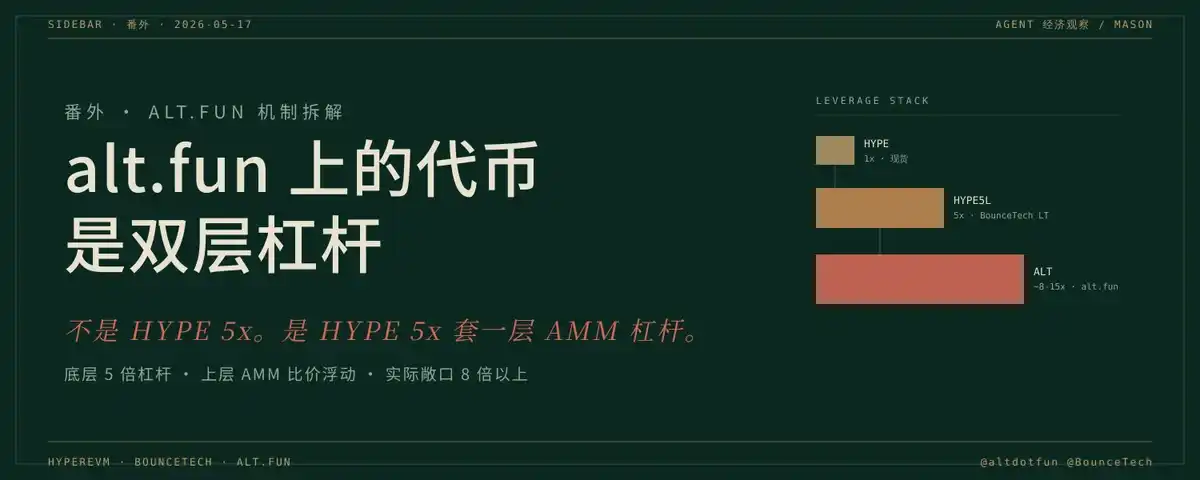
The alt tokens on alt.fun are not 5x leverage on HYPE. They are 5x leverage on HYPE with an additional layer of AMM leverage stacked on top.

This isn't obvious intuitively. You'll understand after reviewing the mechanism. First, let's look at current data for reference.

HYPE spot price is 42.84 USDC.

HYPE5L (the HYPE 5x long leverage token LT issued by BounceTech) has a current NAV of 0.870 USDC, which is a 13% decay from its issue price of 1 USDC.

In the HyperSwap V2 pool for the alt.fun flagship token ALT, there are 18.58 million ALT tokens and 129,400 HYPE5L tokens. 1 ALT equals 0.00697 HYPE5L. Converted to USDC price, that's 0.00606. The USDC price of ALT is the product of two things.

Note: After graduation, the pool contains no USDC; the paired asset is HYPE5L LT. This is the starting point for all understanding.

ALT's USDC price = The exchange rate of ALT to HYPE5L in the pool multiplied by HYPE5L's current NAV.

The first factor is the AMM price ratio. The fewer ALT and more HYPE5L in the pool, the higher the ratio, meaning ALT is more expensive. The opposite makes it cheaper. This factor is determined by buy/sell pressure and is unrelated to the HYPE price.

The second factor is the LT's Net Asset Value. When HYPE rises 1%, HYPE5L's NAV rises approximately 5%, and vice versa. This factor is determined by BounceTech's actual perp position on Hyperliquid and is unrelated to trading activity on alt.fun.

These two factors are independent. Multiply them together to get ALT's final USDC price.

Why this constitutes double-layered leverage.

HYPE rises 1%.

The second layer (LT) amplifies it to 5%. HYPE5L NAV rises 5%.

The first layer (AMM) will amplify further. When HYPE5L rises, holders who are making money may go to alt.fun to buy more alt tokens (leveraged exposure plus alt narrative exposure). This buying increases HYPE5L in the pool and decreases ALT, causing the AMM price ratio to rise. The same 1% HYPE increase is amplified once more in the AMM layer.

Ultimately, ALT's USDC price increase will likely be between 8% and 15%, depending on AMM pool depth and buying intensity. But it will always be greater than 5%.

The same logic applies in reverse when the price falls. If HYPE falls 1%, HYPE5L falls 5%, alt holders see amplified losses, and some start selling ALT for HYPE5L to redeem. Selling pressure pushes down the AMM price ratio, likely causing ALT's USDC price to fall between 8% and 15%.

When falling, there's also an asymmetric effect. The alt.fun docs themselves warn that large sell orders may revert due to the path not being atomic (the path from alt to HYPE5L to USDC redemption; if the order is large, the LT redemption on BounceTech's side can't handle it). This means when the pool is thin, retail investors wanting to stop losses can't. The first ones out sell at high prices, later ones at lower prices, and those after get stuck in the contract.

The five alt tokens backed by HYPE5L—ALT, HBULL, HYPE Life, BALD, HLC—are now all graduated. Every trade they make on HyperSwap V2 moves the AMM price ratio. Simultaneously, the HYPE price moves the HYPE5L NAV. The two layers stack.

HYPE5L is an LT issued by BounceTech. Theoretically 5x exposure, but due to frequent rebalancing, it suffers from volatility decay. In ranging markets, actual exposure is less than 5x; in trending markets, it's more than 5x.

So when you open the alt.fun UI and see an alt token labeled "HYPE 5x Long," the USDC price displayed in the UI is the result of the HYPE price being amplified by BounceTech's 5x leverage, then amplified again by the HyperSwap V2 AMM. You think you're buying 5x exposure to HYPE, but you're actually buying a floating exposure of 8x to 15x.

This floating exposure makes you earn much more than 5x when prices rise, and lose much more than 5x when prices fall. This is the full meaning of double-layered leverage.

Comparing with pump.fun makes it clearer.

Tokens on pump.fun are paired with SOL. SOL is a 1x exposure spot asset. If SOL falls 10%, a pump.fun token's USDC price falls 10% plus the AMM selling pressure, roughly 15% to 25%. The AMM is an amplifier, but the underlying asset has no leverage.

Tokens on alt.fun are paired with HYPE5L. HYPE5L is already a 5x exposure derivative. If HYPE falls 10%, HYPE5L falls 50%, and an alt token's USDC price falls 50% plus the AMM selling pressure, roughly 60% to 80%. The AMM is an amplifier, but the underlying asset itself already carries 5x leverage.

Both are launchpads, both use AMM pairing, but alt.fun, by changing the quote asset, pulls the overall risk curve to a completely different magnitude. This is not prominently highlighted anywhere on the alt.fun UI.

A final word for retail investors.

You open alt.fun, see a token labeled "HYPE 5x Long," and intuitively think this is 5x leveraged exposure to HYPE. That intuition is wrong.

The underlying leverage is 5x. The AMM layer adds another 1x to 2x of floating exposure. In trending markets, you outperform 5x by a lot. In ranging markets, volatility decay eats away at you. During a crash, large sells won't go through; early sellers exit at high prices, later ones get stuck in the contract.

This is not HYPE 5x long. It's a second-order product: HYPE 5x long wrapped in a layer of AMM leverage.

Not investment advice, just trying to figure things out clearly.

Tiền kỹ thuật số thịnh hành

Câu hỏi Liên quan

QAccording to the author, why is the alt token on alt.fun considered a double-layer leverage?

AThe author explains that the alt token is backed by HYPE5L (a 5x leveraged token) in its liquidity pool. This creates a two-layer effect: First, HYPE5L provides ~5x exposure to HYPE's price movements. Second, buying and selling pressure on the alt.fun AMM further amplifies the alt token's price relative to HYPE5L's NAV. This results in a total leverage that fluctuates, often between 8x to 15x, rather than a fixed 5x.

QWhat are the two independent factors that determine the USDC price of an alt token like ALT on alt.fun?

A1) The AMM exchange rate: The ratio between the alt token (e.g., ALT) and its paired asset (HYPE5L) in the HyperSwap V2 pool. This rate changes based on trading activity on alt.fun. 2) The NAV (Net Asset Value) of HYPE5L: The underlying value of the 5x leveraged token from BounceTech, which moves based on HYPE's price on Hyperliquid. The final USDC price is the product of these two factors.

QHow does the risk profile of an alt.fun token differ from a pump.fun token, according to the article?

AThe article states that pump.fun tokens are paired with SOL, which has 1x spot exposure. A drop in SOL leads to a drop in the token's USDC price plus AMM selling pressure. In contrast, alt.fun tokens are paired with HYPE5L, a 5x leveraged derivative. Therefore, a drop in HYPE leads to a magnified drop in HYPE5L's NAV (e.g., -50% for a -10% HYPE move), which is then further amplified by AMM selling pressure on alt.fun. This results in a significantly higher risk profile for alt.fun tokens.

QWhat potential issue does the article highlight for users trying to sell their alt tokens during a market downturn?

AThe article points out an asymmetric risk during downturns. Large sell orders may fail (revert) because the exit path is not atomic: selling alt for HYPE5L and then redeeming HYPE5L for USDC. If the sell pressure is high, BounceTech's redemption mechanism for the leveraged token (LT) might not be able to handle it. This means early sellers get out at a higher price, later sellers at a lower price, and some users may get stuck in the contract, unable to sell at all.

QWhat misconception does the author warn retail users about regarding the 'HYPE 5x Long' label on alt.fun?

AThe author warns that the intuitive understanding of a 'HYPE 5x Long' token is incorrect. It is not simply a 5x leveraged exposure to HYPE. Instead, it is a second-order product: a 5x leveraged token (HYPE5L) wrapped with an additional layer of variable leverage from the alt.fun AMM dynamics. The actual leverage fluctuates, often exceeding 5x, which is not clearly communicated on the platform's user interface.

Nội dung Liên quan

TVL Cơ Sở Trên $2 Tỷ Cho Thấy Layer-2 Của Coinbase Không Còn Là Một Canh Bạc Phụ

Tổng giá trị bị khóa (TVL) của Base đã vượt mốc 2 tỷ USD, đánh dấu sự thay đổi lớn. Mạng lưới này không còn chỉ là một lớp-2 thử nghiệm của Coinbase, mà đã trở thành một sàn giao dịch tài chính phi tập trung (DeFi) đầy đủ với đủ thanh khoản để tác động đến cuộc thảo luận về mở rộng quy mô Ethereum. TVL tăng trưởng nhờ hoạt động tại các nhóm DEX (như Aerodrome và Uniswap) và DeFi trên lớp-2. Mốc 2 tỷ USD cho thấy Base đã vượt qua giai đoạn ban đầu, với tính thanh khoản hình thành xung quanh các ứng dụng cho người dùng lý do để giữ tiền trên mạng. Lợi thế lớn của Base là mối liên kết trực tiếp với Coinbase, mang đến khả năng tiếp cận hàng triệu người dùng. Thách thức là biến tiềm năng phân phối đó thành hoạt động on-chain thực tế, và cột mốc TVL cho thấy quá trình này đang diễn ra. Sự cạnh tranh giữa các giải pháp lớp-2 giờ đây được đo lường cụ thể hơn bằng người dùng, thanh khoản và ứng dụng. Việc Base hoạt động tốt trên những chỉ số này khiến nó trở thành một trong những nền tảng mở rộng chính của Ethereum cần theo dõi, chứ không còn là một dự án phụ. Bài viết nhấn mạnh tầm quan trọng của việc coi sự kiện này như một điểm dữ liệu khách quan, được xác minh từ nguồn (DeFiLlama), thay vì một tín hiệu thị trường ngắn hạn. Nó cung cấp bối cảnh quan trọng cho nhà đầu tư trong bức tranh DeFi rộng lớn hơn.

bitcoinist27 phút trước

TVL Cơ Sở Trên $2 Tỷ Cho Thấy Layer-2 Của Coinbase Không Còn Là Một Canh Bạc Phụ

bitcoinist27 phút trước

Công trình Chứng minh Rollup của Vitalik cho thấy việc Mở rộng Quy mô Ethereum vẫn Phụ thuộc vào Mật mã học

Bài viết thảo luận về nghiên cứu kỹ thuật mới nhất của Vitalik Buterin tập trung vào tối ưu hóa bằng chứng (proof optimization) cho các rollup trên Ethereum. Công trình này liên quan đến các cam kết đa thức (polynomial commitments) và cải thiện hiệu suất, nhấn mạnh rằng việc mở rộng quy mô của Ethereum vẫn phụ thuộc sâu sắc vào tiến bộ mật mã học, không chỉ đơn thuần là ra mắt sản phẩm. Việc tối ưu hóa bằng chứng rất quan trọng vì rollups dựa vào chúng để nén và xác minh hoạt động. Bằng chứng hiệu quả hơn có thể dẫn đến giao dịch rẻ hơn và khả năng mở rộng lớn hơn mà không ảnh hưởng đến bảo mật. Nghiên cứu này minh họa văn hóa nghiên cứu vẫn tiếp diễn của Ethereum, ngay cả khi thị trường bị phân tâm bởi các chủ đề như ETF. Về lâu dài, những tiến bộ kỹ thuật như vậy là nền tảng cho việc định giá Ethereum, vì chúng củng cố vị thế của nó như một lớp giải quyết và thực thi chính cho các ứng dụng. Bài viết khuyến nghị độc giả xem đây là một điểm dữ liệu quan trọng trong bức tranh tổng thể, tránh diễn giải quá mức thành các dự đoán thị trường tức thì, mà nên tập trung vào những tác động thực tế và có thể kiểm chứng được đối với hệ sinh thái.

bitcoinist41 phút trước

Công trình Chứng minh Rollup của Vitalik cho thấy việc Mở rộng Quy mô Ethereum vẫn Phụ thuộc vào Mật mã học

bitcoinist41 phút trước

Thông Số Phí Ưu Tiên Của Solana Đặt Nền Kinh Tế Của Người Xác Thực Vào Tầm Ngắm

Thảo luận về phí ưu tiên của Solana tuy không dễ hiểu nhưng rất quan trọng đối với những người quan tâm đến cơ chế vận hành mạng lưới. Đề xuất SIMD-0096 một lần nữa tập trung vào kinh tế học của trình xác thực (validator) bằng cách làm rõ cách phân bổ phí ưu tiên. Điều này có ý nghĩa vì tốc độ và chi phí thấp của Solana phụ thuộc vào động lực của các trình xác thực duy trì mạng. Phí ưu tiên xuất hiện khi người dùng sẵn sàng trả thêm để giao dịch được xử lý nhanh. Đề xuất định hướng toàn bộ loại phí này cho người sản xuất khối (block producer), nhằm thay đổi cấu trúc khuyến khích, giúp trình xác thực có thêm phần thưởng trực tiếp trong thời gian mạng cao tải. Đối với người nắm giữ SOL, vấn đề cốt lõi không phải là tác động giá ngắn hạn, mà là liệu đề xuất có cải thiện được nền kinh tế vận hành và bảo mật mạng lưới về lâu dài hay không. Nếu Solana có thể sắp xếp hợp lý động lực của trình xác thực trong khi vẫn duy trì chi phí thấp cho người dùng, vị thế cạnh tranh của mạng lưới sẽ được củng cố. Cuộc tranh luận này là một phần quan trọng trong thiết kế kinh tế, quyết định sự lành mạnh và hiệu quả của mạng lưới dưới áp lực sử dụng thực tế.

bitcoinist57 phút trước

Thông Số Phí Ưu Tiên Của Solana Đặt Nền Kinh Tế Của Người Xác Thực Vào Tầm Ngắm

bitcoinist57 phút trước

Giao dịch

Giao ngay

Bài viết Nổi bật

Làm thế nào để Mua HYPE

Chào mừng bạn đến với HTX.com! Chúng tôi đã làm cho mua Hyperliquid (HYPE) trở nên đơn giản và thuận tiện. Làm theo hướng dẫn từng bước của chúng tôi để bắt đầu hành trình tiền kỹ thuật số của bạn.Bước 1: Tạo Tài khoản HTX của BạnSử dụng email hoặc số điện thoại của bạn để đăng ký tài khoản miễn phí trên HTX. Trải nghiệm hành trình đăng ký không rắc rối và mở khóa tất cả tính năng. Nhận Tài khoản của tôiBước 2: Truy cập Mua Crypto và Chọn Phương thức Thanh toán của BạnThẻ Tín dụng/Ghi nợ: Sử dụng Visa hoặc Mastercard của bạn để mua Hyperliquid (HYPE) ngay lập tức.Số dư: Sử dụng tiền từ số dư tài khoản HTX của bạn để giao dịch liền mạch.Bên thứ ba: Chúng tôi đã thêm những phương thức thanh toán phổ biến như Google Pay và Apple Pay để nâng cao sự tiện lợi.P2P: Giao dịch trực tiếp với người dùng khác trên HTX.Thị trường mua bán phi tập trung (OTC): Chúng tôi cung cấp những dịch vụ được thiết kế riêng và tỷ giá hối đoái cạnh tranh cho nhà giao dịch.Bước 3: Lưu trữ Hyperliquid (HYPE) của BạnSau khi mua Hyperliquid (HYPE), lưu trữ trong tài khoản HTX của bạn. Ngoài ra, bạn có thể gửi đi nơi khác qua chuyển khoản blockchain hoặc sử dụng để giao dịch những tiền kỹ thuật số khác.Bước 4: Giao dịch Hyperliquid (HYPE)Giao dịch Hyperliquid (HYPE) dễ dàng trên thị trường giao ngay của HTX. Chỉ cần truy cập vào tài khoản của bạn, chọn cặp giao dịch, thực hiện giao dịch và theo dõi trong thời gian thực. Chúng tôi cung cấp trải nghiệm thân thiện với người dùng cho cả người mới bắt đầu và người giao dịch dày dạn kinh nghiệm.

Tổng lượt xem 543Xuất bản vào 2024.12.11Cập nhật vào 2026.06.02

Làm thế nào để Mua HYPE

Thảo luận

Chào mừng đến với Cộng đồng HTX. Tại đây, bạn có thể được thông báo về những phát triển nền tảng mới nhất và có quyền truy cập vào thông tin chuyên sâu về thị trường. Ý kiến ​​của người dùng về giá của HYPE (HYPE) được trình bày dưới đây.

活动图片