Short Positions Have Been Squeezed Out: Will the Next Leg of the U.S. Stock AI Rally Continue in Seoul?

marsbitXuất bản vào 2026-05-12Cập nhật gần nhất vào 2026-05-12

Tóm tắt

"Short Squeeze Exhausted: Will the Next Leg of the AI Rally Continue in Seoul?" A Nomura report suggests the US AI stock rally, which saw the S&P 500 rise ~16.6% in 28 days largely driven by 10 key stocks, may be pausing. The fuel from short covering, CTA fund positioning, and volatility-control strategies is nearing its limit. For the rally to continue, new momentum from retail and sentiment-driven FOMO (Fear Of Missing Out) is needed. South Korea's market provided a potential answer on the very day the report was published. The KOSPI index surged 4.32%, triggering a buy-side circuit breaker, led by massive gains in chip giants SK Hynix (+11.98%) and Samsung. This surge is characterized by retail "hynix FOMO" and overseas funds precisely buying into AI themes via chip-focused ETFs, shifting from broad Korean market ETFs. The Korean rally is a high-beta extension of the US AI capital expenditure story, as major cloud providers plan massive infrastructure spending, directly benefiting memory chip leaders. However, this linkage also implies vulnerability. The sustainability of this next leg depends on whether US tech stocks correct, the trajectory of US inflation (with upcoming CPI data key), and geopolitical tensions around the Strait of Hormuz. Seoul has emerged as the new epicenter of the AI trade, but its fate remains tied to these broader macro and market dynamics.

Author: Claude, Deep Tide TechFlow

Deep Tide Introduction: A key judgment in Nomura's May 11th research report stated: "At least for U.S. stocks, the AI rally may be taking a breather." On the very same day, the KOSPI surged 4.32% in a single day to 7822.24 points, triggering a buy-side sidecar during the session. SK Hynix soared 11.98%, with its market cap surpassing Eli Lilly for the first time, becoming the 14th largest globally. The report's call that "the next leg depends on Korean FOMO" occurred almost simultaneously with the Korean stock surge. The driving force behind the U.S. stock AI trade is shifting from a "short squeeze" to "retail FOMO."

The U.S. stock AI rally is not over. The S&P 500 accumulated gains of about 16.6% over 28 trading days. However, the source of the funds lifting the index and the remaining fuel for the rally are undergoing subtle changes. Nomura's assessment is that the phase driven by short covering and institutional positioning is nearing its end. For the AI trade to continue, a new wave of capital must take the baton. The Korean market provided a sample case on the very day the report was released, with the KOSPI crossing the 7000, 7400, and 7800 levels within a week, retail investors falling into "hynix FOMO," and foreign capital concentrating on chip stocks via DRAM ETFs. The narrative is shifting from the Nasdaq to the KOSPI.

U.S. Stocks Appear Normal, But the Anomalous "Spot Up/Volatility Also Up" Combo is Flashing

The surface readings of the U.S. stock AI trade remain strong. Saxo's options briefing on May 11th showed the VIX closing at 17.19, up 0.64% for the day. This level is below its historical average, but the VIX rising while the index hits record highs is itself an anomalous signal. The CBOE SKEW Index rose to 138.21 (+1.54%), the VVIX (measuring VIX volatility) rose to 96.78 (+3.39%). The simultaneous rise of these three indicators suggests institutional investors have not abandoned hedging even as the index hits new highs.

Nomura's May 11th report described this combination as an "anomalous state" for U.S. tech stocks. The report noted the Nasdaq exhibited a pattern of "spot prices rising, but volatility also rising," with the VIX continuing its decline while the VXN (Nasdaq volatility) rebounded noticeably. The option skew for U.S. tech stocks (the difference between the implied volatility of 1-month 25-delta puts and 25-delta calls) has rapidly fallen to near historical lows, back to levels around October 2025. A declining skew means the premium for put protection relative to calls has been compressed, indicating more crowded pricing for tech stock upside.

More concerning is the structure of this rally. According to a return attribution chart from Nomura's Vol team cited by TECHi, of the S&P 500's roughly 16% gain since March 30th, 10 stocks contributed 69%: Alphabet, Nvidia, Amazon, Broadcom, Intel, Micron, Apple, AMD, Microsoft, SanDisk. The remaining 490 constituents contributed only 31%. Goldman Sachs' U.S. equity strategy chief Ben Snider also pointed out that current market breadth has fallen to one of the narrowest levels since the dot-com bubble era. Goldman lists "AI Megaprojects" and "Iran Conflict" as the two clearest stock market risks for the coming weeks.
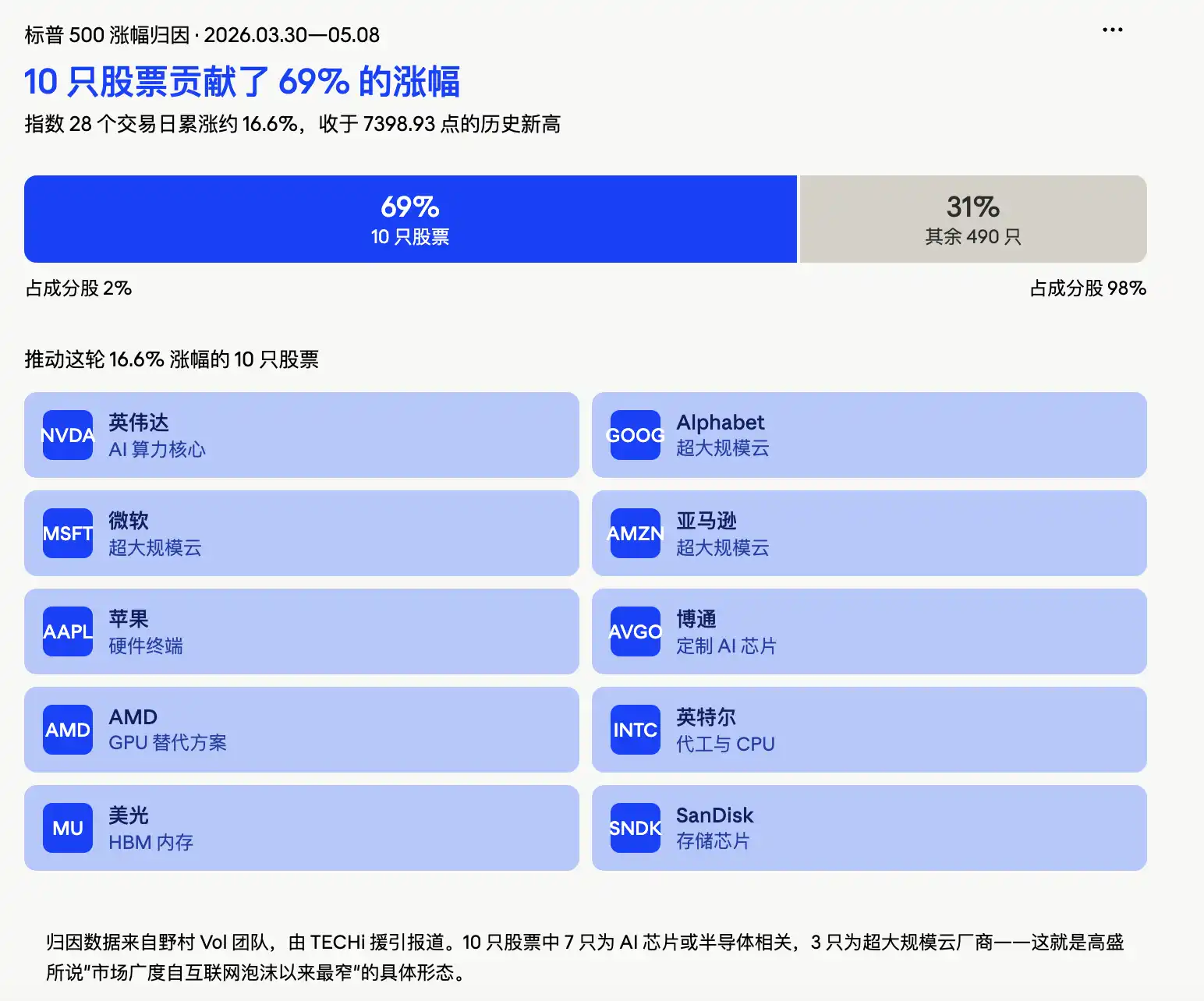
The Shorts Have Been Squeezed Out, Who Will Push the Next Leg?

The real killer judgment in Nomura's report isn't the "anomalous combo" itself, but its dissection of fund flows: Quant funds' equity exposure has recovered to near neutral, and the process of forced buying and short covering is largely complete. CTA (Commodity Trading Advisor) funds have largely returned to full long positions, and the marginal incremental demand from volatility control strategies is also waning.

In other words, the three main buying forces that drove AI stocks higher in recent weeks—shorts being squeezed, CTAs adding positions, and declining volatility prompting vol-control funds to add leverage—are all nearing their limits. If AI stocks are to continue rising, they can no longer primarily rely on the "short squeeze" buying force.

It's important to note that Nomura's estimates of quant fund, CTA, and macro fund positioning are based on model calculations, not actual measured holdings. This makes them better suited as a temperature gauge for marginal changes rather than a precise positioning table. Even so, the direction is clear: Programmatic buying from the institutional side is nearing its limits, and subsequent upward momentum must rely more on retail and sentiment-driven capital.

Goldman's trading desk largely agrees with Nomura's assessment. Goldman's One-Delta trading desk head Rich Privorotsky recently described the current pace as "semi-irrational chasing," drawing a comparison to 1999, when overflowing telecom equipment orders provided a "physical bottleneck narrative," similar to the current logic of AI compute scarcity. Goldman's volatility trading desk characterized recent dynamics as "spot up, volatility up," which limits the space for systematic strategies to add further positions.

This assessment means the U.S. stock AI trade isn't breaking, but the script of "pushing higher by squeezing shorts" is nearing its end.

Korean Stocks Provide the Answer: On the Day of Nomura's Report, KOSPI Surges 4.32%, Triggering Buy-Side Sidecar

Another judgment in Nomura's report was: For the AI trade to have another leg, the true signal for continuation would be to watch for a resurgence of FOMO in Korea.

The Korean market responded with an extreme outburst on the very day the report was released. The KOSPI closed at 7822.24 points, up 4.32% for the day, touching 7899.32 points during the session, which triggered a buy-side sidecar. SK Hynix surged 11.98% to 1.888 million KRW, with its market cap surpassing Eli Lilly for the first time to become the 14th largest globally. Samsung Electronics rose 6.33% to 285,500 KRW. The combined market cap of the two companies exceeded 3,000 trillion KRW, accounting for nearly half of the KOSPI's total market cap. The combined market cap of the Korean stock market (KOSPI and KOSDAQ) exceeded 7,000 trillion KRW for the first time, just 8 trading days after breaking 6,000 trillion KRW on October 27th.

During the May 12th session, the KOSPI further broke above 3900 points (the 7900-point level), setting another new all-time high. However, data from the same day revealed the other side of FOMO: Of the 948 stocks on the KOSPI, only 186 rose while 696 fell; approximately 30% of the index constituents have fallen year-to-date. Gains were entirely concentrated in the two semiconductor heavyweights, Samsung and SK Hynix.

A retail FOMO has already spawned new market vocabulary. Korean financial media uses "hynix FOMO" to describe the psychological divide among retail investors: on one side, the regret of missing out ("I should have bought at 800,000 KRW"), and on the other, the anxiety of "should I jump in now?" and "a correction is coming soon." Retail communities are flooded with discussions about "Samjeon-nix" (a portmanteau of Samsung + Hynix). This is a typical retail-driven chasing pattern, highly consistent with the "FOMO signal" Nomura defined.

The flow of foreign capital is even more telling. According to a Seoul Economic Daily report on May 10th, the iShares MSCI Korea ETF (EWY) saw net outflows of $1.0145 billion between May 1st and 7th, a signal of passive fund withdrawal from the Korean market. However, during the same period, the Roundhill Active DRAM ETF saw net inflows of $1.9538 billion. This ETF has a 25.94% weighting in SK Hynix and 21.62% in Samsung Electronics, totaling about 48%. Foreign capital isn't selling Korea, they are selling broad-based ETFs and buying chips, a precise overweighting of the AI theme.

One detail warrants caution. Nomura's May 11th report pointed out that the KOSPI 200 also showed "spot up, volatility up," but the call skew didn't rise alongside it. This doesn't look like volatility expansion driven by call-buying chase demand. In other words, as of the report's release, the Korean market had not yet entered a typical "fear of missing out, scrambling for calls" state. Whether this signal reverses quickly after the KOSPI's surge that day will be key to judging the sustainability of the FOMO.
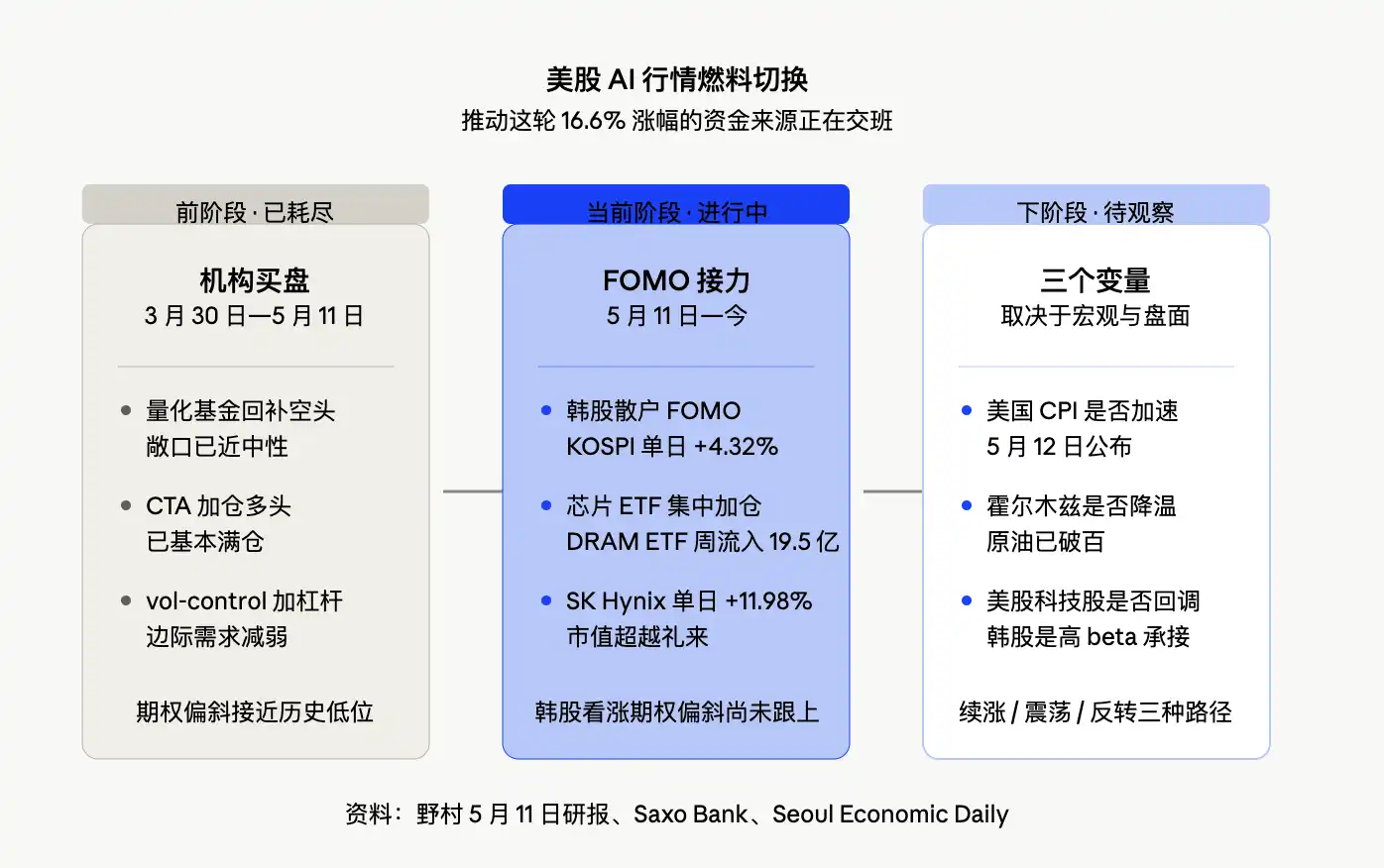
Korean Stocks are an Extension of the U.S. AI Capex Chain; How Long the Next Leg Lasts Depends on the "Pyramid's Apex"

The Korean FOMO is not an isolated event; it's essentially a high-beta extension of the U.S. stock AI capital expenditure story.

Data directly anchors this transmission chain. According to Bridgewater estimates, Alphabet, Amazon, Meta, and Microsoft are projected to collectively invest around $650 billion in AI-related infrastructure in 2026. Goldman Sachs cites data showing that the consensus estimate for the largest cloud infrastructure companies' 2026 capex jumped by $130 billion last quarter to $670 billion, equivalent to over 90% of these companies' projected operating cash flow. Microsoft's Q3 capex reached $31.9 billion, Alphabet's Q1 property and equipment purchases were $35.7 billion, and Meta raised its 2026 capex guidance to a range of $125-145 billion.

This money flows into data centers, GPUs, memory, networking, power systems, and cloud capacity. SK Hynix and Samsung sit at the core of this money flow, with HBM4 memory and high-bandwidth memory being snapped up by hyperscale cloud providers. According to a Reuters report, SK Hynix recently received "unprecedented" order proposals from major tech companies, with some customers proactively offering to help finance new production lines and ASML lithography machines. Chip capacity is essentially sold out. This is why the KOSPI's single-day 4.32% surge is narratively coherent—Korean stocks are essentially the "second derivative" of the U.S. AI story.

But this linkage also implies vulnerability. If U.S. tech stocks experience a full-scale reversal, Korean stocks would be the most direct high-beta asset to bear the selling pressure. Another risk path mentioned by Nomura is a resurgence of inflation forcing global central banks to be more hawkish. This week's (May 12th) U.S. CPI is a key event, yet the premium in options markets for this event remains low; the market hasn't paid a high insurance premium for this risk yet.

There's one more variable in the macro backdrop: The Strait of Hormuz. WTI crude closed at $100.09 on May 8th (+4.89%), Brent crude at $105.66 (+4.31%). Conflict near the Strait of Hormuz continues to escalate. Nomura's judgment is: As long as the Strait remains obstructed and the U.S. and Iran remain divided on ceasefire terms, the AI-dominated market environment may last longer than expected. Energy price shocks will lift inflation expectations but could also make the market even more reluctant to leave "the AI story that's making money."

Layering these clues together: The phase of the U.S. stock AI rally driven by "squeezing shorts" is nearing its end. Korean FOMO has been ignited, with retail and foreign chip ETFs adding positions in sync, but the option skew hasn't caught up yet. How long the next leg lasts depends on whether U.S. tech stocks correct, whether U.S. CPI signals accelerating inflation, and whether the Strait of Hormuz ultimately cools down. Nomura's report's judgment framework is being validated one by one by market action. Seoul is becoming the latest epicenter of this AI trade.


Câu hỏi Liên quan

QAccording to Nomura's report, what are the three main forces behind the recent AI stock rally in the US market, and why is their influence now considered to be nearing its limit?

AThe three main forces identified are: 1) Short covering (shorts being squeezed), 2) CTA (Commodity Trading Advisors) funds adding long positions, and 3) Volatility-control strategies increasing leverage as volatility receded. Their influence is nearing its limit because quantitative fund equity exposure is back near neutral, CTAs are mostly back to full long positions, and the 'spot up, VIX up' dynamic has limited the room for further systematic buying from these strategies.

QWhy does the article suggest South Korea's stock market (KOSPI) has become a focal point for the next phase of the AI trade, and what evidence supports this?

AThe article suggests South Korea is the next focal point because its market exhibited classic FOMO (Fear Of Missing Out) behavior driven by retail investors, precisely as predicted by Nomura's report. Evidence includes: KOSPI's 4.32% single-day surge triggering a buy-side circuit breaker; SK Hynix rising nearly 12% and Samsung Electronics rising over 6%; massive inflows into the Roundhill Active DRAM ETF concentrated on chip stocks; and the emergence of 'hynix FOMO' sentiment among Korean retail investors.

QWhat does the 'spot up, volatility up' dynamic observed in US indices like the Nasdaq indicate, and why is it considered an 'abnormal signal'?

AThe 'spot up, volatility up' dynamic means that while stock indices are hitting record highs, the CBOE Volatility Index (VIX) and Nasdaq Volatility Index (VXN) are also rising. This is considered an abnormal or contrary signal because typically, when markets rally to new highs, investor fear subsides, leading to lower volatility (VIX down). The concurrent rise suggests institutional investors are still hedging against potential downside even as prices climb, indicating underlying caution and crowded positioning.

QHow is the Korean stock market's AI rally fundamentally linked to the AI capital expenditure story in the US?

AThe Korean stock market's AI rally is a high-beta extension of the US AI capital expenditure story. Massive AI infrastructure spending by US tech giants like Alphabet, Amazon, Meta, and Microsoft (estimated at hundreds of billions annually) flows directly into data center components, including high-bandwidth memory (HBM) and DRAM chips. South Korean firms SK Hynix and Samsung Electronics are dominant suppliers in this critical segment. Therefore, the surge in their stock prices reflects the intense demand and 'scarcity narrative' downstream from US tech capital spending.

QAccording to the article, what are the key risks that could determine how long the current phase of the AI trade, centered on Korea, can last?

AThe key risks are: 1) A significant correction or reversal in US tech stocks, which would directly pressure high-beta Korean chip stocks. 2) US CPI data showing accelerating inflation, which could force central banks into more hawkish policies and disrupt the low-rate environment favorable for growth stocks. 3) Escalation of conflict around the Strait of Hormuz, which could spike oil prices, increase inflation fears, and create broader market instability.

Nội dung Liên quan

Kraken Lên Kế Hoạch Cung Cấp Hợp Đồng Tương Lai Vĩnh Viễn Được CFTC Quy Định Cho Nhà Giao Dịch Chuyên Nghiệp Hoa Kỳ

Kraken đang chuẩn bị ra mắt hợp đồng tương lai vĩnh viễn được CFTC quản lý cho các nhà giao dịch chuyên nghiệp đủ điều kiện tại Hoa Kỳ. Sản phẩm sẽ được cung cấp thông qua sàn phái sinh Bitnomial mà Kraken đã mua lại và dự kiến tích hợp vào nền tảng Kraken Pro. Hợp đồng tương lai vĩnh viễn là sản phẩm phái sinh crypto lớn toàn cầu, cho phép giao dịch không ngày đáo hạn. Tại Mỹ, các hạn chế quy định trước đây khiến nhà giao dịch có ít lựa chọn trong nước. Động thái của Kraken nhằm thu hẹp khoảng cách này, cung cấp một con đường được quản lý để tiếp cận sản phẩm chi phối khối lượng giao dịch crypto ở nước ngoài. Việc ra mắt sẽ tập trung vào các nhà giao dịch chuyên nghiệp đủ điều kiện. Các yếu tố cần theo dõi bao gồm điều khoản về tính đủ điều kiện, thiết kế hợp đồng, tài sản được hỗ trợ và quan trọng nhất là thanh khoản khi ra mắt. Thành công của sản phẩm có thể mở đường cho nhiều sản phẩm tương lai vĩnh viễn được quản lý khác tại thị trường Mỹ, đưa sản phẩm phái sinh chủ chốt này tiến gần hơn đến cơ sở hạ tầng thị trường nội địa được quản lý.

bitcoinist9 giờ trước

Kraken Lên Kế Hoạch Cung Cấp Hợp Đồng Tương Lai Vĩnh Viễn Được CFTC Quy Định Cho Nhà Giao Dịch Chuyên Nghiệp Hoa Kỳ

bitcoinist9 giờ trước

Sự Ra Mắt Của Warsh: Chủ Tịch Fed Hiểu Crypto Nhất Lịch Sử Sẽ Mang Đến Bất Ngờ Hay Cú Sốc Cho Thị Trường?

Tân Chủ tịch Cục Dự trữ Liên bang Kevin Warsh, người được mệnh danh là chủ tịch FED "hiểu rõ về Crypto nhất trong lịch sử", sắp có buổi họp báo chính sách đầu tiên trong bối cảnh thử thách ba mặt: lạm phát quay trở lại, áp lực giảm lãi suất từ Tổng thống Trump và kỳ vọng thị trường về việc tăng lãi suất. Khác với người tiền nhiệm, Warsh có cái nhìn sâu sắc về tài sản số, từng coi Bitcoin như "cảnh sát tốt cho chính sách" và nhấn mạnh giá trị sản xuất của ngành công nghiệp blockchain. Tuy nhiên, ông cũng nổi tiếng là người theo chủ nghĩa diều hâu về lạm phát. Sự kết hợp giữa "lãi suất chặt chẽ" và "quy định thân thiện" từ ông có thể trở thành yếu tố cốt lõi định giá tài sản mã hóa. Bài viết phân tích tác động từ ba khía cạnh: 1. **Chuyển đổi khuôn mẫu kỳ vọng quy định:** Từ phòng thủ sang tích hợp và đổi mới, có thể thúc đẩy các khung pháp lý rõ ràng hơn, hỗ trợ ổn định do khu vực tư nhân phát hành. 2. **Định giá lại lộ trình lãi suất và phần bù rủi ro:** Một chủ tịch hiểu biết và giao tiếp rõ ràng có thể giảm bớt phí bảo hiểm bất định, có lợi về cấu trúc cho thị trường. 3. **Tái phân bổ dòng vốn toàn cầu:** Kinh nghiệm đầu tư cá nhân của Warsh truyền tải tín hiệu về sự chấp nhận chính thống, có thể thúc đẩy các quỹ thể chế truyền thống phân bổ tài sản số. Hai kịch bản chính được đưa ra: * **Ngạc nhiên thú vị:** Nếu Warsh thể hiện thái độ ôn hòa và công nhận giá trị của tài sản số, thị trường có thể được tiếp thêm sức mạnh. * **Cú sốc:** Nếu ông phát tín hiệu tăng lãi suất mạnh mẽ, tài sản rủi ro, bao gồm crypto, có thể chịu áp lực bán. Mặc dù Warsh đã bán các khoản nắm giữ liên quan đến crypto để tuân thủ quy tắc đạo đức, nhưng sự hiểu biết thực sự của ông về công nghệ blockchain được kỳ vọng sẽ đặt nền tảng cho việc chính thống hóa tài sản số về lâu dài, vượt ra ngoài các phản ứng thị trường ngắn hạn.

marsbit9 giờ trước

Sự Ra Mắt Của Warsh: Chủ Tịch Fed Hiểu Crypto Nhất Lịch Sử Sẽ Mang Đến Bất Ngờ Hay Cú Sốc Cho Thị Trường?

marsbit9 giờ trước

XRP Ledger Ra Mắt Rebrand XRPLd Cùng Với Bản Nâng Cấp Phiên Bản 3.2.0

Phiên bản 3.2.0 của XRP Ledger đã chính thức ra mắt, đánh dấu một bước nâng cấp quan trọng cho cơ sở hạ tầng blockchain cốt lõi. Lần này, các nhà phát triển đã đổi tên phần mềm vận hành mạng từ "rippled" thành "xrpld" để phù hợp hơn với toàn bộ hệ sinh thái của dự án. Bản cập nhật tập trung chủ yếu vào các cải tiến back-end và hiệu suất thay vì tính năng người dùng mới. Các tối ưu hóa bộ nhớ được giới thiệu có khả năng tiết kiệm tới 40% lượng bộ nhớ máy chủ, đồng thời chuẩn bị kiến trúc phần mềm cho việc mở rộng quy mô trong tương lai. Về mặt bảo mật, bản sửa đổi `fixCleanup3_2_0` mang lại nhiều cải thiện cho các mô-đun như kho lưu ký tài sản đơn, giao thức cho vay, sàn giao dịch phi tập trung và mã thông báo đa năng. Các kiểm tra bất biến mới được thêm vào để đảm bảo tính toàn vẹn của sổ cái khi tài khoản bị xóa. Một khả năng mới cho nhà phát triển là ứng dụng có thể truy xuất thông tin định nghĩa giao thức và máy chủ XRP Ledger mà không cần kết nối trực tiếp, hỗ trợ đáng kể việc phát triển ví, công cụ khám phá chuỗi khối và API. Các thay đổi về khả năng mở rộng và ổn định bao gồm kích thước khối có thể cấu hình, hỗ trợ lưu trữ cơ sở dữ liệu hiệu quả qua nuDB, và việc hỗ trợ máy chủ gRPC cho TLS/mutual TLS trở thành tùy chọn. Cổng kết nối ngang hàng mặc định cũng được đổi từ 51235 sang 2459. Các tính năng kiểm tra bất biến giao dịch tạm thời bị vô hiệu hóa trong phiên bản 3.2.0 do ảnh hưởng đến hiệu suất, nhưng không gây rủi ro bảo mật.

TheNewsCrypto9 giờ trước

XRP Ledger Ra Mắt Rebrand XRPLd Cùng Với Bản Nâng Cấp Phiên Bản 3.2.0

TheNewsCrypto9 giờ trước

AGI không phải là điểm kết thúc, nghiên cứu mới của DeepMind: Hướng tới ASI, tiến bộ AI thực sự mới chỉ bắt đầu

DeepMind mới đây công bố nghiên cứu cho rằng AGI (Trí tuệ nhân tạo phổ quát) không phải là điểm cuối. AI sẽ tiếp tục phát triển vượt qua khả năng của các nhóm chuyên gia con người hàng đầu, hướng tới ASI (Trí tuệ siêu nhân tạo). Báo cáo phân biệt ba khái niệm: AGI (năng lực nhận thức tương đương mức trung bình của con người), ASI (vượt trội con người trong hầu hết lĩnh vực quan tâm), và UAI (giới hạn lý thuyết tối thượng). Nghiên cứu đề xuất bốn con đường tiềm năng để chuyển từ AGI sang ASI: 1. Mở rộng quy mô tính toán, mô hình và dữ liệu. 2. Tiến hóa thuật toán, có thể thay đổi mô hình mới. 3. Tự cải thiện đệ quy, tạo phản hồi tích cực. 4. Điều phối đa tác tử và trí tuệ tập thể. Đồng thời, báo cáo chỉ ra sáu điểm nghẽn chính: giới hạn dữ liệu chất lượng cao, áp lực tài nguyên và kinh tế, hạn chế của mô hình mạng nơ-ron hiện tại, nghiên cứu ngày càng khó khăn, rào cản trừu tượng, cùng các vấn đề quản lý và phản ứng xã hội. Khi AI vượt con người, các phương pháp đánh giá truyền thống sẽ mất ý nghĩa. Cần xây dựng hệ thống đánh giá mới cho thời kỳ hậu AGI. ASI không phải là hệ thống toàn năng, vẫn chịu ràng buộc bởi các quy luật vật lý, độ phức tạp tính toán, dữ liệu, tài nguyên và tốc độ phản hồi thực tế. Tương lai phát triển của AI vẫn chứa nhiều bất định, đòi hỏi một nỗ lực liên ngành quy mô lớn để theo dõi và ứng phó.

marsbit10 giờ trước

AGI không phải là điểm kết thúc, nghiên cứu mới của DeepMind: Hướng tới ASI, tiến bộ AI thực sự mới chỉ bắt đầu

marsbit10 giờ trước

Kraken Ra Mắt Hợp Đồng Perpetual Trước IPO Cho OpenAI Và Anthropic Với Đòn Bẩy Lên Đến 5x

Kraken đã ra mắt hợp đồng tương lai vĩnh viễn (perps) tiền IPO cho hai công ty trí tuệ nhân tạo hàng đầu là OpenAI và Anthropic. Các hợp đồng này cho phép các nhà giao dịch đủ điều kiện mở vị thế mua (long) hoặc bán (short) đối với các công ty tư nhân được theo dõi sát sao này trước khi họ lên sàn chứng khoán, với đòn bẩy lên tới 5x. Sản phẩm này đánh dấu một bước tiến trong việc mở rộng cơ sở hạ tầng phái sinh tiền mã hóa sang các tài sản ngoài chuỗi, cung cấp cho các nhà giao dịch một cách tiếp cận thay thế để có thể tiếp xúc với các công ty tư nhân vốn thường khó tiếp cận. Tuy nhiên, hợp đồng tiền IPO có những rủi ro đặc thù. Khác với các hợp đồng vĩnh viễn cho tiền mã hóa có giá cả minh bạch, định giá công ty tư nhân phụ thuộc vào nhiều yếu tố như các vòng gọi vốn, giao dịch thứ cấp và kỳ vọng về thời điểm IPO. Điều này khiến việc định giá và quản lý rủi ro trở nên phức tạp hơn. Việc sử dụng đòn bẩy cao có thể khuếch đại lợi nhuận nhưng cũng làm gia tăng đáng kể rủi ro thua lỗ và thanh lý. Do đó, các nhà giao dịch cần hiểu rõ bản chất của sản phẩm mới và các rủi ro độc đáo của thị trường tư nhân trước khi tham gia.

bitcoinist11 giờ trước

Kraken Ra Mắt Hợp Đồng Perpetual Trước IPO Cho OpenAI Và Anthropic Với Đòn Bẩy Lên Đến 5x

bitcoinist11 giờ trước

Giao dịch

Giao ngay
Hợp đồng Tương lai

Bài viết Nổi bật

Làm thế nào để Mua NOM

Chào mừng bạn đến với HTX.com! Chúng tôi đã làm cho mua Nomina (NOM) trở nên đơn giản và thuận tiện. Làm theo hướng dẫn từng bước của chúng tôi để bắt đầu hành trình tiền kỹ thuật số của bạn.Bước 1: Tạo Tài khoản HTX của BạnSử dụng email hoặc số điện thoại của bạn để đăng ký tài khoản miễn phí trên HTX. Trải nghiệm hành trình đăng ký không rắc rối và mở khóa tất cả tính năng. Nhận Tài khoản của tôiBước 2: Truy cập Mua Crypto và Chọn Phương thức Thanh toán của BạnThẻ Tín dụng/Ghi nợ: Sử dụng Visa hoặc Mastercard của bạn để mua Nomina (NOM) ngay lập tức.Số dư: Sử dụng tiền từ số dư tài khoản HTX của bạn để giao dịch liền mạch.Bên thứ ba: Chúng tôi đã thêm những phương thức thanh toán phổ biến như Google Pay và Apple Pay để nâng cao sự tiện lợi.P2P: Giao dịch trực tiếp với người dùng khác trên HTX.Thị trường mua bán phi tập trung (OTC): Chúng tôi cung cấp những dịch vụ được thiết kế riêng và tỷ giá hối đoái cạnh tranh cho nhà giao dịch.Bước 3: Lưu trữ Nomina (NOM) của BạnSau khi mua Nomina (NOM), lưu trữ trong tài khoản HTX của bạn. Ngoài ra, bạn có thể gửi đi nơi khác qua chuyển khoản blockchain hoặc sử dụng để giao dịch những tiền kỹ thuật số khác.Bước 4: Giao dịch Nomina (NOM)Giao dịch Nomina (NOM) dễ dàng trên thị trường giao ngay của HTX. Chỉ cần truy cập vào tài khoản của bạn, chọn cặp giao dịch, thực hiện giao dịch và theo dõi trong thời gian thực. Chúng tôi cung cấp trải nghiệm thân thiện với người dùng cho cả người mới bắt đầu và người giao dịch dày dạn kinh nghiệm.

Tổng lượt xem 321Xuất bản vào 2025.09.30Cập nhật vào 2026.06.02

Làm thế nào để Mua NOM

Thảo luận

Chào mừng đến với Cộng đồng HTX. Tại đây, bạn có thể được thông báo về những phát triển nền tảng mới nhất và có quyền truy cập vào thông tin chuyên sâu về thị trường. Ý kiến ​​của người dùng về giá của NOM (NOM) được trình bày dưới đây.

活动图片












