AI Inference Bills Soar, Shopify and Roblox Warn: Savings from Layoffs Not Enough to Cover Chip Costs

marsbitXuất bản vào 2026-05-11Cập nhật gần nhất vào 2026-05-11

Tóm tắt

The 2026 Q1 earnings season reveals a paradox: while AI helps companies freeze hiring and boost productivity, the soaring costs of AI inference—token consumption and GPU depreciation—are eroding savings from workforce reductions. Shopify reported that AI now writes over 50% of its code, enabling significant output with stable headcount. However, LLM costs, driven by heavy usage of its AI assistant Sidekick, are pressuring its subscription毛利率. Similarly, Roblox attributed a quarter of its full-year利润率下调 to increased AI investment. The article highlights a broader industry imbalance: combined AI capital expenditure for Amazon, Meta, Microsoft, and Google is projected to reach $725 billion in 2026, vastly outpacing potential savings from layoffs. For instance, Meta's planned裁员 would save about $2.4 billion annually, offsetting only ~12% of its incremental AI depreciation. While底层 model and chip suppliers like NVIDIA maintain high profitability, application-layer companies face a pricing squeeze. Their strategies now involve要么 tightly linking AI costs to user engagement (like Shopify) or introducing fees for advanced AI features (like Roblox), as covering AI bills with裁员 savings alone is financially unsustainable.

Author: Claude, Deep Chao TechFlow

Deep Chao Introduction: The Q1 2026 earnings season for tech giants reveals a new phenomenon: while AI helps companies freeze hiring and cut positions, its own token consumption and GPU depreciation are inversely eroding gross margins. Shopify's subscription business gross margin is being suppressed by LLM costs, with about a quarter of Roblox's full-year margin guidance downgrade directly attributed to incremental AI investments. The combined AI capital expenditures of Amazon, Meta, Microsoft, and Google will reach $725 billion in 2026, a 77% year-over-year increase. For the first time, the two ends of the AI dividend—labor savings and compute consumption—are being accounted for on the same balance sheet in the same quarter, with the latter clearly larger.

The first-quarter earnings season is applying a corrective patch to the simplistic narrative of 'AI replacing labor.'

While a group of tech companies report successes in hiring freezes and accelerated product iteration, they are forced to explain a more棘手 question to investors: soaring AI chip depreciation and unpredictable token consumption are inversely eating up the money saved from layoffs.

Shopify President Harley Finkelstein stated at the May 5, 2026 earnings call that AI now handles over 50% of the company's code writing and helped Shopify deliver over 300 products and features while keeping headcount flat. However, in the same call, management also acknowledged that the gross margin of subscription solutions is being partially offset by large language model (LLM) costs, and this dynamic will persist.

Shopify: The LLM Cost Black Hole Behind an 80% Gross Margin

Shopify's Q1 subscription solutions gross margin was 80%, flat year-over-year, but the cost of maintaining this figure is changing.

According to Shopify's 10-Q filing with the SEC, subscription solutions costs grew 20% year-over-year in Q1 2026, reaching $148 million, compared to $123 million in the same period last year. Cloud and infrastructure costs (including AI-related usage) increased by $22 million as a single line item, being the primary driver of cost expansion. Shopify CFO Jeff Hoffmeister said on the earnings call that scale effects and support efficiency improvements were "partially offset by increased LLM costs, primarily driven by merchant usage of Sidekick, and we expect this dynamic to continue."

Sidekick is Shopify's AI assistant embedded in the platform. Its weekly active shops grew 385% year-over-year this quarter. Merchants used Sidekick to create over 12,000 custom apps this quarter, up more than 200% sequentially, with nearly half of Shopify Flows being AI-generated. AI-driven store traffic grew 8x year-over-year, and orders from AI search grew nearly 13x year-over-year.

But this explosion in usage means exponential growth in AI inference calls. Every interaction a merchant has with Sidekick, every proactive suggestion generated by the Pulse feature, corresponds to a token bill paid to upstream model providers.

Shopify explained the books for "internal AI" and "external AI" separately to investors: using AI internally for coding and controlling personnel expenses is a victory in the "cost game," while providing AI products externally to merchants is a strategic choice to "deeply tie infrastructure costs to merchant usage." Finkelstein summarized this logic on the earnings call as "AI is a structural advantage, not just a cost."

Roblox: One-Quarter of Margin Downgrade Directly from AI

Roblox CFO Naveen Chopra explicitly disclosed at the Q1 2026 earnings call on April 30 that about one-quarter of the full-year margin downgrade relative to prior guidance stems from incremental AI investment and adjustments to DevEx (Developer Exchange) for U.S. users aged 18 and above.

Roblox currently runs over 400 AI models on its own and cloud GPUs, processing 1.5 million inference calls per second, covering scenarios like discovery recommendations, communication safety, marketplace recommendations, and 3D generation.

Management is attempting to slice through inference costs via business model adjustments. Roblox Co-founder and CEO David Baszucki said on the earnings call that the company's upcoming "Roblox Reality" project, a technology capable of running 2K real-time photorealistic video models at 60Hz, will not be offered for free. "This will use cloud compute resources. We will have some form of subscription or payment mechanism, so we believe we can offset the costs on the real-time inference side," Baszucki explained.

Chopra added that the company's 2026 capital expenditure guidance remains unchanged, relying primarily on deploying GPUs in its own data centers to meet inference demand for the year, while some training tasks will still use the cloud. Roblox previously disclosed that by migrating some AI inference workloads from third-party clouds to its own data centers by the end of 2025, it had already achieved a 10x efficiency improvement in specific workloads like safety review and content discovery.

However, Roblox's quarterly full-year guidance includes multiple pressures: the aforementioned incremental AI investment, deleveraging of fixed costs due to lower-than-expected bookings scale, and the DevEx rate increase for 18+ adult content creators to 37.8%, ultimately triggering a market repricing of its full-year margin.

Industry Ledger: $725 Billion Capex vs. $2.7 Billion Salary Savings

The micro cases of Shopify and Roblox sit within a larger macro structural imbalance.

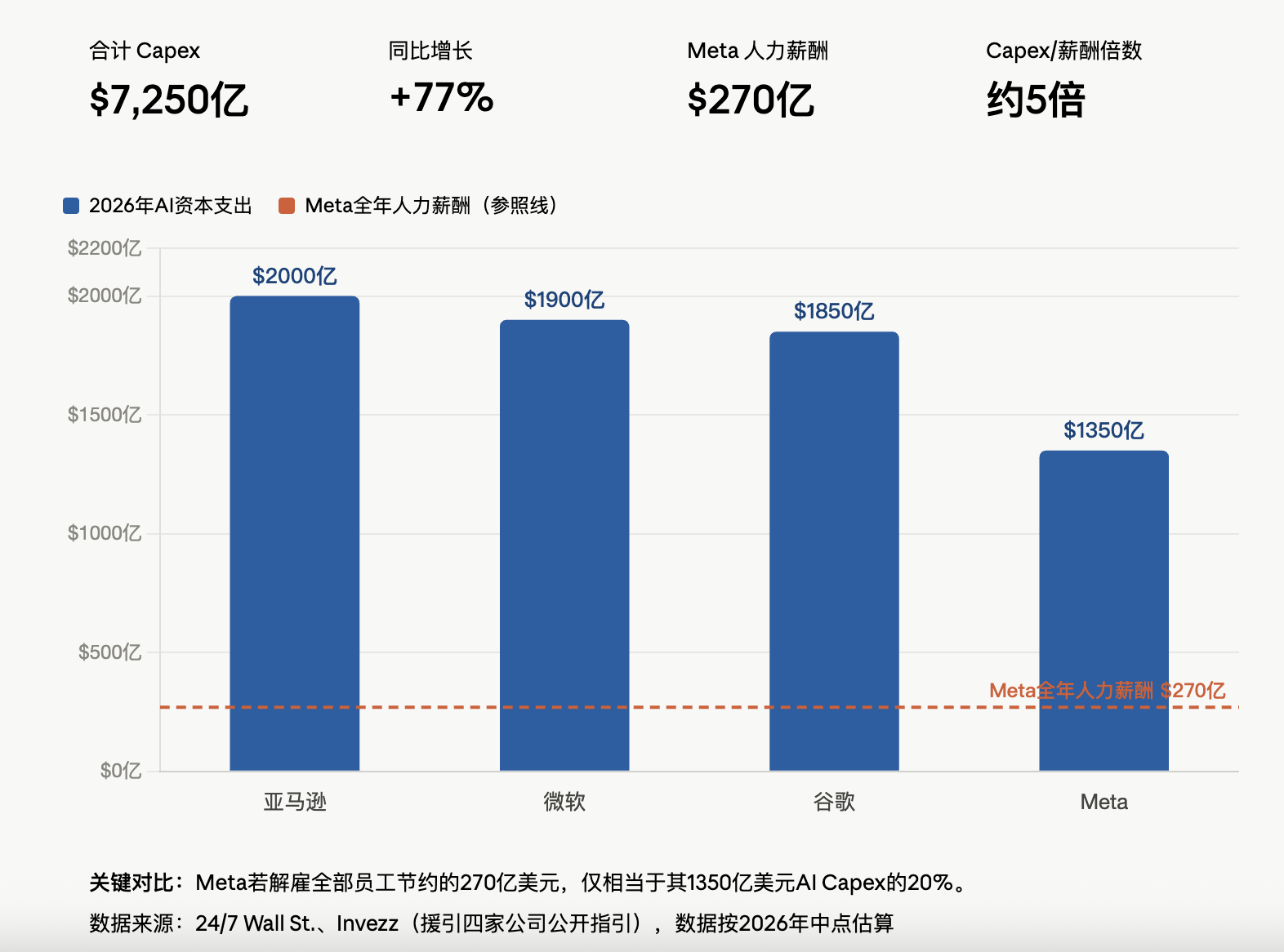
According to data cited by 24/7 Wall St., the combined AI capital expenditures of Amazon, Meta, Microsoft, and Google will reach $725 billion in 2026, a 77% year-over-year increase. Among them, Meta's full-year capex guidance is between $125 billion and $145 billion, meaning a daily expenditure of $370 million on data center construction; Microsoft's 2026 calendar year capex is $190 billion, with Amazon committing $200 billion.

This calculation is quite disproportionate compared to personnel expenses. Meta's total human compensation—all wages, benefits, stock-based compensation—amounts to approximately $27 billion. Even if Meta fired all its employees tomorrow, the savings would be less than one-fifth of its 2026 infrastructure expenditure.

Wedbush Securities analyst Dan Ives estimated in an April 25 research note that Meta's upcoming layoff of 8,000 people could free up about $2.4 billion in annual operating expenses, only offsetting about 12% of the incremental depreciation drag expected in 2026. In other words, for every dollar of financial pressure from AI compute expenditure, nearly ten dollars of human cost savings would be needed to fully offset it.

Meta CFO Susan Li positioned Meta's headcount reduction on the Q4 2025 earnings call as "building a leaner operating model to help offset the massive investments we are making." This statement clearly characterizes layoffs as a financial tool for AI capital expenditure, not a byproduct of productivity gains.
Victory for Model Providers, Dilemma for the Application Layer

The biggest beneficiaries of this ledger博弈 are the underlying model and compute suppliers. Microsoft Cloud gross margin held at 69% under the pressure of AI infrastructure expansion; OpenAI's gross margin is externally estimated at around 50%, Anthropic's at around 60%. Nvidia continued to report a gross margin level of about 70% in fiscal year 2026.

Application-layer companies, especially SaaS players that both consume AI and package AI capabilities into subscription products for sale, are facing a new financial structure: revenue is highly correlated with AI usage intensity, but the cost curve is dictated by upstream model provider pricing, and every model upgrade can bring new token consumption.

In his analysis of AI gross margins, Tanay Jaipuria points out that although the inference cost for a single model is declining at 80%-90% annually, the price of frontier models remains stable or even rises. If application-layer companies insist on calling the strongest model for every request, their Cost of Goods Sold (COGS) is effectively being led by the model providers' price cards.

Shopify's response is to position AI products as a strategic gateway deeply binding traffic and merchants, making the growth in inference costs a proxy indicator for "platform embed depth." Roblox's solution is to strip high-end AI experiences out of the free tier, forcing users to pay for inference costs. Behind both paths lies the same consensus: purely covering AI compute bills with savings from layoffs simply doesn't add up mathematically.


Câu hỏi Liên quan

QAccording to the article, what is the main financial challenge that companies like Shopify and Roblox are facing despite using AI to reduce labor costs?

ACompanies are facing the challenge that the soaring costs of AI chip depreciation and unpredictable token consumption for AI inference are eating up the money saved from layoffs and headcount reductions, creating a negative impact on their profit margins.

QHow much of Shopify's subscription solution cost increase in Q1 2026 was driven by AI-related usage?

AIn Shopify's Q1 2026 subscription solution costs, the 'cloud and infrastructure costs (including AI-related usage)' line item increased by $22 million, which was the primary driver of the total cost expansion compared to the previous year.

QWhat proportion of Roblox's downward revision to its full-year profit margin guidance is directly attributed to AI investments?

AApproximately one-quarter of Roblox's downward revision to its full-year profit margin guidance is directly attributed to incremental AI investments.

QWhat is the estimated total AI capital expenditure for Amazon, Meta, Microsoft, and Google in 2026 according to the data cited?

AThe combined AI capital expenditure for Amazon, Meta, Microsoft, and Google is estimated to reach $725 billion in 2026.

QAccording to the Wedbush Securities analyst's estimate mentioned, how does the cost savings from Meta's potential 8,000-person layoff compare to its incremental AI depreciation cost?

AThe estimated annual operating expense savings from Meta's potential 8,000-person layoff is about $2.4 billion, which would only offset approximately 12% of the incremental depreciation drag expected in 2026 from its AI investments.

Nội dung Liên quan

Khoản phạt của Futu đã trở thành tin tốt cho Hyperliquid?

Tác giả: Thejaswini M A Biên dịch và tổng hợp: BitpushNews Ngày 22/5/2026, Ủy ban Chứng khoán Trung Quốc (CSRC) công bố đề xuất xử phạt nghiêm khắc các công ty môi giới như Tiger Brokers, Futu Securities và Longbridge Securities vì hoạt động kinh doanh xuyên biên giới trái phép. Động thái này bao gồm phạt tiền lớn, tịch thu lợi nhuận, ngừng hoạt động trong hai năm và chỉ cho phép khách hàng hiện tại bán ra. Tin tức khiến cổ phiếu các công ty này giảm hơn 40%. Việc siết chặt các kênh đầu tư xuyên biên giới hợp pháp có thể khiến dòng vốn tìm kiếm cơ hội toàn cầu chuyển hướng sang các nền tảng như Hyperliquid. Hyperliquid, một giao thức phái sinh phi tập trung, đang thu hút sự chú ý và áp lực từ các sàn giao dịch truyền thống như CME Group và ICE. Họ chỉ trích Hyperliquid là nơi tiềm ẩn rủi ro thao túng thị trường và né tránh lệnh trừng phạt do không yêu cầu xác minh danh tính (KYC), không giới hạn vị thế và thiếu hệ thống giám sát. Tuy nhiên, mối quan tâm chính của họ dường như tập trung vào các hợp đồng dầu thô của Hyperliquid, nơi xử lý khối lượng giao dịch 720 triệu USD vào cuối tuần khi thị trường truyền thống đóng cửa, phá vỡ "độc quyền" về thời gian giao dịch. Mặc dù vậy, Hyperliquid vẫn thể hiện hiệu suất ấn tượng. Với chỉ 11 nhân viên, giao thức tạo ra doanh thu 51 triệu USD trong 30 ngày và xử lý khối lượng giao dịch phái sinh danh nghĩa 2,6 nghìn tỷ USD vào tháng 3. Giao thức sử dụng 97% phí giao dịch để mua lại token HYPE. Gần đây, các hợp đồng tương lai vĩnh viễn Pre-IPO cho Cerebras và SpaceX được ra mắt trên nền tảng Trade.xyz xây dựng trên Hyperliquid đã chứng minh khả năng phát hiện giá chính xác đáng chú ý, vượt trội so với các nền tảng chuyển nhượng cổ phần tư nhân truyền thống. Hyperliquid tiếp cận thị trường Pre-IPO thông qua các hợp đồng phái sinh tổng hợp "phi vật chất", không yêu cầu quyền sở hữu cổ phiếu thực tế, khiến nó khó bị các công ty mục tiêu kiện tụng hoặc các cơ quan quản lý nhắm đến hơn so với các mô hình dựa trên tài sản thực như PreStocks hay Ondo. Tuy nhiên, mô hình không KYC và phi tập trung một phần này cũng đặt ra những lo ngại về rủi ro an ninh quốc gia. Người đồng sáng lập Jeff Yan đã đến Washington để thảo luận với các nhà hoạch định chính sách, cho thấy áp lực quản lý đang gia tăng. Dù vậy, lợi thế cốt lõi của Hyperliquid có lẽ nằm ở khả năng cung cấp khả năng tiếp cận và phát hiện giá liên tục, bất kể thời gian hay địa lý.

marsbit4 phút trước

Khoản phạt của Futu đã trở thành tin tốt cho Hyperliquid?

marsbit4 phút trước

Báo cáo đầu tiên của Mythos công bố: Hàng tỷ thiết bị trên toàn cầu đang 'trần như nhộng', phát hiện 10.000 lỗ hổng chết người trong 30 ngày

Báo cáo đầu tiên của Mythos đã công bố: Chỉ trong 30 ngày, AI Claude Mythos Preview từ Anthropic đã phát hiện hơn 10.000 lỗ hổng nghiêm trọng trên toàn cầu, thậm chí ngăn chặn thành công một vụ lừa đảo chuyển tiền 1,5 triệu USD. Thông qua "Dự án Glasswing", với sự tham gia của khoảng 50 công ty công nghệ và cơ sở hạ tầng quan trọng, mô hình AI này đã quét các dự án mã nguồn mở và hệ thống độc quyền, làm lộ ra hàng nghìn lỗ hổng nguy hiểm, bao gồm cả những lỗi tiềm ẩn hơn 27 năm. Khả năng tự động xây dựng chuỗi khai thác và tỷ lệ dương tính thật cao 90,6% đã gây sốc cho giới an ninh mạng. Tuy nhiên, lượng báo cáo khổng lồ đã tạo ra cuộc khủng hoảng mới: tốc độ sửa lỗi của con người không theo kịp AI. Anthropic đang phát triển bộ công cụ tự động hóa như Claude Security để hỗ trợ vá lỗi, đồng thời hết sức thận trọng trước khi phát hành công khai Mythos vì lo ngại nguy cơ bị lạm dụng. Tương lai hứa hẹn một thế giới phần mềm an toàn hơn, nhưng hiện tại là giai đoạn chuyển đổi đầy thách thức.

marsbit1 giờ trước

Báo cáo đầu tiên của Mythos công bố: Hàng tỷ thiết bị trên toàn cầu đang 'trần như nhộng', phát hiện 10.000 lỗ hổng chết người trong 30 ngày

marsbit1 giờ trước

Cha đẻ của AlphaGo cho AI vào xã hội nhân tạo 23 năm: Ba điểm khó nhất của tác tử thông minh đều ở đây

Giám đốc điều hành DeepMind, cha đẻ AlphaGo Demis Hassabis, đã chọn EVE Online - một trò chơi không gian MMORPG đã vận hành suốt 23 năm - làm "vũ trụ sống" mới để nghiên cứu AI. Hợp tác này nhằm giải quyết ba thách thức lớn nhất của tác nhân AI hiện nay: lập kế hoạch dài hạn (long-horizon planning), trí nhớ (memory) và học tập liên tục (continual learning). Khác với các trò chơi có ván đấu kết thúc như Go hay StarCraft, EVE Online là một vũ trụ duy nhất, tồn tại liên tục, nơi người chơi xây dựng các hệ thống kinh tế, liên minh chính trị và kế hoạch chiến tranch kéo dài hàng năm. Môi trường phức tạp, do chính người chơi định hình này là bài kiểm tra lý tưởng cho các khả năng mà AI cần. Nghiên cứu ban đầu sẽ được thực hiện trong một phiên bản EVE Offline, trên máy chủ cục bộ, đảm bảo môi trường kiểm soát và không ảnh hưởng đến máy chủ chính thức. Lựa chọn này đánh dấu bước tiến trong lộ trình nghiên cứu của DeepMind: từ môi trường quy tắc cố định (Atari, Go) đến thế giới mở, tồn tại lâu dài và tiến hóa tự nhiên như EVE. Động thái này cho thấy xu hướng mới: thay vì tạo ra môi trường tổng hợp, các nhà nghiên cứu đang tìm đến những "xã hội nhân tạo" đã được kiểm chứng độ phức tạp qua thời gian dài để huấn luyện và đánh giá tác nhân AI thông minh hơn.

marsbit1 giờ trước

Cha đẻ của AlphaGo cho AI vào xã hội nhân tạo 23 năm: Ba điểm khó nhất của tác tử thông minh đều ở đây

marsbit1 giờ trước

Giao dịch

Giao ngay
Hợp đồng Tương lai

Bài viết Nổi bật

Làm thế nào để Mua CHIP

Chào mừng bạn đến với HTX.com! Chúng tôi đã làm cho mua USD.AI (CHIP) trở nên đơn giản và thuận tiện. Làm theo hướng dẫn từng bước của chúng tôi để bắt đầu hành trình tiền kỹ thuật số của bạn.Bước 1: Tạo Tài khoản HTX của BạnSử dụng email hoặc số điện thoại của bạn để đăng ký tài khoản miễn phí trên HTX. Trải nghiệm hành trình đăng ký không rắc rối và mở khóa tất cả tính năng. Nhận Tài khoản của tôiBước 2: Truy cập Mua Crypto và Chọn Phương thức Thanh toán của BạnThẻ Tín dụng/Ghi nợ: Sử dụng Visa hoặc Mastercard của bạn để mua USD.AI (CHIP) ngay lập tức.Số dư: Sử dụng tiền từ số dư tài khoản HTX của bạn để giao dịch liền mạch.Bên thứ ba: Chúng tôi đã thêm những phương thức thanh toán phổ biến như Google Pay và Apple Pay để nâng cao sự tiện lợi.P2P: Giao dịch trực tiếp với người dùng khác trên HTX.Thị trường mua bán phi tập trung (OTC): Chúng tôi cung cấp những dịch vụ được thiết kế riêng và tỷ giá hối đoái cạnh tranh cho nhà giao dịch.Bước 3: Lưu trữ USD.AI (CHIP) của BạnSau khi mua USD.AI (CHIP), lưu trữ trong tài khoản HTX của bạn. Ngoài ra, bạn có thể gửi đi nơi khác qua chuyển khoản blockchain hoặc sử dụng để giao dịch những tiền kỹ thuật số khác.Bước 4: Giao dịch USD.AI (CHIP)Giao dịch USD.AI (CHIP) dễ dàng trên thị trường giao ngay của HTX. Chỉ cần truy cập vào tài khoản của bạn, chọn cặp giao dịch, thực hiện giao dịch và theo dõi trong thời gian thực. Chúng tôi cung cấp trải nghiệm thân thiện với người dùng cho cả người mới bắt đầu và người giao dịch dày dạn kinh nghiệm.

Tổng lượt xem 325Xuất bản vào 2026.04.21Cập nhật vào 2026.04.21

Làm thế nào để Mua CHIP

Thảo luận

Chào mừng đến với Cộng đồng HTX. Tại đây, bạn có thể được thông báo về những phát triển nền tảng mới nhất và có quyền truy cập vào thông tin chuyên sâu về thị trường. Ý kiến ​​của người dùng về giá của CHIP (CHIP) được trình bày dưới đây.

活动图片