On August 8, 2022, tornado cash was sanctioned by OFAC (Office of overseas assets control of the U.S. Department of Finance), and some Ethereum addresses related to the tornado cash agreement were included in the SDN list (the list of specially formulated nationals of the United States).
Since its establishment in 2019, more than $7 billion worth of virtual money laundering has occurred on tornado cash. Brian E. Nelson, deputy secretary of the US Treasury Department, said: "the Treasury Department will continue to take active actions to crack down on mixed currency agreements that help criminals clean virtual currencies."
OFAC's action against tornado cash shows that defi has now become the target of regulatory agencies and cannot escape regulation.
The whole story
1. On August 8, the US Treasury Department listed tornado cash on the sanctions list, prohibiting US citizens and institutions from using it
2. On August 8, circle frozen the usdc funds in the tornado cash wallet address approved by the US Treasury Department
3. On August 9, the GitHub account of the founder / community builder of tornado cash was suspended
4. As of 02:00 on August 9, tornado cash (torn) fell to US $20.44, the largest drop of more than 30% in two days.
5. On August 9, gitcoin suspended its funding for tornado cash
6. On August 9, the blockchain research company elliptic marked the relevant addresses of tornado cash in all chains
7. On August 9, anonymous users sent eth to a large number of famous people through tornado cash
8. On August 10, peckshield pointed out that curve's attackers transferred about 340 eth to tornado cash, fixedfloat and binance respectively
9. As of August 10, tornado cash has transferred more than $40 million of eth since OFAC sanctions
10. Tornado cash has sorted out the list of prohibited resources, including the official website of tornado cash, the GitHub accounts of founders, organizations and participating community builders, all $usdc, infra in the tornado cash agreement_ IO, alchemyplatform, RPC of TC, etc
11. W3. Hitchhiker pointed out that although the front end is forbidden to access, it can be directly called through the smart contract interface. It can also be accessed through IPNs or directly through the CID of IPFs.
Industry attitude
People in the circle, including vitalik, expressed their views on the tornado incident, and most people supported the importance of privacy.
1. Hayden Adam, founder of uniswap: privacy is essential to a normal society
Hayden Adams, the founder of uniswap, tweeted his opinion on the tornado cash time: "privacy is very important to a normal and safe society. It is absurd and dangerous to only focus on privacy to bring convenience to illegal activities. It is usually more effective to sanction companies to make them comply with the law than to come up with reasonable laws or policies."
2. Ryan Sean Adams, founder of bankless: supports digital privacy
On August 10, Ryan Sean Adams tweeted that similar events would not end in tornado cash. Aztec, the layer2 protocol dedicated to protecting privacy, zcash, which has been running for many years, and many other similar tools. Will all encryption privacy tools be defined as illegal in the end? Every country will face this problem sooner or later.
3. Jeremy Allaire, CEO of circle: circle will freeze usdc funds in the tornado cash wallet address approved by the US Treasury Department
Circle said that it would work with coinbase to restrict the flow of usdc funds in these sanctioned addresses, or it would face the charge of deliberately evading the compliance obligations of US sanctions, and the maximum penalty would be 30 years' imprisonment. The regulatory intervention in this case has crossed a major threshold in the history of the Internet and the history of blockchain finance, indicating that the main government is trying to prevent or restrict the functions of open source software on the Internet.
4. Vitalik, founder of Ethereum: This review will be regarded as an attack on Ethereum.
On August 16, 2022, the Ethereum community launched a vote on Twitter to discuss what to do if OFAC starts to supervise Ethereum through verification nodes?
10) The censorship system is regarded as an attack on Ethereum, and the rights and interests of these nodes are burned through a broad consensus.
Y) Tolerance and censorship.
Vitalik said that Ethereum will regard this review as an attack on Ethereum and punish these verifiers to avoid the situation of "being controlled" by Ethereum. At the same time, vitalik also said that the crypto world should be free and have private property rights, rather than those who hold "guns" decide to blow up other people's houses and steal other people's refrigerators.
4. Patrick Hansen, crypto venture capital advisor of insight capital: EU citizens are not affected by the US sanctions against tornado cash.
According to the forthcoming EU regulations, the mixer will be considered as a high-risk transaction. The connected assets will be difficult to sell and need to be justified and may be reported to the financial regulatory authority. He also said that although the regulatory news surprised many people, the existing laws and regulations have restricted the use of encrypted anonymous tools and tokens globally for some time.
Torn market performance:
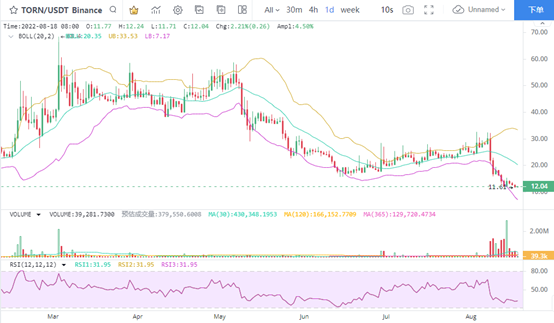
After the sanctions event, tornado token Tron continued to fall, and the price retreated from the short-term high of $30 to the lowest of $11.61, with a maximum drop of 65%. In terms of market value, the circulation market value of torn decreased to US $13.13 million. From the perspective of market performance, investors' expectations after the regulatory force are obviously pessimistic, which is also reflected in the decline of the lock up data on the torn chain and the trend of capital outflow.
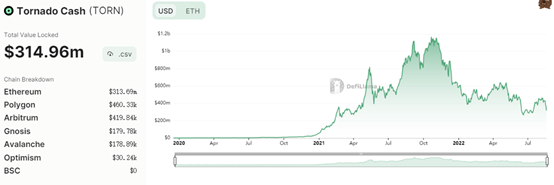
Tornado lock up data distribution
According to tornado cash's lock up data, the overall lock up volume reached 314 million US dollars. Among them, as much as $313 million is locked up on the Ethereum chain, and the rest are locked up on polygon, arbitrum, Gnosis, avalanche and optimism.
After tornado encountered the regulatory storm, its lock up volume continued to decline significantly. From US $451 million in August to US $314 million, a decrease of as much as US $137 million, with a decrease of 30.4%. Judging from this, the impact of regulation on tornado is very obvious, but not fatal.
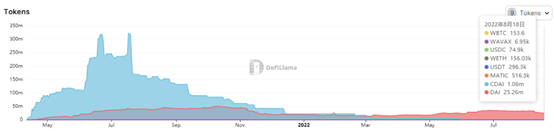
Tornado lock up asset distribution
Tornado's asset distribution is relatively concentrated. The data on August 18 showed that as many as 25.26 million assets were Dai stable coins, followed by 1.06 million assets estimated by CDAI. Compared with 34.31 million assets on August 8, the decline of Dai assets reached 26%. From the performance of the decline, there is no doubt that the regulation has a relatively large impact on the decline of lock up. However, from the downward trend, the scale contraction of Dai assets has slowed down.
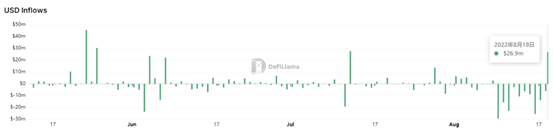
Net capital flow of tornado cash
The capital outflow trend of the mixed currency agreement torn has been within the expectation of most investors. Among the outflows flowing to as many as 10 trading days, the capital outflow scale can reach 29.49 million, 15.71 million and 22.86 million respectively. 2.77 million, 10.73 million, 6.45 million, 8.83 million, 25.33 million, 13.89 million and 6.03 million. The cumulative scale can reach 140 million US dollars. By August 18, the cumulative inflow was as high as US $26.9 million. The flow of funds continued to flow back significantly, and the impact of sanctions appeared to be weakening.
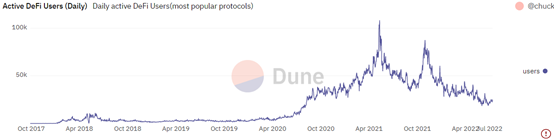
Number of defi users
Although the number of defi users has continued to decrease significantly in the past year, the cumulative number remains around 30000. In terms of quantity, it has dropped significantly from the peak of more than 100000 in 2021.
Market impact
OFAC first regulated the protocol running on the blockchain - Tornado cash privacy mixed currency protocol. A centralized and decentralized "war" immediately started, but the purpose of the regulation was not achieved.
Usdc: after tornado cash was regulated, although the website was blocked, other defi protocols were forced by law to prohibit front-end interaction with addresses related to tornado protocol, and the issuer of usdc pulled the blacklist of regulated wallets to freeze usdc and other regulatory means, the smart contract of tornado cash still runs on Ethereum and cannot be stopped, and users can still interact with it.
Makerdao: OFAC's control of tornado cash has produced a series of chain reactions. A large-scale "poisoning" event began to occur. A large number of addresses were "poisoned" and the front-end interaction was blocked by the def protocol. Moreover, due to the blacklist behavior of the usdc issuing institution, makerdao founder Rune was worried that the blacklist of the maker protocol would lead to the collapse of makerdao. He is planning to sell all the usdcs in makerdao and exchange them for eth as collateral assets.
Eth: at present, Ethereum's beacon chain is in a relatively centralized stage. The first few verifiers have more than 66% of the total equity, and are all subject to regulatory pressure with entity node operators. If OFAC starts to conduct on-line regulatory review on Ethereum, Ethereum will be "controlled" and lose the characteristics of decentralized and anti review, which will have a very serious impact on the industry.
OFAC can control the address on the chain in a real sense by controlling the verifier with the entity node operator as the main body. By monitoring the requests sent by the regulated address and refusing to block the blocks containing these requests, the regulated address can not make any operation and the assets become worthless, which will make Ethereum lose "private property ownership".