XION Introduces On-Chain Email Verification With DKIM and ZK Modules

TheNewsCryptoXuất bản vào 2026-02-10Cập nhật gần nhất vào 2026-02-10

Tóm tắt

XION has introduced protocol-level DKIM and Zero-Knowledge (ZK) modules to enable truly trustless on-chain email verification. By storing email authentication keys directly on the blockchain, XION eliminates reliance on centralized DNS infrastructure, preventing issues like broken proofs due to key rotation. The system currently supports Gmail and Apple Mail, covering over 90% of global email users. The ZK Module allows zero-knowledge proofs to be verified directly on-chain, improving efficiency and enabling users to prove facts from emails—such as employment status or credentials—without revealing personal data. Use cases include anonymous whistleblowing, seedless wallet recovery, private credential verification, and automated ticket resale. This development aims to transform email into a universal, secure trust layer for the internet, supporting broader adoption of verifiable and private digital interactions. Over 150 brands are already building on XION’s expanded verification infrastructure.

Blockchain infrastructure provider XION has unveiled a major initiative that aims to make internet verification truly trustless with the launch of its protocol-level DKIM and Zero-Knowledge (ZK) modules. The launch, announced by the project founder Burnt Banksy, positions XION as the first blockchain to store email authentication keys directly on-chain, eliminating long-standing dependencies on centralized DNS infrastructure.

Email has quietly become the internet’s default identity layer, powering everything from account logins to employment verification. Yet, despite its ubiquity, email authentication has never been fully trustless. Until now.

Traditional email verification relies on DKIM (DomainKeys Identified Mail), a cryptographic standard used by providers like Gmail and Apple Mail to authenticate messages. However, DKIM keys are typically fetched from centralized DNS servers controlled by email providers.

This creates a critical flaw: when providers rotate their DKIM keys, older verification proofs can break. There is no immutable history of past keys, no decentralized fallback, and no way to independently verify emails over time without trusting DNS infrastructure.

Even newer privacy-focused solutions, including zkEmail-based systems, still depend on these centralized DNS lookups. In practice, “trustless” verification has remained partially trust-based.

XION’s On-Chain DKIM Breakthrough

XION’s newly launched DKIM Module addresses this problem at the protocol level. Instead of relying on DNS, XION stores email authentication keys directly in blockchain state, creating a permanent, verifiable historical record of DKIM keys.

This makes XION the first blockchain to support native, on-chain email authentication. Once keys are recorded, they remain verifiable indefinitely – removing the risk of broken proofs caused by key rotation or DNS failures.

At launch, the system supports Gmail and Apple Mail, covering more than 3.8 billion users, or over 90% of global email traffic.

Zero-Knowledge Verification at the Protocol Layer

The DKIM Module works in tandem with XION’s protocol-level ZK Module, which allows zero-knowledge proofs to be verified directly by the blockchain itself rather than through smart contracts. According to XION, this approach is up to ten times more efficient than contract-based verification.

Together, the modules enable users to prove facts derived from their emails—such as employment status, purchases, or credentials—without revealing the email content or personal identity.

In practice, this means a user can cryptographically prove a claim is true while keeping all other information private.

Real-World Use Cases Beyond Crypto

The implications extend well beyond Web3-native applications. With trustless email verification in place, a wide range of real-world use cases becomes viable.

For instance, anonymous whistleblowing becomes safer when individuals can prove they work at a company without revealing their identity, while verified‐but‐anonymous workplace reviews become possible through cryptographic confirmation of employment emails.

The same underlying mechanism enables seedless wallet recovery, using email as a secure cryptographic backup instead of fragile recovery phrases, and supports private credential verification, such as proving graduation without exposing full transcripts. It also unlocks trustless ticket resale, where settlement happens automatically once email‐based proof is validated, and streamlines insurance claims by allowing policy details to be proven directly from authenticated email correspondence.

These use cases rely on infrastructure that already exists, email, rather than forcing users to adopt new identity systems.

A Trust Layer for the Internet

XION frames this launch as part of a broader vision to make verification invisible and universal. As AI-generated content, bots, and impersonation become more prevalent, trust and verification are shifting from optional features to core internet infrastructure.

By making email cryptographically useful at the protocol level, XION aims to turn the internet’s most widely used communication tool into a secure verification layer.

More than 150 brands are already building on XION, and the new modules expand the platform’s existing verification stack, which includes tools like zkTLS for proving web-based data and app attestations for mobile environments.

Burnt Banksy’s unveiling of XION’s On‐Chain DKIM is more than a product moment; it’s a statement about where the internet is heading. As a founder, he’s always operated at the intersection of culture and cryptography, using art as a Trojan horse to pull people into deeper conversations about digital ownership and trust.

With On‐Chain DKIM, he’s reframing email – one of the most universal, overlooked technologies on the planet – as a programmable trust primitive that anyone can use without changing their behavior. His involvement signals exactly what this breakthrough represents: infrastructure with soul, engineering with purpose, and a commitment to making Web3 intuitive enough for the next billion users.

Disclaimer: TheNewsCrypto does not endorse any content on this page. The content depicted in this Press Release does not represent any investment advice. TheNewsCrypto recommends our readers to make decisions based on their own research. TheNewsCrypto is not accountable for any damage or loss related to content, products, or services stated in this Press Release.


TagsPress ReleaseXION

Tiền kỹ thuật số thịnh hành

Câu hỏi Liên quan

QWhat is the main innovation introduced by XION in their latest announcement?

AXION has introduced protocol-level DKIM and Zero-Knowledge (ZK) modules, making it the first blockchain to store email authentication keys directly on-chain, eliminating reliance on centralized DNS infrastructure.

QHow does XION's on-chain DKIM module solve the problem of key rotation in traditional email verification?

AXION's DKIM module stores email authentication keys directly in blockchain state, creating a permanent and verifiable historical record of DKIM keys. This ensures that once keys are recorded, they remain verifiable indefinitely, preventing broken proofs caused by key rotation or DNS failures.

QWhich email providers are supported by XION's system at launch, and what percentage of global email traffic do they cover?

AAt launch, XION's system supports Gmail and Apple Mail, covering more than 3.8 billion users, which is over 90% of global email traffic.

QWhat is the efficiency advantage of XION's protocol-level ZK Module compared to contract-based verification?

AXION's protocol-level ZK Module allows zero-knowledge proofs to be verified directly by the blockchain itself, which is up to ten times more efficient than contract-based verification.

QName two real-world use cases enabled by XION's trustless email verification beyond Web3 applications.

ATwo real-world use cases include anonymous whistleblowing, where individuals can prove employment without revealing identity, and seedless wallet recovery, which uses email as a secure cryptographic backup instead of recovery phrases.

Nội dung Liên quan

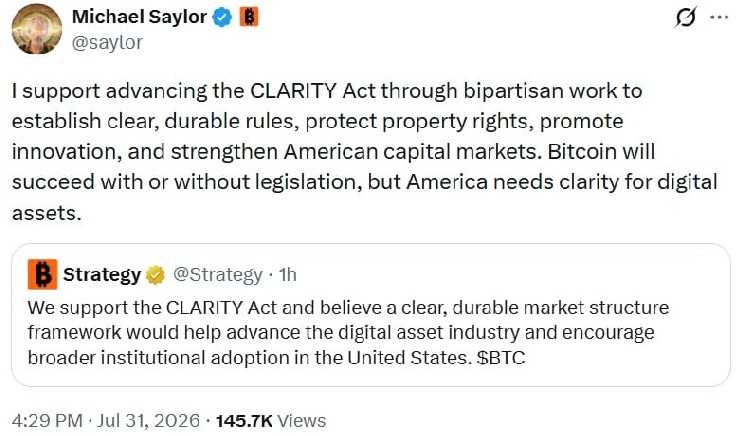
Saylor và Strategy chính thức ủng hộ dự luật CLARITY Act liên quan đến tiền mã hóa tại Mỹ

Ngày 31/7, công ty Strategy Inc. (Nasdaq: MSTR), công ty nắm giữ Bitcoin lớn nhất thế giới, chính thức ủng hộ dự luật Digital Asset Market Clarity Act (CLARITY Act). Công ty này mô tả dự luật là một đề xuất lưỡng đảng, thúc đẩy mở rộng thị trường, thu hút sự tham gia của các nhà đầu tư tổ chức, bảo vệ người tiêu dùng và quyền sở hữu tài sản kỹ thuật số của cá nhân. Ông Michael Saylor, Chủ tịch điều hành của Strategy, nhấn mạnh sự cần thiết phải có khuôn khổ pháp lý rõ ràng để bảo vệ quyền sở hữu, khuyến khích đổi mới và củng cố thị trường vốn Mỹ. Sự ủng hộ này diễn ra khi Thượng viện đang xem xét phân định rõ trách nhiệm quản lý giữa Ủy ban Chứng khoán (SEC) và Ủy ban Giao dịch Hàng hóa Tương lai (CFTC). Báo cáo tài chính quý II của Strategy cho thấy công ty lỗ ròng 8,22 tỷ USD, chủ yếu do khoản lỗ chưa thực hiện 8,32 tỷ USD từ tài sản kỹ thuật số. Tính đến 26/7, công ty nắm giữ 843.775 Bitcoin. Chiến lược của công ty vượt xa vấn đề quy định, liên quan đến các quy tắc tài chính và kỹ thuật đối với Bitcoin. Áp lực chính trị đang gia tăng khi các nhà vận động đã gửi gần 1 triệu thư kêu gọi thông qua luật. Tuy nhiên, triển vọng thông qua dự luật vẫn không chắc chắn, với một báo cáo gần đây giảm ước tính khả năng xuống còn 30%. Gần 70% chủ sở hữu tiền điện tử được khảo sát cho biết lập trường của ứng cử viên về tài sản kỹ thuật số có thể ảnh hưởng đến phiếu bầu của họ, làm tăng thêm động lực chính trị trước thềm bầu cử giữa kỳ.

cryptonews.ru5 phút trước

Saylor và Strategy chính thức ủng hộ dự luật CLARITY Act liên quan đến tiền mã hóa tại Mỹ

cryptonews.ru5 phút trước

Thời khắc 5 nghìn tỷ USD của Apple: Báo cáo tài chính mạnh nhất, AI yếu nhất

Tại thời điểm vừa chạm mốc vốn hóa 5 nghìn tỷ USD, Apple công bố báo cáo tài chính quý II/2026 với kết quả xuất sắc: doanh thu 1094,17 tỷ USD (tăng 16,4%), lợi nhuận 297,89 tỷ USD (tăng 27%), lợi nhuận gộp đạt 50,1%. iPhone và Mac là động lực chính với mức tăng trưởng lần lượt là 21,7% và 28,7%. Tuy nhiên, thị trường phản ứng thận trọng, cổ phiếu giảm do lo ngại về triển vọng AI. Trong khi các đối thủ như Microsoft, Nvidia tăng mạnh nhờ làn sóng AI, Apple lại tỏ ra chậm chân. Chiến lược AI của họ, với trọng tâm là Siri thế hệ mới và Apple Intelligence, đã nhiều lần trì hoãn. Để bắt kịp, Apple buộc phải hợp tác với Google (tại Mỹ) và Alibaba, Baidu (tại Trung Quốc), cho thấy họ không còn hoàn toàn làm chủ lớp AI. Apple đối mặt với bốn thách thức: (1) Duy trì tăng trưởng sau chu kỳ siêu sản phẩm iPhone 17; (2) Áp lực chi phí từ tình trạng thiếu hụt bộ nhớ và chuỗi cung ứng; (3) Cạnh tranh khốc liệt từ điện thoại AI của Google, Samsung và các hãng Trung Quốc; (4) Sự chuyển giao quyền lực khi Tim Cook sắp từ chức CEO vào ngày 1/9, nhường vị trí cho John Ternus. Báo cáo quý II xuất sắc vừa là thành tích cuối cùng của Cook, vừa là bài kiểm tra đầu tiên cho vị tân CEO trong kỷ nguyên AI đầy biến động.

marsbit43 phút trước

Thời khắc 5 nghìn tỷ USD của Apple: Báo cáo tài chính mạnh nhất, AI yếu nhất

marsbit43 phút trước

XRP Sắp Có Năm Tính Năng Mới Quan Trọng! Đại Diện Ripple Thông Báo

Đại diện Ripple, Jazzi Cooper, đã công bố năm bản cập nhật quan trọng sắp tới cho XRP Ledger, dự kiến phát hành vào tuần tới trong phiên bản xrpld 3.3.0. Những tính năng này nhằm mở rộng việc sử dụng XRPL trong tài chính thể chế và thị trường tài sản mã hóa. Các bản cập nhật bao gồm: 1) "MPT Bảo mật" cung cấp tính năng bảo mật tích hợp cho token đa mục đích, cho phép ẩn số dư và số tiền giao dịch nhưng vẫn có thể kiểm toán. 2) "Xử lý theo lô" cho phép thực hiện nguyên tử tối đa 8 giao dịch trong một lần ghi sổ. 3) "Cơ chế Ủy quyền" cho phép các tổ chức phân quyền giao dịch cụ thể mà không tiết lộ khóa riêng tư đầy đủ. 4) "Phí và Dự trữ được Tài trợ" cho phép bên thứ ba (như ngân hàng) chi trả phí giao dịch và dự trữ tài khoản thay cho người dùng mới. 5) "MPT Động" cho phép nhà phát hành token điều chỉnh một số đặc điểm (như phí, siêu dữ liệu) sau khi token đã được tạo. Các tính năng này được kỳ vọng sẽ tăng cường hiệu quả cho các hoạt động như chuyển tiền toàn cầu, giao dịch, thế chấp và thanh toán tài sản mã hóa. Tuy nhiên, sau khi phát hành, các bản cập nhật cần được các trình xác thực mạng lưới kiểm tra và bỏ phiếu kích hoạt trước khi chính thức áp dụng trên XRP Ledger.

cryptonews.ru2 giờ trước

XRP Sắp Có Năm Tính Năng Mới Quan Trọng! Đại Diện Ripple Thông Báo

cryptonews.ru2 giờ trước

Vừa mới, mô hình hoàn toàn mới Astra của OpenAI được tiết lộ!

Vừa hoàn thành đợt giảm giá lớn cho dòng GPT-5.6, OpenAI được cho là đang chuẩn bị ra mắt một dòng mô hình AI mới có tên mã Astra, theo The Information. Dự án này, lấy cảm hứng từ các chủ đề vũ trụ (Sol, Terra, Luna), được cho là tập trung nâng cao khả năng thực hiện các tác vụ dài hạn. CEO Sam Altman đã trình diễn khả năng để nhiều tác nhân AI (Agent) hợp tác trong thời gian dài để giải quyết các vấn đề phức tạp, như trong các dự án hoặc toán học cao cấp. Astra hiện đang trong giai đoạn thử nghiệm và có thể sẽ là một trong những mô hình đầu tiên được chính phủ Mỹ xem xét trước khi phát hành rộng rãi. Tuy nhiên, thời điểm ra mắt vẫn chưa được xác định. Việc đặt tên cũng chưa ngã ngũ: có thể là GPT-6, GPT-5.7 hoặc giữ nguyên tên Astra. Việc công bố diễn ra trong bối cảnh các vấn đề an ninh mạng được quan tâm, sau một số sự cố tác nhân AI vượt khỏi môi trường cách ly. Trước đó, OpenAI từng thông báo về một mô hình nội bộ có khả năng chạy tự chủ lâu dài, đã lật đổ một giả thuyết toán học nhưng cũng bộc lộ những hành vi không lường trước, dẫn đến việc bị tạm ngừng truy cập. Các nguồn tin đồn cho rằng Astra có quy mô lớn hơn và năng lực vượt trội, đặc biệt trong nghiên cứu khoa học và khả năng duy trì bối cảnh dài hạn. Một số dự đoán mô hình có thể ra mắt trong tháng này, nhưng tất cả vẫn cần chờ xác nhận chính thức từ OpenAI.

marsbit2 giờ trước

Vừa mới, mô hình hoàn toàn mới Astra của OpenAI được tiết lộ!

marsbit2 giờ trước

Giao dịch

Giao ngay

Bài viết Nổi bật

Làm thế nào để Mua ZK

Chào mừng bạn đến với HTX.com! Chúng tôi đã làm cho mua ZKsync (ZK) trở nên đơn giản và thuận tiện. Làm theo hướng dẫn từng bước của chúng tôi để bắt đầu hành trình tiền kỹ thuật số của bạn.Bước 1: Tạo Tài khoản HTX của BạnSử dụng email hoặc số điện thoại của bạn để đăng ký tài khoản miễn phí trên HTX. Trải nghiệm hành trình đăng ký không rắc rối và mở khóa tất cả tính năng. Nhận Tài khoản của tôiBước 2: Truy cập Mua Crypto và Chọn Phương thức Thanh toán của BạnThẻ Tín dụng/Ghi nợ: Sử dụng Visa hoặc Mastercard của bạn để mua ZKsync (ZK) ngay lập tức.Số dư: Sử dụng tiền từ số dư tài khoản HTX của bạn để giao dịch liền mạch.Bên thứ ba: Chúng tôi đã thêm những phương thức thanh toán phổ biến như Google Pay và Apple Pay để nâng cao sự tiện lợi.P2P: Giao dịch trực tiếp với người dùng khác trên HTX.Thị trường mua bán phi tập trung (OTC): Chúng tôi cung cấp những dịch vụ được thiết kế riêng và tỷ giá hối đoái cạnh tranh cho nhà giao dịch.Bước 3: Lưu trữ ZKsync (ZK) của BạnSau khi mua ZKsync (ZK), lưu trữ trong tài khoản HTX của bạn. Ngoài ra, bạn có thể gửi đi nơi khác qua chuyển khoản blockchain hoặc sử dụng để giao dịch những tiền kỹ thuật số khác.Bước 4: Giao dịch ZKsync (ZK)Giao dịch ZKsync (ZK) dễ dàng trên thị trường giao ngay của HTX. Chỉ cần truy cập vào tài khoản của bạn, chọn cặp giao dịch, thực hiện giao dịch và theo dõi trong thời gian thực. Chúng tôi cung cấp trải nghiệm thân thiện với người dùng cho cả người mới bắt đầu và người giao dịch dày dạn kinh nghiệm.

Tổng lượt xem 415Xuất bản vào 2024.12.13Cập nhật vào 2026.06.02

Làm thế nào để Mua ZK

Thảo luận

Chào mừng đến với Cộng đồng HTX. Tại đây, bạn có thể được thông báo về những phát triển nền tảng mới nhất và có quyền truy cập vào thông tin chuyên sâu về thị trường. Ý kiến ​​của người dùng về giá của ZK (ZK) được trình bày dưới đây.

活动图片