Crypto VCs Pivot to AI: A 'Coming of Age' Ceremony Beginning with a Collapse of Belief

比推Xuất bản vào 2026-02-05Cập nhật gần nhất vào 2026-02-05

Tóm tắt

In a personal reflection, the author expresses sadness over Kyle Samani, a partner at crypto VC firm Multicoin Capital, publicly announcing his departure from the crypto industry to focus on AI, longevity tech, and robotics. Kyle was known for his thesis-driven, opinionated, and often controversial investment style—publicly criticizing Ethereum’s scaling roadmap, backing Solana early, and supporting DePIN projects like Helium. Despite mistakes (EOS, FTX exposure), he was transparent about losses and decisions. His exit feels symbolic: an honest, sharp voice leaving crypto. Before deleting the tweet, Kyle stated that crypto is primarily an asset ledger with limited use beyond finance, marking a shift from evangelist to realist—a “loss of faith” rather than just market loss. The author contrasts crypto’s current state—filled with memecoins, gambling, and technical debates—with AI’s rapid, tangible progress. Yet, they choose to stay, seeing crypto as a permissionless, open field for upward mobility and financial infrastructure innovation (e.g., stablecoins, DeFi, RWA), while remaining open to future possibilities.

Author: Dora B Dream, Deep Tide TechFlow

Original Title: Kyle Left the Crypto Industry, and I'm a Bit Sad


*This article expresses personal opinions.

On the morning of February 5th, a day that began with a market crash, I was scrolling through Twitter as usual when a departure announcement from Kyle Samani, a partner at the well-known crypto VC firm Multicoin, suddenly appeared in my feed. My finger paused on the screen for a few seconds. My heart sank. Why him?

I know Kyle, or more accurately, I know *of* him.

Back in 2020, during my junior year of college, I read Multicoin's "pitch" paper for the first time. It was eye-opening. The concept of being "Thesis-Driven" was imprinted in my mind.

I realized VCs could write like this—not using vague, PPT-style phrases like "we see long-term value in the XX sector," but thinking like traders, directly providing clear bullish and bearish logic, avoiding ambiguity, and presenting sharp, distinct viewpoints.

Kyle's persona on Twitter has always been distinct: aggressive, mean, offending countless people.

He dared to publicly criticize Ethereum's scaling roadmap when everyone was bullish on it. He dared to place firm bets on Solana when others dismissed it. He dared to promptly, transparently disclose losses and复盘 decision-making after the FTX collapse, where Multicoin suffered significant losses.

Many in the Western crypto circle dislike him, finding him *too arrogant*. But I've always felt the industry needs people like him.

Now he's gone. Pivoting to AI, longevity technology, robotics. I suddenly felt a pang of sadness: If even Kyle doesn't want to play anymore, what's wrong with this industry?

When Kyle Left

What makes me sad isn't just another VC pivoting to AI—who isn't talking about AI these days?

What makes me sad is that it's specifically Multicoin's Kyle, someone I viewed as very resolute.

What is the investment logic of most Crypto VCs? Spray and pray, bet on sectors, say nice things but never make a definitive judgment, or just follow others' leads.

Open the investment reports of those famous firms; it's always "we believe in a decentralized future," "we are optimistic about innovation in the XX field," but you never see a firm statement like "we think Project A will outperform Project B."

This isn't prudence; it's worldliness. No matter who wins, they can always say, "See, we were positioned early."

Kyle, or rather Multicoin, wasn't like that. He dared to make "life-or-death judgments."

He publicly declared Ethereum's sharding roadmap a dead end as early as 2017. He once bet on EOS and failed. In 2018, he placed his bets on Solana. In 2020, he strongly supported Helium, believing DePIN was the only viable non-financial use case for Crypto.

Yes, he missed many opportunities and made big mistakes—EOS and FTX are bloody lessons. But he never hid them, disclosing losses transparently and owning up to every error he should.

He wasn't the smartest VC, nor the gentlest evangelist, but he was one of the most "real" ones. His departure symbolizes a certain kind of "honesty and sharpness" fading from this industry.

That Instantly Deleted Tweet

What struck me even more was the tweet he sent just before leaving, though he deleted it instantly.

He said: "Crypto is not fundamentally as interesting as many crypto enthusiasts want it to be. I used to believe in the Web3 vision, I used to believe in dApps. I no longer do. Blockchains are primarily asset ledgers. They can reshape finance, but their potential in other areas is limited."
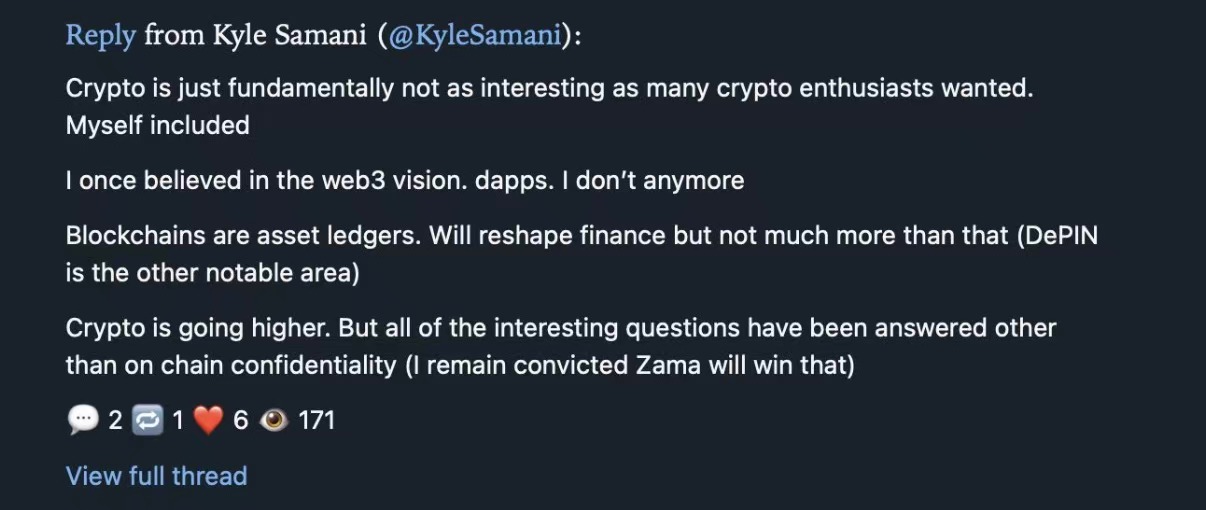
Why delete it instantly? Because saying it out loud makes you a "heretic."

Why couldn't he resist posting it? It's the conclusion reached by someone trapped between faith and reality, after spending 8 years and investing hundreds of millions of dollars.

I understand this feeling all too well because it mirrors my own journey this past year.

What did we believe in when we entered in 2021? That decentralized social would颠覆 Twitter. That on-chain identity (DID) would let users control their data. That GameFi would let players truly "own their assets." Back then, everyone on Twitter timelines was discussing "how Web3 will change the world." Every new project felt like a gateway to the future.

What is the reality in 2025? Friend.tech died. Lens Protocol has no users. ENS has become a tool for speculation; no one actually uses DID beyond wallet addresses. The collapses of Axie and StepN proved "X to Earn" is just a Ponzi scheme in disguise.

But Kyle didn't否定 everything. He still sees value in stablecoins, DeFi, RWA (these financial applications), and projects like Helium (DePIN). He's still betting on technologies like Zama's fully homomorphic encryption.

The question is: Do these things still require "faith"? Or just rational calculation?

Some see Kyle's departure as a betrayal. In my eyes, it's a process of "disenchantment"—transitioning from a Crypto Evangelist to a Crypto Realist. This transformation might be the necessary coming-of-age ceremony the entire industry must undergo.

Last Time We Lost Money, This Time We're Losing Confidence

When FTX imploded in 2022, the entire industry hit rock bottom. Luna went to zero, Three Arrows Capital破产, the market was halved and halved again. But back then, everyone still held onto a belief: The market crashed, but we weren't wrong. If we persevere, the bull market will prove us right.

Back then, we still believed in Ethereum's "endgame narrative"—from PoW to PoS, from a single chain to modularity—thinking it was the necessary path to the "world computer."

We still believed in Solana's "performance revolution," thinking that high-performance chains would surely win if they could just survive the bear market.

We still believed in Web3's "paradigm shift," believing the next chapter of the internet必然 was decentralization.

What about now, in 2025?

Objectively, the data is much better than the last trough. BTC briefly surpassed $100,000, ETFs were approved, and Crypto's ties with Wall Street grew stronger.

But the subjective feeling is completely opposite. Prices are higher, but confidence is lower.

The "culprit," or perhaps the "revealing mirror," is AI.

When ChatGPT launched in 2023, everyone was discussing "how AI will change the world." What was Crypto discussing at the same time? "Should L2 sequencers be decentralized?" One was talking about a productivity revolution; the other was arguing over technical details.

The subsequent two years saw AI progress at a dizzying pace: Gemini, Claude, ChatGPT—a three-way battle, with new developments daily. Lately, everyone is obsessed with OpenClaw.

And Crypto? There are more and more L2s and chains, but no one can clearly explain "why we need 100 L2s." Even Vitalik has reflected on past roadmap mistakes. NFT, GameFi, SocialFi have all had their moments, but they were all flashes in the pan.

By now, the biggest innovation of this cycle has turned out to be Meme Coins and "reinventing gambling."

I often ask myself late at night: AI is redefining productivity with technology. Crypto is redistributing wealth with financial games. The former creates; the latter transfers. What are we actually building?

Kyle's departure is, at its core, a "value choice."

He chose to chase AI, longevity tech, robotics—fields that are truly "expanding human frontiers." Crypto, at least for now,更像 is a high-stakes casino.

But I'm Not Ready to Leave Yet

After saying all this, you might think I'm about to announce my exit too.

But no, I still want to "gamble" one more time.

Kyle can leave because he is already financially free and can pursue grander dreams. But for young people like me, Crypto still represents: a relatively fair channel for "upward mobility," a "permissionless" testing ground that doesn't require diplomas, background, or connections—just cognition and courage. It's an emerging industry not yet completely monopolized by the elite class.

More importantly, perhaps the grand Web3 narrative has failed, but that doesn't mean Crypto is worthless.

The revolution in financial infrastructure has already happened. The daily settlement volume of stablecoins has surpassed Visa. DeFi allows people worldwide to use financial services and RWA 24/7.

Most crucially: I haven't figured out my own answer yet.

Kyle spent 8 years concluding "Crypto is just an asset ledger."

But I'm still just a rookie; what right do I have to make that judgment now?

Maybe in a few years, I'll leave like he did. But for now, I want to stay at the table to see if this industry still holds some unseen possibilities.

Years from now, Crypto might no longer be the "disrupt-everything" revolution but rather the value settlement layer for the AI era.

When that time comes, I'll order a coffee and chat about the scenery I saw along the way.


Twitter:https://twitter.com/BitpushNewsCN

Bitpush TG Discussion Group:https://t.me/BitPushCommunity

Bitpush TG Subscription: https://t.me/bitpush

Original article link:https://www.bitpush.news/articles/7609106

Câu hỏi Liên quan

QWhy did Kyle Samani's departure from the crypto industry resonate so deeply with the author?

ABecause Kyle represented a rare combination of honesty, sharpness, and a willingness to make bold, public judgments in an industry often filled with vague, non-committal statements. His departure felt like the loss of a 'real' and aggressive voice that the author believed the industry needed.

QWhat was the core belief that Kyle Samani expressed in his since-deleted tweet?

AHe expressed that cryptocurrency is not as revolutionary as many enthusiasts hope. He no longer believes in the Web3 vision or dApps, concluding that blockchain is primarily a ledger for assets with significant potential mainly in finance, but limited potential in other fields.

QHow does the author contrast the current state of the AI and Crypto industries?

AThe author contrasts them by stating that AI is focused on a 'productivity revolution,' creating new things and pushing the boundaries of human capability with rapid, tangible progress. In contrast, much of Crypto's recent innovation has been in 'Meme Coin and reinventing gambling,' which is more about wealth transfer than creation, leading to a crisis of confidence despite higher prices.

QDespite the author's sense of disillusionment, what reasons do they give for staying in the crypto industry?

AThe author cites that crypto still offers a relatively fair path for social mobility ('class leap'), a permissionless testing ground that doesn't require traditional credentials, and that the financial infrastructure revolution (e.g., stablecoins, DeFi) is already real. They feel it's too early in their own journey to make a final judgment and want to see if there are still unseen possibilities.

QWhat does the author mean by calling Kyle's departure a '祛魅' (disenchantment) and the industry's 'adult ceremony'?

AIt means that Kyle's shift from a 'Crypto Evangelist' to a 'Crypto Realist' represents a loss of naive faith and a transition to a more mature, sober, and pragmatic understanding of the technology's actual capabilities and limitations, which the author believes is a necessary growing-up phase for the entire industry.

Nội dung Liên quan

Sau ba quý liên tiếp suy giảm, thị trường tiền điện tử có thể đón cửa sổ ổn định trong quý III?

Thị trường tiền mã hóa vừa trải qua quý tồi tệ nhất kể từ năm 2022, với vốn hóa giảm 12.6% xuống 2.1 nghìn tỷ USD, khối lượng giao dịch sụt giảm và dòng tiền rút mạnh khỏi các quỹ ETF Bitcoin. Bitcoin và Ethereum lần lượt giảm 14.2% và 25.4% trong quý, đánh dấu sự đảo ngược so với mối tương quan trước đây với các tài sản rủi ro như Nasdaq. Dòng vốn ETF chứng khoán Mỹ ghi nhận dòng ròng rút khoảng 46.7 tỷ USD trong quý II, báo hiệu áp lực bán. Tuy nhiên, dấu hiệu tích cực ban đầu xuất hiện khi các nhà đầu tư dài hạn bắt đầu tích lũy trở lại và dòng ETF có đợt thu hút ngắn hạn. Toàn bộ thị trường hiện tập trung vào cuộc họp của Cục Dự trữ Liên bang Mỹ (FOMC) vào cuối tháng 7. Các tín hiệu chính sách tiền tệ sẽ quyết định xu hướng: tín hiệu ôn hòa có thể đẩy Bitcoin lên vùng 68,000-84,000 USD, trong khi lập trường cứng rắn có thể kéo giá về vùng 50,000-56,000 USD. Tiến trình pháp lý của Đạo luật CLARITY gần như đình trệ, làm giảm kỳ vọng và gia tăng phí rủi ro cho toàn ngành. Trong bối cảnh ảm đạm, hai lĩnh vực nổi bật là thị trường dự đoán (tăng trưởng 48.7%) và bộ sưu tập kỹ thuật số được mã hóa (tăng ~143%), cho thấy sự chuyển dịch nhu cầu thực tế. Nhìn chung, thị trường thiếu động lực cho một đợt tăng trưởng mạnh dựa trên tâm lý. Các quyết định giao dịch trong quý III sẽ chủ yếu xoay quanh diễn biến giá, lựa chọn chính sách và kỳ vọng lãi suất.

marsbitHôm qua 08:39

Sau ba quý liên tiếp suy giảm, thị trường tiền điện tử có thể đón cửa sổ ổn định trong quý III?

marsbitHôm qua 08:39

Giao Dịch SpaceX, Đã Mở Khóa: SPCXON Được Giao Dịch Trên WEEX

SpaceX đã thực hiện đợt IPO lớn nhất lịch sử vào tháng 6/2026, nhưng nhiều nhà giao dịch không thể tiếp cận do các rào cản như hạn chế môi giới và khu vực. Sàn giao dịch tiền điện tử WEEX đã giới thiệu SPCXON/USDT, một công cụ token hóa cho phép tiếp cận biến động giá của SpaceX thông qua tài khoản crypto được quyết toán bằng USDT, mà không cần môi giới Mỹ hay tài khoản ngân hàng. Sản phẩm này, xây dựng trên nền tảng cổ phiếu token hóa của Ondo, dành cho các nhà giao dịch bên ngoài Hoa Kỳ. Trường hợp đầu tư dựa trên đà tăng doanh thu Starlink và các cột mốc Starship, trong khi các yếu tố cần thận trọng bao gồm định giá cao, lượng cổ phiếu lưu hành công chúng ít và sự kiện mở khóa cổ phiếu nội bộ sắp tới. Lưu ý quan trọng: SPCXON cung cấp mức tiếp xúc với hiệu quả kinh tế, không phải quyền sở hữu cổ phiếu trực tiếp, và có thể giao dịch ở mức cao hơn hoặc thấp hơn giá trị tài sản ròng. WEEX tích hợp SPCXON cùng các sản phẩm TradFi token hóa khác như MicroStrategy (MSTRON) và Micron (MUON) vào một tài khoản thống nhất, cho phép luân chuyển giữa crypto và cổ phiếu dễ dàng. Sàn cũng đang chạy chiến dịch TradFi Trading Challenge với quỹ thưởng $50,000.

TheNewsCryptoHôm qua 08:32

Giao Dịch SpaceX, Đã Mở Khóa: SPCXON Được Giao Dịch Trên WEEX

TheNewsCryptoHôm qua 08:32

BIT Trading Hours: BTC Vẫn Chịu Áp Lực Từ Đường MA 200 Tuần, Bị Từ Chối Có Thể Tái Khởi Động Đợt Giảm, Ngành Lưu Trữ và Bán Dẫn Tăng Mạnh Đêm Qua Bắt Đầu Giảm Trong Khung Giờ Giao Dịch Ban Đêm

Bitcoin (BTC) hiện giao dịch quanh mức $66,000, đối mặt với vùng kháng cự mạnh gần $68,000 - nơi tập trung nhiều lệnh mua trước đó có thể chốt lời. Về mặt kỹ thuật, BTC đang nằm giữa đường trung bình động 200 tuần (MA ~$63,333) và đường trung bình động hàm mũ 200 tuần (EMA ~$68,328). Việc không thể vượt qua mức $68,000 có thể kéo giá về kiểm tra lại vùng hỗ trợ $63,000. Thị trường hiện có tính thanh khoản thấp và được xem là đang trong đợt phục hồi nhẹ. Trên thị trường chứng khoán Mỹ, các chỉ số tương lai giảm nhẹ. Nhóm cổ phiếu bán dẫn và lưu trữ, vốn tăng mạnh vào đêm trước, đã điều chỉnh giảm trong phiên giao dịch ngoài giờ. Tuy nhiên, Super Micro Computer (SMCI) tăng mạnh sau báo cáo doanh thu và đơn đặt hàng tích cực. Dầu thô tăng (trên $91) và lợi suất trái phiếu kho bạc Mỹ tăng cao tiếp tục gây áp lực lên thị trường cổ phiếu và làm dấy lên lo ngại lạm phát. Tại châu Á, thị trường Hàn Quốc phục hồi nhẹ cùng với cổ phiếu công nghệ, trong khi Nhật Bản thận trọng do đồng Yên yếu kỷ lục. Các sự kiện quan trọng sắp tới bao gồm báo cáo thu nhập từ các gã khổng lồ công nghệ như Alphabet, Tesla, IBM; sự kiện AI của AMD; và cuộc họp chính sách tiền tệ của Ngân hàng Trung ương châu Âu.

marsbitHôm qua 08:31

BIT Trading Hours: BTC Vẫn Chịu Áp Lực Từ Đường MA 200 Tuần, Bị Từ Chối Có Thể Tái Khởi Động Đợt Giảm, Ngành Lưu Trữ và Bán Dẫn Tăng Mạnh Đêm Qua Bắt Đầu Giảm Trong Khung Giờ Giao Dịch Ban Đêm

marsbitHôm qua 08:31

Chủ tịch CFTC cũ, Chủ tịch Circle Tarbert: Một mặt khuyên bạn chủ nghĩa dài hạn, mặt kia tự mình thoái vốn 30 triệu USD

Tác giả: Zen, PANews Trước tình cảnh cổ phiếu Circle (CRCL) giảm 70% so với đỉnh và bị hạ xếp hạng, Chủ tịch Heath Tarbert - cựu Chủ tịch CFTC - trong một cuộc phỏng vấn ngày 14/7 đã kêu gọi các nhà đầu tư kiên nhẫn và tập trung vào tầm nhìn dài hạn của công ty. Tuy nhiên, hành động của ông lại trái ngược hoàn toàn. Kể từ khi Circle IPO, Tarbert đã không ngừng bán cổ phiếu CRCL thông qua kế hoạch giao dịch 10b5-1 được lập trước, thu về tổng cộng khoảng 30 triệu USD. Ông chưa từng mua lại cổ phiếu trên thị trường mở, ngay cả khi giá cổ phiếu lao dốc. Bài viết nêu bật sự mâu thuẫn giữa lời nói "chủ nghĩa dài hạn" và hành động "thoái vốn" mạnh tay của Tarbert. Sự nghiệp của ông được mô tả là điển hình của "cánh cửa xoay" chính trị-thương mại Mỹ: từ các vị trí cấp cao tại Bộ Tài chính và CFTC, ông nghỉ hưu chỉ 27 ngày trước khi gia nhập Citadel Securities - một nhà tạo lập thị trường lớn - vào thời điểm công ty này đang đối mặt với cuộc điều tra của Quốc hội sau sự kiện GameStop. Sau đó, ông chuyển sang Circle, nơi ông được cho là đã sử dụng kinh nghiệm và quan hệ quản lý để giúp công ty vượt qua các rào cản pháp lý và niêm yết thành công. Bài báo đặt câu hỏi liệu Tarbert có thực sự tin vào tương lai dài hạn của Circle hay không, khi mà ông liên tục chốt lời trong khi lại khuyên các cổ đông nhỏ lẻ giữ vị thế. Nó gợi ý rằng mô hình của ông là tận dụng tối đa kiến thức về chu kỳ chính sách và cơ hội thị trường để biến các nguồn lực và uy tín tích lũy được thành lợi thế nghề nghiệp và tài chính cá nhân, trong khi rủi ro dài hạn được chuyển sang cho các nhà đầu tư tin tưởng vào những tường thuật công khai của ông.

marsbitHôm qua 08:08

Chủ tịch CFTC cũ, Chủ tịch Circle Tarbert: Một mặt khuyên bạn chủ nghĩa dài hạn, mặt kia tự mình thoái vốn 30 triệu USD

marsbitHôm qua 08:08

Gate Research: Làn sóng "phố Wall hóa" trong các sản phẩm tài chính tiền điện tử - Cạnh tranh hay Hội tụ?

Gate Research Institute: Sự hòa hợp hay cạnh tranh trong làn sóng "phố Wall hóa" các sản phẩm tài chính tiền mã hóa? Từ tầm nhìn ban đầu về một hệ thống tài chính phi tập trung, loại bỏ trung gian của Bitcoin, thị trường tiền mã hóa đang chứng kiến sự hội tụ mạnh mẽ với tài chính truyền thống (TradFi). Các quỹ ETF Bitcoin, tài sản thế giới thực được mã hóa (RWA) và trái phiếu chính phủ trên chuỗi cho thấy các tổ chức như BlackRock, Fidelity đang đưa tài sản mã hóa vào hệ thống phát hành, định giá, lưu ký và phân phối truyền thống. Tuy nhiên, đây không phải là một trò chơi tổng bằng không. Xu hướng này thể hiện sự bổ sung lẫn nhau: TradFi cung cấp khung pháp lý, mạng lưới phân phối rộng và sự tin cậy, trong khi Crypto mang lại tính mở, thanh khoản toàn cầu 24/7 và khả năng thanh toán lập trình được. Hai hướng đi tiêu biểu minh chứng cho sự hội tụ hai chiều: các sàn giao dịch tiền mã hóa (CEX) như Gate mở rộng sang giao dịch cổ phiếu thực, ETF thông qua cơ sở hạ tầng môi giới truyền thống; trong khi các công ty môi giới truyền thống như Robinhood tích hợp tài sản mã hóa và phát triển tài sản mã hóa (như cổ phiếu mã hóa) để thu hút người dùng. Mục tiêu chung của cả hai hướng là tranh giành "tài khoản tài chính tổng hợp" thế hệ tiếp theo - một điểm vào duy nhất nơi người dùng có thể giao dịch đa dạng tài sản từ cổ phiếu, tiền mã hóa đến RWA. Sự tăng trưởng mạnh mẽ của thị trường RWA, đặc biệt là cổ phiếu mã hóa, bất chấp xu hướng thị trường giảm, cho thấy đây là một xu hướng cấu trúc thực sự. Kết luận, "phố Wall hóa" không có nghĩa là thị trường tiền mã hóa bị TradFi thôn tính. Thay vào đó, đây là một sự chuyển đổi hai chiều, nơi cả hai hệ thống đang cùng nhau định hình lại thị trường vốn thành một cấu trúc hỗn hợp hiệu quả và toàn cầu hơn, với trải nghiệm người dùng liền mạch cho nhiều loại tài sản khác nhau.

marsbitHôm qua 08:06

Gate Research: Làn sóng "phố Wall hóa" trong các sản phẩm tài chính tiền điện tử - Cạnh tranh hay Hội tụ?

marsbitHôm qua 08:06

Giao dịch

Giao ngay
活动图片





