Gold and Silver Plummet in Epic Crash! What Happened?

marsbitXuất bản vào 2026-01-31Cập nhật gần nhất vào 2026-01-31

Tóm tắt

Gold and silver experienced a historic plunge after reaching record highs, triggered by reports that former President Trump would nominate Kevin Warsh—a known hawk—as Federal Reserve Chair. This shift in Fed leadership expectations spurred a sharp dollar rally, dampening appeal for dollar-denominated metals. Spot gold fell over 13% intraday, its largest drop since the 1980s, while silver plummeted more than 35%, its worst decline on record. Industrial metals like copper also retreated. The sell-off exposed extreme market fragility, with overbought conditions, crowded long positions, and high leverage accelerating the decline. Technical indicators like gamma squeezes and RSI levels had previously signaled overheating. Despite the crash, both metals ended January with significant monthly gains. Mining stocks and ETFs suffered heavy losses. Analysts suggest the correction was overdue and may present buying opportunities, though volatility is expected to remain high.

Original Author: Wall Street Insights

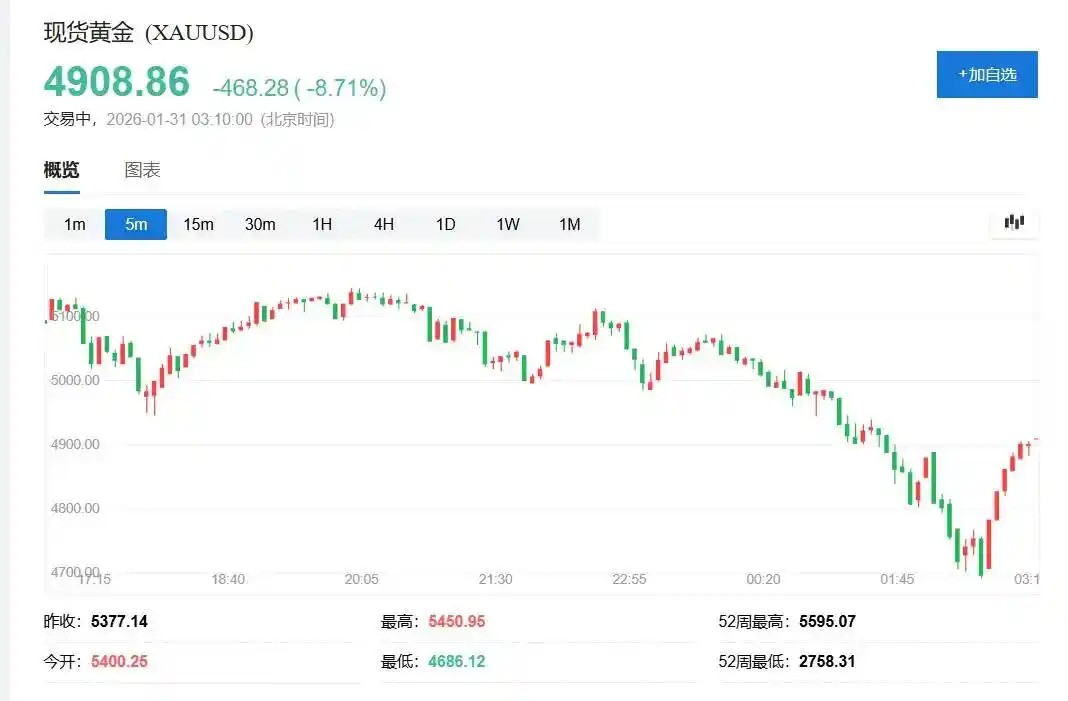
Gold and silver, which had both hit record intraday highs on Thursday, experienced a sharp decline. Gold turned lower early in the Asian session on Friday following news that Trump would nominate Warsh as Fed Chair, and had fallen below the $5,000/oz level during European trading. Losses accelerated during the US afternoon session, with spot gold at one point down nearly 13% intraday, its largest drop in over forty years since the early 1980s, exceeding the declines seen during the 2008 financial crisis.
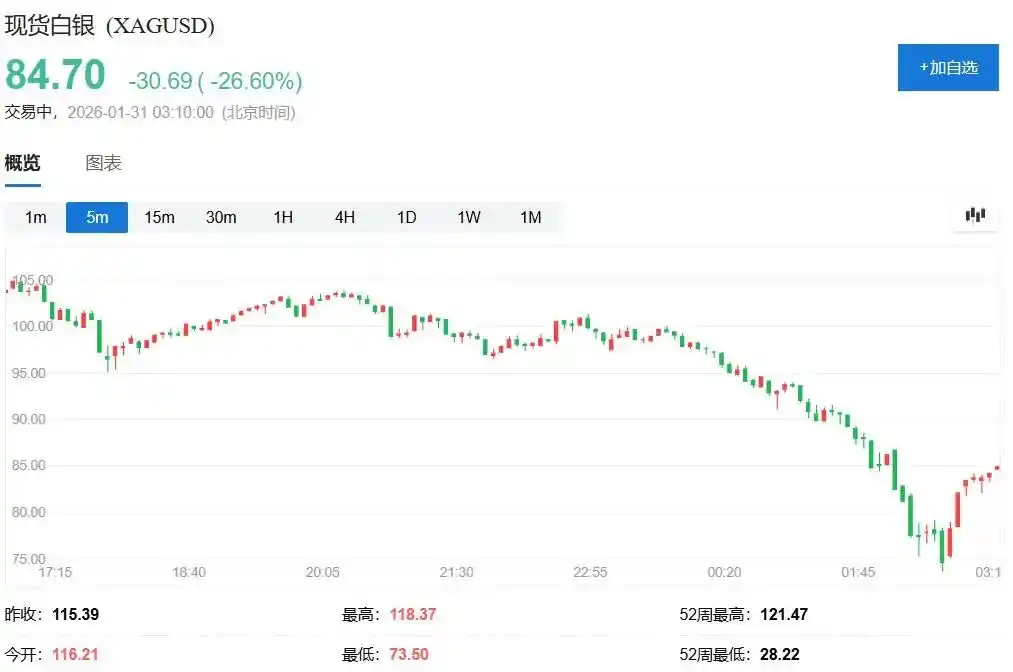
Silver, which broke above $120 for the first time ever on Thursday, fell below $100 during European trading on Friday and dropped below $80 during US session. Spot silver plummeted over 35% at one point, its largest recorded decline. This 'bloodbath' spread across the entire metals complex, with LME copper, which also hit a record high on Thursday, retreating nearly 6% at one point.
The market attributed the crash to a sharp shift in investor expectations regarding Fed policy.

Warsh has long been known for his hawkish stance, and although he recently publicly supported rate cuts to align with Trump, the market still believes he is unlikely to cut rates aggressively.

Commerzbank analyst Thu Lan Nguyen stated: "The market perceives Warsh as more hawkish than other candidates like Hassett." This expectation fueled a rebound in the US dollar, making dollar-denominated commodities less attractive to global buyers.

Warsh's nomination also alleviated market concerns about a loss of Fed independence.

Previously, investors flocked to precious metals for safety, partly due to fears of currency devaluation and concerns about Fed independence.

ING FX strategist Francesco Pesole said the choice of Warsh is "good news for the dollar, removing some concerns about a more dovish candidate."

The crash also exposed the extreme fragility of the precious metals market.

After the continuous surge in gold and silver prices recently, crowded long positions, record call option buying, and extreme leverage levels left the market in a state ripe for triggering a "gamma squeeze."

Pepperstone Senior Research Strategist Michael Brown stated: "The market was already very bubbly; it only took a small trigger to spark a move like this."

Historic Plunge for Gold and Silver

During the US afternoon session on Friday, the precious metals market staged a heart-stopping dive. The front-month NYMEX silver contract, after hitting a historic high of $121.785 on Thursday, fell below $80, touching $74 at one point, for an intraday drop of just over 35%. Spot silver fell below $74.60, down 35.5% on the day, its largest intraday decline on record.

Gold was also hit hard. NYMEX gold futures, which reached a historic high of $5,586.2 intraday on Thursday, fell to $4,714.5 during the US afternoon session on Friday, down nearly 12% on the day. Spot gold approached $4,670 during the US afternoon session, down over 12.7%.

By the close of COMEX floor trading, February gold futures settled down 11.37% at $4,713.9/oz, the largest single-day drop since January 22, 1980. February silver futures settled down 31.35% at $78.29/oz, the largest settlement decline since March 27, 1980.

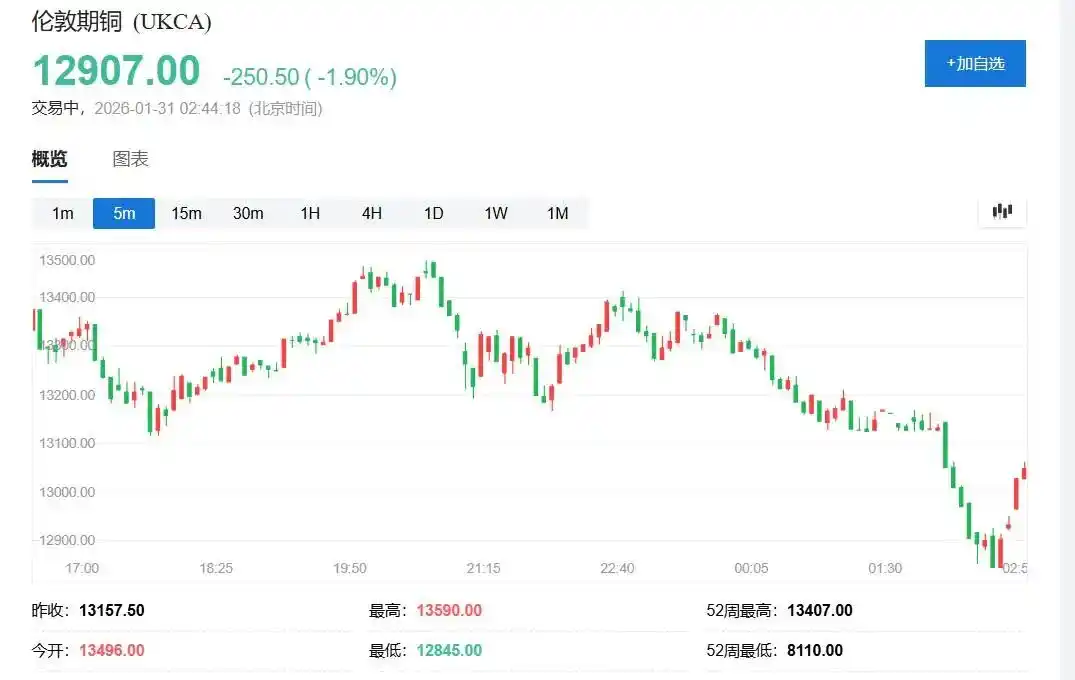
Industrial metals were not spared. LME copper, which surged over 11% to a record high above $14,520 on Thursday, fell below $12,850 during Friday's session, down nearly 5.7% intraday, and settled about 3.4% lower at $13,158/ton. At the close, tin was down about 5.7%, while aluminum and nickel fell over 2%.
Fed Chair Pick Seen as Hawkish

The trigger for the market sell-off was the news of Warsh's nomination.

Reports emerged early in the Asian session on Friday that Trump would nominate Warsh as Fed Chair, and gold, which had set intraday record highs for nine consecutive sessions, immediately turned lower.

Before the US market open on Friday, Trump officially announced the nomination in a post on his social media platform, stating he has known Warsh for a long time, has no doubt he will rank among the great Fed Chairs, and might even be the best one.

Warsh was long known for his hawkish views but changed his tune last year, echoing Trump's calls for significant rate cuts, seen as key to his nomination.

Wall Street investors and strategists said Trump's choice of Warsh to lead the Fed is a relatively hawkish selection; he would likely resist balance sheet expansion, which would support the dollar and steepen the US Treasury yield curve.

Panmure Liberum analyst Tom Price said:

"The market sees Kevin Warsh as rational; he won't aggressively push for rate cuts. Those retail investors with various goals—like capital preservation—are taking profits."

Warsh's nomination fueled a major dollar rebound, with the currency posting its best single-day performance in six months since last July on Friday. The ICE US Dollar Index, which tracks the dollar against a basket of currencies, rose above 97.10 during the US afternoon session, up nearly 0.9% on the day. A stronger dollar makes dollar-denominated commodities less attractive to many global buyers and undermines theories that precious metals could replace the dollar as the global reserve currency.

Crowded Market Triggers "Stampede"

Although the Warsh nomination was the trigger for the sell-off, analysts widely believe technical factors amplified the decline.

Media reports suggest soaring prices and volatility had already put pressure on traders' risk models and balance sheets. A Goldman Sachs research note pointed out that the record wave of call option buying "mechanically reinforced the upward price momentum" because option sellers hedge their exposure by buying more futures.

Gold's decline may have been accelerated by a so-called "gamma squeeze." This refers to option dealers needing to buy more futures to keep their portfolios balanced when prices rise, and sell when prices fall.

For the SPDR Gold ETF, a large number of positions expiring on Friday were concentrated at $465 and $455, while a significant number of option positions on Comex for March and April were concentrated at $5300, $5200, and $5100.

Miller Tabak equity strategist Matt Maley said: "This is insane. Much of this is likely 'forced selling.' Silver has recently been the hottest asset for day traders and other short-term traders, so silver accumulated some leverage. With today's big drop, margin calls went out."

Pepperstone's Michael Brown noted, "Conditions in the metals market have been very bubbly for some time, and signs earlier this week suggested things were becoming completely disorderly." He stated that positioning in the gold and silver markets was "clearly extremely crowded on the long side, and volatility had increased to frankly absurd levels." In a market with such high volume and such stretched "leveraged longs," "it doesn't take much to trigger" a move like Friday's.

Brown said: "Simply put, everyone was rushing for the exit at the same time, forcing prices lower, which in turn triggered further forced selling," a reminder that "momentum works both ways."

Overseas-Chinese Banking Corp. strategist Christopher Wong said gold's move "validates the warning of 'fast up, fast down'." While the Warsh report was the trigger, he said a pullback was long overdue, "It's like one of those excuses the market was waiting for to unwind those parabolic moves."

Technical Indicators Had Warned Earlier

Before the crash, several technical indicators had flashed warning signals. The Relative Strength Index (RSI) had shown in recent weeks that gold and silver might be overbought and due for a pullback. Gold's RSI recently touched 90, its highest level for the precious metal in decades.

Heraeus Precious Metals trading head Dominik Sperzel said volatility was extremely extreme, and the psychological resistance levels of $5,000 and $100 were breached multiple times on Friday, "but we need to be prepared for the rollercoaster to continue."

Despite Friday's plunge, gold and silver still posted substantial gains for January. Based on the front-month contract settlement prices, NYMEX gold rose about 9% in January, and silver rose over 10%.

COMEX February gold futures gained 8.98% for January, the largest monthly gain in four months, marking six consecutive months of gains, the longest winning streak since October 2024. COMEX February silver futures gained 11.63% in January, rising for nine consecutive months, a record monthly winning streak. Over these nine months, they accumulated a gain of 140.66%, the largest nine-month gain since April 2011.

Commerzbank analysts wrote in a note on Friday that the extent of the pullback "suggests market participants were just waiting for an opportunity to take profits after the rapid price increases." The bank's head of commodity research, Thu Lan Nguyen, noted,

Although "the market perceives Warsh as more hawkish than other candidates like Hassett," "we still believe it is very likely that the Fed will yield to pressure to some extent and cut rates more than the market currently expects"

Mining Stocks Also Plunge

The precious metals crash dragged down shares of major mining companies. During Friday's session, US-listed gold mining giants Newmont (NEM), Barrick Gold (GOLD), and Agnico Eagle Mines (AEM) all fell over 10%, while Coeur Mining (CDE) dropped nearly 19% at one point.

Silver ETFs were hit even harder. During the session, ProShares Ultra Silver (AGQ) fell over 60% at one point, and iShares Silver Trust ETF (SLV) fell over 30% at one point, both funds recording their worst single-day performances on record. Gold ETFs also came under pressure.

Although mining stocks were battered on Friday, some analysts believe the pullback is healthy for the market. Amplify ETFs VP of Product Development Nate Miller said silver benefits from safe-haven and store-of-value demand, industrial demand, and global supply shortages, and some consolidation after such a sharp rally "is healthy and consistent with typical behavior in commodity markets following rapid price appreciation."

Zaner Metals VP and senior metals strategist Peter Grant said that while the rally did go too far too fast, it's not too late to buy metals. He called the drop below $100 an "opportunity," especially near the 20-day moving average around $93. However, "you have to be able to handle the volatility, which is likely to remain elevated."

Bloomberg Macro Strategist Simon White noted:

"The silver/gold (price) ratio had climbed almost as much as in the late 1970s, and today's dramatic move suggests this may mark a point of rejection. However, looking at gold and silver individually, they haven't yet fully matched the 1979 rally. It is too early to conclude whether silver relative to gold marks the end of the historic precious metals rally. Price is now becoming the main driver, with fundamentals temporarily taking a back seat."

Câu hỏi Liên quan

QWhat triggered the historic plunge in gold and silver prices?

AThe plunge was triggered by reports that former President Trump would nominate Kevin Warsh, known for his hawkish stance, as Federal Reserve Chair, leading to a shift in market expectations toward less aggressive interest rate cuts.

QHow much did silver prices drop during the sell-off?

ASilver prices plummeted by over 35% at one point, with spot silver falling below $74.60, marking the largest intraday decline on record.

QWhat technical factors amplified the decline in precious metals?

AThe decline was amplified by extreme leverage, crowded long positions, record call option purchases, and a 'squeeze' dynamic where forced selling accelerated the price drop.

QWhy was Kevin Warsh's nomination perceived as hawkish?

AWarsh was perceived as hawkish due to his historical stance against monetary easing, and although he recently supported rate cuts to align with Trump, markets believed he would resist aggressive easing policies.

QDid gold and silver still post monthly gains despite the crash?

AYes, gold futures rose about 9% in January, while silver futures gained over 11%, marking their sixth and ninth consecutive monthly gains, respectively.

Nội dung Liên quan

AGI không phải là điểm kết thúc, nghiên cứu mới của DeepMind: Hướng tới ASI, tiến bộ AI thực sự mới chỉ bắt đầu

DeepMind mới đây công bố nghiên cứu cho rằng AGI (Trí tuệ nhân tạo phổ quát) không phải là điểm cuối. AI sẽ tiếp tục phát triển vượt qua khả năng của các nhóm chuyên gia con người hàng đầu, hướng tới ASI (Trí tuệ siêu nhân tạo). Báo cáo phân biệt ba khái niệm: AGI (năng lực nhận thức tương đương mức trung bình của con người), ASI (vượt trội con người trong hầu hết lĩnh vực quan tâm), và UAI (giới hạn lý thuyết tối thượng). Nghiên cứu đề xuất bốn con đường tiềm năng để chuyển từ AGI sang ASI: 1. Mở rộng quy mô tính toán, mô hình và dữ liệu. 2. Tiến hóa thuật toán, có thể thay đổi mô hình mới. 3. Tự cải thiện đệ quy, tạo phản hồi tích cực. 4. Điều phối đa tác tử và trí tuệ tập thể. Đồng thời, báo cáo chỉ ra sáu điểm nghẽn chính: giới hạn dữ liệu chất lượng cao, áp lực tài nguyên và kinh tế, hạn chế của mô hình mạng nơ-ron hiện tại, nghiên cứu ngày càng khó khăn, rào cản trừu tượng, cùng các vấn đề quản lý và phản ứng xã hội. Khi AI vượt con người, các phương pháp đánh giá truyền thống sẽ mất ý nghĩa. Cần xây dựng hệ thống đánh giá mới cho thời kỳ hậu AGI. ASI không phải là hệ thống toàn năng, vẫn chịu ràng buộc bởi các quy luật vật lý, độ phức tạp tính toán, dữ liệu, tài nguyên và tốc độ phản hồi thực tế. Tương lai phát triển của AI vẫn chứa nhiều bất định, đòi hỏi một nỗ lực liên ngành quy mô lớn để theo dõi và ứng phó.

marsbit33 phút trước

AGI không phải là điểm kết thúc, nghiên cứu mới của DeepMind: Hướng tới ASI, tiến bộ AI thực sự mới chỉ bắt đầu

marsbit33 phút trước

Kraken Ra Mắt Hợp Đồng Perpetual Trước IPO Cho OpenAI Và Anthropic Với Đòn Bẩy Lên Đến 5x

Kraken đã ra mắt hợp đồng tương lai vĩnh viễn (perps) tiền IPO cho hai công ty trí tuệ nhân tạo hàng đầu là OpenAI và Anthropic. Các hợp đồng này cho phép các nhà giao dịch đủ điều kiện mở vị thế mua (long) hoặc bán (short) đối với các công ty tư nhân được theo dõi sát sao này trước khi họ lên sàn chứng khoán, với đòn bẩy lên tới 5x. Sản phẩm này đánh dấu một bước tiến trong việc mở rộng cơ sở hạ tầng phái sinh tiền mã hóa sang các tài sản ngoài chuỗi, cung cấp cho các nhà giao dịch một cách tiếp cận thay thế để có thể tiếp xúc với các công ty tư nhân vốn thường khó tiếp cận. Tuy nhiên, hợp đồng tiền IPO có những rủi ro đặc thù. Khác với các hợp đồng vĩnh viễn cho tiền mã hóa có giá cả minh bạch, định giá công ty tư nhân phụ thuộc vào nhiều yếu tố như các vòng gọi vốn, giao dịch thứ cấp và kỳ vọng về thời điểm IPO. Điều này khiến việc định giá và quản lý rủi ro trở nên phức tạp hơn. Việc sử dụng đòn bẩy cao có thể khuếch đại lợi nhuận nhưng cũng làm gia tăng đáng kể rủi ro thua lỗ và thanh lý. Do đó, các nhà giao dịch cần hiểu rõ bản chất của sản phẩm mới và các rủi ro độc đáo của thị trường tư nhân trước khi tham gia.

bitcoinist40 phút trước

Kraken Ra Mắt Hợp Đồng Perpetual Trước IPO Cho OpenAI Và Anthropic Với Đòn Bẩy Lên Đến 5x

bitcoinist40 phút trước

Các giao dịch M&A trên thị trường tiền mã hóa đang diễn ra sôi động bất thường

Thị trường mua bán và sáp nhập (M&A) trong lĩnh vực tiền mã hóa đang trở nên sôi động bất thường. Theo số liệu từ RootData, trong tháng này, số vụ M&A đã lên tới 10, trong khi số vòng gọi vốn chỉ là 14. Tỷ lệ M&A trong tổng số giao dịch thị trường sơ cấp đã đạt khoảng 42%, mức cao nhất từ trước đến nay. Hiện tượng này phản ánh trước hết là sự suy giảm kéo dài của thị trường gọi vốn. Kể từ tháng 11/2024, số lượng giao dịch M&A hàng tháng duy trì ở mức 10-20 vụ, trong khi giao dịch gọi vốn giảm mạnh từ khoảng 100 xuống còn khoảng 50 vụ. Điều này có nghĩa là M&A không thay thế cho sự sôi động của thị trường vốn, mà trở thành hình thức giao dịch ổn định hơn khi thị trường vốn thu hẹp. Các công ty lớn như Coinbase, Kraken, Ripple, MoonPay... đang tận dụng thời kỳ giá trị định thấp để mua lại các đội ngũ, giấy phép, công nghệ với chi phí thấp hơn, ít cạnh tranh hơn và có thêm quyền thương lượng. Bốn lý do chính thúc đẩy M&A là: định giá đủ rẻ, tiết kiệm chi phí thời gian và thử sai, tiếp cận nguồn lực giấy phép/tuân thủ, và hợp nhất chuỗi giá trị thượng-nhượng nguồn. Các lĩnh vực trọng tâm của M&A hiện nay bao gồm: cơ sở hạ tầng giao dịch (đặc biệt là phái sinh), thanh toán & stablecoin, giấy phép tuân thủ, và phát hành/phân phối tài sản (RWA). Làn sóng M&A này đang viết lại logic thoái vốn cho thị trường sơ cấp, cung cấp một lối thoát khác ngoài việc phụ thuộc vào phát hành token. Nó buộc các dự án phải chú trọng hơn vào giá trị sản phẩm, doanh thu thực và khả năng tích hợp chiến lược thay vì chỉ đóng gói câu chuyện để gọi vốn. Tuy nhiên, xu hướng này cũng cho thấy ngành công nghiệp tiền mã hóa đang trở nên tập trung hơn. Các nền tảng lớn dần nắm giữ tài sản, thanh khoản và giấy phép, khiến việc gia nhập thị trường của các startup mới ngày càng khó khăn, đánh dấu sự kết thúc của thời kỳ khởi nghiệp dễ dàng.

链捕手1 giờ trước

Các giao dịch M&A trên thị trường tiền mã hóa đang diễn ra sôi động bất thường

链捕手1 giờ trước

Giao dịch mua lại và sáp nhập trên thị trường tiền mã hóa đang diễn ra cực kỳ sôi động

Thị trường M&A trong lĩnh vực tiền mã hóa đang hoạt động sôi động một cách bất thường, với tỷ lệ giao dịch mua lại chiếm khoảng 42% tổng số giao dịch thị trường sơ cấp, mức cao nhất từ trước đến nay. Điều này phản ánh xu hướng suy giảm rõ rệt của thị trường gọi vốn. Các giao dịch M&A không thực sự thay thế sự sôi động của thị trường vốn, mà trở thành hình thức giao dịch ổn định khi thị trường gọi vốn thu hẹp. Các công ty hàng đầu như Coinbase, Kraken, Ripple, MoonPay đang tích cực mua lại để bổ sung năng lực cốt lõi với chi phí thấp hơn. Động lực chính bao gồm: định giá mục tiêu rẻ hơn, tiết kiệm thời gian và chi phí thử sai, tiếp cận giấy phép/tài nguyên tuân thủ, và tích hợp chuỗi giá trị. Các lĩnh vực trọng tâm của M&A là: cơ sở hạ tầng giao dịch (đặc biệt là phái sinh), thanh toán & stablecoin, RWA & phát hành tài sản. Điều này cho thấy các gã khổng lồ đang mở rộng từ sản phẩm đơn lẻ sang mô hình tập đoàn tài chính. Sự gia tăng M&A đang viết lại logic thoát vốn cho thị trường sơ cấp, cung cấp một lối thoát thay thế ngoài việc phụ thuộc vào token, khuyến khích các startup tập trung vào giá trị sản phẩm và năng lực tích hợp thực tế. Tuy nhiên, nó cũng cho thấy ngành công nghiệp đang trở nên tập trung hơn, với rào cản gia nhập ngày càng cao do yếu tố tuân thủ và sức mạnh của các nền tảng lớn.

marsbit1 giờ trước

Giao dịch mua lại và sáp nhập trên thị trường tiền mã hóa đang diễn ra cực kỳ sôi động

marsbit1 giờ trước

Bức tranh toàn cảnh về hệ sinh thái bảo mật Solana: Chồng bảo mật hoàn chỉnh từ Máy tính đến AI

Solana vẫn đang ở giai đoạn đầu trong việc phát triển hệ sinh thái bảo mật, tập trung vào các lĩnh vực như Ngân hàng mới (Neobanks) và DeFi riêng tư. Bài viết cung cấp cái nhìn toàn cảnh về hệ sinh thái này, từ cơ sở hạ tầng tính toán đến các ứng dụng AI. **Cơ sở hạ tầng Tính toán Riêng tư:** Hai dự án chính là Arcium (sử dụng MPC - Tính toán Đa bên) và Magic Block (sử dụng TEE - Môi trường Thực thi Tin cậy) cung cấp nền tảng cho tính toán bảo mật trên Solana. Chúng cho phép tạo lập sổ lệnh, nhóm thanh khoản kín và các giao thức DeFi riêng tư. **Chuyển khoản & Số dư Riêng tư:** Các ứng dụng như Umbra (trên Arcium), Privacy Cash và Hush cung cấp giải pháp cho giao dịch và số dư riêng tư thông qua các kỹ thuật như mã hóa, nhóm che giấu (shielding pools) và bằng chứng không kiến thức (ZK-proof). **Giao dịch không để lại dấu vết:** Các giao thức như encifherio và VanishTrade bảo vệ chiến lược giao dịch khỏi front-running và MEV bằng cách ẩn chi tiết đặt lệnh thông qua mã hóa hoặc định tuyến thanh khoản được che giấu. Darklake phát triển cơ sở hạ tầng thanh khoản và nhóm giao dịch kín (dark pool) dựa trên ZK. **Ứng dụng Nâng cao:** Các thị trường dự đoán riêng tư (ví dụ: Melee Markets) sử dụng cơ sở hạ tầng như của Arcium để mã hóa sổ lệnh, bảo vệ chiến lược của người tham gia. Trong lĩnh vực AI, Loyal tạo ra các giao thức thông minh bảo mật, lưu trữ dữ liệu người dùng (hội thoại, truy vấn) ở dạng mã hóa trên Solana với các quy tắc truy cập nghiêm ngặt. Tầm nhìn cuối cùng là một "ngăn xếp bảo mật hoàn chỉnh" nơi các công nghệ như ZK và FHE (Mã hóa Đồng cấu hình Đầy đủ) kết hợp để mang lại tính bảo mật mạnh mẽ và có thể kết hợp trên quy mô lớn.

Foresight News1 giờ trước

Bức tranh toàn cảnh về hệ sinh thái bảo mật Solana: Chồng bảo mật hoàn chỉnh từ Máy tính đến AI

Foresight News1 giờ trước

Giao dịch

Giao ngay
Hợp đồng Tương lai

Bài viết Nổi bật

Làm thế nào để Mua EPIC

Chào mừng bạn đến với HTX.com! Chúng tôi đã làm cho mua Epic Chain (EPIC) trở nên đơn giản và thuận tiện. Làm theo hướng dẫn từng bước của chúng tôi để bắt đầu hành trình tiền kỹ thuật số của bạn.Bước 1: Tạo Tài khoản HTX của BạnSử dụng email hoặc số điện thoại của bạn để đăng ký tài khoản miễn phí trên HTX. Trải nghiệm hành trình đăng ký không rắc rối và mở khóa tất cả tính năng. Nhận Tài khoản của tôiBước 2: Truy cập Mua Crypto và Chọn Phương thức Thanh toán của BạnThẻ Tín dụng/Ghi nợ: Sử dụng Visa hoặc Mastercard của bạn để mua Epic Chain (EPIC) ngay lập tức.Số dư: Sử dụng tiền từ số dư tài khoản HTX của bạn để giao dịch liền mạch.Bên thứ ba: Chúng tôi đã thêm những phương thức thanh toán phổ biến như Google Pay và Apple Pay để nâng cao sự tiện lợi.P2P: Giao dịch trực tiếp với người dùng khác trên HTX.Thị trường mua bán phi tập trung (OTC): Chúng tôi cung cấp những dịch vụ được thiết kế riêng và tỷ giá hối đoái cạnh tranh cho nhà giao dịch.Bước 3: Lưu trữ Epic Chain (EPIC) của BạnSau khi mua Epic Chain (EPIC), lưu trữ trong tài khoản HTX của bạn. Ngoài ra, bạn có thể gửi đi nơi khác qua chuyển khoản blockchain hoặc sử dụng để giao dịch những tiền kỹ thuật số khác.Bước 4: Giao dịch Epic Chain (EPIC)Giao dịch Epic Chain (EPIC) dễ dàng trên thị trường giao ngay của HTX. Chỉ cần truy cập vào tài khoản của bạn, chọn cặp giao dịch, thực hiện giao dịch và theo dõi trong thời gian thực. Chúng tôi cung cấp trải nghiệm thân thiện với người dùng cho cả người mới bắt đầu và người giao dịch dày dạn kinh nghiệm.

Tổng lượt xem 277Xuất bản vào 2025.03.17Cập nhật vào 2026.06.02

Làm thế nào để Mua EPIC

Thảo luận

Chào mừng đến với Cộng đồng HTX. Tại đây, bạn có thể được thông báo về những phát triển nền tảng mới nhất và có quyền truy cập vào thông tin chuyên sâu về thị trường. Ý kiến ​​của người dùng về giá của EPIC (EPIC) được trình bày dưới đây.

活动图片