Interop Roadmap Accelerates: After Fusaka Upgrade, Ethereum Interoperability May Take a Key Leap

marsbitXuất bản vào 2025-12-11Cập nhật gần nhất vào 2025-12-11

Tóm tắt

Recent Ethereum Fusaka upgrade, while primarily focused on Blob capacity expansion, introduced the underappreciated EIP-7825, a critical enabler for Ethereum's zero-knowledge (ZK) and interoperability roadmap. This proposal sets a hard per-transaction gas limit (~16.78 million gas), preventing "mega-transactions" from monopolizing a block. This change transforms block proof generation from a sequential logic problem into a parallelizable computational task, making real-time ZK proofs an engineering feasibility rather than a theoretical impossibility. This foundational shift is pivotal for the L1 zkEVM vision, where Ethereum itself generates verifiable proofs for its state transitions. L1 zkEVM acts as a universal "trust anchor," allowing Layer 2s (L2s) to instantly and trustlessly verify the mainnet's state without waiting for challenge periods. This eliminates the speed-trust decentralization trade-off, enabling near-instant, decentralized cross-chain interoperability. Concurrently, ZK technology is evolving from EVM-compatible zkEVMs to more efficient, ZK-optimized zkVMs. EIP-7825's parallelizable environment allows these zkVMs to operate at peak efficiency, drastically reducing proof generation cost and time. The convergence of EIP-7825, L1 zkEVM, and advanced zkVMs paves the way for the final stage of interoperability (Interop)—abstracting away chain boundaries to deliver a single-chain user experience where cross-chain actions are seamless, secure, and instantaneous.

Author: imToken

In previous articles of the Interop series, we discussed OIF (Intent Framework) and EIL (Interoperability Layer), which respectively address the standardization of cross-chain intents (making the entire network understand what you want to do) and the execution channel problem (enabling funds to move in a standardized manner).

However, achieving a perfect "single-chain experience" still involves a trade-off between speed and trust. After all, in the current interoperability experience, one must either endure slowness (such as Optimistic Rollup requiring a 7-day challenge period to confirm finality) or sacrifice decentralization (relying on the trust assumptions of multi-signature bridges).

To break this "impossible triangle," it is essential to have a foundational capability that spans the "acceleration" and finalization of Ethereum's interoperability roadmap—the "real-time proof" brought by ZK technology (extended reading: "Ethereum Interop Roadmap: How to Unlock the 'Last Mile' of Mass Adoption").

And the recently activated Fusaka upgrade, with its inconspicuous EIP-7825, has cleared the biggest engineering obstacle for this ultimate goal.

I. Behind the Fusaka Upgrade: The Underestimated EIP-7825

On December 4, the Ethereum Fusaka upgrade was officially activated on the mainnet. Unlike the fanfare of the Dencun upgrade, the market spotlight was largely focused on Blob scaling and PeerDAS, with much discussion about the further reduction of L2 data costs.

But beyond this buzz, there was actually a low-profile proposal, EIP-7825, which removed the biggest obstacle to achieving L1 zkEVM and real-time proof for Ethereum, and can even be said to be quietly paving the way for the ultimate goal of Interop.
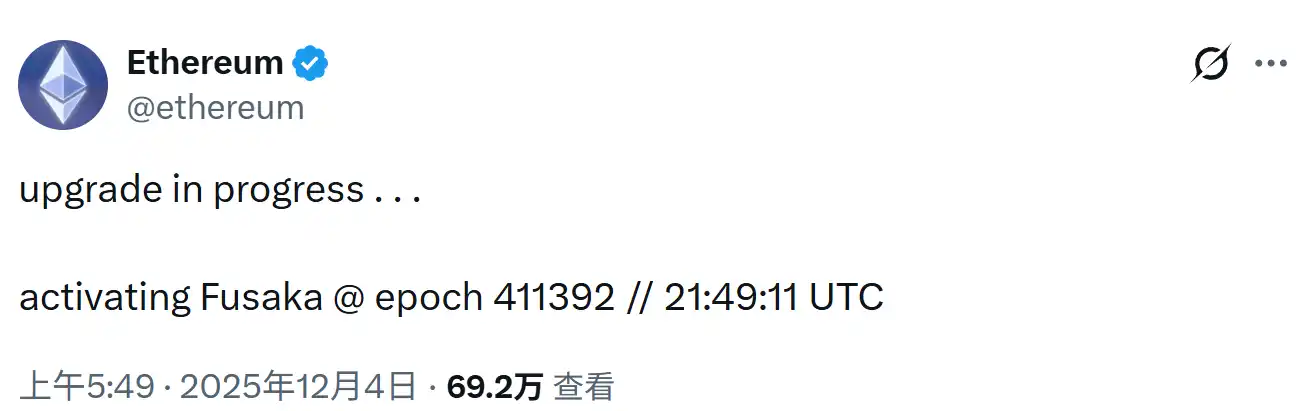
In this Fusaka upgrade, the focus was almost entirely on scaling: Blob capacity expanded by 8 times, combined with PeerDAS random sampling verification, making the cost narrative of the DA (Data Availability) track a thing of the past.

Indeed, cheaper L2s are a good thing, but for Ethereum's long-term ZK roadmap, EIP-7825 is the real game-changer because it sets a Gas limit for a single transaction on Ethereum (about 16.78 million Gas).

As we all know, Ethereum's block Gas Limit was increased to 60 million this year. But even as the upper limit continues to rise, theoretically, if they were willing to pay an extremely high Gas Price, someone could send a super-complex "Mega-Transaction" that directly occupies the entire block's 60 million Gas capacity, thereby clogging the entire block.

This was allowed before, but EIP-7825 introduces a new restriction: no single transaction can consume more than 16.78 million Gas, regardless of the block size.

So why limit the size of a single transaction? This change actually has no impact on ordinary user transfers, but for ZK Provers (proof generators), it is a matter of life and death, and it is also closely related to how ZK systems generate proofs.

To give a simple example, before EIP-7825, if a block contained a "Mega-Transaction" consuming 60 million Gas, the ZK Prover had to run this extremely complex transaction sequentially—it couldn't be split or parallelized. This is like a single-lane highway where a giant, extremely slow truck is in front, and all the cars behind (other transactions) have to wait for it to pass.

This would undoubtedly sentence "real-time proof" to death—because the time to generate the proof would be completely unpredictable, potentially taking dozens of minutes or even longer.

After EIP-7825, even if the block capacity expands to 100 million Gas in the future, since each transaction is forcibly limited to within 16.78 million Gas, each block is broken down into predictable, bounded, and parallelizable "small task units." This means that Ethereum's proof generation has changed from a tricky "logical puzzle" to a pure "money problem":

As long as enough parallel computing power is invested, we can process these split small tasks simultaneously in an extremely short time, thereby generating ZK proofs for huge blocks.

As Michael, co-founder and CEO of Brevis, said, EIP-7825 is the most underestimated upgrade on the future path of ZK and 100x scaling for Ethereum. It turns "real-time proof" from "theoretically impossible" to "engineerably schedulable." As long as we can solve the computing power problem through parallel computation, even a 200 million Gas block could achieve second-level proof. This is not only a breakthrough for ZK technology but also the physical foundation for Ethereum's Interoperability Layer (EIL) to achieve second-level cross-chain settlement.
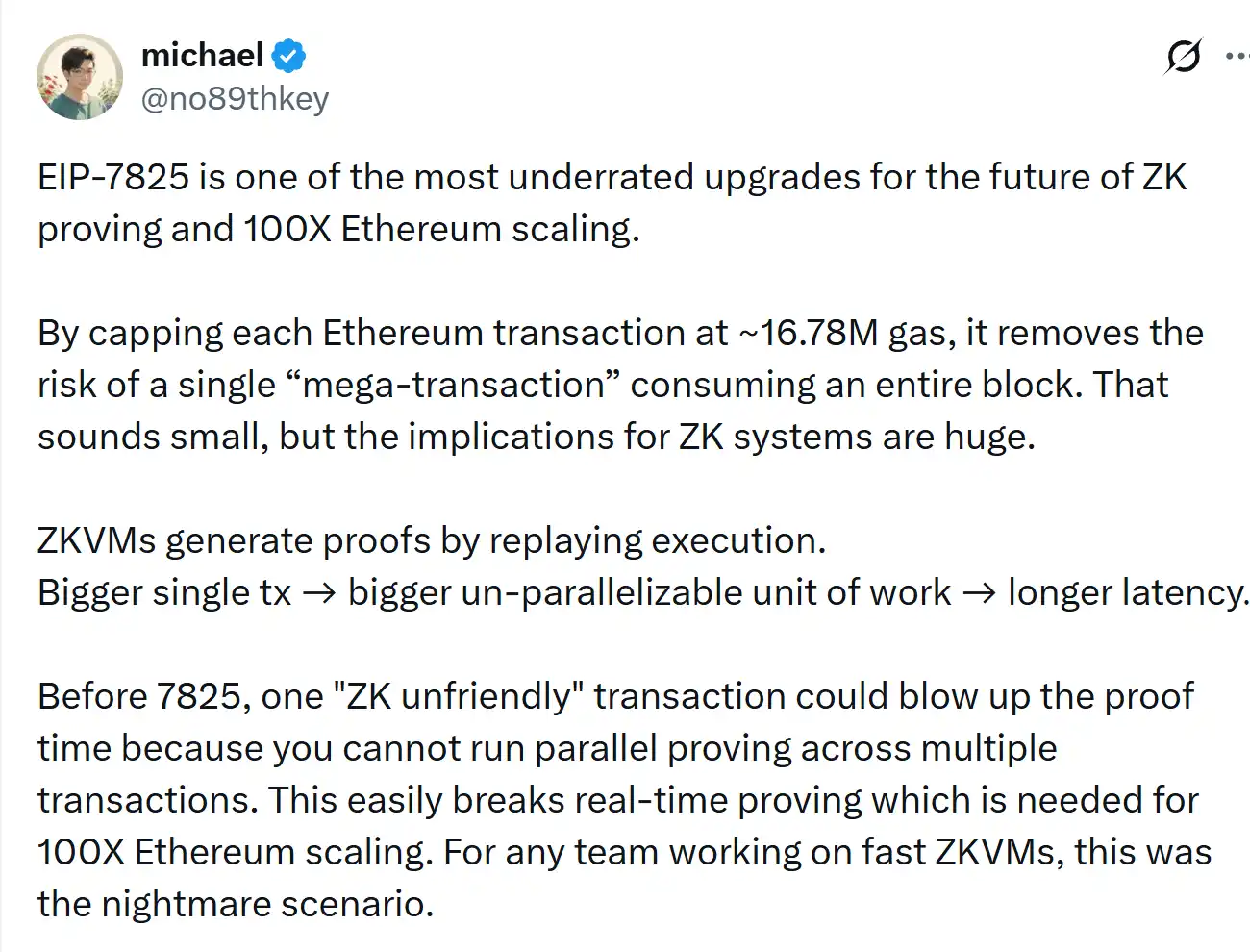
So this upgrade might not seem like the main event, but it is actually a huge breakthrough for the ZK roadmap and Ethereum's scaling future in 2026.

II. L1 zkEVM: The "Trust Anchor" for Ethereum Interoperability

However, although EIP-7825 paves the physical path (parallelizability) for real-time proof by limiting single transaction size, this is only one side of the coin. The other side is how the Ethereum mainnet itself utilizes this capability?

This involves the most hardcore narrative in Ethereum's roadmap—L1 zkEVM.

For a long time, zkEVM has been regarded as the "holy grail" for scaling Ethereum, not only because it can solve performance bottlenecks but also because it redefines the trust mechanism of blockchain. Its core idea is to enable the Ethereum mainnet to generate and verify ZK proofs.

In other words, in the future, after each Ethereum block is executed, it can output a verifiable mathematical proof, allowing other nodes (especially light nodes and L2s) to confirm the correctness of the result without repeating the calculation—if the ability to generate ZK proofs is directly written into the Ethereum protocol layer (L1), the proposer packs a block and generates a ZK proof, and validating nodes no longer need to rerun the transactions; they only need to verify this tiny mathematical proof.

What does this mean for interoperability?

In the context of Interop, the significance of L1 zkEVM far exceeds scaling itself. It can be said to be the "trust anchor" for all L2s. After all, if Ethereum L1 can generate proofs in real time, it means all L2s can read L1's final state in real time and trustlessly. This will bring about two qualitative changes:

  • Eliminate the Challenge Period: The confirmation time between chains will be compressed from "7 days (OP mechanism)" to "seconds (ZK mechanism)";
  • Decentralized Interconnection: Cross-chain will no longer require trust in third-party multi-signature bridges but will trust the mathematical truth of the Ethereum mainnet;

This is also the physical foundation we mentioned in the previous article for EIL (Interoperability Layer) to truly work—without real-time finality from L1, interoperability between L2s will never escape the shadow of "delay."

The goal is set (L1 zkEVM), and the physical limitation is removed (EIP-7825). So what about the specific implementation tools?

This leads to the subtle evolution happening in the ZK technology stack: from zkEVM to zkVM.

III. Fusaka & EIP-7825: The Interoperability Roadmap is Liberated

If EIP-7825 provides a "parallelizable hardware environment" for ZK by limiting single transaction size, then the evolution of the ZK technology stack is to find a "more efficient software architecture." This might sound like a tongue twister, but the difference is significant and represents two stages of ZK development.

The first stage is naturally zkEVM, which can be seen as the compatibility faction or the reformist faction.

The logic is to strive to imitate every instruction of the Ethereum EVM, allowing developers to deploy Solidity code directly, reducing migration costs and barriers.

In other words, the biggest advantage of zkEVM is its compatibility with existing Ethereum applications, greatly reducing the workload for Ethereum ecosystem developers. They can reuse most of the existing infrastructure and tools (including execution clients, block explorers, debugging tools, etc.).

However, precisely because of this, since the EVM was not designed with ZK-friendliness in mind, for the sake of compatibility, zkEVM's proof efficiency often has a ceiling, and proof times are much slower, burdened by historical baggage.

zkVM, on the other hand, belongs to the radical revolutionary faction, directly building a virtual machine that is extremely friendly to ZK proofs (such as based on RISC-V or WASM) to speed up proof time and achieve better execution speed and performance.

But it also loses compatibility with many EVM features and the ability to use existing tools (like low-level debuggers). However, a clear trend is that more and more L2 projects are shedding their baggage,极致 optimizing proof speed and cost, and exploring architectures based on zkVM.

So why is the Fusaka upgrade the unlocker?

After all, before EIP-7825, whether zkEVM or zkVM, once they encountered a Mega-Transaction on Ethereum, the proof generation time would skyrocket due to the inability to split the task.

Now, EIP-7825 forcibly breaks down transactions into predictable small units. With a parallelizable environment, an efficient architecture like zkVM can exert its maximum power. Even complex Ethereum blocks, when placed in a zkVM and combined with parallel computing power, can achieve real-time proof.

What does this mean for interoperability? The proliferation of zkVM combined with EIP-7825 means the cost of generating proofs will drop significantly. When the cost of generating a cross-chain proof is low enough to be negligible, and the speed is as fast as sending an email, traditional "cross-chain bridges" will completely disappear, replaced by underlying universal message protocols.

In Conclusion

As repeatedly mentioned in previous articles of the Interop series, the ultimate goal of Interop is not just asset "cross-chain," nor is it limited to the concept of "asset bridges" anymore. It is a comprehensive set of system-level capabilities, including cross-chain data communication, cross-chain logic execution, cross-chain user experience, cross-chain security, and consensus.

From this perspective, Interop can be understood as the universal language between future Ethereum ecosystem protocols. Its significance lies not only in transferring value but also in sharing logic. ZK's role in this is to guarantee execution correctness and support real-time state verification, making cross-domain calls "dare to do, able to do." It can even be said that without real-time ZK, there can hardly be truly usable Interop UX.

So when EIP-7825 was quietly activated in the Fusaka upgrade, and as L1 zkEVM gradually becomes a reality, we are getting closer to that ultimate goal: execution, settlement, and proof are completely abstracted in the background, and users are completely unaware of the chain's existence throughout the process.

This is the Interop endgame we all look forward to in the future.

Câu hỏi Liên quan

QWhat is the significance of EIP-7825 in the Fusaka upgrade for Ethereum's interoperability?

AEIP-7825 introduces a gas limit per transaction (approximately 16.78 million gas), which prevents a single complex 'mega-transaction' from blocking an entire Ethereum block. This allows for parallel processing of transactions, making it feasible to generate ZK proofs in real-time. This is a critical engineering enabler for Ethereum's ZK roadmap and interoperability, as it transforms proof generation from a logical challenge into a solvable computational problem, paving the way for near-instant cross-chain settlements.

QHow does L1 zkEVM serve as a 'trust anchor' for Ethereum interoperability?

AL1 zkEVM integrates the ability to generate and verify ZK proofs directly into the Ethereum protocol layer. This means every block produced on Ethereum L1 can be accompanied by a verifiable mathematical proof. For interoperability, this allows all L2s to read the final state of L1 in real-time without trust. It eliminates the need for long challenge periods (e.g., the 7-day wait in Optimistic Rollups) and enables decentralized cross-chain communication without relying on trusted multi-signature bridges, as chains can trust the mathematical truth of Ethereum's mainnet.

QWhat is the key difference between zkEVM and zkVM in the context of ZK technology evolution?

AzkEVM focuses on full compatibility with the Ethereum Virtual Machine (EVM), allowing developers to deploy existing Solidity code with minimal changes. However, this compatibility often results in slower proof generation due to EVM's design not being ZK-friendly. In contrast, zkVM is a more radical approach that builds a new virtual machine (e.g., based on RISC-V or WASM) optimized for ZK proof efficiency and execution speed. While zkVM sacrifices some EVM compatibility and existing tooling, it offers significantly faster proof generation and better performance, which is crucial for real-time interoperability.

QHow does the combination of EIP-7825 and zkVM architecture enhance Ethereum's interoperability capabilities?

AEIP-7825 ensures that Ethereum transactions are broken down into small, predictable units that can be processed in parallel. This eliminates the problem of 'mega-transactions' causing unpredictable proof generation times. When combined with the efficient architecture of zkVM, which is designed for speed and low cost, it becomes possible to generate ZK proofs for complex Ethereum blocks in real-time. This drastically reduces the cost and increases the speed of cross-chain proof generation, making traditional cross-chain bridges obsolete and enabling seamless,底层通用消息协议 for interoperability.

QWhat is the ultimate goal of Interop (interoperability) in the Ethereum ecosystem, as described in the article?

AThe ultimate goal of Interop is not just cross-chain asset transfers but a comprehensive system-level capability that includes cross-chain data communication, logic execution, user experience, security, and consensus. It aims to create a universal language for protocols within the Ethereum ecosystem, enabling not only value transfer but also logic sharing. ZK technology ensures execution correctness and real-time state verification, making cross-domain interactions feasible and user-friendly. The end vision is a fully abstracted backend where users are unaware of the underlying chains, experiencing seamless interoperability.

Nội dung Liên quan

General Tensor và Talisman Hợp Lực Xây Dựng Hệ Thống Tài Chính Cho AI Phi Tập Trung

General Tensor và Talisman Wallet đã công bố một đối tác chiến lược lớn nhằm đơn giản hóa cách người dùng và tổ chức tương tác với Bittensor, đồng thời đặt nền móng cho một cơ sở hạ tầng tài chính "sẵn sàng cho tác nhân AI". Sự hợp tác kết hợp công nghệ ví và đa chữ ký của Talisman với hoạt động validator, cơ sở hạ tầng khai thác, mạng con và nền tảng giao dịch của General Tensor. Talisman, hiện bảo mật khoảng 2 tỷ USD tài sản xuyên chuỗi với một nửa kết nối với hệ sinh thái Bittensor, cung cấp các giải pháp bảo mật cấp tổ chức như Signet. Trong khi đó, General Tensor tập trung vào tích hợp dọc trong hệ sinh thái Bittensor, bao gồm việc mua lại nền tảng giao dịch Backprop Finance. Hợp tác này nhằm thu hẹp khoảng cách giữa ý định ở cấp độ ví và việc thực thi trên mạng, tạo đường dẫn liền mạch cho việc lưu ký, giao dịch, đặt cọc và tương tác với các mạng con. Nó cũng phản ánh sự quan tâm ngày càng tinh vi của các tổ chức đối với AI phi tập trung, không chỉ dừng ở đầu cơ token mà còn ở việc tiếp xúc với cơ sở hạ tầng hoạt động. General Tensor gần đây đã huy động vốn từ các nhà đầu tư như Digital Currency Group và một công ty được Goldman Sachs hậu thuẫn.

TheNewsCrypto27 phút trước

General Tensor và Talisman Hợp Lực Xây Dựng Hệ Thống Tài Chính Cho AI Phi Tập Trung

TheNewsCrypto27 phút trước

Logic cơ bản đằng sau sự truyền dẫn nút cổ chai trong chuỗi cung ứng điện toán AI

Tác giả phân tích logic cơ bản về sự lan truyền điểm nghẽn trong chuỗi cung ứng năng lực tính toán AI, mô tả một quá trình chuyển dịch theo trình tự từ "GPU → Bộ nhớ (HBM) → Kết nối quang → Điện/Làm mát bằng chất lỏng". Trong giai đoạn đầu (2022-2024), điểm nghẽn chính là sản lượng wafer và đóng gói tiên tiến cho GPU cao cấp. Sau khi năng lực đóng gói CoWoS của TSMC được mở rộng, điểm nghẽn chuyển sang Bộ nhớ Băng thông Cao (HBM) vào năm 2024-2025. Nhu cầu về băng thông khổng lồ cho các mô hình lớn khiến HBM trở nên khan hiếm, với nguồn cung hạn chế từ ba nhà sản xuất chính. Đến năm 2025-2026, kết nối đồng (cáp đồng) đạt đến giới hạn vật lý về băng thông, khoảng cách và tản nhiệt, thúc đẩy sự chuyển dịch tất yếu sang công nghệ kết nối quang (như CPO và silicon quang) để mở rộng quy mô cụm AI. Hiện tại, điểm nghẽn cuối cùng và cấp bách nhất là "Tường năng lượng" và "Tường tản nhiệt" (2026). Công suất tiêu thụ của các cụm AI quy mô siêu lớn đã vượt xa khả năng của giải pháp làm mát bằng không khí truyền thống và gây áp lực lên lưới điện. Giải pháp làm mát bằng chất lỏng (trực tiếp lên chip hoặc ngâm) và nguồn cung điện ổn định trở thành điều kiện tiên quyết để vận hành. Bài viết kết luận rằng chuỗi cung ứng năng lực tính toán AI hoạt động như một hàm sản xuất Leontief, nơi các điểm nghẽn di chuyển tuần tự và việc giải quyết một nút thắt sẽ ngay lập tức làm lộ ra nút thắt tiếp theo. Điều này định hình lại việc phân bổ giá trị trong toàn bộ ngành công nghiệp.

marsbit1 giờ trước

Logic cơ bản đằng sau sự truyền dẫn nút cổ chai trong chuỗi cung ứng điện toán AI

marsbit1 giờ trước

Từ "Thà ăn chuối" đến việc bán 80% Bitcoin: Mối quan hệ yêu - ghét với tiền mã hóa của Mark Cuban

Tỷ phú doanh nhân Mark Cuban, cựu chủ sở hữu Dallas Mavericks, mới đây đã công bố đã bán phần lớn lượng Bitcoin nắm giữ. Ông bày tỏ thất vọng khi Bitcoin không phát huy được vai trò như một công cụ phòng ngừa rủi ro hiệu quả trước tình hình địa chính trị biến động và đồng USD suy yếu, đặc biệt trong giai đoạn xung đột với Iran gần đây, khi giá vàng tăng vọt còn Bitcoin lại giảm. Hành trình của Cuban với tiền mã hóa trải qua nhiều bước ngoặt. Năm 2019, ông từng tỏ ra hoài nghi, so sánh Bitcoin với quả chuối và coi đó là một khoản đầu cơ. Đến đỉnh cao bull run 2021, thái độ của ông thay đổi hoàn toàn, trở thành người ủng hộ tích cực và tiết lộ danh mục crypto của mình có tới 60% là Bitcoin. Cùng năm đó, ông cũng bị "dạy một bài học" đắt giá khi tham gia cung cấp thanh khoản cho dự án DeFi Iron Finance trên Polygon, dẫn đến thua lỗ sau sự sụp đổ của token TITAN. Từ 2022 đến 2025, Cuban chuyển sang đối mặt với các vấn đề pháp lý và chỉ trích cơ quan quản lý, sau khi bị kiện tập thể liên quan đến việc quảng bá cho sàn Voyager Digital trước khi nó phá sản, vụ kiện sau đó đã bị bác bỏ. Năm 2025, ông từng cân nhắc phát hành memecoin riêng nhưng không thành. Trong vòng 7 năm, Cuban đã trải qua ba lần đảo ngược quan điểm, từ hoài nghi, sang nhiệt thành, rồi đến thất vọng. Lộ trình này phản ánh khá rõ tâm lý biến động của nhiều nhà đầu tư cá nhân trong chu kỳ tiền mã hóa vừa qua. Dù phân tích cho thấy từ đầu năm 2026, Bitcoin vẫn có mức tăng trưởng dương và vượt trội hơn vàng, quyết định bán ra của Cuban dường như vẫn chịu ảnh hưởng lớn từ cảm xúc và góc nhìn ngắn hạn trước các sự kiện thị trường.

marsbit1 giờ trước

Từ "Thà ăn chuối" đến việc bán 80% Bitcoin: Mối quan hệ yêu - ghét với tiền mã hóa của Mark Cuban

marsbit1 giờ trước

Giao dịch

Giao ngay
Hợp đồng Tương lai

Bài viết Nổi bật

Làm thế nào để Mua HPP

Chào mừng bạn đến với HTX.com! Chúng tôi đã làm cho mua House Party Protocol (HPP) trở nên đơn giản và thuận tiện. Làm theo hướng dẫn từng bước của chúng tôi để bắt đầu hành trình tiền kỹ thuật số của bạn.Bước 1: Tạo Tài khoản HTX của BạnSử dụng email hoặc số điện thoại của bạn để đăng ký tài khoản miễn phí trên HTX. Trải nghiệm hành trình đăng ký không rắc rối và mở khóa tất cả tính năng. Nhận Tài khoản của tôiBước 2: Truy cập Mua Crypto và Chọn Phương thức Thanh toán của BạnThẻ Tín dụng/Ghi nợ: Sử dụng Visa hoặc Mastercard của bạn để mua House Party Protocol (HPP) ngay lập tức.Số dư: Sử dụng tiền từ số dư tài khoản HTX của bạn để giao dịch liền mạch.Bên thứ ba: Chúng tôi đã thêm những phương thức thanh toán phổ biến như Google Pay và Apple Pay để nâng cao sự tiện lợi.P2P: Giao dịch trực tiếp với người dùng khác trên HTX.Thị trường mua bán phi tập trung (OTC): Chúng tôi cung cấp những dịch vụ được thiết kế riêng và tỷ giá hối đoái cạnh tranh cho nhà giao dịch.Bước 3: Lưu trữ House Party Protocol (HPP) của BạnSau khi mua House Party Protocol (HPP), lưu trữ trong tài khoản HTX của bạn. Ngoài ra, bạn có thể gửi đi nơi khác qua chuyển khoản blockchain hoặc sử dụng để giao dịch những tiền kỹ thuật số khác.Bước 4: Giao dịch House Party Protocol (HPP)Giao dịch House Party Protocol (HPP) dễ dàng trên thị trường giao ngay của HTX. Chỉ cần truy cập vào tài khoản của bạn, chọn cặp giao dịch, thực hiện giao dịch và theo dõi trong thời gian thực. Chúng tôi cung cấp trải nghiệm thân thiện với người dùng cho cả người mới bắt đầu và người giao dịch dày dạn kinh nghiệm.

Tổng lượt xem 133Xuất bản vào 2026.04.29Cập nhật vào 2026.04.29

Làm thế nào để Mua HPP

GENIUS là gì

I. Giới thiệu Dự án1. Genius là gì?Genius (GENIUS) được định vị là “trạm giao dịch trên chuỗi tối ưu,” một nền tảng giao dịch phi tập trung tập trung vào quyền riêng tư và tốc độ. Bằng cách tích hợp công nghệ bảo mật hàng đầu, nó nhằm xây dựng một cơ sở hạ tầng giao dịch bảo mật thế hệ tiếp theo trên các mạng như BNB Chain, cho phép người dùng tương tác trên chuỗi với trải nghiệm liền mạch tương đương với các sàn giao dịch tập trung.2. Genius hoạt động như thế nào?Kiến trúc kỹ thuật cốt lõi của Genius được cấu trúc như sau:(1) Không nhìn thấy chuỗi: Người dùng không cần phải xử lý thủ công các phê duyệt nhiều bước cho các hoạt động xuyên chuỗi, bao bọc tài sản hoặc quản lý gas phức tạp.(2) Giao dịch không cần chữ ký: Thông qua các tích hợp như Turnkey, Genius cho phép giao dịch ngay lập tức mà không cần xác nhận pop-up hoặc ủy quyền theo giao dịch.(3) Tập hợp của các Tập hợp: Genius được hỗ trợ bởi một ngăn xếp tập hợp hàng đầu tích hợp với hơn 150 DEX, tuyên bố hiệu suất báo giá vượt trội so với các sản phẩm cạnh tranh.(4) Quản lý Tài khoản: Nền tảng áp dụng kiến trúc không lưu ký và tận dụng Turnkey và Lit Protocol cho quản lý khóa, cho phép người dùng truy cập an toàn vào tài khoản của họ thông qua các khóa truy cập.3. Ai đã tạo ra Genius?Theo Điều khoản Dịch vụ chính thức của nó, Genius được phát triển bởi Shuttle Labs, Inc. Dựa trên tài khoản X chính thức của dự án, Ryan Myher là một trong những người đóng góp chính thúc đẩy sự phát triển sản phẩm, bao gồm các phát triển như triển khai giao thức Ghost, cũng như sự tham gia rộng rãi của cộng đồng.Người sáng lập Binance CZ đã chính thức tham gia dự án với tư cách là cố vấn, với mục tiêu giúp đội ngũ xây dựng trải nghiệm giao dịch trên chuỗi nhanh hơn và bảo mật hơn.Thêm vào đó, dự án đã nhận được sự hỗ trợ mạnh mẽ từ YZi Labs, đơn vị đã đầu tư vào Genius và làm việc cùng với Genius Foundation, chịu trách nhiệm duy trì Giao thức Cầu Genius (GBP) cốt lõi.4. Kinh tế Token của GeniusGENIUS là token gốc của hệ sinh thái Genius. Đến thời điểm hiện tại, dự án chưa phát hành tài liệu kinh tế token đầy đủ.Dựa trên các thông báo chính thức mới nhất, Genius tích hợp một cơ chế giảm phát, và 4,6% tổng nguồn cung token đã được đốt trong giai đoạn ra mắt ban đầu.Hệ thống Điểm Genius (GP):(1) Giao dịch để kiếm: Nền tảng đã thiết lập một quỹ thưởng 200 triệu Điểm Genius, và người dùng kiếm GP cho mỗi giao dịch thực hiện qua trạm.(2) Phân cấp và Huy hiệu: Genius có hệ thống huy hiệu dựa trên tiến trình từ Thông minh đến Thần thánh, với các cấp độ cao hơn mở khóa thêm các đặc quyền và lợi ích.(3) Lợi suất gốc: Người dùng nắm giữ các tài sản được chỉ định như usdGG trong bảng điều khiển có thể kiếm lợi suất gốc trực tiếp mà không cần trải qua quá trình staking phức tạp.(4) Khuyến khích Giới thiệu: Người giới thiệu có thể kiếm được khoản hoàn phí trên 45% được trả bằng USDC, cùng với GP bổ sung.5. Thời gian & Các cột mốc chínhTháng 3 năm 2020: Tài khoản X chính thức của dự án được tạo ra, đánh dấu sự khởi đầu của giai đoạn chuẩn bị ban đầu.Ngày 13 tháng 1 năm 2026: Genius công bố một khoản đầu tư hàng triệu đô la từ YZi Labs và đồng thời xác nhận CZ là cố vấn để tăng tốc xây dựng cơ sở hạ tầng giao dịch bảo mật của mình.Ngày 18 tháng 4 năm 2026: Dự án thông báo rằng giao thức bảo mật Ghost sẽ sớm ra mắt.Ngày 29 tháng 4 năm 2026: Giao thức Ghost chính thức mở cửa cho 50 người thử nghiệm đầu tiên, đánh dấu sự khởi đầu của một kỷ nguyên mới cho giao dịch bảo mật trên BNB Chain. Đồng thời, đội ngũ xác nhận 4,6% token đã bị đốt.​II. Thông tin Token1) Thông tin cơ bảnTên token: GENIUS (Genius)III. Liên kết liên quanWebsite:https://www.tradegenius.com/homeKhám phá:https://bscscan.com/address/0x1f12b85aac097e43aa1555b2881e98a51090e9a6Mạng xã hội:https://x.com/GeniusTerminalGhi chú: Giới thiệu dự án đến từ các tài liệu được công bố hoặc cung cấp bởi đội ngũ dự án chính thức, chỉ mang tính tham khảo và không cấu thành lời khuyên đầu tư. HTX không chịu trách nhiệm cho bất kỳ tổn thất trực tiếp hoặc gián tiếp nào phát sinh.

Tổng lượt xem 270Xuất bản vào 2026.04.29Cập nhật vào 2026.05.12

GENIUS là gì

Làm thế nào để Mua GENIUS

Chào mừng bạn đến với HTX.com! Chúng tôi đã làm cho mua Genius (GENIUS) trở nên đơn giản và thuận tiện. Làm theo hướng dẫn từng bước của chúng tôi để bắt đầu hành trình tiền kỹ thuật số của bạn.Bước 1: Tạo Tài khoản HTX của BạnSử dụng email hoặc số điện thoại của bạn để đăng ký tài khoản miễn phí trên HTX. Trải nghiệm hành trình đăng ký không rắc rối và mở khóa tất cả tính năng. Nhận Tài khoản của tôiBước 2: Truy cập Mua Crypto và Chọn Phương thức Thanh toán của BạnThẻ Tín dụng/Ghi nợ: Sử dụng Visa hoặc Mastercard của bạn để mua Genius (GENIUS) ngay lập tức.Số dư: Sử dụng tiền từ số dư tài khoản HTX của bạn để giao dịch liền mạch.Bên thứ ba: Chúng tôi đã thêm những phương thức thanh toán phổ biến như Google Pay và Apple Pay để nâng cao sự tiện lợi.P2P: Giao dịch trực tiếp với người dùng khác trên HTX.Thị trường mua bán phi tập trung (OTC): Chúng tôi cung cấp những dịch vụ được thiết kế riêng và tỷ giá hối đoái cạnh tranh cho nhà giao dịch.Bước 3: Lưu trữ Genius (GENIUS) của BạnSau khi mua Genius (GENIUS), lưu trữ trong tài khoản HTX của bạn. Ngoài ra, bạn có thể gửi đi nơi khác qua chuyển khoản blockchain hoặc sử dụng để giao dịch những tiền kỹ thuật số khác.Bước 4: Giao dịch Genius (GENIUS)Giao dịch Genius (GENIUS) dễ dàng trên thị trường giao ngay của HTX. Chỉ cần truy cập vào tài khoản của bạn, chọn cặp giao dịch, thực hiện giao dịch và theo dõi trong thời gian thực. Chúng tôi cung cấp trải nghiệm thân thiện với người dùng cho cả người mới bắt đầu và người giao dịch dày dạn kinh nghiệm.

Tổng lượt xem 206Xuất bản vào 2026.04.29Cập nhật vào 2026.05.12

Làm thế nào để Mua GENIUS

Thảo luận

Chào mừng đến với Cộng đồng HTX. Tại đây, bạn có thể được thông báo về những phát triển nền tảng mới nhất và có quyền truy cập vào thông tin chuyên sâu về thị trường. Ý kiến ​​của người dùng về giá của A (A) được trình bày dưới đây.

活动图片