Why Did Crypto Really Underperform In 2025? The Hard Truths

bitcoinistXuất bản vào 2025-12-01Cập nhật gần nhất vào 2025-12-02

Tóm tắt

For most of 2025, the crypto price action felt out of sync with the rest of the risk complex. Equities,...

Trusted Editorial content, reviewed by leading industry experts and seasoned editors. Ad Disclosure

For most of 2025, the crypto price action felt out of sync with the rest of the risk complex. Equities, gold and even parts of the defense and AI trade found sustained bids, while Bitcoin repeatedly failed to hold breakouts and altcoins bled liquidity.

A widely circulated X post by pseudonymous macro commentator and crypto analyst “plur_daddy” offers one of the most coherent internal diagnoses of what went wrong. His argument is not about a single shock, but about structural supply, fading belief and a new kind of existential risk.

Why Crypto Truly Lagged In 2025

At the core is ownership concentration and the long-awaited six-figure exit ramp. Bitcoin, he argues, “never fully distributed out at lower prices.” Large OG balances accumulated over more than a decade remained tightly held, and 2025 finally offered them both price and liquidity. With spot ETFs, deep derivatives markets and institutional counterparties in place, there was “heavy liquidity available for exiting large bags at the mythical $100k price target,” in line with the long-running meme of “dumping on the suits.”

Around that price region, several narratives converged: the perceived apex of the four-year cycle, a shift in Bitcoin’s image “from being a cypherpunk beacon to a Wall St/Trump family vehicle,” and mounting unease about quantum computing. For holders with essentially their entire net worth in BTC, that mix changed the calculus.

He asks readers to imagine “someone who has massive bags that can’t be sold overnight, with 99.99% of their wealth tied up in a single asset.” Quantum is not cast as an imminent catastrophe, but as a persistent tail risk whose timeline “has been accelerating.” Technical fixes exist, but “they’re all difficult,” and he highlights “the political dysfunction within the Bitcoin dev community.”

Once that worry lodges, he says, “the mind-virus is hard to shake.” With an estimated “$200–250bn+ of OG holdings out there,” it becomes “totally rational to dump a meaningful part of the bag.” In his summary line, “BTC got to a price where the supply overwhelmed the demand in the market.”

The second leg of the underperformance story is narrative. “There wasn’t anything to believe in,” he writes. The meme of financial nihilism may describe reality for some, but “does not captivate the interest of retail buyers.” At the same time, equity markets were selling far more compelling dreams around “AI, quantum, space, drones, nuclear, and defense.”

On the macro-hedge front, “the debasement story for BTC was real but gold simply beat it out.” Bitcoin faced adverse supply dynamics just as gold enjoyed “favorable demand dynamics (Central Bank buying),” weakening BTC’s claim as the superior monetary hedge.

Within crypto itself, there was also a vacuum. In late 2023 and early 2024, the ETFs and then Trump provided powerful, easy-to-grasp narratives. “In 2025,” he argues, “there also wasn’t a narrative around liquidity, or an overarching sense of hope and optimism around what crypto could achieve for the world.”

Liquidity still matters, but in his framing crypto is now “the tip of the spear for liquidity conditions,” a “blow-off valve for excess liquidity.” With conditions “without any doubt” the loosest in 2021 and “meaningfully more loose in 2024 over 2025,” price action simply tracked that tightening.

At the same time, the risk-reward stopped making sense for many participants. BTC “still had a lot of volatility and risk and traded like aids,” he writes, and that was acceptable when the upside was a 3–5x. As people “came to Jesus on the shift in potential upside,” and watched episodes such as the “$10bn seller in July,” they began to question whether trillion-dollar valuations and $500k–$1m BTC really “passed the smell test.”

The internal market structure did the rest. In a “liquidity deprived state,” the game turned increasingly “PvP,” with capital concentrating into sharps who then “offramp the money into other asset classes, helping to fuel them.” Severe altcoin weakness “ultimately became a drag on BTC as well,” because it pushed people to “fully offramp from the crypto ecosystem, instead of taking profits into BTC.”

Looking ahead, his base case is quietly bearish on narratives and quietly constructive on time. Bitcoin “most likely” needs “a period of re-accumulation.” OG selling and quantum awareness will remain overhangs, while “gold and silver are cleaner and simpler bets on debasement.” Liquidity “may improve a lot if Trump successfully takes over the Fed,” but that is “a complex process, and half a year away.”

As of the end of 2025, in his telling, crypto underperformance is not a glitch – it is the logical outcome of who owns the coins, what they fear, and what the rest of the world chose to believe in instead.

At press time, the total crypto market cap stood at $2.91 trillion.
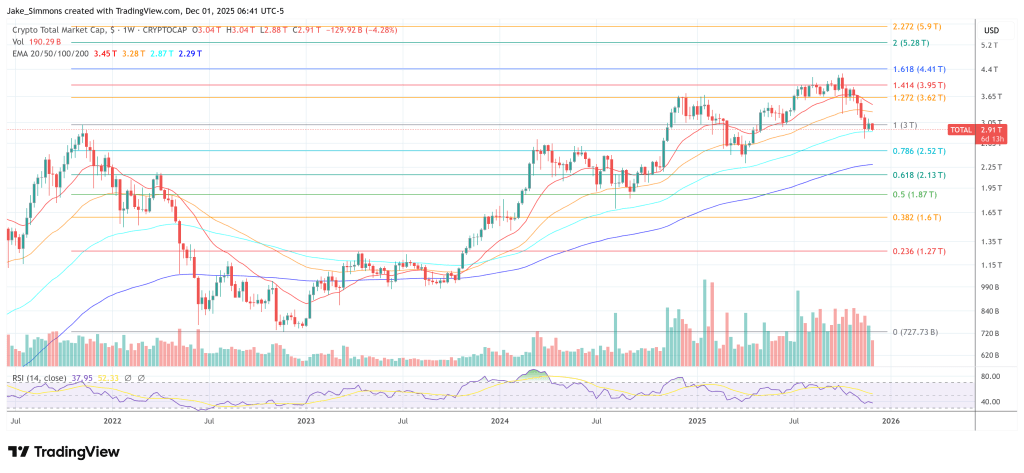
Total crypto market cap
Total crypto market cap holds above the 100-week EMA, 1-week chart | Source: TOTAL on TradingView.com
Featured image created with DALL.E, chart from TradingView.com
Editorial Process for bitcoinist is centered on delivering thoroughly researched, accurate, and unbiased content. We uphold strict sourcing standards, and each page undergoes diligent review by our team of top technology experts and seasoned editors. This process ensures the integrity, relevance, and value of our content for our readers.

Jake Simmons has been a Bitcoin enthusiast since 2016. Ever since he heard about Bitcoin, he has been studying the topic every day and trying to share his knowledge with others. His goal is to contribute to Bitcoin's financial revolution, which will replace the fiat money system. Besides BTC and crypto, Jake studied Business Informatics at a university. After graduation in 2017, he has been working in the blockchain and crypto sector. You can follow Jake on Twitter at @realJakeSimmons.

Nội dung Liên quan

Giá Bitcoin duy trì trên mức 60.000 USD – Nhưng liệu một cái bẫy tăng giá BTC đang hình thành?

Bitcoin (BTC) đang thể hiện sự kiên cường khi duy trì trên mức hỗ trợ quan trọng 60.000 USD, bất chấp sự bất ổn vĩ mô gia tăng từ căng thẳng địa chính trị và giá dầu tăng. Điều thú vị là sức mạnh này xuất hiện cùng lúc với giá dầu cao, một sự phân kỳ so với các chu kỳ trước. Dữ liệu từ CoinGlass cho thấy hơn 13 triệu USD vị thế mua (long) bị thanh lý, giúp loại bỏ đòn bẩy dư thừa mà không phá vỡ xu hướng chung. Vị thế của cá voi (whale) là yếu tố then chốt. Theo Alphractal, cá voi đang tăng dần vị thế mua, đặc biệt mua vào tại vùng đáy gần 58.000 USD, trong khi nhà đầu tư nhỏ lẻ vẫn thận trọng. Tuy nhiên, chỉ số Nhu cầu Giao ngay (Spot Demand) 30 ngày từ CryptoQuant vẫn ở vùng âm từ tháng 12/2025, cho thấy nguồn cung Bitcoin mới chưa được hấp thụ hoàn toàn. Tóm lại, khả năng phục hồi của Bitcoin hiện phụ thuộc nhiều vào hành vi tích lũy của cá voi. Nếu nhu cầu giao ngay bắt đầu cải thiện, BTC có thể có nền tảng để tăng trưởng tiếp theo, nhắm mục tiêu vùng 65.000-70.000 USD. Nếu không, sự củng cố quanh mức 60.000 USD hiện tại có nguy cơ chỉ là một cái bẫy tăng giá (bull trap).

ambcrypto1 giờ trước

Giá Bitcoin duy trì trên mức 60.000 USD – Nhưng liệu một cái bẫy tăng giá BTC đang hình thành?

ambcrypto1 giờ trước

Cá voi Ethereum bổ sung 20,6 triệu USD ETH – Liệu mốc 2.000 USD có trong tầm với?

Ethereum (ETH) đã lấy lại và duy trì mức giá 1.800 USD trong ba ngày liên tiếp, hiện giao dịch quanh 1.807 USD. Trong bối cảnh này, các "cá voi" có giá trị ròng cao đang tích cực gia tăng vị thế nắm giữ. Theo Lookonchain và Onchain Lens, hai cá thể cá voi đã mua tổng cộng 11.306k ETH, trị giá khoảng 20.59 triệu USD, thể hiện sự tự tin mạnh mẽ vào sự phục hồi thị trường. Dữ liệu từ CryptoQuant cho thấy dòng chảy ròng trên các sàn giao dịch (Exchange Netflow) đã âm liên tục trong tám ngày, chuỗi dài nhất từ đầu năm, báo hiệu áp lực mua chiếm ưu thế. Tỷ lệ cung cấp trên sàn (ESR) của ETH cũng giảm xuống mức thấp nhất trong ba tuần, là 0.13, cho thấy tính khan hiếm gia tăng và nguồn cung bán ngay lập tức giảm. Về mặt kỹ thuật, chỉ số Sức mạnh Tương đối (RSI) của ETH duy trì trên mức 50 trong tám ngày qua, củng cố tín hiệu về đà tăng dựa trên nhu cầu. Để duy trì cấu trúc tăng giá và hướng tới mục tiêu 2.000 USD, ETH cần đóng cửa trên đường trung bình động ngắn hạn ở mức 1.778 USD. Ngược lại, việc không thể làm được điều này có thể dẫn đến một đợt điều chỉnh giảm giá khác.

ambcrypto3 giờ trước

Cá voi Ethereum bổ sung 20,6 triệu USD ETH – Liệu mốc 2.000 USD có trong tầm với?

ambcrypto3 giờ trước

‘Chúng tôi đang cố gắng bảo vệ Bitcoin’: Tại sao BIP-110 đang mất dần sự ủng hộ từ cộng đồng

Đề xuất cải tiến Bitcoin (BIP-110), một bản nâng cấp mềm gây tranh cãi, đang thu hút sự chú ý trở lại. Adam Back, CEO Blockstream, cho rằng những hiểu lầm về kiến trúc Bitcoin là nguyên nhân chính thúc đẩy thảo luận về BIP-110 và chính sách OP_RETURN, chứ không phải ý định xấu. Ông nhận định nhiều người ủng hộ BIP-110 là những người mới tham gia thiện chí nhưng có thể thiếu hiểu biết sâu về cách Bitcoin vận hành. Back thừa nhận vấn đề giao dịch rác (spam) là có thật, nhưng lập luận rằng Bitcoin đã có cơ chế thị trường tự nhiên như phí giao dịch và sự đồng thuận phi tập trung để xử lý, thay vì cần các quy tắc hạn chế như BIP-110. Ông nhấn mạnh đề xuất này trái ngược với tính chất không cần xin phép (permissionless) cốt lõi của Bitcoin và khẳng định một bản fork dựa trên BIP-110 khó có thể thành công do thiếu sự ủng hộ rộng rãi. Quan điểm này được Michael Saylor ủng hộ. Bối cảnh thị trường hiện tại cũng cho thấy sự ủng hộ dành cho BIP-110 rất thấp, với chỉ 10 block trong số 2,016 block hỗ trợ bản nâng cấp tạm thời vào ngày 4/7. Hoạt động Ordinals trên mạng Bitcoin cũng đã giảm xuống mức thấp kỷ lục, dưới 10.000 Ordinals mỗi ngày trong tháng qua. Giá Bitcoin đồng thời giảm khoảng 45% trong một năm qua.

ambcrypto5 giờ trước

‘Chúng tôi đang cố gắng bảo vệ Bitcoin’: Tại sao BIP-110 đang mất dần sự ủng hộ từ cộng đồng

ambcrypto5 giờ trước

Vụ khai thác 9 triệu đô của Bonzo Lend – Tại sao hợp đồng thông minh an toàn không thể ngăn chặn

Bonzo Lend, một giao thức cho vay và đi vay không giám sát trên mạng Hedera (HBAR), gần đây đã bị khai thác với tổn thất 9,05 triệu USD. Nguyên nhân không đến từ lỗ hổng hợp đồng thông minh của chính giao thức hoặc mạng lưới Hedera, mà từ một lỗi trong cơ sở hạ tầng oracle bên ngoài. Cuộc tấn công khai thác lỗi xác minh chữ ký trong dịch vụ oracle của Supra, cho phép kẻ tấn công thao túng giá feed của token SAUCE. Bằng cách này, chúng đã vay được tài sản vượt quá giá trị tài sản thế chấp đã đăng ký. Điều đáng chú ý là hợp đồng thông minh của Bonzo Lend đã hoạt động chính xác theo thiết kế khi sử dụng giá bị thao túng này để tính toán, cho thấy rủi ro khi logic giao thức phụ thuộc hoàn toàn vào đầu vào oracle được tin cậy. Sự cố này nhanh chóng ảnh hưởng đến thị trường, khiến giá HBAR giảm và tổng giá trị bị khóa (TVL) trong hệ sinh thái DeFi của Hedera sụt giảm 21,43%. Vụ việc làm nổi bật một rủi ro lặp lại trong DeFi: ngay cả khi mã nguồn được thực thi hoàn hảo, các quy tắc của giao thức vẫn có thể bị lợi dụng. Nó nhấn mạnh tầm quan trọng ngày càng tăng của việc xây dựng các cơ chế oracle kiên cố, các tiêu chuẩn xác minh chặt chẽ hơn và việc áp dụng các biện pháp bổ sung như mô phỏng kinh tế để bảo vệ các giao thức cho vay DeFi.

ambcrypto6 giờ trước

Vụ khai thác 9 triệu đô của Bonzo Lend – Tại sao hợp đồng thông minh an toàn không thể ngăn chặn

ambcrypto6 giờ trước

Giao dịch

Giao ngay
活动图片