‘Crypto Cloud Reset’: Putin Adviser Accuses US Of Plot To Erase $35 Trillion Debt

bitcoinistXuất bản vào 2025-09-09Cập nhật gần nhất vào 2025-09-09

Tóm tắt

A senior adviser to Russian President Vladimir Putin has alleged that the United States is preparing to use cryptocurrencies —specifically...

Trusted Editorial content, reviewed by leading industry experts and seasoned editors. Ad Disclosure

A senior adviser to Russian President Vladimir Putin has alleged that the United States is preparing to use cryptocurrencies —specifically US dollar stablecoins—alongside gold to “devalue” and ultimately reset its towering national liabilities. Speaking at the Eastern Economic Forum in Vladivostok, Anton Kobyakov framed crypto and gold as “alternative currencies” to the dollar-centric system and argued that Washington aims to harness them to address what he called a crisis of confidence in the greenback.

“Right now, the United States is trying to change the rules on the gold and cryptocurrency markets. Just think about their debt – $35 trillion. These are two alternative currencies to the global market,” Kobyakov said.
He added: “Washington’s actions in this direction clearly demonstrate one of the main American goals. They want to solve the problem of lowering the dollar’s trust. The United States, as it was in the 1930s and 1970s, will solve its financial problems at the expense of the whole world, driving everyone into the cryptocurrency cloud.”

Kobyakov’s most arresting claim was operational: “Over time, when part of the US government debt is placed in stablecoins, the US will devalue this debt. In other words, they have a $35 trillion debt, they drive it into the cryptocurrency cloud, devalue it and start from scratch.” The remarks, which were circulated by Russian state-adjacent outlets, did not include a detailed mechanism for how “placing” sovereign obligations into stablecoins would alter their real value.

Can Bitcoin And Crypto (Stablecoins) Erase The US Debt?

The accusation lands amid two relevant backdrops: a US debt load now measured in the mid-$30 trillions and a fast-expanding stablecoin and tokenized-Treasury ecosystem that nonetheless remains orders of magnitude smaller than public debt. Treasury data and Congressional dashboards put gross federal debt at roughly $37.4 trillion in early September, with about $30.1 trillion held by the public. By contrast, the entire stablecoin market stands in the high-$200 billions, and tokenized US Treasury products total about $7.4 billion—hardly a platform capable of “absorbing” sovereign liabilities at scale.

US policy developments complicate Kobyakov’s narrative in another way. In July, President Donald Trump signed the GENIUS Act, the first federal framework for payment stablecoins. The law requires 100% reserve backing in cash and short-term Treasuries and mandates regular public disclosures—design choices that, if anything, tie stablecoin growth to incremental demand for Treasury bills rather than a mechanism for extinguishing US obligations. That is, more regulated stablecoins typically mean more private-sector buying of T-bills to back those tokens, not fewer Treasuries outstanding.

Kobyakov’s historical analogy—invoking the 1930s and 1970s—references episodes when US authorities changed the monetary regime: FDR’s dollar devaluation against gold in 1933–34 and Nixon’s 1971 closure of the gold window. But translating that precedent into a “stablecoin devaluation” is tenuous.

Stablecoins are issued by private or specially licensed entities and are designed to be redeemed at par; moving government liabilities “into” them would neither novate the debt nor change its legal terms. Any genuine devaluation of dollar-denominated debt would still occur via familiar channels—higher inflation, negative real rates, buybacks at discounts, or maturity transformation—not by wrapping the debt in token form.

Beyond the stablecoin debate, Washington has already sketched an alternative pathway: a Strategic Bitcoin Reserve. On March 6, 2025, the White House issued an executive order establishing a federal bitcoin reserve alongside a US Digital Asset Stockpile to manage government-owned crypto (largely from forfeitures) on a long-term, “budget-neutral” basis; companion legislation—the BITCOIN Act introduced in both chambers—would codify governance and disclosure rules.

US President Donald Trump himself has floated the idea in blunt terms. In an Aug. 2024 Fox Business interview with Maria Bartiromo, he mused: “Who knows? Maybe we’ll pay off our $35 trillion, hand them a little crypto check, right? We’ll hand them a little Bitcoin and wipe out our $35 trillion.” The remark was rhetorical rather than an operational plan, but it prefigured the administration’s March 6, 2025 executive order establishing a Strategic Bitcoin Reserve.

At press time, Bitcoin traded at $113,237.
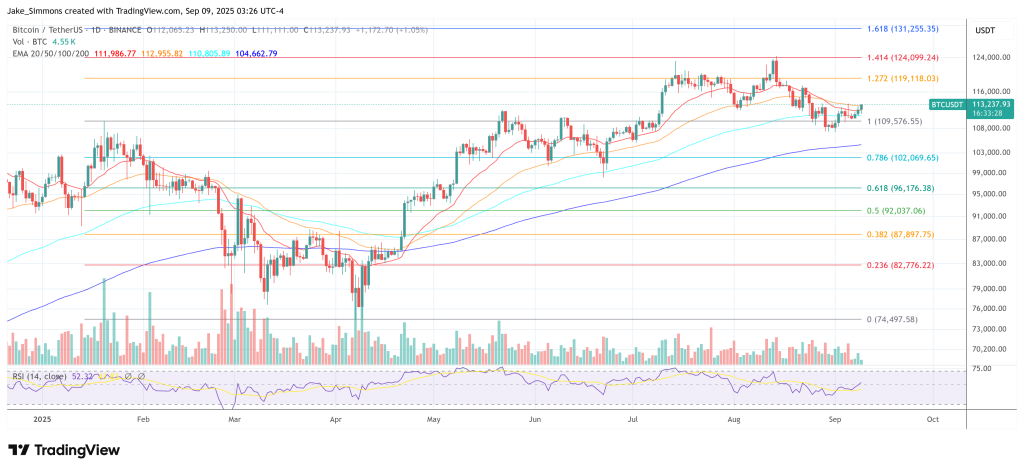
Bitcoin price
BTC rises back above $113,000, 1-day chart | Source: BTCUSDT on TradingView.com
Featured image created with DALL.E, chart from TradingView.com
Editorial Process for bitcoinist is centered on delivering thoroughly researched, accurate, and unbiased content. We uphold strict sourcing standards, and each page undergoes diligent review by our team of top technology experts and seasoned editors. This process ensures the integrity, relevance, and value of our content for our readers.

Jake Simmons has been a Bitcoin enthusiast since 2016. Ever since he heard about Bitcoin, he has been studying the topic every day and trying to share his knowledge with others. His goal is to contribute to Bitcoin's financial revolution, which will replace the fiat money system. Besides BTC and crypto, Jake studied Business Informatics at a university. After graduation in 2017, he has been working in the blockchain and crypto sector. You can follow Jake on Twitter at @realJakeSimmons.

Nội dung Liên quan

Cách mà thần đồng Karpathy sử dụng Claude, hóa ra là như thế này?

Andrej Karpathy, một chuyên gia hàng đầu trong lĩnh vực AI, được cho là đã sử dụng một tệp CLAUDE.md cá nhân để hướng dẫn Claude - công cụ AI lập trình từ Anthropic - hoạt động hiệu quả hơn. Dù tính xác thực của tệp này chưa được kiểm chứng, nhưng nội dung của nó phản ánh chính xác những nguyên tắc Karpathy thường chia sẻ. Tài liệu này đưa ra các quy tắc then chốt để tránh những lỗi phổ biến khi AI viết code. Trọng tâm bao gồm: **Đọc kỹ code hiện có** trước khi viết mới để đảm bảo tính nhất quán; **Suy nghĩ thấu đáo** về yêu cầu và các phương án triển khai trước khi bắt tay vào code; **Giữ mọi thứ đơn giản nhất có thể**, tránh thiết kế thừa và chỉ xử lý những vấn đề thực sự tồn tại; **Sửa đổi một cách "phẫu thuật"**, chỉ thay đổi phần cần thiết và tuân thủ phong cách code sẵn có của dự án. Các hướng dẫn khác bao gồm việc luôn **xác minh code** bằng kiểm thử, làm việc **theo mục tiêu rõ ràng**, **gỡ lỗi có phương pháp**, thận trọng khi thêm **phụ thuộc mới**, và **giao tiếp hiệu quả** về những thay đổi. Tài liệu cũng chỉ ra các "mẫu thất bại" thường gặp như làm quá nhiều việc cùng lúc, tạo ra sự trừu tượng hóa không cần thiết, hoặc lạc quyết định ban đầu. Về cơ bản, những nguyên tắc này nhằm biến Claude từ một thực thể tạo code chung chung thành một trợ lý lập trình thực sự hiểu ngữ cảnh, tuân thủ dự án và giảm thiểu nhu cầu viết lại code. Dù tệp gốc có phải của Karpathy hay không, các nguyên tắc này được cộng đồng đánh giá cao và đã có dự án trên GitHub tổng hợp chúng, được cho là giúp giảm tỷ lệ lỗi code do AI tạo ra một cách đáng kể.

marsbit1 giờ trước

Cách mà thần đồng Karpathy sử dụng Claude, hóa ra là như thế này?

marsbit1 giờ trước

BIT Nghiên cứu: Halving năm 2028 không phải là dấu chấm hết, cuộc đại phẫu thật sự của ngành khai thác Bitcoin chỉ mới bắt đầu

Ngành công nghiệp khai thác Bitcoin hiện đang trải qua đợt điều chỉnh cấu trúc phức tạp nhất từ trước đến nay. Dù giá Bitcoin duy trì quanh 61.000 USD và hashrate toàn mạng gần chạm mức lịch sử 1 ZH/s, lợi nhuận của thợ đào liên tục xấu đi. Mô hình kinh tế cho thấy, giá sản xuất dưới hiện tại là 46.744 USD, nhưng thực tế, thu nhập thực tế của thợ đào thấp hơn 136% so với mức lý thuyết ở mức giá này. Doanh thu từ phí giao dịch cũng ở mức thấp. Áp lực chi phí gia tăng, với điện chiếm 71.5% tổng doanh thu năm 2025. Ngưỡng hòa vốn toàn ngành ước tính khoảng 65.000 USD. Sau đợt halving năm 2028, giá sản xuất dưới dự kiến tăng lên khoảng 93.289 USD, đẩy nhanh quá trình đào thải. Ngành công nghiệp đang chuyển từ kinh doanh khai thác đơn thuần sang mô hình kinh doanh cơ sở hạ tầng. Các công ty khai thác đang đa dạng hóa sang các lĩnh vực như vận hành cơ sở hạ tầng năng lượng, cung cấp dịch vụ điện toán AI/HPC. Những công ty lớn, có nguồn vốn mạnh, nguồn điện chi phí thấp và nguồn thu đa dạng sẽ có lợi thế cạnh tranh. Điểm then chốt cho các nhà đầu tư không chỉ là sự kiện halving, mà là khả năng chuyển đổi mô hình kinh doanh và xây dựng lợi thế bền vững của các công ty khai thác.

marsbit1 giờ trước

BIT Nghiên cứu: Halving năm 2028 không phải là dấu chấm hết, cuộc đại phẫu thật sự của ngành khai thác Bitcoin chỉ mới bắt đầu

marsbit1 giờ trước

Làn sóng sa thải lan rộng trong giới tiền mã hóa, Phố Wall chi hàng tỷ USD mua lại tài sản cốt lõi của lĩnh vực

**Làn sóng sa thải tràn ngập không gian tiền mã hóa, Phố Wall bỏ ra hàng tỷ USD để mua lại tài sản lõi** Giá Bitcoin giảm sâu kéo dài khiến nhiều doanh nghiệp tiền mã hóa phải sa thải nhân sự hàng loạt và thắt chặt hoạt động. Tuy nhiên, trái ngược với bức tranh ảm đạm đó, hoạt động mua bán và sáp nhập (M&A) trong ngành lại bùng nổ, đạt tổng giá trị 9.37 tỷ USD trong nửa đầu năm 2026. Các tổ chức tài chính truyền thống (TradFi) như ngân hàng, mạng lưới thanh toán và công ty quản lý tài sản là động lực chính, chọn cách mua lại trực tiếp cơ sở hạ tầng đã chín muồi như giấy phép tuân thủ, dịch vụ lưu ký và kênh thanh toán để nhanh chóng tiếp cận thị trường. Việc khung pháp lý dần hoàn thiện (như MiCA của EU) tạo điều kiện cho làn sóng này. Ngược lại, thị trường việc làm trong ngành tiếp tục thu hẹp. Các vị trí tuyển dụng hiện tập trung chủ yếu vào các vai trò kỹ thuật và tuân thủ, trong khi nhu cầu về nhân sự AI tăng mạnh. Các giao dịch M&A diễn ra mạnh mẽ ở phân khúc doanh nghiệp có giá trị tài sản kho bạc tiền mã hóa bị suy giảm mạnh, trở thành mục tiêu mua lại với giá hời. Dòng vốn đầu tư trở nên cực kỳ khắt khe, chủ yếu đổ vào các doanh nghiệp có mô hình kết nối rõ ràng giữa tài chính truyền thống và tài sản số, sở hữu giấy phép và dòng doanh thu ổn định. Các giao thức tài chính phi tập trung (DeFi) thuần túy hoặc các blockchain lớp cơ sở không có ứng dụng thực tế hầu như không nhận được sự quan tâm. Tóm lại, thị trường giá xuống đang thực hiện quá trình chọn lọc tự nhiên: các doanh nghiệp yếu kém bị đào thải hoặc sáp nhập, trong khi các công ty xây dựng được cơ sở hạ tầng tài chính tuân thủ mạnh mẽ lại thu hút cả vốn đầu tư lẫn sự quan tâm mua lại.

Foresight News2 giờ trước

Làn sóng sa thải lan rộng trong giới tiền mã hóa, Phố Wall chi hàng tỷ USD mua lại tài sản cốt lõi của lĩnh vực

Foresight News2 giờ trước

Giao dịch

Giao ngay
活动图片