A16z, DeFi Education Fund Propose SEC ‘Safe Harbor’ For DApps Developers

bitcoinistXuất bản vào 2025-08-14Cập nhật gần nhất vào 2025-08-14

Tóm tắt

Venture Capital (VC) firm Andreessen Horowitz (a16z) and nonprofit research and advocacy organization DeFi Education Fund (DEF) have jointly submitted...

Trusted Editorial content, reviewed by leading industry experts and seasoned editors. Ad Disclosure

Venture Capital (VC) firm Andreessen Horowitz (a16z) and nonprofit research and advocacy organization DeFi Education Fund (DEF) have jointly submitted a key proposal to the Securities and Exchange Commission (SEC) to protect developers and innovation.

A16z, DeFi Group Partner For Crypto Policies

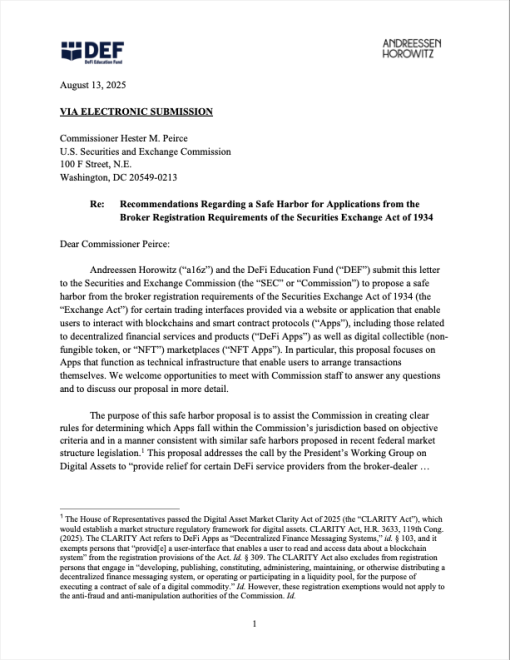
On Wednesday, a16z and the DeFi Education Fund sent a letter to SEC Commissioner Hester Peirce, urging the regulatory agency to exempt decentralized app (dApp) and developers from broker-dealer rules.

The VC firm and the DeFi advocacy group proposed a safe harbor from the broker registration requirements of the Securities Exchange Act of 1934 for trading interfaces that enable users to interact with blockchains and smart contract protocols, including those related to DeFi services and non-fungible token (NFT) marketplaces.
DeFi

Except from a16z and DeFi Education Fund's letter to Commissioner Peirce. Source: a16z crypto

The letter aims to aid the Commission in creating clear rules for determining which Apps fall within the SEC’s jurisdiction, based on specific criteria and consistent with similar safe harbors recently proposed in federal market structure legislation.

DEF’s Executive Directors, Amanda Tuminelli, affirmed that “Developers deserve clarity, and our hope in submitting this proposal is to provide front end developers with clear rules so they can build without worrying they will be subject to unreasonable requirements that are misaligned with the realities of the technology.”

According to the DeFi Education Fund’s blog post, the joint proposal seeks to be flexible enough to account for the “ever-evolving nature” of early-stage tech development, while being grounded in the principle that “most web-based or app-based trading interfaces (…) inherently do not engender the risks that the Exchange Act’s broker-dealer regulatory regime was designed to address.”

“Only those Apps which do not engender the risks that the Exchange Act’s broker-dealer regulatory regime was designed to address should be eligible; in such cases, registration as a broker under the Exchange Act is unwarranted and inappropriate. Conversely, Apps that do pose traditional risks that broker regulations were designed to address should not be able to avail themselves of this safe harbor,” the proposal reads.

Clarity For Developers

As the letter explained, apps must meet four objective criteria to qualify for the safe harbor. First, an app must be non-custodial, never taking control of users’ funds, and it must not exercise discretion over the execution of user transactions. Additionally, the app must not actively solicit or provide investment recommendations and may only passively display neutral market data or functionality.

Lastly, the underlying protocol must be decentralized, either interfacing with protocols that have eliminated operational control or have demonstrated “good faith intention” to decentralize. The proposal also highlighted a limited exception for early-stage protocols under a certain threshold.

According to the letter, this approach would offer three primary benefits, including establishing limits for the application of federal and securities laws to apps that fall within the scope of the proposed safe harbor and safeguarding DeFi developers from being subject to “retroactive application of federal securities laws.”

Additionally, the proposal aligns with the SEC’s historical practices concerning broker registration safe harbors and “is consistent with the historical lack of prohibition on persons engaging in private peer-to-peer securities transactions without the participation of a registered broker, as well as Commissioner Peirce’s recent dictum.”

As reported by Bitcoinist, the SEC Commissioner recently called for the protection of crypto privacy rights and DeFi developments. Peirce asserted that US authorities should welcome privacy-protecting technologies and safeguard individuals’ right to self-custody their digital assets.

We should not ask peers transacting with one another, where no intermediary exists, to collect and report information on each other. Doing so would deputize us to surveil our neighbors—a practice antithetical to a free society. Nor should we require an intermediary to step in the middle of peer-to-peer transactions.

Peirce’s remarks followed the official revocation in July of a controversial crypto rule that would have mandated decentralized exchanges to comply with broker reporting obligations. Notably, the US Department of the Treasury and the Internal Revenue Service (IRS) formally scrapped the regulation, which was set to take full effect in 2027.

The rule, originally proposed in November 2021 through the Infrastructure Investment and Jobs Act, aimed to close the “tax gap” by broadening the definition of “brokers” to include crypto exchanges and other intermediaries, while requiring DeFi platforms to report proceeds from digital asset transactions and detail user transaction information, including names and addresses.
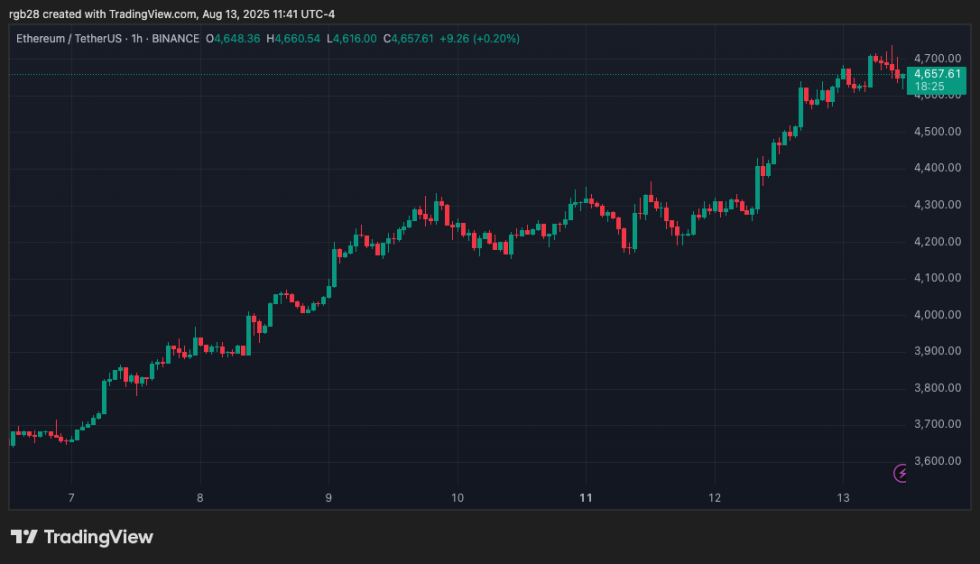
DeFi, ethereum, eth, ethusdt

Ethereum (ETH) trades at $4,657 in the one-week chart. Source: ETHUSDT on TradingView
Featured Image from Unsplash.com, Chart from TradingView.com
Editorial Process for bitcoinist is centered on delivering thoroughly researched, accurate, and unbiased content. We uphold strict sourcing standards, and each page undergoes diligent review by our team of top technology experts and seasoned editors. This process ensures the integrity, relevance, and value of our content for our readers.

Rubmar is a crypto enthusiast who likes learning and improving constantly. She enjoys reporting on the latest news and developments in the crypto industry. Rubmar also enjoys scrapbooking, crafting, simulation games, and watching football.

Nội dung Liên quan

Số Địa Chỉ XRP Hoạt Động Tăng 72% Khi Đòn Bẩy Rút Khỏi Thị Trường Phái Sinh

XRP đã ghi nhận mức tăng 72% về số địa chỉ hoạt động hàng ngày trong hai tuần, diễn ra song song với việc giảm đòn bẩy suy đoán trên thị trường phái sinh. Sự kết hợp này cho thấy các tín hiệu trên chuỗi trở nên rõ ràng hơn, do hoạt động thị trường có thể ít phụ thuộc hơn vào các vị thế đòn bẩy và nhiều hơn vào hoạt động mạng thực tế. Việc gia tăng địa chỉ tích cực có thể phản ánh nhiều người dùng tương tác hơn với mạng lưới hoặc sự quan tâm trở lại. Điều này đặc biệt quan trọng với XRP, một tài sản thường bị ảnh hưởng bởi nhiều yếu tố. Thị trường với ít đòn bẩy hơn và hoạt động trên chuỗi mạnh hơn thường được coi là lành mạnh hơn. Tuy nhiên, số địa chỉ tăng không phải lúc nào cũng đồng nghĩa với nhu cầu mua tăng. Nó có thể bao gồm các giao dịch bảo trì ví, chuyển khoản sàn giao dịch hoặc hoạt động tự động. Do đó, việc đòn bẩy phái sinh giảm cùng lúc làm cho tín hiệu này đáng chú ý hơn. Nhìn chung, dữ liệu hiện tại là tích cực nhưng chưa thể khẳng định. Thị trường cần theo dõi xem liệu hoạt động địa chỉ có duy trì ở mức cao, khối lượng giao dịch có tăng theo và nhu cầu giao ngay có cải thiện mà không cần một làn sóng đòn bẩy mới hay không. Các phiên giao dịch sắp tới sẽ rất quan trọng để xác định xu hướng ngắn hạn của XRP.

bitcoinist16 phút trước

Số Địa Chỉ XRP Hoạt Động Tăng 72% Khi Đòn Bẩy Rút Khỏi Thị Trường Phái Sinh

bitcoinist16 phút trước

Mức độ hoạt động mạng gia tăng của Solana có thể thúc đẩy SOL vượt trên mức 82 USD như thế nào

Hoạt động trên mạng Solana đã tăng mạnh, với số ví hoạt động hàng ngày đạt mức cao kỷ lục 4,51 triệu. Sự gia tăng này được thúc đẩy bởi sự phát triển của cổ phiếu được mã hóa (tokenized equity), hoạt động xStocks và sự hồi phục trong lĩnh vực DeFi. Điều này cho thấy mạng lưới đang hỗ trợ giá nhờ vào việc sử dụng ngày càng tăng, chứ không chỉ do biến động giá. Tuy nhiên, sự phục hồi bền vững phụ thuộc vào việc người dùng mới có tiếp tục sử dụng nền tảng sau khi đợt tăng giá lắng xuống hay không. Việc mở rộng ứng dụng tài chính trong thế giới thực, như cổ phiếu được mã hóa, cùng với nguồn cung stablecoin cao và dòng vốn ổn định chảy vào hệ sinh thái (thể hiện qua TVL và khối lượng giao dịch DEX), đang củng cố tăng trưởng dài hạn cho Solana. Về mặt giá, SOL đã phục hồi, tăng 7.48% vào ngày 29/6, tiến gần đến việc chấm dứt chuỗi 9 tháng giảm giá liên tiếp. Tuy nhiên, vùng kháng cự quan trọng $78–$82 vẫn là thách thức lớn, từng khiến nhiều đợt tăng giá trước đó thất bại. Việc phá vỡ trên mức $82 có thể mở đường chinh phục mức $92, trong khi mức hỗ trợ then chốt cần giữ là $72 để duy trì cấu trúc thị trường tăng.

ambcrypto35 phút trước

Mức độ hoạt động mạng gia tăng của Solana có thể thúc đẩy SOL vượt trên mức 82 USD như thế nào

ambcrypto35 phút trước

SUI, ENA Và EIGEN Dẫn Đầu Làn Sóng Mở Khóa Token 73 Triệu USD Tuần Này

**TÓM TẮT** Tuần này, thị trường tiền mã hóa chứng kiến làn sóng mở khóa token trị giá 73 triệu USD, với các dự án SUI, EIGEN và ENA dẫn đầu. Cụ thể, SUI (13.72 triệu token, ~9.4 triệu USD) và EIGEN (36.82 triệu token, ~8.7 triệu USD) sẽ mở khóa vào ngày 1 tháng 7 năm 2026, trong khi ENA mở khóa ~3.12 triệu USD vào ngày 3 tháng 7 năm 2026. Điểm quan trọng cần lưu ý: Việc mở khóa không tự động dẫn đến bán tháo ngay lập tức, vì các nhà tạo lập thị trường thường phòng ngừa rủi ro từ trước cho các sự kiện cung cấp này. Đối với nhà giao dịch, thông tin này quan trọng vì nó ảnh hưởng đến cách định giá vốn, thanh khoản và sự tự tin trên toàn thị trường hiện nay. Các đợt mở khóa là sự kiện về nguồn cung mà trader không thể bỏ qua, đặc biệt với các tài sản có nhiều quan tâm đầu cơ như SUI, ENA và EIGEN. Chúng có thể định hình vị thế giao dịch ngắn hạn và thanh khoản xung quanh ngày phát hành. Tuy nhiên, cần hiểu đây là một tín hiệu thị trường, không phải sự đảm bảo cho biến động giá. Tác động thực tế thường lan tỏa sang các giao dịch liên quan và phụ thuộc nhiều vào bối cảnh thanh khoản tổng thể, dòng ETF và điều kiện vĩ mô. Điều cần theo dõi tiếp theo là liệu mô hình này có được xác nhận bởi các dòng tiền, số liệu on-chain, hoặc dữ liệu phái sinh tiếp theo hay không, để xác định đây là một chủ đề bền vững hay chỉ là một đợt biến động ngắn hạn.

bitcoinist1 giờ trước

SUI, ENA Và EIGEN Dẫn Đầu Làn Sóng Mở Khóa Token 73 Triệu USD Tuần Này

bitcoinist1 giờ trước

Upbit Niêm Yết Gensyn Khi Phong Trào Tiền Mã Hóa AI Nhận Được Sự Thúc Đẩy Từ Thị Trường Hàn Quốc

Upbit, sàn giao dịch tiền điện tử lớn của Hàn Quốc, đã thông báo hỗ trợ giao dịch cho token GEN của Gensyn, một dự án cung cấp tài nguyên GPU điện toán phi tập trung cho AI. Việc niêm yết này mang lại các cặp giao dịch GEN với Won Hàn Quốc, Bitcoin và USDT, mở ra cánh cửa tiếp cận thị trường bán lẻ crypto sôi động nhất thế giới. Bài viết nhấn mạnh rằng niêm yết trên Upbit có thể tạo ra sự chú ý và thanh khoản tức thời mạnh mẽ cho GEN, nhờ sự kết hợp giữa tính thanh khoản mới, sự quan tâm của nhà đầu tư bán lẻ và câu chuyện đầu cơ liên tục xoay quanh lĩnh vực AI trong crypto. Gensyn được định vị rõ ràng trong xu hướng này với đề xuất về một thị trường mở cho sức mạnh tính toán phục vụ AI. Tuy nhiên, tác giả cũng đưa ra lời cảnh báo: "hiệu ứng niêm yết" có thể cắt cả hai chiều, dẫn đến biến động giá mạnh và sự điều chỉnh sau đợt mua ban đầu. Giá trị lâu dài của GEN sẽ không phụ thuộc vào tin tức niêm yết mà vào hoạt động thực tế của mạng lưới, mức độ sử dụng, tính bền vững của cơ chế token và sức hấp dẫn liên tục của xu hướng AI. Dù vậy, việc được niêm yết trên một sàn lớn như Upbit chắc chắn là một chất xúc tác quan trọng, giúp dự án tiếp cận đối tượng rộng lớn hơn và khó bị các nhà giao dịch altcoin bỏ qua.

bitcoinist1 giờ trước

Upbit Niêm Yết Gensyn Khi Phong Trào Tiền Mã Hóa AI Nhận Được Sự Thúc Đẩy Từ Thị Trường Hàn Quốc

bitcoinist1 giờ trước

Giao dịch

Giao ngay
活动图片