- Many crypto treasury companies trade at massive premiums to the value of the crypto they hold, suggesting that investors may be overpaying for indirect crypto exposure.
- These firms are often microcaps with low share floats, making them highly volatile and prone to speculative surges. Some companies may exploit this by announcing exaggerated crypto purchase plans to pump their stock prices temporarily, exposing retail investors to pump-and-dump risks.
- In the short term, these strategies inject capital and liquidity into altcoins, supporting prices and connecting crypto to public markets. But if the bubble bursts, coordinated sell-offs from treasury firms could flood the market and trigger massive drawdowns.
Introduction
The past year has delivered a striking paradox in the crypto markets. Many altcoins have been languishing well below their historic highs, yet a wave of publicly traded companies that stockpile these very altcoins in their treasuries have seen their share prices explode.
This article will explore how stocks of companies holding altcoins (like Solana, Ethereum, and XRP) have surged dramatically in value. We will also discuss whether this phenomenon resembles a bubble and what it could mean for the broader crypto market and investors.
Altcoin Markets Under Pressure, Yet Crypto-Linked Stocks Surge
Despite some recovery in major cryptocurrencies, altcoins as a whole have underperformed in 2025. Bitcoin dominance has climbed to multi-year highs, and many altcoins remain far below their peaks. Even with total crypto market capitalization above $3 trillion, most altcoins are still 80–90% below their all-time highs, indicating a lackluster “altseason” so far.
Yet, in a surprising twist, stocks of certain companies that hold or plan to accumulate altcoins have skyrocketed, vastly outperforming the underlying crypto assets. These publicly-listed firms have essentially turned themselves into crypto holding vehicles – a strategy pioneered by MicroStrategy with Bitcoin – but now extending to various altcoins.
Below are several notable examples of this phenomenon:
DeFi Development Corp (Nasdaq: DFDV) for SOL
Formerly a real estate financing company called Janover, this firm was acquired by a group of former Kraken executives in April 2025 and pivoted sharply into crypto. It rebranded as DeFi Development Corp and adopted a Solana (SOL) reserve treasury strategy, buying hundreds of thousands of SOL tokens.
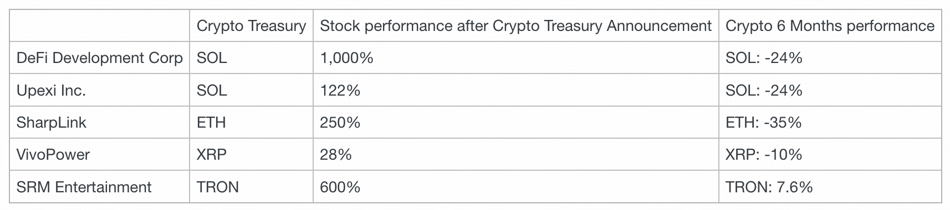
In just over a month after announcing its Solana-centric treasury plan, DeFi Dev’s stock price soared more than 1,000%, climbing from under $4 to over $40 at its peak.

Investors essentially treated the stock as a Solana proxy, bidding it up wildly despite the broader altcoin market’s weakness. (By contrast, Solana’s own price experienced a decline during this period!)
SharpLink Gaming (Nasdaq: SBET) for ETH
Perhaps the most dramatic case is SharpLink, a sports-betting and iGaming marketing firm that announced plans to transform into an Ethereum holding company.
Backed by prominent crypto players, including Joseph Lubin (Ethereum’s co-founder and ConsenSys CEO), SharpLink raised a whopping $425 million in a private placement to buy Ether for its corporate treasury. The market reaction was euphoric: within a week of unveiling this Ethereum-focused strategy, SharpLink’s stock catapulted from under $3 to over $100 at one point.
Although SharpLink’s stock later swung wildly – even plunging 70% in after-hours trading when investors misunderstood a share registration filing recently – it remained far above its pre-pivot price. As of mid-June 2025, SBET shares were still up nearly 250% year-to-date despite the volatility, far outpacing ETH's sluggish price performance.
VivoPower International (Nasdaq: VVPR) for XRP
VivoPower is a small-cap renewable energy company that in May 2025 decided to adopt XRP as its primary treasury reserve asset. The company announced plans to raise $121 million to buy XRP, with backing from a Saudi prince in its private funding round.
Unlike the Solana and Ethereum plays, VivoPower’s XRP move led to a more modest immediate stock reaction – shares jumped about 28% on the news to reach a two-year high.
Nonetheless, the pivot made VivoPower one of the first public companies to bet on XRP as a treasury asset, signaling how even Ripple’s token (long embroiled in regulatory battles) is now seen by some corporates as a potential store of value. Company executives framed the move as “growing institutional conviction in real-world blockchain applications,” and indicated they would explore XRP-based DeFi opportunities for business synergy.
Tron Inc. (Nasdaq: SRM)
SRM Entertainment is a small-market company based in Florida that primarily designs and sells licensed merchandise tied to theme parks, movies, and comic culture—think plush toys, action figures, and collectibles sold in gift shops and specialty retailers.
In June 2025, SRM announced a dramatic pivot into crypto by launching a $210 million TRON (TRX) treasury strategy. The company raised $100 million through a PIPE deal structured as convertible preferred stock and warrants, with an additional $110 million available through warrant exercise. The funding was provided in TRX tokens rather than cash, making SRM the first U.S. public company to hold TRX at such scale.
Justin Sun, founder of Tron, joined as a strategic advisor. SRM’s stock price exploded more than 600%, moving from $1.45 to above $10 in days. The company rebranded as Tron Inc., with plans to stake its TRX holdings and return staking yields to shareholders as dividends. This move effectively provided retail investors with equity exposure to the TRON ecosystem and marked what some analysts dubbed “Tron’s unofficial Nasdaq IPO.”
In summary, altcoin markets have been relatively subdued, but public companies holding altcoins have enjoyed outsized stock rallies. Retail investors, starved for high-growth opportunities, seem to be flocking to these crypto-treasury stocks as an alternative way to ride potential crypto upside.
Bubble Concerns and Implications for the Crypto Market
The spectacular surge of crypto treasury stocks has drawn parallels to past speculative manias. Market analysts and industry veterans are increasingly debating whether these stocks represent a bubble in the making. Several red flags point to bubble-like dynamics:
Sky-High Valuations vs. Assets
As noted, many of these companies trade at lavish premiums to the value of the crypto they hold. Paying $4 or $8 in market cap for each $1 of Solana or Ethereum on the balance sheet implies investors expect tremendous future value creation – or are simply caught in a frenzy.
Such “multiple-to-NAV” distortion is reminiscent of the Grayscale Bitcoin Trust (GBTC) premium that prevailed in 2020–21, which eventually flipped to a steep discount with painful consequences. Retail buyers of these stocks are effectively purchasing crypto exposure at high markups, a practice that is unlikely to be sustainable.
Microcap Hype and Pump-and-Dump Risks
The rapid stock spikes have been amplified by the tiny size of many of these firms. Most were microcap or penny-stock companies before their crypto treasuries put them on the map. This makes them susceptible to extreme volatility and potential manipulation.
Low floats (few shares available for trading) can create explosive price moves, as seen with SharpLink’s 2-million-share float fueling a 20× rally. SharpLink issued 69 million new shares in a PIPE deal to fund its Ethereum treasury strategy. However, almost all of these were initially restricted and required SEC registration before being tradable.
Additionally, some operators may be exploiting the hype. There have been instances of obscure companies announcing ambitious crypto purchase plans far beyond their means simply to enjoy a “headline-induced, momentary” price jump.
When a tiny firm with no credible backers claims it will buy, say, $500 million of crypto, it’s likely just fishing for speculative buyers of its stock. Retail investors need to be extremely cautious not to get caught holding the bag in such cases.
Leverage and Financial Engineering
There is also concern that these companies are effectively introducing hidden leverage into the crypto ecosystem.
By raising debt or equity capital to buy crypto, these companies mirror the GBTC trade where investors leveraged up to capture a premium – a trade that ended in forced liquidations when the premium vanished. If crypto prices fall or if the stock premiums shrink, companies may face pressure to raise cash, potentially selling off their crypto reserves at the worst time.
Implications for the crypto market
The rise of altcoin treasury stocks carries a mix of potential outcomes for the broader crypto ecosystem.
In the short term, these companies do bring fresh capital into the crypto markets. When SharpLink raises $425 million to buy ETH or when Upexi receives $100 million to buy SOL, those funds are converted into crypto purchases, potentially driving up demand and liquidity for the underlying coins.
These developments also signal a deeper integration of crypto into traditional finance channels. The fact that public equity markets are being used as a vehicle to gain crypto exposure underscores growing acceptance in digital assets among institutional circles. If done responsibly, crypto treasury strategies could further legitimize crypto as a corporate treasury tool and bring more participants into the ecosystem.
On the flip side, a collapse of this bubble could have ripple effects that extend into the crypto market. If many of these companies end up overextended and their stock prices crash, they might be forced to liquidate their crypto holdings to meet obligations. Large, coordinated sell-offs of SOL, ETH, XRP, or others by treasury-holding firms could flood the market with supply and depress prices.
For retail investors, this episode is a vivid reminder of the risks of chasing hype. The analytical takeaway is that a company’s stock can diverge wildly from fundamentals in the short run. Buying a stock just because it’s buying crypto is not the same as a diversified way to own crypto; in fact, it can be more volatile and overpriced.