Tether CEO: ‘Demand for dollar settlement is a wages story’ – $7M Pact Labs investment proves it

ambcrypto發佈於 2026-07-15更新於 2026-07-15

文章摘要

Tether is expanding the utility of stablecoins beyond crypto trading, targeting everyday financial infrastructure like payroll and real-time payments. Its $7 million investment in Pact Labs underscores a strategy to address the $11 trillion U.S. payroll system, where legacy settlement delays wage access. CEO Paolo Ardoino states that demand for dollar settlement is fundamentally a "wages story." This shift focuses on generating consistent, recurring payment flows rather than competing for trading volume. For this expansion to succeed, enterprise adoption in payroll and daily transactions is crucial. Tether is bolstering this push with compliance infrastructure, highlighted by Chainalysis's support for the USDT-native Stable network, providing real-time transaction screening and monitoring. The combination of faster settlement and robust compliance aims to overcome regulatory hurdles, encouraging businesses to move beyond pilot programs. Ultimately, the goal is to embed stablecoins like USA₮ into mainstream finance, transforming them from speculative assets into trusted infrastructure for recurring financial services.

Tether is shifting stablecoin adoption from crypto markets toward everyday financial infrastructure. By leading Pact Labs’ $7 million Series A, the company is targeting payroll, earned wage access, and real-time payments through USA₮.

That strategy addresses a U.S. payroll system processing more than $11 trillion annually, where legacy settlement still delays access to earned wages.

Supporting this, Tether CEO Paolo Ardoino noted,

This confirms what our transaction data has shown for years: the demand for dollar-denominated settlement is a wages story.
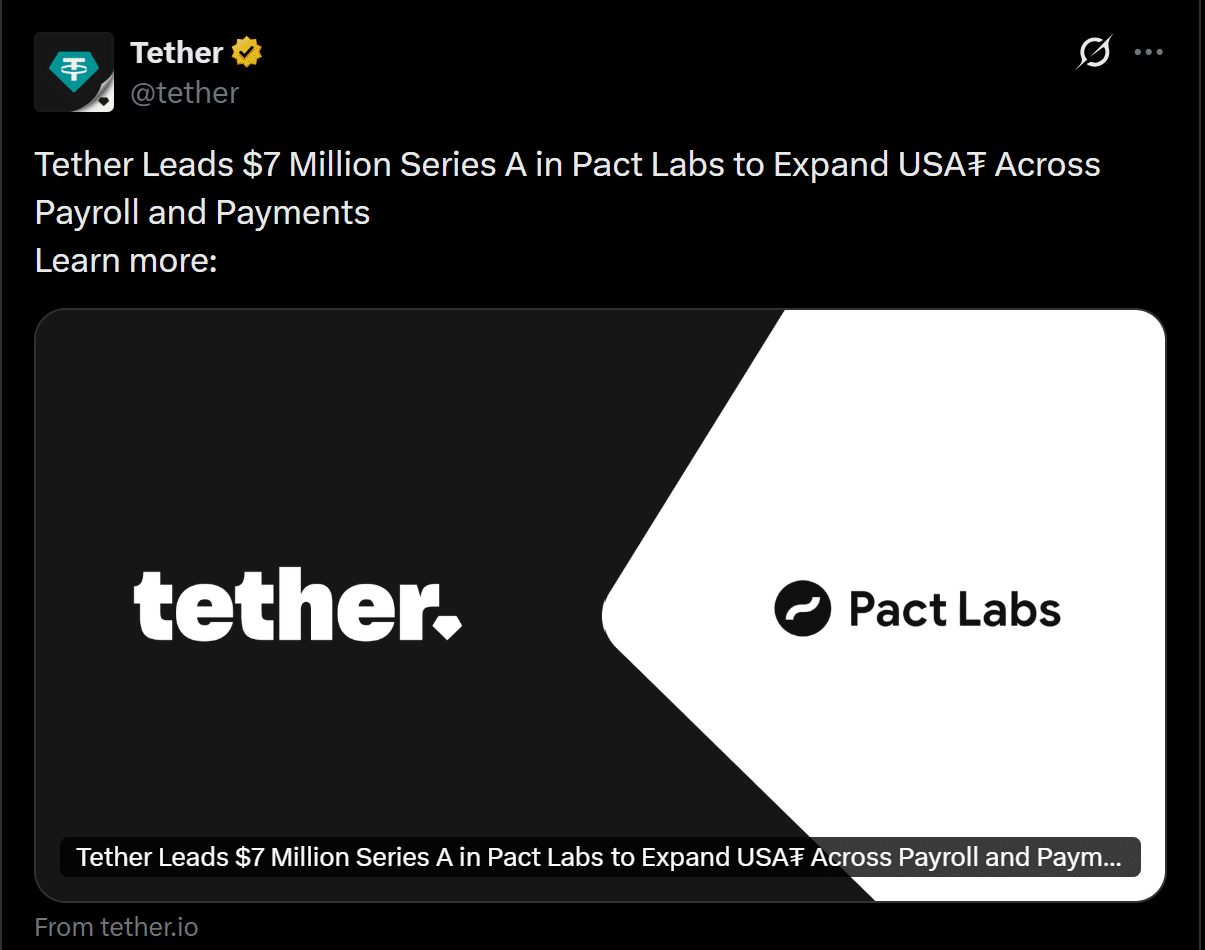
Source: Tether on X

Rather than competing for trading volume, Tether is pursuing recurring payment flows that generate consistent stablecoin demand. This marks a structural expansion of stablecoin utility beyond speculative markets.

Still, enterprise integrations, payroll adoption, and transaction growth will determine whether USA₮ becomes embedded in mainstream finance or remains a niche payment alternative.

Compliance reinforces Tether’s expansion

On one hand, building payment rails addresses just one-half of the problem. That makes Chainalysis’ support for Stable, a USDT-native Layer 1, more significant than another blockchain integration.

As Tether continues to push stablecoins into payroll and daily transactions, institutions will require continuous monitoring prior to committing larger transactional volume on-chain.

Chainalysis provides this critical layer. This is via real-time transaction screening, entity monitoring, and fund flow analysis.


Source: Chainalysis

Chainalysis’s automatic support for additional ERC-20 and ERC-721 tokens enables Stable to continue to grow. It does so while providing ongoing compliance coverage. Thus, the opportunities for Stable extend far beyond fast settlement.

If payment activity and institutional adoption grow together, compliance could become the catalyst that transforms stablecoins into trusted financial infrastructure.

Payment infrastructure now faces its most important challenge. It must show resilience in generating sustained real-world activity. Faster settlement and strong compliance have removed many of the regulatory hurdles for enterprises to adopt blockchain technology.

Rising enterprise wallets, larger transaction sizes, and expanding payment flows would signal businesses are moving beyond pilot programs.

That momentum gradually shifts blockchain’s role from facilitating digital asset transfers to supporting everyday financial services.

The competitive advantage is also changing. Networks that attract recurring payment activity, rather than simply launching new infrastructure, are increasingly positioning themselves at the center of mainstream finance.


Final Summary

  • Tether is expanding beyond trading by positioning stablecoins as infrastructure for payroll and everyday payments.
  • Stablecoin adoption now depends on recurring payment activity supported by scalable infrastructure and institutional-grade compliance.


相關問答

QAccording to the article, what strategic shift is Tether making in stablecoin adoption?

ATether is shifting stablecoin adoption from crypto markets towards everyday financial infrastructure, specifically targeting payroll, earned wage access, and real-time payments through USA₮.

QWhat does Tether CEO Paolo Ardoino identify as the core driver for dollar-denominated settlement demand?

APaolo Ardoino identifies the demand for dollar-denominated settlement as 'a wages story,' a conclusion supported by Tether's transaction data over years.

QHow does Chainalysis's role support Tether's expansion into payroll and daily transactions?

AChainalysis provides a critical compliance layer through real-time transaction screening, entity monitoring, and fund flow analysis, enabling institutions to commit larger transactional volume with continuous monitoring.

QWhat will determine whether USA₮ becomes embedded in mainstream finance according to the article?

AEnterprise integrations, payroll adoption, and transaction growth will determine whether USA₮ becomes embedded in mainstream finance or remains a niche payment alternative.

QWhat is changing in terms of competitive advantage for networks in the financial space, as mentioned in the article?

AThe competitive advantage is shifting towards networks that attract recurring payment activity, rather than simply launching new infrastructure, positioning themselves at the center of mainstream finance.

你可能也喜歡

Ratio首席执行官表示,多货币稳定币可以使亚洲摆脱昂贵的货币兑换成本

Ratio公司的首席执行官John Cho指出,多重货币稳定币有望帮助亚洲摆脱昂贵的外汇兑换成本。当前全球贸易金融基础设施依赖日益过时的代理银行网络、预存账户(Nostro/Vostro)和跨时区结算,导致企业面临结算延迟、银行营业时间限制和汇率滑点等问题。在亚洲,这相当于对营运资本征收了数十亿美元的“税”。 虽然与美元挂钩的稳定币(如USDT、USDC)在数字资产结算中已证明有效,但它们主要服务于美元交易。亚洲本地贸易通常使用本地货币(如韩元、新加坡元),通过美元中介进行转换会产生额外成本和汇率波动风险。因此,行业正转向发展多重货币稳定币生态系统。 Cho认为,这并非要取代美元稳定币,而是形成互补架构:美元稳定币继续主导全球流动性,而本地货币稳定币则用于本地贸易,消除不必要的货币转换,实现境内结算。关键在于建立基础设施,使多种数字资产能够无缝跨链交互。 传统银行体系中的Nostro/Vostro账户要求金融机构在全球预存资金,锁定了大量资本。区块链结算层提供了替代方案,通过链上流动性和7x24小时运作,能实现即时结算,提升资本效率。为吸引保守的企业用户,Web3基础设施提供商正转向务实集成,将区块链路由层嵌入现有企业ERP和财资系统,让企业能逐步将交易转向数字通道。 监管明确性是推动机构大规模采用的关键。随着美国CLARITY法案等全球标准逐步确立,亚洲主要司法管辖区预计未来12-24个月内也将出台各自的稳定币法规。最终,随着受监管稳定币被纳入国家支付系统并成为结算工具,法币与数字资产之间的界限将逐渐模糊,稳定币将成为支撑全球贸易的基础结算层。

cryptonews.ru51 分鐘前

Ratio首席执行官表示,多货币稳定币可以使亚洲摆脱昂贵的货币兑换成本

cryptonews.ru51 分鐘前

交易

現貨
活动图片