Zhejiang University Research Team Proposes New Approach: Teaching AI How the Human Brain Understands the World

marsbitОпубліковано о 2026-04-05Востаннє оновлено о 2026-04-05

Анотація

A research team from Zhejiang University published a paper in *Nature Communications* challenging the prevailing notion that larger AI models inherently think more like humans. They found that while model performance on recognizing concrete concepts improved as parameters increased (from 74.94% to 85.87%), performance on abstract concept tasks slightly declined (from 54.37% to 52.82%) in models like SimCLR, CLIP, and DINOv2. The key difference lies in how concepts are organized. Humans naturally form hierarchical categories (e.g., grouping a swan and an owl into "birds"), enabling them to apply past knowledge to new situations. Models, however, rely heavily on statistical patterns in data and struggle to form stable, abstract categories. The team proposed a novel solution: using human brain signals (recorded when viewing images) to supervise and guide the model's internal organization of concepts. This method, termed transferring "human conceptual structures," helped the model learn a brain-like categorical system. In experiments, the model showed improved few-shot learning and generalization, with a 20.5% average improvement on a task requiring abstract categorization like distinguishing living vs. non-living things, even outperforming much larger models. This research shifts the focus from simply scaling model size ("bigger is better") to designing smarter internal structures ("structured is smarter"). It highlights a new pathway for developing AI that possesses more hum...

Large models have been growing in size, with the mainstream view being that the more parameters a model has, the closer it gets to human-like thinking. However, a paper published by a Zhejiang University team on April 1 in Nature Communications presents a different perspective (original article link: https://www.nature.com/articles/s41467-026-71267-5). They found that as model size (primarily SimCLR, CLIP, DINOv2) increases, the ability to recognize specific objects does continue to improve, but the ability to understand abstract concepts not only fails to improve but can even decline. When parameters increased from 22.06 million to 304.37 million, performance on concrete concept tasks rose from 74.94% to 85.87%, while performance on abstract concept tasks dropped from 54.37% to 52.82%.

Differences Between Human and Model Thinking

When the human brain processes concepts, it first forms a system of categorical relationships. Swans and owls look different, but humans still classify them both as birds. Moving up, birds and horses can be further grouped into the animal category. When humans encounter something new, they often first consider what it resembles from past experience and which category it might belong to. Humans continuously learn new concepts, then organize this experience, using this relational system to recognize new things and adapt to new situations.
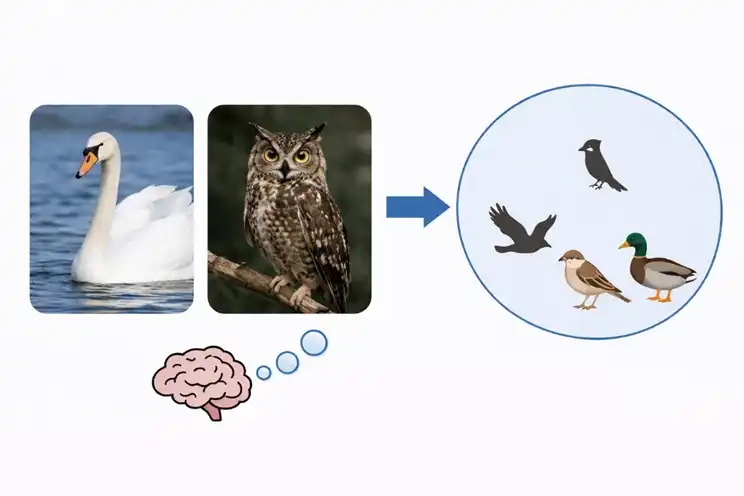
Models also classify, but they form these classifications differently. They rely primarily on patterns that repeatedly appear in large-scale data. The more frequently a specific object appears, the easier it is for the model to recognize it. When it comes to larger categories, models struggle more. They need to capture the commonalities between multiple objects and then group these commonalities into the same category. Existing models still have significant shortcomings here. As parameters continue to increase, performance on concrete concept tasks improves, while performance on abstract concept tasks sometimes even decreases.
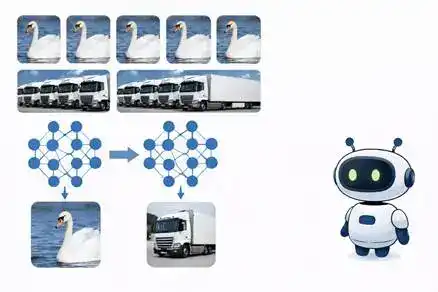
A commonality between the human brain and models is that both internally form a system of categorical relationships. However, their emphases differ. The higher-order visual regions of the human brain naturally distinguish broad categories like living and non-living things. Models can separate specific objects but find it difficult to stably form these larger categories. This difference means the human brain more easily applies past experience to new objects, allowing for rapid categorization of unseen things. Models, conversely, rely more on existing knowledge, so when encountering new objects, they tend to focus on superficial features. The method proposed in the paper addresses this characteristic, using brain signals to constrain the model's internal structure, making it closer to the human brain's categorization method.

The Solution from the Zhejiang University Team

The team's proposed solution is also unique: instead of simply adding more parameters, they use a small amount of brain signal data for supervision. These brain signals come from recordings of brain activity while humans view images. The original paper states the goal as transferring 'human conceptual structures' to DNNs. This means teaching the model, as much as possible, how the human brain classifies, generalizes, and groups similar concepts together.
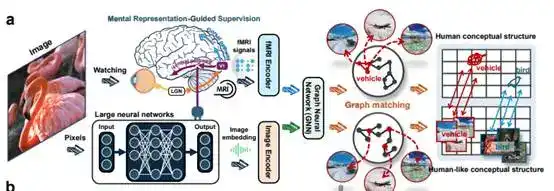
The team conducted experiments using 150 known training categories and 50 unseen test categories. The results showed that as this training progressed, the distance between the model's representations and the brain representations continuously narrowed. This change occurred for both categories, indicating that the model was learning not just individual samples but truly beginning to learn a conceptual organization method more akin to the human brain.

After this process, the model demonstrated stronger few-shot learning capabilities and performed better in novel situations. In a task requiring the model to distinguish abstract concepts like living vs. non-living things with very few examples, the model improved by an average of 20.5%, even surpassing much larger control models. The team also conducted 31 additional specialized tests, where several types of models showed improvements of nearly ten percent.

Over the past few years, the familiar path in the modeling industry has been larger model scale. The Zhejiang University team has chosen a different direction: moving from 'bigger is better' to 'structured is smarter'. Scaling up is indeed useful, but it primarily improves performance on familiar tasks. Abstract understanding and transfer capabilities, inherent to humans, are equally crucial for AI. This requires future AI thinking structures to more closely resemble the human brain. The value of this direction lies in redirecting the industry's attention from pure size expansion back to the cognitive structure itself.

Neosoul and the Future

This points to a larger possibility: AI evolution may not only occur during the model training phase. Model training can determine how AI organizes concepts and forms higher-quality judgment structures. Then, after entering the real world, another layer of AI evolution just begins: how an AI agent's judgments are recorded, tested, and how they continuously grow and evolve through real-world competition, learning and evolving on their own, much like humans. This is precisely what Neosoul is doing now. Neosoul doesn't just have AI agents produce answers; it places AI agents into a system of continuous prediction, verification, settlement, and selection, allowing them to continuously optimize themselves based on predictions and outcomes, preserving better structures and淘汰ing worse ones. What the Zhejiang University team and Neosoul jointly point towards is actually the same goal: enabling AI to not just solve problems, but to possess comprehensive thinking abilities and continuously evolve.


Пов'язані питання

QWhat was the key finding of the Zhejiang University team's research published in Nature Communications regarding model scaling?

AThey found that as model parameters increased (from 22.06 million to 304.37 million), performance on recognizing concrete concepts improved (74.94% to 85.87%), but performance on understanding abstract concepts not only failed to improve but actually decreased (54.37% to 52.82%).

QWhat is the fundamental difference between how the human brain and AI models form conceptual categories?

AThe human brain naturally forms a hierarchical classification system (e.g., grouping specific birds into the 'bird' category, then 'birds' and 'horses' into 'animals'). AI models primarily rely on statistical patterns from large-scale data, excelling at recognizing specific, frequently appearing objects but struggling to form stable, larger abstract categories.

QWhat was the unique solution proposed by the Zhejiang University team to improve AI's abstract reasoning?

AInstead of scaling model size, they used a small amount of brain signal data (recordings of human brain activity when viewing images) as supervision to transfer human conceptual structures to the deep neural networks (DNNs), teaching them how to classify and generalize concepts more like the human brain.

QWhat improvements were observed in the model after being trained with the brain signal supervision method?

AThe distance between the model's representations and brain representations decreased. The model showed stronger few-shot learning capabilities and performed better in novel situations. In a task requiring abstract concept discrimination with very few examples, performance improved by an average of 20.5%, even surpassing much larger control models.

QWhat broader shift in AI development philosophy does the research and Neosoul project represent, according to the article?

AIt represents a shift from the 'bigger is better' paradigm focused on scaling parameters to a 'structured is smarter' approach. The focus is on improving the AI's cognitive structure to be more human-like, enabling abstract understanding and transfer capabilities, and creating systems for continuous learning and evolution through real-world prediction, verification, and competition.

Пов'язані матеріали

The Age of Decoupling Has Arrived: Bitcoin is No Longer the Sole Compass of Crypto

The era of the cryptocurrency market moving in lockstep with Bitcoin is ending, as the industry splits into two distinct asset categories: endogenous and exogenous. Endogenous assets, like Bitcoin, derive value purely from the crypto market's cycles. Their narratives swing between being "interstellar money" in bull markets and "digital collectibles" in bear markets. Exogenous assets, however, are nominally crypto but operate with independent value drivers. Examples include: * **Venice:** An AI inference service using tokens for payments; its consumer-AI business model is decoupled from crypto price swings. * **Figure:** A fintech lender using blockchain to speed up loan approvals; its core value is in credit, not crypto. * **Stablecoin firms like BVNK:** Acquired by traditional finance giants (Mastercard, Stripe), their growth is tied to payment infrastructure, not market cycles. Hybrid projects like **Hyperliquid** (a decentralized exchange) show a shift, with a growing share of non-crypto trading (e.g., prediction markets). This divergence is fundamental. Endogenous assets remain highly correlated to Bitcoin, similar to gold miners to gold. Exogenous assets are evolving to have their own fundamentals, like the weak correlation between gold and the S&P 500. This changes investment analysis. Evaluating exogenous assets requires traditional fundamental research—assessing user bases, unit economics, and moats—more akin to fintech investing than charting Bitcoin. Promising exogenous sectors include: on-chain exchanges/brokers, AI-crypto fusion, privacy-focused digital banks, lending (institutional/private credit), stablecoins/real-world asset tokenization, payment rails, and non-financial crypto-consumer products. Currently, investing via equity is often safer than via tokens, as token value accrual mechanisms need further regulatory and industry development (e.g., the CLARITY Act). Nonetheless, the core trend is clear: crypto market drivers are diversifying from a single factor (Bitcoin) to multiple fundamentals, ending the era of uniform market moves.

marsbit42 хв тому

The Age of Decoupling Has Arrived: Bitcoin is No Longer the Sole Compass of Crypto

marsbit42 хв тому

Five Cryptos That Could Outperform Bitcoin Over the Next Cycle Due To Higher Growth Velocity

Bitcoin's growth often sets market trends, but analysts believe the next cycle's highest percentage gains may come from assets with greater growth velocity. While Bitcoin provides stability, several cryptocurrencies are positioned for stronger relative upside. This article highlights five such assets, with a particular focus on Ozak AI as the potential high-growth standout of the cycle. Ethereum (ETH) is noted for its ongoing evolution and institutional adoption. Solana (SOL) is recognized for its high throughput and history of sharp rallies. Chainlink (LINK) is highlighted as essential infrastructure for DeFi and AI applications. Avalanche (AVAX) is mentioned for its subnet architecture and enterprise potential. Ozak AI ($OZ) is presented as a distinct early-stage opportunity, currently in presale at $0.014 with a target listing price of $1.00. The project is building a full AI-native blockchain ecosystem, including prediction agents, a data stream network, and structured data vaults. Analysts suggest its early valuation stage and focus on AI infrastructure could allow for exponential growth velocity compared to more mature assets like Bitcoin, which requires massive capital inflows for significant price movement. The final takeaway positions Ozak AI as a high-asymmetry bet for investors seeking exponential upside alongside more stable assets.

TheNewsCrypto1 год тому

Five Cryptos That Could Outperform Bitcoin Over the Next Cycle Due To Higher Growth Velocity

TheNewsCrypto1 год тому

What's New in Jensen Huang's 'Agent Factory'?

In a keynote at COMPUTEX 2026, NVIDIA CEO Jensen Huang shifted the company's focus from hardware "full-stack" solutions to the era of AI Agents. The centerpiece is the Vera Rubin platform, now in production, which is designed specifically for Agent workloads and offers 10x the efficiency of its predecessor. The platform features the new Vera CPU, built for AI, and incorporates Spectrum-X Ethernet Photonics with CPO technology for improved networking and energy efficiency. NVIDIA introduced DSX, an integrated toolkit for designing, simulating, and operating AI data centers, aiming to streamline "AI factory" deployment and management. For end-user deployment, the company unveiled DGX Station for Windows, a desktop AI supercomputer for running Agents locally, and the RTX Spark SoC for AI PCs. On the software front, NVIDIA launched the 550B-parameter Nemotron 3 Ultra model for enterprise Agents and the Cosmos 3 foundation model for physical AI, unifying visual reasoning and action prediction. In robotics, a partnership with Unitree yielded the H2 Plus, a reference humanoid robot built on the Isaac GR00T platform to lower development barriers. Security was emphasized with enhanced confidential computing for Vera Rubin and new data path security features for the BlueField-4 STX storage platform. The presentation highlighted a strategic pivot: NVIDIA is reorganizing its entire technology stack—from chips and data centers to models, software, and robots—around the emerging ecosystem of autonomous, practical AI Agents.

marsbit1 год тому

What's New in Jensen Huang's 'Agent Factory'?

marsbit1 год тому

Торгівля

Спот
Ф'ючерси
活动图片