What's New in Jensen Huang's 'Agent Factory'?

marsbitОпубліковано о 2026-06-01Востаннє оновлено о 2026-06-01

Анотація

In a keynote at COMPUTEX 2026, NVIDIA CEO Jensen Huang shifted the company's focus from hardware "full-stack" solutions to the era of AI Agents. The centerpiece is the Vera Rubin platform, now in production, which is designed specifically for Agent workloads and offers 10x the efficiency of its predecessor. The platform features the new Vera CPU, built for AI, and incorporates Spectrum-X Ethernet Photonics with CPO technology for improved networking and energy efficiency. NVIDIA introduced DSX, an integrated toolkit for designing, simulating, and operating AI data centers, aiming to streamline "AI factory" deployment and management. For end-user deployment, the company unveiled DGX Station for Windows, a desktop AI supercomputer for running Agents locally, and the RTX Spark SoC for AI PCs. On the software front, NVIDIA launched the 550B-parameter Nemotron 3 Ultra model for enterprise Agents and the Cosmos 3 foundation model for physical AI, unifying visual reasoning and action prediction. In robotics, a partnership with Unitree yielded the H2 Plus, a reference humanoid robot built on the Isaac GR00T platform to lower development barriers. Security was emphasized with enhanced confidential computing for Vera Rubin and new data path security features for the BlueField-4 STX storage platform. The presentation highlighted a strategic pivot: NVIDIA is reorganizing its entire technology stack—from chips and data centers to models, software, and robots—around the emerging ecosyst...

Original Author: Li Hailun, Su Yang

Original Editor: Xu Qingyang

Original Source: Tencent Technology

June 1, 2026 - NVIDIA Founder and CEO Jensen Huang delivered a keynote speech at the NVIDIA GTC Taipei conference held during COMPUTEX 2026.

It had only been three months since the last GTC.

At that time, NVIDIA announced the "chip family bundle" of Vera Rubin, including: the Vera CPU, Rubin GPU, Groq 3 LPU, ConnectX-9, BlueField-4 DPU, and Spectrum-6 switch. These six chips form a rack-scale AI supercomputer, announcing that the number of GPUs required to train large MoE models was reduced to one-quarter, inference throughput per watt improved 10x, and single token cost dropped to one-tenth.

Different from previous emphasis on system-level solutions like the "chip family bundle" or "computing power family bundle," three months later at COMPUTEX, Jensen Huang turned his focus to the target these infrastructures will serve—Agents.

In his speech, Jensen Huang revealed: Vera Rubin has officially entered mass production, Vera CPUs have begun shipping globally, DGX Station for the first time comes to enterprise desktops in a Windows form factor, Cosmos 3 redefines the perceptual framework for physical AI, and DSX becomes the operating system for AI factories. NVIDIA also partnered with Unitree to launch the H2 Plus—the first humanoid robot reference design based on Isaac GR00T, extending Agent boundaries from the digital world to physical form.

NVIDIA is reorganizing its complete technical system around the Agent ecosystem, from chips and data centers to models, software, and robotics platforms.

Jensen Huang said: "The era of Agent AI and practical artificial intelligence has arrived. Now tokens are the unit of profit, AI is the 'generator' of GDP, and the number of software engineers is increasing. People talk about AI reducing jobs; that's complete nonsense. In fact, more software engineers are being hired."
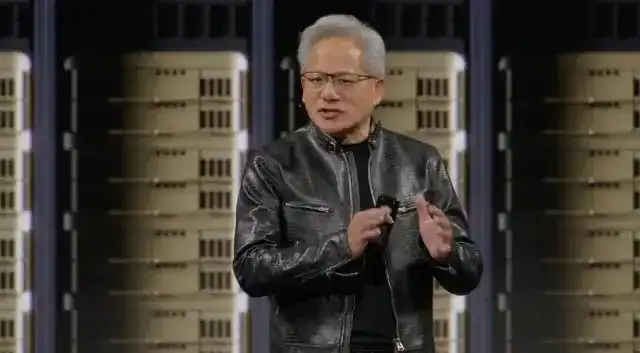
The Same AI Factory, Runs 10x More Agent Tasks

The Vera Rubin platform is now in full production.

Unlike the past, which mainly focused on large model training and inference, Vera Rubin was designed from the start with Agent as a key workload.

In his speech, Jensen Huang stated that an Agent task is often not just a single model inference, but includes multiple steps such as inference, search, tool calls, code execution, and result validation, potentially involving thousands of steps behind the scenes. In the future, data centers will need to handle not just individual model requests but more of these continuous, collaborative Agent tasks.

The platform is defined as a massive, unified compute-unit-level AI supercomputer built specifically for handling Agent workloads from inference, retrieval to tool usage. In a same-scale hyperscale data center, using the new Vera Rubin platform to run autonomous AI Agent tasks achieves a processing efficiency 10 times that of the previous generation Grace Blackwell platform.

Beyond the compute platform itself, networking has also become a focus of the Vera Rubin upgrade.

In the past, data transmission between GPUs in data centers relied primarily on traditional optical modules and switch architectures. However, as cluster sizes continue to expand, power consumption, cooling, and deployment complexity rapidly increase. To address this, NVIDIA introduced the Spectrum-X Ethernet Photonics networking system into the Vera Rubin platform.

This marks NVIDIA's first large-scale introduction of Co-Packaged Optics (CPO) technology into AI data center networks.

Simply put, traditional solutions require plugging optical modules externally into switches, while CPO directly integrates optical devices into the switch internal, thereby reducing energy consumption and signal loss.

Additionally, security is a core capability heavily emphasized in this Vera Rubin platform.

To this end, NVIDIA extended Confidential Computing capabilities across the entire Vera Rubin platform. Through trusted execution environments, hardware-level verification, and end-to-end encryption mechanisms, enterprises can achieve higher levels of security assurance when handling private data, industry-sensitive information, and critical models.

Jensen Huang revealed that Vera Rubin has entered mass production. As a third-generation MGX rack-level system, it involves over 150 partners, more than 350 factories, and a supply chain covering over 30 countries and regions. According to NVIDIA's announced plan, Vera Rubin will begin official shipments this fall.
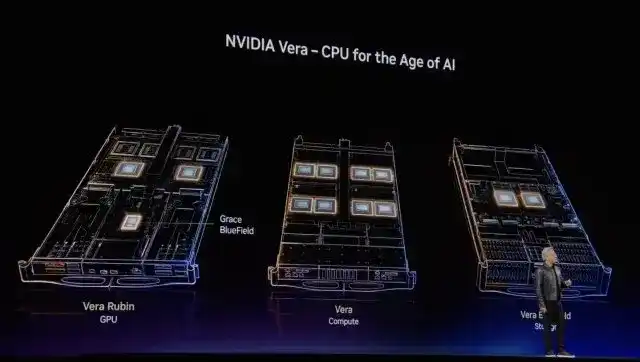
The "Born-for-Agent" Processor

NVIDIA launched a new type of processor, Vera, designed specifically for the Agent era and has entered full production.

Jensen Huang pointed out that advancements in memory systems will drive innovation and modernization in storage systems. All CPUs to date have been built for humans, but Vera is a CPU designed for the AI era, built for Agents.

As the successor to Grace, Vera adopts NVIDIA's self-designed "Olympus" CPU core architecture, increasing core count from 72 to 88 cores and significantly improving memory and data processing capabilities. According to NVIDIA, in testing with Agent-related workloads, Vera achieved task execution speeds 1.8 times faster than contemporary x86 server CPUs.

More important than pure performance gains is the change in the relationship between Vera and the Rubin GPU: Vera connects to the Rubin GPU via second-generation NVLink-C2C, with an interconnect bandwidth reaching 1.8TB/s, further reducing the overhead of data transfer between CPU and GPU during Agent operation.

Jensen Huang stated that Vera Rubin uses HBM (High-Bandwidth Memory) from Micron, SK Hynix, and Samsung, and the supply chain scale is "twice" that of the previous generation Blackwell. However, deploying a large Blackwell rack took two hours, while the time for Vera Rubin has been compressed to the 5-minute level.
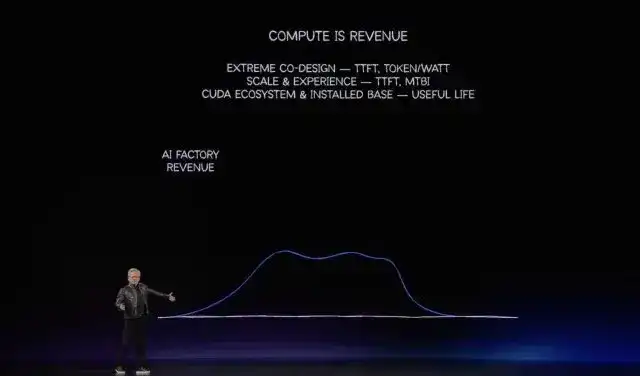
Moving AI Factories from "Construction" to "Operation"

The DSX launched by NVIDIA this time can be understood as an "AI Factory Construction and Operation Toolkit."

In the past, building an AI data center required clients to separately consider servers, networking, power, cooling, facility design, and operational systems, with many steps relying on coordination among different suppliers. DSX aims to integrate these previously fragmented steps into a single framework, providing clients with a standardized, verifiable reference plan from design, simulation, construction, to operation.

Jensen Huang stated at the launch event: "NVIDIA isn't just selling chips; we're providing infrastructure builders with a complete AI factory blueprint."

The most important new capabilities in DSX this time are two-fold.

The first is DSX MaxLPS. It addresses the most practical problem for AI factories: given a fixed power budget, how to place more GPUs and run more Tokens.

According to NVIDIA, MaxLPS, combined with liquid cooling and intra-rack power optimization, allows operators to run up to 40% more GPUs without significantly impacting performance.

The second is DSX OS. It acts as the operational software for the AI factory, responsible for lifecycle management, intelligent scheduling, health monitoring, failure recovery, multi-tenancy management, and more. Simply put, if an AI factory is a complex facility, DSX OS ensures its continuous, stable operation.

Within the DSX product matrix, Reference Design provides AI factory reference designs, telling clients how to build facilities, racks, networking, power, and cooling systems; DSX Sim handles simulation, allowing clients to verify designs before construction; DSX Flex connects the AI factory to the power grid, enabling data centers to adjust tasks based on electricity prices, loads, and demand response signals; DSX Exchange is responsible for data interfaces between IT systems, operational systems, energy, and cooling systems.

In terms of the ecosystem, cloud partners like CoreWeave, Crusoe, and Lambda are deploying DSX Sim, MaxLPS, and DSX OS to reduce risks and improve GPU utilization. Manufacturers like Dell, HPE, Lenovo, Supermicro, and ASUS, Foxconn, GIGABYTE, Wistron are building DSX-compatible systems.

Teaming Up with Windows and ARM

In his live speech, Jensen Huang officially announced the unveiling of the "DGX Station for Windows" workstation, defined by NVIDIA as a desktop-level AI supercomputer for the Windows ecosystem.

Hardware-wise, it features the GB300 Grace Blackwell Ultra Desktop Superchip, connecting the Blackwell Ultra GPU and 72-core Grace CPU via NVLink-C2C, offering up to 748GB unified memory and 20 PFLOPS FP4 performance, and equipped with up to 800Gb/s networking capability.

The key point of this product lies in the change in Agent deployment methods.

NVIDIA hopes enterprises can run multiple Agents locally, securely, and manageably within a Windows environment and integrate them into workflows like design, engineering, data science, inference, and Physical AI. Simultaneously launched, OpenShell handles Agent runtime security through isolated sandboxes and system-level policy control, limiting Agents from unauthorized operations or leaking credentials and private data.

Besides products for enterprise desktops, Jensen Huang also announced a system-level SoC—the RTX Spark SoC—integrating the N1X CPU and Blackwell GPU into a single chip with unified memory architecture, specifically for thin-and-light laptops and small form-factor desktops.

Among these, N1X is NVIDIA's first PC processor co-developed with Microsoft, based on Arm architecture, custom-designed by MediaTek, and manufactured using TSMC's 3nm process. It will debut this fall on laptops from Microsoft, Dell, HP, ASUS, Lenovo, and MSI, with over 30 models initially, targeting high-end thin-and-light notebooks.

This is NVIDIA's "super chip" prepared for the AI PC era, which Jensen Huang sees as a significant redefinition of the PC form factor.
The Agent's "Two Brains"

At this launch event, NVIDIA announced the latest progress on two core model product lines, corresponding to two scenarios for Agents: one running within enterprise systems and one running in the physical world.

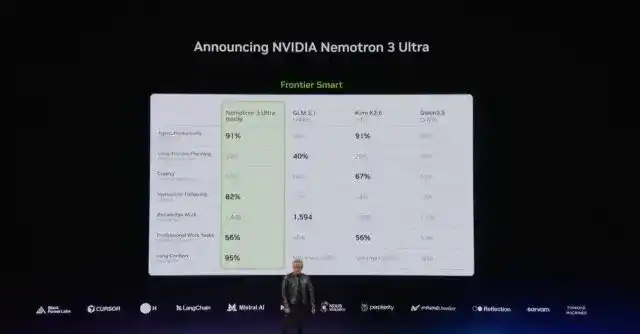
NVIDIA released Nemotron 3 Ultra, a 550-billion-parameter Mixture-of-Experts (MoE) model, providing top-tier intelligence for long-running agents in code development, scientific research, and enterprise business processes. Compared to mainstream open-source frontier models of similar scale, this model offers up to 5x faster inference speed and up to 30% lower usage cost, helping agents complete tasks more efficiently and affordably.

Surrounding the Nemotron open model, NVIDIA released a series of software, open-source models, and partnership progress, aiming to enable enterprises to build "digital colleagues" that assist employees in scenarios like engineering design, healthcare, software development, and business operations.

In this combination, Nemotron provides foundational model capabilities, NemoClaw organizes models into Agents, OpenShell handles runtime security, and Agent Toolkit transforms NVIDIA software libraries like CUDA-X into tools directly callable by Agents. Agents can use tools, call data, execute tasks, and integrate into existing enterprise systems within a controlled environment.

Jensen Huang stated that global software companies are bringing AI Agents into real work systems, enabling them to help employees complete complex tasks faster. NemoClaw provides open components needed to build long-running Agents, including orchestration, context, memory, tool calling, and security control capabilities.

In the past, enterprise discussions on AI focused more on what models could answer; now, NVIDIA aims to solve how Agents can securely integrate tools, data, and business processes and operate continuously in real work.

There's also Cosmos 3, officially launched as the third generation of the Cosmos series, representing an architectural-level redesign.

Cosmos 3 is a world foundation model for physical AI, providing the underlying ability to "understand the physical world, predict what will happen, and decide what to do."

Compared to previous Cosmos versions, earlier editions primarily targeted robotics and autonomous driving developers, focusing on video generation and physical world simulation, essentially being a relatively single-modal generation framework. Cosmos 3 adopts a new architecture—a hybrid Transformer—for the first time unifying three aspects: visual reasoning, world generation, and action prediction into a single system.

It can natively understand and generate text, images, videos, ambient sounds, and actions, achieving leading levels of physical accuracy, and is the world's first fully open, all-capable model. NVIDIA claims it has the potential to compress physical AI training and evaluation cycles from months in the past to days.

Jensen Huang predicted that due to breakthroughs in multimodal reasoning for language, vision, and world models, the big bang of physical AI is imminent.

The Cosmos 3 series of open frontier all-capable models provides developers with generational leap capabilities for building robots, autonomous vehicles, and visual AI that can perceive, reason, plan, and act in the physical world.

Lowering the Barrier to Physical AI

NVIDIA and Unitree jointly launched the H2 Plus—a sample humanoid robot for research and developers.

"Sample" means: Unitree is responsible for the robot body, NVIDIA is responsible for the software and computing platform, with both sides pre-integrating hardware and software. Development teams can start skill development immediately upon receiving it, without spending time solving underlying integration issues. It is also the world's first open humanoid robot built on the NVIDIA Isaac GR00T development platform.

This sample model targets a long-standing pain point in humanoid robot development: hardware integration, data collection, simulation, training, evaluation, deployment—each step operates in silos, making the entire process highly fragmented.

NVIDIA stated that research teams receiving a robot body often spend significant time on underlying integration, delaying actual skill development. What H2 Plus attempts to do is streamline this path, allowing research teams to skip underlying integration and directly enter skill development and real-world scenario validation.

In Jensen Huang's view, humanoid robots will bring physical AI to the world's largest industries, unlocking multi-trillion-dollar economic opportunities, and H2 Plus is the starting point for pushing frontier research into real scenarios like factories, warehouses, and logistics systems.

Additionally, NVIDIA announced the official open-sourcing of a set of Physical AI Skills toolkits, covering core scenarios like robotics, autonomous driving, visual AI, and industrial digital twins.

These "Skills" can be understood as standardized usage methods of NVIDIA's platforms like Cosmos, Omniverse, Isaac, Metropolis, written into operational instructions that Agents can directly read and execute. Open-sourcing these packaged instructions forms the toolkit released this time.

When an Agent receives a task, for example, generating a batch of training data for defect detection, it knows which model to call, what format to output, and how to validate results, automatically running the entire process without human step-by-step operation of each stage.

Upgrading AI Storage: From "Fast Running" to "Managed Control"

At the March GTC in San Jose, NVIDIA launched the Vera BlueField-4 STX. At that time, Jensen Huang focused on "AI-native storage architecture," with the core selling point being high-performance KV Cache storage support for Agents' long-context reasoning.

Now, NVIDIA announced the addition of a new set of security capabilities to STX, shifting the focus from "storage performance" to "storage security."

The core logic here stems from the changing context of enterprise AI usage. Now, many enterprises are actively deploying Agents. When Agents access enterprise systems, continuously reading and writing, sharing information across systems without direct human supervision—questions like who is accessing what data, whether there's unauthorized access, or data leakage become major headaches for enterprises.

NVIDIA's solution is to add a layer of security on top of accelerated storage—through a unified NVIDIA DOCA security software and hardware-enforced policies directly in the BlueField-4 chip, platforms based on STX can inspect and control interactions between agents, data, and contextual memory in real-time, helping enterprises achieve continuous policy enforcement across the AI data path.

Jensen Huang explained: "Agents have turned enterprise data into a real-time, living system, and this system must be protected wherever data moves, wherever context is stored, wherever Agents act. What Vera BlueField-4 STX aims to do is use inherently secure design to enforce trust at chip-level, at AI speeds."

Being "Mutual Suppliers" with TSMC

A particularly interesting point in this conference was the collaboration between NVIDIA and TSMC—Currently, TSMC is utilizing NVIDIA technology to improve cycle time, energy efficiency, yield, and operational productivity in advanced wafer fabs.

For the past thirty years, the relationship between TSMC and NVIDIA had only one form: TSMC manufacturing chips for NVIDIA. But now, roles have subtly changed; NVIDIA has begun helping TSMC "manage factories."

Jensen Huang stated: "NVIDIA and TSMC have collaborated for nearly thirty years, continuously pushing the limits of computing. TSMC is bringing NVIDIA's AI and accelerated computing inside the wafer fab, using simulation, optimization, and AI to tackle the world's most complex design and manufacturing challenges, improving speed, efficiency, and yield for next-generation chips."

Their relationship has evolved from a one-way client-vendor dynamic to one of mutual interdependence.

Conclusion

Looking back at this launch event, NVIDIA is piecing together a new blueprint around "Agents."

Vera CPU schedules tasks for Agents, Vera Rubin provides compute power for Agents, BlueField-4 STX secures data for Agents, Cosmos 3 enables Agents to understand the physical world, Nemotron+NemoClaw+OpenShell enables Agents to be organized, invoked, and constrained, DGX Station for Windows brings Agents to enterprise employee desktops, H2 Plus gives Agents a physical body, and DSX and Skills enable all this to be mass-produced and deployed.

From this perspective, Jensen Huang is attempting to depict a new computing era. This echoes his opening statement: "The era of Agent AI and practical artificial intelligence has arrived."

Ultimately, what Jensen Huang wanted to convey this time is one thing: when Agents become AI infrastructure, every layer can have NVIDIA.


Пов'язані питання

QAccording to the article, what is the main focus of NVIDIA's new strategy at COMPUTEX 2026, as outlined by Jensen Huang?

AAccording to Jensen Huang's keynote at COMPUTEX 2026, NVIDIA's main strategic focus has shifted from emphasizing 'system-level solutions' like chip or computing power 'family buckets' to the infrastructure's ultimate target: the Agent. NVIDIA is reorganizing its entire technology stack—from chips and data centers to models, software, and robotics platforms—around the Agent ecosystem.

QWhat key performance claim does NVIDIA make for the new Vera Rubin AI platform compared to its predecessor?

ANVIDIA claims that the new Vera Rubin platform can handle autonomous AI agent tasks with 10 times the processing efficiency of the previous-generation Grace Blackwell platform, within similarly sized mega-data centers.

QWhat is the significance of NVIDIA's collaboration with Unitree on the H2 Plus robot?

AThe collaboration with Unitree resulted in the H2 Plus, which is described as the first open humanoid robot reference design built on the NVIDIA Isaac GR00T platform. It serves as a 'template' or 'sample machine' that integrates hardware (by Unitree) and software/platform (by NVIDIA), allowing research teams to skip complex low-level integration and focus directly on skill development and real-world validation. Its goal is to lower the barrier to entry for Physical AI development.

QWhat are the two core model product lines NVIDIA announced for Agents, and what are their respective purposes?

ANVIDIA announced updates to two core model product lines for Agents: 1) The Nemotron series, exemplified by the Nemotron 3 Ultra model, is designed for 'digital colleagues' running within enterprise systems to assist with tasks like code development and business processes. 2) The Cosmos 3 series is a foundational world model for Physical AI, providing the underlying ability to understand the physical world, predict outcomes, and decide on actions for robots, autonomous vehicles, and visual AI.

QHow has the relationship between NVIDIA and TSMC evolved, as mentioned in the article?

AThe relationship between NVIDIA and TSMC has evolved from a traditional, one-way supplier-client dynamic (where TSMC manufactures chips for NVIDIA) into a more bidirectional, interdependent partnership. TSMC is now implementing NVIDIA's AI and accelerated computing technology within its own advanced wafer fabs to improve turnaround time, energy efficiency, yield, and operational productivity for next-generation chip manufacturing.

Пов'язані матеріали

Reddit Crypto Discussion: Tech Stocks Surge for 8 Months, Is the Crypto Community Starting to 'Accept Fate'?

Reddit Crypto Discussion: Has the Community 'Given Up' as Tech Stocks Soar? A recent post on Reddit's r/CryptoMarkets asking if the crypto market feels "dead" compared to surging tech stocks has sparked intense debate. The discussion highlights a community grappling with underperformance: Bitcoin is down ~44% from its October 2025 high and ~20% YTD in 2026, while the S&P 500 and Nasdaq 100 have gained significantly. The debate features classic opposing views. Some users, citing Bitcoin's history, are "cycle believers" who anticipate a return to form, arguing it has "died" many times before. Others counter that crypto's narratives keep shifting without delivering a stable, compelling real-world use case beyond speculation. A prevalent third view pinpoints AI as the core issue: the tech sector's transformative boom is absorbing all attention and capital, while crypto lacks a comparable, impactful utility. Data supports the pessimistic mood. Bitcoin spot ETFs saw their largest monthly net outflow in May 2026 (~$2.3B), indicating institutional de-risking. The Crypto Fear & Greed Index has fallen to "Fear" levels. When asked about the timing of a potential market rotation back to crypto, answers are uncertain. A key practical point raised is the current high-interest-rate environment, which makes stable yields from cash and bonds attractive, reducing incentive to move into volatile assets like crypto. The underlying anxiety, as one user summarized, is "opportunity cost"—the worry about missing gains elsewhere while waiting for a crypto revival.

marsbit42 хв тому

Reddit Crypto Discussion: Tech Stocks Surge for 8 Months, Is the Crypto Community Starting to 'Accept Fate'?

marsbit42 хв тому

Chatbot has been burning money for three years, is it still the 'New Continent' of the AI era?

For years, the AI industry has been guided by a singular "map" — the belief that the AI era's "new continent" would be found in the Chatbot, a super-app akin to the mobile internet's super-apps. This belief was fueled by ChatGPT's explosive 2022 debut. However, three years of heavy investment reveal a different reality: the Chatbot-as-ultimate-entry-point model is struggling. The core issue is economic. Chatbots defy traditional internet economics. Unlike apps with near-zero marginal cost, each AI query consumes significant, expensive compute. More users mean higher costs, not profits. OpenAI, despite ~900M weekly active users, reportedly loses money. The expected network effects and data flywheels that power internet giants are weak in Chatbots, as one user's interactions don't improve another's experience. Monetization is a major hurdle. The subscription model faces low conversion rates, especially in China where users expect AI to be free. The "free + ads" model also struggles. Chatbot interactions often lack commercial intent, and inserting ads compromises the trust essential for an answer engine. Perplexity's minimal ad revenue and subsequent pivot away from ads highlight this difficulty. Switching between Chatbots is easy, making user loyalty low and competition a potential race to the bottom on price. Data suggests the standalone Chatbot's growth is slowing, and user engagement (avg. ~6 mins/day) pales compared to apps like TikTok. The product form itself is limiting; studies show nearly half of interactions are simple Q&A, trapping AI's potential in a passive, single-turn "cage." A contrasting, more successful path is emerging, exemplified by Anthropic. With over 85% of its ~$30B annualized revenue from enterprises, it focuses on AI as a productivity tool, not a companion. The rise of AI Agents (like OpenClaw) and the integration of AI into existing workflows (e.g., Google's AI Overviews, Apple Intelligence in OS) signal a shift. The future may not be a dominant Chatbot app, but AI embedded seamlessly into social apps, operating systems, and hardware — a capability-layer revolution, not a new distribution container. The conclusion is clear: the old "map" centered on a standalone Chatbot super-app is leading to a dead end. To find the true valuable "continent" of the AI era, the industry must update its navigation to prioritize deep integration, practical utility, and sustainable economics over a generic conversation window.

marsbit56 хв тому

Chatbot has been burning money for three years, is it still the 'New Continent' of the AI era?

marsbit56 хв тому

Торгівля

Спот
Ф'ючерси

Популярні статті

Що таке $S$

Розуміння SPERO: Комплексний огляд Вступ до SPERO Оскільки ландшафт інновацій продовжує еволюціонувати, виникнення технологій web3 та криптовалютних проектів відіграє ключову роль у формуванні цифрового майбутнього. Один з проектів, який привернув увагу в цій динамічній сфері, — це SPERO, позначений як SPERO,$$s$. Ця стаття має на меті зібрати та представити детальну інформацію про SPERO, щоб допомогти ентузіастам та інвесторам зрозуміти його основи, цілі та інновації в рамках web3 та крипто-сектору. Що таке SPERO,$$s$? SPERO,$$s$ — це унікальний проект у криптопросторі, який прагне використати принципи децентралізації та технології блокчейн для створення екосистеми, що сприяє залученню, корисності та фінансовій інклюзії. Проект розроблений для полегшення взаємодії між користувачами новими способами, надаючи їм інноваційні фінансові рішення та послуги. У своїй основі SPERO,$$s$ прагне надати можливості індивідам, забезпечуючи інструменти та платформи, які покращують користувацький досвід у криптовалютному просторі. Це включає в себе можливість більш гнучких методів транзакцій, сприяння ініціативам, що підтримуються спільнотою, та створення шляхів для фінансових можливостей через децентралізовані додатки (dApps). Основна концепція SPERO,$$s$ обертається навколо інклюзивності, прагнучи зменшити розриви в традиційній фінансовій системі, використовуючи переваги технології блокчейн. Хто є творцем SPERO,$$s$? Особистість творця SPERO,$$s$ залишається дещо невідомою, оскільки є обмежені публічно доступні ресурси, що надають детальну інформацію про його засновників. Ця відсутність прозорості може бути наслідком зобов'язання проекту до децентралізації — етики, яку багато проектів web3 поділяють, ставлячи колективні внески вище за індивідуальне визнання. Зосереджуючи обговорення навколо спільноти та її колективних цілей, SPERO,$$s$ втілює суть наділення без виділення конкретних осіб. Таким чином, розуміння етики та місії SPERO є більш важливим, ніж ідентифікація єдиного творця. Хто є інвесторами SPERO,$$s$? SPERO,$$s$ підтримується різноманітними інвесторами, починаючи від венчурних капіталістів до ангельських інвесторів, які прагнуть сприяти інноваціям у крипто-секторі. Зосередження цих інвесторів зазвичай узгоджується з місією SPERO — пріоритет надається проектам, які обіцяють технологічний прогрес у суспільстві, фінансову інклюзію та децентралізоване управління. Ці інвесторські фонди зазвичай зацікавлені в проектах, які не лише пропонують інноваційні продукти, але й позитивно впливають на спільноту блокчейн та її екосистеми. Підтримка з боку цих інвесторів підкріплює SPERO,$$s$ як значного конкурента в швидко змінюваній сфері крипто-проектів. Як працює SPERO,$$s$? SPERO,$$s$ використовує багатогранну структуру, яка відрізняє його від традиційних криптовалютних проектів. Ось деякі ключові особливості, які підкреслюють його унікальність та інноваційність: Децентралізоване управління: SPERO,$$s$ інтегрує моделі децентралізованого управління, надаючи користувачам можливість активно брати участь у процесах прийняття рішень щодо майбутнього проекту. Цей підхід сприяє відчуттю власності та відповідальності серед членів спільноти. Корисність токена: SPERO,$$s$ використовує свій власний криптовалютний токен, розроблений для виконання різних функцій в екосистемі. Ці токени дозволяють здійснювати транзакції, отримувати винагороди та полегшувати послуги, що пропонуються на платформі, підвищуючи загальну залученість та корисність. Шарова архітектура: Технічна архітектура SPERO,$$s$ підтримує модульність та масштабованість, що дозволяє безперешкодно інтегрувати додаткові функції та додатки в міру розвитку проекту. Ця адаптивність є надзвичайно важливою для збереження актуальності в постійно змінюваному крипто-ландшафті. Залучення спільноти: Проект підкреслює ініціативи, що підтримуються спільнотою, використовуючи механізми, які стимулюють співпрацю та зворотний зв'язок. Підтримуючи сильну спільноту, SPERO,$$s$ може краще задовольняти потреби користувачів та адаптуватися до ринкових тенденцій. Фокус на інклюзію: Пропонуючи низькі комісії за транзакції та зручні інтерфейси, SPERO,$$s$ прагне залучити різноманітну базу користувачів, включаючи осіб, які раніше не брали участі в крипто-просторі. Це зобов'язання до інклюзії узгоджується з його загальною місією наділення через доступність. Хронологія SPERO,$$s$ Розуміння історії проекту надає важливі уявлення про його розвиток та етапи. Нижче наведено пропоновану хронологію, що відображає значні події в еволюції SPERO,$$s$: Етап концептуалізації та ідеації: Початкові ідеї, що стали основою SPERO,$$s$, були сформовані, тісно пов'язані з принципами децентралізації та фокусом на спільноті в індустрії блокчейн. Запуск білого паперу проекту: Після концептуального етапу був випущений комплексний білий папір, що детально описує бачення, цілі та технологічну інфраструктуру SPERO,$$s$, щоб залучити інтерес та зворотний зв'язок від спільноти. Створення спільноти та ранні залучення: Активні зусилля були спрямовані на створення спільноти ранніх прихильників та потенційних інвесторів, що полегшило обговорення цілей проекту та отримання підтримки. Подія генерації токенів: SPERO,$$s$ провів подію генерації токенів (TGE) для розподілу своїх рідних токенів серед ранніх прихильників та встановлення початкової ліквідності в екосистемі. Запуск початкового dApp: Перший децентралізований додаток (dApp), пов'язаний з SPERO,$$s$, став доступним, дозволяючи користувачам взаємодіяти з основними функціями платформи. Постійний розвиток та партнерства: Безперервні оновлення та вдосконалення пропозицій проекту, включаючи стратегічні партнерства з іншими учасниками блокчейн-простору, сформували SPERO,$$s$ у конкурентоспроможного та еволюціонуючого гравця на крипто-ринку. Висновок SPERO,$$s$ є свідченням потенціалу web3 та криптовалют для революціонізації фінансових систем та наділення індивідів. Завдяки зобов'язанню до децентралізованого управління, залучення спільноти та інноваційно спроектованих функцій, він прокладає шлях до більш інклюзивного фінансового ландшафту. Як і з будь-якими інвестиціями в швидко змінюваному крипто-просторі, потенційним інвесторам та користувачам рекомендується ретельно досліджувати та обдумано взаємодіяти з поточними подіями в SPERO,$$s$. Проект демонструє інноваційний дух крипто-індустрії, запрошуючи до подальшого дослідження його численних можливостей. Хоча подорож SPERO,$$s$ ще триває, його основні принципи можуть справді вплинути на майбутнє того, як ми взаємодіємо з технологією, фінансами та один з одним у взаємопов'язаних цифрових екосистемах.

73 переглядів усьогоОпубліковано 2024.12.17Оновлено 2024.12.17

Що таке $S$

Що таке AGENT S

Агент S: Майбутнє автономної взаємодії в Web3 Вступ У постійно змінюваному ландшафті Web3 та криптовалюти інновації постійно переосмислюють, як люди взаємодіють з цифровими платформами. Один з таких новаторських проектів, Агент S, обіцяє революціонізувати взаємодію людини з комп'ютером через свою відкриту агентну структуру. Прокладаючи шлях для автономних взаємодій, Агент S прагне спростити складні завдання, пропонуючи трансформаційні застосування в штучному інтелекті (ШІ). Це детальне дослідження заглиблюється в складності проекту, його унікальні особливості та наслідки для сфери криптовалюти. Що таке Агент S? Агент S є революційною відкритою агентною структурою, спеціально розробленою для вирішення трьох основних викликів в автоматизації комп'ютерних завдань: Набуття специфічних знань у галузі: Структура інтелектуально навчається з різних зовнішніх джерел знань та внутрішнього досвіду. Цей подвійний підхід дозволяє їй створити багатий репозиторій специфічних знань у галузі, покращуючи її продуктивність у виконанні завдань. Планування на довгих горизонтах завдань: Агент S використовує планування з підкріпленням досвіду, стратегічний підхід, який полегшує ефективний розподіл та виконання складних завдань. Ця функція значно підвищує її здатність ефективно та результативно управляти кількома підзавданнями. Обробка динамічних, неоднорідних інтерфейсів: Проект представляє Інтерфейс Агент-Комп'ютер (ACI), інноваційне рішення, яке покращує взаємодію між агентами та користувачами. Використовуючи багатомодальні великі мовні моделі (MLLMs), Агент S може безперешкодно орієнтуватися та маніпулювати різноманітними графічними інтерфейсами користувача. Завдяки цим новаторським функціям Агент S надає надійну структуру, яка вирішує складнощі, пов'язані з автоматизацією людської взаємодії з машинами, прокладаючи шлях для численних застосувань у ШІ та за його межами. Хто є творцем Агент S? Хоча концепція Агент S є фундаментально новаторською, конкретна інформація про його творця залишається невідомою. Творець наразі невідомий, що підкреслює або початкову стадію проекту, або стратегічний вибір зберегти засновників у таємниці. Незважаючи на анонімність, акцент залишається на можливостях та потенціалі структури. Хто є інвесторами Агент S? Оскільки Агент S є відносно новим у криптографічній екосистемі, детальна інформація про його інвесторів та фінансових спонсорів не задокументована. Відсутність публічно доступних відомостей про інвестиційні фонди або організації, що підтримують проект, викликає питання щодо його фінансової структури та дорожньої карти розвитку. Розуміння підтримки є критично важливим для оцінки стійкості проекту та потенційного впливу на ринок. Як працює Агент S? В основі Агент S лежить передова технологія, яка дозволяє йому ефективно функціонувати в різних умовах. Його операційна модель побудована навколо кількох ключових функцій: Взаємодія з комп'ютером, подібна до людської: Структура пропонує розширене планування ШІ, прагнучи зробити взаємодії з комп'ютерами більш інтуїтивними. Імітуючи людську поведінку при виконанні завдань, вона обіцяє підвищити досвід користувачів. Наративна пам'ять: Використовується для використання високорівневого досвіду, Агент S використовує наративну пам'ять для відстеження історій завдань, тим самим покращуючи свої процеси прийняття рішень. Епізодична пам'ять: Ця функція надає користувачам покрокові інструкції, дозволяючи структурі пропонувати контекстуальну підтримку в міру виконання завдань. Підтримка OpenACI: Завдяки можливості працювати локально, Агент S дозволяє користувачам зберігати контроль над своїми взаємодіями та робочими процесами, узгоджуючи з децентралізованою етикою Web3. Легка інтеграція з зовнішніми API: Його універсальність і сумісність з різними платформами ШІ забезпечують те, що Агент S може безперешкодно вписатися в існуючі технологічні екосистеми, роблячи його привабливим вибором для розробників та організацій. Ці функціональні можливості колективно сприяють унікальному положенню Агент S у крипто-просторі, оскільки він автоматизує складні, багатоступеневі завдання з мінімальним втручанням людини. У міру розвитку проекту його потенційні застосування в Web3 можуть переосмислити, як відбуваються цифрові взаємодії. Хронологія Агент S Розробка та етапи Агент S можуть бути узагальнені в хронології, яка підкреслює його значні події: 27 вересня 2024 року: Концепція Агент S була представлена в комплексній науковій статті під назвою “Відкрита агентна структура, яка використовує комп'ютери як людина”, що демонструє основи проекту. 10 жовтня 2024 року: Наукова стаття була опублікована на arXiv, пропонуючи детальне дослідження структури та її оцінки продуктивності на основі бенчмарку OSWorld. 12 жовтня 2024 року: Було випущено відеопрезентацію, що надає візуальне уявлення про можливості та особливості Агент S, ще більше залучаючи потенційних користувачів та інвесторів. Ці маркери в хронології не лише ілюструють прогрес Агент S, але й вказують на його прихильність до прозорості та залучення громади. Ключові моменти про Агент S У міру розвитку структури Агент S кілька ключових характеристик виділяються, підкреслюючи її новаторський характер та потенціал: Інноваційна структура: Розроблена для забезпечення інтуїтивного використання комп'ютерів, подібного до людської взаємодії, Агент S пропонує новий підхід до автоматизації завдань. Автономна взаємодія: Здатність автономно взаємодіяти з комп'ютерами через GUI означає стрибок до більш інтелектуальних та ефективних обчислювальних рішень. Автоматизація складних завдань: Завдяки своїй надійній методології він може автоматизувати складні, багатоступеневі завдання, роблячи процеси швидшими та менш схильними до помилок. Безперервне вдосконалення: Механізми навчання дозволяють Агенту S покращуватися на основі минулого досвіду, постійно підвищуючи свою продуктивність та ефективність. Універсальність: Його адаптивність до різних операційних середовищ, таких як OSWorld та WindowsAgentArena, забезпечує його здатність служити широкому спектру застосувань. Оскільки Агент S займає своє місце в ландшафті Web3 та криптовалюти, його потенціал покращити можливості взаємодії та автоматизувати процеси означає значний прогрес у технологіях ШІ. Завдяки своїй інноваційній структурі Агент S є прикладом майбутнього цифрових взаємодій, обіцяючи більш безперешкодний та ефективний досвід для користувачів у різних галузях. Висновок Агент S представляє собою сміливий крок вперед у поєднанні ШІ та Web3, з можливістю переосмислити, як ми взаємодіємо з технологією. Хоча проект все ще на ранніх стадіях, можливості для його застосування є величезними та переконливими. Завдяки своїй комплексній структурі, що вирішує критичні виклики, Агент S прагне вивести автономні взаємодії на передній план цифрового досвіду. У міру того, як ми заглиблюємося в сфери криптовалюти та децентралізації, проекти, подібні до Агент S, безсумнівно, відіграватимуть ключову роль у формуванні майбутнього технологій та співпраці людини з комп'ютером.

672 переглядів усьогоОпубліковано 2025.01.14Оновлено 2025.01.14

Що таке AGENT S

Як купити S

Ласкаво просимо до HTX.com! Ми зробили покупку Sonic (S) простою та зручною. Дотримуйтесь нашої покрокової інструкції, щоб розпочати свою криптовалютну подорож.Крок 1: Створіть обліковий запис на HTXВикористовуйте свою електронну пошту або номер телефону, щоб зареєструвати обліковий запис на HTX безплатно. Пройдіть безпроблемну реєстрацію й отримайте доступ до всіх функцій.ЗареєструватисьКрок 2: Перейдіть до розділу Купити крипту і виберіть спосіб оплатиКредитна/дебетова картка: використовуйте вашу картку Visa або Mastercard, щоб миттєво купити Sonic (S).Баланс: використовуйте кошти з балансу вашого рахунку HTX для безперешкодної торгівлі.Треті особи: ми додали популярні способи оплати, такі як Google Pay та Apple Pay, щоб підвищити зручність.P2P: Торгуйте безпосередньо з іншими користувачами на HTX.Позабіржова торгівля (OTC): ми пропонуємо індивідуальні послуги та конкурентні обмінні курси для трейдерів.Крок 3: Зберігайте свої Sonic (S)Після придбання Sonic (S) збережіть його у своєму обліковому записі на HTX. Крім того, ви можете відправити його в інше місце за допомогою блокчейн-переказу або використовувати його для торгівлі іншими криптовалютами.Крок 4: Торгівля Sonic (S)Легко торгуйте Sonic (S) на спотовому ринку HTX. Просто увійдіть до свого облікового запису, виберіть торгову пару, укладайте угоди та спостерігайте за ними в режимі реального часу. Ми пропонуємо зручний досвід як для початківців, так і для досвідчених трейдерів.

1.5k переглядів усьогоОпубліковано 2025.01.15Оновлено 2026.06.02

Як купити S

Обговорення

Ласкаво просимо до спільноти HTX. Тут ви можете бути в курсі останніх подій розвитку платформи та отримати доступ до професійної ринкової інформації. Нижче представлені думки користувачів щодо ціни S (S).

活动图片













