Your Backtest Is Lying: Why You Must Use Point-in-Time Data

insights.glassnodeОпубліковано о 2026-03-13Востаннє оновлено о 2026-03-13

Анотація

This article warns against a common pitfall in backtesting trading strategies: look-ahead bias caused by using revised historical data. It illustrates this with a hypothetical Bitcoin strategy based on exchange outflows from Binance. The strategy is built on the premise that sustained outflows (when the 5-day moving average of BTC balance falls below the 14-day average) are bullish, while inflows signal a sell-off. An initial backtest using standard, revised data shows the strategy performing comparably to a simple buy-and-hold approach. However, the author argues these results are misleading because the data has been updated with information that wasn't available in real-time. This data mutation creates an unfair advantage in the backtest. To demonstrate, the test is rerun using Point-in-Time (PiT) data—an immutable, append-only record that reflects only what was known on any given day. The results are significantly worse, as the PiT-based strategy misses key profitable moves. The key takeaway is that accurate backtesting requires immutable Point-in-Time data to avoid look-ahead bias and replay history honestly.

Let's build a simple, hypothetical trading strategy. The premise is straightforward and rooted in a widely discussed narrative: when coins leave exchanges, it tends to be bullish. The reasoning is intuitive: coins moving off exchanges typically signal that holders are withdrawing to self-custody, reducing the available supply for selling. Conversely, coins flowing onto exchanges may indicate that holders are preparing to sell.

A single day of outflows, however, is just noise. To identify a genuine trend, we would apply a moving average crossover on the exchange balance. When the short-term average falls below the long-term average, it confirms that coins have been leaving exchanges consistently, as a sustained pattern, rather than isolated events.

Using Glassnode's exchange balance for Binance, we define the following:

  • Enter the market when the 5-day moving average of Binance's BTC balance falls below its 14-day moving average, signaling a sustained outflow trend.
  • Exit the market when the 5-day average rises back above the 14-day average, signaling that the outflow trend has reversed and coins are returning to the exchange.

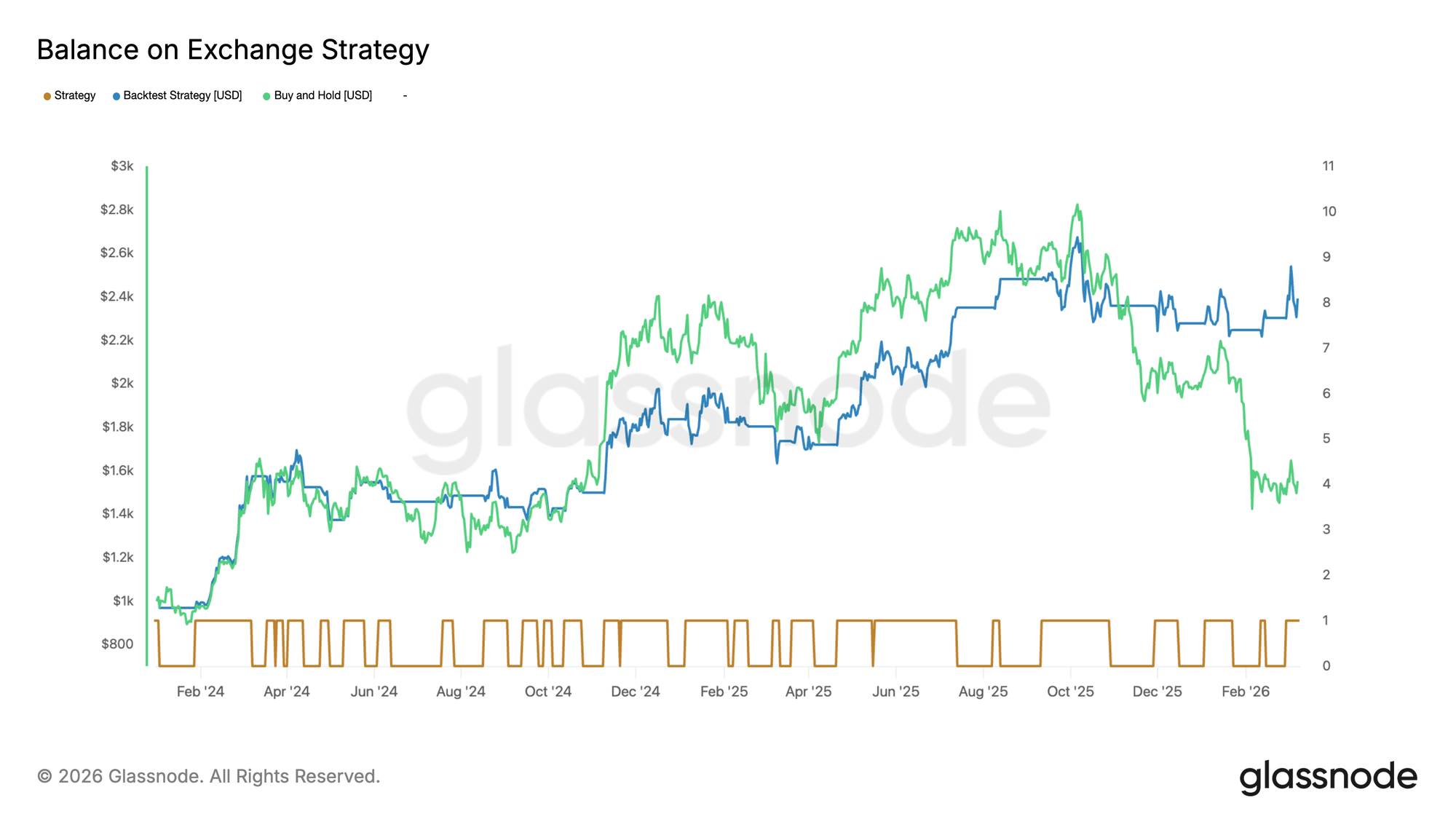
We then benchmark this strategy against simply holding BTC over the same period, starting January 1, 2024 through March 9, 2026, with an initial capital of $1,000 and 0.1% trading fees applied to each trade.
This is a simplified trading strategy, designed primarily for illustrative purposes. It is not investment advice, nor is it meant to suggest that exchange balances are a robust foundation for a trading system.
Access live chart

Here's how to read this chart:

🟫 The brown line at the bottom is the binary trading signal, toggling between in the market (1) and out of the market (0).

🟦 The blue line tracks the strategy's portfolio value over time.

🟩 The green line is the buy-and-hold portfolio benchmark.

We can observe that the exchange balance strategy performed reasonably well, although at times the buy-and-hold strategy outperformed it. In the final days of the research period, however, the exchange balance strategy caught up. While some investors may find the combination of reduced volatility and an ultimately comparable performance to buy-and-hold appealing, the final numbers are misleading – and here’s why.

The Problem: Data Mutation and Look-Ahead Bias

Metrics are not static. Many are retroactively revised as new information becomes available. This is particularly true for metrics that depend on address clustering or entity labeling, such as on-chain exchange balances. However, it is also the case for metrics such as trading volume or price, as individual exchanges can occasionally submit their data with slight delays.

This means that a value you see today for, say, January 15, 2024, may not be the same value that was published on January 15, 2024. The data has been revised with hindsight. When you backtest a strategy on this revised data, you are implicitly using information that was not available at the time the trading decisions would have been made. This introduces a look-ahead bias.

The Honest Backtest: Using Point-in-Time Data

Let's therefore repeat the exact same backtest – same signal logic, same parameters, same dates, same fees – but this time using the Point-in-Time (PiT) variant of the Exchange Balance metric, available in Glassnode Studio.

PiT metrics are strictly append-only and immutable. Each historical data point reflects only the information that was known at the time it was first computed. No retroactive revisions, no look-ahead bias.

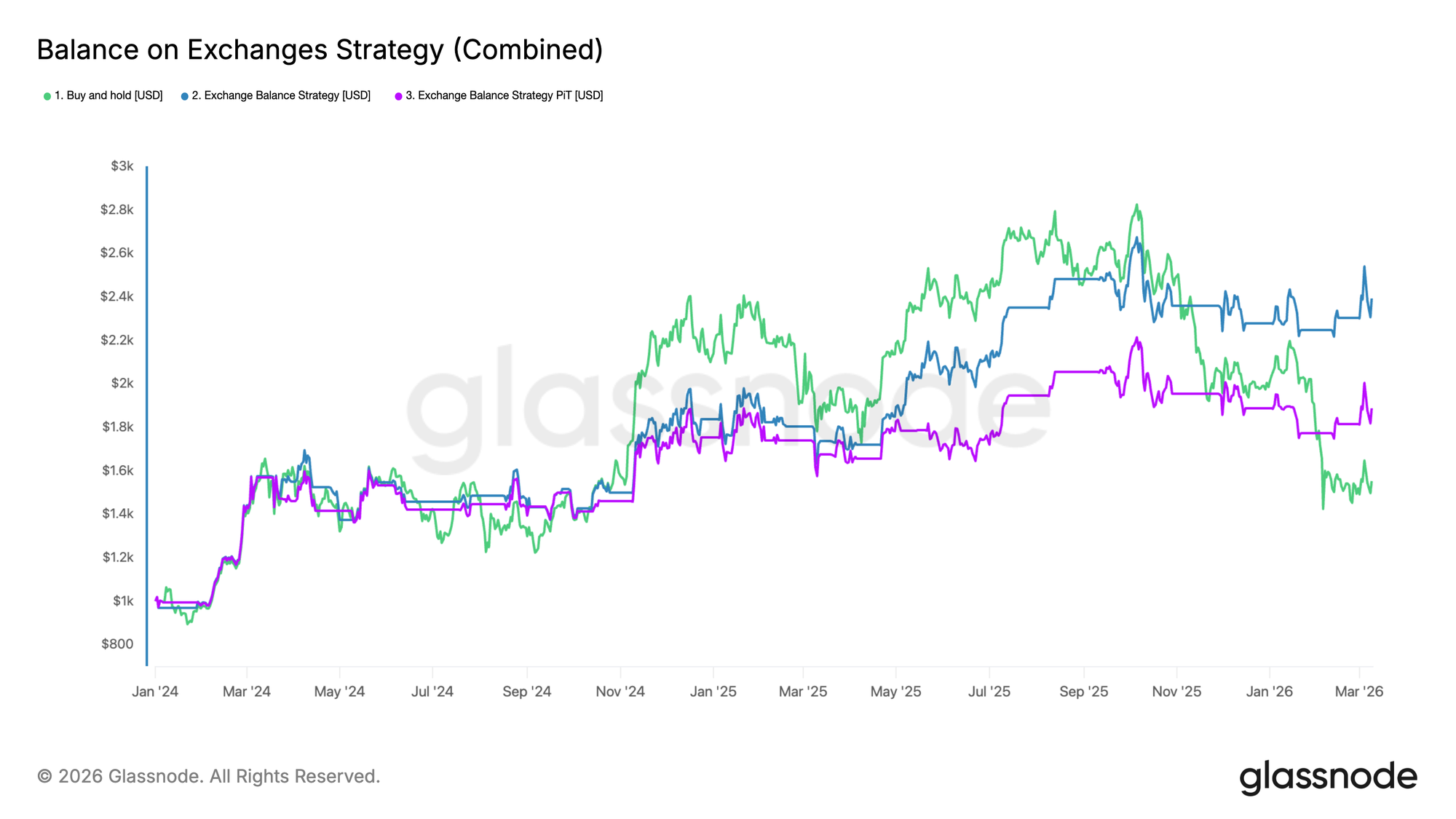
While we are using the same metric, the strategy now produces significantly different results, as illustrated by the purple line in the new chart below. The overall performance is notably worse.

Although both strategies behave similarly for much of 2024, we observe that the PiT-based version fails to capture the strong upticks in November 2024 and March 2025 as effectively. As a result, the cumulative performance diverges meaningfully and ends up considerably lower.
Access live chart

Key Takeaway

In this example, the purple strategy, which only has access to information as it was available at the time, performs noticeably worse. ► Backtests will lie if fed with wrong or revised data. Only immutable, Point-in-Time metrics ensure you’re replaying history as it actually happened.


Пов'язані питання

QWhat is the main problem with using revised data for backtesting a trading strategy?

AThe main problem is that it introduces look-ahead bias, as the revised data includes information that was not available at the time the trading decisions would have been made.

QHow does the Point-in-Time (PiT) data differ from the standard exchange balance metric?

APoint-in-Time data is strictly append-only and immutable, meaning each historical data point reflects only the information known at the time it was first computed, with no retroactive revisions.

QWhat was the trading signal used in the hypothetical strategy based on exchange balances?

AThe strategy entered the market when the 5-day moving average of Binance's BTC balance fell below its 14-day moving average, and exited when the 5-day average rose back above the 14-day average.

QWhy did the backtest using Point-in-Time data perform worse than the one using revised data?

AThe PiT-based strategy failed to capture strong market upticks as effectively because it only had access to information available in real-time, without the benefit of hindsight revisions.

QWhat is the key takeaway from the article regarding backtesting and data quality?

ABacktests will produce misleading results if fed with revised data; only immutable, Point-in-Time metrics ensure an accurate replay of history as it actually happened.

Пов'язані матеріали

Lowering Expectations for BTC's Next Bull Market

The author, Alex Xu, explains his decision to significantly reduce his Bitcoin holdings (from full to ~30% of his portfolio) during the current bull cycle, citing a lowered long-term outlook for BTC's price appreciation in the next cycle. He outlines six key reasons for this reduced expectation: 1. **Diminished Growth Drivers:** The narrative of exponential user adoption has largely played out with institutional ETF adoption. The next major growth phase—adoption by sovereign national reserves or central banks—seems unlikely in the near future. 2. **Personal Opportunity Cost:** More attractive investment opportunities have emerged in other assets, such as undervalued companies. 3. **Industry-Wide Contraction:** The broader crypto industry is struggling, with most Web3 business models (SocialFi, GameFi, DePIN) failing. This overall萧条 (depression) reduces the fundamental demand and consensus for Bitcoin. 4. **Strain on Major Buyer:** MicroStrategy, a major corporate buyer of BTC, faces rising financing expenses for its debt, which could slow its purchasing rate and create significant marginal pressure on the market. 5. **Increased Competition from Gold:** The emergence of "tokenized gold" has closed the functional gap (portability, divisibility) between physical gold and Bitcoin, offering a strong competitor in the non-sovereign store-of-value space. 6. **Security Budget Concerns:** The block reward halving continues to exacerbate the long-standing issue of funding Bitcoin's network security, with new fee source explorations like Ordinals and L2s largely failing. The author's decision to hold a significant (though reduced) position reflects a cautious, not bearish, outlook. He remains open to increasing his exposure if the fundamental reasons for his skepticism change or if new positive catalysts emerge.

marsbit36 хв тому

Lowering Expectations for BTC's Next Bull Market

marsbit36 хв тому

Can Iran 'Control' the Strait of Hormuz?

Iran has announced a comprehensive plan to assert control over the strategic Strait of Hormuz, a critical global oil shipping chokepoint. The proposed measures include requiring all vessels to obtain Iranian permission for passage, imposing fees for security, environmental protection, and navigation management—preferably paid in Iranian rials—and absolutely banning Israeli ships. Vessels from countries deemed hostile by Iran’s top security bodies may also be barred. Analysts suggest Iran’s motives are multifaceted: increasing pressure on the U.S. and Israel by leveraging control over oil transit to influence global prices and inflation; creating a new revenue stream, potentially exceeding $7.7 billion annually, to counter Western sanctions and support postwar reconstruction; and using transit permissions as bargaining chips in future negotiations, notably with the U.S. However, the plan faces significant practical and diplomatic challenges. Enforcing comprehensive interception and fee collection in the busy waterway, patrolled by international military forces, would be difficult. The U.S. has already countering with a blockade of Iranian ports and threats to intercept any ship paying fees, potentially strangling Iran’s oil exports and fee revenue. Broad international opposition, led by European and Gulf states, and legal controversies further complicate implementation. The proposal may ultimately serve more as a negotiating tactic than a feasible policy, with its execution remaining highly uncertain.

marsbit1 год тому

Can Iran 'Control' the Strait of Hormuz?

marsbit1 год тому

Торгівля

Спот
Ф'ючерси
活动图片



