Wintermute Trader: BTC Stuck at $64-67k, Market Has Entered a Phase of Macro Paradigm Shift

marsbitОпубліковано о 2026-02-25Востаннє оновлено о 2026-02-25

Анотація

A Wintermute OTC trader analyzes the current crypto market, noting that BTC remains range-bound between $64k-$67k with weak momentum. The market is undergoing a potential macro paradigm shift driven by three key structural forces: AI-driven repricing, deglobalization, and Federal Reserve policy inefficacy. These factors are causing a rotation away from growth assets—including crypto, which is being sold as high-beta risk-on exposure—and into value sectors like commodities, energy, and defense. AI disruption is compressing software valuations, while deglobalization and tariffs are increasing input costs and geopolitical risks. The Fed is seen as ineffective in responding to sticky inflation and slowing growth. Despite brief interest in altcoins, institutional demand remains weak, and derivatives indicate low conviction. The key question for 2026 is whether this rotation is a temporary shift or a lasting macro regime change favoring hard assets over growth. The answer remains uncertain.

Author: Jjay_dm, Wintermute OTC Trader

Compiled by: Deep Tide TechFlow

Deep Tide Guide: Wintermute is one of the world's largest crypto market makers. This market update, written on February 23, is one of the most sobering descriptions of the current crypto market situation.

It's not just about being bullish or bearish, but integrates three threads—AI repricing, deglobalization, and the Fed's ineffectiveness—into a unified framework. It clearly states that crypto assets are currently being sold as "the highest beta growth assets," and whether this trend is a short-term rotation or a true paradigm shift is the most critical question to watch in 2026.

Full Text Below:

📈 Market Update — February 23, 2026

BTC remains range-bound in the $64-67k zone after the liquidation wave, trading as a high-beta asset with price action increasingly resembling that of some blue-chip altcoins. AI disruption and slow deglobalization have triggered the core question for the crypto market in 2026, with short-term pressures persisting.

Paradigm Shift

Macro

For months, the market has been driven by micro-catalysts: individual tariff headlines, Fed official speeches, earnings data. React, reprice, reset. But this framework is breaking down. A recent article by Citrini crystallized a sentiment many investors felt but never clearly expressed into a judgment: we are in a paradigm shift.

The Fed, which dominated market moves for most of this cycle, is changing. The forces driving asset prices now are slower, harder to trade, and won't be resolved by a single policy pivot. Tariffs aren't going away, AI is disrupting entire industries in real-time, growth is slowing while inflation remains sticky. The Fed's tools are increasingly ineffective against these forces, and investors are starting to question the "Fed/Trump put" that underpinned the market—the very expectation that supported the outperformance of growth stocks and momentum strategies (crypto excepted).

Two structural trade logics are running simultaneously and reinforcing each other:

AI Repricing. The US FY2025 earnings season, combined with Anthropic's recent model release, is forcing the market to underwrite AI disruption risk industry by industry, in real time. Software moats are being reassessed, growth valuation multiples are compressing, and the intensity of hardware capex is also being questioned. The easy trade in AI appears to be over for now, replaced by a messier, more volatile situation.

Deglobalization. Trump's shift from IEEPA to Section 122 of the Trade Act following the Supreme Court ruling is the clearest signal yet: tariffs are structural, not temporary. The government will always find a mechanism. Supply chains continue to fragment, input costs remain high, and geopolitical settlement risk is now a permanent feature of asset allocation.

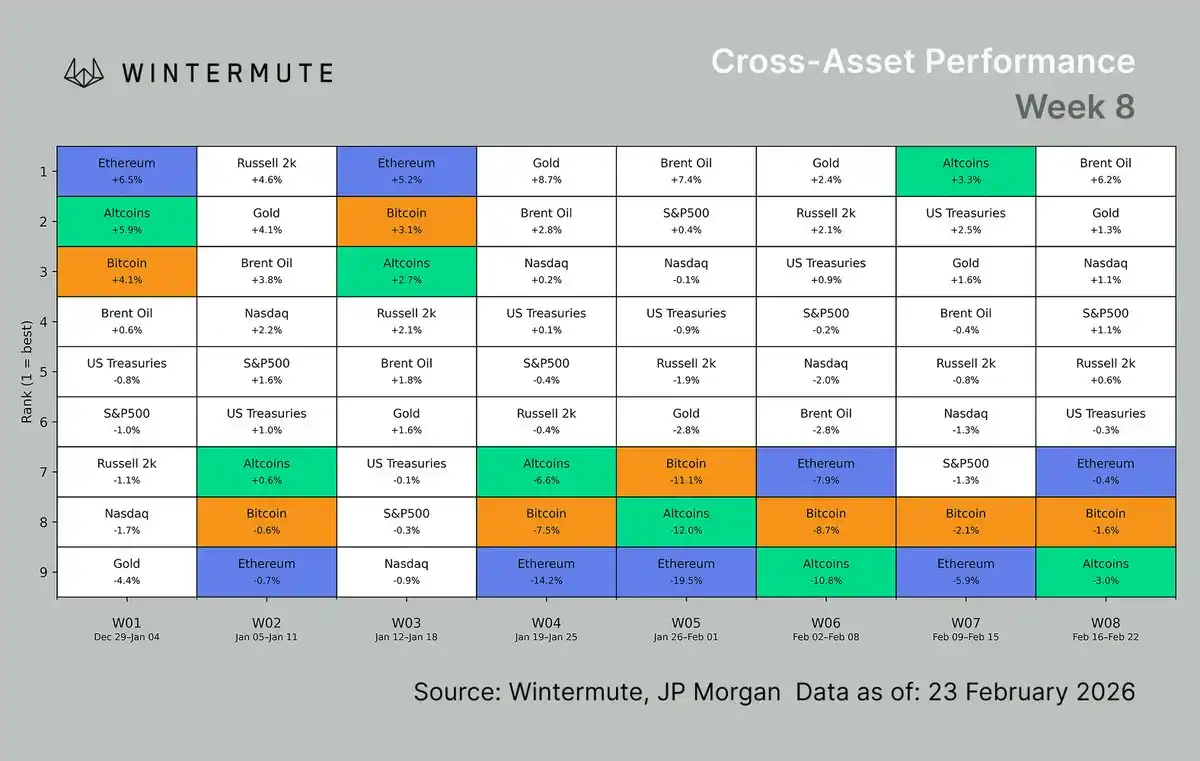
Both drivers attack the same thing: the valuation premium embedded in globally integrated, software-leveraged growth companies. The rotation is already well advanced. Gold, commodities, industrials, metals & mining, defense, and energy are outperforming. Value works, growth is being sold. There is no clarity on rates, no signal that would reverse this trend. The Fed can neither cut with sticky inflation nor hike with slowing growth—this stalemate is the entire trade.
Digital Assets

BTC has failed multiple attempts to break $70k since the liquidation cascade two weeks ago. The absence of bounce buying is more telling than the range itself. Price action is messy, liquidity is thin, the range is tightening and lacks direction. ETH broke below $1,900 this week, a level more psychologically significant than technical; the real support level to watch for ETH is around $1,600.

Institutional demand has not returned after prices stabilized—this contrasts with the situation in the previous $85-95k range, where institutional buying was quite evident. The derivatives market also confirms the lack of directional conviction and trading appetite: basis is at multi-month lows, put skew is rising and still climbing, and open interest has been declining since October.

Trading desk flow is skewed to the sell side, but a noteworthy signal emerged mid-week: high-net-worth individuals briefly showed selective willingness to buy altcoins. In an overall defensive environment, this was a small but notable spark of confidence, though it faded very quickly.

The latter part of the week became messy again; any buying willingness quickly dissipated, indicating the market isn't ready to reward early positioning. The marginal activity remains protective, not offensive.

Our Take

First slowly, then suddenly. The market feels like it's consolidating various narratives into a picture of a paradigm shift.

Right now, crypto assets are being sold as the highest-beta growth assets—falling alongside tech stocks and momentum strategies—in a world where growth asset risk premia are rising and the Fed is powerless to act. The continued net outflows from ETFs confirm this; it's the short-term reality.

But zooming out, the more interesting question is: how sticky is this paradigm? The narratives around stagflation, deglobalization, and Fed gridlock are starting to feel less like a short-term catalyst and more like a genuine repricing of the macro backdrop—a setup favoring hard assets, commodities, and value, not growth. Crypto is currently on the wrong side of this trade.

That said, we've seen this before. Over the past decade, multiple growth scare-induced shifts ultimately reversed as risk appetite returned and the market found its momentum direction again. The difference this time is the structural nature of AI repricing and deglobalization. But it's too early to call it a paradigm shift. How sticky this narrative proves to be is the most important question for crypto in 2026—and we don't have the answer yet.


Пов'язані питання

QAccording to the Wintermute trader, what is the current trading range for Bitcoin and what does its price action resemble?

ABitcoin is trading sideways in the $64-67k range, and its price action is increasingly resembling that of some blue-chip altcoins, trading as a high beta asset.

QWhat two major structural forces does the article identify as driving the current market paradigm shift?

AThe two major structural forces are AI repricing, which is forcing a real-time reassessment of industry risks and valuations, and slow de-globalization, characterized by structural tariffs and fragmenting supply chains.

QHow has institutional demand for Bitcoin behaved since the price stabilized, and what does the derivatives market indicate?

AInstitutional demand has not returned since the price stabilized, in contrast to the significant buying seen in the $85-95k range. The derivatives market confirms a lack of directional conviction, with basis at multi-month lows, rising put skew, and declining open interest since October.

QIn the context of the new macro paradigm, what type of assets are currently outperforming, and where do crypto assets fit into this?

AAssets like gold, commodities, industrials, metals and mining, defense, and energy are outperforming. Value is working, while growth is being sold. Crypto assets are currently on the wrong side of this trade, being sold as the highest beta growth assets.

QWhat does the author state is the most important question for the crypto market in 2026?

AThe most important question for the crypto market in 2026 is determining the stickiness of the new macro paradigm—whether the narratives of stagflation, de-globalization, and Fed impotence represent a true re-pricing of the macro backdrop or just a temporary rotation.

Пов'язані матеріали

From South Korea to the United States: Blue-Collar Jobs Are Becoming Increasingly Popular, Thanks to AI

AI is reshaping the labor market's value proposition. The traditional four-year college degree is losing its appeal as a guaranteed career path, while skilled blue-collar trades like electricians, welders, and plumbers are experiencing historic demand and wage premiums. This shift is driven by dual pressures: AI's displacement of certain white-collar roles and a booming need for physical infrastructure and data center construction. Data confirms the trend. In the U.S., vocational school revenue surged, and a significant portion of recent layoffs are AI-related. Surveys show a majority of Gen Z adults plan to pursue blue-collar work, citing better job security against AI automation. Vocational education interest has exploded recently. Experts cite a psychological shift as younger generations seek tangible, AI-resistant careers and avoid high student debt. In many cases, salaries for skilled trades now match or exceed those requiring a bachelor's degree. In South Korea, semiconductor vocational high schools boast near-total employment, with graduates securing high-paying roles at companies like Samsung. The shortage is structural, exacerbated by a retiring baby boomer workforce and massive infrastructure projects. Companies like JPMorgan Chase, Meta, and Lowe's are investing heavily in training programs. However, overcoming historical stigma and a "perception gap" around trade careers remains a key challenge to closing the talent gap.

marsbit50 хв тому

From South Korea to the United States: Blue-Collar Jobs Are Becoming Increasingly Popular, Thanks to AI

marsbit50 хв тому

Qualcomm: AI Hype Subsides, When Will Smartphones Emerge from the Gloom?

Qualcomm reported its Q3 FY2026 results (ending June 2026), with revenue of $9.95B, down 4% YoY but above expectations. Gross margin declined to 53.1%, pressured by rising costs across manufacturing and memory. Key business segments showed mixed performance: Handset revenue fell 19.6% YoY to $5.09B, dragged by an 11% decline in non-Apple Android shipments and weaker high-end mix. Conversely, Automotive revenue surged 61% to $1.59B, and IoT grew 9% to $1.83B. Core operating profit dropped 41% YoY due to margin compression and higher expenses. Management's Q4 FY2026 guidance projects revenue of $9.7B-$10.5B, in line with consensus, but Non-GAAP EPS guidance of $2.05-$2.25 fell short of expectations. Amidst persistent weakness in its core handset market, Qualcomm is pursuing growth in AI, focusing on Edge AI (smartphones, PCs, automotive) and Data Center AI. Its data center strategy includes four pillars: AI accelerators (e.g., AI200), commercial CPUs (Dragonfly C1000), custom silicon, and connectivity solutions. While these initiatives initially boosted its stock, concerns over AI capital expenditure sustainability have since erased those gains. The company targets $5B in data center revenue for FY2027 and $15B for FY2029. The report concludes that with the traditional handset business still under pressure, the data center opportunity is currently viewed as a longer-term option, and a more conservative valuation based on core operations may be warranted until AI contributions materialize.

marsbit54 хв тому

Qualcomm: AI Hype Subsides, When Will Smartphones Emerge from the Gloom?

marsbit54 хв тому

From TPU to Self-Evolving Agents: How Jeff Dean Predicts the Next Step in AI

At the 2026 YC Startup School, Jeff Dean outlined his vision for AI's next phase, shifting focus from simply scaling models to building intelligent, autonomous systems. He believes AI's progress is no longer just about creating smarter models, but about integrating them into systems capable of long-term, iterative work, automated experimentation, and continuous learning. This evolution moves the competition from "who has the bigger model" to "who can best organize intelligence." Dean suggests AI capabilities are now comparable to a junior engineer, enabling the automation of complex workflows. However, the true challenge and opportunity lie in managing these AI "workers" at scale. He emphasizes the importance of **context engineering**—structuring tools, memory, and feedback loops—over raw model power. For startups, this means building deep expertise in niche domains where general models currently fail (near 0-1% success rates), leveraging proprietary data, specialized tools, and domain-specific evaluators. A recurring theme is re-examining fundamental constraints. Dean's past work, like moving Google's search index to memory or creating the TPU, stemmed from questioning outdated assumptions about hardware and cost. He sees similar inflection points today, particularly in **specialized inference hardware** to drastically reduce latency and energy consumption for real-time Agent operation. Notably, he points out that in modern AI systems, the dominant cost is often not computation but **data movement**. Reliable, long-running Agents require robust system design, borrowing concepts from distributed computing like checkpointing, state management, and parallel exploration to handle failures and maintain progress over days or weeks. As AI automates execution, the scarcest human skills will shift to **defining clear specifications**, **judging what problems are worth solving** (taste), and designing effective feedback loops. Ultimately, Dean's framework prioritizes understanding the problem deeply, identifying the true bottlenecks, and systematically building closed-loop systems where AI can not only perform tasks but also improve AI itself.

marsbit54 хв тому

From TPU to Self-Evolving Agents: How Jeff Dean Predicts the Next Step in AI

marsbit54 хв тому

Торгівля

Спот
活动图片




