Why Stripe’s $53B PayPal bid could reshape stablecoin payments

ambcryptoОпубліковано о 2026-07-15Востаннє оновлено о 2026-07-15

Анотація

Stripe, in a joint bid with private equity firm Advent International, has made a $53 billion offer to acquire PayPal. The $60.50 per share offer represents a 28% premium and is backed by $50 billion in bank financing. While not yet accepted, prediction markets estimate a 72% chance of the deal closing. Analysts describe the potential acquisition as the "biggest story in the payments industry," noting that Stripe recently surpassed PayPal in annual payment volume. A combined entity would process an estimated $3.7 trillion annually. The move is seen as a major bet on stablecoin payments. Stripe has previously acquired Bridge to enable stablecoin transactions and built its own Tempo network. Acquiring PayPal would allow Stripe to scale retail offerings like Venmo and leverage PayPal's PYUSD stablecoin, merging Stripe's developer focus with PayPal's consumer trust. However, the deal faces significant regulatory and integration hurdles, including antitrust scrutiny. It highlights a broader trend of major payment firms like Mastercard and Visa also aggressively entering the stablecoin sector.

Payments giant Stripe has jointly made a $53 billion offer to acquire PayPal amid growing consolidation in the stablecoin sector. The joint move, which includes private equity firm Advent International, would acquire PayPal at $60.50 per share.

If completed, that would be a 28% premium on the value of the share as of the 15th of July. According to the Reuters report, Stripe and Advent would equally own the firm and not break it up.

The report added that the offer was submitted earlier this month but was first floated in April. Already, a $50 billion backing has been committed by banks for the offer.

Although Stripe and Advent are seeking advance discussions in the upcoming weeks, there was no certainty that it would result in a deal. Even so, the odds of a final acquisition deal surged by +50% to 72%, according to prediction site Polymarket.
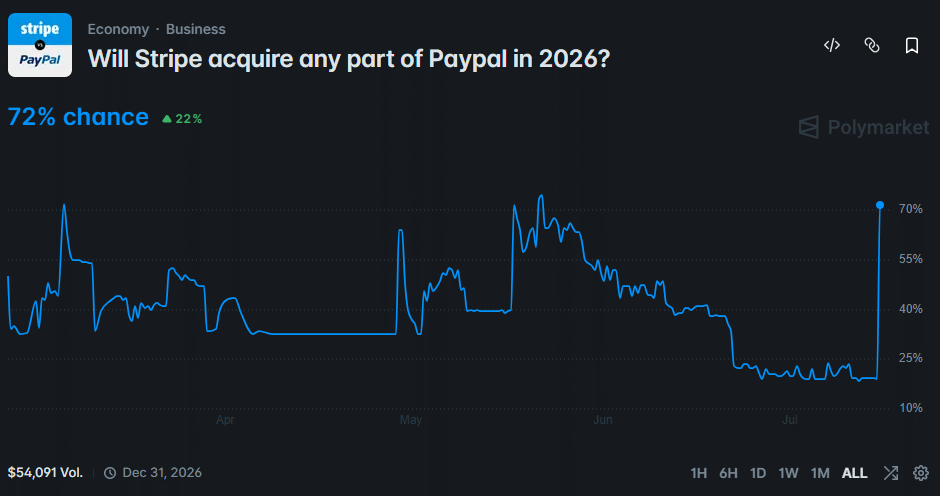
Source: Polymarket

As Stefan Deiss of the Hashgraph Group told AMBCrypto,

This offer signals that mainstream payments infrastructure is converging around crypto rails in a bigger way than ever.

Stripe’s stablecoin bet

Stripe has doubled down on stablecoin payments. Last year, the firm acquired Bridge for $1.1 billion to enable institutions to accept stablecoins via banks. Effectively, this allowed the firm to begin offering global stablecoin payments at a flat 1.5% fee.

To further avoid fluctuations in blockchain transfer fees, as most chains are used for speculation, Stripe opted to build its own network, Tempo, for enterprise payments.

If the PayPal bid is completed, Stripe will likely scale its retail offerings too (including Venmo) and stablecoin issuance through PYUSD.

Deiss added,

Stripe’s developer-first approach combined with PayPal’s consumer trust could make accepting crypto payments the default for millions of businesses.

Currently, PayPal’s PYUSD offers about a 4% yield but, like broader stablecoins, has seen a sharp decline in market supply from $4.2 billion to $2.8 billion.
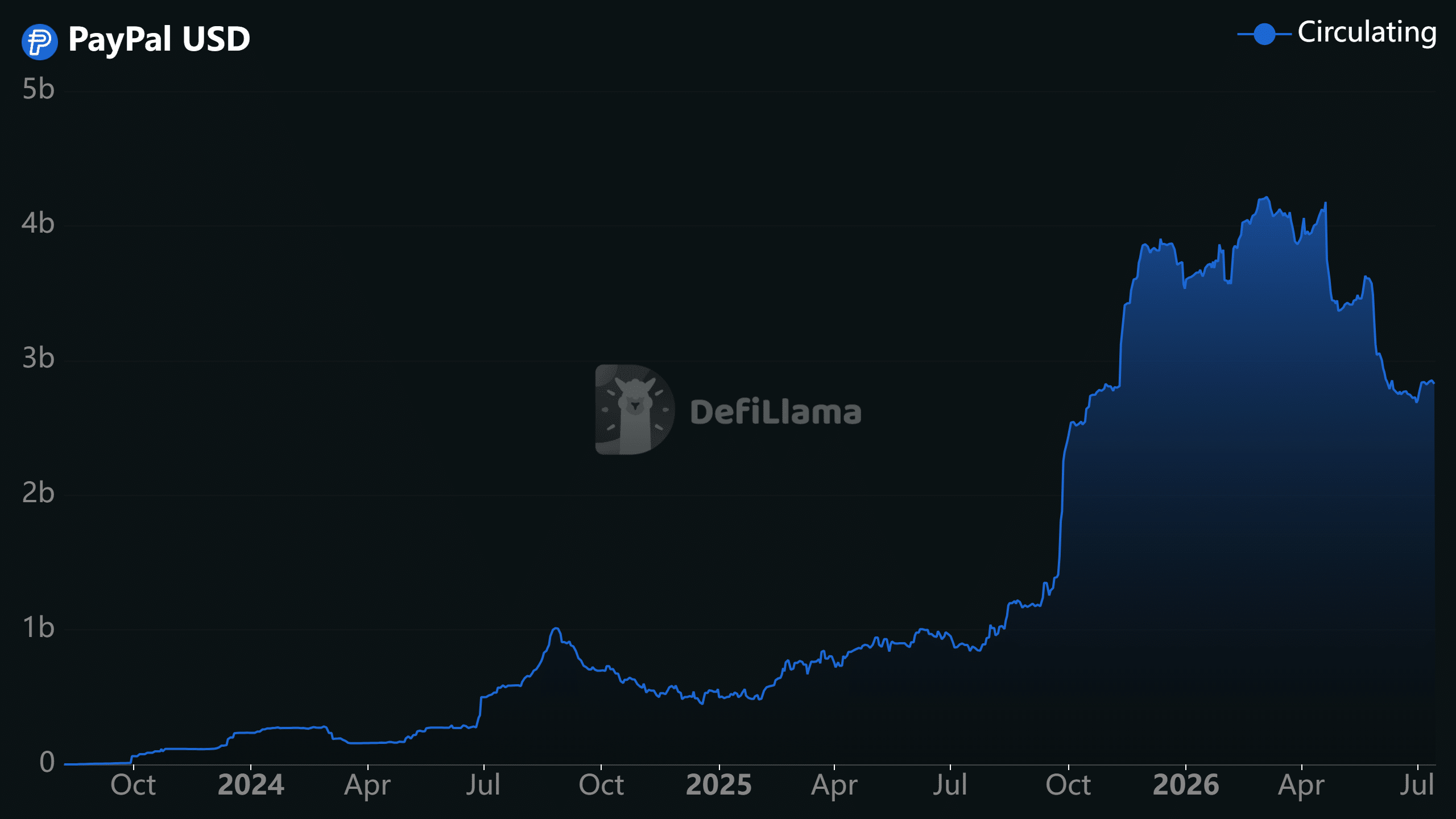
Source: DeFiLlama

Reacting to the Stripe acquisition offer, market analyst Simon Taylor dubbed it the ‘biggest story in the payment industry.’ He stated,

Last year was the first year Stripe’s payment volume passed PayPal’s. $1.9 trillion vs $1.79 trillion. The challenger passed the pioneer on volume, then went straight for the whole company.

He noted that if the deal is completed, Stripe will handle $3.7T in annual volume or 3% of global GDP. That would make it the ‘largest US merchant acquirer by volume.’ PayPal’s stock, PYPL, surged 18.9% to $56.35 in pre-market hours on the 15th of July following the update.

However, Deiss examined the deal from a critical lens.

Regulatory and integration risks are real. Antitrust scrutiny is inevitable given the combined market share. On the crypto side, stablecoin regulation will shape how products like PYUSD and Bridge can operate under unified ownership.

That said, the trend underscores a broader stablecoin race by major payment firms. For example, Mastercard acquired BVNK for $1.8 billion in early 2026 for enterprise stablecoin payouts.

On the other hand, Visa has gone the equity and partnership route as an early BVNK investor and Stripe’s Bridge partner for its stablecoin payments.


Final Summary

  • Stripe is pushing for a $53B PayPal acquisition, a move analysts billed as ‘biggest story in payments.’
  • Although PayPal was yet to respond to the offer, the market was pricing a 72% chance the deal could be completed.


Пов'язані питання

QWhat is the total value of Stripe's joint offer to acquire PayPal, and what premium does it represent over PayPal's stock price as of July 15th?

AStripe, jointly with Advent International, has made a $53 billion offer to acquire PayPal at $60.50 per share. This represents a 28% premium over the value of PayPal's share as of July 15th.

QAccording to the article, what specific technology area is Stripe focusing on, and what key acquisition and infrastructure project are mentioned in this context?

AStripe is doubling down on stablecoin payments. Last year, it acquired Bridge for $1.1 billion to enable institutions to accept stablecoins via banks. Furthermore, to avoid fluctuations in blockchain fees, Stripe is building its own network called Tempo for enterprise payments.

QWhat potential combined annual payment volume is mentioned if the Stripe-PayPal deal is completed, and what significance does this hold?

AIf the deal is completed, Stripe would handle an estimated $3.7 trillion in annual payment volume, which is about 3% of global GDP. This would make it the largest US merchant acquirer by volume.

QWhat are two main risks or challenges associated with the potential acquisition, as highlighted by Stefan Deiss in the article?

AStefan Deiss highlighted two main risks: 1) Regulatory and integration risks, including inevitable antitrust scrutiny due to the combined market share. 2) The impact of stablecoin regulation on how products like PYUSD and Bridge can operate under unified ownership.

QHow did the market and analysts react to the news of Stripe's offer for PayPal?

AFollowing the news, PayPal's stock (PYPL) surged 18.9% to $56.35 in pre-market hours on July 15th. Market analyst Simon Taylor dubbed it the 'biggest story in the payment industry.' Additionally, prediction site Polymarket showed the odds of a final acquisition deal surging by +50% to 72%.

Пов'язані матеріали

In Jinjiang, Fujian, a Storage Super Unicorn Lies Quiet

In Fujian's Jinjiang, a city known for sportswear, lies a quiet semiconductor giant: Fujian Jinhua Integrated Circuit Co. (JHICC). Once a promising domestic DRAM manufacturer alongside Yangtze Memory and ChangXin Memory Technologies (CXMT), its journey was derailed in 2018 when the U.S. placed it on an Entity List and filed criminal charges for alleged trade secret theft. This halted production for years. A turning point came in February 2024 when a U.S. federal court found JHICC not guilty. However, it had lost crucial time. While CXMT soared to become a top-valued A-share company in 2024, JHICC, with an estimated valuation of 80 billion RMB, was just restarting. Its current output is primarily customized DDR4 chips, not the advanced DDR5/HBM demanded for AI, but it still benefits from the broader memory chip upcycle. JHICC's story is tied to Chen Zhengkun, a veteran engineer who left Micron to lead the venture. Founded in 2016 with state-backed funding, JHICC partnered with Taiwan's UMC to develop DRAM technology. Rapid progress was cut short by the U.S. actions, which Micron initiated, partly due to its heavy reliance on the Chinese market. Post-sanctions, Chen's team worked to rebuild the production line with reduced reliance on U.S. technology. According to its records, JHICC achieved small-scale production and revenue growth under immense pressure. It now focuses on the stable "niche" DRAM market (e.g., TVs, routers) with a monthly capacity of ~40,000 wafers, aiming for 60,000 by 2026. It holds over 1,000 patents but remains on the Entity List. For Jinjiang, investing in JHICC was a bold industrial leap. The local government provided unwavering financial and logistical support during the crisis, helping the company survive. JHICC has become the anchor for a growing local semiconductor cluster. Though its scale lags behind domestic peers, JHICC's persistence symbolizes a hard-won foothold in a global market long dominated by Samsung, SK Hynix, and Micron. Having missed one boom, it seeks a place in the new AI-driven memory supercycle.

marsbit46 хв тому

In Jinjiang, Fujian, a Storage Super Unicorn Lies Quiet

marsbit46 хв тому

Торгівля

Спот
活动图片




