Why Is Wall Street Collectively Shorting the Crypto Leader Strategy?

marsbitОпубліковано о 2026-02-27Востаннє оновлено о 2026-02-27

Анотація

The Financial Times' Alphaville column highlighted that S&P 500 short interest has reached a multi-year high, with MicroStrategy (referred to as "Strategy" in the text) being the most shorted stock at 14% of its market value, followed by Coinbase at 11%. This indicates significant skepticism toward MicroStrategy, a major crypto-related company. Analysts, including former investment banker Craig Coben, criticize MicroStrategy’s business model, which involves accumulating Bitcoin without generating cash flow, leading to continuous financing and dilution of shareholder equity. The company tends to buy Bitcoin at market peaks, a systemic flaw. While some short positions may hedge Bitcoin exposure, the high short interest reflects broad bearish sentiment. MicroStrategy’s CEO, Michael Saylor, promotes a "digital asset" framework where Bitcoin serves as foundational capital," followed by "digital credit" (perpetual preferred shares) and "digital currency" (stablecoins). This model relies on perpetual debt issuance, similar to U.S. Treasuries, assuming Bitcoin’s long-term appreciation. The company claims it would only face liquidity issues if Bitcoin stays below $8,000 for 4-5 years—a scenario that would likely cripple the broader crypto industry. Despite short-term stability, Wall Street remains skeptical. Hedge funds use MicroStrategy to hedge against Bitcoin’s volatility, and short sellers target it as a proxy for crypto downturns. Saylor’s ambition to build a new monetar...

On February 24, the Financial Times' Alphaville column published an article titled "Mirror mirror on the wall, what is the most shorted stock of them all?" providing some very interesting data.

The article shows that the median short interest in S&P 500 index constituents has climbed to 2.7%, reaching one of the highest levels in nearly a decade. Among all the constituents, Strategy leads with a short interest accounting for 14% of its market value, while Coinbase ranks fourth with 11%. This means that among all U.S. listed companies with a market capitalization exceeding $25 billion, Strategy is the least favored.

Articles published in the Alphaville column do not represent the views of the Financial Times; its characteristic is sharp and unsparing language. Even as cryptocurrency has gradually moved into the mainstream today, articles about cryptocurrency in the Alphaville column still spare no effort in criticizing it. Whether Bitcoin is $10 or $100,000, they consistently believe cryptocurrency is meaningless.

On February 2, Craig Coben, a veteran investment banker and former Vice Chairman of Global Capital Markets and Head of Global Equity Capital Markets at Merrill Lynch, also published an article in the Alphaville column criticizing Strategy's model.

Craig Coben's views are not extreme; he similarly believes that Strategy does not face a short-term "run" risk and currently has no liquidity crisis. However, he pointed out some core issues, such as the fact that the model of hoarding Bitcoin does not generate cash flow, thus requiring constant financing and diluting common shareholders' equity. Additionally, Strategy's tendency to buy when market sentiment is high and Bitcoin prices are elevated is a systemic, unsolvable problem.

Regarding Strategy's high short interest, some analysts believe that not all short positions are "naked shorts" against Strategy; some may be used by hedge funds to hedge their Bitcoin spot holdings. Nevertheless, it still indicates that there are many people bearish on Strategy, at the very least, everyone believes that if Bitcoin falls, Strategy cannot remain unscathed.

In Craig Coben's article, he mentioned that Strategy refers to the five types of perpetual preferred stock it issued as "digital credit," a concept that Michael Saylor has been emphasizing since the end of last year.
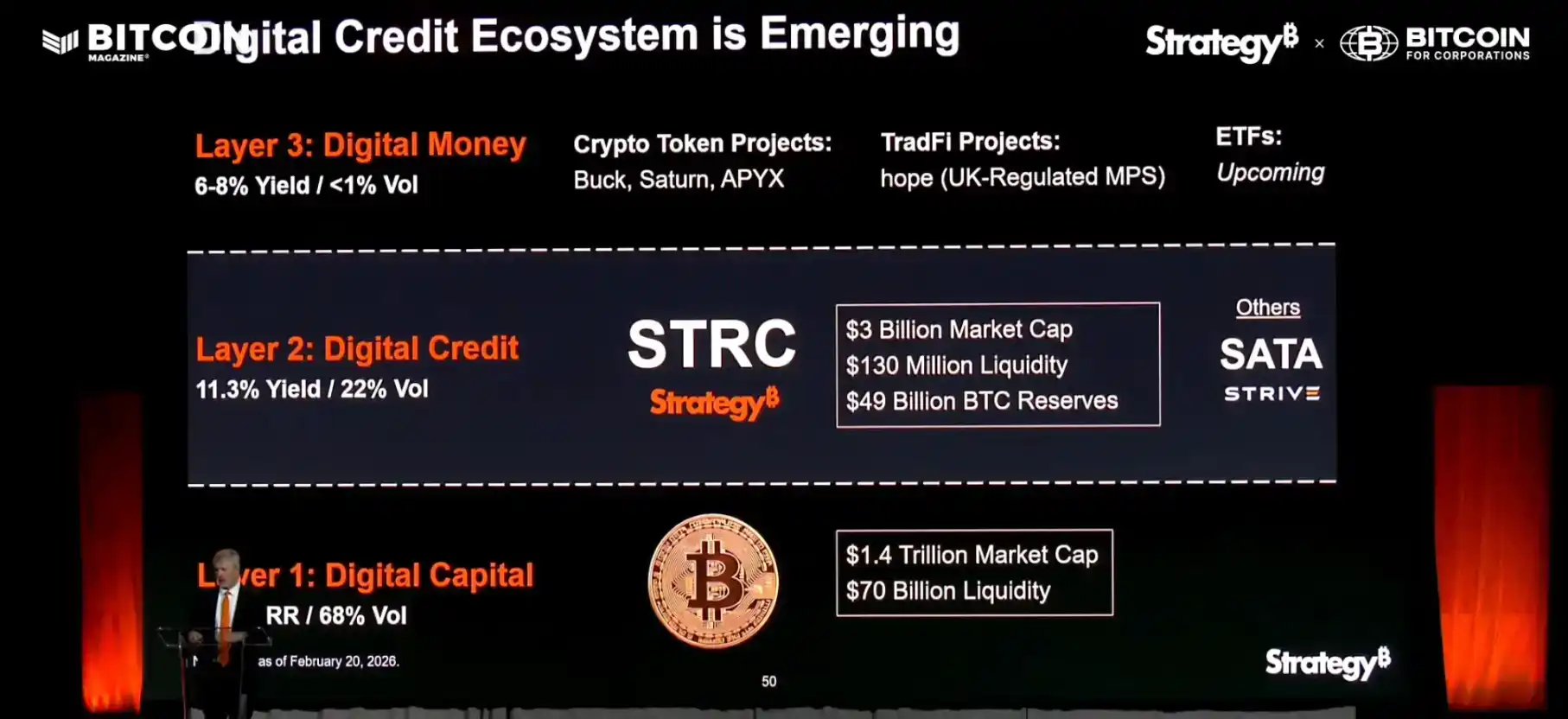
In this conceptual framework, the first layer, "digital capital," is Bitcoin. The second layer, "digital credit (or digital debt)," consists of the various perpetual preferred stocks issued by Strategy. These preferred stocks come with high yields, and Strategy must pay corresponding interest to holders annually.

The third layer is "digital currency," which refers to currencies, including stablecoins, issued based on the financial products in the second layer for trading. For example, Saturn in the diagram above plans to issue the USDat stablecoin based on STRC and U.S. Treasury bonds; this project has also received investment from YZi Labs.

If this logic isn't clear, you can draw an analogy with the United States. The U.S. continuously issues Treasury bonds based on its influence, only needing to pay interest before maturity and using new debt to repay old debt upon maturity. As long as the U.S.'s international influence and the status of the dollar do not weaken, this game can continue indefinitely. For Strategy, Bitcoin is like the U.S. influence, digital credit is like U.S. Treasury bonds, and Strategy also needs to borrow new debt to pay the annual preferred stock interest. However, as long as the price of Bitcoin continues to rise in the long term and drives Strategy's stock price up, the company can continuously issue new shares to finance the purchase of more Bitcoin and pay interest, continuing this cycle.

Michael Saylor is a firm believer that Bitcoin will change everything. In his view, Bitcoin's infinite rise is a more reliable bet than the U.S. winning forever, so he is more willing to issue currency based on an asset that is "destined" to continuously appreciate, just as the U.S. dollar was initially pegged to gold.

Strategy's strategy is not new; it only needs to ensure it has enough cash to pay interest to continuously finance the purchase of Bitcoin. Like U.S. Treasury bonds, this is a game that everyone knows will eventually reach its end one day, but no one can determine how long it can last. Strategy's current financial reserves are also sufficient; its CEO stated that Strategy would only be forced to sell Bitcoin if the price remained below $8,000 for 4 to 5 consecutive years.

If this extreme condition were actually met, not just Strategy, but the entire Web3 industry might disappear.

Even an old-school banker like Craig Coben must admit that Strategy will not face financial problems in the short term. However, for hedge funds, Strategy is a good tool for hedging against a decline in Bitcoin; for short sellers, it is reasonable to short a system that only functions normally when Bitcoin rises during a cryptocurrency downturn. At least for now, there aren't many reasons to be bullish on Strategy.

Michael Saylor's ambition to leverage Bitcoin to launch a new currency is itself interesting. The U.S. dollar is used to buy Bitcoin, and the U.S. dollar is also used to pay interest. The goal of a system built with billions of U.S. dollars is ultimately to destroy the very bricks and mortar that built it. Perhaps the elites on Wall Street are also chuckling; after all, they have no interest in researching whether Strategy can truly become a century-old company. They only care about when your stock price will rise and when it will fall.

Michael Saylor believes Bitcoin will inevitably continue to hit new highs, so he uses it as the cornerstone of everything; holders and users of the U.S. dollar believe the United States will continue to prosper, so they tacitly allow the constant raising of the U.S. debt ceiling. Both are acts of belief—so which is more advanced than the other?


Пов'язані питання

QWhy is MicroStrategy the most shorted stock among S&P 500 companies with a market cap over $25 billion?

AAccording to the Financial Times' Alphaville column, MicroStrategy has the highest short interest at 14% of its market value among S&P 500 companies with a market cap over $25 billion, making it the most heavily shorted stock in that category. This indicates a significant lack of confidence from investors, who are betting that its stock price will decline.

QWhat are the core problems with MicroStrategy's business model as pointed out by Craig Coben?

ACraig Coben pointed out that MicroStrategy's model of hoarding Bitcoin does not generate cash flow, forcing the company to continuously raise capital, which dilutes the equity of common shareholders. He also criticized its strategy of buying Bitcoin when market sentiment is high and prices are elevated, a systemic issue with no easy solution.

QWhat are the three layers in Michael Saylor's concept of 'digital credit'?

AThe three layers are: 1) 'Digital Capital,' which is Bitcoin itself. 2) 'Digital Credit (or Digital Debt),' which refers to the various perpetual preferred shares issued by the company. 3) 'Digital Currency,' which are currencies, including stablecoins, issued based on the financial products from the second layer and intended for transactions.

QHow does MicroStrategy's financial strategy resemble that of the U.S. government's debt system?

AMicroStrategy's strategy is analogous to the U.S. debt system. The company uses Bitcoin (like U.S. influence) as its foundation to issue 'digital credit' (like U.S. Treasury bonds). It plans to pay the interest on these instruments by continuously issuing new debt or equity, similar to how the U.S. refinances its debt, as long as the value of its foundational asset (Bitcoin) is perceived to be rising.

QUnder what extreme condition would MicroStrategy be forced to sell its Bitcoin holdings?

AMicroStrategy's CEO has stated that the company would only be forced to sell its Bitcoin if the price remained below $8,000 for a sustained period of 4 to 5 years. Such an extreme scenario would likely indicate a catastrophic collapse for the entire Web3 and cryptocurrency industry.

Пов'язані матеріали

The King of Blind Date Attire in Korea: How SK Hynix Made a Comeback Against Samsung?

In South Korea's dating scene, SK Hynix employees are now highly sought after, a status shift fueled by the company's astronomical profits and employee bonuses, projected to reach up to 6.1 million RMB per person by 2027. This marks a dramatic reversal for the long-time second-place player in memory semiconductors, which has now surpassed its rival Samsung in annual operating profit. The turnaround story began in 2008 when a struggling Hynix, emerging from bankruptcy restructuring, took a risky bet by agreeing to develop High Bandwidth Memory (HBM) with AMD. At the time, HBM had no clear market beyond high-end graphics cards and was a costly, complex technology. Major players like Samsung, pursuing its own HMC technology, declined. For Hynix, with only memory as its core business, it was a gamble born of necessity. The pivotal moment came in 2012 when SK Group Chairman Chey Tae-won acquired Hynix. Defying industry downturns, he invested heavily in R&D and fabrication, sustaining the HBM project through over a decade of commercial uncertainty and internal challenges. A key break occurred around 2016-2017 when Samsung faced production issues supplying HBM2 for Google's TPU, allowing SK Hynix to gain a crucial foothold in the data center market. The AI explosion post-ChatGPT in 2022 was the catalyst, turning HBM into a critical bottleneck for AI accelerators like NVIDIA's GPUs. By 2025, SK Hynix captured 62% of the global HBM market, leaving Samsung at 17%. For the first time, its annual operating profit exceeded Samsung's. Analysts point to the "innovator's dilemma" to explain Samsung's miss: its vast, successful business portfolio made it risk-averse, preventing an all-in bet on the initially niche HBM technology. In contrast, SK Hynix, as a challenger with its back against the wall, had no choice but to commit fully. The story highlights how Korea's chaebol system allows for ultra-long-term bets beyond quarterly pressures. However, SK Hynix's lead isn't guaranteed. Samsung is aggressively catching up on HBM4, and challenges like customer concentration (heavy reliance on NVIDIA) and technical hurdles in advanced packaging remain. The narrative underscores a market truth: the greatest alpha often comes from betting on uncertain, long-term directions others dismiss, much like HBM in 2008.

marsbit7 хв тому

The King of Blind Date Attire in Korea: How SK Hynix Made a Comeback Against Samsung?

marsbit7 хв тому

Understanding Hash in One Article: The "Browser Miner" on Ethereum

Hash is an Ethereum-based ERC-20 token described as a "browser-minable post-quantum token." Its key features include enabling browser-based GPU mining without specialized hardware, a fixed supply cap of 21 million tokens, immutable and permissionless smart contracts with no team allocation or pre-mining, and an emphasis on post-quantum security using Keccak256 hashing. The mining mechanism is a simplified on-chain proof-of-work where miners solve unique challenges tied to their wallet address. Key design elements prevent answer theft, with epochs resetting every 100 blocks (~20 minutes) and a per-block minting limit. Emission follows a Bitcoin-like halving schedule every 100,000 mints, starting at 100 tokens per mint. Projections suggest all tokens could be mined within approximately 294 days if a target rate of one mint per minute is sustained. Hash emphasizes "post-quantum" security by leveraging hash-based primitives like Keccak256, which are considered more resistant to quantum attacks compared to elliptic-curve cryptography. While not a fully post-quantum asset, it aligns with Ethereum's broader post-quantum research narrative. The project completed its Genesis sale at $0.03 and began trading on Uniswap, with its price reaching around $0.19. The initial circulating supply is small, with 5% sold in Genesis and 5% allocated to liquidity. The majority (47.6% of total supply) is allocated to early-stage mining, leading to a front-loaded emission schedule. This structure, combined with low initial liquidity, makes Hash a high-volatility, high-risk project dependent on sustained miner participation and market demand to absorb new supply.

marsbit20 хв тому

Understanding Hash in One Article: The "Browser Miner" on Ethereum

marsbit20 хв тому

OpenAI's Largest Internal Wealth Creation: 600 People Cash Out a Total of $6.6 Billion, 75 Take Home the Maximum $30 Million Each

A Wall Street Journal report reveals OpenAI's unprecedented pre-IPO wealth creation. In a single employee stock sale last October, over 600 current and former employees sold shares, collectively cashing out approximately $6.6 billion. Due to high investor demand, the company tripled the individual sale cap to $30 million, with about 75 employees selling the maximum amount. This event represents the largest such transaction in tech industry history for a private company. OpenAI's valuation was $500 billion for this tender offer. Employees with over two years of tenure were eligible, allowing many post-ChatGPT hires their first liquidity event. The company's stock has reportedly grown over 100-fold in seven years. Following a restructuring, employees collectively hold about 26% of OpenAI. The scale of executive wealth is also staggering. In court testimony related to Elon Musk's lawsuit, President and co-founder Greg Brockman confirmed his OpenAI stake is worth around $30 billion. Analysis indicates about 165 current and former employees hold a combined ~$164.9 billion in equity, averaging nearly $1 billion per person in paper wealth. OpenAI's per-employee stock-based compensation is estimated to be 34 times the average of major tech firms before their IPOs. OpenAI continues its rapid ascent, closing a $122 billion funding round at an $852 billion valuation in March. With monthly revenue hitting $2 billion, over 900 million weekly ChatGPT users, and plans for a potential trillion-dollar IPO in late 2026, this wealth-creation engine shows no signs of stopping.

链捕手43 хв тому

OpenAI's Largest Internal Wealth Creation: 600 People Cash Out a Total of $6.6 Billion, 75 Take Home the Maximum $30 Million Each

链捕手43 хв тому

Торгівля

Спот
Ф'ючерси
活动图片