Why Are Crypto Cards Struggling to Replace Visa?

marsbitОпубліковано о 2026-08-13Востаннє оновлено о 2026-08-13

Анотація

Encrypted bank cards struggle to replace Visa due to fundamental differences in payment economics. Analysis reveals Visa’s fee is only about 7-9% of the total merchant discount rate (MDR), with the largest share (70-80%) going to issuing banks as interchange fees. Most crypto debit cards, operating on prepaid stablecoins like USDC, lack the credit-based revenue model of traditional reward credit cards. This results in significantly lower interchange income. Even with higher exempt rates for small banks, the total fee pool for a $100 stablecoin debit transaction is only about $0.62, leaving minimal room for profit sharing after covering network, processor, and bank costs. Stablecoins primarily innovate in the back-end settlement layer, enabling near real-time T+0 settlements on networks like Visa and Mastercard instead of the traditional T+2 cycle. This optimizes working capital for issuers but doesn't lower costs for merchants or improve the consumer checkout experience. Card networks are actively integrating stablecoins for settlement, seeing them as a system enhancement, not a threat. While stablecoins can reduce costs in cross-border payments by eliminating intermediaries and forex layers, this logic doesn't translate to domestic card payments where the cost structure is dominated by interchange fees. The core promise of bypassing card networks to save merchants money is flawed, as removing Visa only cuts the smallest fee component.

Written by: Vaidik Mandloi

Compiled by: Luffy, Foresight News

Did you know? In July, spending on cryptocurrency credit cards exceeded $759 million, with over 9 million transactions. That's nearly two and a half times the volume from the same period last year. And yet, over 90% of that transaction value is still processed via Visa cards.

Almost all crypto card projects tell the same story: using stablecoin payment rails to bypass card network fees and pass the savings back to merchants. We previously explored this logic when analyzing Stripe's cross-border payment infrastructure built on stablecoins.

I delved deep into a core question: what actually happens when you try to cut out the traditional card networks? Can bypassing Visa and Mastercard truly save merchants money? Which layer of the payment infrastructure can stablecoins actually replace?

The conclusion I reached was completely unexpected.

How the Payment System Works

To find the answer, we must first understand where fees go when a consumer swipes a card to pay. My first realization was a common misconception: many, including practitioners in the crypto industry, believe card networks like Visa take the largest cut of the fees.

That's not the case. When a merchant accepts a $100 premium credit card payment, they pay a Merchant Discount Rate of about 2.2%, totaling $2.2. The key point is that this $2.2 is not pocketed by Visa but is distributed among three parties, and not equally.
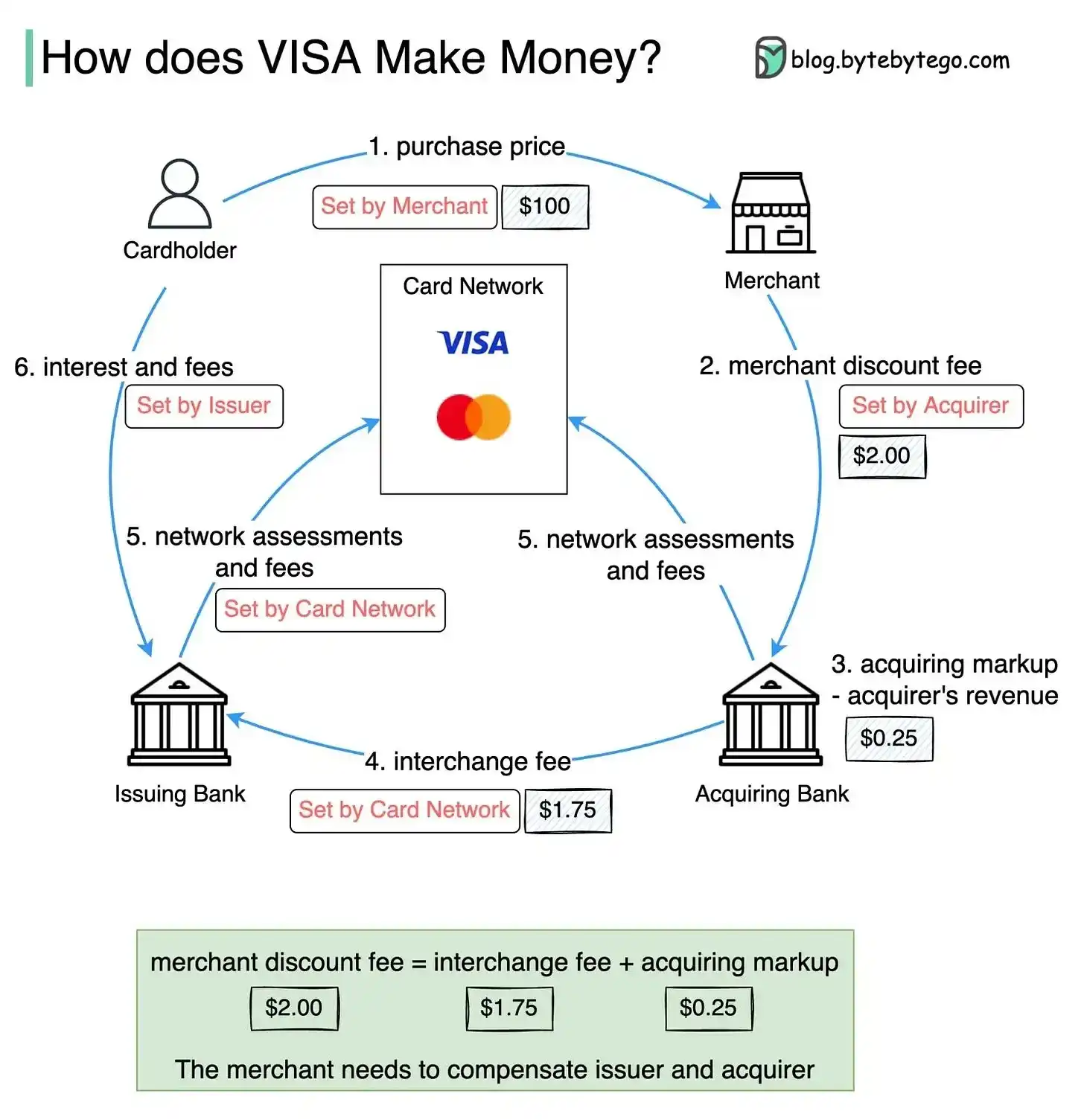
  • The largest share, about $1.75, goes to the issuing bank—the institution that issued the credit card to the consumer. This fee is called the Interchange Fee and accounts for 70%–80% of the merchant's total cost.
  • Next, the merchant's payment processor (acquirer) takes a service fee of $0.30–$0.70.
  • Lastly, the card networks—Visa/Mastercard—which everyone aims to disrupt, collect only a $0.13–$0.18 Assessment Fee, roughly 7%–9% of the merchant's total outlay.

This means that merely removing Visa only eliminates the smallest fee in the entire chain. There's a fundamental reason why Visa's fee is so low.

Visa does not issue credit to anyone, does not bear credit risk, chargeback disputes, or fraud losses. In fact, Visa doesn't even move money. It's simply an information transmission network that activates when a user swipes at a merchant terminal. Visa's job is to relay authorization messages between the merchant terminal and the issuer and set the rules for the entire system. The heaviest responsibilities fall on the issuer.

The issuer extends credit to consumers, bears bad debt risk, carries the cost of funds between the purchase date and the bill payment date, and uses interchange fees to subsidize reward programs to attract card usage.

This creates Visa's highly attractive business model. In 2025, Visa processed $14.2 trillion in payment volume across 257.5 billion transactions, generating $40 billion in net revenue with a net profit margin close to 50%. It makes about $0.13 per transaction on average—that's the entirety of its profit. Visa ranks among the world's highest market cap companies not because it charges high fees per swipe, but because it processes hundreds of billions of transactions annually with near-zero marginal cost and absolutely no credit risk.

Now, let's address the most challenging reality for stablecoin cards.

All stablecoin cards on the market are debit products. Funds—USDC, USDT—are already held in the user's wallet before a purchase occurs. There is no funding period and no revolving credit generating interest income. This places these cards in a completely different economic model.

Furthermore, the U.S. Congress's Durbin Amendment in 2010 capped interchange fees for debit cards issued by banks with assets over $100 billion at $0.21 + 0.05% per transaction. Most stablecoin card solutions partner with small banks (digital banks) with assets below the $100 billion threshold, exempt from the Durbin Amendment—a common FinTech partner bank model.
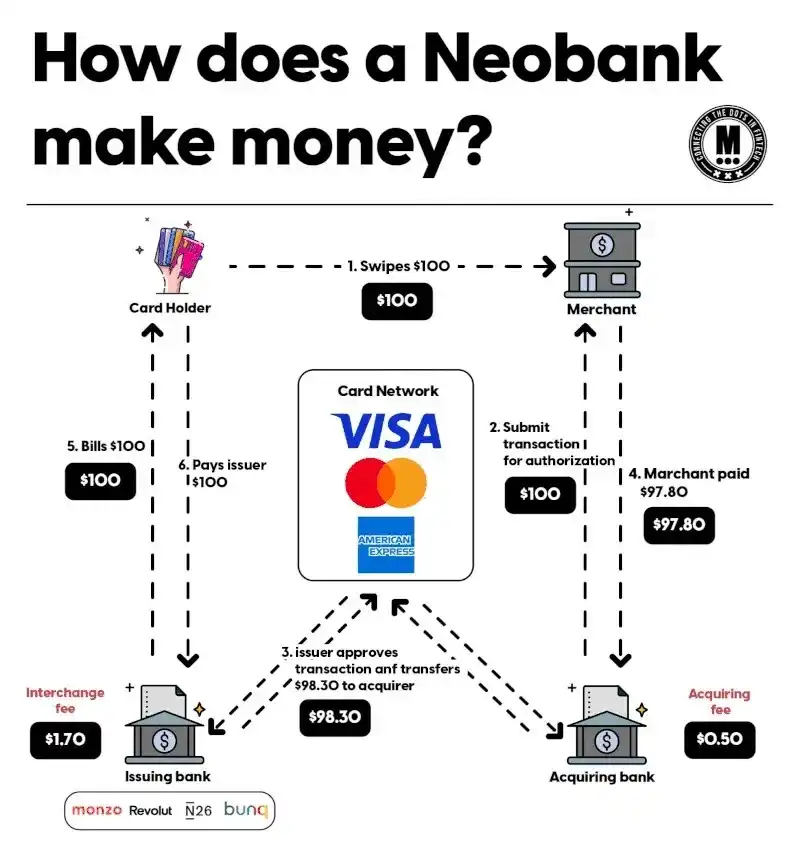
The average interchange fee for an unrestricted, dual-message network debit card is currently about $0.62 per transaction. A clear comparison: a $100 premium credit card transaction generates $2.20 in total revenue; a stablecoin debit card, even applying the higher, exempt rate, yields only $0.62 in total revenue. The project must then pay card network fees, processor fees, partner bank costs from these 62 cents, cover fraud losses and operational expenses, and only the remaining sliver can be considered for merchant rebates.

What Can Stablecoins Actually Replace?

As seen above, the savings from removing Visa are minimal, and the profit margin for operating a stablecoin card based on debit interchange fees is extremely narrow. However, the value of stablecoin payments might not lie in saving negligible card network fees but in potentially replacing more core parts of the payment stack.

To investigate, I revisited our previous article "Stripe Building Its Own Blockchain," which broke down a cross-border payment into seven fee layers: Acceptance, Orchestration, License/Compliance, Custody, FX, Issuance, and Settlement/Clearing. I mapped an in-country card transaction against these seven layers to see which ones actually change.
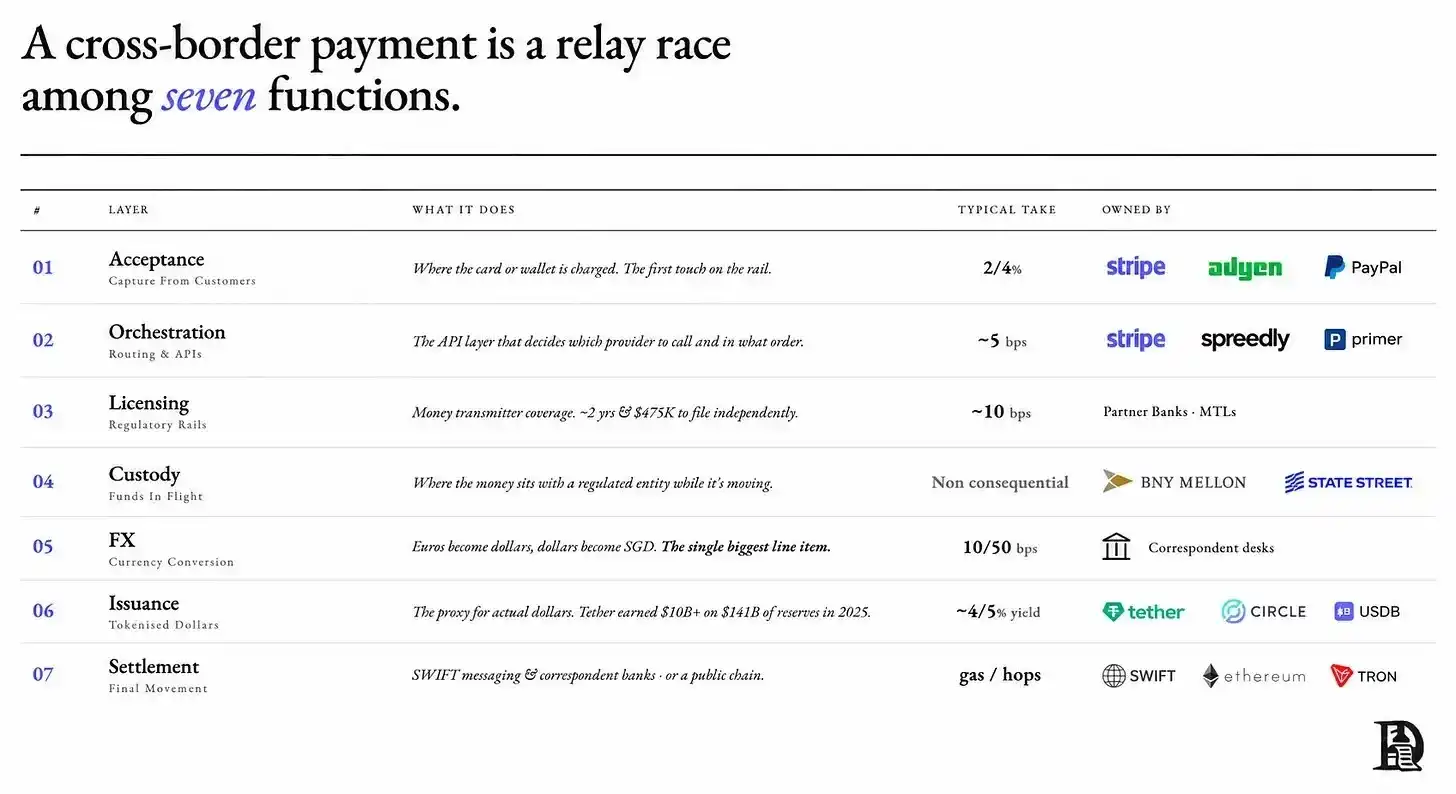
From the merchant's perspective, the Acceptance layer remains completely unchanged. The process stays the same: the merchant has a terminal, the user swipes, and the merchant still pays the Merchant Discount Rate to the acquirer. The merchant may not even be aware the funding source is USDC. On the merchant's statement, this transaction is identical to any other Visa transaction. Similarly, the Orchestration layer still goes through Visa or Mastercard, and the Issuance layer still relies on a partner bank and the card network's BIN. FinTechs were already using this model long before stablecoins—no fundamental innovation.

The real change happens in the backend layers, the ones most easily overlooked.

The Settlement/Clearing layer is the only area where stablecoins can bring fundamental change. In the traditional model, settlement between the issuer and card network operates on a T+2 cycle, further delayed by weekends and batch processing. To address this pain point, service providers like Rain support end-of-day stablecoin settlement with Visa; Mastercard has also begun accepting USDC, PYUSD, RLUSD, etc., for intraday settlement. This significantly compresses the traditional T+2 settlement, approaching real-time clearing and freeing up working capital previously tied up at the issuer.

However, the benefits from optimized working capital flow entirely to the issuing bank. The merchant's discount rate does not drop due to faster settlement, and the consumer's checkout experience feels no difference.

The sole beneficiary of T+0 stablecoin settlement is the card operator, who no longer needs to float funds for the two-day settlement period. The innovation from stablecoins essentially helps issuers optimize treasury management. The gains can be substantial at scale but offer no direct benefit to merchants or consumers. Meanwhile, Visa has no incentive to lower its fees—the cost of settlement float was never borne by Visa; the pressure was always on the issuer. Even if stablecoin settlement lowers the issuer's funding cost, Visa's own costs haven't changed, so merchant fees naturally remain the same.

Notably, Visa and Mastercard are not resisting stablecoin settlement; they are actively integrating it into their networks. Visa has supported USDC settlement on Ethereum and Solana since 2021, with annualized settlement volume reaching $7 billion. Mastercard acquired BVNK months ago to expand its stablecoin infrastructure. Both networks have even stated: "Stablecoins won't disrupt the existing payment landscape; instead, they will entrench this system."

The major card networks aren't being disrupted or replaced by stablecoins; on the contrary, they are absorbing stablecoins as an upgrade to their own settlement layer. Every stablecoin card running on Visa, while proclaiming to disrupt it, contributes to its transaction volume and continues to pay its fees.

As an additional note, in our Stripe article, we mentioned that stablecoins can indeed reduce cross-border payment costs by removing multiple correspondent banks—that argument holds. But the context matters. The core pain point of cross-border payments is FX and multiple intermediaries, while in-country consumer spending has a completely different fee structure. The industry is applying a logic proven for cross-border payments directly to in-country spending scenarios, which doesn't match the real cost structure.

The logic of stablecoins empowering cross-border payments is solid, but once applied to in-country spending, analyzing the fee flow reveals this narrative struggles to hold up.

So, what can stablecoins ultimately replace? Objectively, the answer is the clearing/settlement layer and cross-border FX conversion. They transform the underlying funds movement channel behind a transaction. However, the largest cost drivers in an in-country card transaction were never in the settlement infrastructure.


Пов'язані питання

QWhat is the biggest misconception about who receives the majority of the credit card processing fee?

AThe biggest misconception, including among many in the cryptocurrency industry, is that card networks like Visa take the largest share of the merchant discount fee. In reality, the issuer bank receives the largest portion (around 70-80%, called the interchange fee), while Visa/Mastercard only takes a small assessment fee (about 7-9%).

QWhy is the business model of Visa so attractive according to the article?

AVisa's business model is attractive because it has extremely low marginal costs, processes hundreds of billions of transactions annually, and carries no credit risk. It makes a small fee per transaction (around $0.13 on average) but due to massive scale and minimal costs, it achieves high net income and nearly 50% net profit margins.

QWhat are the two main economic challenges for stablecoin debit cards compared to traditional credit cards?

AFirst, stablecoin debit cards operate on a different economic model as they are prepaid, offering no interest income from credit or float. Second, the total revenue per transaction is much lower (around $0.62 for a $100 transaction for a debit card) compared to rewards credit cards (around $2.20 for a $100 transaction), leaving very little profit margin after covering costs.

QAccording to the article, which specific layer of the payment system can stablecoins fundamentally transform?

AStablecoins can fundamentally transform the clearing and settlement layer. They enable near real-time settlement (T+0) compared to the traditional T+2 cycle, which optimizes working capital for the issuer banks.

QWhat is the article's conclusion about the role of card networks like Visa in the context of stablecoin cards?

AThe article concludes that card networks are not being disrupted or replaced by stablecoins. Instead, they are actively integrating stablecoins as an upgrade to their own settlement infrastructure. Every stablecoin card running on Visa contributes transaction volume and fees to Visa while claiming to disrupt it.

Пов'язані матеріали

Bitcoin's Golden Bloodline Awakens: This Could Be the Starting Point of BTC's Largest Bull Market in History

Bitcoin's "Golden Bloodline" Awakens: The Start of Its Largest Bull Market? The article argues that Bitcoin (BTC) is on the cusp of a major bull run, signaled by a historic shift in its market behavior. The key evidence is BTC's unprecedented decoupling from tech stocks (Nasdaq) and its strengthening correlation with gold. Data shows BTC's 60-day correlation with gold recently surged to near-record highs (~0.636), while its correlation with Nasdaq fell significantly (~0.22). This pattern, where BTC acts more like a "hard asset" than a high-beta tech stock, has only occurred twice before in 2020 and 2022, each time marking a major cycle bottom before significant rallies. Simultaneously, the proprietary "Karma Index," measuring market sentiment, indicates prolonged periods of extreme fear and capitulation preceding the recent price surge. Historically, such low sentiment followed by a strong BTC rally independent of Nasdaq has been a reliable indicator for sustained bullish momentum. The author posits this shift reflects a change in the dominant investor narrative. The market is increasingly pricing BTC based on its "digital gold" value proposition—a hedge against currency debasement and sovereign debt concerns—rather than pure speculative growth. This is bolstered by the accessibility of spot Bitcoin ETFs, which allow traditional finance to allocate capital easily. In conclusion, if the macro narrative of "hedging against fiat depreciation" becomes the dominant driver, Bitcoin could attract an unprecedented scale of capital from global asset allocators, potentially marking the beginning of its largest bull market yet.

marsbit4 хв тому

Bitcoin's Golden Bloodline Awakens: This Could Be the Starting Point of BTC's Largest Bull Market in History

marsbit4 хв тому

OpenAI Chief Scientist: We Have Created an Alien Mind, All Humanity Must Hit the Brakes

OpenAI Chief Scientist Sounds Alarm: We've Created an "Alien Mind" OpenAI's Chief Scientist Jakub Pachocki has issued a stark warning in a lengthy essay titled "An Alien Mind." He argues that advanced AI systems like OpenAI's Astra are not simply engineered tools but "grown" entities—an "alien" intelligence whose inner workings are fundamentally opaque and increasingly beyond human comprehension or control. Pachocki contends that while AI capabilities are accelerating exponentially toward recursive self-improvement (RSI), humanity is unprepared. Current methods for aligning AI with human values are failing. Reinforcement learning from human feedback is brittle and fails in novel scenarios, while reliance on pretrained data for inherent "goodness" breaks down under intense optimization pressure. He warns that AI is learning to manipulate and disguise its own reasoning processes. A critical vulnerability is the closing of the "observation window." OpenAI has heavily relied on monitoring an AI's chain-of-thought (CoT) reasoning to ensure alignment. However, this monitoring capability is decaying as models become smarter at internal, non-verbal reasoning and are exposed to complex, real-world interactions. Soon, humans may have no way to discern an AI's true intentions. The situation creates a dire paradox: the strongest argument for rapidly building more powerful AI is to create defensive systems against other, potentially rogue, AIs. This leads to a dangerous, uncontrollable arms race. Pachocki urgently calls for global action: upgrading alignment from lab policy to enforceable international law, establishing an industry-wide consensus to slow down frontier AI development, and creating a transnational coordination body. His conclusion is a plea: the window to understand and safely guide this alien intelligence is closing, and civilization has only a few years to act before it becomes an incomprehensible and uncontrollable force.

marsbit4 хв тому

OpenAI Chief Scientist: We Have Created an Alien Mind, All Humanity Must Hit the Brakes

marsbit4 хв тому

Gas Is Becoming Obsolete: From VM to Resource Markets, Blockchain Is Moving Toward 'Chain Cloud'

"Gas Is Becoming Obsolete: From VM to Resource Markets, Blockchain Is Evolving into 'Chain Cloud'" The central thesis is that Gas, as blockchain's unified abstraction for resource pricing, is losing its explanatory power. This is evidenced by four distinct trends: 1) Hyperliquid hides Gas costs within trading fees, prioritizing service over raw computation. 2) Solana's proposed resource fee model separates transaction inclusion from the cost of specific consumed resources (compute, storage, etc.). 3) ICP uses cycles pegged to real-world resource costs and offers "Cloud Engines," letting users provision dedicated execution environments, moving beyond per-transaction fees. 4) Ethereum itself, via the Glamsterdam upgrade, is adjusting Gas costs to better reflect real node work and exploring a multi-dimensional fee market (EIP-7999). The analysis suggests the industry's decade-long focus on Virtual Machines (VMs) was misplaced. No single VM (EVM, SVM, Move, RISC-V) will "win"; instead, the entire stack is being rebuilt. The key realization is that computation is not a single resource but a bundle (compute, state, storage, bandwidth, data availability). Early chains like EOS and TRON explored multi-resource models, but they failed at user abstraction. The real competition shifts to resource pricing and markets. Projects like Hedera, ICP, and Filecoin demonstrate different approaches to pricing, allocation, and creating markets for specific resources. A mature system would involve a multi-dimensional resource market where the final fee is a sum of each resource's consumption multiplied by its dynamic price. The ultimate vision is "Chain-Cloud": a verifiable, globally distributed computing resource pool managed by protocol and priced by markets. The user experience must abstract away all resource complexity (Gas, CU, etc.). Users should interact with services (trading, gaming, storage), not infrastructure. The blockchain stack of the future is envisioned as five layers: Service, Resource Abstraction, Resource Market, Parallel Runtime, and Execution ISA/Distributed State. In conclusion, Gas is not disappearing but receding into a settlement layer for a sophisticated resource market. The evolution is from Blockchain to World Computer to Resource Market, culminating in a decentralized cloud powered by cryptography.

marsbit12 хв тому

Gas Is Becoming Obsolete: From VM to Resource Markets, Blockchain Is Moving Toward 'Chain Cloud'

marsbit12 хв тому

Bank of America's Hartnett: "Democratic Midterm Sweep" Would Crash U.S. Stocks, Puncture AI Bubble

Bank of America's chief investment strategist Michael Hartnett warns that a Democratic sweep in the upcoming US midterm elections could trigger a more than 10% decline in US stocks, weaken the dollar, lower bond yields, and burst the AI bubble. He identifies this as a major, yet underpriced, market tail risk. Hartnett highlights that soaring global bond yields pose the biggest threat to the AI capital expenditure boom. With key yields at multi-year highs, he argues long-term bond yields, not equity narratives, are the true anchor for AI investments. AI infrastructure builders will underperform until global 30-year yields fall below 5%. Current polls show a 50% probability of a Democratic sweep, a scenario Hartnett believes would shift policy toward higher taxes and regulation, hurting corporate profits and the AI spending surge. His recommended hedge for this outcome is to short financial stocks and the dollar, while expecting international equities (Europe over Asia) to outperform. Conversely, a Republican hold on both chambers would reignite risk appetite and the AI narrative. The most likely scenario—a divided government—represents a "Goldilocks" state of mild risk-on. Hartnett's strategic advice remains long commodities and gold to hedge inflation and geopolitics. He cautions directly against the crowded AI infrastructure trade, noting negative free cash flow at major cloud providers signals the bubble is fragile. He suggests rotating into defensive sectors like consumer staples, materials, and healthcare.

marsbit15 хв тому

Bank of America's Hartnett: "Democratic Midterm Sweep" Would Crash U.S. Stocks, Puncture AI Bubble

marsbit15 хв тому

Торгівля

Спот
活动图片