Who Can Catch Ma Huateng's Red Envelope?

marsbitОпубліковано о 2026-01-27Востаннє оновлено о 2026-01-27

Анотація

The article discusses the intensifying competition among Chinese tech giants in the AI sector, triggered by Tencent’s announcement of a 10 billion yuan cash giveaway through its AI app, Yuanbao, during the Spring Festival. Pony Ma’s move is reminiscent of WeChat’s 2015 “Pearl Harbor-style” disruption of the digital payment market, which helped it compete fiercely with Alipay. Major players like Baidu, ByteDance (with Doubao), and Alibaba (with Qianwen) have also launched large-scale marketing campaigns and春晚 (Spring Festival Gala) partnerships, with billions in subsidies and promotions. The competition has expanded beyond pure AI model performance to include applications, ecosystem integration, and hardware. The AI landscape is described as a “Warring States” era, with ByteDance (compared to Chu), Tencent (Qi), and Alibaba (Wei) leading through distinct strategies: ByteDance leverages short-video content, Tencent focuses on social integration, and Alibaba builds a super-app ecosystem. Other significant players include Baidu and DeepSeek, while smaller firms pivot to niche markets. Despite massive investments—with companies like ByteDance and Alibaba spending hundreds of billions—the industry has yet to find a sustainable business model. Profitability remains elusive, relying on subsidies and user acquisition rather than stable revenue streams like subscriptions or enterprise solutions. Experts suggest 2026 may be a decisive year for AI commercialization, with intensified ...

Author: Ba Xiaoling, Wu Xiaobo Channel

"Hoping to recreate the grand scene of WeChat red envelopes back in the day." With one sentence from Ma Huateng, the atmosphere in the entire domestic large model industry became tense and confrontational again.

The day before, Tencent Yuanbao announced that starting February 1st, it would distribute 1 billion CNY in Spring Festival cash red envelopes through the Yuanbao APP.
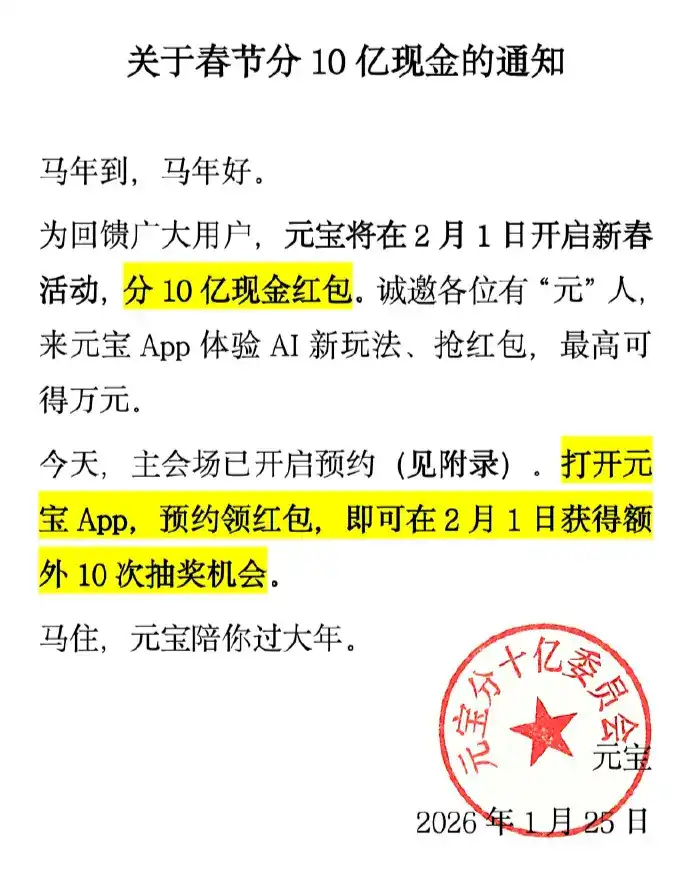
Image source: Internet

Competitors had to be on guard. That legendary red envelope shower from WeChat, which was recorded in the history of Chinese internet business wars, was described by Jack Ma as a "sneak attack on Pearl Harbor." In 2015, WeChat Pay partnered exclusively with the Spring Festival Gala, giving out 500 million CNY in WeChat red envelopes. That single night, WeChat garnered 11 billion "shake" interactions, bound over 100 million bank cards, and in just this one battle, forcefully seized half of the online payment market share from Alipay.

Also starting from this year, "Big Tech Red Envelope Wars" began to become part of the Chinese Spring Festival Gala memory. From Alipay to Douyin and Kuaishou, then to Taobao, JD.com, and Pinduoduo, it seems any internet giant worth its salt must have made an appearance at the Spring Festival Gala. The red envelope shower during the Gala also grew from the initial 500 million CNY to last year's 3 billion CNY.

Thus, this became the most anticipated segment of the Spring Festival Gala: which big tech company will give out red envelopes this year.

This year, the giants are once again standing at the same starting line, splashing cash and flying all sorts of marketing activities. When Ma Huateng steps up to "give red envelopes," can other big tech companies catch them?

Internet Giants Launch AI Red Envelope War

On the same day Yuanbao announced its lavish 1 billion CNY giveaway, Baidu also officially announced it would scatter 500 million CNY in Year of the Horse red envelopes and would cooperate with Beijing Television for the Spring Festival Gala.

ByteDance had already tied up with CCTV's Spring Festival Gala a month earlier, using its B2B AI cloud service platform, Volcano Engine, as the exclusive AI cloud partner for the 2026 Spring Festival Gala, while Doubao will配合上线各种互动玩法 (cooperate to launch various interactive features).

Although the official sponsorship amount was not disclosed, there are some reference figures: In 2020, Kuaishou's exclusive cooperation price with CCTV's Spring Festival Gala was 1.3-1.4 billion CNY, with an overall marketing package of about 2 billion CNY. In 2021, Douyin's exclusive cooperation price with CCTV's Spring Festival Gala was around 1 billion CNY, and additionally, on New Year's Eve, it distributed a total of 1.2 billion CNY in cash red envelopes.

Throughout 2025, compared to Tencent and Alibaba, ByteDance's marketing investment in Doubao could be considered "frugal." Some media analysis suggests this Spring Festival Gala sponsorship is likely ByteDance's largest AI brand marketing investment for the entire year.

Alibaba's response posture is to integrate the Alibaba ecosystem of applications, turning the Qianwen APP into a super traffic入口 (entry point) fully connected to shopping, navigation, travel, and a series of other functions, using incentives like food delivery red envelopes for user acquisition. Prior to this, Qianwen also secured the exclusive总冠名 (title sponsorship) of the Bilibili New Year's Eve Gala.

In the view of资深科技自媒体人 (veteran tech we-media personality) Zhuang Minghao, this year's red envelope war also sends an important signal: AI competition is expanding from pure model capability to application and入口 (entry point) competition.

And even before this, the smoke of battle had already filled手机屏幕 (mobile phone screens).

Throughout 2025, the big tech AI arms race was fought from every angle. For example, the talent war: Tencent high-profile hired 27-year-old former OpenAI researcher Yao Shunyu, concurrently serving as head of both the AI Infra department and the large language model department.

Another example is the hardware offense and defense war. Last December, ByteDance suddenly launched a "Doubao Phone," an action that directly切入 (cut into) the underlying mobile phone operating system, triggering joint boycotts from major software manufacturers. After the cold reception, ByteDance turned around and launched AI earphones and an AI "Recording Bean" equipped with Doubao.

On the other side, Alibaba launched the Quark AI glasses equipped with Qianwen, once承包 (monopolizing) the advertising space on the large screens in the passages of Hangzhou's highest traffic subway stations.
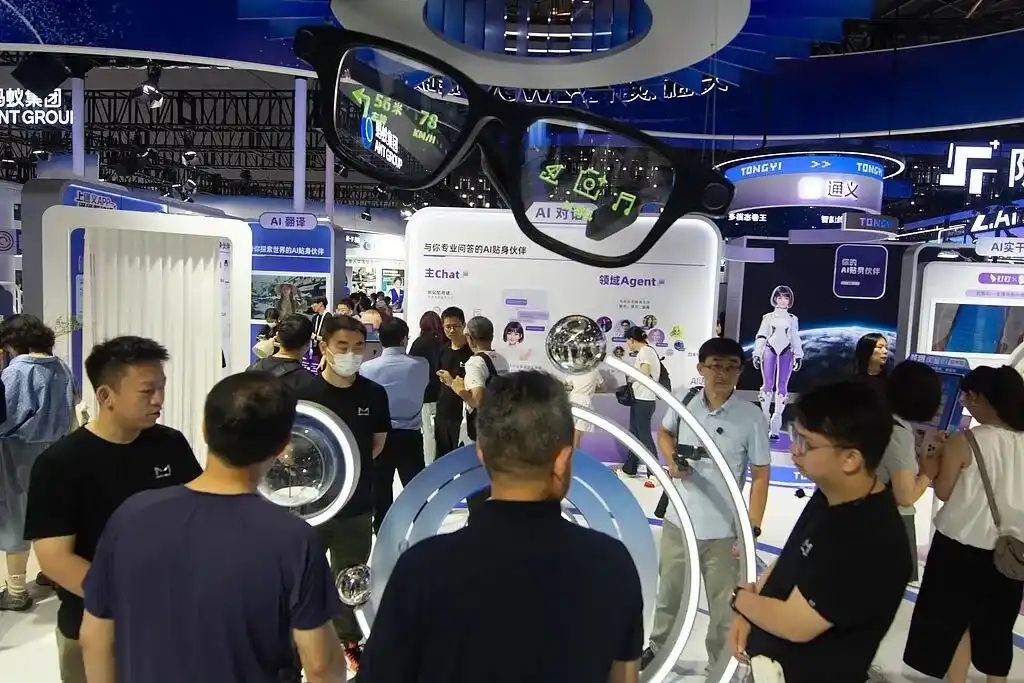
2025 World Artificial Intelligence Conference, Quark Smart AI Glasses

The most direct is the marketing war. According to a DataEye Research Institute report, in December 2025, in the native AI market, the top five in terms of投放素材量 (volume of advertising materials投放) were依次 (in order) Alibaba Qianwen, Yuanbao, Ant Afu, Doubao, and AI Douyin, accounting for 96% of the monthly投放素材量 in the mainland market.

Perhaps because the budgets were too large and the tasks too heavy, the最终出圈的姿态 (final姿态 that broke through the circle) were also varied and strange. For example, Yuanbao, wanting to conquer the下沉市场 (lower-tier market), went to rural areas to paint slogans on walls, "Difficult postpartum care for sows? Ask Tencent Yuanbao."

Image source: Internet

The most震撼 (stunning) is still the capital war. ByteDance's estimated capital expenditure for 2025 was nearly 160 billion CNY. Recently, overseas institutions reported that ByteDance has raised its 2026 capital expenditure target from 160-180 billion CNY to 300 billion CNY.

Alibaba announced at the beginning of 2025 a plan to invest 380 billion CNY in AI construction over the next three years,刷新 (refreshing) the AI spending record for domestic companies. At the end of the year, it又表示 (further stated), "this number might be conservative."

Ma Huateng, who did not disclose specific figures, also said at Tencent's annual meeting: "In 2025, Tencent played it safe and steady, the only area where we spent relatively more on investment was AI." According to institutional predictions, Tencent's AI capital expenditure in 2025 was close to 100 billion CNY.

"In a word, 2025 was a year of 'certainty.' The value and capability of AI were fully confirmed. Giants saw the situation clearly and went 'ALL IN' with full force; AI became usable, while疯狂基建 (frantic infrastructure building) occurred." Hu Yanping, a specially appointed professor at Shanghai University of Finance and Economics, summarized it this way.

And 2026 is the year of "decisiveness."

The Warring States Era of AI

AI industry investor Gao Zhendong compares the current landscape of large model competition to the Warring States era. Each company has its own strengths, and it's hard to distinguish superiority.

Hu Yanping believes that in terms of the overall commercialization picture, domestic AI currently presents a "(3+1)+5+N" pattern.

Among them, "3+1" refers to ByteDance, Alibaba, Tencent, plus Baidu; "5" refers to DeepSeek and the former "Six Little Tigers of Large Models" – Kimi, Zhipu, MiniMax, Step星辰 (Step Star), etc.; "N" refers to other AI enterprises focusing on vertical models and specialized markets.

But with the giants entering with heavy investments, under the spotlight, three "states" stand out in this Warring States struggle.

Gao Zhendong believes ByteDance is similar to the State of Chu:拥有最广的疆域 (having the vastest territory), the thickest foundation, vast land and abundant resources, a latecomer who arrived first, possessing流量母矿 (traffic motherlodes) like Douyin and TikTok.

Tencent is like the State of Qi:富甲天下 (the wealthiest under heaven), sitting on the profits of fishing and salt. It possesses the WeChat "social moat" and ample cash flow. It only needs to guard the social入口 (entry point) and can influence the entire situation with capital and traffic.

Alibaba is more like the State of Wei:率先变法 (the first to enact reforms), profound底蕴 (heritage), talent济济 (abundant talent), possessing强大的组织能力 (strong organizational capabilities). As the pioneer of Chinese cloud computing, Alibaba has打通 (opened up) the entire AI industry chain from chips to the cloud, from models to applications, top to bottom.

The three giants have thus extended their respective strategies.

Alibaba fights an生态战 (ecosystem war). Relying on its application ecosystem, the Qianwen APP is advancing towards becoming a "super app" covering all scenarios of eating, drinking, living, and traveling. It can now achieve ordering takeout, booking flights and hotels, and checking navigation in one stop.

ByteDance relies on short video scenarios, excelling more in AI creation and entertainment-oriented content. Besides the general product Doubao, ByteDance also has the AI creation tool Jimeng AI, which can generate videos, comic dramas, e-commerce pages, advertisements, etc.

Tencent continues to tightly grasp the social入口 (entry point). In the second half of 2025, Tencent Yuanbao successively integrated with Tencent Meeting and QQ, and recently launched the AI social-focused "Yuanbao Pai," which is essentially adding Yuanbao to group chats and supports inviting WeChat friends to join.

Image source: Internet

Beyond the giants displaying their prowess, the market cake left for other competitors seems to be getting smaller.

In Gao Zhendong's view, those that can still be called hegemons alongside the three giants are Baidu and DeepSeek. Baidu is like the State of Zhao in the Warring States, making massive investments in autonomous driving and base large models, with a solid technical foundation—a military power; DeepSeek, although its data and computing power scale cannot match the big factories, its computing efficiency is already on par with the latest models from Google and OpenAI, resembling the State of Han in the Warring States era, with sophisticated weaponry and good at "术"治 (governance by tactics/methods).

More small and medium-sized enterprises are seeking new paths of differentiation. For example, among the "Six Little Tigers of Large Models" that were hugely popular in 2024, Baichuan Intelligence, founded by Sogou founder Wang Xiaochuan, and 01.AI, founded by Kai-Fu Lee, have先后放弃 (successively abandoned) training base large models, turning to industry-level AI applications in healthcare and law; Zhipu AI and MiniMax landed on the Hong Kong stock market in early 2026, pinning their hopes on capital market funds to support subsequent R&D and market investment.

In the view of digital economy scholar Liu Xingliang, second and third-tier models still have space for deep application in细分场景 (segmented scenarios) like education, healthcare, and enterprises, but in the competition for mass入口 (entry points) and traffic, it may already be difficult to compete head-on with the giants.

Zhuang Minghao values "全栈能力" (full-stack capability): The AI competition at the current point is no longer单纯 (purely) model competition, but extends from the cloud to the model to the application, and even needs to expand to chips and hardware.

Hu Yanping uses four dimensions to observe the subsequent competitive situation:

◎ First, technical progress, where coding ability becomes an important central capability.

◎ Second, capital investment. Big factories are multiplying their AI capital expenditures, while slightly smaller leading startups, if they do not have cash reserves and investments of more than 5 billion CNY in 2026, will find it difficult to remain in the second tier.

◎ Third, user base. Either possess a traffic大盘 (large traffic pool) of billions of users, or form alliance cooperation with生态企业 (ecosystem companies) with hundreds of millions of users, otherwise market expansion costs (市场拓展成本) will be extremely high, affecting monetization capabilities.

◎ Fourth, expand monetization channels, quickly forming revenue sources of tens of billions of CNY from AI e-commerce, advertising marketing, enterprise application solutions, API Token, etc., because the Chinese market is an ecosystem where services are often free, and relying solely on subscriptions can hardly support sustainable development.

Therefore, also as Liu Xingliang's view, although the tripod鼎立 (tripod standing stable) seems stable in the short term, the competitive landscape is still full of variables in the future, influenced by technological innovation, outbreaks in vertical细分赛道 (segmented tracks), policy guidance, etc.
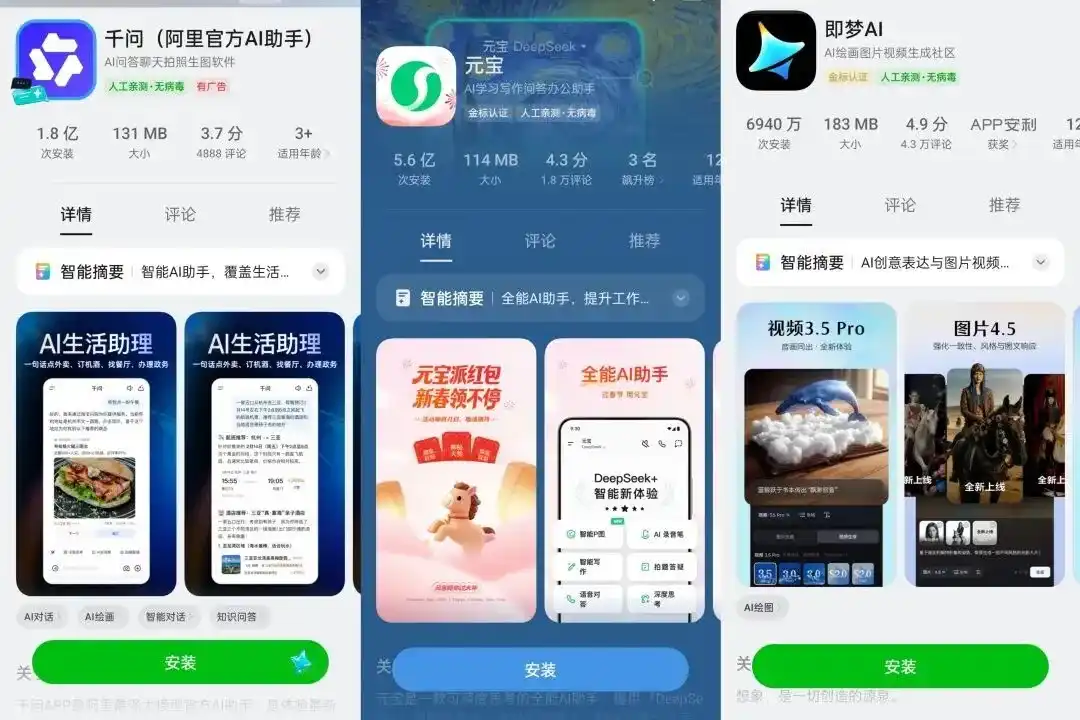
App download page in手机应用商店 (mobile app store)

Winner Undecided

The internet industry is no stranger to giant wars.

From the "Group Buying Wars," "Online Payment Wars," "Hundred-Model Wars" to the "Food Delivery Wars," every round of technological or business model innovation is a money-burning war, but these wars ultimately have more losses than wins, and the winners often change unpredictably.

The current battlefield is like the mid-Warring States period, with诸侯并起 (vassals rising together),霸权更替 (hegemony changing hands),改制与变法不断 (reforms and transformations constant), but a new order has yet to be established.

In other words, whether giants or small factories, although their tactics and situations differ, one point is格外一致 (particularly consistent): they have not yet found effective business models and are all operating at huge losses.

In Liu Xingliang's view, the current large model war still relies on the打法 (playbook) of "subsidies + traffic入口" to seize users, which helps educate the market in the early stages but is difficult to profit from in the long run. Real profitability still requires forming stable revenue sources such as paid subscriptions, AI solutions for enterprise customers, and industry定制服务 (customized services).

Also, as Zhuang Minghao said: "The current competition容不得 (does not allow for) consideration of the so-called sustainability of the money-burning model; it's a prisoner's dilemma."

However, the fact that the new order has not yet been established also means that the real winner is still悬念 (in suspense) and perhaps has not even appeared yet.

Hu Yanping believes that in the next stage, whether big factories, mid-stream enterprises, or "little dragons" and "little tigers," all have opportunities. In the short to medium term, having multiple enterprises participate in competition is a good thing, beneficial for industry development and able to provide consumers with diverse choices.

He also judges that the inflection point for AI monetization is即将到来 (approaching). From the close combat of technology and products to the stalemate of marketing competition, it all means that 2026 will become the "first year of AI value harvest." This year, domestic AI will welcome three major changes: big technical investment, big competitive differentiation, and big market分流 (diversion/shift).

It can be predicted that before the outcome of the battle is settled, red envelope showers will continue to fall in various forms. And the answer to this great war might be hidden in your hand: whose red envelope did you catch?


Пов'язані питання

QWhat is the significance of the 10 billion yuan red envelope campaign launched by Tencent's Yuanbao app, according to the article?

AIt is an attempt by Tencent to replicate the success of the 2015 WeChat red envelope campaign, which dramatically increased WeChat Pay's market share, and signifies the intensifying competition in the domestic AI industry, shifting from pure model capability to application and entry point competition.

QWhich three major companies are highlighted as the leading contenders in the current AI 'Warring States' era, and what are their respective strengths compared to ancient states?

AByteDance is compared to Chu for its vast territory and massive traffic from apps like Douyin/TikTok; Tencent is compared to Qi for its immense wealth and strong social moat with WeChat; Alibaba is compared to Wei for being a first mover with deep底蕴, strong organizational capability, and a full AI industry chain from chips to the cloud.

QWhat are the four key dimensions mentioned by Hu Yanping to observe the future AI competitive landscape?

AThe four dimensions are: 1. Technological progress, with coding capability as a key central ability. 2. Capital investment, requiring massive spending to stay competitive. 3. User base, needing a huge traffic pool or strategic alliances. 4. Diversified monetization channels, requiring rapid formation of multi-billion RMB revenue streams from various sources beyond just subscriptions.

QWhat is the current state of profitability for companies in the large model competition, as described in the article?

ANone of the companies, whether giants or smaller firms, have found an effective business model and are all operating at a significant loss, currently relying on subsidies and traffic入口 strategies to capture users.

QWhat major marketing and partnership moves did ByteDance and Alibaba make in response to the competitive AI landscape around the Chinese New Year period?

AByteDance partnered with China Central Television's Spring Festival Gala as the exclusive AI cloud partner through its Volcano Engine platform, with its Doubao AI participating in interactive activities. Alibaba integrated its Qianwen app across its ecosystem to create a super traffic入口 and secured the exclusive title sponsorship of the Bilibili New Year's Eve Gala.

Пов'язані матеріали

Is AI Creating a New Class of 'Information Poor'?

AI is generating a new kind of "information poverty." The core issue isn't that AI denies answers to the poor; it's that it provides abundant, cheap, and plausible-sounding answers to everyone. This availability shifts the true scarcity from obtaining answers to possessing the **judgment to evaluate them** and the access to turn them into real-world opportunities. New information poverty thus describes those who have AI tools and outputs, but lack the complementary skills, authorization, and contextual experience to critically assess and act on them. Research reveals a multi-layered divide: access to AI is stratified by income and platform design (e.g., premium vs. free, embedded tools). In workplaces, usage heavily favors higher-paid, more experienced, or formally trained employees, with AI often automating entry-level tasks that were traditional stepping stones. Crucially, the heaviest users are often mid-career professionals whose existing expertise allows them to effectively judge and leverage AI outputs, while novices risk over-relying on them without building judgment. While controlled experiments show AI can significantly boost low-skilled workers' performance, real-world adoption and benefit are constrained by unequal social and organizational structures. Historically, general-purpose technologies first reward those with existing complementary capital. AI, by affecting judgment-based work, may accelerate and deepen this initial inequality gap, even if it narrows over decades. The danger lies in the illusion of competence it creates, potentially stunting the very critical thinking needed in an era where judgment is paramount.

marsbit5 хв тому

Is AI Creating a New Class of 'Information Poor'?

marsbit5 хв тому

Jensen Huang 'Saves' South Korean Stock Market: Locks In SK Hynix Memory, Chip Shortage to Continue

On June 5th, South Korea's stock market experienced a sharp decline, with major chipmakers like Samsung and SK Hynix dropping nearly 10%. Amidst the turmoil, NVIDIA CEO Jensen Huang's visit to Seoul played a dramatic role in boosting market sentiment. Following a dinner meeting with SK Group Chairman Chey Tae-won and SK Hynix CEO Kwak Noh-Jung, Huang confirmed that NVIDIA's new Vera CPU will utilize SK Hynix DRAM. The companies announced a multi-year technical partnership to co-develop next-generation memory for NVIDIA's AI infrastructure, covering products from data centers to personal AI and robotics. This collaboration extends beyond memory supply. SK Hynix is integrating NVIDIA's AI and Omniverse platform into its own semiconductor design and manufacturing processes, including computational lithography and creating digital twins of its fabrication plants for autonomous operation. While strengthening ties with SK Hynix, NVIDIA is diversifying its supply chain for the upcoming HBM4 memory, with Samsung, SK Hynix, and Micron all certified as suppliers for its Vera Rubin platform. Despite this, Huang warned that the global chip shortage, driven by relentless demand from AI factory construction, is expected to persist for several years across the entire supply chain. His visit underscores NVIDIA's systematic effort to deepen integration with South Korea's broader tech industry.

marsbit57 хв тому

Jensen Huang 'Saves' South Korean Stock Market: Locks In SK Hynix Memory, Chip Shortage to Continue

marsbit57 хв тому

Nasdaq Plunges 4.2% in a Single Day: Does "Black Friday" Burst the U.S. Stock Market Bubble?

The Nasdaq plunged 4.18% on June 5, 2026, its worst single-day drop in over a year, as a much stronger-than-expected US jobs report triggered fears of economic overheating and delayed Federal Reserve interest rate cuts. The selloff, centered on high-valuation tech and AI stocks like Nvidia and Broadcom, spread across major indices. The article examines whether this signals a market top. The strong May non-farm payrolls data, nearly double expectations, pushed bond yields higher, directly hurting rate-sensitive tech stocks. This exposed vulnerabilities in the crowded AI trade, where valuations had soared on narratives of infinite growth, despite emerging signs of slowing order momentum and corporate AI monetization challenges. Prior to the drop, market indicators flashed warning signs: historically high valuations (e.g., Shiller CAPE ratio near 39.5), extreme bullish sentiment, and high levels of leverage. Technical charts showed key support levels being breached. Wall Street is divided on the outlook. Bears, citing risks of "stagflation" and AI bubble comparisons to the dot-com era, warn of a potential significant correction. Bulls view the drop as a healthy correction within a bull market, underpinned by a strong economy and expected corporate earnings growth of around 7% in 2026. The immediate future hinges on upcoming key events: the May CPI inflation data and the mid-June FOMC meeting. Their outcomes will critically shape market expectations for the Fed's rate path. The article concludes that conditions for a major market top are aligning, marking a fragile transition from narrative-driven gains to a phase demanding validation from macroeconomic data and corporate fundamentals. Caution is advised.

marsbit1 год тому

Nasdaq Plunges 4.2% in a Single Day: Does "Black Friday" Burst the U.S. Stock Market Bubble?

marsbit1 год тому

Nasdaq Plunges 4.2% in a Single Day, Did 'Black Friday' Pop the U.S. Stock Bubble?

The Nasdaq Composite plummeted 4.18% on June 5, its biggest single-day drop since April 2025, triggering widespread debate over whether the U.S. stock market has peaked. The sell-off was sparked by a stronger-than-expected U.S. non-farm payrolls report, which fueled fears of economic overheating and pushed back market expectations for Federal Reserve rate cuts, leading to a sharp rise in Treasury yields. The AI sector, the primary driver of the recent bull market, suffered severe losses, with the Philadelphia Semiconductor Index crashing over 10%. Stocks like Nvidia, Broadcom, and Micron led the decline. Concerns are mounting about the sustainability of AI capital expenditures and high valuations, with signs of order cuts for next-generation chips emerging. Analyses point to several warning signs: historically high market valuations (e.g., elevated Shiller CAPE ratio, Buffett Indicator), extreme bullish sentiment indicators, and significant insider selling. The sell-off also caused a key technical breakdown, with the S&P 500 breaking below its short-term moving average and testing its 200-day moving average. Wall Street is divided on the outlook. Bears warn this could be the start of a bubble deflation or a "stagflation" scenario, while bulls view it as a healthy, overdue correction within a bull market driven by solid corporate earnings growth. A more moderate view suggests the easy liquidity-driven rally is over, and markets are entering a phase of fundamental stock-picking with potential for consolidation. The immediate future hinges on key upcoming events: the May CPI report and the mid-June FOMC meeting. Their outcomes will be critical in determining whether this is a temporary pullback or the beginning of a more significant trend reversal. The consensus is that the era of one-directional market gains may be ending, requiring increased investor caution.

Odaily星球日报1 год тому

Nasdaq Plunges 4.2% in a Single Day, Did 'Black Friday' Pop the U.S. Stock Bubble?

Odaily星球日报1 год тому

The First Case on AI Agents: What Was Adjudicated?

"The First 'Agent' Ruling: What Was Decided?" On April 30, the Guangzhou Internet Court issued a ruling—China's first behavior preservation order in the intelligent agent (AI agent) field. The defendant, an open-source AI agent software, was ordered to stop downloads, cease actions that bypassed a platform's technical protection measures, and delete related tutorials and data. The core issue: the software used the operating system's "accessibility service" permissions to automate user interactions within other apps without those platforms' authorization. This mirrors a recent US case where Amazon sued Perplexity for similar reasons—bypassing Amazon's API to directly scrape and interact with its pages—and won a preliminary injunction. Both rulings establish a crucial legal boundary for the AI agent era: agents cannot operate unchecked. The article argues the fundamental legal principle emerging is one of **dual authorization**. An AI agent requires both **user consent** AND **platform consent** to operate legitimately within that platform's ecosystem. Bypassing platform rules through system-level permissions, even with user permission, undermines platform responsibilities for content moderation, data security, and user privacy, creating liability issues. The piece uses the evolution of "Doubao Phone" (an AI-integrated smartphone) as a case study. Its initial, aggressive version that bypassed platform controls faced roadblocks. Its upcoming 2.0 version is reportedly pivoting to negotiate API access and authorization deals with major platforms (like Alibaba's ecosystem), seen as a strategic adaptation to the new regulatory reality. A global trend is identified: the era of unregulated, "wild west" growth for AI agents is ending, replaced by a **compliance race**. This raises barriers to entry, as securing platform authorizations becomes a new cost. Open-source status is also not a legal shield if the code facilitates bypassing technical protections. In conclusion, these first rulings target not the largest, but the most **aggressive and representative** cases. By setting precedent with them, regulators are efficiently steering the entire industry towards a new, more regulated operating paradigm defined by dual authorization and platform cooperation.

marsbit1 год тому

The First Case on AI Agents: What Was Adjudicated?

marsbit1 год тому

Торгівля

Спот
Ф'ючерси

Популярні статті

Що таке $S$

Розуміння SPERO: Комплексний огляд Вступ до SPERO Оскільки ландшафт інновацій продовжує еволюціонувати, виникнення технологій web3 та криптовалютних проектів відіграє ключову роль у формуванні цифрового майбутнього. Один з проектів, який привернув увагу в цій динамічній сфері, — це SPERO, позначений як SPERO,$$s$. Ця стаття має на меті зібрати та представити детальну інформацію про SPERO, щоб допомогти ентузіастам та інвесторам зрозуміти його основи, цілі та інновації в рамках web3 та крипто-сектору. Що таке SPERO,$$s$? SPERO,$$s$ — це унікальний проект у криптопросторі, який прагне використати принципи децентралізації та технології блокчейн для створення екосистеми, що сприяє залученню, корисності та фінансовій інклюзії. Проект розроблений для полегшення взаємодії між користувачами новими способами, надаючи їм інноваційні фінансові рішення та послуги. У своїй основі SPERO,$$s$ прагне надати можливості індивідам, забезпечуючи інструменти та платформи, які покращують користувацький досвід у криптовалютному просторі. Це включає в себе можливість більш гнучких методів транзакцій, сприяння ініціативам, що підтримуються спільнотою, та створення шляхів для фінансових можливостей через децентралізовані додатки (dApps). Основна концепція SPERO,$$s$ обертається навколо інклюзивності, прагнучи зменшити розриви в традиційній фінансовій системі, використовуючи переваги технології блокчейн. Хто є творцем SPERO,$$s$? Особистість творця SPERO,$$s$ залишається дещо невідомою, оскільки є обмежені публічно доступні ресурси, що надають детальну інформацію про його засновників. Ця відсутність прозорості може бути наслідком зобов'язання проекту до децентралізації — етики, яку багато проектів web3 поділяють, ставлячи колективні внески вище за індивідуальне визнання. Зосереджуючи обговорення навколо спільноти та її колективних цілей, SPERO,$$s$ втілює суть наділення без виділення конкретних осіб. Таким чином, розуміння етики та місії SPERO є більш важливим, ніж ідентифікація єдиного творця. Хто є інвесторами SPERO,$$s$? SPERO,$$s$ підтримується різноманітними інвесторами, починаючи від венчурних капіталістів до ангельських інвесторів, які прагнуть сприяти інноваціям у крипто-секторі. Зосередження цих інвесторів зазвичай узгоджується з місією SPERO — пріоритет надається проектам, які обіцяють технологічний прогрес у суспільстві, фінансову інклюзію та децентралізоване управління. Ці інвесторські фонди зазвичай зацікавлені в проектах, які не лише пропонують інноваційні продукти, але й позитивно впливають на спільноту блокчейн та її екосистеми. Підтримка з боку цих інвесторів підкріплює SPERO,$$s$ як значного конкурента в швидко змінюваній сфері крипто-проектів. Як працює SPERO,$$s$? SPERO,$$s$ використовує багатогранну структуру, яка відрізняє його від традиційних криптовалютних проектів. Ось деякі ключові особливості, які підкреслюють його унікальність та інноваційність: Децентралізоване управління: SPERO,$$s$ інтегрує моделі децентралізованого управління, надаючи користувачам можливість активно брати участь у процесах прийняття рішень щодо майбутнього проекту. Цей підхід сприяє відчуттю власності та відповідальності серед членів спільноти. Корисність токена: SPERO,$$s$ використовує свій власний криптовалютний токен, розроблений для виконання різних функцій в екосистемі. Ці токени дозволяють здійснювати транзакції, отримувати винагороди та полегшувати послуги, що пропонуються на платформі, підвищуючи загальну залученість та корисність. Шарова архітектура: Технічна архітектура SPERO,$$s$ підтримує модульність та масштабованість, що дозволяє безперешкодно інтегрувати додаткові функції та додатки в міру розвитку проекту. Ця адаптивність є надзвичайно важливою для збереження актуальності в постійно змінюваному крипто-ландшафті. Залучення спільноти: Проект підкреслює ініціативи, що підтримуються спільнотою, використовуючи механізми, які стимулюють співпрацю та зворотний зв'язок. Підтримуючи сильну спільноту, SPERO,$$s$ може краще задовольняти потреби користувачів та адаптуватися до ринкових тенденцій. Фокус на інклюзію: Пропонуючи низькі комісії за транзакції та зручні інтерфейси, SPERO,$$s$ прагне залучити різноманітну базу користувачів, включаючи осіб, які раніше не брали участі в крипто-просторі. Це зобов'язання до інклюзії узгоджується з його загальною місією наділення через доступність. Хронологія SPERO,$$s$ Розуміння історії проекту надає важливі уявлення про його розвиток та етапи. Нижче наведено пропоновану хронологію, що відображає значні події в еволюції SPERO,$$s$: Етап концептуалізації та ідеації: Початкові ідеї, що стали основою SPERO,$$s$, були сформовані, тісно пов'язані з принципами децентралізації та фокусом на спільноті в індустрії блокчейн. Запуск білого паперу проекту: Після концептуального етапу був випущений комплексний білий папір, що детально описує бачення, цілі та технологічну інфраструктуру SPERO,$$s$, щоб залучити інтерес та зворотний зв'язок від спільноти. Створення спільноти та ранні залучення: Активні зусилля були спрямовані на створення спільноти ранніх прихильників та потенційних інвесторів, що полегшило обговорення цілей проекту та отримання підтримки. Подія генерації токенів: SPERO,$$s$ провів подію генерації токенів (TGE) для розподілу своїх рідних токенів серед ранніх прихильників та встановлення початкової ліквідності в екосистемі. Запуск початкового dApp: Перший децентралізований додаток (dApp), пов'язаний з SPERO,$$s$, став доступним, дозволяючи користувачам взаємодіяти з основними функціями платформи. Постійний розвиток та партнерства: Безперервні оновлення та вдосконалення пропозицій проекту, включаючи стратегічні партнерства з іншими учасниками блокчейн-простору, сформували SPERO,$$s$ у конкурентоспроможного та еволюціонуючого гравця на крипто-ринку. Висновок SPERO,$$s$ є свідченням потенціалу web3 та криптовалют для революціонізації фінансових систем та наділення індивідів. Завдяки зобов'язанню до децентралізованого управління, залучення спільноти та інноваційно спроектованих функцій, він прокладає шлях до більш інклюзивного фінансового ландшафту. Як і з будь-якими інвестиціями в швидко змінюваному крипто-просторі, потенційним інвесторам та користувачам рекомендується ретельно досліджувати та обдумано взаємодіяти з поточними подіями в SPERO,$$s$. Проект демонструє інноваційний дух крипто-індустрії, запрошуючи до подальшого дослідження його численних можливостей. Хоча подорож SPERO,$$s$ ще триває, його основні принципи можуть справді вплинути на майбутнє того, як ми взаємодіємо з технологією, фінансами та один з одним у взаємопов'язаних цифрових екосистемах.

73 переглядів усьогоОпубліковано 2024.12.17Оновлено 2024.12.17

Що таке $S$

Що таке AGENT S

Агент S: Майбутнє автономної взаємодії в Web3 Вступ У постійно змінюваному ландшафті Web3 та криптовалюти інновації постійно переосмислюють, як люди взаємодіють з цифровими платформами. Один з таких новаторських проектів, Агент S, обіцяє революціонізувати взаємодію людини з комп'ютером через свою відкриту агентну структуру. Прокладаючи шлях для автономних взаємодій, Агент S прагне спростити складні завдання, пропонуючи трансформаційні застосування в штучному інтелекті (ШІ). Це детальне дослідження заглиблюється в складності проекту, його унікальні особливості та наслідки для сфери криптовалюти. Що таке Агент S? Агент S є революційною відкритою агентною структурою, спеціально розробленою для вирішення трьох основних викликів в автоматизації комп'ютерних завдань: Набуття специфічних знань у галузі: Структура інтелектуально навчається з різних зовнішніх джерел знань та внутрішнього досвіду. Цей подвійний підхід дозволяє їй створити багатий репозиторій специфічних знань у галузі, покращуючи її продуктивність у виконанні завдань. Планування на довгих горизонтах завдань: Агент S використовує планування з підкріпленням досвіду, стратегічний підхід, який полегшує ефективний розподіл та виконання складних завдань. Ця функція значно підвищує її здатність ефективно та результативно управляти кількома підзавданнями. Обробка динамічних, неоднорідних інтерфейсів: Проект представляє Інтерфейс Агент-Комп'ютер (ACI), інноваційне рішення, яке покращує взаємодію між агентами та користувачами. Використовуючи багатомодальні великі мовні моделі (MLLMs), Агент S може безперешкодно орієнтуватися та маніпулювати різноманітними графічними інтерфейсами користувача. Завдяки цим новаторським функціям Агент S надає надійну структуру, яка вирішує складнощі, пов'язані з автоматизацією людської взаємодії з машинами, прокладаючи шлях для численних застосувань у ШІ та за його межами. Хто є творцем Агент S? Хоча концепція Агент S є фундаментально новаторською, конкретна інформація про його творця залишається невідомою. Творець наразі невідомий, що підкреслює або початкову стадію проекту, або стратегічний вибір зберегти засновників у таємниці. Незважаючи на анонімність, акцент залишається на можливостях та потенціалі структури. Хто є інвесторами Агент S? Оскільки Агент S є відносно новим у криптографічній екосистемі, детальна інформація про його інвесторів та фінансових спонсорів не задокументована. Відсутність публічно доступних відомостей про інвестиційні фонди або організації, що підтримують проект, викликає питання щодо його фінансової структури та дорожньої карти розвитку. Розуміння підтримки є критично важливим для оцінки стійкості проекту та потенційного впливу на ринок. Як працює Агент S? В основі Агент S лежить передова технологія, яка дозволяє йому ефективно функціонувати в різних умовах. Його операційна модель побудована навколо кількох ключових функцій: Взаємодія з комп'ютером, подібна до людської: Структура пропонує розширене планування ШІ, прагнучи зробити взаємодії з комп'ютерами більш інтуїтивними. Імітуючи людську поведінку при виконанні завдань, вона обіцяє підвищити досвід користувачів. Наративна пам'ять: Використовується для використання високорівневого досвіду, Агент S використовує наративну пам'ять для відстеження історій завдань, тим самим покращуючи свої процеси прийняття рішень. Епізодична пам'ять: Ця функція надає користувачам покрокові інструкції, дозволяючи структурі пропонувати контекстуальну підтримку в міру виконання завдань. Підтримка OpenACI: Завдяки можливості працювати локально, Агент S дозволяє користувачам зберігати контроль над своїми взаємодіями та робочими процесами, узгоджуючи з децентралізованою етикою Web3. Легка інтеграція з зовнішніми API: Його універсальність і сумісність з різними платформами ШІ забезпечують те, що Агент S може безперешкодно вписатися в існуючі технологічні екосистеми, роблячи його привабливим вибором для розробників та організацій. Ці функціональні можливості колективно сприяють унікальному положенню Агент S у крипто-просторі, оскільки він автоматизує складні, багатоступеневі завдання з мінімальним втручанням людини. У міру розвитку проекту його потенційні застосування в Web3 можуть переосмислити, як відбуваються цифрові взаємодії. Хронологія Агент S Розробка та етапи Агент S можуть бути узагальнені в хронології, яка підкреслює його значні події: 27 вересня 2024 року: Концепція Агент S була представлена в комплексній науковій статті під назвою “Відкрита агентна структура, яка використовує комп'ютери як людина”, що демонструє основи проекту. 10 жовтня 2024 року: Наукова стаття була опублікована на arXiv, пропонуючи детальне дослідження структури та її оцінки продуктивності на основі бенчмарку OSWorld. 12 жовтня 2024 року: Було випущено відеопрезентацію, що надає візуальне уявлення про можливості та особливості Агент S, ще більше залучаючи потенційних користувачів та інвесторів. Ці маркери в хронології не лише ілюструють прогрес Агент S, але й вказують на його прихильність до прозорості та залучення громади. Ключові моменти про Агент S У міру розвитку структури Агент S кілька ключових характеристик виділяються, підкреслюючи її новаторський характер та потенціал: Інноваційна структура: Розроблена для забезпечення інтуїтивного використання комп'ютерів, подібного до людської взаємодії, Агент S пропонує новий підхід до автоматизації завдань. Автономна взаємодія: Здатність автономно взаємодіяти з комп'ютерами через GUI означає стрибок до більш інтелектуальних та ефективних обчислювальних рішень. Автоматизація складних завдань: Завдяки своїй надійній методології він може автоматизувати складні, багатоступеневі завдання, роблячи процеси швидшими та менш схильними до помилок. Безперервне вдосконалення: Механізми навчання дозволяють Агенту S покращуватися на основі минулого досвіду, постійно підвищуючи свою продуктивність та ефективність. Універсальність: Його адаптивність до різних операційних середовищ, таких як OSWorld та WindowsAgentArena, забезпечує його здатність служити широкому спектру застосувань. Оскільки Агент S займає своє місце в ландшафті Web3 та криптовалюти, його потенціал покращити можливості взаємодії та автоматизувати процеси означає значний прогрес у технологіях ШІ. Завдяки своїй інноваційній структурі Агент S є прикладом майбутнього цифрових взаємодій, обіцяючи більш безперешкодний та ефективний досвід для користувачів у різних галузях. Висновок Агент S представляє собою сміливий крок вперед у поєднанні ШІ та Web3, з можливістю переосмислити, як ми взаємодіємо з технологією. Хоча проект все ще на ранніх стадіях, можливості для його застосування є величезними та переконливими. Завдяки своїй комплексній структурі, що вирішує критичні виклики, Агент S прагне вивести автономні взаємодії на передній план цифрового досвіду. У міру того, як ми заглиблюємося в сфери криптовалюти та децентралізації, проекти, подібні до Агент S, безсумнівно, відіграватимуть ключову роль у формуванні майбутнього технологій та співпраці людини з комп'ютером.

689 переглядів усьогоОпубліковано 2025.01.14Оновлено 2025.01.14

Що таке AGENT S

Як купити S

Ласкаво просимо до HTX.com! Ми зробили покупку Sonic (S) простою та зручною. Дотримуйтесь нашої покрокової інструкції, щоб розпочати свою криптовалютну подорож.Крок 1: Створіть обліковий запис на HTXВикористовуйте свою електронну пошту або номер телефону, щоб зареєструвати обліковий запис на HTX безплатно. Пройдіть безпроблемну реєстрацію й отримайте доступ до всіх функцій.ЗареєструватисьКрок 2: Перейдіть до розділу Купити крипту і виберіть спосіб оплатиКредитна/дебетова картка: використовуйте вашу картку Visa або Mastercard, щоб миттєво купити Sonic (S).Баланс: використовуйте кошти з балансу вашого рахунку HTX для безперешкодної торгівлі.Треті особи: ми додали популярні способи оплати, такі як Google Pay та Apple Pay, щоб підвищити зручність.P2P: Торгуйте безпосередньо з іншими користувачами на HTX.Позабіржова торгівля (OTC): ми пропонуємо індивідуальні послуги та конкурентні обмінні курси для трейдерів.Крок 3: Зберігайте свої Sonic (S)Після придбання Sonic (S) збережіть його у своєму обліковому записі на HTX. Крім того, ви можете відправити його в інше місце за допомогою блокчейн-переказу або використовувати його для торгівлі іншими криптовалютами.Крок 4: Торгівля Sonic (S)Легко торгуйте Sonic (S) на спотовому ринку HTX. Просто увійдіть до свого облікового запису, виберіть торгову пару, укладайте угоди та спостерігайте за ними в режимі реального часу. Ми пропонуємо зручний досвід як для початківців, так і для досвідчених трейдерів.

1.5k переглядів усьогоОпубліковано 2025.01.15Оновлено 2026.06.02

Як купити S

Обговорення

Ласкаво просимо до спільноти HTX. Тут ви можете бути в курсі останніх подій розвитку платформи та отримати доступ до професійної ринкової інформації. Нижче представлені думки користувачів щодо ціни S (S).

活动图片