Crypto’s next altseason may have fewer winners: Wintermute

cointelegraphОпубліковано о 2026-07-31Востаннє оновлено о 2026-07-31

Анотація

The next altcoin season in crypto may yield fewer winners as institutional investors increasingly concentrate their trading in a narrower set of digital assets, according to a report from market maker Wintermute. Their data shows institutional clients generated a record 72% of spot OTC flow in H1 2026, up from 61% in H2 2025. This activity is focused on fewer tokens and fades faster after price surges compared to retail trading. The findings indicate capital is clustering in favored assets, weakening the "long tail" of the market. Broader industry data from CryptoQuant and Kaiko supports this trend, showing altcoin trading volume concentrating in top assets and a decline in the traditional rotation of Bitcoin profits into smaller coins. Analysts suggest future rallies will be more selective, with institutions focused on major tokens like Bitcoin and Ether.


Crypto’s next altcoin season may produce fewer winners as institutional investors concentrate their activity in a narrower group of digital assets, according to crypto market maker Wintermute.

In its over-the-counter (OTC) flow report for the first half of 2026, Wintermute said institutional counterparties generated 72% of spot flow across all tokens on its OTC desk, the highest share on record. That was up from 61% in the second half of 2025 and 59% in the first half of last year.

With institutional activity concentrated in fewer tokens and fading faster after price surges, the findings suggest future altcoin rallies could become narrower and more selective. Wintermute said liquidity was concentrating in the assets institutions favored while activity across the market’s “long tail” weakened.

Between the first half of 2024 and the first half of 2026, the number of unique tokens traded by Wintermute’s institutional counterparties grew by just 24%, compared with 76% among retail clients. The firm also found that institutional activity following a surge in a token’s price and volume faded after roughly one day. In contrast, retail activity typically remained elevated for about three days.
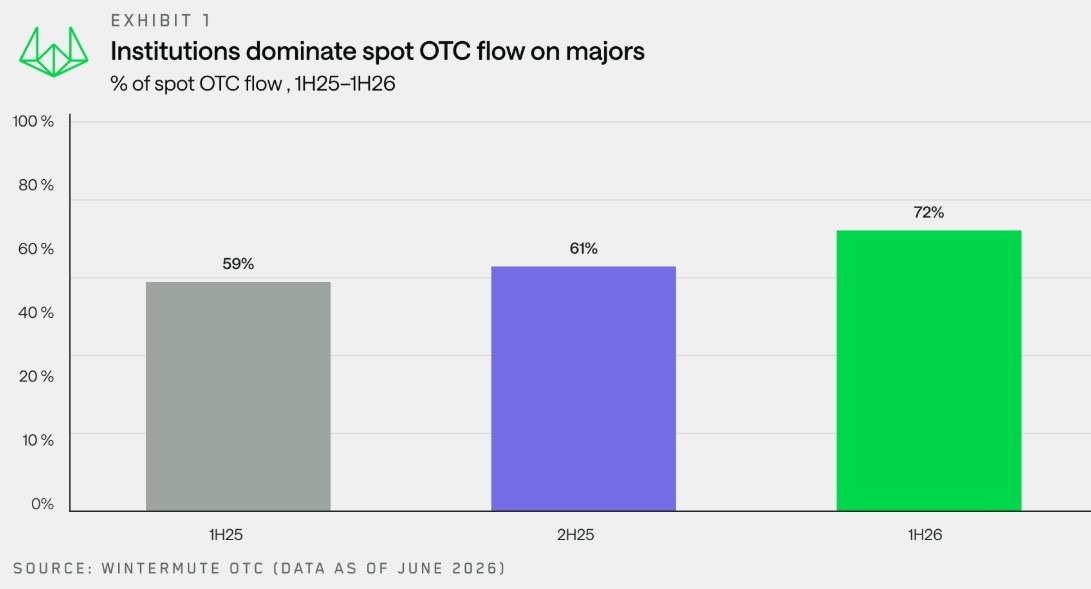
Percentage of institutional spot OTC flow. Source: Wintermute

Altcoin capital was already becoming more concentrated

Wintermute’s findings add proprietary OTC data to signs that capital has been clustering around a smaller group of altcoins across the wider market.

On June 20, CryptoQuant CEO Ki Young Ju said the traditional rotation of Bitcoin profits into smaller crypto assets had “basically disappeared.” CryptoQuant data showed trading volume in Bitcoin-denominated altcoin pairs near its weakest level since 2021.

Meanwhile, the 10 largest non-stablecoin altcoins accounted for about 80.5% of the non-Bitcoin, non-stablecoin market’s capitalization.

Related: Crypto altseason unlikely in 2026 as ‘blue-chip survivors’ to win out: Analyst

Kaiko identified a similar concentration in exchange trading. In July 2025, the data provider said that the 10 largest altcoins accounted for 63% of altcoin trading volume, up from about 50% several months earlier, as activity in smaller tokens weakened.

DWF Labs managing partner Andrei Grachev also argued that broad altcoin rallies were giving way to selective sector moves. On March 15, Grachev said too many tokens were competing for limited capital, while institutional investors remained focused on Bitcoin, Ether and tokenized real-world assets.

Magazine: The 100x obsession: Fundamentals grow in importance as crypto matures

Пов'язані питання

QAccording to Wintermute's report, what percentage of spot flow on its OTC desk was generated by institutional counterparties in H1 2026?

AInstitutional counterparties generated 72% of spot flow across all tokens on Wintermute's OTC desk in the first half of 2026.

QHow does the duration of institutional activity following a token's price surge compare to retail activity, based on Wintermute's findings?

AInstitutional activity faded after roughly one day following a token's price and volume surge, whereas retail activity typically remained elevated for about three days.

QWhat evidence from CryptoQuant's CEO and Kaiko supports the idea of capital concentration in a narrower group of altcoins?

ACryptoQuant's CEO noted the traditional rotation of Bitcoin profits into smaller altcoins had 'basically disappeared,' with Bitcoin-denominated altcoin pair volume near its weakest since 2021. Kaiko reported that the 10 largest altcoins accounted for 63% of altcoin trading volume in July 2025, up from about 50% months earlier.

QWhat reason did DWF Labs' Andrei Grachev give for broad altcoin rallies giving way to selective sector moves?

AAndrei Grachev argued that too many tokens were competing for limited capital, while institutional investors remained focused on Bitcoin, Ether, and tokenized real-world assets.

QWhat is the main implication of Wintermute's findings for the next altcoin season, as suggested in the article?

AThe main implication is that the next altcoin season may produce fewer winners, with rallies becoming narrower and more selective, as institutional activity concentrates in fewer tokens and liquidity clusters in assets favored by institutions.

Пов'язані матеріали

Thanks to Dice Rolls, Bitcoin Keys Are Stored Offline, But Not Everyone Will Do It

The article discusses using dice rolls to generate secure Bitcoin wallet seeds, providing entropy independent of potentially flawed hardware random number generators. It explains that each fair dice roll offers about 2.585 bits of entropy, with around 50 rolls needed for a standard 12-word seed phrase and 99+ recommended for higher security. This method gained attention after a vulnerability was revealed in some Coldcard hardware wallets, where a faulty firmware RNG (dating back to 2021) compromised generated keys. The analysis notes that while a dice-generated main seed was safe from this specific flaw, other Coldcard functions (like creating paper wallets, backup keys, or passwords) could still be vulnerable if they used the defective RNG. The piece argues that while dice-based entropy is technically robust, the manual process is error-prone, tedious, and unrealistic for most new users, who might make mistakes in recording or inputting rolls. It concludes that while manual entropy generation should remain an option for advanced users, the long-term goal is to develop reliable, user-friendly hardware and software that securely generates randomness without requiring specialized knowledge. Coldcard users are advised to check their firmware version and replace any secondary secrets (like paper wallet keys) created with vulnerable devices, while also considering multi-signature setups with devices from different manufacturers for added security.

cryptonews.ru4 год тому

Thanks to Dice Rolls, Bitcoin Keys Are Stored Offline, But Not Everyone Will Do It

cryptonews.ru4 год тому

Торгівля

Спот
活动图片





